© S. Suryanarayanan, 2014
Instructor: Dr. Sid Suryanarayanan
Associate Professor, ECE
sid@colostate.edu
Week 8 (part A)
Grid Integration of Wind Energy
Conversion Systems
ECE 566
© S. Suryanarayanan, 2014
Voltage Deviation Analysis of
a 50 MW Wind Farm
Practical case study
© S. Suryanarayanan, 2014
Outline of presentation
• BPA’s Condon wind farm scenario
• The proposed remedy
• Modeling and simulation based analysis
• Identification of the real cause
• Conclusions
© S. Suryanarayanan, 2014
Types of wind power installations
• Fixed speed induction generators (FSIG)
– Squirrel cage induction machines
– Robust and inexpensive
– Directly coupled to grid and draws reactive power
– Fluctuations in wind cause mechanical and
electrical fluctuations (V deviation)
– Not suitable for weak electric grids
• Variable speed induction generators (VSIG)
– Wound rotor induction machines
– Use power electronics
– More expensive and less robust
© S. Suryanarayanan, 2014
BPA network
• Bonneville Power Administration - federally
owned utility with regions of operation in WA, OR,
ID, and parts of MT
• ~15000 miles of lines and ~300 substations
• Connects to Canada in the North and Los
Angeles in the South thru 500 kV AC lines
• Pacific DC intertie between BPA (Celilo) and LA
(Sylmar)
• In 2011, BPA network had approximately 30% of
wind power on its system (one of the highest
concentrations in the US)
© S. Suryanarayanan, 2014
Condon Wind Farm on BPA
network
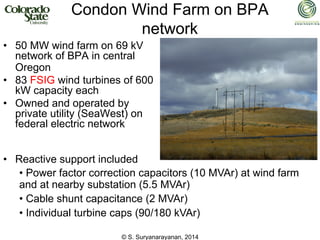
• 50 MW wind farm on 69 kV
network of BPA in central
Oregon
• 83 FSIG wind turbines of 600
kW capacity each
• Owned and operated by
private utility (SeaWest) on
federal electric network
• Reactive support included
• Power factor correction capacitors (10 MVAr) at wind farm
and at nearby substation (5.5 MVAr)
• Cable shunt capacitance (2 MVAr)
• Individual turbine caps (90/180 kVAr)
© S. Suryanarayanan, 2014
Voltage deviation on PCC at Condon
• Persistent voltage deviation of >9% seen regularly
• Note: x-axis is time (1 year period)
01/01/04 03/01/04 04/30/04 06/29/04 08/28/04 10/27/04 12/26/04
90
95
100
105
110
5 min Condon Wind SCADA Data for 365 days starting 01-Jan-2004
Voltage at Wind Farm [%]
Date [MM/DD/YY]
BPA’s nominal operating
voltage level
BPA’s nominal operating
voltage range
• Yet, voltage deviation on PCC was observed periodically
© S. Suryanarayanan, 2014
-10 0 10 20 30 40 50
0.95
0.96
0.97
0.98
0.99
1
1.01
1.02
1.03
1.04
1.05
1.06
1.07
1.08
Real power delivered by wind farm [MW]
Voltage at the
wind farm [pu]
2s SCADA 03/05/2006
5min SCADA 08/22/2004 - 08/24/2004
Δv = 9%
caused
only in
some
cases
Site established as candidate for testing and installing new
technology for mitigating V deviation
Voltage deviation on PCC at Condon
© S. Suryanarayanan, 2014
Remedy for voltage deviation on Condon
wind farm
• Flexible AC Transmission System (FACTS) technology
proposed
• Static synchronous compensator (STATCOM)
– Shunt device
– Fast acting, reactive power compensator
– Dynamic voltage control
• New technology in power electronics (ETO) based
STATCOM at 10 MVA power rating to be installed at
Condon
– developed by NCSU
• FSU-CAPS in collaboration with EPRI, BPA, NCSU to test
and characterize novel controller for ETO based STATCOM
– High-fidelity modeling, simulation and hardware-in-the-loop studies
– Also to identify actual source of V deviation
© S. Suryanarayanan, 2014
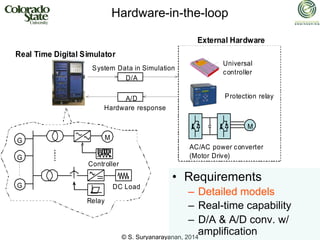
Hardware-in-the-loop
Real Time Digital Simulator
Universal
controller
D/A
A/D Protection relay
M
AC/AC power converter
(Motor Drive)
External Hardware
System Data in Simulation
Hardware response
M
G
G
G
Controller
Relay
DC Load
• Requirements
– Detailed models
– Real-time capability
– D/A & A/D conv. w/
amplification
© S. Suryanarayanan, 2014
Steps in modeling effort
• BPA system modeling and validation
• Individual wind turbine system modeling
and control
• Wind farm modeling and control
• Validation against SCADA data
• Isolate cause of V deviation in wind farm
using high-fidelity models
© S. Suryanarayanan, 2014
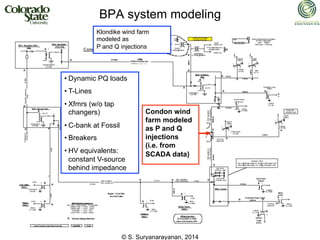
BPA system modeling
Condon wind
farm modeled
as P and Q
injections
(i.e. from
SCADA data)
• Dynamic PQ loads
• T-Lines
• Xfmrs (w/o tap
changers)
• C-bank at Fossil
• Breakers
• HV equivalents:
constant V-source
behind impedance
Klondike wind farm
modeled as
P and Q injections
© S. Suryanarayanan, 2014
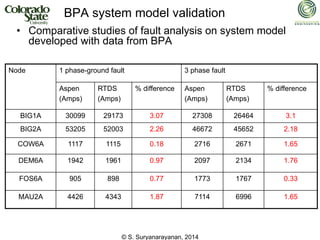
BPA system model validation
• Comparative studies of fault analysis on system model
developed with data from BPA
Node 1 phase-ground fault 3 phase fault
Aspen
(Amps)
RTDS
(Amps)
% difference Aspen
(Amps)
RTDS
(Amps)
% difference
BIG1A 30099 29173 3.07 27308 26464 3.1
BIG2A 53205 52003 2.26 46672 45652 2.18
COW6A 1117 1115 0.18 2716 2671 1.65
DEM6A 1942 1961 0.97 2097 2134 1.76
FOS6A 905 898 0.77 1773 1767 0.33
MAU2A 4426 4343 1.87 7114 6996 1.65
© S. Suryanarayanan, 2014
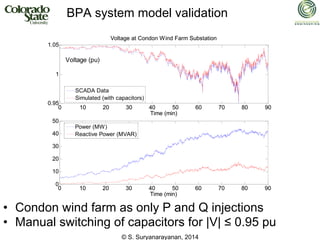
BPA system model validation
• Condon wind farm as only P and Q injections
• Manual switching of capacitors for |V| ≤ 0.95 pu
0 10 20 30 40 50 60 70 80 90
0.95
1
1.05
Time (min)
Voltage
(pu)
Voltage at Condon Wind Farm Substation
SCADA Data
Simulated (with capacitors)
0 10 20 30 40 50 60 70 80 90
0
10
20
30
40
50
Time (min)
Power (MW)
Reactive Power (MVAR)
Voltage (pu)
0 10 20 30 40 50 60 70 80 90
0.95
1
1.05
Time (min)
Voltage
(pu)
Voltage at Condon Wind Farm Substation
SCADA Data
Simulated (with capacitors)
0 10 20 30 40 50 60 70 80 90
0
10
20
30
40
50
Time (min)
Power (MW)
Reactive Power (MVAR)
Voltage (pu)
0 10 20 30 40 50 60 70 80 90
0.95
1
1.05
Time (min)
Voltage
(pu)
Voltage at Condon Wind Farm Substation
SCADA Data
Simulated (with capacitors)
0 10 20 30 40 50 60 70 80 90
0
10
20
30
40
50
Time (min)
Power (MW)
Reactive Power (MVAR)
Voltage (pu)
0 10 20 30 40 50 60 70 80 90
0.95
1
1.05
Time (min)
Voltage
(pu)
Voltage at Condon Wind Farm Substation
SCADA Data
Simulated (with capacitors)
0 10 20 30 40 50 60 70 80 90
0
10
20
30
40
50
Time (min)
Power (MW)
Reactive Power (MVAR)
Voltage (pu)
© S. Suryanarayanan, 2014
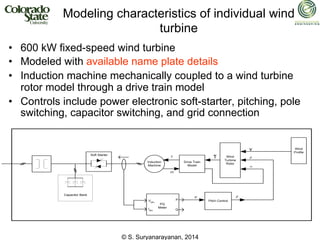
Modeling characteristics of individual wind
turbine
• 600 kW fixed-speed wind turbine
• Modeled with available name plate details
• Induction machine mechanically coupled to a wind turbine
rotor model through a drive train model
• Controls include power electronic soft-starter, pitching, pole
switching, capacitor switching, and grid connection
PQ
Meter
Vabc
P
Q
Iabc
Capacitor Bank
ω
Induction
Machine
T β
ω
Wind
Turbine
Rotor
v
T
Pitch Control
P β
Wind
Profile
Soft Starter
Drive Train
Model
© S. Suryanarayanan, 2014
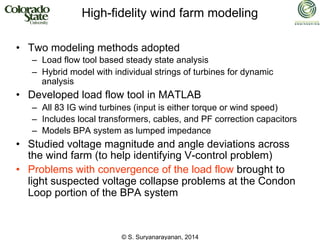
High-fidelity wind farm modeling
• Two modeling methods adopted
– Load flow tool based steady state analysis
– Hybrid model with individual strings of turbines for dynamic
analysis
• Developed load flow tool in MATLAB
– All 83 IG wind turbines (input is either torque or wind speed)
– Includes local transformers, cables, and PF correction capacitors
– Models BPA system as lumped impedance
• Studied voltage magnitude and angle deviations across
the wind farm (to help identifying V-control problem)
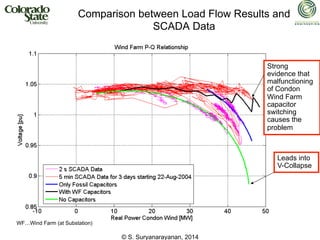
• Problems with convergence of the load flow brought to
light suspected voltage collapse problems at the Condon
Loop portion of the BPA system
© S. Suryanarayanan, 2014
Salient characteristics of wind farm
control
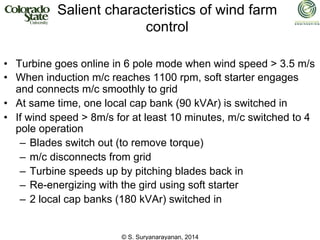
• Turbine goes online in 6 pole mode when wind speed > 3.5 m/s
• When induction m/c reaches 1100 rpm, soft starter engages
and connects m/c smoothly to grid
• At same time, one local cap bank (90 kVAr) is switched in
• If wind speed > 8m/s for at least 10 minutes, m/c switched to 4
pole operation
– Blades switch out (to remove torque)
– m/c disconnects from grid
– Turbine speeds up by pitching blades back in
– Re-energizing with the gird using soft starter
– 2 local cap banks (180 kVAr) switched in
© S. Suryanarayanan, 2014
Salient characteristics of wind farm
control
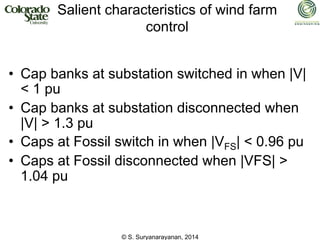
• Cap banks at substation switched in when |V|
< 1 pu
• Cap banks at substation disconnected when
|V| > 1.3 pu
• Caps at Fossil switch in when |VFS| < 0.96 pu
• Caps at Fossil disconnected when |VFS| >
1.04 pu
© S. Suryanarayanan, 2014
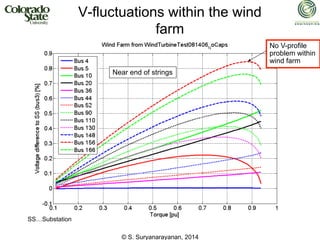
V-fluctuations within the wind
farm
Near end of strings
No V-profile
problem within
wind farm
SS…Substation
© S. Suryanarayanan, 2014
Comparison between Load Flow Results and
SCADA Data
WF…Wind Farm (at Substation)
Leads into
V-Collapse
Strong
evidence that
malfunctioning
of Condon
Wind Farm
capacitor
switching
causes the
problem
© S. Suryanarayanan, 2014
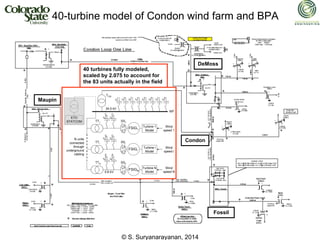
40 turbines fully modeled,
scaled by 2.075 to account for
the 83 units actually in the field
40-turbine model of Condon wind farm and BPA
Fossil
DeMoss
Maupin
Condon
C
1
C
2
C
3
C
4
C
5
C
6
C
7
C
8
FSIG1
Turbine 1
Model
Wind
speed 1
C
aT1
C
bT1
34.5 kV
SS1
Turbine N
Model
Wind
speed N
C
aTN
C
bTN
SSn
N units
connected
through
underground
cabling
0.6 kV
TT1
TTN
ETO
STATCOM
TCW
WF
Turbine i
Model
Wind
speed i
C
aTi
C
bTi
SSi
TTi
FSIGi
FSIGN
© S. Suryanarayanan, 2014
0 5 10 15 20 25 30 35 40 45 50
0.88
0.9
0.92
0.94
0.96
0.98
1
1.02
1.04
1.06
Voltage
at
Condon
Wind
[pu]
Real Power Condon Wind [MW]
2 s SCADA Data
5 min SCADA Data for 3 days starting 22-Aug-2004
No Capacitors (RTDS)
Fossil Capacitors (RTDS)
CWF Capacitors (RTDS)
Power ramped by (slowly) increasing
wind speed uniformly
Validation of hybrid RTDS model
against SCADA Data
More evidence
that
malfunctioning
of Condon
Wind Farm
capacitor
switching
causes the
problem
© S. Suryanarayanan, 2014
BPA Recent Data
Proper cap bank switching
Condon Wind Farm Voltage
[kV]
time [s]
10 min
When cap switching control at Condon Wind works properly, the voltage stays within BPA
criteria as FSU studies predicted
- As confirmed by BPA via email on 11/22/2006
© S. Suryanarayanan, 2014
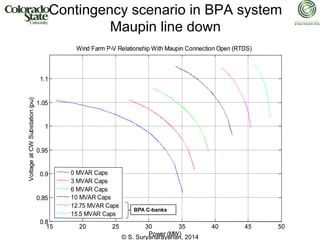
Contingency scenario in BPA system
Maupin line down
15 20 25 30 35 40 45 50
0.8
0.85
0.9
0.95
1
1.05
1.1
Power (MW)
Voltage
at
CW
Substation
(pu)
Wind Farm P-V Relationship With Maupin Connection Open (RTDS)
0 MVAR Caps
3 MVAR Caps
6 MVAR Caps
10 MVAR Caps
12.75 MVAR Caps
15.5 MVAR Caps
15 20 25 30 35 40 45 50
0.8
0.85
0.9
0.95
1
1.05
1.1
Power (MW)
Voltage
at
CW
Substation
(pu)
Wind Farm P-V Relationship With Maupin Connection Open (RTDS)
0 MVAR Caps
3 MVAR Caps
6 MVAR Caps
10 MVAR Caps
12.75 MVAR Caps
15.5 MVAR Caps
BPA C-banks
© S. Suryanarayanan, 2014
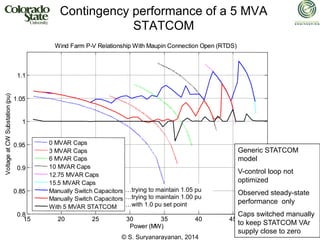
Contingency performance of a 5 MVA
STATCOM
15 20 25 30 35 40 45 50
0.8
0.85
0.9
0.95
1
1.05
1.1
Power (MW)
Voltage
at
CW
Substation
(pu)
Wind Farm P-V Relationship With Maupin Connection Open (RTDS)
0 MVAR Caps
3 MVAR Caps
6 MVAR Caps
10 MVAR Caps
12.75 MVAR Caps
15.5 MVAR Caps
Manually Switch Capacitors
With 5 MVAR STATCOM
15 20 25 30 35 40 45 50
0.8
0.85
0.9
0.95
1
1.05
1.1
Power (MW)
Voltage
at
CW
Substation
(pu)
Wind Farm P-V Relationship With Maupin Connection Open (RTDS)
0 MVAR Caps
3 MVAR Caps
6 MVAR Caps
10 MVAR Caps
12.75 MVAR Caps
15.5 MVAR Caps
Manually Switch Capacitors
With 5 MVAR STATCOM
…trying to maintain 1.05 pu
…trying to maintain 1.00 pu
…with 1.0 pu set point
Generic STATCOM
model
V-control loop not
optimized
Observed steady-state
performance only
Caps switched manually
to keep STATCOM VAr
supply close to zero
© S. Suryanarayanan, 2014
Conclusions
• High-fidelity modeling and simulation of utility
system (BPA’s), existing wind farm, and generic
STATCOM performed
• Actual source of voltage deviation in Condon wind
farm identified as controller of PFC
• Possible use of STATCOM during contingency
situations established
• Sizing of novel STATCOM aided by high-fidelity
modeling effort

GRID integration of Wind energy conversion system

  • 1.
    © S. Suryanarayanan,2014 Instructor: Dr. Sid Suryanarayanan Associate Professor, ECE sid@colostate.edu Week 8 (part A) Grid Integration of Wind Energy Conversion Systems ECE 566
  • 2.
    © S. Suryanarayanan,2014 Voltage Deviation Analysis of a 50 MW Wind Farm Practical case study
  • 3.
    © S. Suryanarayanan,2014 Outline of presentation • BPA’s Condon wind farm scenario • The proposed remedy • Modeling and simulation based analysis • Identification of the real cause • Conclusions
  • 4.
    © S. Suryanarayanan,2014 Types of wind power installations • Fixed speed induction generators (FSIG) – Squirrel cage induction machines – Robust and inexpensive – Directly coupled to grid and draws reactive power – Fluctuations in wind cause mechanical and electrical fluctuations (V deviation) – Not suitable for weak electric grids • Variable speed induction generators (VSIG) – Wound rotor induction machines – Use power electronics – More expensive and less robust
  • 5.
    © S. Suryanarayanan,2014 BPA network • Bonneville Power Administration - federally owned utility with regions of operation in WA, OR, ID, and parts of MT • ~15000 miles of lines and ~300 substations • Connects to Canada in the North and Los Angeles in the South thru 500 kV AC lines • Pacific DC intertie between BPA (Celilo) and LA (Sylmar) • In 2011, BPA network had approximately 30% of wind power on its system (one of the highest concentrations in the US)
  • 6.
    © S. Suryanarayanan,2014 Condon Wind Farm on BPA network • 50 MW wind farm on 69 kV network of BPA in central Oregon • 83 FSIG wind turbines of 600 kW capacity each • Owned and operated by private utility (SeaWest) on federal electric network • Reactive support included • Power factor correction capacitors (10 MVAr) at wind farm and at nearby substation (5.5 MVAr) • Cable shunt capacitance (2 MVAr) • Individual turbine caps (90/180 kVAr)
  • 7.
    © S. Suryanarayanan,2014 Voltage deviation on PCC at Condon • Persistent voltage deviation of >9% seen regularly • Note: x-axis is time (1 year period) 01/01/04 03/01/04 04/30/04 06/29/04 08/28/04 10/27/04 12/26/04 90 95 100 105 110 5 min Condon Wind SCADA Data for 365 days starting 01-Jan-2004 Voltage at Wind Farm [%] Date [MM/DD/YY] BPA’s nominal operating voltage level BPA’s nominal operating voltage range • Yet, voltage deviation on PCC was observed periodically
  • 8.
    © S. Suryanarayanan,2014 -10 0 10 20 30 40 50 0.95 0.96 0.97 0.98 0.99 1 1.01 1.02 1.03 1.04 1.05 1.06 1.07 1.08 Real power delivered by wind farm [MW] Voltage at the wind farm [pu] 2s SCADA 03/05/2006 5min SCADA 08/22/2004 - 08/24/2004 Δv = 9% caused only in some cases Site established as candidate for testing and installing new technology for mitigating V deviation Voltage deviation on PCC at Condon
  • 9.
    © S. Suryanarayanan,2014 Remedy for voltage deviation on Condon wind farm • Flexible AC Transmission System (FACTS) technology proposed • Static synchronous compensator (STATCOM) – Shunt device – Fast acting, reactive power compensator – Dynamic voltage control • New technology in power electronics (ETO) based STATCOM at 10 MVA power rating to be installed at Condon – developed by NCSU • FSU-CAPS in collaboration with EPRI, BPA, NCSU to test and characterize novel controller for ETO based STATCOM – High-fidelity modeling, simulation and hardware-in-the-loop studies – Also to identify actual source of V deviation
  • 10.
    © S. Suryanarayanan,2014 Hardware-in-the-loop Real Time Digital Simulator Universal controller D/A A/D Protection relay M AC/AC power converter (Motor Drive) External Hardware System Data in Simulation Hardware response M G G G Controller Relay DC Load • Requirements – Detailed models – Real-time capability – D/A & A/D conv. w/ amplification
  • 11.
    © S. Suryanarayanan,2014 Steps in modeling effort • BPA system modeling and validation • Individual wind turbine system modeling and control • Wind farm modeling and control • Validation against SCADA data • Isolate cause of V deviation in wind farm using high-fidelity models
  • 12.
    © S. Suryanarayanan,2014 BPA system modeling Condon wind farm modeled as P and Q injections (i.e. from SCADA data) • Dynamic PQ loads • T-Lines • Xfmrs (w/o tap changers) • C-bank at Fossil • Breakers • HV equivalents: constant V-source behind impedance Klondike wind farm modeled as P and Q injections
  • 13.
    © S. Suryanarayanan,2014 BPA system model validation • Comparative studies of fault analysis on system model developed with data from BPA Node 1 phase-ground fault 3 phase fault Aspen (Amps) RTDS (Amps) % difference Aspen (Amps) RTDS (Amps) % difference BIG1A 30099 29173 3.07 27308 26464 3.1 BIG2A 53205 52003 2.26 46672 45652 2.18 COW6A 1117 1115 0.18 2716 2671 1.65 DEM6A 1942 1961 0.97 2097 2134 1.76 FOS6A 905 898 0.77 1773 1767 0.33 MAU2A 4426 4343 1.87 7114 6996 1.65
  • 14.
    © S. Suryanarayanan,2014 BPA system model validation • Condon wind farm as only P and Q injections • Manual switching of capacitors for |V| ≤ 0.95 pu 0 10 20 30 40 50 60 70 80 90 0.95 1 1.05 Time (min) Voltage (pu) Voltage at Condon Wind Farm Substation SCADA Data Simulated (with capacitors) 0 10 20 30 40 50 60 70 80 90 0 10 20 30 40 50 Time (min) Power (MW) Reactive Power (MVAR) Voltage (pu) 0 10 20 30 40 50 60 70 80 90 0.95 1 1.05 Time (min) Voltage (pu) Voltage at Condon Wind Farm Substation SCADA Data Simulated (with capacitors) 0 10 20 30 40 50 60 70 80 90 0 10 20 30 40 50 Time (min) Power (MW) Reactive Power (MVAR) Voltage (pu) 0 10 20 30 40 50 60 70 80 90 0.95 1 1.05 Time (min) Voltage (pu) Voltage at Condon Wind Farm Substation SCADA Data Simulated (with capacitors) 0 10 20 30 40 50 60 70 80 90 0 10 20 30 40 50 Time (min) Power (MW) Reactive Power (MVAR) Voltage (pu) 0 10 20 30 40 50 60 70 80 90 0.95 1 1.05 Time (min) Voltage (pu) Voltage at Condon Wind Farm Substation SCADA Data Simulated (with capacitors) 0 10 20 30 40 50 60 70 80 90 0 10 20 30 40 50 Time (min) Power (MW) Reactive Power (MVAR) Voltage (pu)
  • 15.
    © S. Suryanarayanan,2014 Modeling characteristics of individual wind turbine • 600 kW fixed-speed wind turbine • Modeled with available name plate details • Induction machine mechanically coupled to a wind turbine rotor model through a drive train model • Controls include power electronic soft-starter, pitching, pole switching, capacitor switching, and grid connection PQ Meter Vabc P Q Iabc Capacitor Bank ω Induction Machine T β ω Wind Turbine Rotor v T Pitch Control P β Wind Profile Soft Starter Drive Train Model
  • 16.
    © S. Suryanarayanan,2014 High-fidelity wind farm modeling • Two modeling methods adopted – Load flow tool based steady state analysis – Hybrid model with individual strings of turbines for dynamic analysis • Developed load flow tool in MATLAB – All 83 IG wind turbines (input is either torque or wind speed) – Includes local transformers, cables, and PF correction capacitors – Models BPA system as lumped impedance • Studied voltage magnitude and angle deviations across the wind farm (to help identifying V-control problem) • Problems with convergence of the load flow brought to light suspected voltage collapse problems at the Condon Loop portion of the BPA system
  • 17.
    © S. Suryanarayanan,2014 Salient characteristics of wind farm control • Turbine goes online in 6 pole mode when wind speed > 3.5 m/s • When induction m/c reaches 1100 rpm, soft starter engages and connects m/c smoothly to grid • At same time, one local cap bank (90 kVAr) is switched in • If wind speed > 8m/s for at least 10 minutes, m/c switched to 4 pole operation – Blades switch out (to remove torque) – m/c disconnects from grid – Turbine speeds up by pitching blades back in – Re-energizing with the gird using soft starter – 2 local cap banks (180 kVAr) switched in
  • 18.
    © S. Suryanarayanan,2014 Salient characteristics of wind farm control • Cap banks at substation switched in when |V| < 1 pu • Cap banks at substation disconnected when |V| > 1.3 pu • Caps at Fossil switch in when |VFS| < 0.96 pu • Caps at Fossil disconnected when |VFS| > 1.04 pu
  • 19.
    © S. Suryanarayanan,2014 V-fluctuations within the wind farm Near end of strings No V-profile problem within wind farm SS…Substation
  • 20.
    © S. Suryanarayanan,2014 Comparison between Load Flow Results and SCADA Data WF…Wind Farm (at Substation) Leads into V-Collapse Strong evidence that malfunctioning of Condon Wind Farm capacitor switching causes the problem
  • 21.
    © S. Suryanarayanan,2014 40 turbines fully modeled, scaled by 2.075 to account for the 83 units actually in the field 40-turbine model of Condon wind farm and BPA Fossil DeMoss Maupin Condon C 1 C 2 C 3 C 4 C 5 C 6 C 7 C 8 FSIG1 Turbine 1 Model Wind speed 1 C aT1 C bT1 34.5 kV SS1 Turbine N Model Wind speed N C aTN C bTN SSn N units connected through underground cabling 0.6 kV TT1 TTN ETO STATCOM TCW WF Turbine i Model Wind speed i C aTi C bTi SSi TTi FSIGi FSIGN
  • 22.
    © S. Suryanarayanan,2014 0 5 10 15 20 25 30 35 40 45 50 0.88 0.9 0.92 0.94 0.96 0.98 1 1.02 1.04 1.06 Voltage at Condon Wind [pu] Real Power Condon Wind [MW] 2 s SCADA Data 5 min SCADA Data for 3 days starting 22-Aug-2004 No Capacitors (RTDS) Fossil Capacitors (RTDS) CWF Capacitors (RTDS) Power ramped by (slowly) increasing wind speed uniformly Validation of hybrid RTDS model against SCADA Data More evidence that malfunctioning of Condon Wind Farm capacitor switching causes the problem
  • 23.
    © S. Suryanarayanan,2014 BPA Recent Data Proper cap bank switching Condon Wind Farm Voltage [kV] time [s] 10 min When cap switching control at Condon Wind works properly, the voltage stays within BPA criteria as FSU studies predicted - As confirmed by BPA via email on 11/22/2006
  • 24.
    © S. Suryanarayanan,2014 Contingency scenario in BPA system Maupin line down 15 20 25 30 35 40 45 50 0.8 0.85 0.9 0.95 1 1.05 1.1 Power (MW) Voltage at CW Substation (pu) Wind Farm P-V Relationship With Maupin Connection Open (RTDS) 0 MVAR Caps 3 MVAR Caps 6 MVAR Caps 10 MVAR Caps 12.75 MVAR Caps 15.5 MVAR Caps 15 20 25 30 35 40 45 50 0.8 0.85 0.9 0.95 1 1.05 1.1 Power (MW) Voltage at CW Substation (pu) Wind Farm P-V Relationship With Maupin Connection Open (RTDS) 0 MVAR Caps 3 MVAR Caps 6 MVAR Caps 10 MVAR Caps 12.75 MVAR Caps 15.5 MVAR Caps BPA C-banks
  • 25.
    © S. Suryanarayanan,2014 Contingency performance of a 5 MVA STATCOM 15 20 25 30 35 40 45 50 0.8 0.85 0.9 0.95 1 1.05 1.1 Power (MW) Voltage at CW Substation (pu) Wind Farm P-V Relationship With Maupin Connection Open (RTDS) 0 MVAR Caps 3 MVAR Caps 6 MVAR Caps 10 MVAR Caps 12.75 MVAR Caps 15.5 MVAR Caps Manually Switch Capacitors Manually Switch Capacitors With 5 MVAR STATCOM 15 20 25 30 35 40 45 50 0.8 0.85 0.9 0.95 1 1.05 1.1 Power (MW) Voltage at CW Substation (pu) Wind Farm P-V Relationship With Maupin Connection Open (RTDS) 0 MVAR Caps 3 MVAR Caps 6 MVAR Caps 10 MVAR Caps 12.75 MVAR Caps 15.5 MVAR Caps Manually Switch Capacitors Manually Switch Capacitors With 5 MVAR STATCOM …trying to maintain 1.05 pu …trying to maintain 1.00 pu …with 1.0 pu set point Generic STATCOM model V-control loop not optimized Observed steady-state performance only Caps switched manually to keep STATCOM VAr supply close to zero
  • 26.
    © S. Suryanarayanan,2014 Conclusions • High-fidelity modeling and simulation of utility system (BPA’s), existing wind farm, and generic STATCOM performed • Actual source of voltage deviation in Condon wind farm identified as controller of PFC • Possible use of STATCOM during contingency situations established • Sizing of novel STATCOM aided by high-fidelity modeling effort