Greetings
How to start a conversation in English?
How to start a conversation in
English?
Whether you’re speaking with someone face-to-face,
through Skype, or over the phone, greetings are an
essential part of getting your English conversation
started.
You will only need to learn a few common greetings,
but the words you use will vary based on the situation.
For example, in a job interview, you should use a
formal greeting, but when you meet a friend for
coffee, you’ll likely say something informal.
Greetings
What Is A
Greeting?
A greeting is simply a way of saying hello to
someone.
In the English language, there are multiple
ways in which this can be done. There are
greetings which can be used in formal
situations and also greetings which are used in
a more friendly, informal setting.
It is very important to be able to select an
appropriate greeting for every situation. We
will be looking at this a little more closely in
the next section.
Formal Greetings
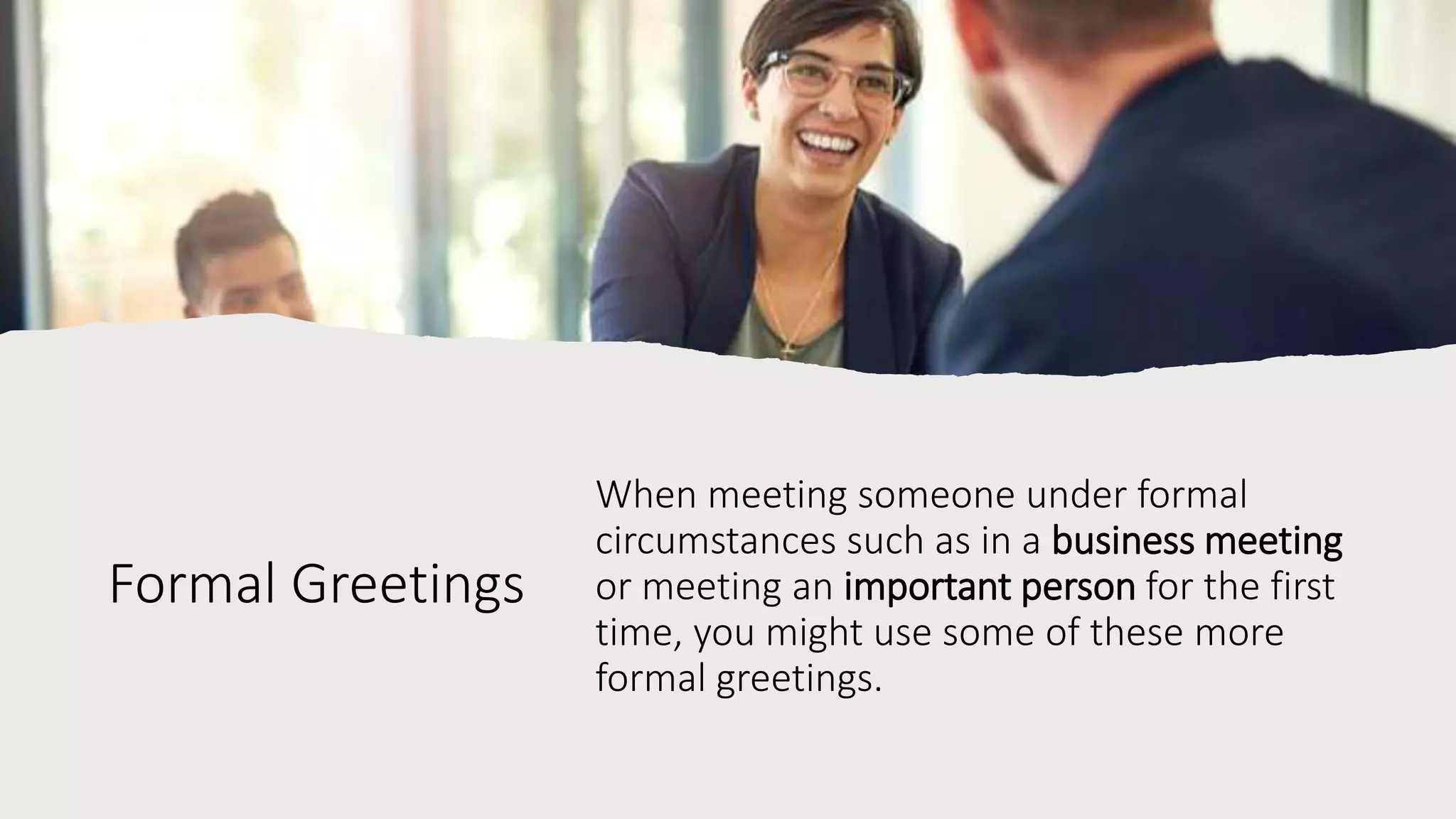
When meeting someone under formal
circumstances such as in a business meeting
or meeting an important person for the first
time, you might use some of these more
formal greetings.
Good morning/afternoon/evening/day
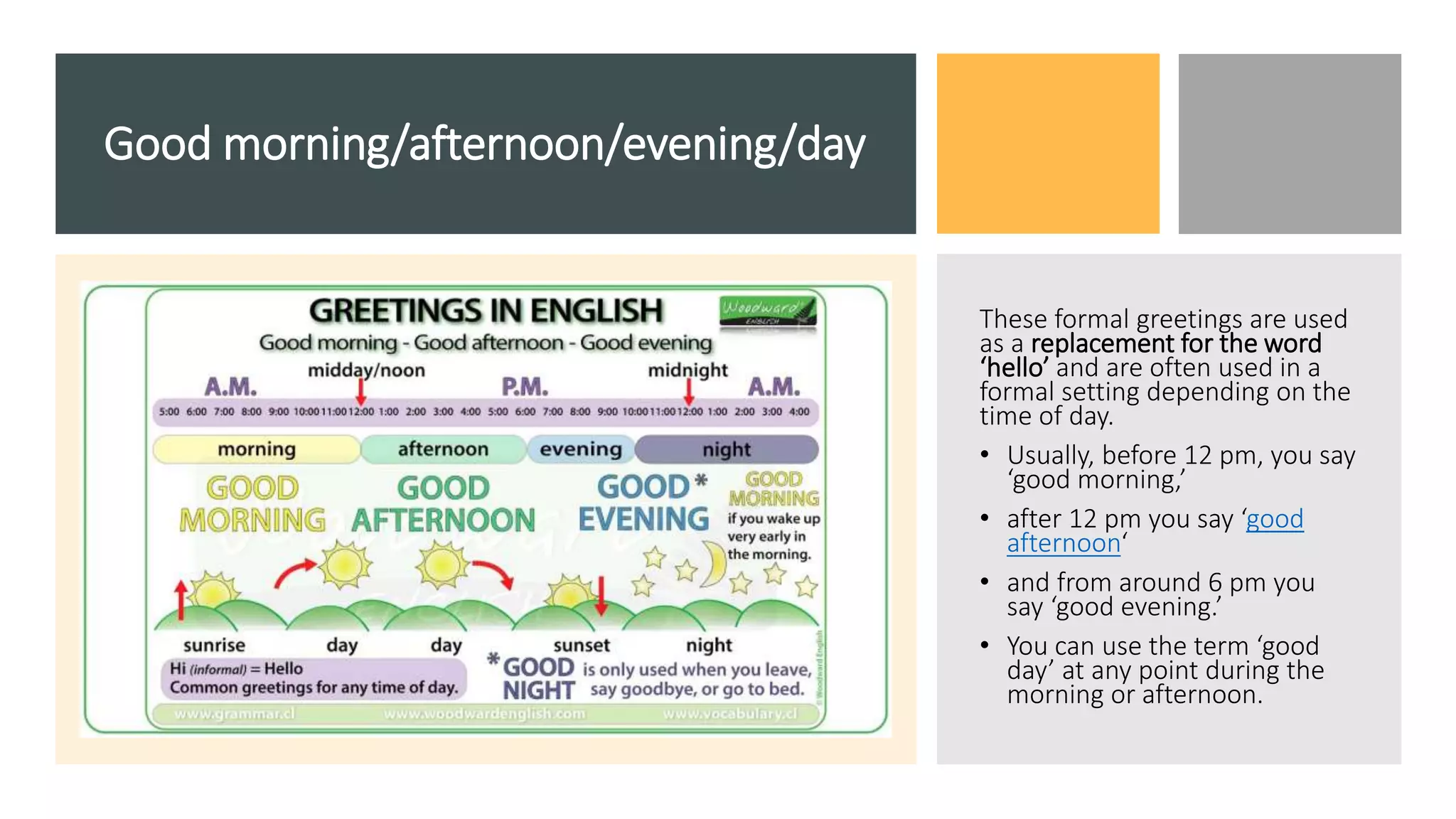
These formal greetings are used
as a replacement for the word
‘hello’ and are often used in a
formal setting depending on the
time of day.
• Usually, before 12 pm, you say
‘good morning,’
• after 12 pm you say ‘good
afternoon‘
• and from around 6 pm you
say ‘good evening.’
• You can use the term ‘good
day’ at any point during the
morning or afternoon.
How do you do?
This is quite an old-
fashioned greeting, but it
is still widely used in very
formal situations.
You are likely to hear a
reply such as ‘very well,
thank you’ when asking
this question.
Pleased to meet you
This is a greeting which is often
used when meeting someone for
the first time.
It is common in formal
circumstances but may also be used
in a less formal situation on a first
meeting.
How are you
doing?
This is a polite way of asking how
someone is and is often used in
conjunction with words like ‘hello’
or ‘good
morning/afternoon/evening’ etc.
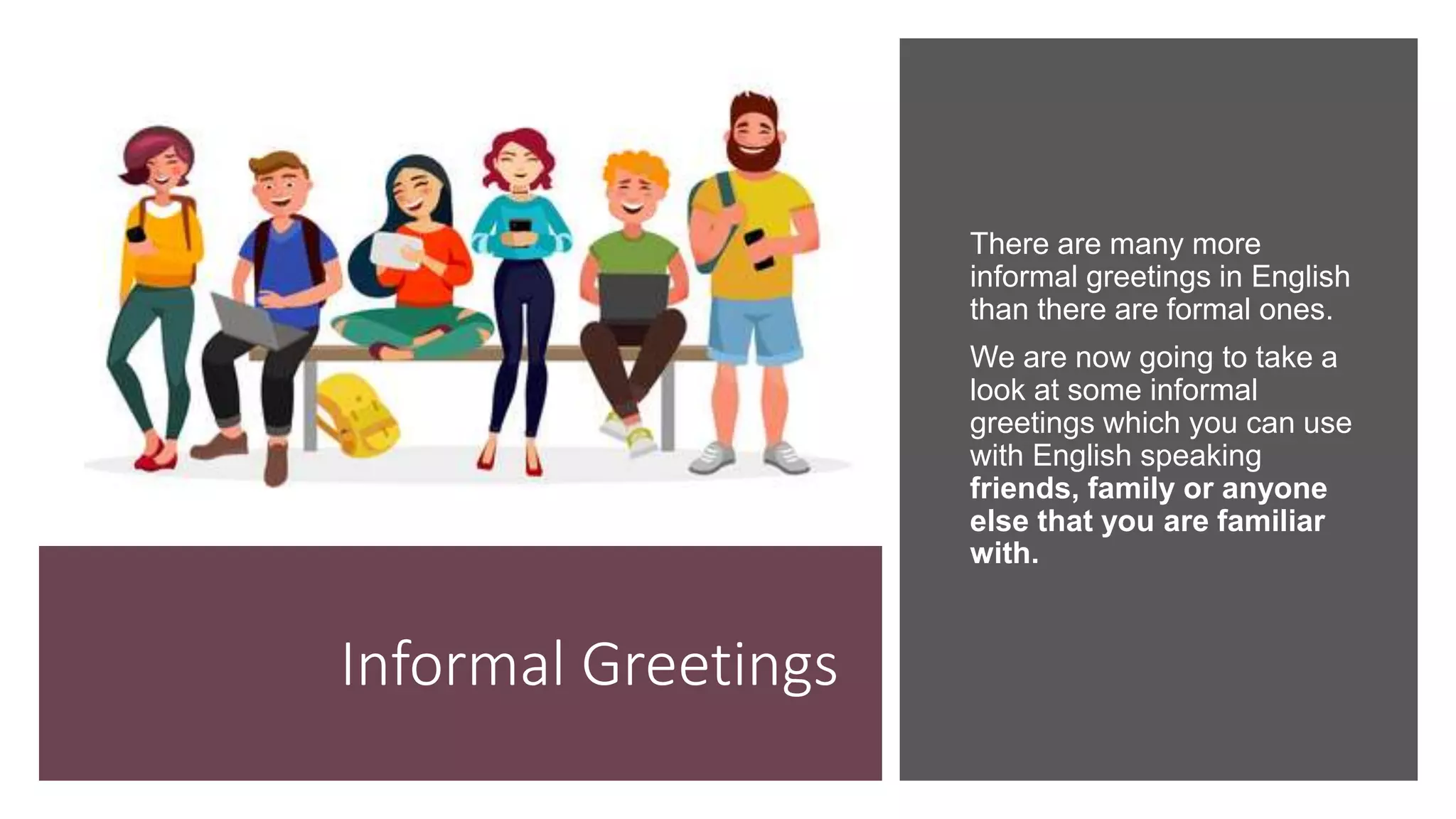
Informal Greetings
There are many more
informal greetings in English
than there are formal ones.
We are now going to take a
look at some informal
greetings which you can use
with English speaking
friends, family or anyone
else that you are familiar
with.
Hi
This word, which is
another word for
‘hello‘ is probably one
of the most commonly
used greetings in the
English language and
something you will
hear very frequently.
Hey (there!)
Another variation on the word
‘hello’. this is used as a friendly,
upbeat greeting.
How’s it going?
This is an informal way to ask someone how
they are and is used often in place of ‘hello.’
‘Sup/ Yo
‘Sup is more common in the USA, this greeting is a
slang term meaning ‘what’s up?’ Many people will
use the term ‘what’s up’ but often it is shortened to
‘sup.
Yo is another one which is more common in the
USA, and is simply another way to say ‘hey, what’s
up?’
Long time no
see
This greeting is usually used when
bumping into a person who you have not
seen for a long time.
Going beyond Hello…
All of the words and phrases above are
simply variations of “hello.” But what
comes next?
This is when an English conversation
moves to polite questions or
introductions, depending on the
situation. Let’s look at a few polite
ways to move forward:
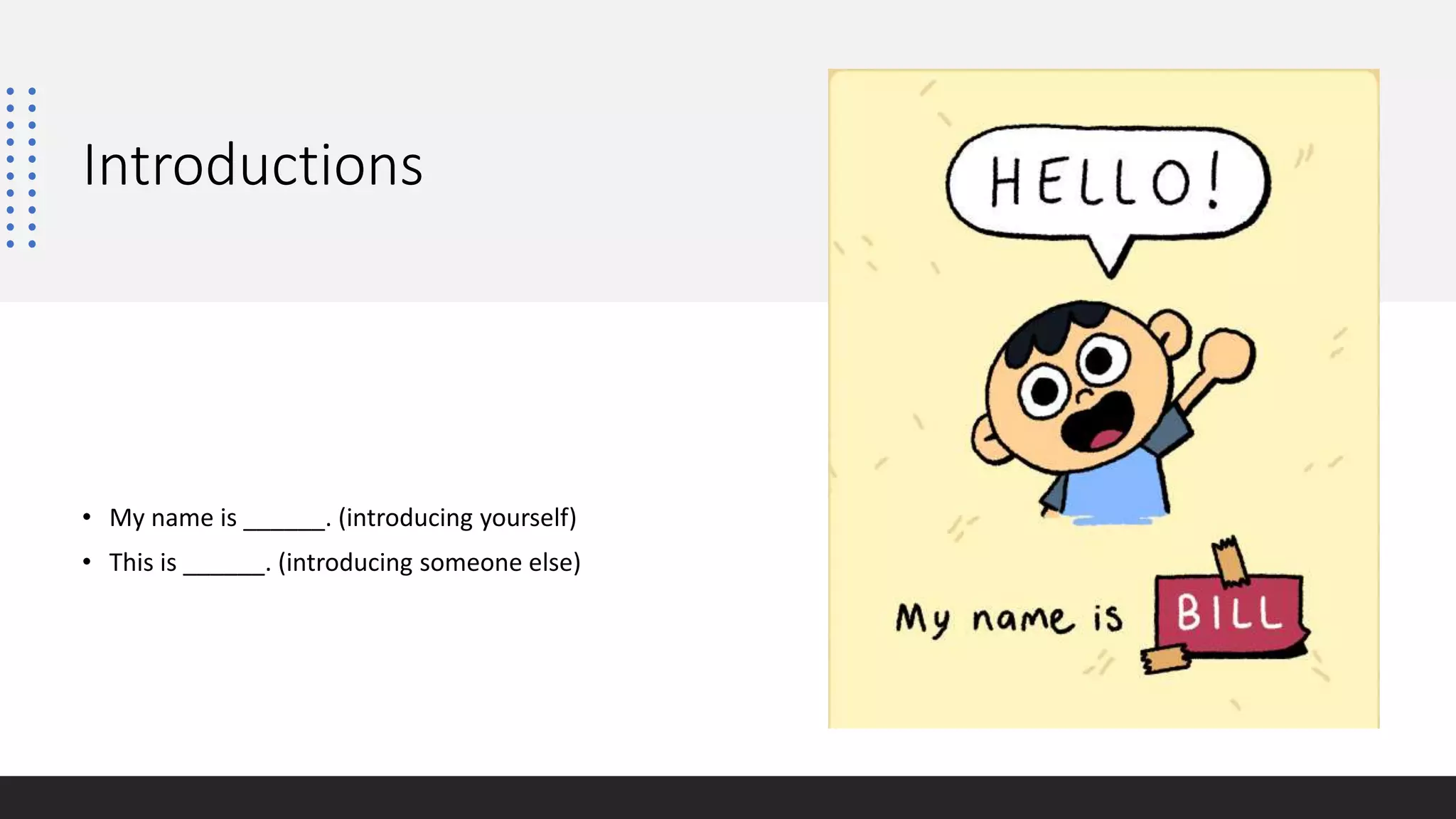
Introductions
• My name is ______. (introducing yourself)
• This is ______. (introducing someone else)
Polite Questions
• How are you?
• How are you doing?
• How have you been?
• How’s your day going so far?
• How’s it going?
• How are things?
Note that the person speaking with you will
probably ask you one or more of those
questions. This means that you should also
know how to answer them. Here are a few
possible answers:
Polite Answers
• I’m great or I’m fine
• I’m doing well
• I’ve been doing very well
• My day has been pretty good so far
• Not too bad
• Things are really good
You can also add “thanks for asking”
at the end of any of these phrases to
make them a little friendlier!
How to Make Small Talk
in English?
“Small talk” is just a polite
exchange used to:
• pass the time;
• share non-essential information,
or;
• learn more about the other
person;
• It’s also a great form of English
conversation practice.
How to Make Small
Talk in English?
This kind of communication can span a wide
range of topics, from weather to sleep
habits.
Small talk often begins naturally with
questions like, “How are you?” From there,
it can expand to cover greater detail and
more topics.
Conversation One:
Movies
• Person 1: What kinds of movies do you like?
• Person 2: I love horror movies!
• Person 1: Oh, I love horror movies, too! But I
can’t watch them alone.
• Person 2: Me neither!
• Person 1: What other kinds of movies do
you like? …
Conversation Two:
Weather
• Person 1: Could we ask for better weather today?
• Person 2: I know, right? It’s gorgeous outside!
• Person 1: It really is. I think I might go for a run today.
• Person 2: It’s a great day for it.
• Person 1: Do you know of any good places to go for a
run nearby? …
Conversation Three:
Hobbies
• Person 1: What do you like to do for fun?
• Person 2: I enjoy a lot of things, but painting is my main passion.
• Person 1: That’s really cool! What do you paint?
• Person 2: I mostly paint landscapes.
• Person 1: That’s amazing. Do you have any pictures of your work? …

Greetings

  • 1.
    Greetings How to starta conversation in English?
  • 2.
    How to starta conversation in English? Whether you’re speaking with someone face-to-face, through Skype, or over the phone, greetings are an essential part of getting your English conversation started. You will only need to learn a few common greetings, but the words you use will vary based on the situation. For example, in a job interview, you should use a formal greeting, but when you meet a friend for coffee, you’ll likely say something informal.
  • 3.
  • 4.
    What Is A Greeting? Agreeting is simply a way of saying hello to someone. In the English language, there are multiple ways in which this can be done. There are greetings which can be used in formal situations and also greetings which are used in a more friendly, informal setting. It is very important to be able to select an appropriate greeting for every situation. We will be looking at this a little more closely in the next section.
  • 5.
    Formal Greetings When meetingsomeone under formal circumstances such as in a business meeting or meeting an important person for the first time, you might use some of these more formal greetings.
  • 6.
    Good morning/afternoon/evening/day These formalgreetings are used as a replacement for the word ‘hello’ and are often used in a formal setting depending on the time of day. • Usually, before 12 pm, you say ‘good morning,’ • after 12 pm you say ‘good afternoon‘ • and from around 6 pm you say ‘good evening.’ • You can use the term ‘good day’ at any point during the morning or afternoon.
  • 7.
    How do youdo? This is quite an old- fashioned greeting, but it is still widely used in very formal situations. You are likely to hear a reply such as ‘very well, thank you’ when asking this question.
  • 8.
    Pleased to meetyou This is a greeting which is often used when meeting someone for the first time. It is common in formal circumstances but may also be used in a less formal situation on a first meeting.
  • 9.
    How are you doing? Thisis a polite way of asking how someone is and is often used in conjunction with words like ‘hello’ or ‘good morning/afternoon/evening’ etc.
  • 10.
    Informal Greetings There aremany more informal greetings in English than there are formal ones. We are now going to take a look at some informal greetings which you can use with English speaking friends, family or anyone else that you are familiar with.
  • 11.
    Hi This word, whichis another word for ‘hello‘ is probably one of the most commonly used greetings in the English language and something you will hear very frequently.
  • 12.
    Hey (there!) Another variationon the word ‘hello’. this is used as a friendly, upbeat greeting.
  • 13.
    How’s it going? Thisis an informal way to ask someone how they are and is used often in place of ‘hello.’
  • 14.
    ‘Sup/ Yo ‘Sup ismore common in the USA, this greeting is a slang term meaning ‘what’s up?’ Many people will use the term ‘what’s up’ but often it is shortened to ‘sup. Yo is another one which is more common in the USA, and is simply another way to say ‘hey, what’s up?’
  • 15.
    Long time no see Thisgreeting is usually used when bumping into a person who you have not seen for a long time.
  • 16.
    Going beyond Hello… Allof the words and phrases above are simply variations of “hello.” But what comes next? This is when an English conversation moves to polite questions or introductions, depending on the situation. Let’s look at a few polite ways to move forward:
  • 17.
    Introductions • My nameis ______. (introducing yourself) • This is ______. (introducing someone else)
  • 18.
    Polite Questions • Howare you? • How are you doing? • How have you been? • How’s your day going so far? • How’s it going? • How are things? Note that the person speaking with you will probably ask you one or more of those questions. This means that you should also know how to answer them. Here are a few possible answers:
  • 19.
    Polite Answers • I’mgreat or I’m fine • I’m doing well • I’ve been doing very well • My day has been pretty good so far • Not too bad • Things are really good You can also add “thanks for asking” at the end of any of these phrases to make them a little friendlier!
  • 20.
    How to MakeSmall Talk in English? “Small talk” is just a polite exchange used to: • pass the time; • share non-essential information, or; • learn more about the other person; • It’s also a great form of English conversation practice.
  • 21.
    How to MakeSmall Talk in English? This kind of communication can span a wide range of topics, from weather to sleep habits. Small talk often begins naturally with questions like, “How are you?” From there, it can expand to cover greater detail and more topics.
  • 22.
    Conversation One: Movies • Person1: What kinds of movies do you like? • Person 2: I love horror movies! • Person 1: Oh, I love horror movies, too! But I can’t watch them alone. • Person 2: Me neither! • Person 1: What other kinds of movies do you like? …
  • 23.
    Conversation Two: Weather • Person1: Could we ask for better weather today? • Person 2: I know, right? It’s gorgeous outside! • Person 1: It really is. I think I might go for a run today. • Person 2: It’s a great day for it. • Person 1: Do you know of any good places to go for a run nearby? …
  • 24.
    Conversation Three: Hobbies • Person1: What do you like to do for fun? • Person 2: I enjoy a lot of things, but painting is my main passion. • Person 1: That’s really cool! What do you paint? • Person 2: I mostly paint landscapes. • Person 1: That’s amazing. Do you have any pictures of your work? …