SHRI PILLAPPA COLLEGE
OF ENGINEERING
DEPARTMENT OF MECHANICAL ENGINEERING
Green Engine Technology
PRESENTED BY:
Abhimanyu sah{1PL12ME001}
UNDER THE GUIDENCE OF:
Dr. channabasavaraj
SEMINAR COORDINATER:
Prof. Amardeepak M
SPECIAL HELP:
Prof. Dileep Kumar
WHAT IS GREEN ENGINE???
 Green engine is the internal combustion engine with
some or major modification in its part and design.
 The green engine is one of the most interesting
discoveries of the new millennium.
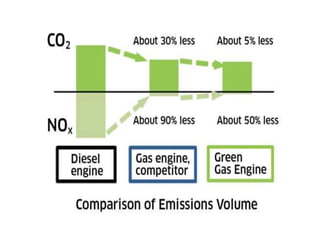
 The efficiency of this engine is high when compared with
the contemporary engines and also the exhaust emission
are near zero.
 The significance of the engine lies in the efficiency when
the present world conditions of limited resources of
energy are considered.
NEEDTOINVENT….
 Today world is facing the major problems regarding
energy crisis.
 Along with this we are facing major environmental
trouble due to increase in harmful gases which are
evolved from nowhere else but the combustion of
these conventional energy sources.
 Major portion of fuels is burnt in the engines used for
various purposes like main automobiles, generators,
power plants etc.
 Statistics show that, the daily consumption of
petroleum all over the world today is 40 million
barrels, of which above 50% is automobile use.
ENERGY CRISIS………
WORLD MARKETED
ENERGY CONSUMPTION
1980-2030
TECHINICAL FEATURES
• Direct intake
• Strong swirling
• Sequential variable
compression Ratios.
• Direct fuel injection
• Super air fuel mixing
• Lowest surface to volume
ratios
• Constant volume
combustion
• Controllable combustion
time
• Multi power pulses
• High Working
Temperature
• High expansion ratios
• Self adapting sealing
system
• Vibration free
• Modular design
• Limited parts and small
size
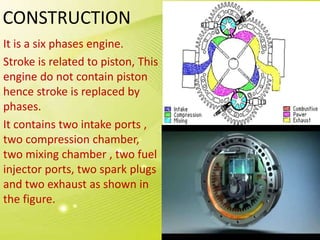
CONSTRUCTION
It is a six phases engine.
Stroke is related to piston, This
engine do not contain piston
hence stroke is replaced by
phases.
It contains two intake ports ,
two compression chamber,
two mixing chamber , two fuel
injector ports, two spark plugs
and two exhaust as shown in
the figure.
Working…
1.INTAKE.
 Air arrives to engine
through air intake port.
 A duct is provided on the
side wall of the vanes and
rotors.
 When air moves through
the duct a strong swirls
generates.
 Air pushes the vane blade,
imparts rotation in the
small rotors.
 The inlet duct ends with
very narrow opening.
2 COMPRESSION.
 The rushing air from the duct
is pushed by the blades the
small chambers in the rotor.
 Compression obtained by such
procedure is satisfactory.
 Compressed air in swirling
state mixed with fuel.
WORKING..
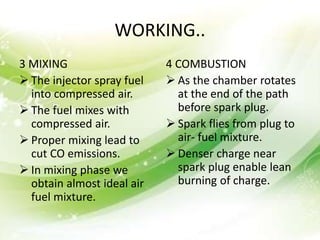
3 MIXING
 The injector spray fuel
into compressed air.
 The fuel mixes with
compressed air.
 Proper mixing lead to
cut CO emissions.
 In mixing phase we
obtain almost ideal air
fuel mixture.
4 COMBUSTION
 As the chamber rotates
at the end of the path
before spark plug.
 Spark flies from plug to
air- fuel mixture.
 Denser charge near
spark plug enable lean
burning of charge.
Working..
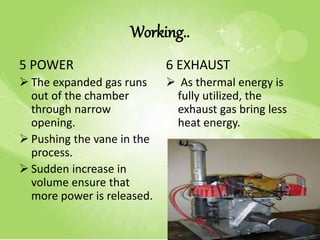
5 POWER
 The expanded gas runs
out of the chamber
through narrow
opening.
 Pushing the vane in the
process.
 Sudden increase in
volume ensure that
more power is released.
6 EXHAUST
 As thermal energy is
fully utilized, the
exhaust gas bring less
heat energy.
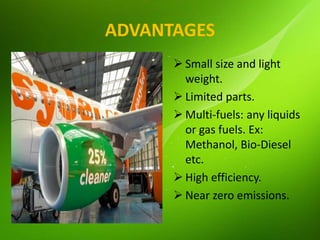
ADVANTAGES
 Small size and light
weight.
 Limited parts.
 Multi-fuels: any liquids
or gas fuels. Ex:
Methanol, Bio-Diesel
etc.
 High efficiency.
 Near zero emissions.
ADVANTAGES
 Smooth operation.
 Fast acceleration
response.
 Quietness and low
exhaust temperature.
 High reliability.
 Low cost.
• LIKE NORMAL ENGINE
• Low emission.
• Low noise.
• Low vibration.
• Volumetric efficiency high.
• Heat lose in exhaust gas is
less.
• Fuel feasibility less.
• Torque and work output
high.
Conventional engine
• High emission.
• High noise.
• Low vibration.
• Volumetric efficiency low.
• Heat lose in exhaust is high.
• Fuel feasibility high.
• Torque and work output
low.
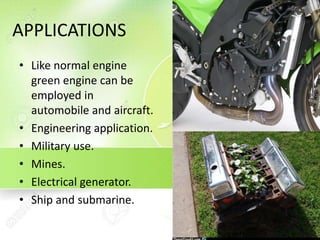
APPLICATIONS
• Like normal engine
green engine can be
employed in
automobile and aircraft.
• Engineering application.
• Military use.
• Mines.
• Electrical generator.
• Ship and submarine.
REFRENCES
• Catania, A.E., D. Misul, E. Spessa and A. Vassallo, 2004.
Analysis of combustion parameters and exhaust emissions in an upgraded
multivalve bi-fuel CNG SI engine. SAE Technical paper 2004-01, 0983.
• Introduction to internal combustion engines by Richard Stone.
• Engineering fundamentals of the Internal combustion engine by Pulkrabek.
• Andrzej, K., 1984. Combustion System of High-speed Piston I.C. Engines.
Wydawnictwa Komunikacji I Lacznos ci, Warszowa, Ganeson, v., 1999.
Internal Combustion Eng Ines, 2nd Edn., Tata McGraw-Hill, New Delhi,
Poulton, M.L., 1994. Alternative fuels for Road Vehicles. Comp. Mechanics
publications, UK.
• http://www.greenenginetech.com
THANK YOU

Green engine technology

  • 1.
    SHRI PILLAPPA COLLEGE OFENGINEERING DEPARTMENT OF MECHANICAL ENGINEERING Green Engine Technology PRESENTED BY: Abhimanyu sah{1PL12ME001} UNDER THE GUIDENCE OF: Dr. channabasavaraj SEMINAR COORDINATER: Prof. Amardeepak M SPECIAL HELP: Prof. Dileep Kumar
  • 2.
    WHAT IS GREENENGINE???  Green engine is the internal combustion engine with some or major modification in its part and design.  The green engine is one of the most interesting discoveries of the new millennium.  The efficiency of this engine is high when compared with the contemporary engines and also the exhaust emission are near zero.  The significance of the engine lies in the efficiency when the present world conditions of limited resources of energy are considered.
  • 3.
    NEEDTOINVENT….  Today worldis facing the major problems regarding energy crisis.  Along with this we are facing major environmental trouble due to increase in harmful gases which are evolved from nowhere else but the combustion of these conventional energy sources.  Major portion of fuels is burnt in the engines used for various purposes like main automobiles, generators, power plants etc.  Statistics show that, the daily consumption of petroleum all over the world today is 40 million barrels, of which above 50% is automobile use.
  • 4.
  • 5.
    TECHINICAL FEATURES • Directintake • Strong swirling • Sequential variable compression Ratios. • Direct fuel injection • Super air fuel mixing • Lowest surface to volume ratios • Constant volume combustion • Controllable combustion time • Multi power pulses • High Working Temperature • High expansion ratios • Self adapting sealing system • Vibration free • Modular design • Limited parts and small size
  • 6.
    CONSTRUCTION It is asix phases engine. Stroke is related to piston, This engine do not contain piston hence stroke is replaced by phases. It contains two intake ports , two compression chamber, two mixing chamber , two fuel injector ports, two spark plugs and two exhaust as shown in the figure.
  • 7.
    Working… 1.INTAKE.  Air arrivesto engine through air intake port.  A duct is provided on the side wall of the vanes and rotors.  When air moves through the duct a strong swirls generates.  Air pushes the vane blade, imparts rotation in the small rotors.  The inlet duct ends with very narrow opening. 2 COMPRESSION.  The rushing air from the duct is pushed by the blades the small chambers in the rotor.  Compression obtained by such procedure is satisfactory.  Compressed air in swirling state mixed with fuel.
  • 8.
    WORKING.. 3 MIXING  Theinjector spray fuel into compressed air.  The fuel mixes with compressed air.  Proper mixing lead to cut CO emissions.  In mixing phase we obtain almost ideal air fuel mixture. 4 COMBUSTION  As the chamber rotates at the end of the path before spark plug.  Spark flies from plug to air- fuel mixture.  Denser charge near spark plug enable lean burning of charge.
  • 9.
    Working.. 5 POWER  Theexpanded gas runs out of the chamber through narrow opening.  Pushing the vane in the process.  Sudden increase in volume ensure that more power is released. 6 EXHAUST  As thermal energy is fully utilized, the exhaust gas bring less heat energy.
  • 10.
    ADVANTAGES  Small sizeand light weight.  Limited parts.  Multi-fuels: any liquids or gas fuels. Ex: Methanol, Bio-Diesel etc.  High efficiency.  Near zero emissions.
  • 11.
    ADVANTAGES  Smooth operation. Fast acceleration response.  Quietness and low exhaust temperature.  High reliability.  Low cost.
  • 12.
  • 14.
    • Low emission. •Low noise. • Low vibration. • Volumetric efficiency high. • Heat lose in exhaust gas is less. • Fuel feasibility less. • Torque and work output high. Conventional engine • High emission. • High noise. • Low vibration. • Volumetric efficiency low. • Heat lose in exhaust is high. • Fuel feasibility high. • Torque and work output low.
  • 15.
    APPLICATIONS • Like normalengine green engine can be employed in automobile and aircraft. • Engineering application. • Military use. • Mines. • Electrical generator. • Ship and submarine.
  • 16.
    REFRENCES • Catania, A.E.,D. Misul, E. Spessa and A. Vassallo, 2004. Analysis of combustion parameters and exhaust emissions in an upgraded multivalve bi-fuel CNG SI engine. SAE Technical paper 2004-01, 0983. • Introduction to internal combustion engines by Richard Stone. • Engineering fundamentals of the Internal combustion engine by Pulkrabek. • Andrzej, K., 1984. Combustion System of High-speed Piston I.C. Engines. Wydawnictwa Komunikacji I Lacznos ci, Warszowa, Ganeson, v., 1999. Internal Combustion Eng Ines, 2nd Edn., Tata McGraw-Hill, New Delhi, Poulton, M.L., 1994. Alternative fuels for Road Vehicles. Comp. Mechanics publications, UK. • http://www.greenenginetech.com THANK YOU