SIX- PHASE GREEN
ENGINE
Contents
● What is a green engine?
● Construction and technical features.
● The six phases.
● Working.
● Comparison of green engine and conventional I.C engines.
● Advantages.
● Applications/Future scope.
● Conclusion.
● Reference.
1. What is a green engine?
A Green Engine is an actual six-phase internal
combustion engine with a much higher expansion ratio.
It is a pistonless engine. It is the only real multi-fuel
engine till date. ie; any liquid or gaseous fuel can be
used.
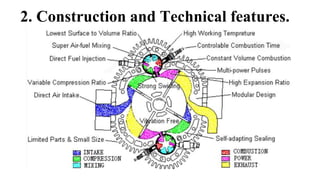
2. Construction and Technical features.
● Direct air intake.
● Strong swirling.
● Sequential variable compression
ratio.
● Direct fuel injection.
● Super air fuel mixing.
● Lowest surface to volume ratio.
● Controllable combustion time.
● Constant volume combustion.
● Multi-power pulses.
● High working temperature.
● High expansion ratio.
● Self-adapting sealing
system.
● Vibration free.
● Direct air intake means that there is no air inlet pipe, throttle and inlet valves on the air
intake system. Air filter is directly connected to the intake port of the engine, therefore
highest volumetric efficiency which makes engine produce a high torque of output on all
speed range is achieved, and the pump loss which consumes the part of engine power is
eliminated.
● Strong Swirling- As a tangential air duct is between combustion chamber and
compression chamber, a very strong swirling of air is achieved. Consequently, the air-
fuel mixing and the combustion process can have a satisfying working condition.
● Sequential Variable Compression Ratio- This great revolutionary innovation can
provide the most suitable compression ratio for the engine whatever operation mode it
works on with burning variety of fuels. Therefore, an excellent combustion performance
is attained.
● Direct fuel injection can provide higher output and torque, while at the same time it also
enhances the response for acceleration.
● Super Air-fuel Mixing Since the independent air-fuel mixing phase is having enough
time for mixing air and fuel under strong swirling and hot situation, the engine is capable
to burn any liquid or gas fuels without modifications. An ideal air-fuel mixture could
delete CO emission. Also centrifugal effect came from both strong swirling and rotation
of the burner makes the air-fuel mixture denser near the spark plug, it benefits to cold
engine starting and managing lean-burning, and allowing the engine use of mass control
for output.
● Lowest Surface to Volume Ratio- The shape of combustion chamber is paraboloidal.
Thus a lowest surface-to-volume ratio is obtained, and the engine is having less heat
losses and high combustion efficiency.
● Controllable Combustion Time- Due to the independent combustion phase, compared
to the conventional engine which performances lack of efficient combustion time
resulting in heavy CO emission and low fuel usage rate, the Green Engine has a
sufficient controllable combustion time to match any fuels.
● Constant Volume Combustion- The fuels can generate more energy while the
combustion is occurred on the constant volume. Also the constant volume combustion
technology can allow the engine to have a stable combustion when the lean-burning is
managed so the heat losses and NOx emissions are decreased.
● Multi-power Pulses- The Green Engine operates on the multi-power pulses with a small
volume of working chamber, resulting in compact structure and limited size. Also a
small amount of air-fuel mixtures being ignited on each power pulse can greatly cut
down explosion noise.
● High Working Temperature- Because the burner, which is made by high heat
resistance and low expansion rate material, such as ceramic, operates without cooling,
and relatively high working temperature can eliminate the quenching zone which is main
source of HC emission, and can greatly reduce the heat losses in the combustion
chamber.
● High expansion ratio can make the burned gases to release much more power, in other
words, the waste gases while they run out the engine are only bringing much less energy
with them, therefore the engine's thermal efficiency is greatly raised, and at the same
time, the noise and temperature of the exhaust are tremendously dropped.
● Self-adapting Sealing System- This is another greatly revolutionary innovation applied
in the Green Engine; it can eliminate a number of seal plates or strips to achieve gapless
seal and to provide most efficient and reliable seal system with less friction.
● Vibration Free- As major moving parts, vanes, which are counted in little mass and
operated symmetrically, the performance of the engine is very smooth got away from
vibration.
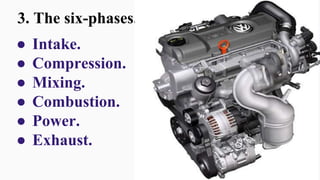
3. The six-phases.
● Intake.
● Compression.
● Mixing.
● Combustion.
● Power.
● Exhaust.
4. Working.
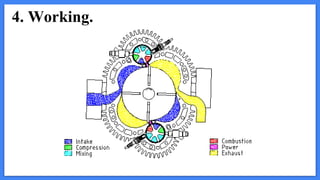
● Intake- The air is admitted directly inside the compression chamber. The air
does not undergo any treatment before entry. The air filter is directly
connected to the entry of the intake pipe. The amount of the air intake can be
varied as per the fuel used.
● Compression- The air admitted in, then enters into the compression chamber.
The compression chamber has variable area. The central disc having arms
pushes the air in the compression chamber. The compression chamber is
connected to the combustion chamber by a small diameter duct which is
tangent to the combustion chamber. So as arm pushes the air in the
compression chamber the pressurized air is forced to flow through this duct.
As the air flow through it, the air is swirled very fast. The air thus enters the
combustion chamber.
● Direct Fuel Injection- One more facility is provided in the green engine is that
of direct fuel injection. The fuel injected is also variable. The amount of fuel
injected is varied as per the mode of the vehicle.
● Super Mixing The combustion chamber is also rotating. This centrifugal force
from the rotation along with the strong swirling causes the fuel to mix with air. The
mixing assures the complete burning of the fuel. The super mixed charge is
forced by the arm towards the spark plug.
● Combustion The charge is ignited by the spark plug. The combustion time can
be varied to burn different grade of fuels. The controlled combustion time gives
the complete burning of the charge. The emissions are greatly reduced.
● Power The burned products of the combustion are expelled out of the combustion
chamber. The high pressure gases push the arm of the compression chamber
causing work output. The power is obtained in the form of the power pulses.
These pulses reduce the area of the engine. The power pulses also reduce the
explosion noise.
● Exhaust The burned gases are expelled out. The gases are first expanded in the
expansion zone. The expansion ratio is more which ensures the maximum work
output. Also the maximum energy is gained from the gases. The temperature also
reduces and hence an optimum utilization of the burned gases is achieved. The
burned gases after expansion are pushed into the exhaust pipe and released into
the atmosphere.
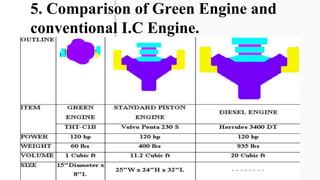
5. Comparison of Green Engine and
conventional I.C Engine.
6. Advantages.
Small size
For same
output.
Near zero
CO,HC
and NOx.
[65+]%
thermal
efficiency.
Smooth
engine
performa-
nce. +
Only real
multi-
fuels
engine.
Overall
cost is
lower.
6. Advantages.
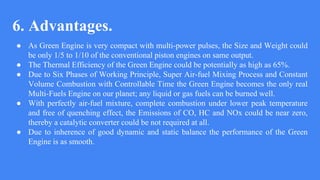
● As Green Engine is very compact with multi-power pulses, the Size and Weight could
be only 1/5 to 1/10 of the conventional piston engines on same output.
● The Thermal Efficiency of the Green Engine could be potentially as high as 65%.
● Due to Six Phases of Working Principle, Super Air-fuel Mixing Process and Constant
Volume Combustion with Controllable Time the Green Engine becomes the only real
Multi-Fuels Engine on our planet; any liquid or gas fuels can be burned well.
● With perfectly air-fuel mixture, complete combustion under lower peak temperature
and free of quenching effect, the Emissions of CO, HC and NOx could be near zero,
thereby a catalytic converter could be not required at all.
● Due to inherence of good dynamic and static balance the performance of the Green
Engine is as smooth.
6. Advantages..
● Limited parts, small in size, light in weight and depended upon current mature
materials and manufacture technologies, it means that it could be done at a much
Lower Cost on manufacture, transportation, installing to other devices, and
maintenance.
● Fast Accelerating Response:- Direct injection, little rotating inertia and deleted
reciprocating motion can characterize the green engine with operating at a very fast
accelerating response.
6. Advantages...
● Highly Reliable As there are fewer moving parts operating smoothly, no crankshaft,
valves, connecting rods, cams and timing chains and intakes and exhaust actions are
accomplished directly by the motion of the vanes. Thus, it is highly reliable.
● Quietness and Low Exhaust Temperature Burst out under small amount of mixtures,
free of vibrations, and high expansion ratio make the Green engine much quieter. It is
really environment-friendly. Green engine vehicles could transport troops on the
battlefield of the future, and could serve as a vital source of auxiliary power in combat.
This is because these engines are quiet, flexible and operate at low temperature,
making them ideal for use in ―stealth vehicle.
7. Applications and Future Scope.
The Green Engines could be used as the ideal power plants on
a very wide range of applications in transportation, farm, mine,
engineering, military uses, such as automobiles, aircrafts,
boats, ships, hovers, locomotives, generators, snowmobiles,
chainsaws, helicopters, tanks, torpedoes, submarines etc.
Conclusion.
It can use almost any type of fuel available. It is superior to the
conventional I.C. engine in terms of smooth operation, efficiency
and cost.
The green engine‘s prototype has been recently developed, and also
because of the unique design, limitation have not been determined to
any extent. But even in the face of limitation if any, the green engine
is sure to serve the purpose to a large extent. Create less smog in the
air; reduce the risk of health problem such as heart diseases and lung
cancer.
9. Reference.
● T. Pushpara, & S. Ramabalan, “Green fuel design for diesel engine, combustion, performance and emission
analysis” International Conference on design and manufacturing, IConDM 2013.
● T. Bohl & G. Tian “Optical investigation on diesel engine fuelled by vegetable oils” The 6th International
Conference on Applied Energy – ICAE2014. International Research Journal of Engineering and Technology
(IRJET) e-ISSN: 2395 -0056 Volume: 03 Issue: 09 | Sep-2016 www.irjet.net p-ISSN: 2395-0072 © 2016, IRJET |
Impact Factor value: 4.45 | ISO 9001:2008 Certified Journal | Page 1204
● I Wayan Surata et al., “Simple Conversion Method from Gasoline to Biogas Fueled Small Engine to Powered
Electric Generator” International Conference on Alternative Energy in Developing Countries and Emerging
Economies 2013
● Internal combustion engine- Mathur & Sharma. pp.1213 to1250.
● Pravesh M. Adhagale , Nilesh S. Mate”Green Engine” 3rd International Conference on Science Technology and
Management (ICSTM-16).
● Sibley, Brian (1995). The Thomas the Tank Engine Man. London: Heinemann. ISBN 0-434-96909-5.
● "The Real Stories Database – book 23, story 2". (Real life events that inspired the Rev W Awdry). The Real Lives of
Thomas the Tank Engine. Retrieved 22 October 2010.
● Green Engine Low RPM High Torque Pressure Driven Turbine for Top Efficiency Power Modulation. Peers
reviewed paper - Published in The Proceeding of Turbo Expo 2007 of the IGTI.
● ”www.google.com/images.
Questions?
THANK YOU.
AKSHAY A.P
MEC15AU007
S7 AUTOMOBILE

Six phase green engine

  • 1.
  • 2.
    Contents ● What isa green engine? ● Construction and technical features. ● The six phases. ● Working. ● Comparison of green engine and conventional I.C engines. ● Advantages. ● Applications/Future scope. ● Conclusion. ● Reference.
  • 3.
    1. What isa green engine? A Green Engine is an actual six-phase internal combustion engine with a much higher expansion ratio. It is a pistonless engine. It is the only real multi-fuel engine till date. ie; any liquid or gaseous fuel can be used.
  • 4.
    2. Construction andTechnical features.
  • 5.
    ● Direct airintake. ● Strong swirling. ● Sequential variable compression ratio. ● Direct fuel injection. ● Super air fuel mixing. ● Lowest surface to volume ratio. ● Controllable combustion time. ● Constant volume combustion. ● Multi-power pulses. ● High working temperature. ● High expansion ratio. ● Self-adapting sealing system. ● Vibration free.
  • 6.
    ● Direct airintake means that there is no air inlet pipe, throttle and inlet valves on the air intake system. Air filter is directly connected to the intake port of the engine, therefore highest volumetric efficiency which makes engine produce a high torque of output on all speed range is achieved, and the pump loss which consumes the part of engine power is eliminated. ● Strong Swirling- As a tangential air duct is between combustion chamber and compression chamber, a very strong swirling of air is achieved. Consequently, the air- fuel mixing and the combustion process can have a satisfying working condition. ● Sequential Variable Compression Ratio- This great revolutionary innovation can provide the most suitable compression ratio for the engine whatever operation mode it works on with burning variety of fuels. Therefore, an excellent combustion performance is attained. ● Direct fuel injection can provide higher output and torque, while at the same time it also enhances the response for acceleration.
  • 7.
    ● Super Air-fuelMixing Since the independent air-fuel mixing phase is having enough time for mixing air and fuel under strong swirling and hot situation, the engine is capable to burn any liquid or gas fuels without modifications. An ideal air-fuel mixture could delete CO emission. Also centrifugal effect came from both strong swirling and rotation of the burner makes the air-fuel mixture denser near the spark plug, it benefits to cold engine starting and managing lean-burning, and allowing the engine use of mass control for output. ● Lowest Surface to Volume Ratio- The shape of combustion chamber is paraboloidal. Thus a lowest surface-to-volume ratio is obtained, and the engine is having less heat losses and high combustion efficiency. ● Controllable Combustion Time- Due to the independent combustion phase, compared to the conventional engine which performances lack of efficient combustion time resulting in heavy CO emission and low fuel usage rate, the Green Engine has a sufficient controllable combustion time to match any fuels.
  • 8.
    ● Constant VolumeCombustion- The fuels can generate more energy while the combustion is occurred on the constant volume. Also the constant volume combustion technology can allow the engine to have a stable combustion when the lean-burning is managed so the heat losses and NOx emissions are decreased. ● Multi-power Pulses- The Green Engine operates on the multi-power pulses with a small volume of working chamber, resulting in compact structure and limited size. Also a small amount of air-fuel mixtures being ignited on each power pulse can greatly cut down explosion noise. ● High Working Temperature- Because the burner, which is made by high heat resistance and low expansion rate material, such as ceramic, operates without cooling, and relatively high working temperature can eliminate the quenching zone which is main source of HC emission, and can greatly reduce the heat losses in the combustion chamber.
  • 9.
    ● High expansionratio can make the burned gases to release much more power, in other words, the waste gases while they run out the engine are only bringing much less energy with them, therefore the engine's thermal efficiency is greatly raised, and at the same time, the noise and temperature of the exhaust are tremendously dropped. ● Self-adapting Sealing System- This is another greatly revolutionary innovation applied in the Green Engine; it can eliminate a number of seal plates or strips to achieve gapless seal and to provide most efficient and reliable seal system with less friction. ● Vibration Free- As major moving parts, vanes, which are counted in little mass and operated symmetrically, the performance of the engine is very smooth got away from vibration.
  • 10.
    3. The six-phases. ●Intake. ● Compression. ● Mixing. ● Combustion. ● Power. ● Exhaust.
  • 11.
  • 12.
    ● Intake- Theair is admitted directly inside the compression chamber. The air does not undergo any treatment before entry. The air filter is directly connected to the entry of the intake pipe. The amount of the air intake can be varied as per the fuel used. ● Compression- The air admitted in, then enters into the compression chamber. The compression chamber has variable area. The central disc having arms pushes the air in the compression chamber. The compression chamber is connected to the combustion chamber by a small diameter duct which is tangent to the combustion chamber. So as arm pushes the air in the compression chamber the pressurized air is forced to flow through this duct. As the air flow through it, the air is swirled very fast. The air thus enters the combustion chamber. ● Direct Fuel Injection- One more facility is provided in the green engine is that of direct fuel injection. The fuel injected is also variable. The amount of fuel injected is varied as per the mode of the vehicle.
  • 13.
    ● Super MixingThe combustion chamber is also rotating. This centrifugal force from the rotation along with the strong swirling causes the fuel to mix with air. The mixing assures the complete burning of the fuel. The super mixed charge is forced by the arm towards the spark plug. ● Combustion The charge is ignited by the spark plug. The combustion time can be varied to burn different grade of fuels. The controlled combustion time gives the complete burning of the charge. The emissions are greatly reduced. ● Power The burned products of the combustion are expelled out of the combustion chamber. The high pressure gases push the arm of the compression chamber causing work output. The power is obtained in the form of the power pulses. These pulses reduce the area of the engine. The power pulses also reduce the explosion noise. ● Exhaust The burned gases are expelled out. The gases are first expanded in the expansion zone. The expansion ratio is more which ensures the maximum work output. Also the maximum energy is gained from the gases. The temperature also reduces and hence an optimum utilization of the burned gases is achieved. The burned gases after expansion are pushed into the exhaust pipe and released into the atmosphere.
  • 14.
    5. Comparison ofGreen Engine and conventional I.C Engine.
  • 15.
    6. Advantages. Small size Forsame output. Near zero CO,HC and NOx. [65+]% thermal efficiency. Smooth engine performa- nce. + Only real multi- fuels engine. Overall cost is lower.
  • 16.
    6. Advantages. ● AsGreen Engine is very compact with multi-power pulses, the Size and Weight could be only 1/5 to 1/10 of the conventional piston engines on same output. ● The Thermal Efficiency of the Green Engine could be potentially as high as 65%. ● Due to Six Phases of Working Principle, Super Air-fuel Mixing Process and Constant Volume Combustion with Controllable Time the Green Engine becomes the only real Multi-Fuels Engine on our planet; any liquid or gas fuels can be burned well. ● With perfectly air-fuel mixture, complete combustion under lower peak temperature and free of quenching effect, the Emissions of CO, HC and NOx could be near zero, thereby a catalytic converter could be not required at all. ● Due to inherence of good dynamic and static balance the performance of the Green Engine is as smooth.
  • 17.
    6. Advantages.. ● Limitedparts, small in size, light in weight and depended upon current mature materials and manufacture technologies, it means that it could be done at a much Lower Cost on manufacture, transportation, installing to other devices, and maintenance. ● Fast Accelerating Response:- Direct injection, little rotating inertia and deleted reciprocating motion can characterize the green engine with operating at a very fast accelerating response.
  • 18.
    6. Advantages... ● HighlyReliable As there are fewer moving parts operating smoothly, no crankshaft, valves, connecting rods, cams and timing chains and intakes and exhaust actions are accomplished directly by the motion of the vanes. Thus, it is highly reliable. ● Quietness and Low Exhaust Temperature Burst out under small amount of mixtures, free of vibrations, and high expansion ratio make the Green engine much quieter. It is really environment-friendly. Green engine vehicles could transport troops on the battlefield of the future, and could serve as a vital source of auxiliary power in combat. This is because these engines are quiet, flexible and operate at low temperature, making them ideal for use in ―stealth vehicle.
  • 19.
    7. Applications andFuture Scope. The Green Engines could be used as the ideal power plants on a very wide range of applications in transportation, farm, mine, engineering, military uses, such as automobiles, aircrafts, boats, ships, hovers, locomotives, generators, snowmobiles, chainsaws, helicopters, tanks, torpedoes, submarines etc.
  • 20.
    Conclusion. It can usealmost any type of fuel available. It is superior to the conventional I.C. engine in terms of smooth operation, efficiency and cost. The green engine‘s prototype has been recently developed, and also because of the unique design, limitation have not been determined to any extent. But even in the face of limitation if any, the green engine is sure to serve the purpose to a large extent. Create less smog in the air; reduce the risk of health problem such as heart diseases and lung cancer.
  • 21.
    9. Reference. ● T.Pushpara, & S. Ramabalan, “Green fuel design for diesel engine, combustion, performance and emission analysis” International Conference on design and manufacturing, IConDM 2013. ● T. Bohl & G. Tian “Optical investigation on diesel engine fuelled by vegetable oils” The 6th International Conference on Applied Energy – ICAE2014. International Research Journal of Engineering and Technology (IRJET) e-ISSN: 2395 -0056 Volume: 03 Issue: 09 | Sep-2016 www.irjet.net p-ISSN: 2395-0072 © 2016, IRJET | Impact Factor value: 4.45 | ISO 9001:2008 Certified Journal | Page 1204 ● I Wayan Surata et al., “Simple Conversion Method from Gasoline to Biogas Fueled Small Engine to Powered Electric Generator” International Conference on Alternative Energy in Developing Countries and Emerging Economies 2013 ● Internal combustion engine- Mathur & Sharma. pp.1213 to1250. ● Pravesh M. Adhagale , Nilesh S. Mate”Green Engine” 3rd International Conference on Science Technology and Management (ICSTM-16). ● Sibley, Brian (1995). The Thomas the Tank Engine Man. London: Heinemann. ISBN 0-434-96909-5. ● "The Real Stories Database – book 23, story 2". (Real life events that inspired the Rev W Awdry). The Real Lives of Thomas the Tank Engine. Retrieved 22 October 2010. ● Green Engine Low RPM High Torque Pressure Driven Turbine for Top Efficiency Power Modulation. Peers reviewed paper - Published in The Proceeding of Turbo Expo 2007 of the IGTI. ● ”www.google.com/images.
  • 22.
  • 23.