Submitted by :-
SALMAN KHAN.J
 VENKATESAN.R


              salmantoy@gmail.com
              venkattoy@gmail.com
• Also called as Green IT.
• It is an environmental friendly IT where the
  main objective is to reduce the hazardous
  materials and maximize the energy efficiency .
• Reduce the power consumption and thus
  reduce the global warming.
•   Computer consumes a lot of energy.
•   Printing often unnecessary stuff is waste.
•   Reduce pollution.
•   Toxicity.
• It originated in 1992 at the U.S
  Environmental Protection Agency that
  launched Energy Star program.
• Shortly after that the term “Green
  Computing “ was coined.
• Shortly after that the Swedish also launched
  the TCO Certification.
• CPU uses 120 Watts.
• CRT uses 150 Watts.
 Energy use comes from
 electrical current to run the CPU, motherboard, memory
 running the fan and spinning the disk(s)
 monitor (CRTs consume more power than any other
  computer component)
 printers
The following are the pathways to green
    computing:
•   Green Use
•   Green Disposal
•   Green Design
•   Green Manufacturing
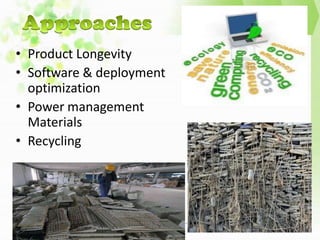
• Product Longevity
• Software & deployment
  optimization
• Power management
  Materials
• Recycling
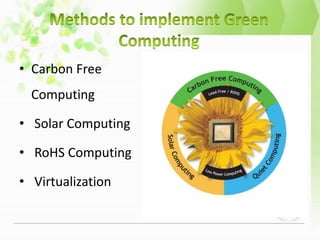
• Carbon Free
  Computing

• Solar Computing

• RoHS Computing

• Virtualization
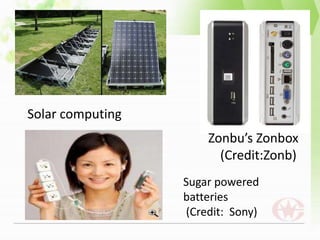
Solar computing
                      Zonbu’s Zonbox
                        (Credit:Zonb)
                  Sugar powered
                  batteries
                  (Credit: Sony)
• Turn off the computer when not in
 use, even if just for an hour.

• Turn off the monitor when not in use (as
 opposed to running a screen saver).

• Use power saver mode.
• Use LCDs instead of CRTs as they are more
  power efficient.
• Use hardware/software with the Energy Star
  label.
• Don’t print unless required.
• Choose Intel & VIA Processors in comparison
  to AMD Processors.
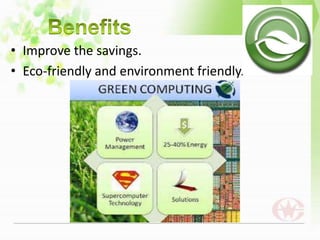
• Improve the savings.
• Eco-friendly and environment friendly.
• www.HowStuffWorks.com

• www.google.com

• www.wikipedia.com
the difference between
     the impossible and
     the possible lies in
 the persons determination
Green computing 1

Green computing 1

  • 1.
    Submitted by :- SALMANKHAN.J VENKATESAN.R salmantoy@gmail.com venkattoy@gmail.com
  • 2.
    • Also calledas Green IT. • It is an environmental friendly IT where the main objective is to reduce the hazardous materials and maximize the energy efficiency . • Reduce the power consumption and thus reduce the global warming.
  • 3.
    Computer consumes a lot of energy. • Printing often unnecessary stuff is waste. • Reduce pollution. • Toxicity.
  • 4.
    • It originatedin 1992 at the U.S Environmental Protection Agency that launched Energy Star program. • Shortly after that the term “Green Computing “ was coined. • Shortly after that the Swedish also launched the TCO Certification.
  • 5.
    • CPU uses120 Watts. • CRT uses 150 Watts. Energy use comes from  electrical current to run the CPU, motherboard, memory  running the fan and spinning the disk(s)  monitor (CRTs consume more power than any other computer component)  printers
  • 6.
    The following arethe pathways to green computing: • Green Use • Green Disposal • Green Design • Green Manufacturing
  • 7.
    • Product Longevity •Software & deployment optimization • Power management Materials • Recycling
  • 8.
    • Carbon Free Computing • Solar Computing • RoHS Computing • Virtualization
  • 9.
    Solar computing Zonbu’s Zonbox (Credit:Zonb) Sugar powered batteries (Credit: Sony)
  • 10.
    • Turn offthe computer when not in use, even if just for an hour. • Turn off the monitor when not in use (as opposed to running a screen saver). • Use power saver mode.
  • 11.
    • Use LCDsinstead of CRTs as they are more power efficient. • Use hardware/software with the Energy Star label. • Don’t print unless required. • Choose Intel & VIA Processors in comparison to AMD Processors.
  • 12.
    • Improve thesavings. • Eco-friendly and environment friendly.
  • 13.
  • 14.
    the difference between the impossible and the possible lies in the persons determination