FOLK SONGS : THE
ORIGINAL EXPRESSION OF
THE GREEK SOUL.
Just a few words…
WHAT IS A FOLK SONG ?
 It is an oral creation by an unknown artist which is
corrected, completed and handed down, by word of
mouth, from generation to generation, changing as it
does so.
 It is the expression of the people in rural areas.
 It is the first, major landmark of Modern Literature.
THE CREATION OF THE FOLK SONG
 A gifted person, in the right emotional state, creates a
song in which he or she may add music of his own
device or otherwise fit the song to an already existing
tune.
 This song is then heard by someone else who relates
to it, he or she then repeats it, makes their own
changes and in this way the song becomes public
property.
 Nicholas Politis is considered to be the father of folk
song, being the first scholar who studied it in depth.
THE ORIGINS OF FOLK SONGS
 The issue of the origin of folk songs was first
introduced in the pre-revolutionary period, when
the cause for national liberation from the
Ottoman Empire was looking for grounds on
which to base the claim of the cultural continuity
of Hellenism.
 Folk songs are undoubtedly rooted in Homeric
times, more specifically the pre-Homeric years,
although the relationship of these songs to
antiquity is not yet quite clear.
A BRIEF CHRONOLOGY OF FOLK CREATIVITY
 The folk song did not flourish in Ancient Greece . It also faded and
disappeared in the classical and post-classical Greece.
 It flourished in Byzantine times in the form of the songs of the
frontier guards defending the eastern borders of the Byzantine
Empire (Acritic Songs), as well as in the Ottoman period.
 After the liberation of Greece from the Ottoman Empire, the new
songs imitate older ones and are limited in number.
 In the 19th century the heroic song becomes predominant.
 In the 20th century the folk song gives way to the rebetiko song
and after World War II it celebrates Greek Resistance against the
Germans.
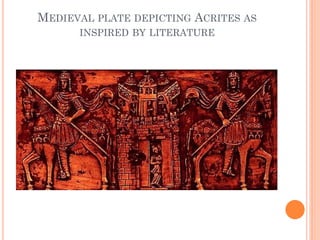
MEDIEVAL PLATE DEPICTING ACRITES AS
INSPIRED BY LITERATURE
THE VALUE OF THE FOLK SONG
 Aesthetic and anthropological value: emotions are pretty
forward and songs describe simple situations. The language is
simple, lyrical and moving.
 Linguistic value: verb phrases are prominent and the
language is natural and lively giving the song an air of
innocence and naiveté.
 Cultural value: It reveals the personality of the creators
depicting the details of their daily life: their anxieties, their
passions, their behaviour as well as the customs and
traditions of past centuries .
 Historical value: through folk songs, we learn about
Byzantine times (Acritic songs), about the dark times of
slavery after the conquest of Constantinople, about the
hardships the Greeks faced during the Ottoman rule, about
their struggle for freedom.
TECHNIQUES AND STYLE IN FOLK SONGS
 1. Metric form of verse / The law of isometry
 2. Rhyme
 3. Repetition
 4. A preference for the number 3
 5. Symbols
 6. Metaphors
 7. Allegory
 8. Emphatic structures
 9. The use of Dialogue
 10. Hyperbole
 11. Use of certain archaic techniques
 12. Pointless questions
 13. Simplicity of expressive means
 14. Simplicity in storytelling
 15.Giving human form to the natural / animal world
(anthropomorphism)
WOMEN IN FOLK SONGS
 Akritic songs: in the borders of Byzantium, it is evident
that female figures were rare, only portrayed in connection
to the courage and bravery of Akritas (a frontier guard
defending the eastern borders of the Byzantine Empire).
 Historical songs: the role of women is limited here, since
these are accounts of enemies in captivity and the struggle
for freedom.
 In general, the female image is controversial, since she is
presented as subservient to her husband and
spineless.
 There are also cases of the representation of evil and
scheming women at the side of weak and unsuspecting
husbands.
THE MONTHS AND THE SEASONS IN FOLK SONGS
 Changes in seasons and weather conditions
generally affect every aspect of the natural as
well as the animal world.
 Each season has special significance both for
nature and for humans.
 In almost all of our folk songs, from the simple
lullaby to the song of love, as well as in the
most unsettling laments, the months and the
seasons of the year are ever present.
FOLK SONG AND CONTEMPORARY POETRY
 Although the folk song as a work of art is considered obsolete
because our time has pushed it aside in the archives of history,
a brief glimpse at contemporary poetry can actually reveal its
central position .
 Many contemporary poets such as
 Yiannis Ritsos
 Odysseas Elytis and
 Nikos Engonopoulos
have been inspired by folk songs.
 The above brief reference to contemporary poets shows that
modern poetry, regardless of fashions, schools, styles and
periods, draws its themes, rhythm, techniques, imagery and
expressive means from the rich resource of folk tradition.
THE RELATIONSHIP BETWEEN YOUNG PEOPLE AND FOLK SONGS
 Certain types of folk songs with timeless character never
stopped being sung in Greece from antiquity until today,
especially when they are interwoven with the everyday life
(weddings, births, immigration and longing for one’s home, etc...)
 But in the era of globalization, in this fast changing world, the
relationship between young people and folk song is not like it
used to be. In the past folk songs were a means of expressing
emotions and having fun .They were performed mostly at
festivals in order to accompany dancing.
 Today young people are not interested in folk songs and the only
way to change the present situation is by encouraging them to
take part in folk dance groups and events. Today, young people
prefer foreign songs because they go hand in hand with fashion
and are part of the new global era.
CONCLUSION
 Folk songs are an integral part of everyday life of Greeks and
reflect the values ​​and experience of Greek folk culture.
 Their birth is lost in the mists of time and are the product of
diverse and timeless creativity. They begin at pre-Homeric
years and continue to this day. They are associated with
standard techniques which is why they share characteristics.
 The value of folksongs lies in that they help preserve and
pass down from generation to generation, the
accomplishments of a people’s ancestors and the history of
their culture.
 They are characterized by simplicity of expressive and
narrative means, make wide use of hyperbole and
anthropomorphism while building something intensely
dramatic.

Greek folk songs overview (comenius)

  • 1.
    FOLK SONGS :THE ORIGINAL EXPRESSION OF THE GREEK SOUL. Just a few words…
  • 2.
    WHAT IS AFOLK SONG ?  It is an oral creation by an unknown artist which is corrected, completed and handed down, by word of mouth, from generation to generation, changing as it does so.  It is the expression of the people in rural areas.  It is the first, major landmark of Modern Literature.
  • 3.
    THE CREATION OFTHE FOLK SONG  A gifted person, in the right emotional state, creates a song in which he or she may add music of his own device or otherwise fit the song to an already existing tune.  This song is then heard by someone else who relates to it, he or she then repeats it, makes their own changes and in this way the song becomes public property.  Nicholas Politis is considered to be the father of folk song, being the first scholar who studied it in depth.
  • 4.
    THE ORIGINS OFFOLK SONGS  The issue of the origin of folk songs was first introduced in the pre-revolutionary period, when the cause for national liberation from the Ottoman Empire was looking for grounds on which to base the claim of the cultural continuity of Hellenism.  Folk songs are undoubtedly rooted in Homeric times, more specifically the pre-Homeric years, although the relationship of these songs to antiquity is not yet quite clear.
  • 5.
    A BRIEF CHRONOLOGYOF FOLK CREATIVITY  The folk song did not flourish in Ancient Greece . It also faded and disappeared in the classical and post-classical Greece.  It flourished in Byzantine times in the form of the songs of the frontier guards defending the eastern borders of the Byzantine Empire (Acritic Songs), as well as in the Ottoman period.  After the liberation of Greece from the Ottoman Empire, the new songs imitate older ones and are limited in number.  In the 19th century the heroic song becomes predominant.  In the 20th century the folk song gives way to the rebetiko song and after World War II it celebrates Greek Resistance against the Germans.
  • 6.
    MEDIEVAL PLATE DEPICTINGACRITES AS INSPIRED BY LITERATURE
  • 7.
    THE VALUE OFTHE FOLK SONG  Aesthetic and anthropological value: emotions are pretty forward and songs describe simple situations. The language is simple, lyrical and moving.  Linguistic value: verb phrases are prominent and the language is natural and lively giving the song an air of innocence and naiveté.  Cultural value: It reveals the personality of the creators depicting the details of their daily life: their anxieties, their passions, their behaviour as well as the customs and traditions of past centuries .  Historical value: through folk songs, we learn about Byzantine times (Acritic songs), about the dark times of slavery after the conquest of Constantinople, about the hardships the Greeks faced during the Ottoman rule, about their struggle for freedom.
  • 8.
    TECHNIQUES AND STYLEIN FOLK SONGS  1. Metric form of verse / The law of isometry  2. Rhyme  3. Repetition  4. A preference for the number 3  5. Symbols  6. Metaphors  7. Allegory  8. Emphatic structures  9. The use of Dialogue  10. Hyperbole  11. Use of certain archaic techniques  12. Pointless questions  13. Simplicity of expressive means  14. Simplicity in storytelling  15.Giving human form to the natural / animal world (anthropomorphism)
  • 9.
    WOMEN IN FOLKSONGS  Akritic songs: in the borders of Byzantium, it is evident that female figures were rare, only portrayed in connection to the courage and bravery of Akritas (a frontier guard defending the eastern borders of the Byzantine Empire).  Historical songs: the role of women is limited here, since these are accounts of enemies in captivity and the struggle for freedom.  In general, the female image is controversial, since she is presented as subservient to her husband and spineless.  There are also cases of the representation of evil and scheming women at the side of weak and unsuspecting husbands.
  • 10.
    THE MONTHS ANDTHE SEASONS IN FOLK SONGS  Changes in seasons and weather conditions generally affect every aspect of the natural as well as the animal world.  Each season has special significance both for nature and for humans.  In almost all of our folk songs, from the simple lullaby to the song of love, as well as in the most unsettling laments, the months and the seasons of the year are ever present.
  • 11.
    FOLK SONG ANDCONTEMPORARY POETRY  Although the folk song as a work of art is considered obsolete because our time has pushed it aside in the archives of history, a brief glimpse at contemporary poetry can actually reveal its central position .  Many contemporary poets such as  Yiannis Ritsos  Odysseas Elytis and  Nikos Engonopoulos have been inspired by folk songs.  The above brief reference to contemporary poets shows that modern poetry, regardless of fashions, schools, styles and periods, draws its themes, rhythm, techniques, imagery and expressive means from the rich resource of folk tradition.
  • 12.
    THE RELATIONSHIP BETWEENYOUNG PEOPLE AND FOLK SONGS  Certain types of folk songs with timeless character never stopped being sung in Greece from antiquity until today, especially when they are interwoven with the everyday life (weddings, births, immigration and longing for one’s home, etc...)  But in the era of globalization, in this fast changing world, the relationship between young people and folk song is not like it used to be. In the past folk songs were a means of expressing emotions and having fun .They were performed mostly at festivals in order to accompany dancing.  Today young people are not interested in folk songs and the only way to change the present situation is by encouraging them to take part in folk dance groups and events. Today, young people prefer foreign songs because they go hand in hand with fashion and are part of the new global era.
  • 13.
    CONCLUSION  Folk songsare an integral part of everyday life of Greeks and reflect the values ​​and experience of Greek folk culture.  Their birth is lost in the mists of time and are the product of diverse and timeless creativity. They begin at pre-Homeric years and continue to this day. They are associated with standard techniques which is why they share characteristics.  The value of folksongs lies in that they help preserve and pass down from generation to generation, the accomplishments of a people’s ancestors and the history of their culture.  They are characterized by simplicity of expressive and narrative means, make wide use of hyperbole and anthropomorphism while building something intensely dramatic.