Gravitation
Gravitation isa fundamental force of nature that
causes attraction between objects having mass. It
plays a vital role in holding objects on the Earth
and controlling the motion of planets and
satellites. This force acts throughout the
universe. Without gravitation, the structure of
the universe would not exist.
2.
Introduction to Gravitation
Gravitation is the force by which the Earth
attracts all objects towards its center. This force
exists between all objects, whether small or
large. Although gravitation is a weak force, its
effect becomes significant when large masses are
involved. Many natural events depend on this
force.
3.
Universal Law ofGravitation
The Universal Law of Gravitation states that
every object in the universe attracts every other
object with a force. This force depends on the
masses of the objects and the distance between
them. The law was given by Sir Isaac Newton. It
applies equally to objects on Earth and in space.
4.
Mathematical Form ofthe Law
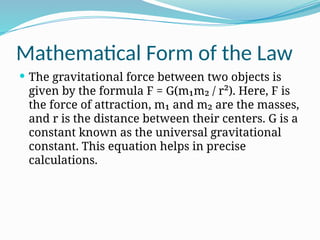
The gravitational force between two objects is
given by the formula F = G(m₁m₂ / r²). Here, F is
the force of attraction, m₁ and m₂ are the masses,
and r is the distance between their centers. G is a
constant known as the universal gravitational
constant. This equation helps in precise
calculations.
5.
Free Fall
Whenan object falls towards the Earth under the
influence of gravity alone, it is said to be in free
fall. During free fall, no other force acts on the
object except gravity. All objects fall with the
same acceleration. Air resistance is ignored in
ideal conditions.
6.
Acceleration Due toGravity
The acceleration gained by an object during free
fall due to Earth’s gravity is called acceleration
due to gravity. It is represented by the symbol g.
Its value near the Earth’s surface is
approximately 9.8 m/s². The direction of this
acceleration is always towards the center of the
Earth.
7.
Mass and Weight
Mass is the quantity of matter present in an
object and remains constant everywhere. Weight
is the force exerted by gravity on an object and
varies from place to place. Weight depends on
the value of gravitational acceleration. The
relation between mass and weight is given by W
= mg.
8.
Thrust and Pressure
Thrust is the force acting on a surface in a
perpendicular direction. Pressure is defined as
the thrust acting per unit area. When force is
applied on a smaller area, pressure increases.
This explains why sharp objects can cut more
easily than blunt ones.