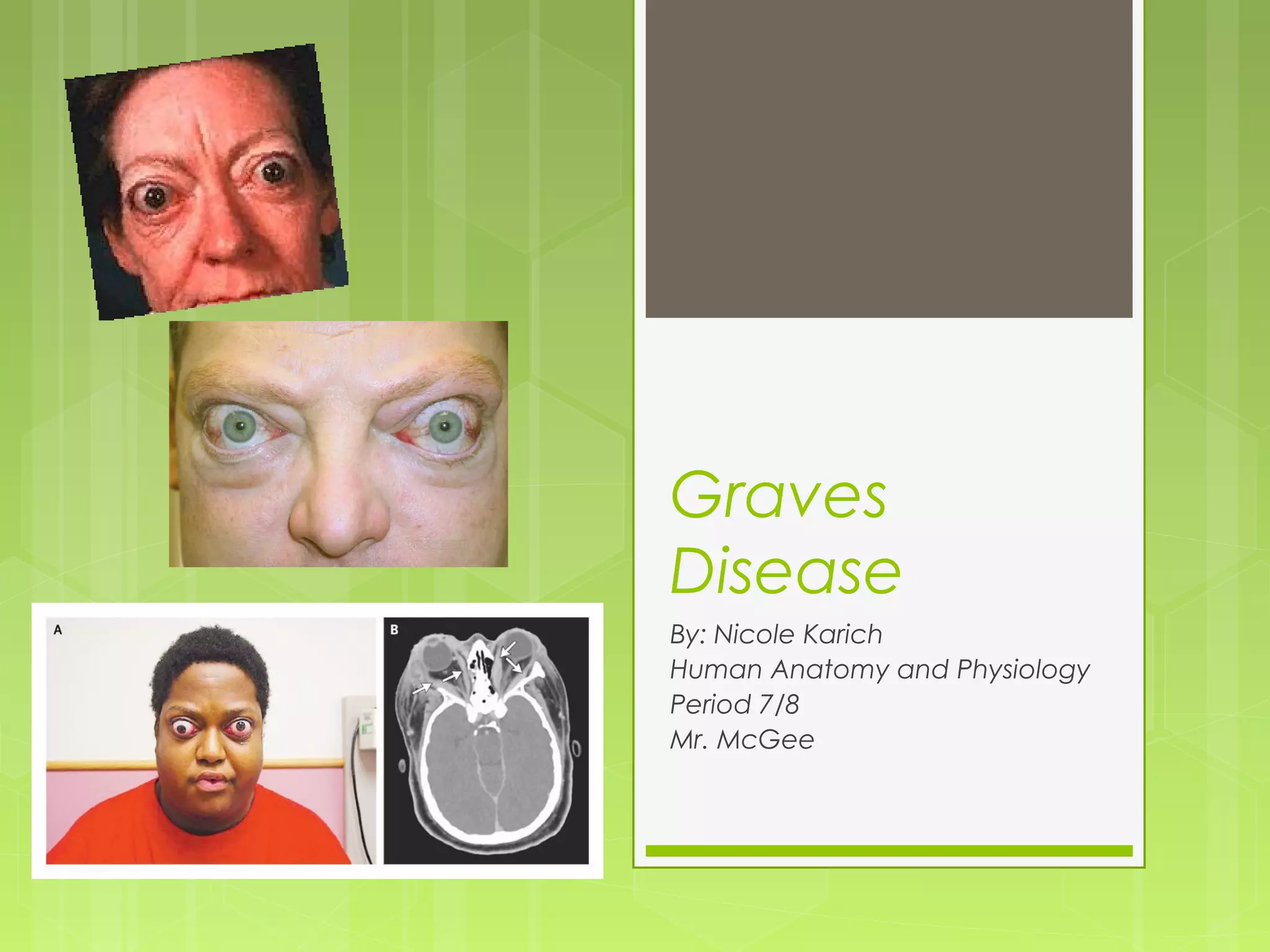
Graves
Disease
By: Nicole Karich
Human Anatomy and Physiology
Period 7/8
Mr. McGee
Diagnosis
 Graves   Disease is an autoimmune disorder
  that leads to over activity of the thyroid
  gland (hyperthyroidism)
 It is most common in women over age 20
  but can effect either gender at any age
Symptoms
•   Anxiety                      •   Insomnia
•   Breast enlargement in men    •   Irregular menstrual periods
•   Difficulty concentrating         in women
•   Double vision                •   Muscle weakness
•   Eyeballs that stick out      •   Nervousness
    (exophthalmos)
•   Eye irritation and tearing   •   Rapid/irregular heartbeat
•   Fatigue                          (palpitations or arhythmia)
•   Frequent bowel movements     •   Restlessness or difficulty
•   Goiter                           sleeping
•   Heart intolerance            •   Shortness of breath with
•   Increased appetite               activity
•   Increased sweating           •   Tremor
                                 •   Weight loss
Causes
•   Abnormal immune system response that
    causes thyroid gland to produce too
    much thyroid hormone (hyperthyroidism)
•   Normally, thyroid gets production orders
    through TSH (thyroid-stimulating chemical)
    released by the pituitary gland, but in
    Graves Disease, a malfunction in the
    body’s immune system releases abnormal
    antibodies that mimic TSH
Treatments
• Beta blockers such as propanolol (treat rapid
  heart rate, sweating, and anxiety)
• To treat hyperthyroidism:
-Antithyroid medications
-Radioactive iodine
-Surgery
**using radiation or surgery will require you to
  take replacement thyroid hormones for the
  rest of your life because these treatments
  destroy the gland
Prognosis
 This  disease usually responds to treatment.
  However, sometimes radiation or surgery
  will lead to hypothyroidism which can
  lead to depression, mental/physical
  sluggishness, or weight gain if the dose of
  replacement thyroid hormone is not
  correct
Bibliography
   Board, A.D.A.M. Editorial. "Graves Disease." PubMed
    Health. U.S. National Library of Medicine, 4 June 2012.
    Web. 25 Mar. 2013.
    http://www.ncbi.nlm.nih.gov/pubmedhealth/PMH00013
    98/.


   Seibel, John A., MD. "Graves' Disease Symptoms and
    Causes." WebMD. WebMD, 19 Mar. 2012. Web. 25 Mar.
    2013. http://www.webmd.com/a-to-z-
    guides/understanding-graves-disease-basics.

Graves disease

  • 1.
    Graves Disease By: Nicole Karich HumanAnatomy and Physiology Period 7/8 Mr. McGee
  • 2.
    Diagnosis  Graves Disease is an autoimmune disorder that leads to over activity of the thyroid gland (hyperthyroidism)  It is most common in women over age 20 but can effect either gender at any age
  • 3.
    Symptoms • Anxiety • Insomnia • Breast enlargement in men • Irregular menstrual periods • Difficulty concentrating in women • Double vision • Muscle weakness • Eyeballs that stick out • Nervousness (exophthalmos) • Eye irritation and tearing • Rapid/irregular heartbeat • Fatigue (palpitations or arhythmia) • Frequent bowel movements • Restlessness or difficulty • Goiter sleeping • Heart intolerance • Shortness of breath with • Increased appetite activity • Increased sweating • Tremor • Weight loss
  • 4.
    Causes • Abnormal immune system response that causes thyroid gland to produce too much thyroid hormone (hyperthyroidism) • Normally, thyroid gets production orders through TSH (thyroid-stimulating chemical) released by the pituitary gland, but in Graves Disease, a malfunction in the body’s immune system releases abnormal antibodies that mimic TSH
  • 5.
    Treatments • Beta blockerssuch as propanolol (treat rapid heart rate, sweating, and anxiety) • To treat hyperthyroidism: -Antithyroid medications -Radioactive iodine -Surgery **using radiation or surgery will require you to take replacement thyroid hormones for the rest of your life because these treatments destroy the gland
  • 6.
    Prognosis  This disease usually responds to treatment. However, sometimes radiation or surgery will lead to hypothyroidism which can lead to depression, mental/physical sluggishness, or weight gain if the dose of replacement thyroid hormone is not correct
  • 7.
    Bibliography  Board, A.D.A.M. Editorial. "Graves Disease." PubMed Health. U.S. National Library of Medicine, 4 June 2012. Web. 25 Mar. 2013. http://www.ncbi.nlm.nih.gov/pubmedhealth/PMH00013 98/.  Seibel, John A., MD. "Graves' Disease Symptoms and Causes." WebMD. WebMD, 19 Mar. 2012. Web. 25 Mar. 2013. http://www.webmd.com/a-to-z- guides/understanding-graves-disease-basics.