GraphQL - when REST
API is not enough -
lessons learned
Marcin Stachniuk
Marcin Stachniuk
stachniuk.com
/mstachniuk/graphql-java-example
@MarcinStachniuk
wroclaw.jug.pl
shipkit.org
Who is using REST?
@MarcinStachniukGraphQL - when REST API is not enough - lessons learned
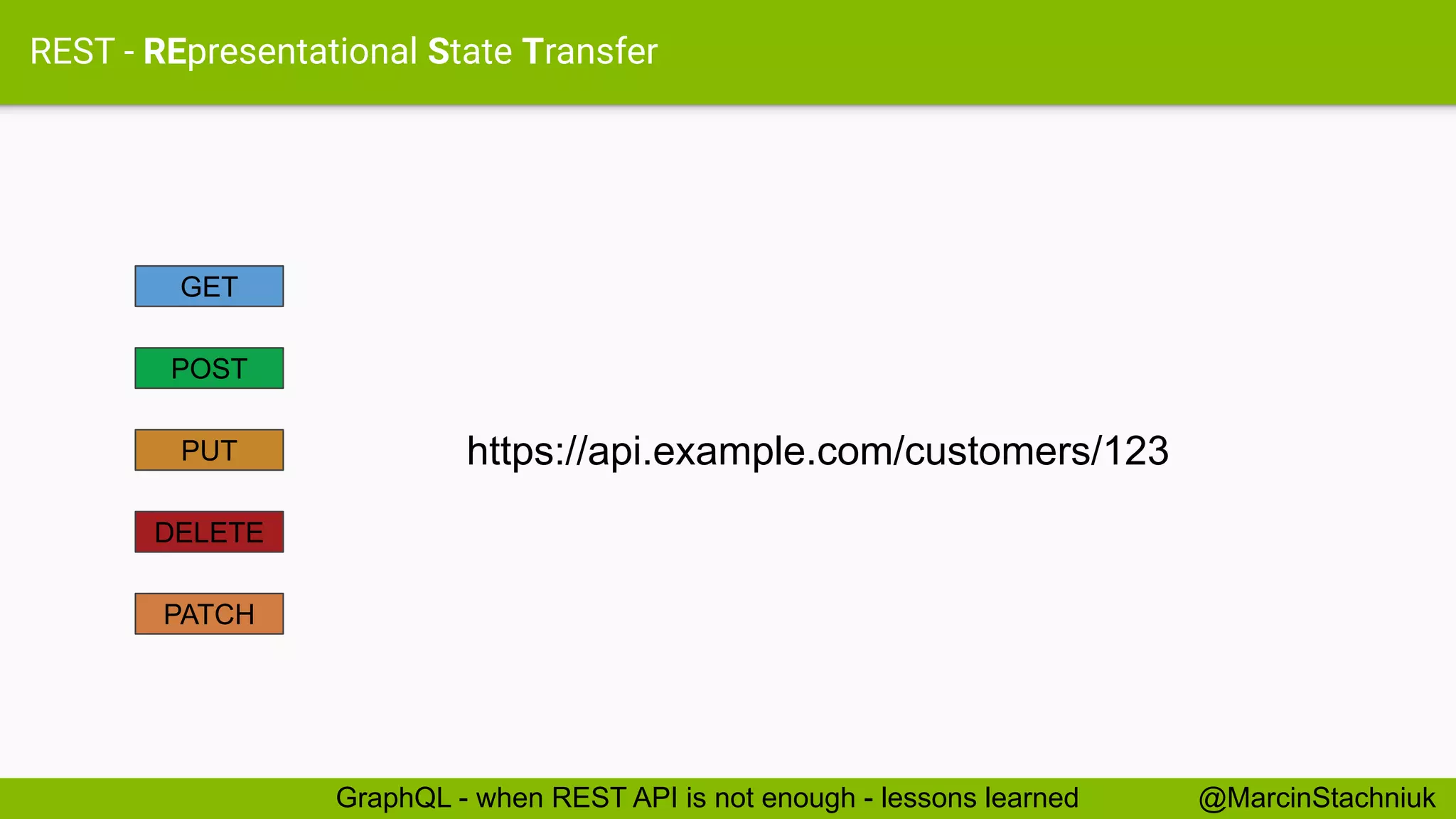
REST - REpresentational State Transfer
https://api.example.com/customers/123
DELETE
PUT
POST
GET
PATCH
@MarcinStachniukGraphQL - when REST API is not enough - lessons learned
REST fixed response
GET /customers/111
{
"customer": {
"id": "111",
"name": "John Doe",
"email": "john@doe.com",
"company": {
"id": "222"
},
"orders": [
{
"id": "333"
},
{
"id": "444"
}
]
}
}
{
"customer": {
"id": "111",
"name": "John Doe",
"email": "john@doe.com",
"company": {
"href": "https://api.example.com/companies/222"
},
"orders": [
{
"href": "https://api.example.com/orders/333"
},
{
"href": "https://api.example.com/orders/444"
}
]
}
}
RE
ST
@MarcinStachniukGraphQL - when REST API is not enough - lessons learned
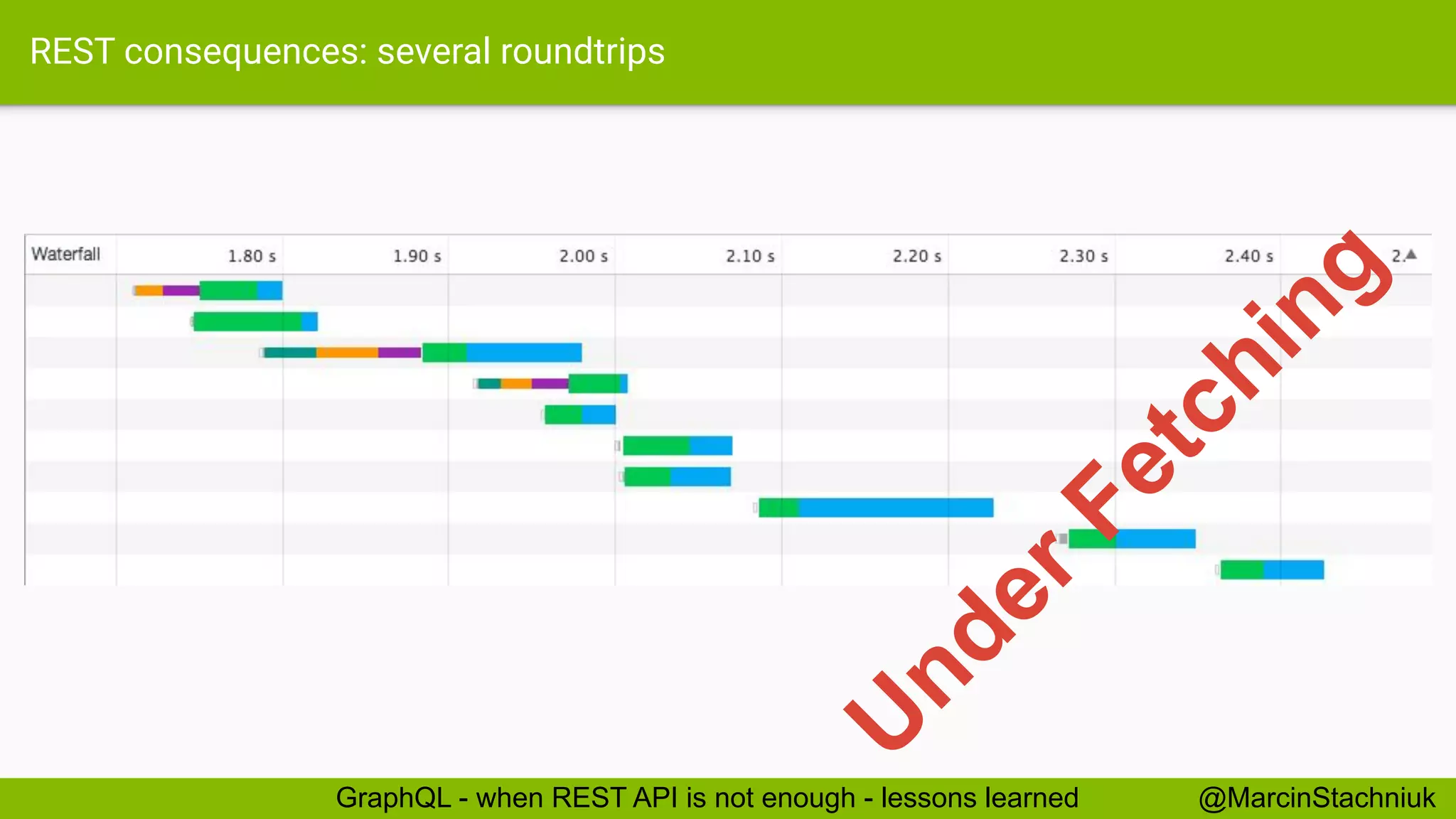
REST consequences: several roundtrips
@MarcinStachniukGraphQL - when REST API is not enough - lessons learned
U
nderFetching
REST response with nested data
GET /customers/111
{
"customer": {
"id": "111",
"name": "John Doe",
"email": "john@doe.com",
"company": {
"id": "222",
"name": "My Awesome Corporation",
"website": "MyAwesomeCorporation.com"
},
"orders": [
{
"id": "333",
"status": "delivered",
"items": [
{
"id": "555",
"name": "Silver Bullet",
"amount": "42",
"price": "10000000",
"currency": "USD",
"producer": {
"id": "777",
"name": "Lorem Ipsum",
"website": "LoremIpsum.com"
}
}
]
},
{
"id": "444",
"name": "Golden Hammer",
"amount": "5",
"price": "10000",
"currency": "USD",
"producer": {
...
}
}
] } }
RE
ST
@MarcinStachniukGraphQL - when REST API is not enough - lessons learned
O
verFetching
REST response with nested data and limit fields
GET /customers/111?fields=name,company/*,orders.status,orders.items(name,producer/name)
{
"customer": {
"id": "111",
"name": "John Doe",
"email": "john@doe.com",
"company": {
"id": "222",
"name": "My Awesome Corporation",
"website": "MyAwesomeCorporation.com"
},
"orders": [
{
"id": "333",
"status": "delivered",
"items": [
{
"id": "555",
"name": "Silver Bullet",
"amount": "42",
"price": "10000000",
"currency": "USD",
"producer": {
"id": "777",
"name": "Lorem Ipsum",
"website": "LoremIpsum.com"
}
}
]
},
{
"id": "444",
"name": "Golden Hammer",
"amount": "5",
"price": "10000",
"currency": "USD",
"producer": {
...
}
}
] } }
RE
ST
@MarcinStachniukGraphQL - when REST API is not enough - lessons learned
REST response with projection
GET /customers/111?projection=customerPreview
{
"customer": {
"id": "111",
"name": "John Doe",
"email": "john@doe.com",
"company": {
"id": "222",
"name": "My Awesome Corporation",
"website": "MyAwesomeCorporation.com"
},
"orders": [
{
"id": "333",
"status": "delivered",
"items": [
{
"id": "555",
"name": "Silver Bullet",
"amount": "42",
"price": "10000000",
"currency": "USD",
"producer": {
"id": "777",
"name": "Lorem Ipsum",
"website": "LoremIpsum.com"
}
}
]
},
{
"id": "444",
"name": "Golden Hammer",
"amount": "5",
"price": "10000",
"currency": "USD",
"producer": {
...
}
}
] } }
RE
ST
@MarcinStachniukGraphQL - when REST API is not enough - lessons learned
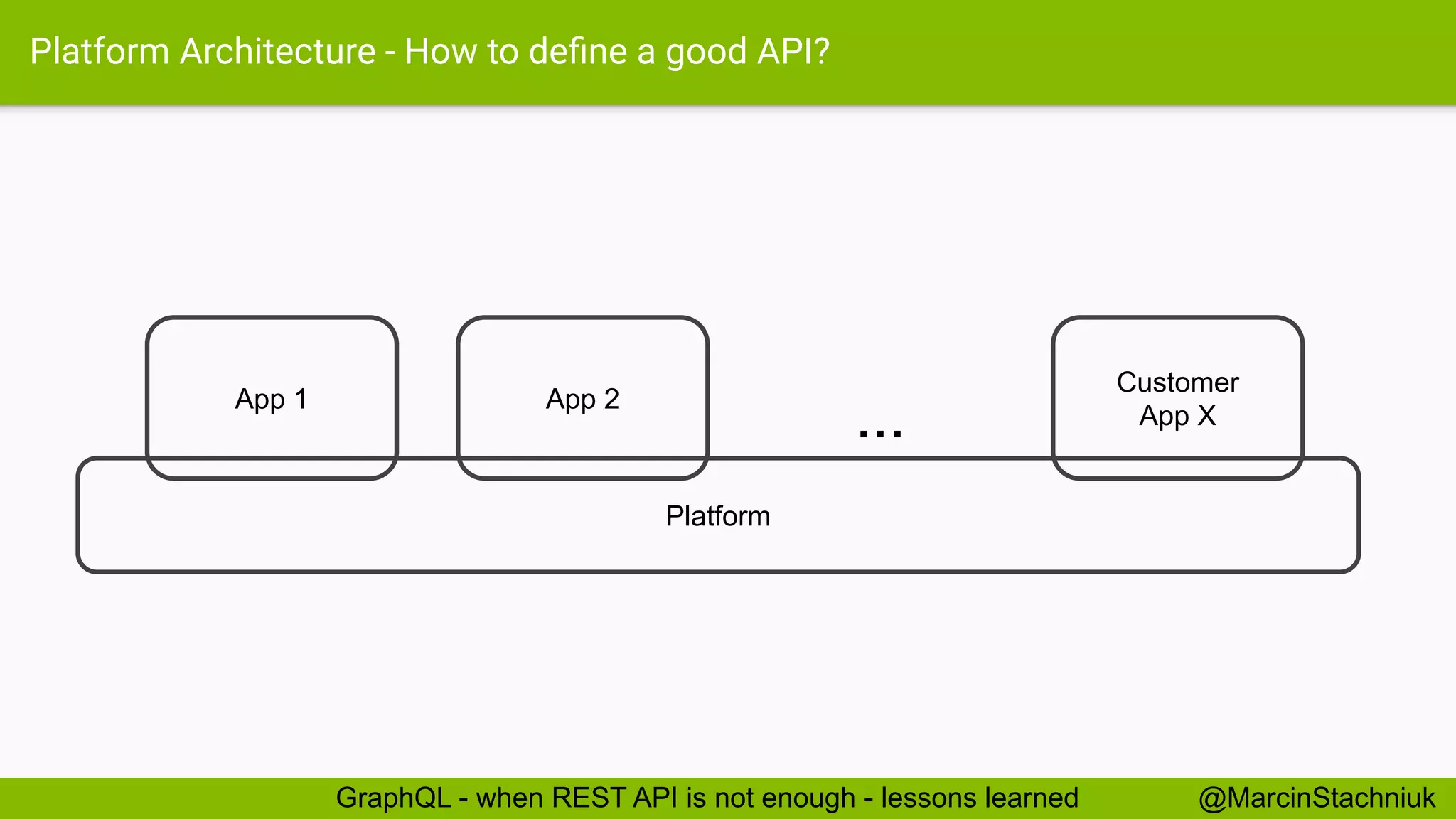
Platform Architecture - How to define a good API?
Platform
App 1 App 2
Customer
App X...
@MarcinStachniukGraphQL - when REST API is not enough - lessons learned
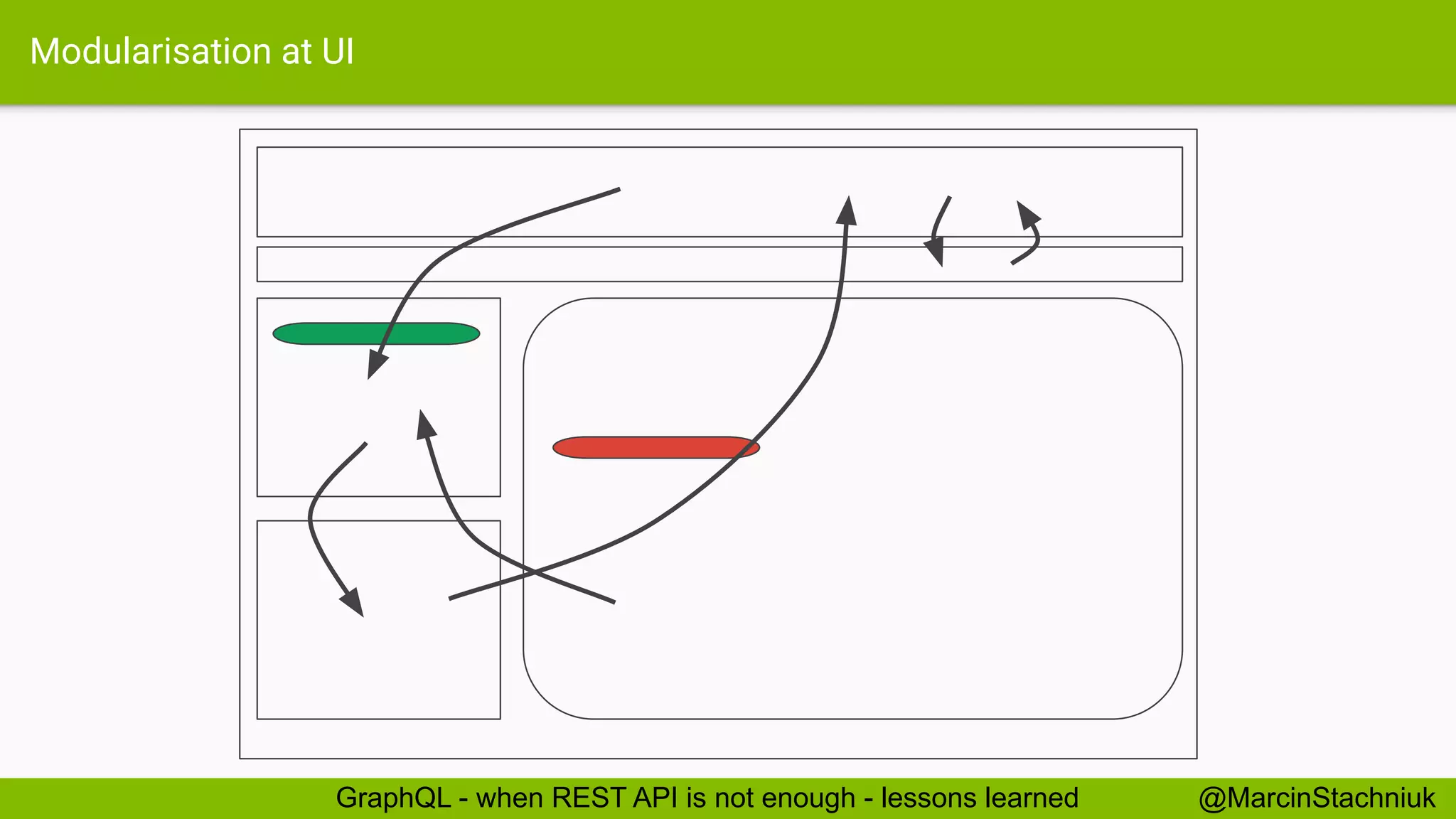
Modularisation at UI
@MarcinStachniukGraphQL - when REST API is not enough - lessons learned
New Frontend Framework
ReactJS
Relay GraphQL
TypeScript
@MarcinStachniukGraphQL - when REST API is not enough - lessons learned
GraphQL
● Graph Query Language
● Published by Facebook in 2015
● Growth from Facebook Graph API
● Reference implementation in JavaScript
● First version of Java Library: 18 Jul 2015
https://github.com/graphql-java/graphql-java
● First usage: 21 Sep 2015
@MarcinStachniukGraphQL - when REST API is not enough - lessons learned
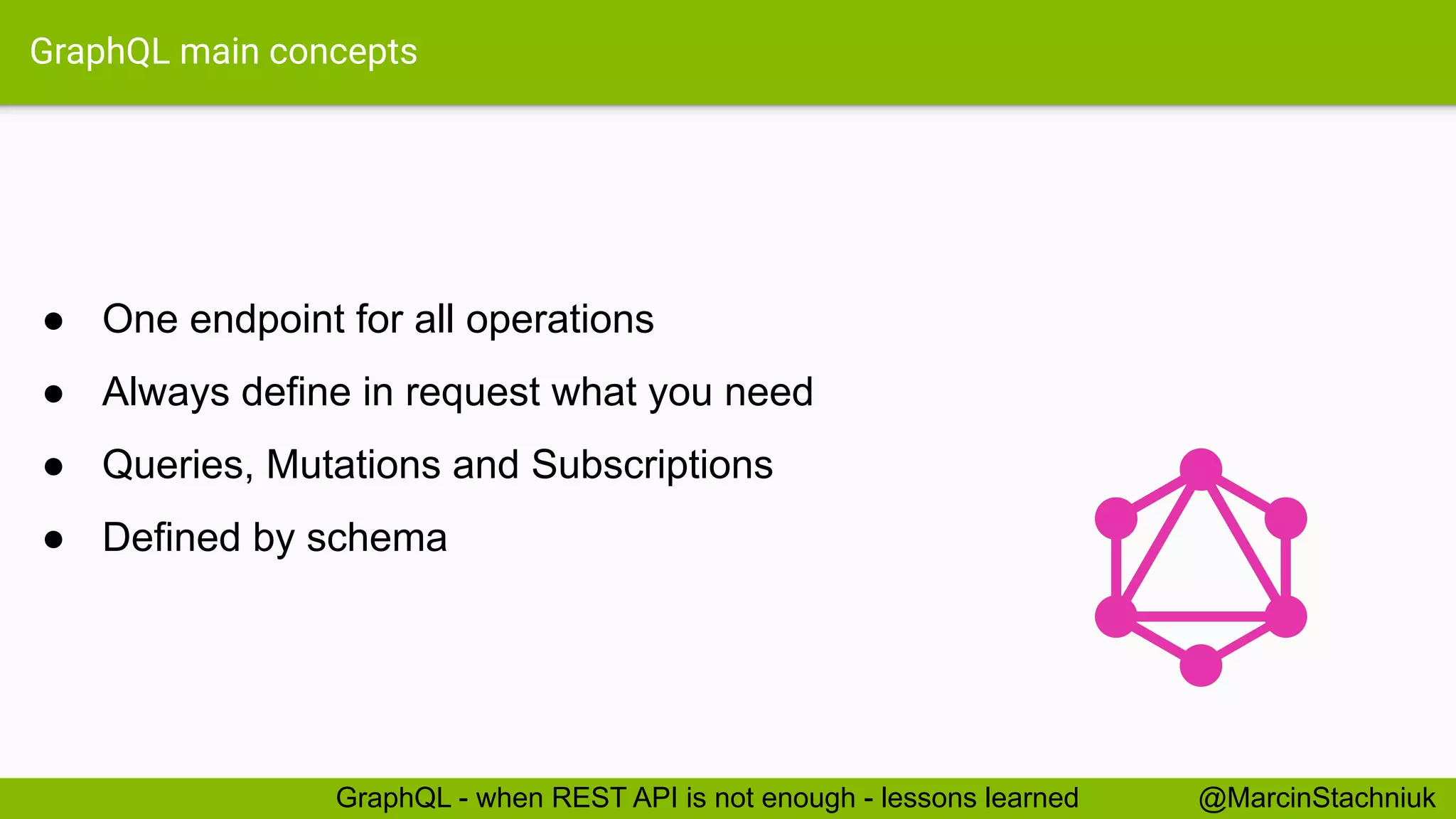
GraphQL main concepts
● One endpoint for all operations
● Always define in request what you need
● Queries, Mutations and Subscriptions
● Defined by schema
@MarcinStachniukGraphQL - when REST API is not enough - lessons learned
Data is a graph
@MarcinStachniukGraphQL - when REST API is not enough - lessons learned
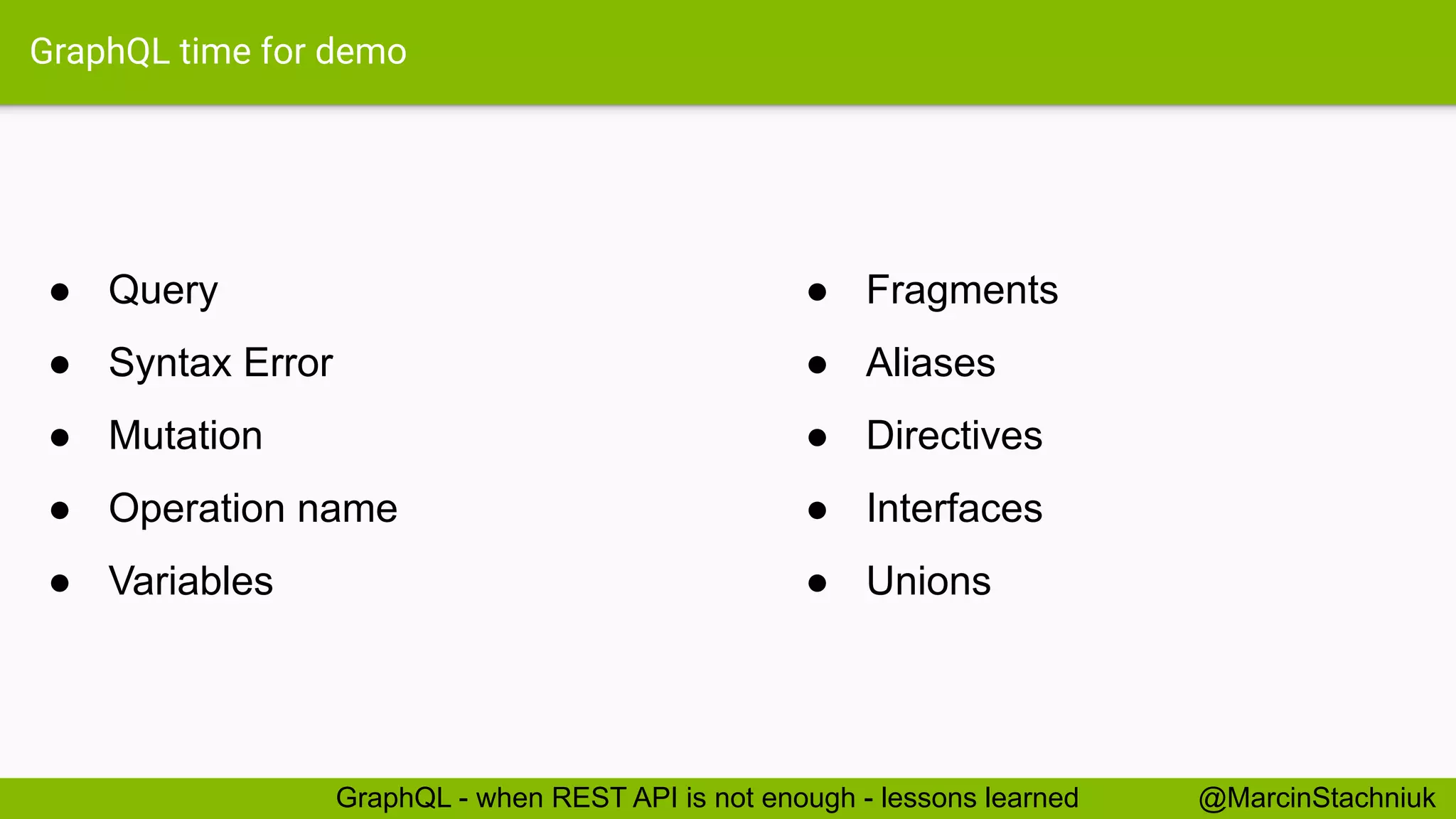
GraphQL time for demo
● Fragments
● Aliases
● Directives
● Interfaces
● Unions
@MarcinStachniukGraphQL - when REST API is not enough - lessons learned
● Query
● Syntax Error
● Mutation
● Operation name
● Variables
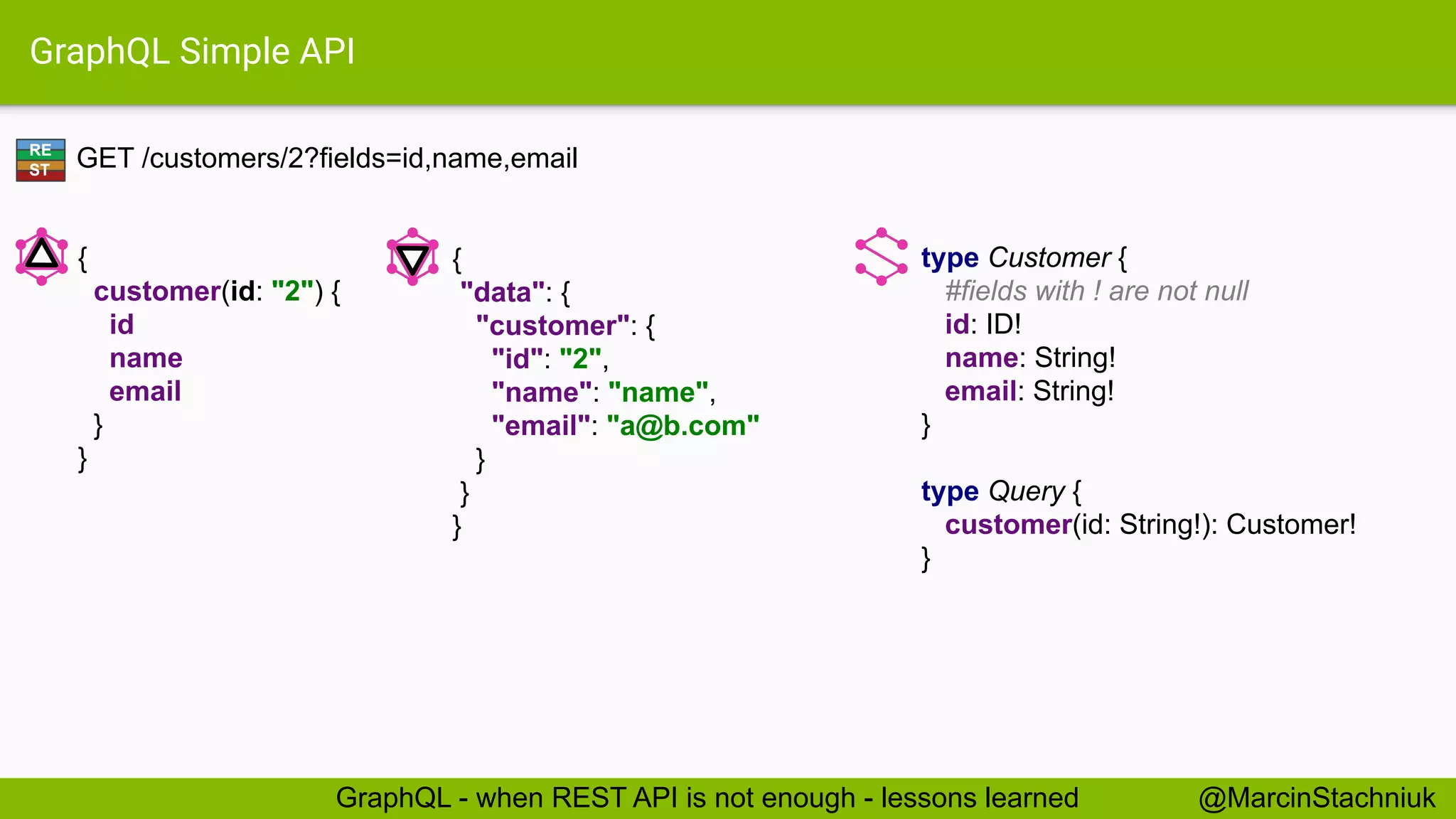
GraphQL Simple API
GET /customers/2?fields=id,name,email
type Customer {
#fields with ! are not null
id: ID!
name: String!
email: String!
}
type Query {
customer(id: String!): Customer!
}
{
"data": {
"customer": {
"id": "2",
"name": "name",
"email": "a@b.com"
}
}
}
{
customer(id: "2") {
id
name
email
}
}
RE
ST
@MarcinStachniukGraphQL - when REST API is not enough - lessons learned
GraphQL Bad Request
GET /custo!@#$ -> 404
{
"data": null,
"errors": [
{
"message": "Invalid Syntax",
"locations": [
{
"line": 2,
"column": 8
}
],
"errorType": "InvalidSyntax",
"path": null,
"extensions": null
} ] }
{
custo!@#$
}
RE
ST
http.cat/200
@MarcinStachniukGraphQL - when REST API is not enough - lessons learned
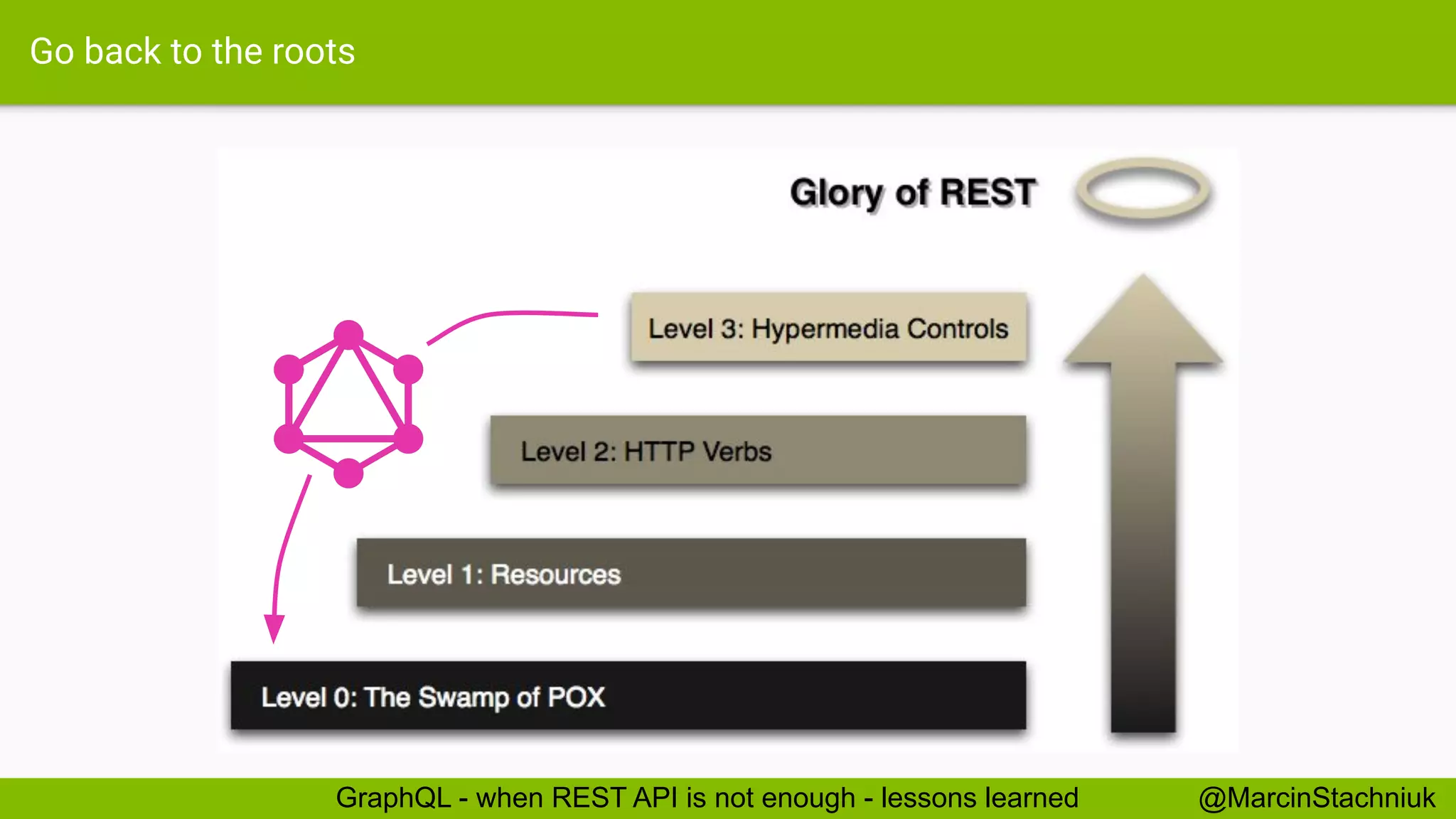
Go back to the roots
@MarcinStachniukGraphQL - when REST API is not enough - lessons learned
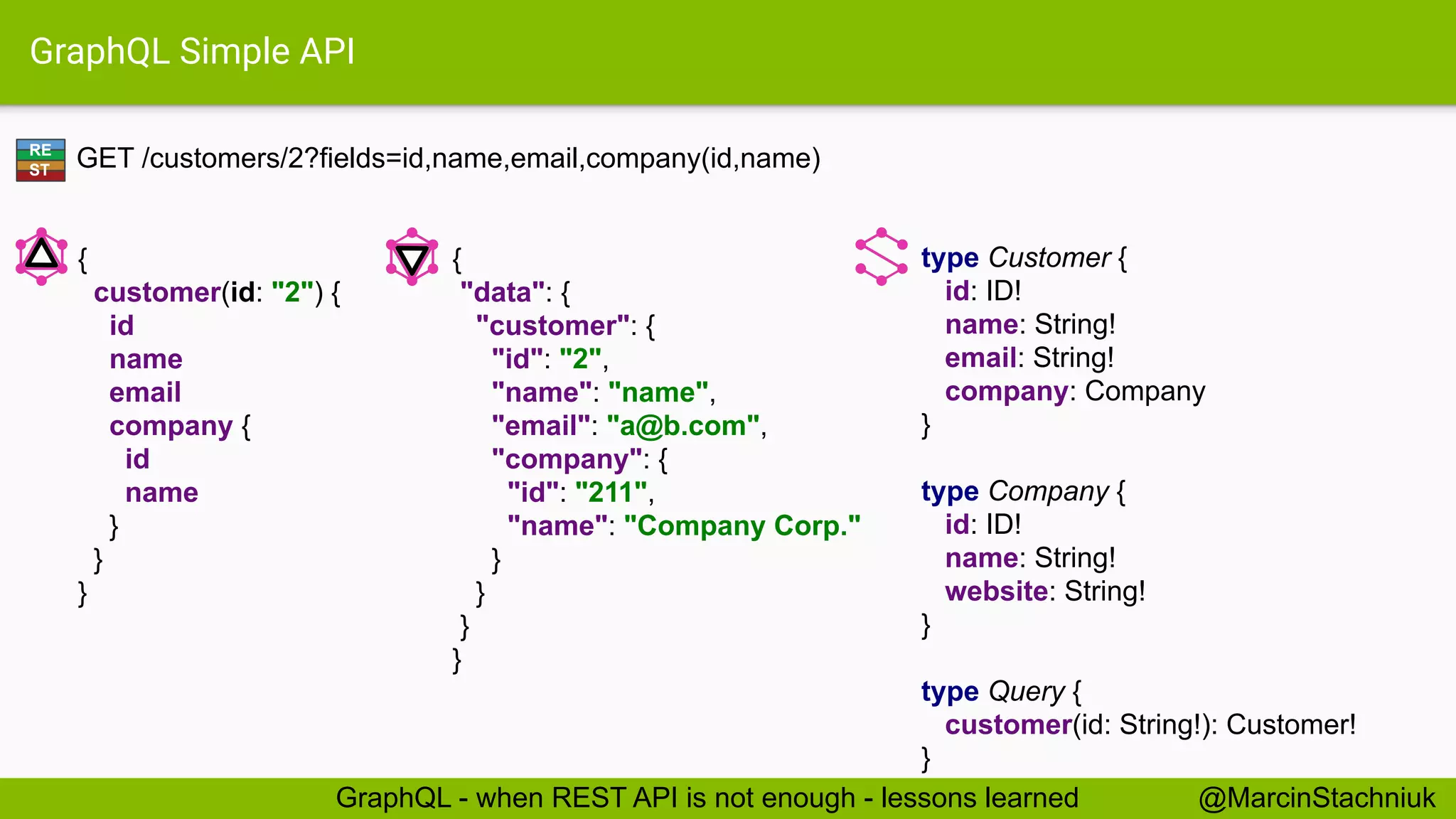
GraphQL Simple API
GET /customers/2?fields=id,name,email,company(id,name)
type Customer {
id: ID!
name: String!
email: String!
company: Company
}
type Company {
id: ID!
name: String!
website: String!
}
type Query {
customer(id: String!): Customer!
}
{
"data": {
"customer": {
"id": "2",
"name": "name",
"email": "a@b.com",
"company": {
"id": "211",
"name": "Company Corp."
}
}
}
}
{
customer(id: "2") {
id
name
email
company {
id
name
}
}
}
RE
ST
@MarcinStachniukGraphQL - when REST API is not enough - lessons learned
GraphQL Simple API
GET /customers/2?fields=id,name,email,orders(id,status)
type Customer {
id: ID!
name: String!
email: String!
company: Company
orders: [Order]
}
type Order {
id: ID!
status: Status
}
enum Status {
NEW, CANCELED, DONE
}
{
"data": {
"customer": {
"id": "2",
"name": "name",
"orders": [
{
"id": "55",
"status": "NEW"
},
{
"id": "66",
"status": "DONE"
}
] } } }
{
customer(id: "2") {
id
name
orders {
id
status
}
}
}
RE
ST
@MarcinStachniukGraphQL - when REST API is not enough - lessons learned
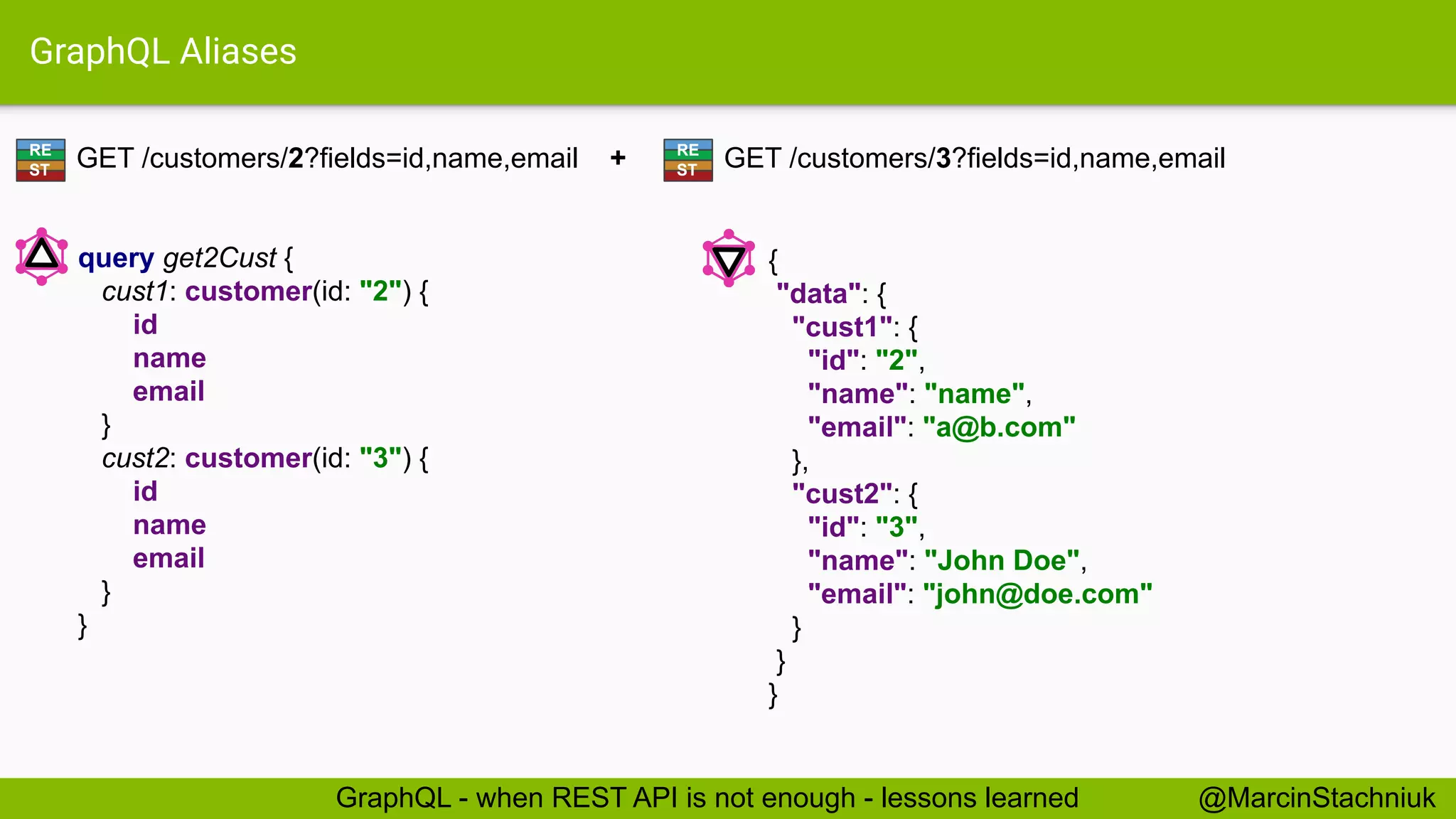
GraphQL Aliases
GET /customers/2?fields=id,name,email +
{
"data": {
"cust1": {
"id": "2",
"name": "name",
"email": "a@b.com"
},
"cust2": {
"id": "3",
"name": "John Doe",
"email": "john@doe.com"
}
}
}
query get2Cust {
cust1: customer(id: "2") {
id
name
email
}
cust2: customer(id: "3") {
id
name
email
}
}
RE
ST
@MarcinStachniukGraphQL - when REST API is not enough - lessons learned
GET /customers/3?fields=id,name,emailRE
ST
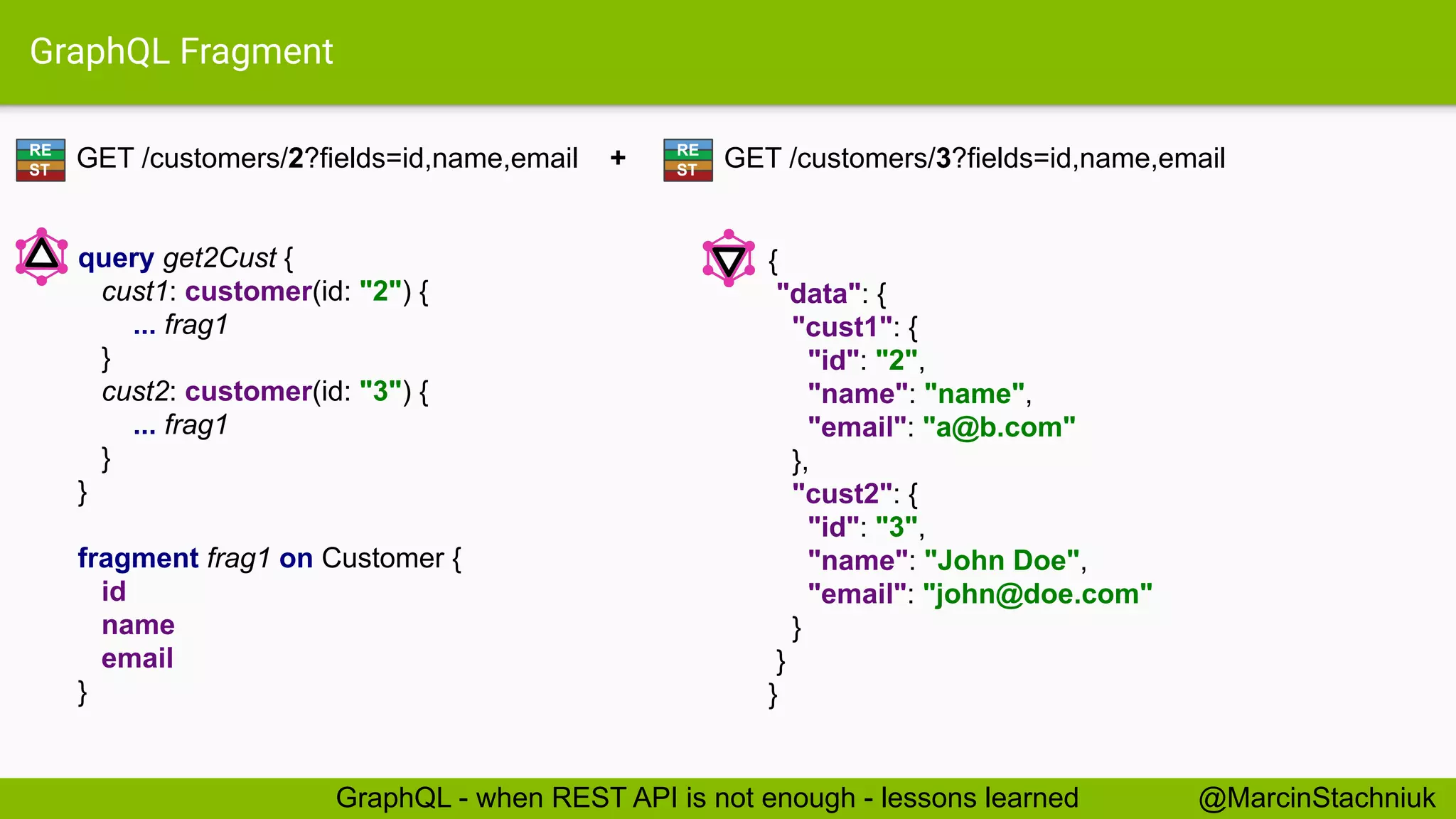
GraphQL Fragment
GET /customers/2?fields=id,name,email +
{
"data": {
"cust1": {
"id": "2",
"name": "name",
"email": "a@b.com"
},
"cust2": {
"id": "3",
"name": "John Doe",
"email": "john@doe.com"
}
}
}
query get2Cust {
cust1: customer(id: "2") {
... frag1
}
cust2: customer(id: "3") {
... frag1
}
}
fragment frag1 on Customer {
id
name
email
}
RE
ST
@MarcinStachniukGraphQL - when REST API is not enough - lessons learned
GET /customers/3?fields=id,name,emailRE
ST
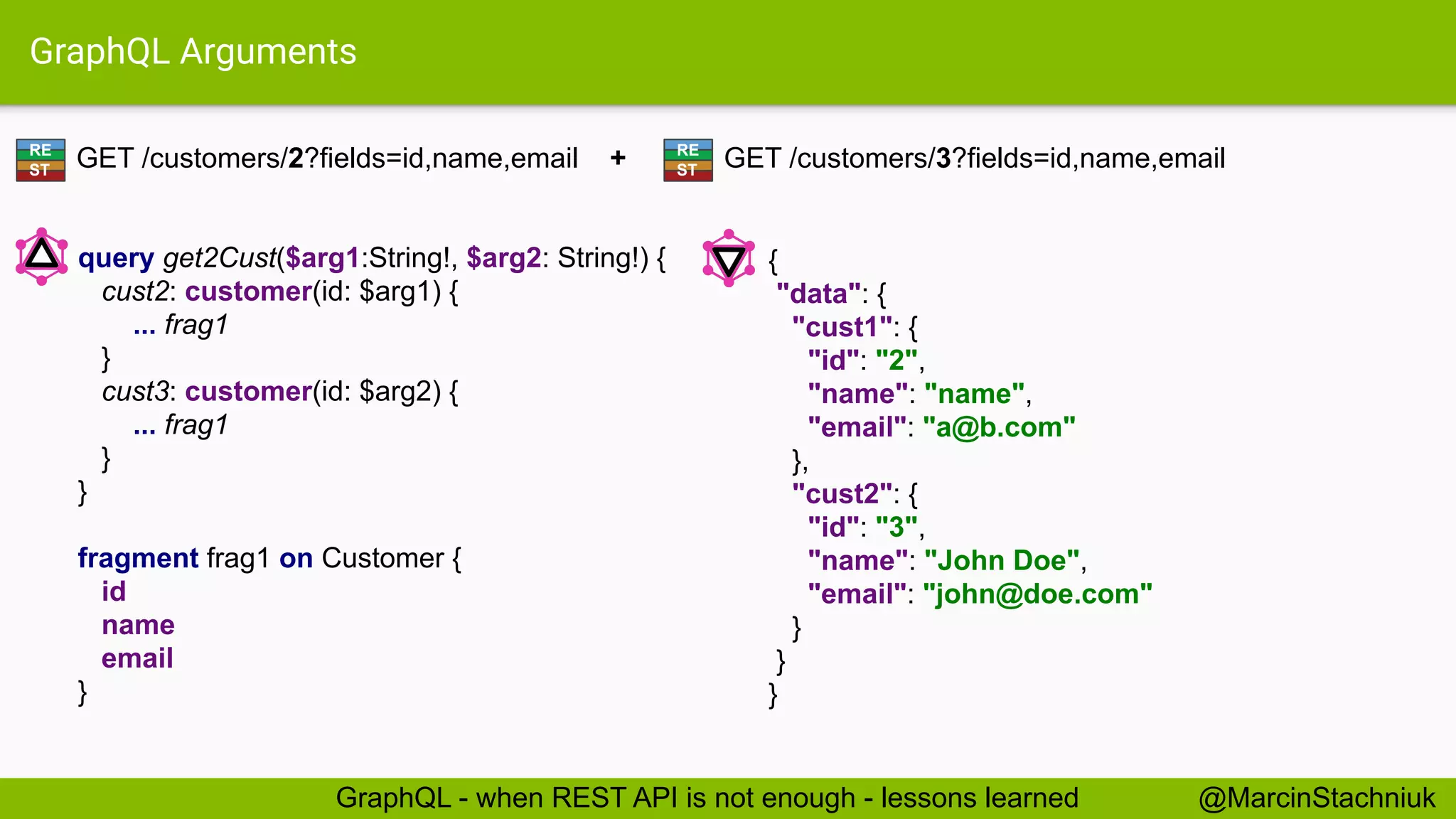
GraphQL Arguments
GET /customers/2?fields=id,name,email +
{
"data": {
"cust1": {
"id": "2",
"name": "name",
"email": "a@b.com"
},
"cust2": {
"id": "3",
"name": "John Doe",
"email": "john@doe.com"
}
}
}
query get2Cust($arg1:String!, $arg2: String!) {
cust2: customer(id: $arg1) {
... frag1
}
cust3: customer(id: $arg2) {
... frag1
}
}
fragment frag1 on Customer {
id
name
email
}
RE
ST
@MarcinStachniukGraphQL - when REST API is not enough - lessons learned
GET /customers/3?fields=id,name,emailRE
ST
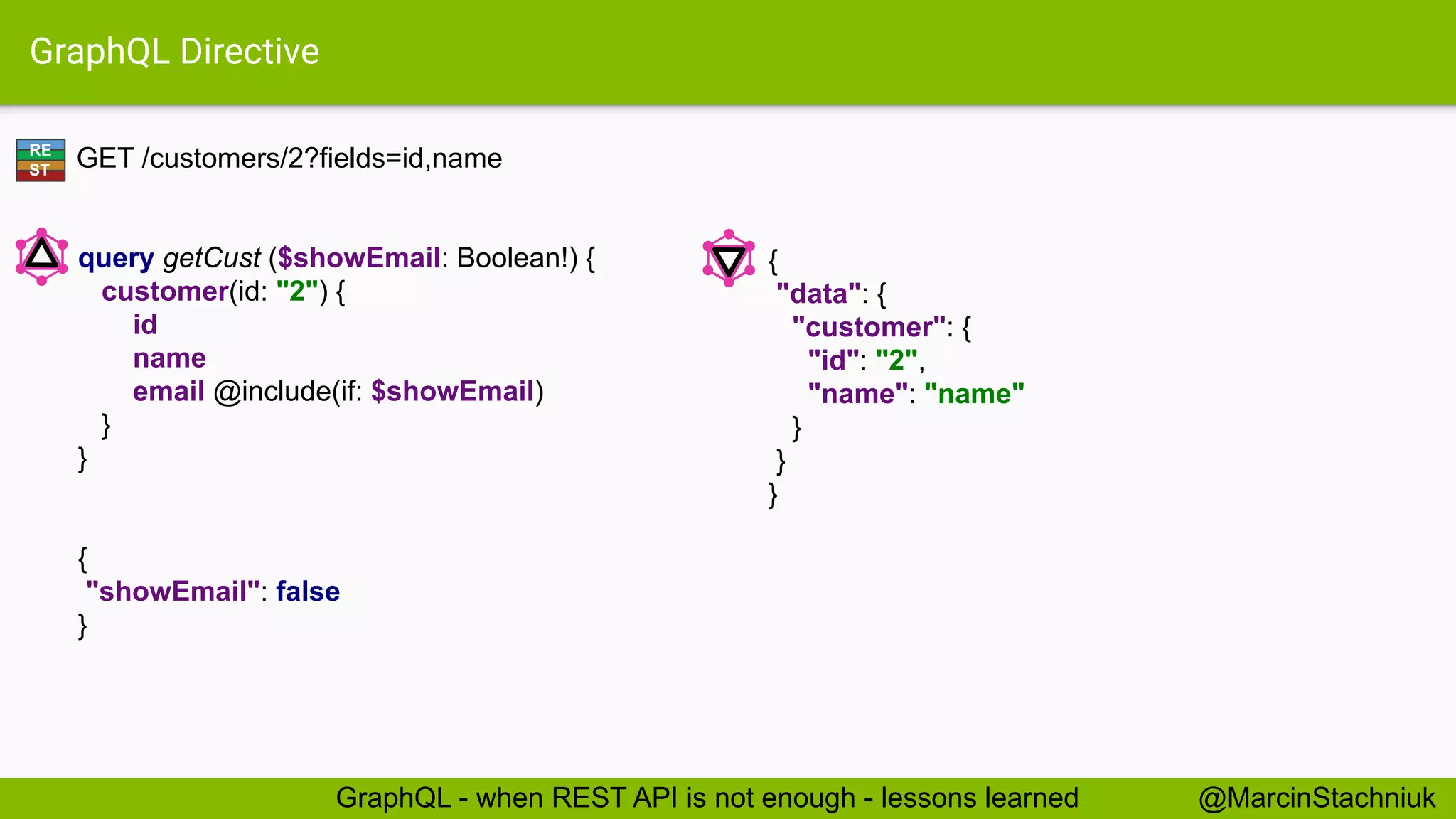
GraphQL Directive
GET /customers/2?fields=id,name
{
"data": {
"customer": {
"id": "2",
"name": "name"
}
}
}
query getCust ($showEmail: Boolean!) {
customer(id: "2") {
id
name
email @include(if: $showEmail)
}
}
{
"showEmail": false
}
RE
ST
@MarcinStachniukGraphQL - when REST API is not enough - lessons learned
GraphQL Interface
GET /users?fields=id,name,superAdmin,permissions
type Query {
users: [User]
}
interface User {
id: ID!
name: String!
email: String!
}
type Admin implements User {
superAdmin: Boolean! // + id...
}
type Moderator implements User {
permissions: [String] // + id...
}
{
"data": {
"users": [
{
"id": "777",
"name": "Admin a",
"superAdmin": true
},
{
"id": "888",
"name": "Moderator",
"permissions": [
"Delete Customer",
"Delete comment"
]}]}}
query getUsers {
users {
... on Admin {
id
name
superAdmin
}
... on Moderator {
id
name
permissions
}
}
}
RE
ST
@MarcinStachniukGraphQL - when REST API is not enough - lessons learned
GraphQL Union
GET /search?input=a?fields=typename,name
type Query {
search(input: String):
[SearchResult]
}
union SearchResult =
Customer |
Admin |
Moderator
{
"data": {
"search": [
{
"__typename": "Customer",
"name": "name"
},
{
"__typename": "Admin",
"name": "Admin a"
},
{
"__typename": "Moderator",
"name": "Moderator"
}]}}
query searchSmth {
search(input: "a") {
__typename
... on Customer {
name
}
... on Admin {
name
}
... on Moderator {
name
}
}
}
RE
ST
@MarcinStachniukGraphQL - when REST API is not enough - lessons learned
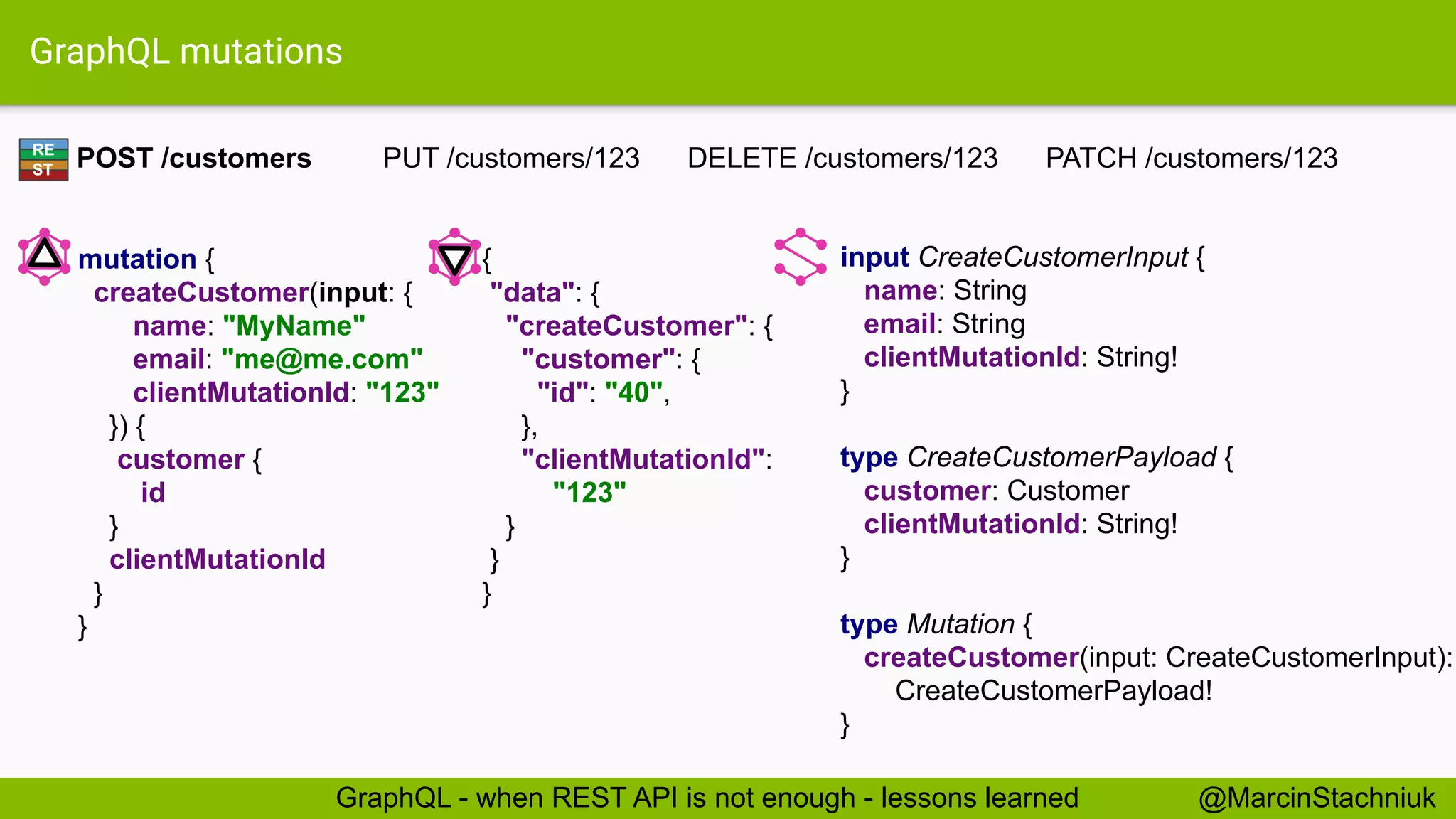
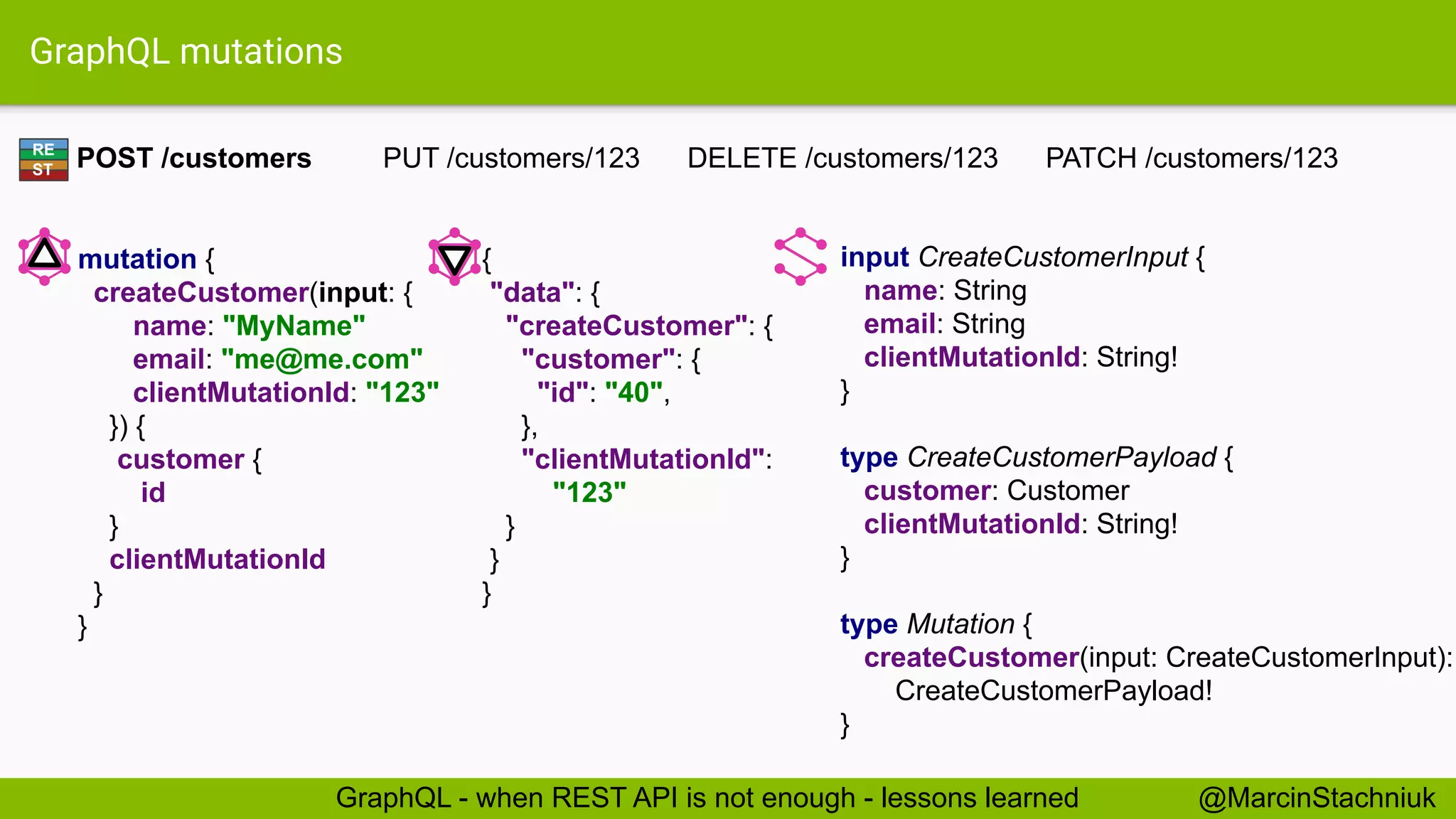
GraphQL mutations
input CreateCustomerInput {
name: String
email: String
clientMutationId: String!
}
type CreateCustomerPayload {
customer: Customer
clientMutationId: String!
}
type Mutation {
createCustomer(input: CreateCustomerInput):
CreateCustomerPayload!
}
{
"data": {
"createCustomer": {
"customer": {
"id": "40",
},
"clientMutationId":
"123"
}
}
}
POST /customers PUT /customers/123 DELETE /customers/123 PATCH /customers/123
mutation {
createCustomer(input: {
name: "MyName"
email: "me@me.com"
clientMutationId: "123"
}) {
customer {
id
}
clientMutationId
}
}
RE
ST
@MarcinStachniukGraphQL - when REST API is not enough - lessons learned
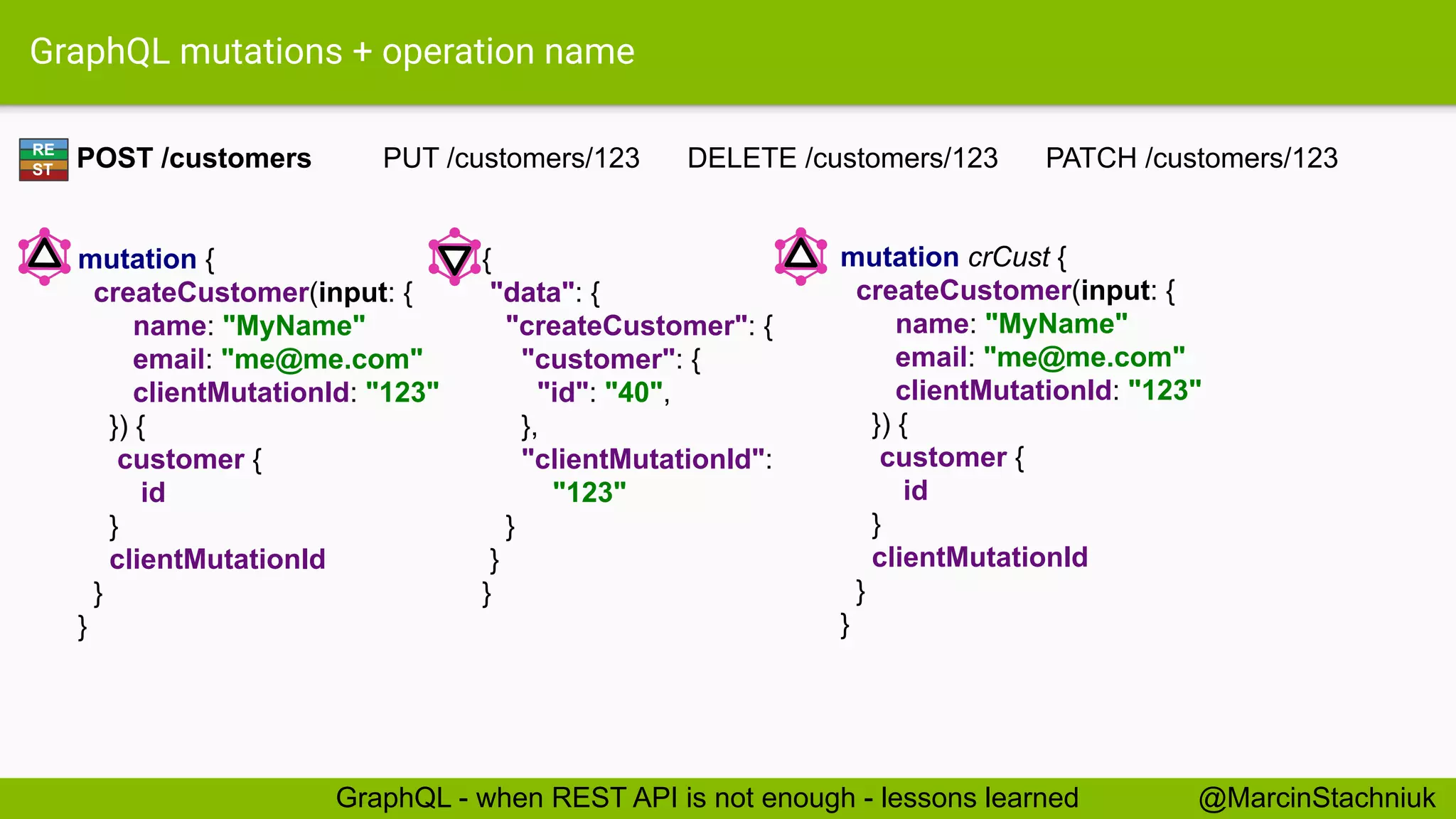
GraphQL mutations + operation name
mutation crCust {
createCustomer(input: {
name: "MyName"
email: "me@me.com"
clientMutationId: "123"
}) {
customer {
id
}
clientMutationId
}
}
{
"data": {
"createCustomer": {
"customer": {
"id": "40",
},
"clientMutationId":
"123"
}
}
}
POST /customers PUT /customers/123 DELETE /customers/123 PATCH /customers/123RE
ST
@MarcinStachniukGraphQL - when REST API is not enough - lessons learned
mutation {
createCustomer(input: {
name: "MyName"
email: "me@me.com"
clientMutationId: "123"
}) {
customer {
id
}
clientMutationId
}
}
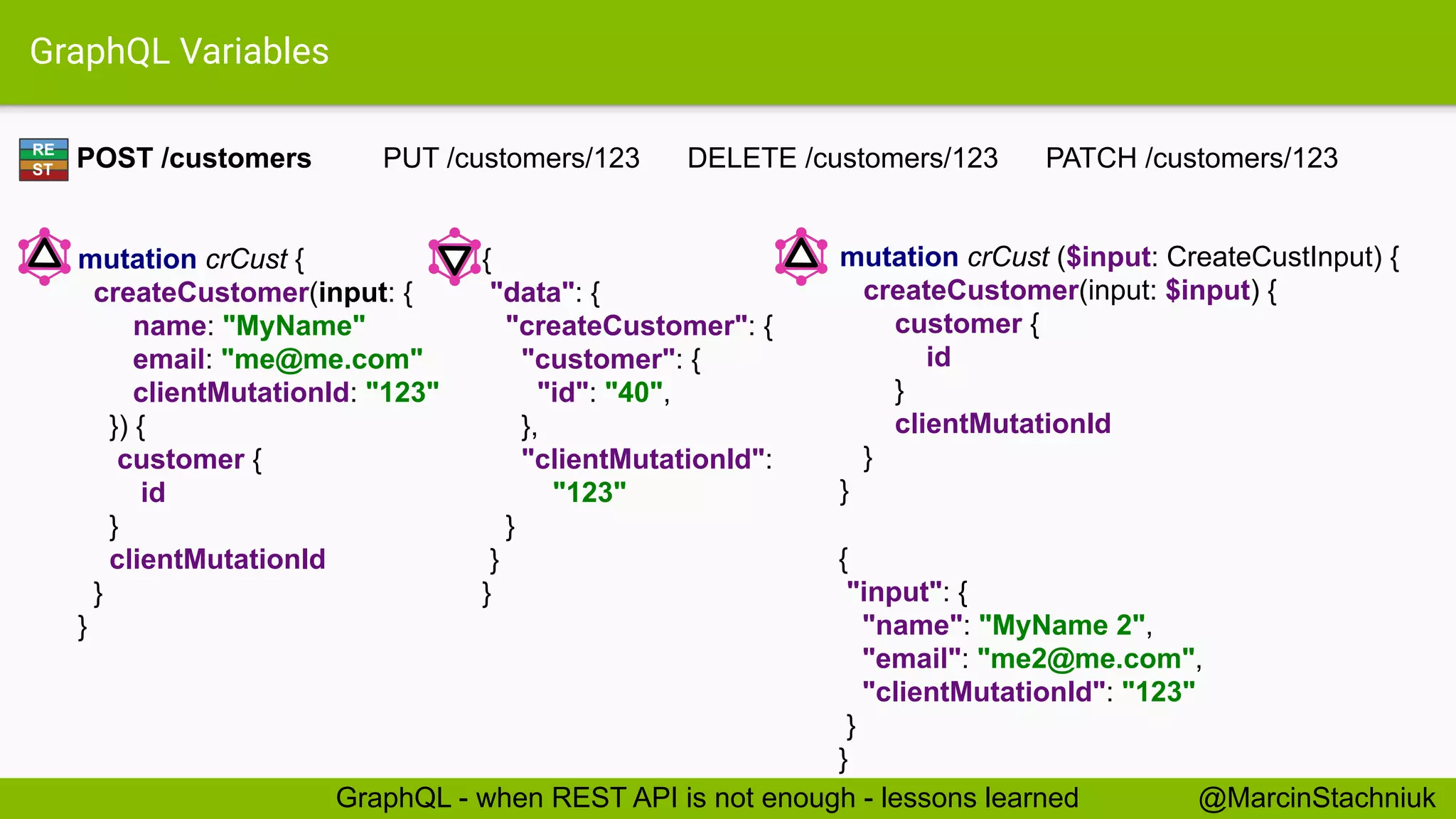
GraphQL Variables
{
"data": {
"createCustomer": {
"customer": {
"id": "40",
},
"clientMutationId":
"123"
}
}
}
POST /customers PUT /customers/123 DELETE /customers/123 PATCH /customers/123
mutation crCust {
createCustomer(input: {
name: "MyName"
email: "me@me.com"
clientMutationId: "123"
}) {
customer {
id
}
clientMutationId
}
}
RE
ST
@MarcinStachniukGraphQL - when REST API is not enough - lessons learned
mutation crCust ($input: CreateCustInput) {
createCustomer(input: $input) {
customer {
id
}
clientMutationId
}
}
{
"input": {
"name": "MyName 2",
"email": "me2@me.com",
"clientMutationId": "123"
}
}
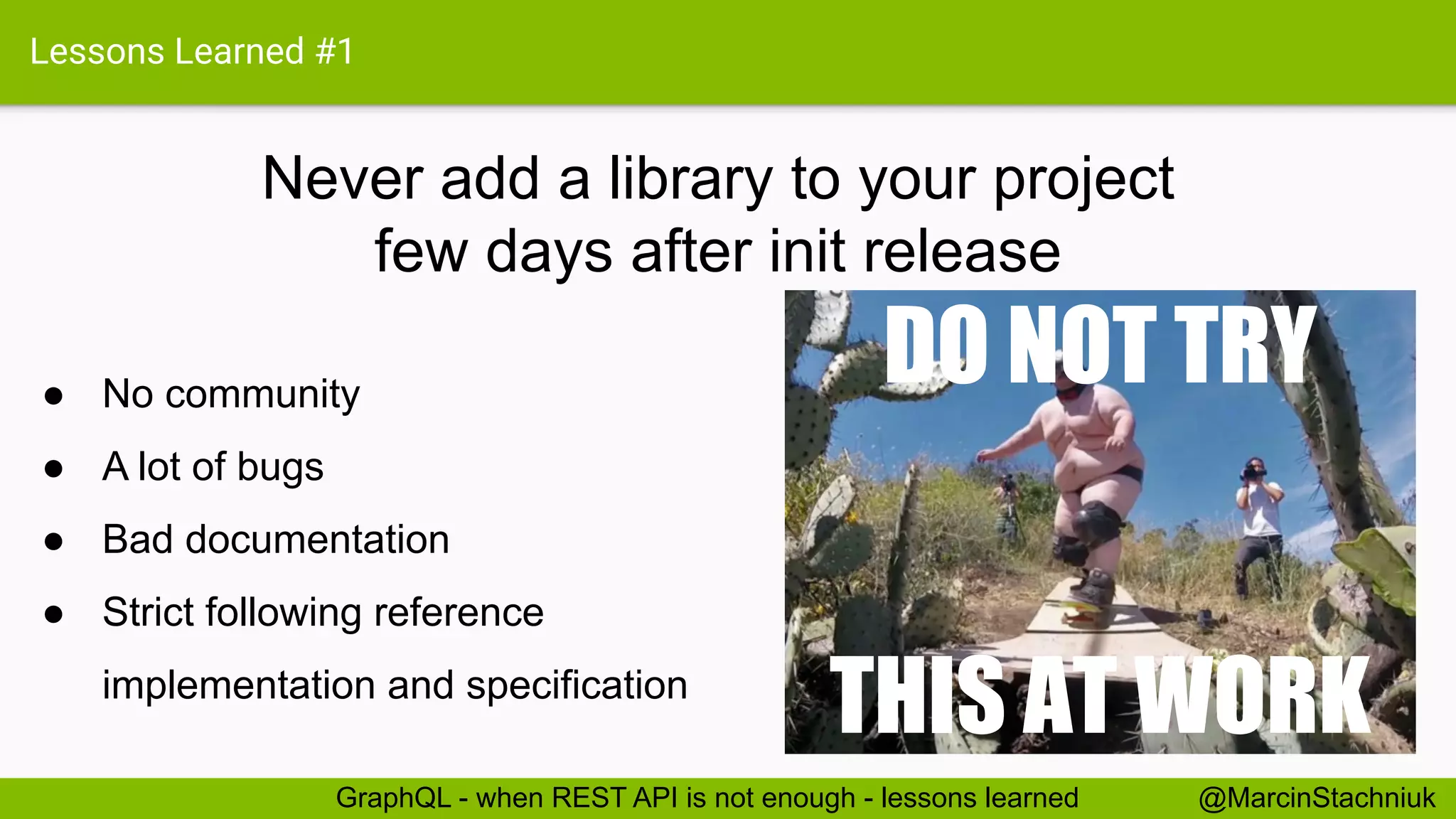
Lessons Learned #1
Never add a library to your project
few days after init release
@MarcinStachniukGraphQL - when REST API is not enough - lessons learned
● No community
● A lot of bugs
● Bad documentation
● Strict following reference
implementation and specification
DO NOT TRY
THIS AT WORK
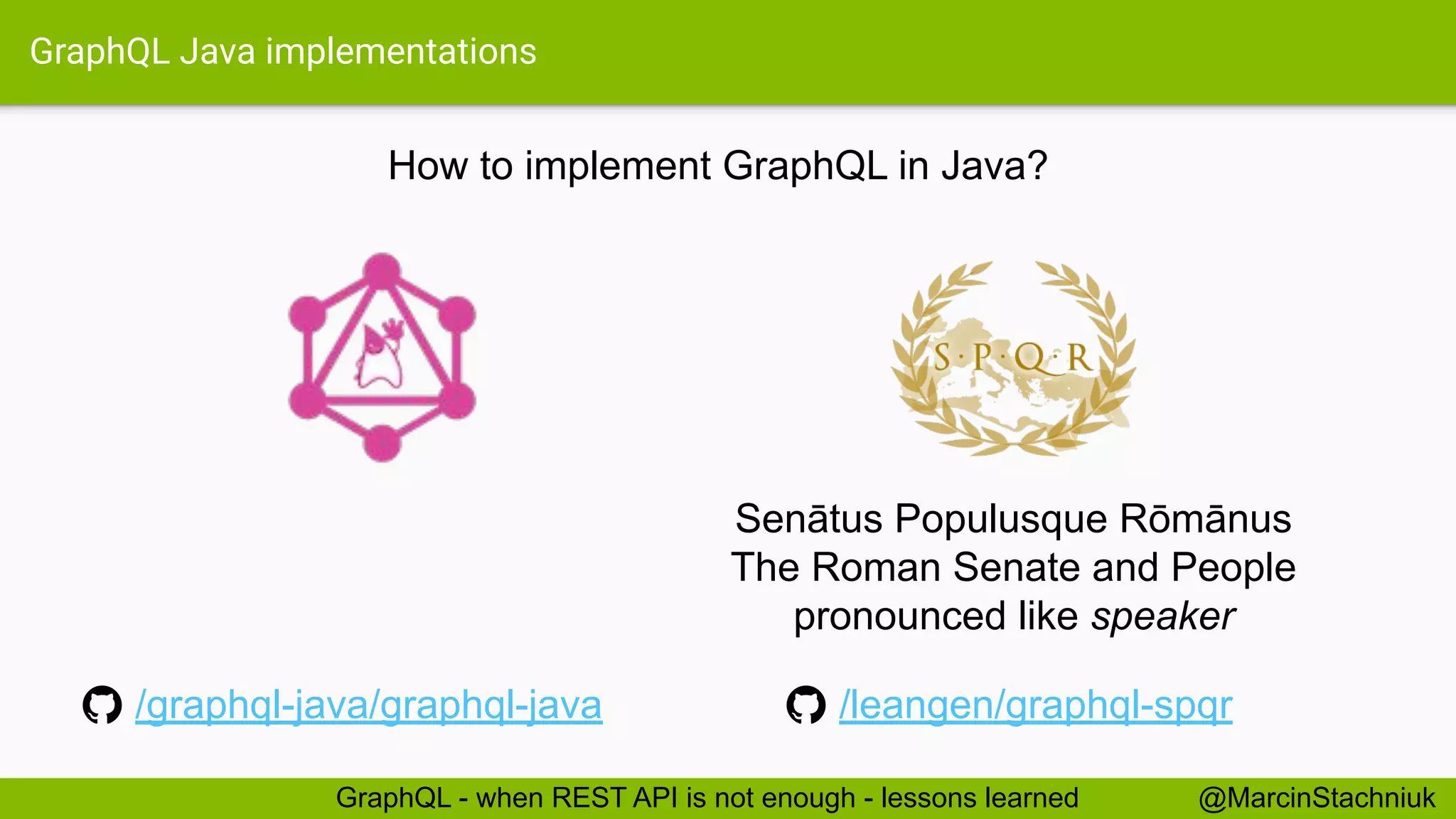
GraphQL Java implementations
How to implement GraphQL in Java?
@MarcinStachniukGraphQL - when REST API is not enough - lessons learned
/graphql-java/graphql-java /leangen/graphql-spqr
Senātus Populusque Rōmānus
The Roman Senate and People
pronounced like speaker
GraphQL Simple API
GET /customers/2?fields=id,name,email,orders(id,status)
type Customer {
id: ID!
name: String!
email: String!
company: Company
orders: [Order]
}
type Order {
id: ID!
status: Status
}
enum Status {
NEW, CANCELED, DONE
}
{
"data": {
"customer": {
"id": "2",
"name": "name",
"orders": [
{
"id": "55",
"status": "NEW"
},
{
"id": "66",
"status": "DONE"
}
] } } }
{
customer(id: "2") {
id
name
orders {
id
status
}
}
}
RE
ST
@MarcinStachniukGraphQL - when REST API is not enough - lessons learned
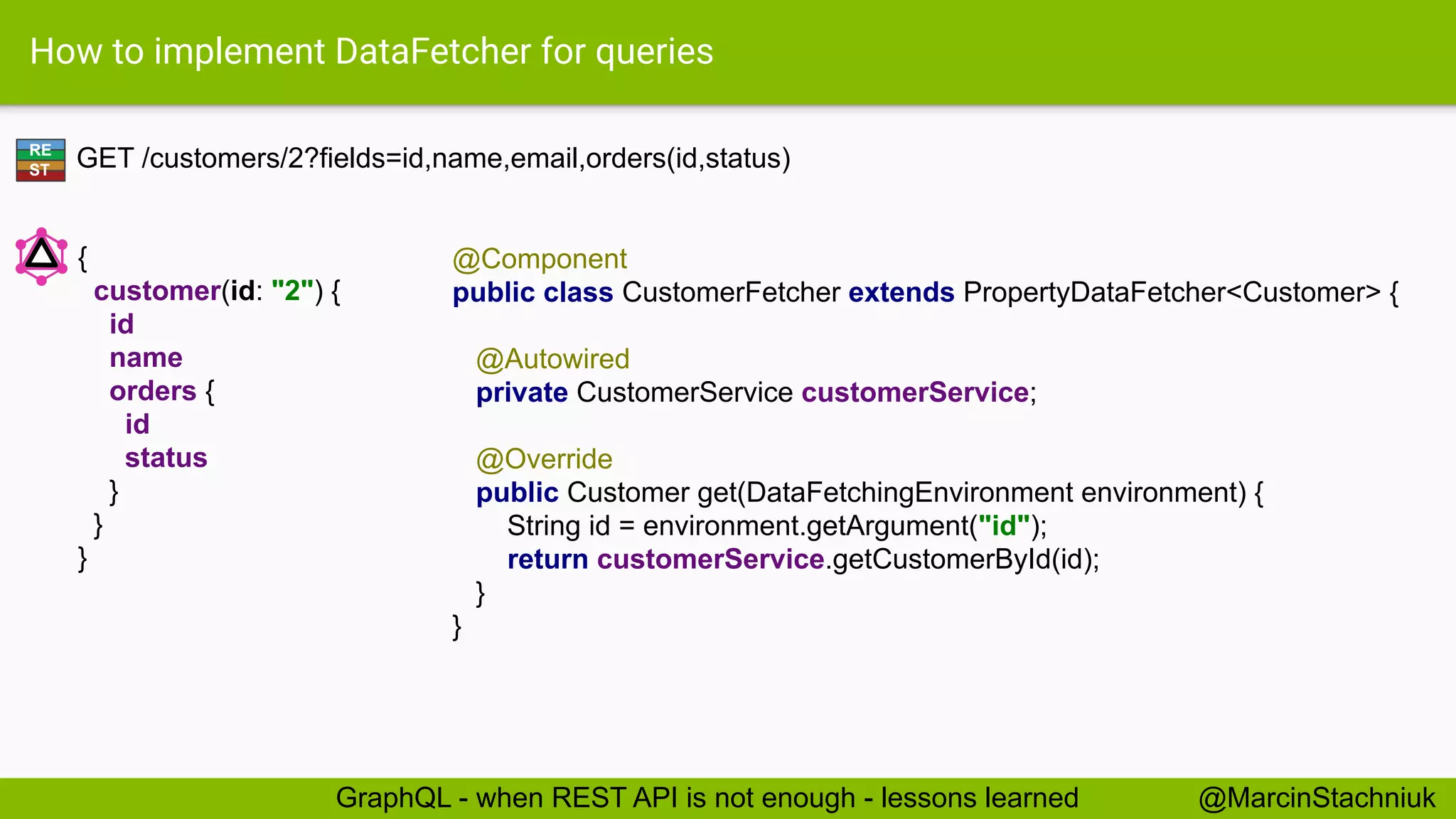
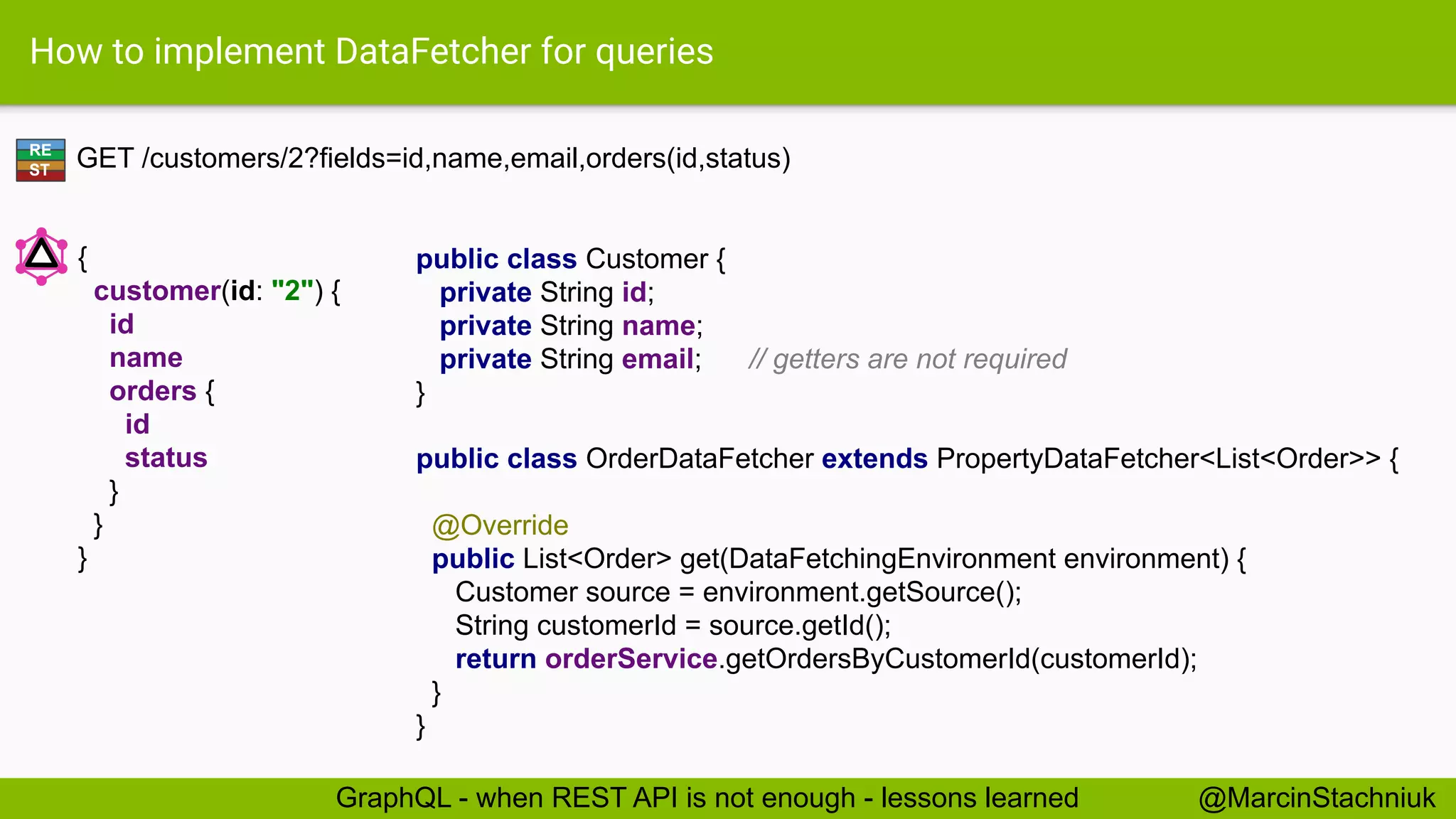
How to implement DataFetcher for queries
GET /customers/2?fields=id,name,email,orders(id,status)
@Component
public class CustomerFetcher extends PropertyDataFetcher<Customer> {
@Autowired
private CustomerService customerService;
@Override
public Customer get(DataFetchingEnvironment environment) {
String id = environment.getArgument("id");
return customerService.getCustomerById(id);
}
}
RE
ST
{
customer(id: "2") {
id
name
orders {
id
status
}
}
}
@MarcinStachniukGraphQL - when REST API is not enough - lessons learned
How to implement DataFetcher for queries
GET /customers/2?fields=id,name,email,orders(id,status)
public class Customer {
private String id;
private String name;
private String email; // getters are not required
}
RE
ST
{
customer(id: "2") {
id
name
orders {
id
status
}
}
}
@MarcinStachniukGraphQL - when REST API is not enough - lessons learned
public class OrderDataFetcher extends PropertyDataFetcher<List<Order>> {
@Override
public List<Order> get(DataFetchingEnvironment environment) {
Customer source = environment.getSource();
String customerId = source.getId();
return orderService.getOrdersByCustomerId(customerId);
}
}
GraphQL mutations
input CreateCustomerInput {
name: String
email: String
clientMutationId: String!
}
type CreateCustomerPayload {
customer: Customer
clientMutationId: String!
}
type Mutation {
createCustomer(input: CreateCustomerInput):
CreateCustomerPayload!
}
{
"data": {
"createCustomer": {
"customer": {
"id": "40",
},
"clientMutationId":
"123"
}
}
}
POST /customers PUT /customers/123 DELETE /customers/123 PATCH /customers/123
mutation {
createCustomer(input: {
name: "MyName"
email: "me@me.com"
clientMutationId: "123"
}) {
customer {
id
}
clientMutationId
}
}
RE
ST
@MarcinStachniukGraphQL - when REST API is not enough - lessons learned
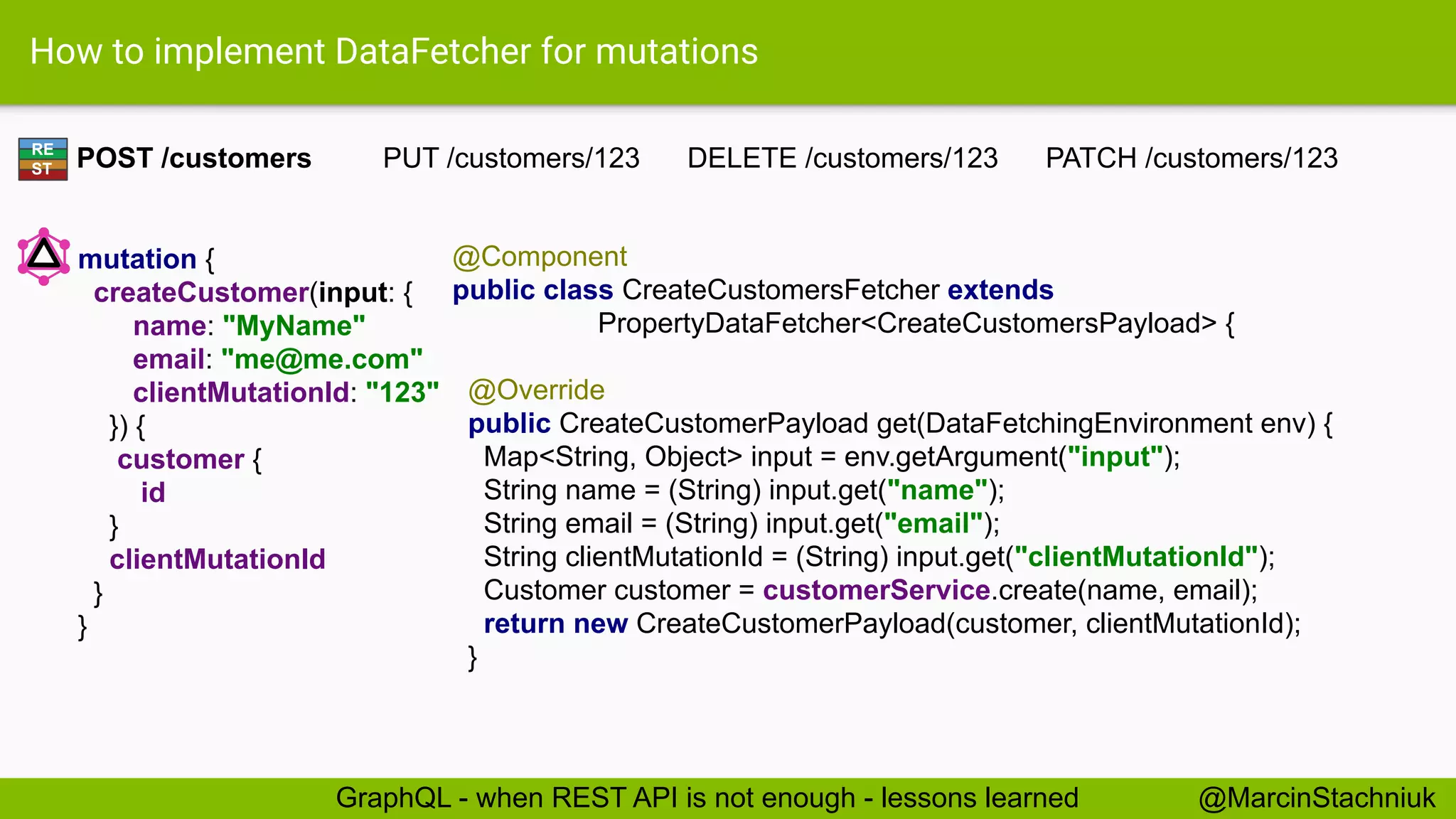
How to implement DataFetcher for mutations
POST /customers PUT /customers/123 DELETE /customers/123 PATCH /customers/123
@Component
public class CreateCustomersFetcher extends
PropertyDataFetcher<CreateCustomersPayload> {
@Override
public CreateCustomerPayload get(DataFetchingEnvironment env) {
Map<String, Object> input = env.getArgument("input");
String name = (String) input.get("name");
String email = (String) input.get("email");
String clientMutationId = (String) input.get("clientMutationId");
Customer customer = customerService.create(name, email);
return new CreateCustomerPayload(customer, clientMutationId);
}
RE
ST
mutation {
createCustomer(input: {
name: "MyName"
email: "me@me.com"
clientMutationId: "123"
}) {
customer {
id
}
clientMutationId
}
}
@MarcinStachniukGraphQL - when REST API is not enough - lessons learned
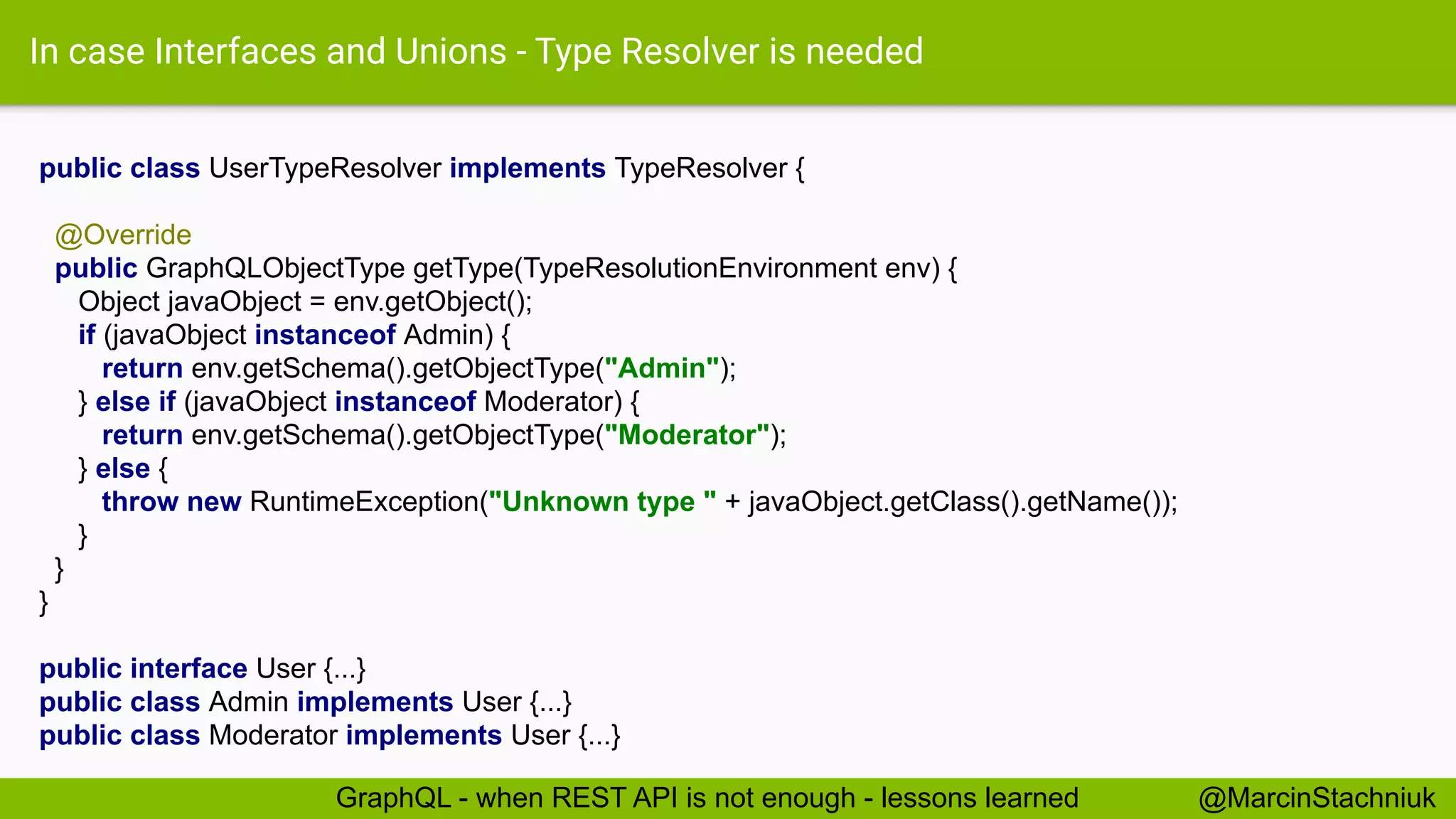
In case Interfaces and Unions - Type Resolver is needed
public class UserTypeResolver implements TypeResolver {
@Override
public GraphQLObjectType getType(TypeResolutionEnvironment env) {
Object javaObject = env.getObject();
if (javaObject instanceof Admin) {
return env.getSchema().getObjectType("Admin");
} else if (javaObject instanceof Moderator) {
return env.getSchema().getObjectType("Moderator");
} else {
throw new RuntimeException("Unknown type " + javaObject.getClass().getName());
}
}
}
public interface User {...}
public class Admin implements User {...}
public class Moderator implements User {...}
@MarcinStachniukGraphQL - when REST API is not enough - lessons learned
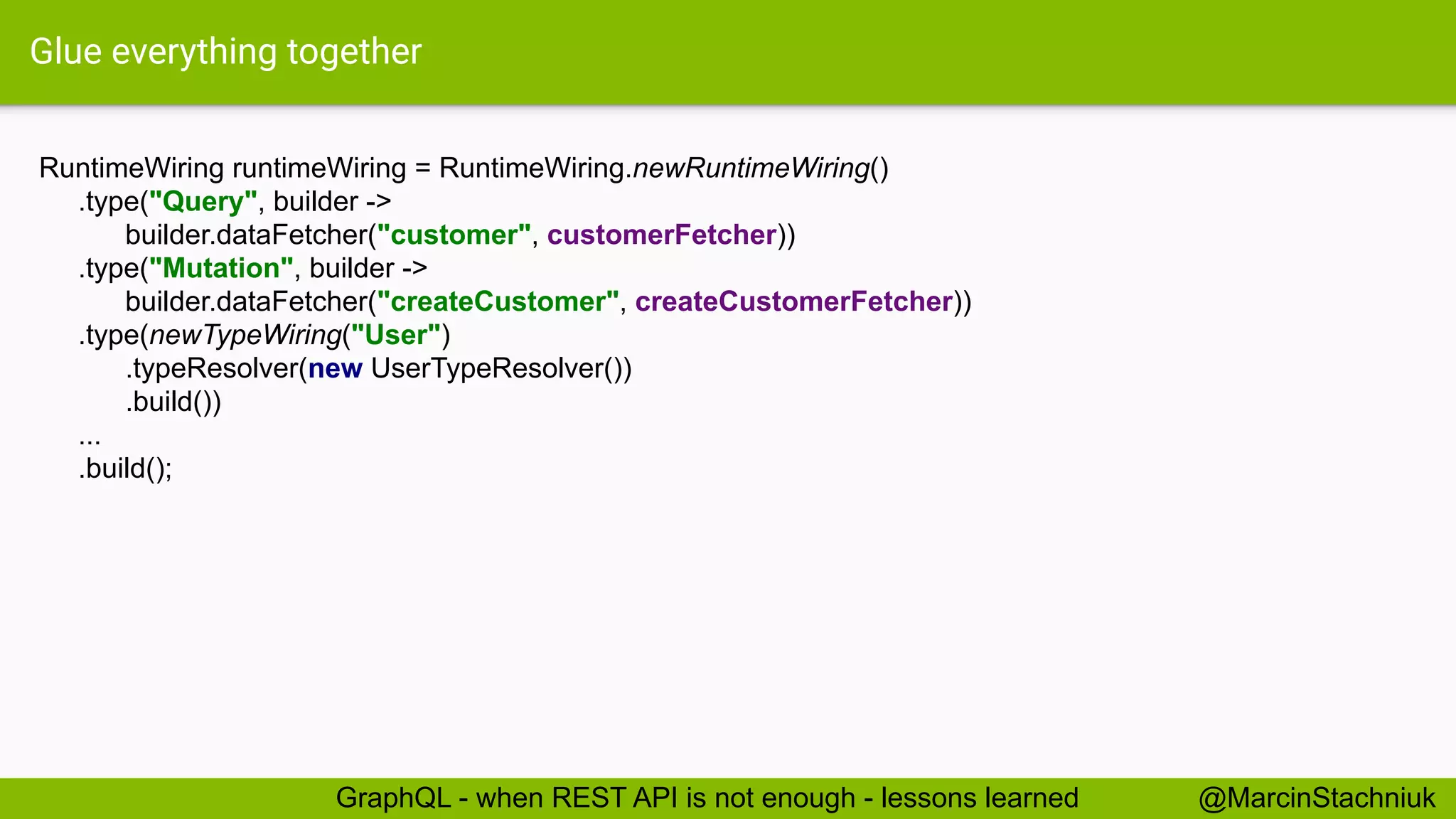
Glue everything together
RuntimeWiring runtimeWiring = RuntimeWiring.newRuntimeWiring()
.type("Query", builder ->
builder.dataFetcher("customer", customerFetcher))
.type("Mutation", builder ->
builder.dataFetcher("createCustomer", createCustomerFetcher))
.type(newTypeWiring("User")
.typeResolver(new UserTypeResolver())
.build())
...
.build();
@MarcinStachniukGraphQL - when REST API is not enough - lessons learned
GraphQL type system
How to define your schema?
@MarcinStachniukGraphQL - when REST API is not enough - lessons learned
Code First approach
private GraphQLFieldDefinition customerDefinition() {
return GraphQLFieldDefinition.newFieldDefinition()
.name("customer")
.argument(GraphQLArgument.newArgument()
.name("id")
.type(new GraphQLNonNull(GraphQLString)))
.type(new GraphQLNonNull(GraphQLObjectType.newObject()
.name("Customer")
.field(GraphQLFieldDefinition.newFieldDefinition()
.name("id")
.description("fields with ! are not null")
.type(new GraphQLNonNull(GraphQLID))
.build())
….
.build()))
.dataFetcher(customerFetcher)
.build();
}
Schema First approach
type Query {
customer(id: String!): Customer!
}
type Customer {
#fields with ! are not null
id: ID!
name: String!
email: String!
company: Company
orders: [Order]
}
@MarcinStachniukGraphQL - when REST API is not enough - lessons learned
Schema First approach
type Customer {
# fields with ! are required
id: ID!
name: String!
email: String!
company: Company
orders: [Order]
}
*.graphqls
SchemaParser schemaParser = new SchemaParser();
File file = // ...
TypeDefinitionRegistry registry = schemaParser.parse(file);
SchemaGenerator schemaGenerator = new SchemaGenerator();
RuntimeWiring runtimeWiring = RuntimeWiring.newRuntimeWiring()
.type("Query", builder ->
builder.dataFetcher("customer", customerFetcher))
// ...
.build();
return schemaGenerator.makeExecutableSchema(registry, runtimeWiring);
@MarcinStachniukGraphQL - when REST API is not enough - lessons learned
GraphQL SPQR
@MarcinStachniukGraphQL - when REST API is not enough - lessons learned
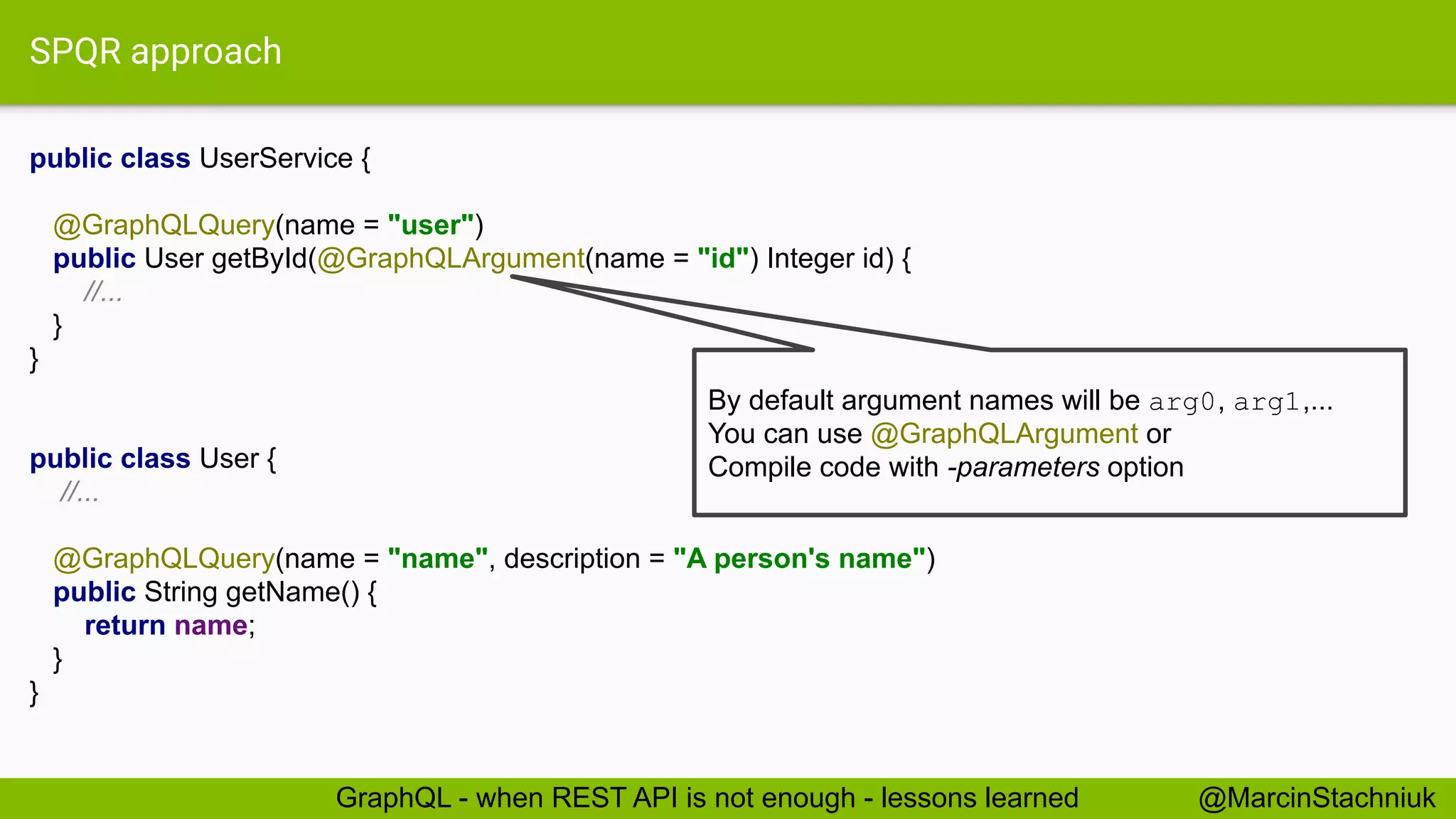
SPQR approach
public class UserService {
@GraphQLQuery(name = "user")
public User getById(@GraphQLArgument(name = "id") Integer id) {
//...
}
}
@MarcinStachniukGraphQL - when REST API is not enough - lessons learned
public class User {
//...
@GraphQLQuery(name = "name", description = "A person's name")
public String getName() {
return name;
}
}
By default argument names will be arg0, arg1,...
You can use @GraphQLArgument or
Compile code with -parameters option
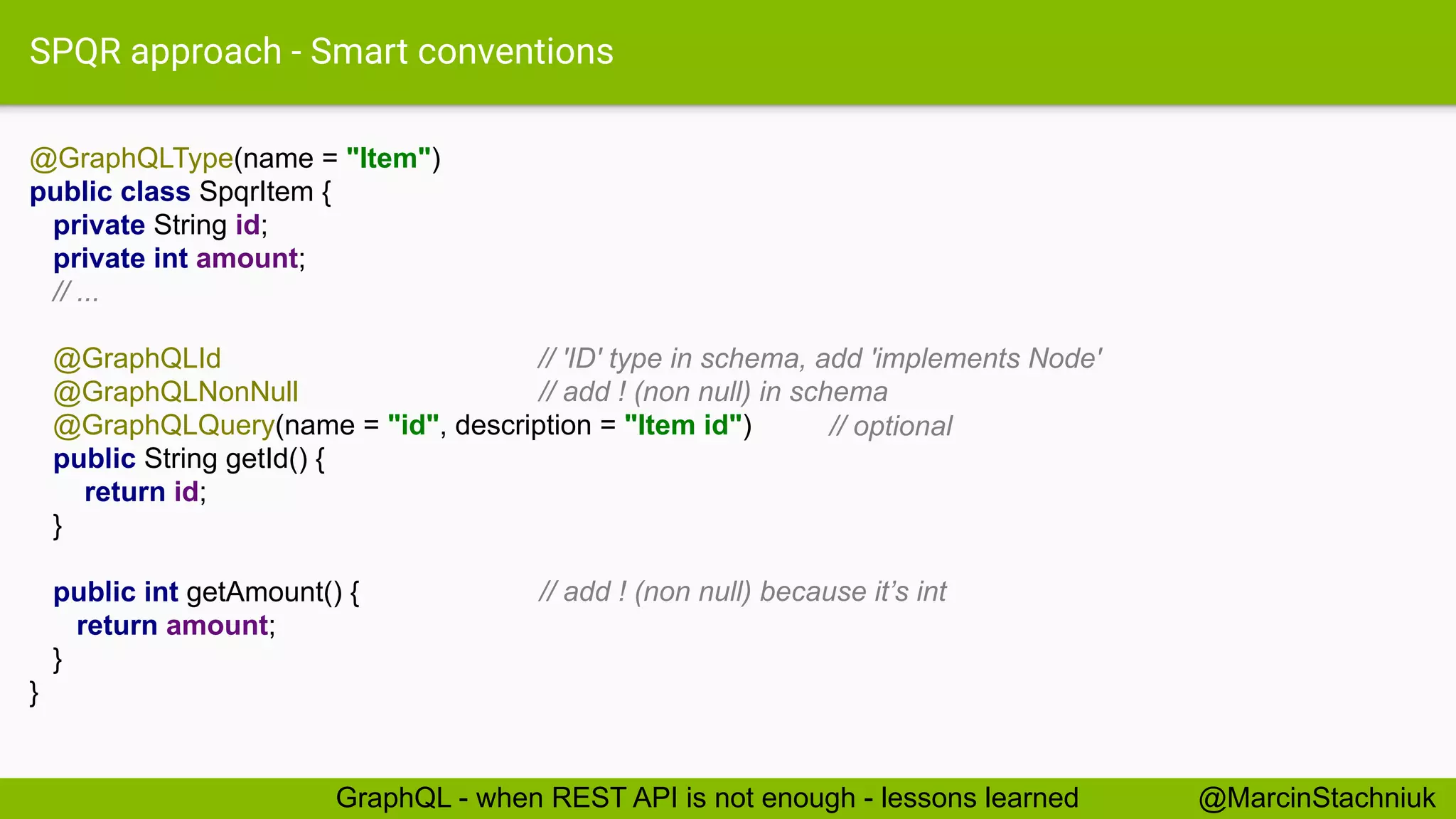
SPQR approach - Smart conventions
@GraphQLType(name = "Item")
public class SpqrItem {
private String id;
private int amount;
// ...
@GraphQLId
@GraphQLNonNull
@GraphQLQuery(name = "id", description = "Item id")
public String getId() {
return id;
}
public int getAmount() {
return amount;
}
}
@MarcinStachniukGraphQL - when REST API is not enough - lessons learned
// 'ID' type in schema, add 'implements Node'
// add ! (non null) in schema
// optional
// add ! (non null) because it’s int
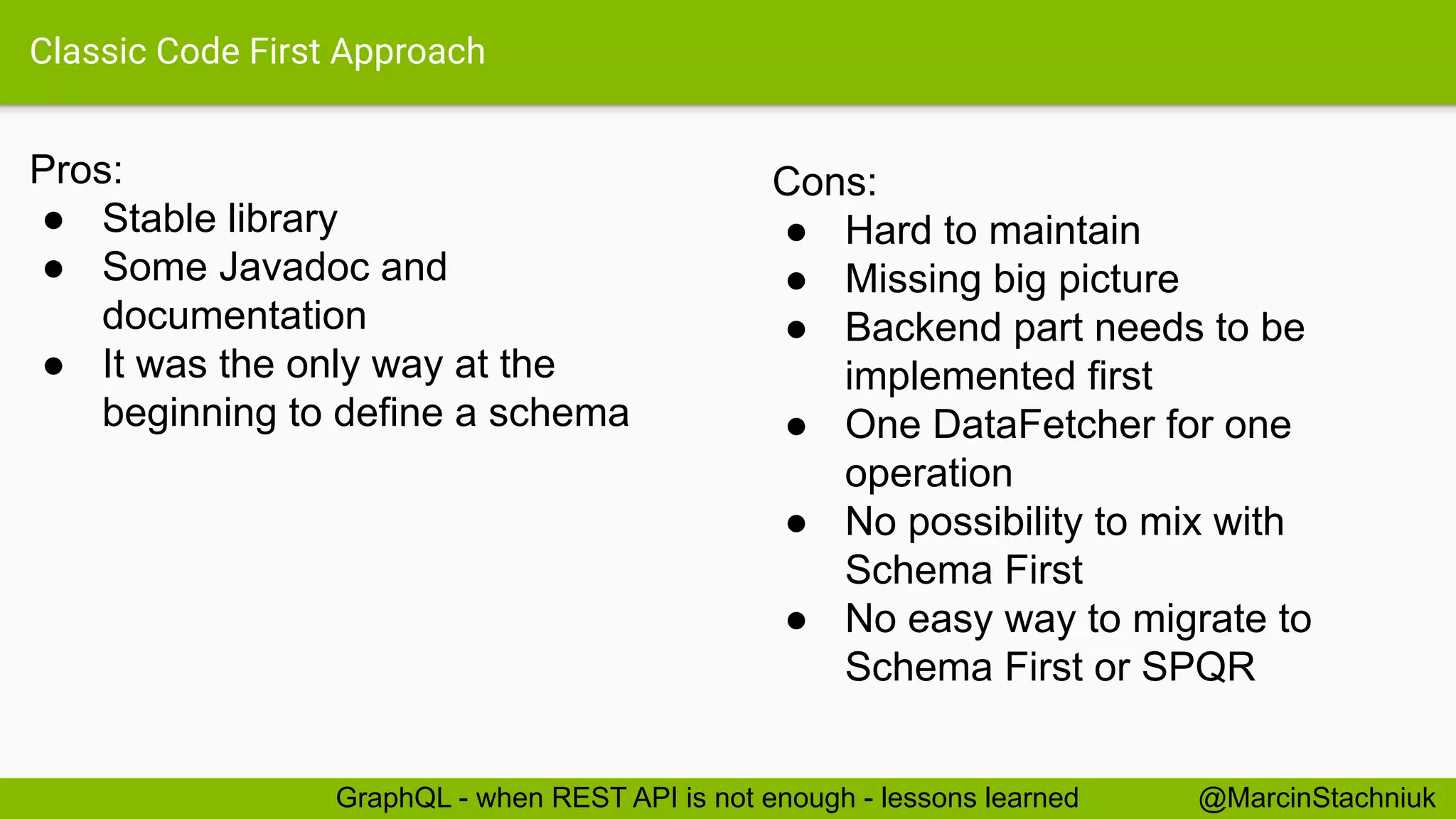
Classic Code First Approach
Pros:
● Stable library
● Some Javadoc and
documentation
● It was the only way at the
beginning to define a schema
@MarcinStachniukGraphQL - when REST API is not enough - lessons learned
Cons:
● Hard to maintain
● Missing big picture
● Backend part needs to be
implemented first
● One DataFetcher for one
operation
● No possibility to mix with
Schema First
● No easy way to migrate to
Schema First or SPQR
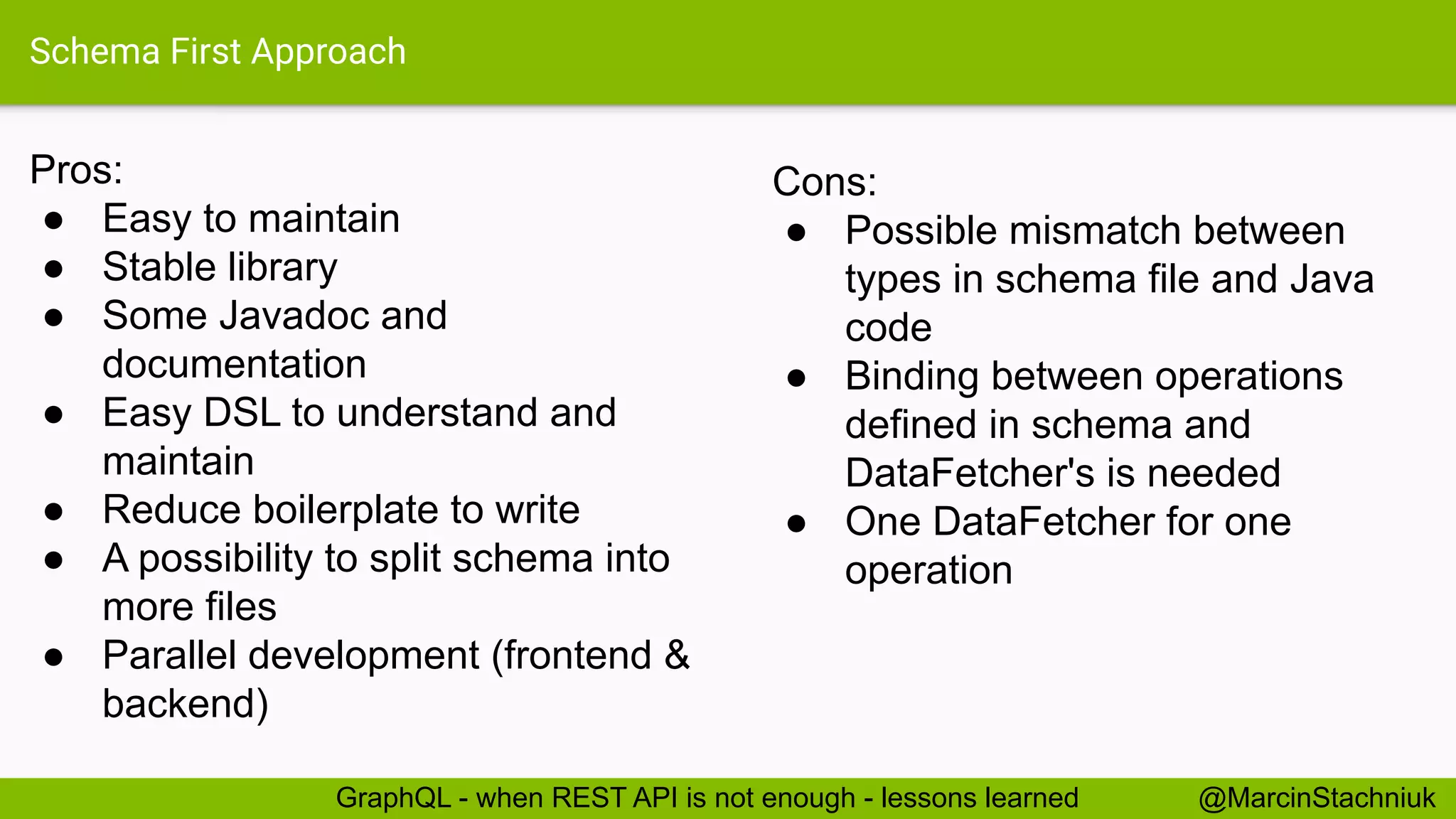
Schema First Approach
Pros:
● Easy to maintain
● Stable library
● Some Javadoc and
documentation
● Easy DSL to understand and
maintain
● Reduce boilerplate to write
● A possibility to split schema into
more files
● Parallel development (frontend &
backend)
@MarcinStachniukGraphQL - when REST API is not enough - lessons learned
Cons:
● Possible mismatch between
types in schema file and Java
code
● Binding between operations
defined in schema and
DataFetcher's is needed
● One DataFetcher for one
operation
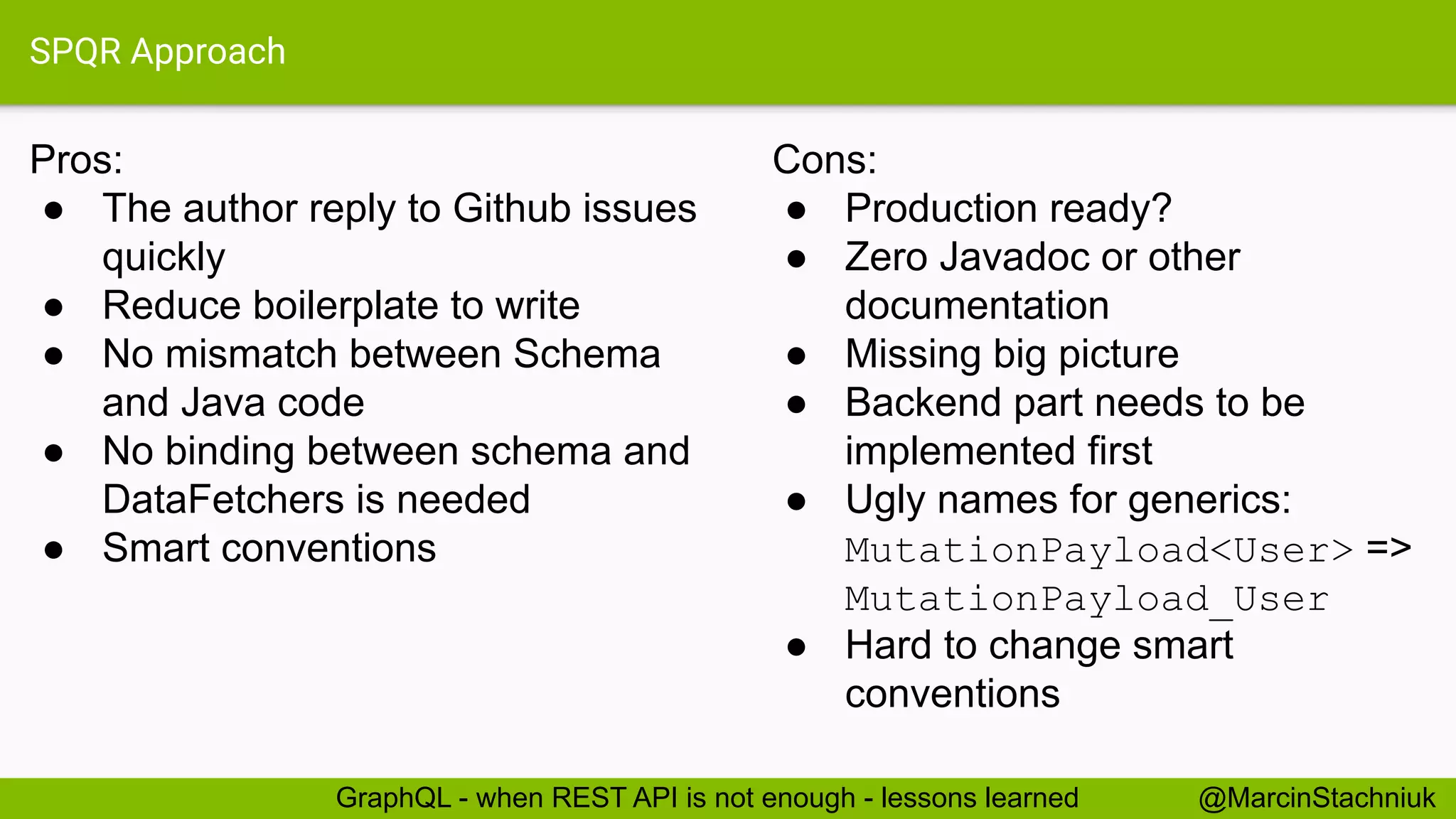
SPQR Approach
Pros:
● The author reply to Github issues
quickly
● Reduce boilerplate to write
● No mismatch between Schema
and Java code
● No binding between schema and
DataFetchers is needed
● Smart conventions
@MarcinStachniukGraphQL - when REST API is not enough - lessons learned
Cons:
● Production ready?
● Zero Javadoc or other
documentation
● Missing big picture
● Backend part needs to be
implemented first
● Ugly names for generics:
MutationPayload<User> =>
MutationPayload_User
● Hard to change smart
conventions
Lessons Learned #2
Classic Code First Approach is the worst
@MarcinStachniukGraphQL - when REST API is not enough - lessons learned
● Big project
● High risk project
● Old project
● Small project
● Low risk project
● New Project
?
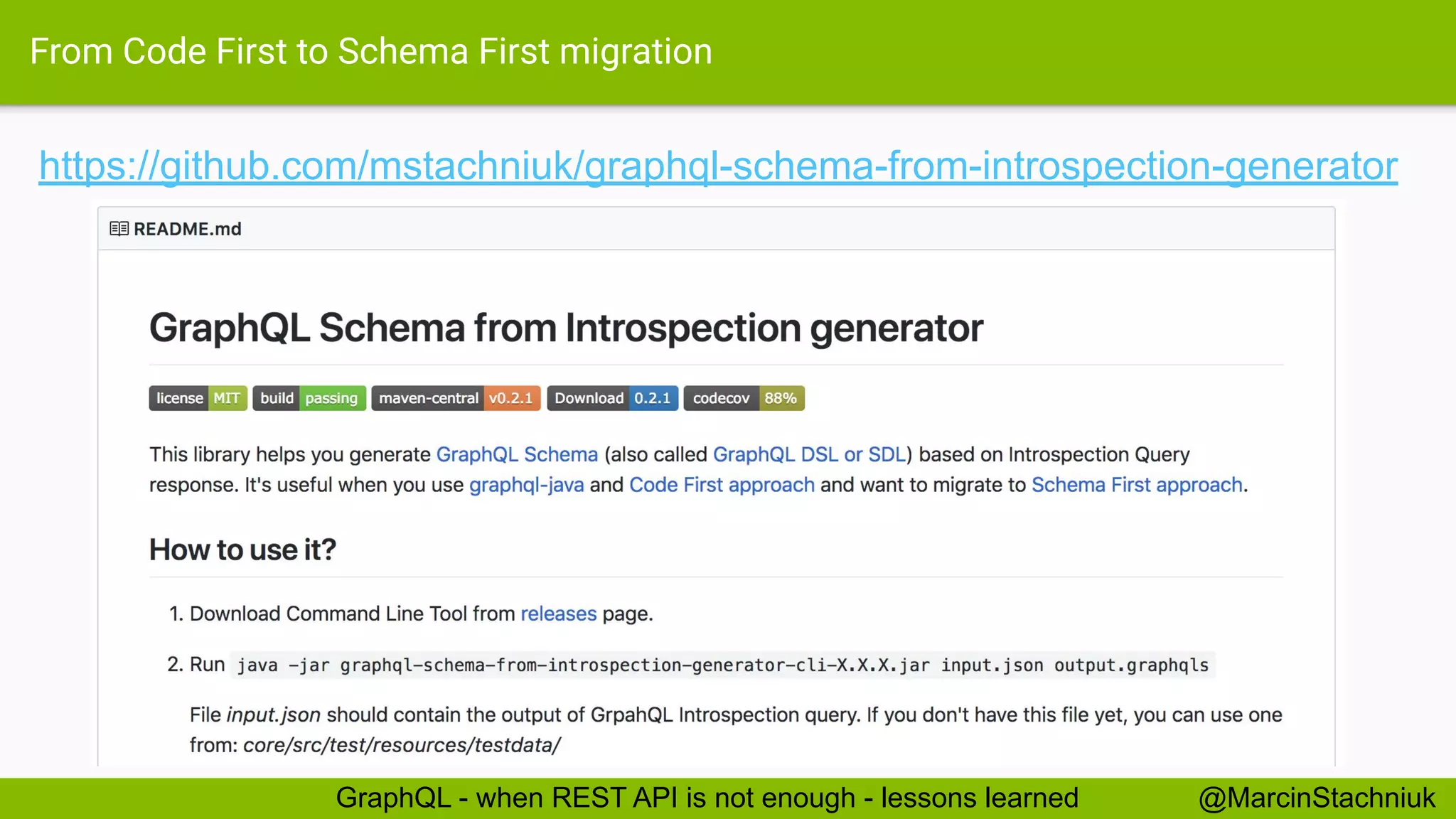
From Code First to Schema First migration
https://github.com/mstachniuk/graphql-schema-from-introspection-generator
@MarcinStachniukGraphQL - when REST API is not enough - lessons learned
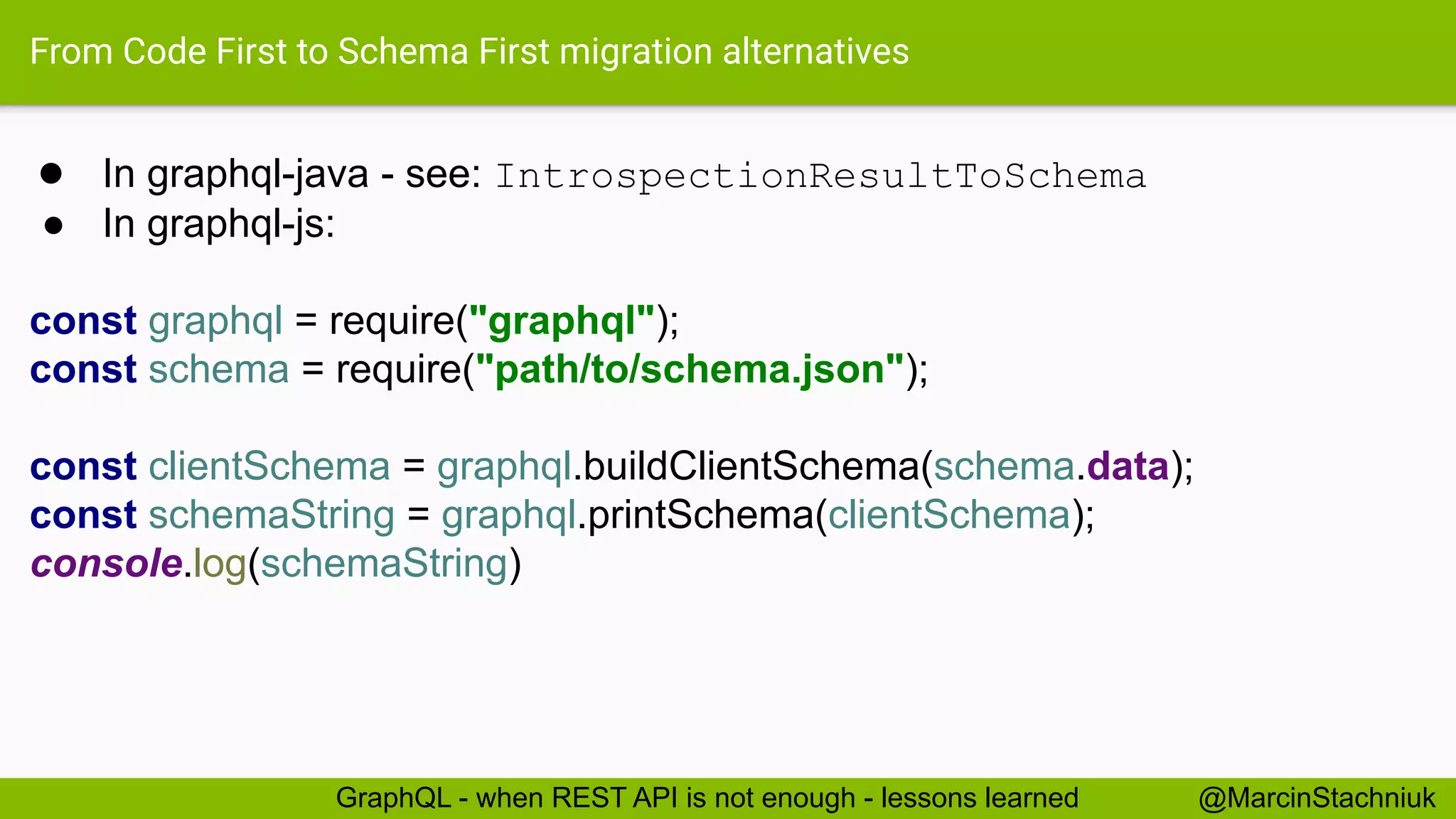
From Code First to Schema First migration alternatives
● In graphql-java - see: IntrospectionResultToSchema
● In graphql-js:
const graphql = require("graphql");
const schema = require("path/to/schema.json");
const clientSchema = graphql.buildClientSchema(schema.data);
const schemaString = graphql.printSchema(clientSchema);
console.log(schemaString)
@MarcinStachniukGraphQL - when REST API is not enough - lessons learned
GraphQL - How to define pagination, filtering, sorting?
Pagination:
● before, after
● offset, limit
Filtering:
● filter(name: “Bob” email: “%@gmail.com”)
● filter: {
OR: [{
email: “%@gmail.com”
}]
}, name: “Bob”
}
Sorting:
● orderBy: ASC, DESC
● sort: NEWEST, IMPORTANCE
@MarcinStachniukGraphQL - when REST API is not enough - lessons learned
Lessons Learned #3
GraphQL is not full query language
@MarcinStachniukGraphQL - when REST API is not enough - lessons learned
● Flexibility
● Less common conventions
● Dgraph.io created GraphQL+-
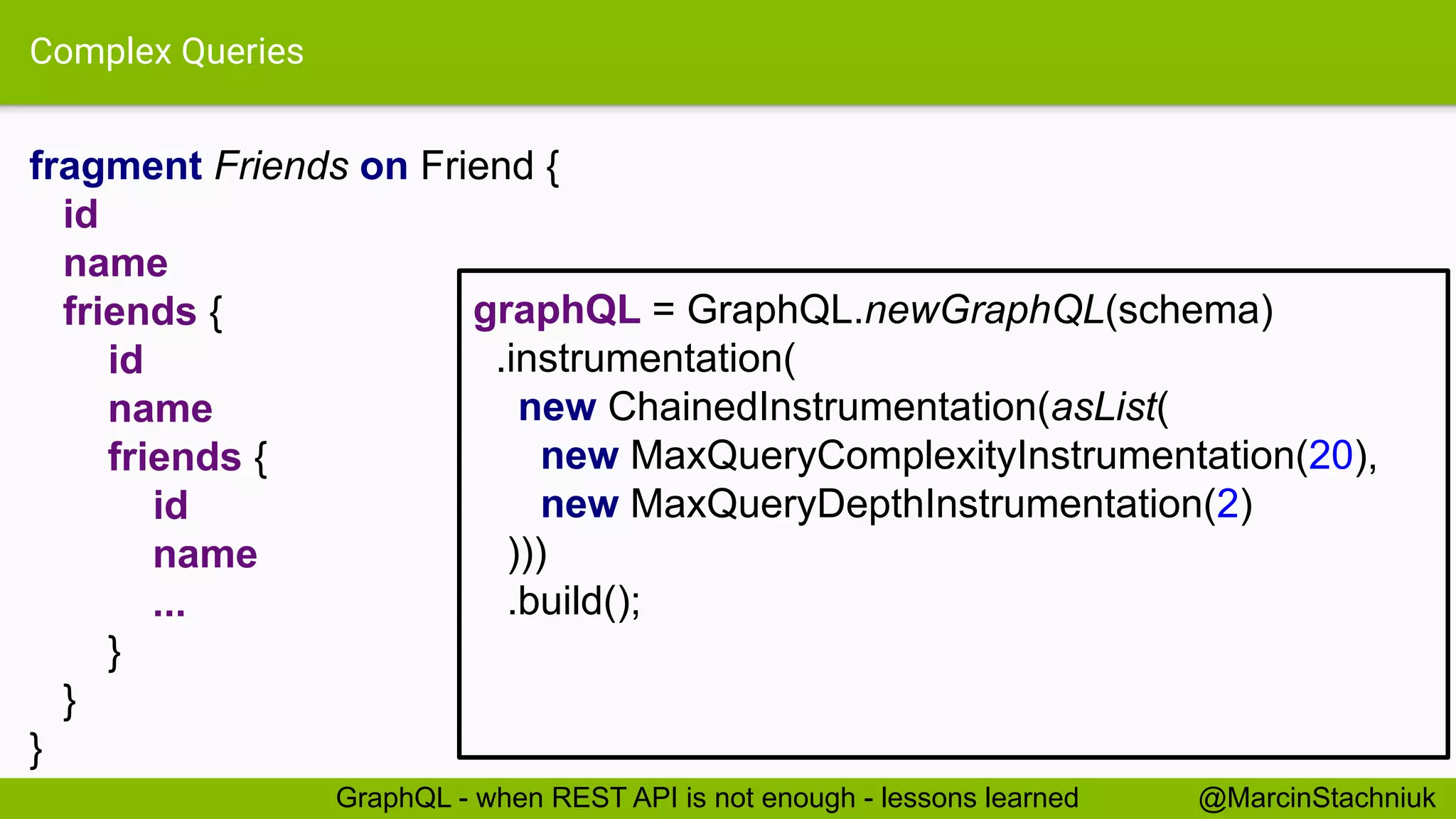
Complex Queries
fragment Friends on Friend {
id
name
friends {
id
name
friends {
id
name
...
}
}
}
@MarcinStachniukGraphQL - when REST API is not enough - lessons learned
graphQL = GraphQL.newGraphQL(schema)
.instrumentation(
new ChainedInstrumentation(asList(
new MaxQueryComplexityInstrumentation(20),
new MaxQueryDepthInstrumentation(2)
)))
.build();
Lessons Learned #4
Performance killer?
Define instrumentation!
@MarcinStachniukGraphQL - when REST API is not enough - lessons learned
Lessons Learned #5
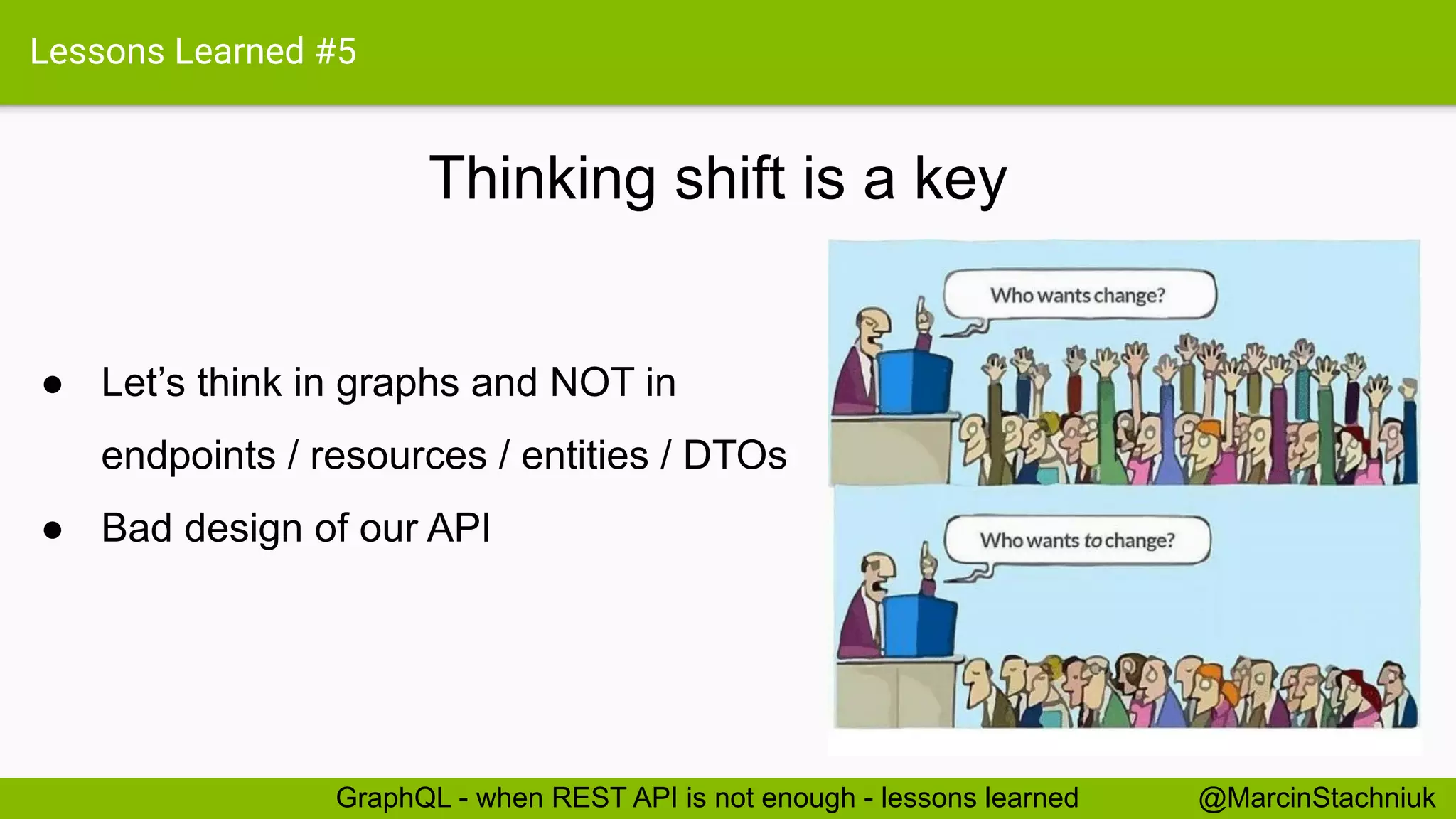
Thinking shift is a key
@MarcinStachniukGraphQL - when REST API is not enough - lessons learned
● Let’s think in graphs and NOT in
endpoints / resources / entities / DTOs
● Bad design of our API
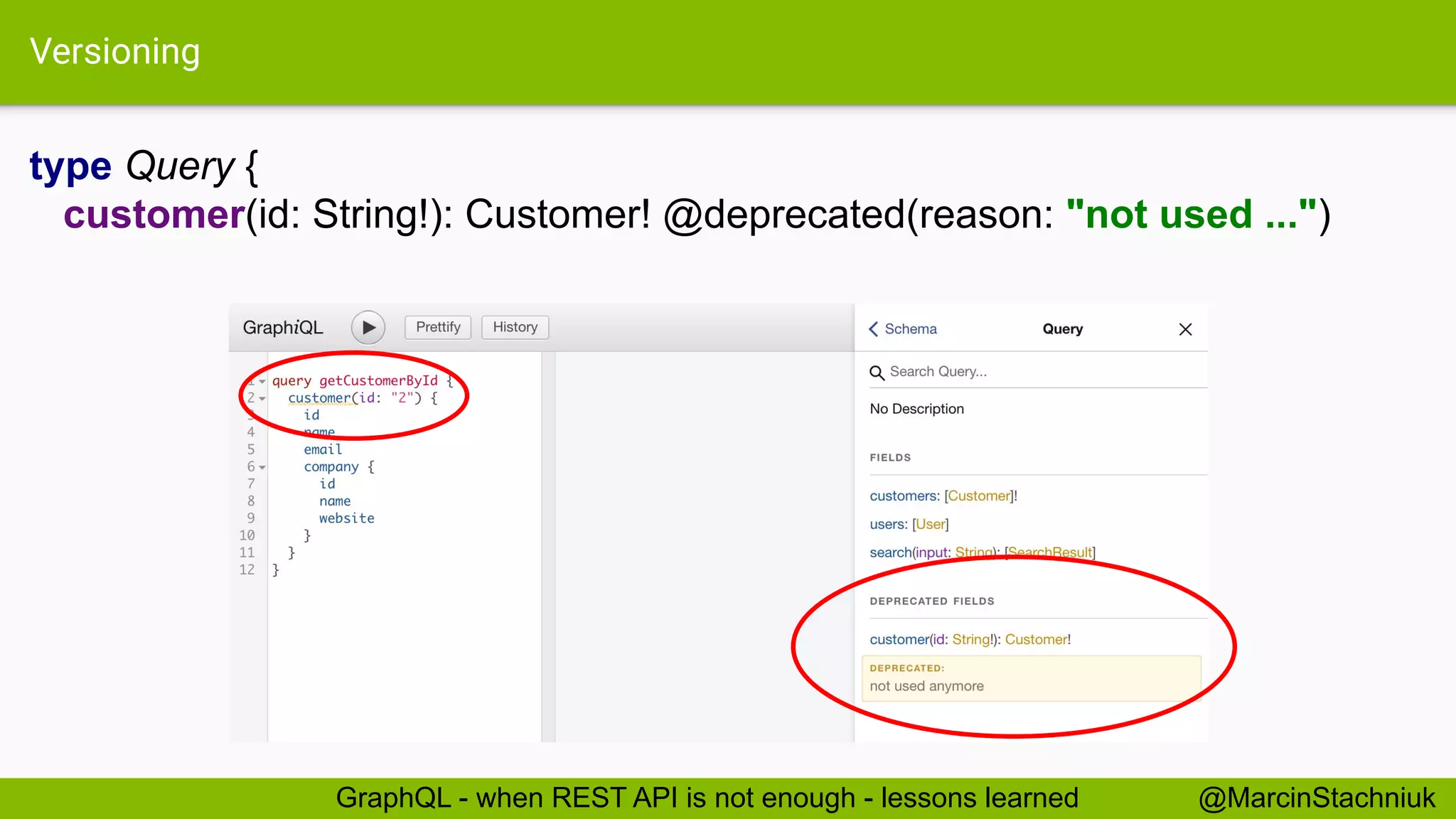
Versioning
@MarcinStachniukGraphQL - when REST API is not enough - lessons learned
GraphQL takes a strong opinion on avoiding
versioning by providing the tools for the
continuous evolution of a GraphQL schema.
Src: https://graphql.org/learn/best-practices/#versioning
Versioning
type Query {
customer(id: String!): Customer! @deprecated(reason: "not used ...")
@MarcinStachniukGraphQL - when REST API is not enough - lessons learned
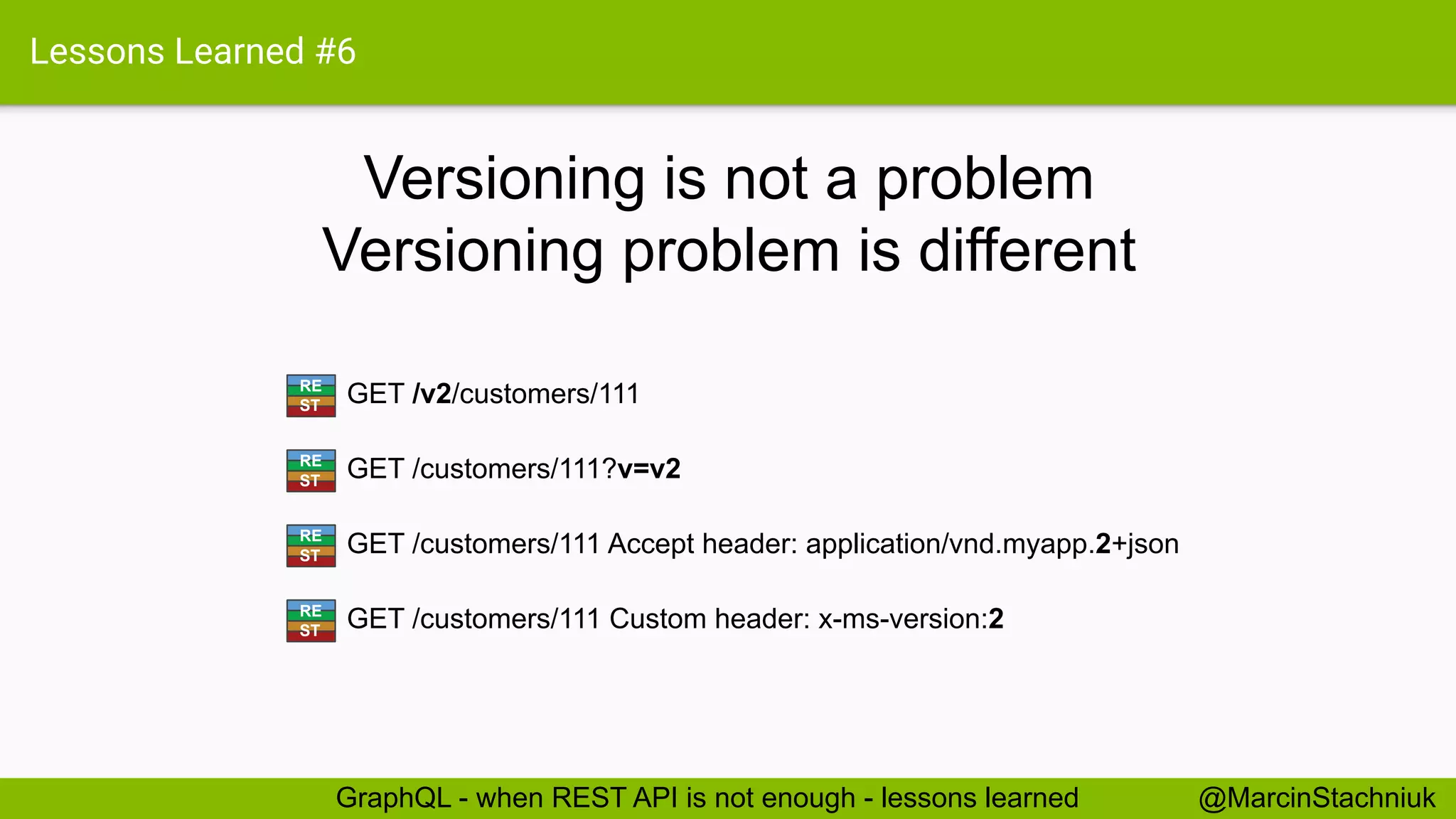
Lessons Learned #6
Versioning is not a problem
@MarcinStachniukGraphQL - when REST API is not enough - lessons learned
GET /v2/customers/111RE
ST
GET /customers/111?v=v2RE
ST
GET /customers/111 Accept header: application/vnd.myapp.2+jsonRE
ST
GET /customers/111 Custom header: x-ms-version:2RE
ST
Versioning problem is different
Tools
@MarcinStachniukGraphQL - when REST API is not enough - lessons learned
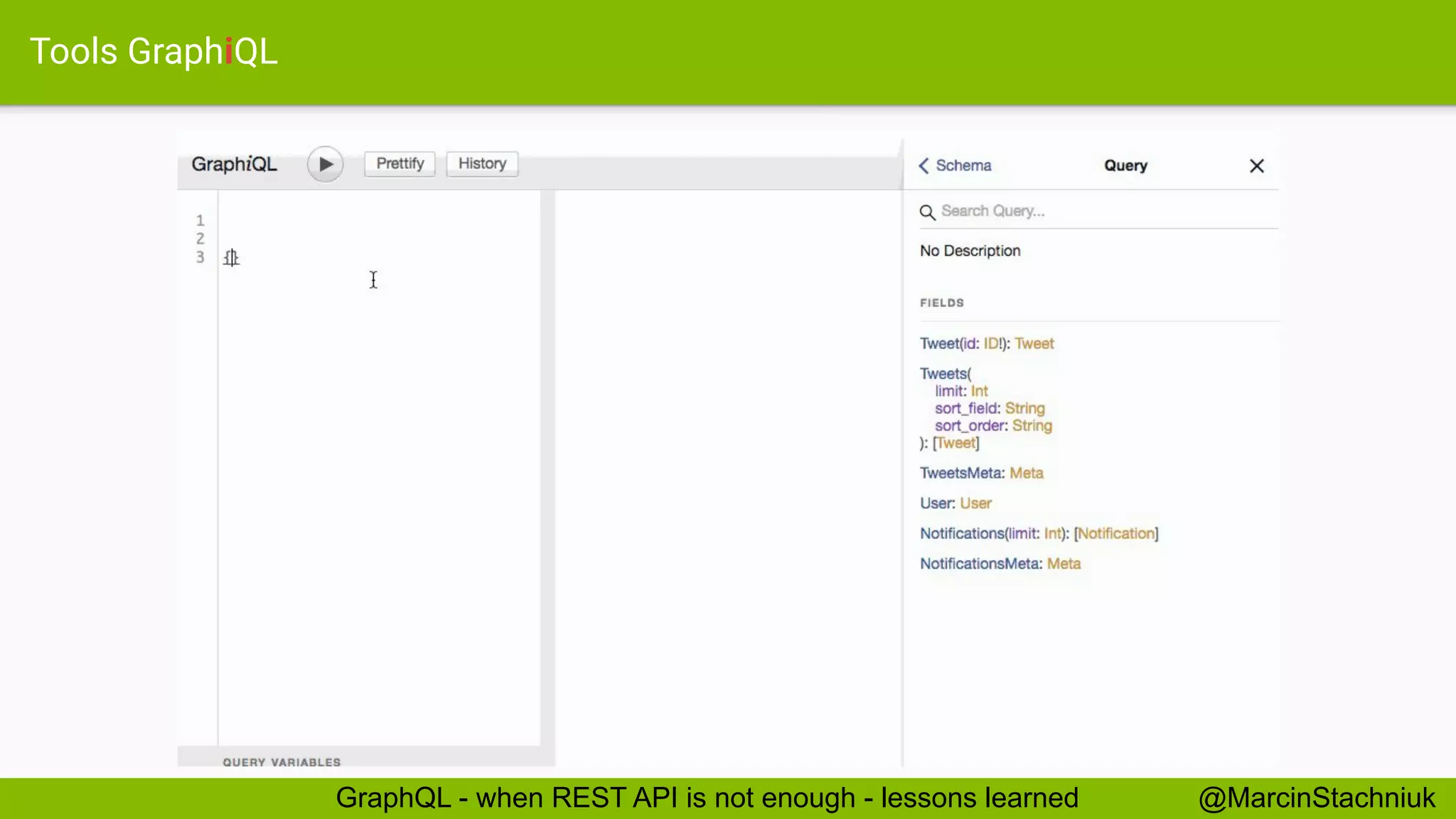
Tools GraphiQL
@MarcinStachniukGraphQL - when REST API is not enough - lessons learned
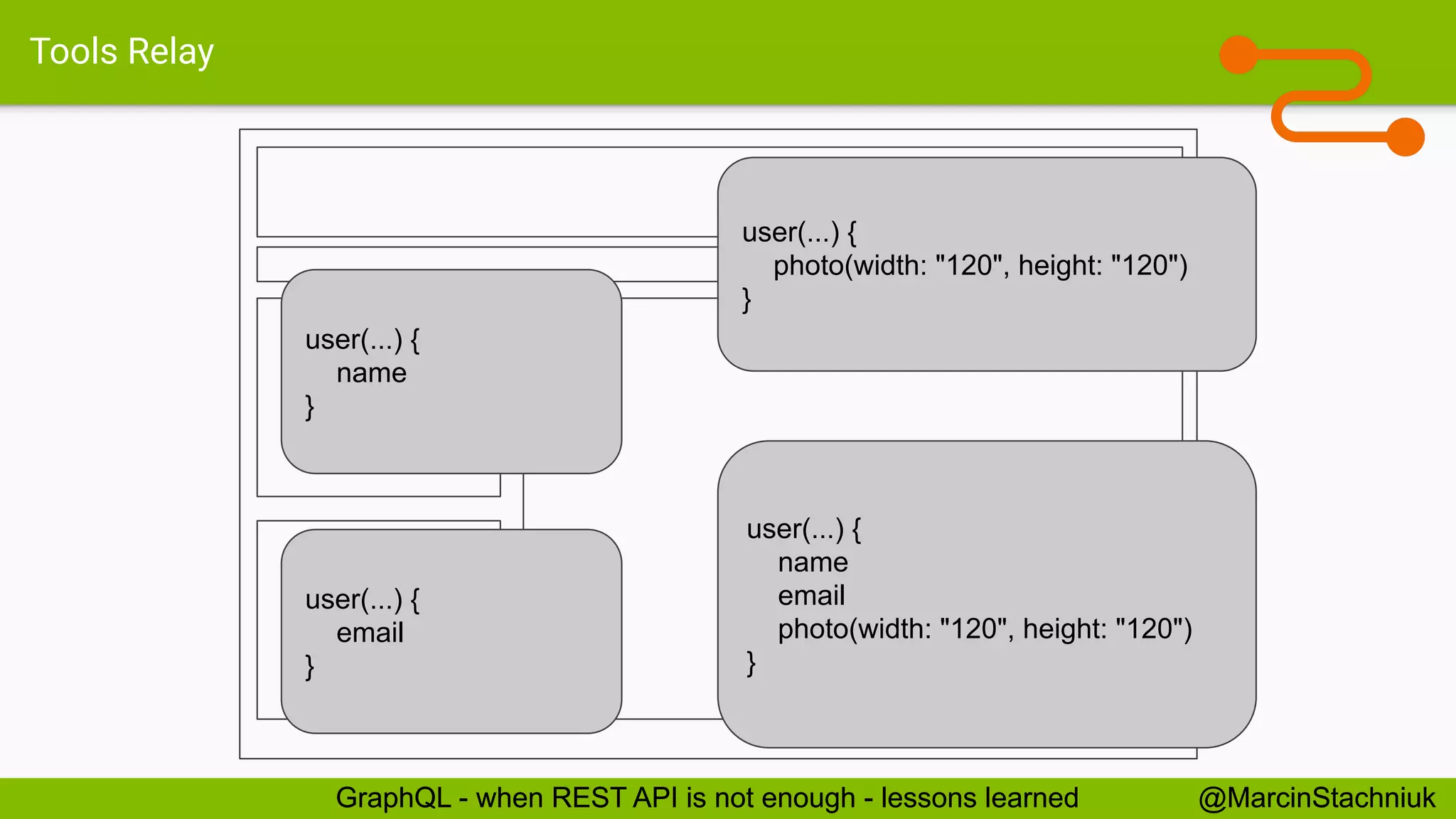
Tools Relay
@MarcinStachniukGraphQL - when REST API is not enough - lessons learned @MarcinStachniukGraphQL - when REST API is not enough - lessons learned
user(...) {
photo(width: "120", height: "120")
}
user(...) {
name
}
user(...) {
email
}
user(...) {
name
email
photo(width: "120", height: "120")
}
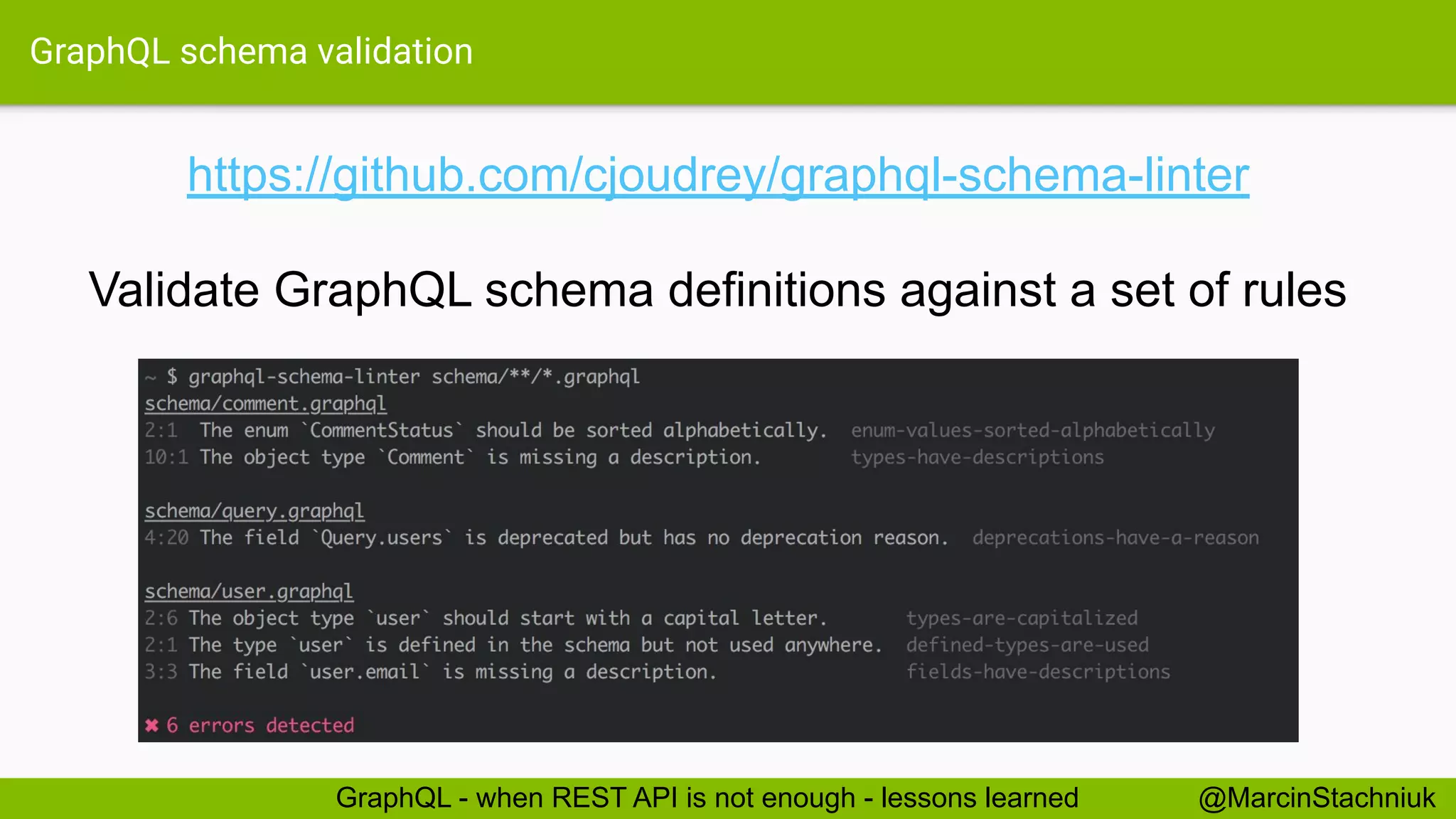
GraphQL schema validation
https://github.com/cjoudrey/graphql-schema-linter
Validate GraphQL schema definitions against a set of rules
@MarcinStachniukGraphQL - when REST API is not enough - lessons learned
GraphQL Java Tools
https://github.com/graphql-java/graphql-java-tools
Map GraphQL schema to POJOs
@MarcinStachniukGraphQL - when REST API is not enough - lessons learned
More libraries and projects related to graphql-java
https://github.com/graphql-java/awesome-graphql-java
@MarcinStachniukGraphQL - when REST API is not enough - lessons learned
● JPA Implementation of GraphQL (builds on graphql-java)
● And more examples
Apollo
@MarcinStachniukGraphQL - when REST API is not enough - lessons learned
Build a universal GraphQL API on top of your existing REST
APIs, so you can ship new application features fast without
waiting on backend changes.
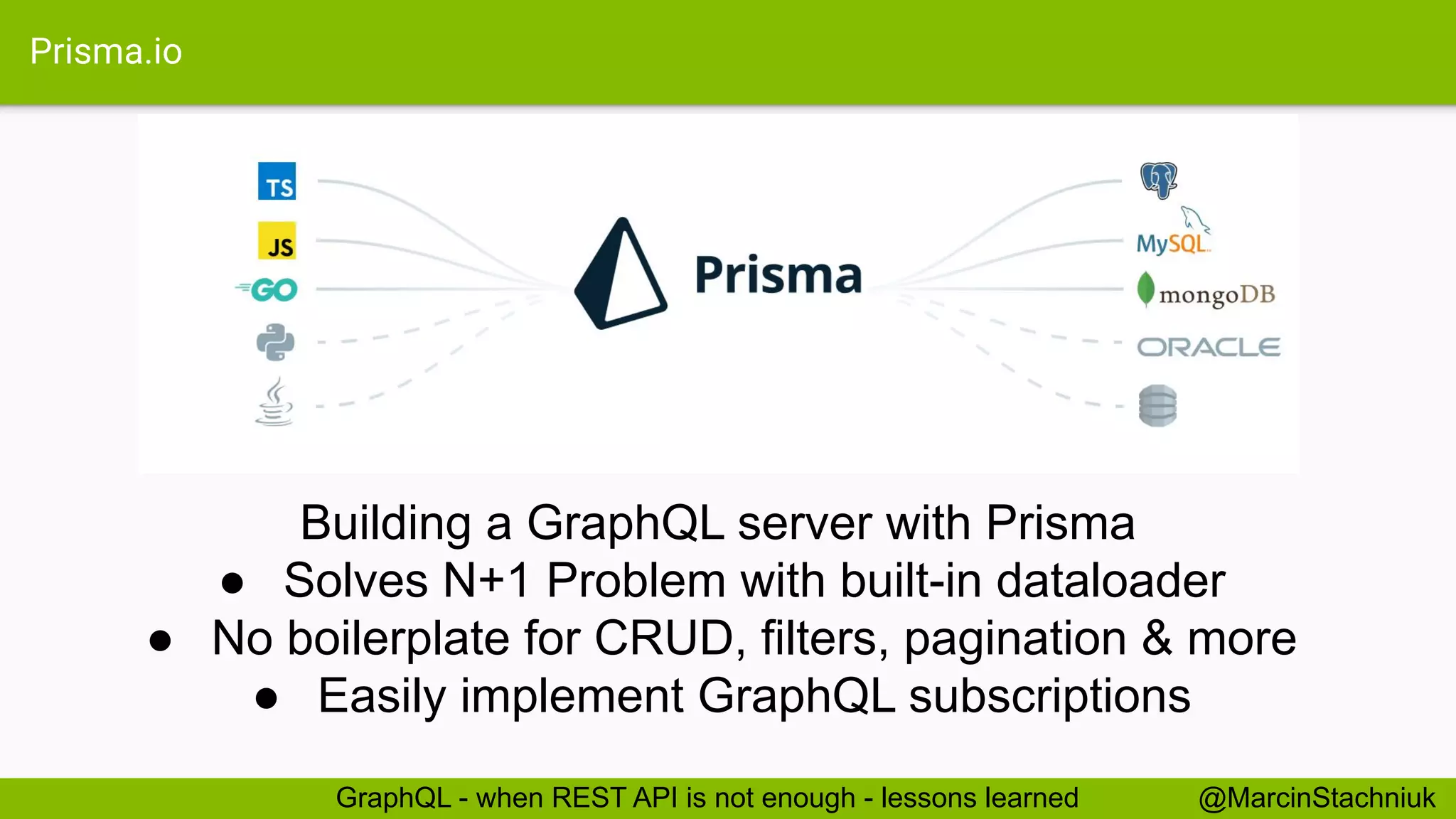
Prisma.io
@MarcinStachniukGraphQL - when REST API is not enough - lessons learned
Building a GraphQL server with Prisma
● Solves N+1 Problem with built-in dataloader
● No boilerplate for CRUD, filters, pagination & more
● Easily implement GraphQL subscriptions
Lessons Learned #7
Tooling is nice
@MarcinStachniukGraphQL - when REST API is not enough - lessons learned
now
Good practices
● Always generate GraphQL Schema and commit into your repository
● Validate your schema
● Do not use classic code first approach to define schema
@MarcinStachniukGraphQL - when REST API is not enough - lessons learned
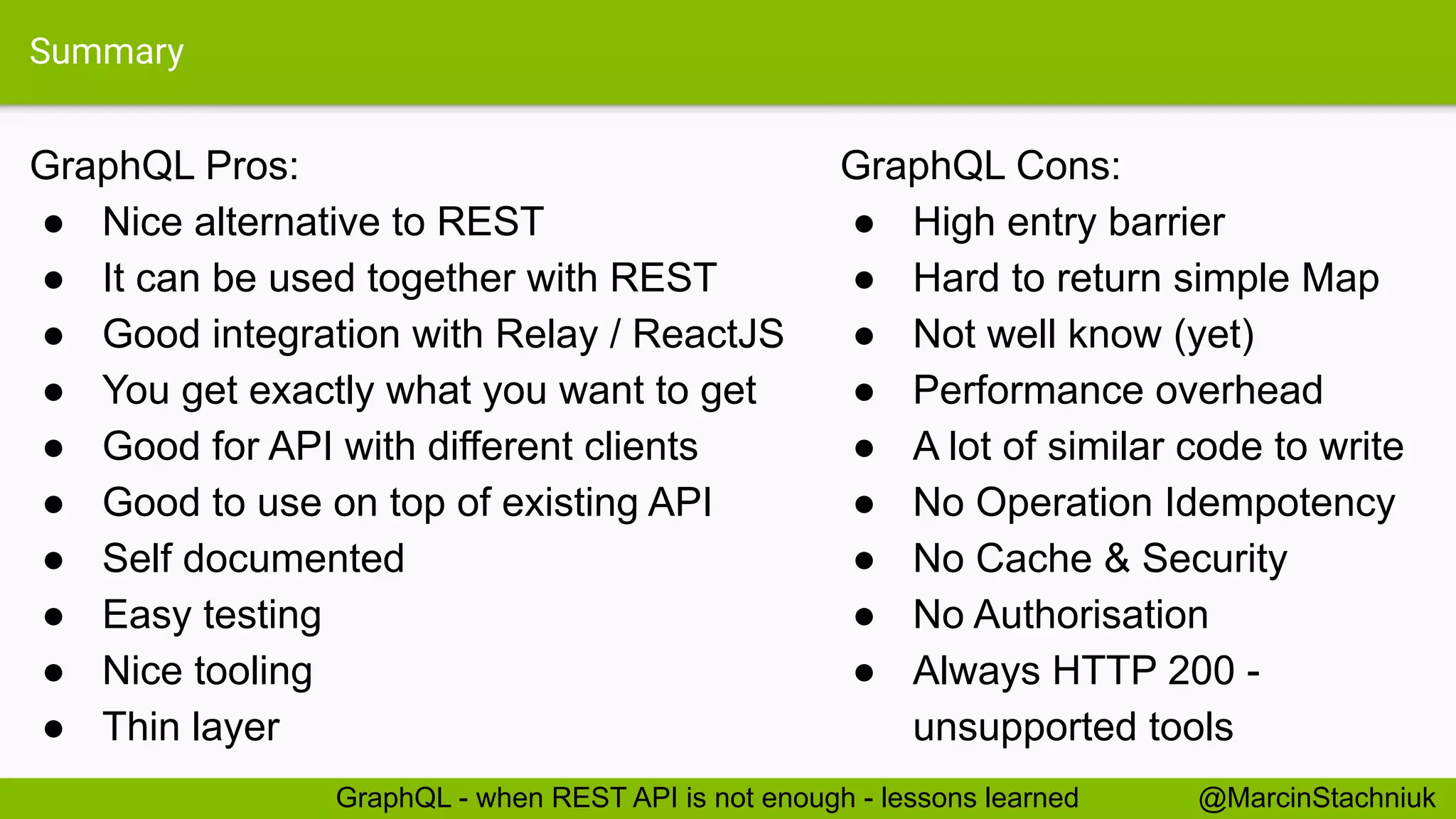
Summary
GraphQL Pros:
● Nice alternative to REST
● It can be used together with REST
● Good integration with Relay / ReactJS
● You get exactly what you want to get
● Good for API with different clients
● Good to use on top of existing API
● Self documented
● Easy testing
● Nice tooling
● Thin layer
GraphQL Cons:
● High entry barrier
● Hard to return simple Map
● Not well know (yet)
● Performance overhead
● A lot of similar code to write
● No Operation Idempotency
● No Cache & Security
● No Authorisation
● Always HTTP 200 -
unsupported tools
@MarcinStachniukGraphQL - when REST API is not enough - lessons learned
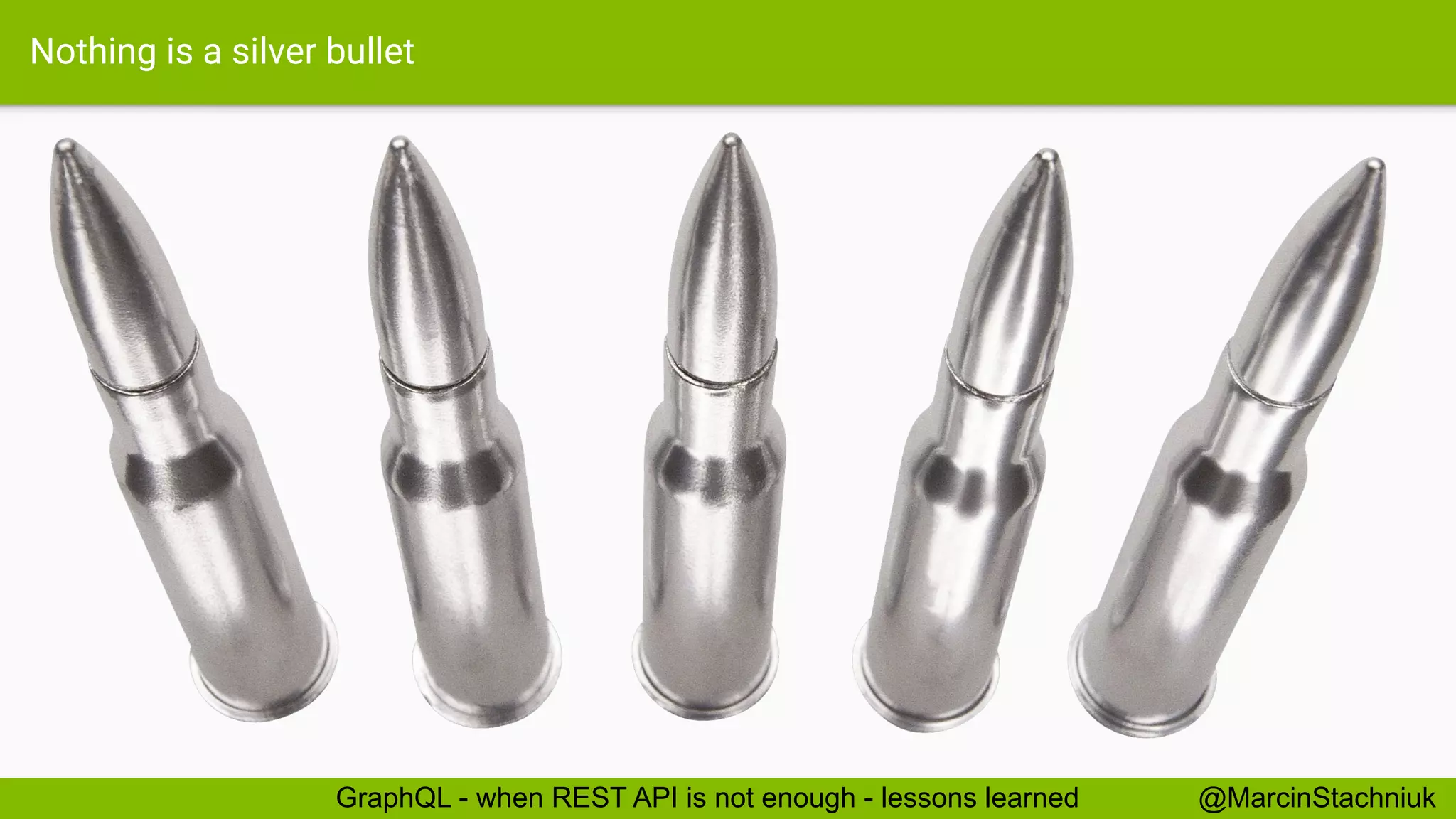
Nothing is a silver bullet
@MarcinStachniukGraphQL - when REST API is not enough - lessons learned
Q&A
@MarcinStachniukGraphQL - when REST API is not enough - lessons learned
GraphQL - when REST
API is not enough -
lessons learned
Marcin Stachniuk
Thank
you!

GraphQL - gdy API RESTowe to za mało

  • 1.
    GraphQL - whenREST API is not enough - lessons learned Marcin Stachniuk
  • 2.
  • 3.
    Who is usingREST? @MarcinStachniukGraphQL - when REST API is not enough - lessons learned
  • 4.
    REST - REpresentationalState Transfer https://api.example.com/customers/123 DELETE PUT POST GET PATCH @MarcinStachniukGraphQL - when REST API is not enough - lessons learned
  • 5.
    REST fixed response GET/customers/111 { "customer": { "id": "111", "name": "John Doe", "email": "john@doe.com", "company": { "id": "222" }, "orders": [ { "id": "333" }, { "id": "444" } ] } } { "customer": { "id": "111", "name": "John Doe", "email": "john@doe.com", "company": { "href": "https://api.example.com/companies/222" }, "orders": [ { "href": "https://api.example.com/orders/333" }, { "href": "https://api.example.com/orders/444" } ] } } RE ST @MarcinStachniukGraphQL - when REST API is not enough - lessons learned
  • 6.
    REST consequences: severalroundtrips @MarcinStachniukGraphQL - when REST API is not enough - lessons learned U nderFetching
  • 7.
    REST response withnested data GET /customers/111 { "customer": { "id": "111", "name": "John Doe", "email": "john@doe.com", "company": { "id": "222", "name": "My Awesome Corporation", "website": "MyAwesomeCorporation.com" }, "orders": [ { "id": "333", "status": "delivered", "items": [ { "id": "555", "name": "Silver Bullet", "amount": "42", "price": "10000000", "currency": "USD", "producer": { "id": "777", "name": "Lorem Ipsum", "website": "LoremIpsum.com" } } ] }, { "id": "444", "name": "Golden Hammer", "amount": "5", "price": "10000", "currency": "USD", "producer": { ... } } ] } } RE ST @MarcinStachniukGraphQL - when REST API is not enough - lessons learned O verFetching
  • 8.
    REST response withnested data and limit fields GET /customers/111?fields=name,company/*,orders.status,orders.items(name,producer/name) { "customer": { "id": "111", "name": "John Doe", "email": "john@doe.com", "company": { "id": "222", "name": "My Awesome Corporation", "website": "MyAwesomeCorporation.com" }, "orders": [ { "id": "333", "status": "delivered", "items": [ { "id": "555", "name": "Silver Bullet", "amount": "42", "price": "10000000", "currency": "USD", "producer": { "id": "777", "name": "Lorem Ipsum", "website": "LoremIpsum.com" } } ] }, { "id": "444", "name": "Golden Hammer", "amount": "5", "price": "10000", "currency": "USD", "producer": { ... } } ] } } RE ST @MarcinStachniukGraphQL - when REST API is not enough - lessons learned
  • 9.
    REST response withprojection GET /customers/111?projection=customerPreview { "customer": { "id": "111", "name": "John Doe", "email": "john@doe.com", "company": { "id": "222", "name": "My Awesome Corporation", "website": "MyAwesomeCorporation.com" }, "orders": [ { "id": "333", "status": "delivered", "items": [ { "id": "555", "name": "Silver Bullet", "amount": "42", "price": "10000000", "currency": "USD", "producer": { "id": "777", "name": "Lorem Ipsum", "website": "LoremIpsum.com" } } ] }, { "id": "444", "name": "Golden Hammer", "amount": "5", "price": "10000", "currency": "USD", "producer": { ... } } ] } } RE ST @MarcinStachniukGraphQL - when REST API is not enough - lessons learned
  • 10.
    Platform Architecture -How to define a good API? Platform App 1 App 2 Customer App X... @MarcinStachniukGraphQL - when REST API is not enough - lessons learned
  • 11.
    Modularisation at UI @MarcinStachniukGraphQL- when REST API is not enough - lessons learned
  • 12.
    New Frontend Framework ReactJS RelayGraphQL TypeScript @MarcinStachniukGraphQL - when REST API is not enough - lessons learned
  • 13.
    GraphQL ● Graph QueryLanguage ● Published by Facebook in 2015 ● Growth from Facebook Graph API ● Reference implementation in JavaScript ● First version of Java Library: 18 Jul 2015 https://github.com/graphql-java/graphql-java ● First usage: 21 Sep 2015 @MarcinStachniukGraphQL - when REST API is not enough - lessons learned
  • 14.
    GraphQL main concepts ●One endpoint for all operations ● Always define in request what you need ● Queries, Mutations and Subscriptions ● Defined by schema @MarcinStachniukGraphQL - when REST API is not enough - lessons learned
  • 15.
    Data is agraph @MarcinStachniukGraphQL - when REST API is not enough - lessons learned
  • 16.
    GraphQL time fordemo ● Fragments ● Aliases ● Directives ● Interfaces ● Unions @MarcinStachniukGraphQL - when REST API is not enough - lessons learned ● Query ● Syntax Error ● Mutation ● Operation name ● Variables
  • 17.
    GraphQL Simple API GET/customers/2?fields=id,name,email type Customer { #fields with ! are not null id: ID! name: String! email: String! } type Query { customer(id: String!): Customer! } { "data": { "customer": { "id": "2", "name": "name", "email": "a@b.com" } } } { customer(id: "2") { id name email } } RE ST @MarcinStachniukGraphQL - when REST API is not enough - lessons learned
  • 18.
    GraphQL Bad Request GET/custo!@#$ -> 404 { "data": null, "errors": [ { "message": "Invalid Syntax", "locations": [ { "line": 2, "column": 8 } ], "errorType": "InvalidSyntax", "path": null, "extensions": null } ] } { custo!@#$ } RE ST http.cat/200 @MarcinStachniukGraphQL - when REST API is not enough - lessons learned
  • 19.
    Go back tothe roots @MarcinStachniukGraphQL - when REST API is not enough - lessons learned
  • 20.
    GraphQL Simple API GET/customers/2?fields=id,name,email,company(id,name) type Customer { id: ID! name: String! email: String! company: Company } type Company { id: ID! name: String! website: String! } type Query { customer(id: String!): Customer! } { "data": { "customer": { "id": "2", "name": "name", "email": "a@b.com", "company": { "id": "211", "name": "Company Corp." } } } } { customer(id: "2") { id name email company { id name } } } RE ST @MarcinStachniukGraphQL - when REST API is not enough - lessons learned
  • 21.
    GraphQL Simple API GET/customers/2?fields=id,name,email,orders(id,status) type Customer { id: ID! name: String! email: String! company: Company orders: [Order] } type Order { id: ID! status: Status } enum Status { NEW, CANCELED, DONE } { "data": { "customer": { "id": "2", "name": "name", "orders": [ { "id": "55", "status": "NEW" }, { "id": "66", "status": "DONE" } ] } } } { customer(id: "2") { id name orders { id status } } } RE ST @MarcinStachniukGraphQL - when REST API is not enough - lessons learned
  • 22.
    GraphQL Aliases GET /customers/2?fields=id,name,email+ { "data": { "cust1": { "id": "2", "name": "name", "email": "a@b.com" }, "cust2": { "id": "3", "name": "John Doe", "email": "john@doe.com" } } } query get2Cust { cust1: customer(id: "2") { id name email } cust2: customer(id: "3") { id name email } } RE ST @MarcinStachniukGraphQL - when REST API is not enough - lessons learned GET /customers/3?fields=id,name,emailRE ST
  • 23.
    GraphQL Fragment GET /customers/2?fields=id,name,email+ { "data": { "cust1": { "id": "2", "name": "name", "email": "a@b.com" }, "cust2": { "id": "3", "name": "John Doe", "email": "john@doe.com" } } } query get2Cust { cust1: customer(id: "2") { ... frag1 } cust2: customer(id: "3") { ... frag1 } } fragment frag1 on Customer { id name email } RE ST @MarcinStachniukGraphQL - when REST API is not enough - lessons learned GET /customers/3?fields=id,name,emailRE ST
  • 24.
    GraphQL Arguments GET /customers/2?fields=id,name,email+ { "data": { "cust1": { "id": "2", "name": "name", "email": "a@b.com" }, "cust2": { "id": "3", "name": "John Doe", "email": "john@doe.com" } } } query get2Cust($arg1:String!, $arg2: String!) { cust2: customer(id: $arg1) { ... frag1 } cust3: customer(id: $arg2) { ... frag1 } } fragment frag1 on Customer { id name email } RE ST @MarcinStachniukGraphQL - when REST API is not enough - lessons learned GET /customers/3?fields=id,name,emailRE ST
  • 25.
    GraphQL Directive GET /customers/2?fields=id,name { "data":{ "customer": { "id": "2", "name": "name" } } } query getCust ($showEmail: Boolean!) { customer(id: "2") { id name email @include(if: $showEmail) } } { "showEmail": false } RE ST @MarcinStachniukGraphQL - when REST API is not enough - lessons learned
  • 26.
    GraphQL Interface GET /users?fields=id,name,superAdmin,permissions typeQuery { users: [User] } interface User { id: ID! name: String! email: String! } type Admin implements User { superAdmin: Boolean! // + id... } type Moderator implements User { permissions: [String] // + id... } { "data": { "users": [ { "id": "777", "name": "Admin a", "superAdmin": true }, { "id": "888", "name": "Moderator", "permissions": [ "Delete Customer", "Delete comment" ]}]}} query getUsers { users { ... on Admin { id name superAdmin } ... on Moderator { id name permissions } } } RE ST @MarcinStachniukGraphQL - when REST API is not enough - lessons learned
  • 27.
    GraphQL Union GET /search?input=a?fields=typename,name typeQuery { search(input: String): [SearchResult] } union SearchResult = Customer | Admin | Moderator { "data": { "search": [ { "__typename": "Customer", "name": "name" }, { "__typename": "Admin", "name": "Admin a" }, { "__typename": "Moderator", "name": "Moderator" }]}} query searchSmth { search(input: "a") { __typename ... on Customer { name } ... on Admin { name } ... on Moderator { name } } } RE ST @MarcinStachniukGraphQL - when REST API is not enough - lessons learned
  • 28.
    GraphQL mutations input CreateCustomerInput{ name: String email: String clientMutationId: String! } type CreateCustomerPayload { customer: Customer clientMutationId: String! } type Mutation { createCustomer(input: CreateCustomerInput): CreateCustomerPayload! } { "data": { "createCustomer": { "customer": { "id": "40", }, "clientMutationId": "123" } } } POST /customers PUT /customers/123 DELETE /customers/123 PATCH /customers/123 mutation { createCustomer(input: { name: "MyName" email: "me@me.com" clientMutationId: "123" }) { customer { id } clientMutationId } } RE ST @MarcinStachniukGraphQL - when REST API is not enough - lessons learned
  • 29.
    GraphQL mutations +operation name mutation crCust { createCustomer(input: { name: "MyName" email: "me@me.com" clientMutationId: "123" }) { customer { id } clientMutationId } } { "data": { "createCustomer": { "customer": { "id": "40", }, "clientMutationId": "123" } } } POST /customers PUT /customers/123 DELETE /customers/123 PATCH /customers/123RE ST @MarcinStachniukGraphQL - when REST API is not enough - lessons learned mutation { createCustomer(input: { name: "MyName" email: "me@me.com" clientMutationId: "123" }) { customer { id } clientMutationId } }
  • 30.
    GraphQL Variables { "data": { "createCustomer":{ "customer": { "id": "40", }, "clientMutationId": "123" } } } POST /customers PUT /customers/123 DELETE /customers/123 PATCH /customers/123 mutation crCust { createCustomer(input: { name: "MyName" email: "me@me.com" clientMutationId: "123" }) { customer { id } clientMutationId } } RE ST @MarcinStachniukGraphQL - when REST API is not enough - lessons learned mutation crCust ($input: CreateCustInput) { createCustomer(input: $input) { customer { id } clientMutationId } } { "input": { "name": "MyName 2", "email": "me2@me.com", "clientMutationId": "123" } }
  • 31.
    Lessons Learned #1 Neveradd a library to your project few days after init release @MarcinStachniukGraphQL - when REST API is not enough - lessons learned ● No community ● A lot of bugs ● Bad documentation ● Strict following reference implementation and specification DO NOT TRY THIS AT WORK
  • 32.
    GraphQL Java implementations Howto implement GraphQL in Java? @MarcinStachniukGraphQL - when REST API is not enough - lessons learned /graphql-java/graphql-java /leangen/graphql-spqr Senātus Populusque Rōmānus The Roman Senate and People pronounced like speaker
  • 33.
    GraphQL Simple API GET/customers/2?fields=id,name,email,orders(id,status) type Customer { id: ID! name: String! email: String! company: Company orders: [Order] } type Order { id: ID! status: Status } enum Status { NEW, CANCELED, DONE } { "data": { "customer": { "id": "2", "name": "name", "orders": [ { "id": "55", "status": "NEW" }, { "id": "66", "status": "DONE" } ] } } } { customer(id: "2") { id name orders { id status } } } RE ST @MarcinStachniukGraphQL - when REST API is not enough - lessons learned
  • 34.
    How to implementDataFetcher for queries GET /customers/2?fields=id,name,email,orders(id,status) @Component public class CustomerFetcher extends PropertyDataFetcher<Customer> { @Autowired private CustomerService customerService; @Override public Customer get(DataFetchingEnvironment environment) { String id = environment.getArgument("id"); return customerService.getCustomerById(id); } } RE ST { customer(id: "2") { id name orders { id status } } } @MarcinStachniukGraphQL - when REST API is not enough - lessons learned
  • 35.
    How to implementDataFetcher for queries GET /customers/2?fields=id,name,email,orders(id,status) public class Customer { private String id; private String name; private String email; // getters are not required } RE ST { customer(id: "2") { id name orders { id status } } } @MarcinStachniukGraphQL - when REST API is not enough - lessons learned public class OrderDataFetcher extends PropertyDataFetcher<List<Order>> { @Override public List<Order> get(DataFetchingEnvironment environment) { Customer source = environment.getSource(); String customerId = source.getId(); return orderService.getOrdersByCustomerId(customerId); } }
  • 36.
    GraphQL mutations input CreateCustomerInput{ name: String email: String clientMutationId: String! } type CreateCustomerPayload { customer: Customer clientMutationId: String! } type Mutation { createCustomer(input: CreateCustomerInput): CreateCustomerPayload! } { "data": { "createCustomer": { "customer": { "id": "40", }, "clientMutationId": "123" } } } POST /customers PUT /customers/123 DELETE /customers/123 PATCH /customers/123 mutation { createCustomer(input: { name: "MyName" email: "me@me.com" clientMutationId: "123" }) { customer { id } clientMutationId } } RE ST @MarcinStachniukGraphQL - when REST API is not enough - lessons learned
  • 37.
    How to implementDataFetcher for mutations POST /customers PUT /customers/123 DELETE /customers/123 PATCH /customers/123 @Component public class CreateCustomersFetcher extends PropertyDataFetcher<CreateCustomersPayload> { @Override public CreateCustomerPayload get(DataFetchingEnvironment env) { Map<String, Object> input = env.getArgument("input"); String name = (String) input.get("name"); String email = (String) input.get("email"); String clientMutationId = (String) input.get("clientMutationId"); Customer customer = customerService.create(name, email); return new CreateCustomerPayload(customer, clientMutationId); } RE ST mutation { createCustomer(input: { name: "MyName" email: "me@me.com" clientMutationId: "123" }) { customer { id } clientMutationId } } @MarcinStachniukGraphQL - when REST API is not enough - lessons learned
  • 38.
    In case Interfacesand Unions - Type Resolver is needed public class UserTypeResolver implements TypeResolver { @Override public GraphQLObjectType getType(TypeResolutionEnvironment env) { Object javaObject = env.getObject(); if (javaObject instanceof Admin) { return env.getSchema().getObjectType("Admin"); } else if (javaObject instanceof Moderator) { return env.getSchema().getObjectType("Moderator"); } else { throw new RuntimeException("Unknown type " + javaObject.getClass().getName()); } } } public interface User {...} public class Admin implements User {...} public class Moderator implements User {...} @MarcinStachniukGraphQL - when REST API is not enough - lessons learned
  • 39.
    Glue everything together RuntimeWiringruntimeWiring = RuntimeWiring.newRuntimeWiring() .type("Query", builder -> builder.dataFetcher("customer", customerFetcher)) .type("Mutation", builder -> builder.dataFetcher("createCustomer", createCustomerFetcher)) .type(newTypeWiring("User") .typeResolver(new UserTypeResolver()) .build()) ... .build(); @MarcinStachniukGraphQL - when REST API is not enough - lessons learned
  • 40.
    GraphQL type system Howto define your schema? @MarcinStachniukGraphQL - when REST API is not enough - lessons learned
  • 41.
    Code First approach privateGraphQLFieldDefinition customerDefinition() { return GraphQLFieldDefinition.newFieldDefinition() .name("customer") .argument(GraphQLArgument.newArgument() .name("id") .type(new GraphQLNonNull(GraphQLString))) .type(new GraphQLNonNull(GraphQLObjectType.newObject() .name("Customer") .field(GraphQLFieldDefinition.newFieldDefinition() .name("id") .description("fields with ! are not null") .type(new GraphQLNonNull(GraphQLID)) .build()) …. .build())) .dataFetcher(customerFetcher) .build(); } Schema First approach type Query { customer(id: String!): Customer! } type Customer { #fields with ! are not null id: ID! name: String! email: String! company: Company orders: [Order] } @MarcinStachniukGraphQL - when REST API is not enough - lessons learned
  • 42.
    Schema First approach typeCustomer { # fields with ! are required id: ID! name: String! email: String! company: Company orders: [Order] } *.graphqls SchemaParser schemaParser = new SchemaParser(); File file = // ... TypeDefinitionRegistry registry = schemaParser.parse(file); SchemaGenerator schemaGenerator = new SchemaGenerator(); RuntimeWiring runtimeWiring = RuntimeWiring.newRuntimeWiring() .type("Query", builder -> builder.dataFetcher("customer", customerFetcher)) // ... .build(); return schemaGenerator.makeExecutableSchema(registry, runtimeWiring); @MarcinStachniukGraphQL - when REST API is not enough - lessons learned
  • 43.
    GraphQL SPQR @MarcinStachniukGraphQL -when REST API is not enough - lessons learned
  • 44.
    SPQR approach public classUserService { @GraphQLQuery(name = "user") public User getById(@GraphQLArgument(name = "id") Integer id) { //... } } @MarcinStachniukGraphQL - when REST API is not enough - lessons learned public class User { //... @GraphQLQuery(name = "name", description = "A person's name") public String getName() { return name; } } By default argument names will be arg0, arg1,... You can use @GraphQLArgument or Compile code with -parameters option
  • 45.
    SPQR approach -Smart conventions @GraphQLType(name = "Item") public class SpqrItem { private String id; private int amount; // ... @GraphQLId @GraphQLNonNull @GraphQLQuery(name = "id", description = "Item id") public String getId() { return id; } public int getAmount() { return amount; } } @MarcinStachniukGraphQL - when REST API is not enough - lessons learned // 'ID' type in schema, add 'implements Node' // add ! (non null) in schema // optional // add ! (non null) because it’s int
  • 46.
    Classic Code FirstApproach Pros: ● Stable library ● Some Javadoc and documentation ● It was the only way at the beginning to define a schema @MarcinStachniukGraphQL - when REST API is not enough - lessons learned Cons: ● Hard to maintain ● Missing big picture ● Backend part needs to be implemented first ● One DataFetcher for one operation ● No possibility to mix with Schema First ● No easy way to migrate to Schema First or SPQR
  • 47.
    Schema First Approach Pros: ●Easy to maintain ● Stable library ● Some Javadoc and documentation ● Easy DSL to understand and maintain ● Reduce boilerplate to write ● A possibility to split schema into more files ● Parallel development (frontend & backend) @MarcinStachniukGraphQL - when REST API is not enough - lessons learned Cons: ● Possible mismatch between types in schema file and Java code ● Binding between operations defined in schema and DataFetcher's is needed ● One DataFetcher for one operation
  • 48.
    SPQR Approach Pros: ● Theauthor reply to Github issues quickly ● Reduce boilerplate to write ● No mismatch between Schema and Java code ● No binding between schema and DataFetchers is needed ● Smart conventions @MarcinStachniukGraphQL - when REST API is not enough - lessons learned Cons: ● Production ready? ● Zero Javadoc or other documentation ● Missing big picture ● Backend part needs to be implemented first ● Ugly names for generics: MutationPayload<User> => MutationPayload_User ● Hard to change smart conventions
  • 49.
    Lessons Learned #2 ClassicCode First Approach is the worst @MarcinStachniukGraphQL - when REST API is not enough - lessons learned ● Big project ● High risk project ● Old project ● Small project ● Low risk project ● New Project ?
  • 50.
    From Code Firstto Schema First migration https://github.com/mstachniuk/graphql-schema-from-introspection-generator @MarcinStachniukGraphQL - when REST API is not enough - lessons learned
  • 51.
    From Code Firstto Schema First migration alternatives ● In graphql-java - see: IntrospectionResultToSchema ● In graphql-js: const graphql = require("graphql"); const schema = require("path/to/schema.json"); const clientSchema = graphql.buildClientSchema(schema.data); const schemaString = graphql.printSchema(clientSchema); console.log(schemaString) @MarcinStachniukGraphQL - when REST API is not enough - lessons learned
  • 52.
    GraphQL - Howto define pagination, filtering, sorting? Pagination: ● before, after ● offset, limit Filtering: ● filter(name: “Bob” email: “%@gmail.com”) ● filter: { OR: [{ email: “%@gmail.com” }] }, name: “Bob” } Sorting: ● orderBy: ASC, DESC ● sort: NEWEST, IMPORTANCE @MarcinStachniukGraphQL - when REST API is not enough - lessons learned
  • 53.
    Lessons Learned #3 GraphQLis not full query language @MarcinStachniukGraphQL - when REST API is not enough - lessons learned ● Flexibility ● Less common conventions ● Dgraph.io created GraphQL+-
  • 54.
    Complex Queries fragment Friendson Friend { id name friends { id name friends { id name ... } } } @MarcinStachniukGraphQL - when REST API is not enough - lessons learned graphQL = GraphQL.newGraphQL(schema) .instrumentation( new ChainedInstrumentation(asList( new MaxQueryComplexityInstrumentation(20), new MaxQueryDepthInstrumentation(2) ))) .build();
  • 55.
    Lessons Learned #4 Performancekiller? Define instrumentation! @MarcinStachniukGraphQL - when REST API is not enough - lessons learned
  • 56.
    Lessons Learned #5 Thinkingshift is a key @MarcinStachniukGraphQL - when REST API is not enough - lessons learned ● Let’s think in graphs and NOT in endpoints / resources / entities / DTOs ● Bad design of our API
  • 57.
    Versioning @MarcinStachniukGraphQL - whenREST API is not enough - lessons learned GraphQL takes a strong opinion on avoiding versioning by providing the tools for the continuous evolution of a GraphQL schema. Src: https://graphql.org/learn/best-practices/#versioning
  • 58.
    Versioning type Query { customer(id:String!): Customer! @deprecated(reason: "not used ...") @MarcinStachniukGraphQL - when REST API is not enough - lessons learned
  • 59.
    Lessons Learned #6 Versioningis not a problem @MarcinStachniukGraphQL - when REST API is not enough - lessons learned GET /v2/customers/111RE ST GET /customers/111?v=v2RE ST GET /customers/111 Accept header: application/vnd.myapp.2+jsonRE ST GET /customers/111 Custom header: x-ms-version:2RE ST Versioning problem is different
  • 60.
    Tools @MarcinStachniukGraphQL - whenREST API is not enough - lessons learned
  • 61.
    Tools GraphiQL @MarcinStachniukGraphQL -when REST API is not enough - lessons learned
  • 62.
    Tools Relay @MarcinStachniukGraphQL -when REST API is not enough - lessons learned @MarcinStachniukGraphQL - when REST API is not enough - lessons learned user(...) { photo(width: "120", height: "120") } user(...) { name } user(...) { email } user(...) { name email photo(width: "120", height: "120") }
  • 63.
    GraphQL schema validation https://github.com/cjoudrey/graphql-schema-linter ValidateGraphQL schema definitions against a set of rules @MarcinStachniukGraphQL - when REST API is not enough - lessons learned
  • 64.
    GraphQL Java Tools https://github.com/graphql-java/graphql-java-tools MapGraphQL schema to POJOs @MarcinStachniukGraphQL - when REST API is not enough - lessons learned
  • 65.
    More libraries andprojects related to graphql-java https://github.com/graphql-java/awesome-graphql-java @MarcinStachniukGraphQL - when REST API is not enough - lessons learned ● JPA Implementation of GraphQL (builds on graphql-java) ● And more examples
  • 66.
    Apollo @MarcinStachniukGraphQL - whenREST API is not enough - lessons learned Build a universal GraphQL API on top of your existing REST APIs, so you can ship new application features fast without waiting on backend changes.
  • 67.
    Prisma.io @MarcinStachniukGraphQL - whenREST API is not enough - lessons learned Building a GraphQL server with Prisma ● Solves N+1 Problem with built-in dataloader ● No boilerplate for CRUD, filters, pagination & more ● Easily implement GraphQL subscriptions
  • 68.
    Lessons Learned #7 Toolingis nice @MarcinStachniukGraphQL - when REST API is not enough - lessons learned now
  • 69.
    Good practices ● Alwaysgenerate GraphQL Schema and commit into your repository ● Validate your schema ● Do not use classic code first approach to define schema @MarcinStachniukGraphQL - when REST API is not enough - lessons learned
  • 70.
    Summary GraphQL Pros: ● Nicealternative to REST ● It can be used together with REST ● Good integration with Relay / ReactJS ● You get exactly what you want to get ● Good for API with different clients ● Good to use on top of existing API ● Self documented ● Easy testing ● Nice tooling ● Thin layer GraphQL Cons: ● High entry barrier ● Hard to return simple Map ● Not well know (yet) ● Performance overhead ● A lot of similar code to write ● No Operation Idempotency ● No Cache & Security ● No Authorisation ● Always HTTP 200 - unsupported tools @MarcinStachniukGraphQL - when REST API is not enough - lessons learned
  • 71.
    Nothing is asilver bullet @MarcinStachniukGraphQL - when REST API is not enough - lessons learned
  • 72.
    Q&A @MarcinStachniukGraphQL - whenREST API is not enough - lessons learned
  • 73.
    GraphQL - whenREST API is not enough - lessons learned Marcin Stachniuk Thank you!