Overview of

GraphQL & Clients
! # @zetavg

fb.me/pokaichang72
My Background
⬢ Building stuff as a web developer from
2012
⬢ Shallow experiences covered from
design, mobile, front-end and backend
develop to cloud deployments (AWS)
⬢ Fan of GraphQL/Relay of its beauty of
API design since 2015
⬢ Working at with Ruby,
JavaScript (React.js) and playing Elixir
⬢ Former tech lead at Colorgy
! # @zetavg

fb.me/pokaichang72
⬡ Complain about RESTful Introduce GraphQL
⬡ Just enough GraphQL to get started
⬡ GraphQL client library overview
⬡ Intro to Relay
⬡ Demo: GraphQL & Relay on Rails

https://github.com/zetavg/RailsRelayTodoMVC
Outline
Background of API
Developing
The evolution of API
⬢ RESTful: Easy to use, easy to develop
⬡ Directly based on Wide World Web
⬡ URI as resource name (noun), HTTP method as
action (verb)
⬡ We need documents: Swagger...
⬡ ...and type definitions: JSON Schema
⬡ ...and data relations: JSON API
⬡ Combine them all: API Blueprint, RAML
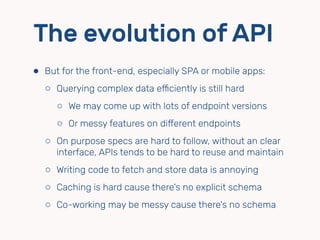
The evolution of API
⬢ But for the front-end, especially SPA or mobile apps:
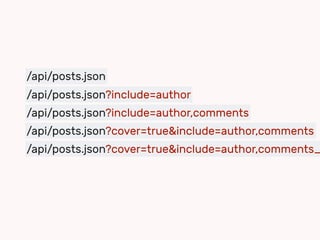
⬡ Querying complex data efficiently is still hard
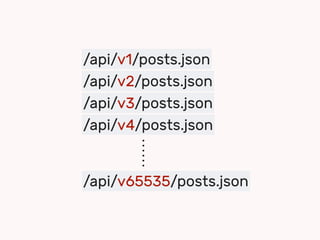
⬡ We may come up with lots of endpoint versions
⬡ Or messy features on different endpoints
⬡ On purpose specs are hard to follow, without an clear
interface, APIs tends to be hard to reuse and maintain
⬡ Writing code to fetch and store data is annoying
⬡ Caching is hard cause there's no explicit schema
⬡ Co-working may be messy cause there's no schema
/api/v1/posts.json
/api/v2/posts.json
/api/v3/posts.json
/api/v4/posts.json
/api/v65535/posts.json
⋯⋯
/api/posts.json
/api/posts.json?include=author
/api/posts.json?include=author,comments
/api/posts.json?cover=true&include=author,comments
/api/posts.json?cover=true&include=author,comments_
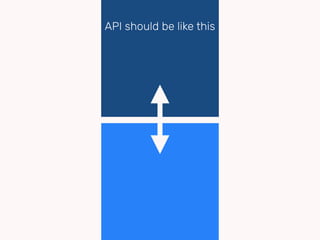
API should be like this
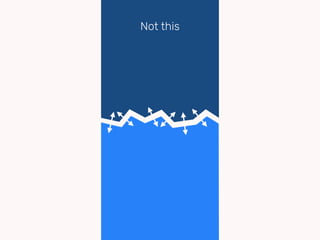
Not this
GraphQL
⬢ A new query language
⬢ Brief History:
⬡ 2012 - Used for Facebook mobile app
⬡ 2015 - Publicly released
⬡ 2017 - Now: GraphQL & Relay re-licensed under 

    MIT
⬢ Normally uses a single endpoint URL ( POST /graphql )
A Glance on GraphQL
All your application data 

can be represented as a graph
$
{
"name": "Pokai Chang",
"bio":"Yet another geek.",
"followers": [◌, ◌, ◌],
"repos": [◌, ◌, ◌]

}
$
{
"name": "Lucy",
"bio":"...",
"followers": [◌],
"repos": [◌, ◌]

}
$
{
"name": "Ja
"bio":"..."
"followers"
"repos": [◌
}
$
{
"name": "Pusheen",
"bio":"Nyan nyan nyan~",
"followers": [◌],
"repos": [◌]

}
!
{
"name": "Thing Compiler",
"description": "...",
"stargazers": [◌, ◌, ◌]

}
!
{
"name": "Hello World",
"description": "...",
"stargazers": [◌, ◌]

}
!
{
"name": "Handy Ut
"description": ".
"stargazers": [◌]
}
!
{
"name": "Awes
"description"
"stargazers":
}
!
{
"name": "Todo",
"description": "...",
"stargazers": [◌]

}
!
{ }
{
"viewer": ◌

}
A subset of the graph 

is used to show an UI
$
{
}
$
{
"name": "Pusheen",
"bio":"Nyan nyan nyan~",
"followers": [◌],
"repos": [◌]

}
$
{
"name": "Lucy",
"bio":"...",
"followers": [◌]
"repos": [◌, ◌]

}
!
{
"n
"d
"s
}
!
{
"name": "Todo",
"description": "...",
"stargazers": [◌]

}
!
{
"name": "Thing Compiler",
"description": "...",
"stargazers": [◌, ◌, ◌]

}
!
{
"name": "Thing Compile
"description": "...",
"stargazers": [◌, ◌, ◌
}
!
{
"name"
"descr
"starg
}
{ }
{
"viewer": ◌

}
$
{
"name": "Pokai Chang",
"bio":"Yet another geek.",
"followers": [◌, ◌, ◌],
"repos": [◌, ◌, ◌]

}
$ dd
dd
dd
dd
!
{
"name": "Thing Compiler",
"description": "...",
"stargazers": [◌, ◌, ◌]

}
!
{
"name": "Thing Compile
"description": "...",
"stargazers": [◌, ◌, ◌
}
!
{
"name"
"descr
"starg
}
!
{
"n
"d
"s
}
!
{
"name": "Todo",
"description": "...",
"stargazers": [◌]

}
{ }
{
"viewer": ◌

}
$
{
"name": "Pokai Chang",
"bio":"Yet another geek.",
"followers": [◌, ◌, ◌],
"repos": [◌, ◌, ◌]

}
$
{
"name": "Lucy",
"bio":"...",
"followers": [◌]
"repos": [◌, ◌]

}
$
{
}
$
{
"name": "Pusheen",
"bio":"Nyan nyan nyan~",
"followers": [◌],
"repos": [◌]

}
$
$
$
$
$
$
!
{
"name"
"descr
"starg
}
!
{
"name": "Thing Compile
"description": "...",
"stargazers": [◌, ◌, ◌
}
$
{
"name": "Pusheen",
"bio":"Nyan nyan nyan~",
"followers": [◌],
"repos": [◌]

}
!
{
"n
"d
"s
}
!
{
"name": "Todo",
"description": "...",
"stargazers": [◌]

}
!
{
"name": "Thing Compiler",
"description": "...",
"stargazers": [◌, ◌, ◌]

}
{ }
{
"viewer": ◌

}
$ $ $
$ $ $
$ $ $
$ $
/
$
{
"name": "Lucy",
"bio":"...",
"followers": [◌]
"repos": [◌, ◌]

}
$
{
}
$
{
"name": "Pokai Chang",
"bio":"Yet another geek.",
"followers": [◌, ◌, ◌],
"repos": [◌, ◌, ◌]

}
$
{
"name": "Pokai Chang",
"bio":"Yet another geek.",
"followers": [◌, ◌, ◌],
"repos": [◌, ◌, ◌]

}
$
{
"name": "Lucy",
"bio":"...",
"followers": [◌],
"repos": [◌, ◌]

}
$
{
"name": "Ja
"bio":"..."
"followers"
"repos": [◌
}
$
{
"name": "Pusheen",
"bio":"Nyan nyan nyan~",
"followers": [◌],
"repos": [◌]

}
!
{
"name": "Thing Compiler",
"description": "...",
"stargazers": [◌, ◌, ◌]

}
!
{
"name": "Hello World",
"description": "...",
"stargazers": [◌, ◌]

}
!
{
"name": "Handy Ut
"description": ".
"stargazers": [◌]
}
!
{
"name": "Awes
"description"
"stargazers":
}
!
{
"name": "Todo",
"description": "...",
"stargazers": [◌]

}
!
{ }
{
"viewer": ◌

}
GraphQL
⬡ Complain about RESTful Introduce GraphQL
⬡ Just enough GraphQL to get started
⬡ GraphQL client library overview
⬡ Intro to Relay
⬡ Demo: GraphQL & Relay on Rails

https://github.com/zetavg/RailsRelayTodoMVC
Outline
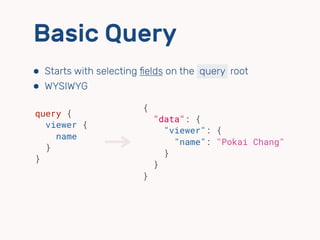
Basic Query
⬢ Starts with selecting fields on the query root
⬢ WYSIWYG
{
"data": {
"viewer": {
"name": "Pokai Chang"
}
}
}
query {
viewer {
name
}
}
Basic Query
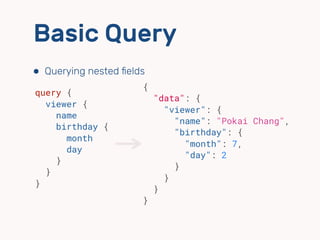
⬢ Querying nested fields
{
"data": {
"viewer": {
"name": "Pokai Chang",
"birthday": {
"month": 7,
"day": 2
}
}
}
}
query {
viewer {
name
birthday {
month
day
}
}
}
Types
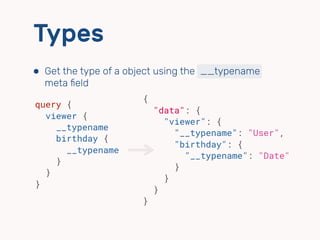
⬢ Get the type of a object using the __typename
meta field
{
"data": {
"viewer": {
"__typename": "User",
"birthday": {
"__typename": "Date"
}
}
}
}
query {
viewer {
__typename
birthday {
__typename
}
}
}
Type defs as docs
# GraphQL query language


query {
viewer {
name
birthday {
month
day
}
following {
name
}
}
}
# GraphQL schema language


type Query {
viewer: User
}
type User {
name: String!

birthday: Date

followers: [User]
following: [User]
}
type Date {
year: Integer
month: Integer
day: Integer
}
Non-Null & Lists
# GraphQL schema language


type Query {
viewer: User
}
type User {
name: String!

birthday: Date

followers: [User]
following: [User]
}
type Date {
year: Integer
month: Integer
day: Integer
}
[<thing>] means an array of <thing> objects
! means that the field is non-nullable
Arguments
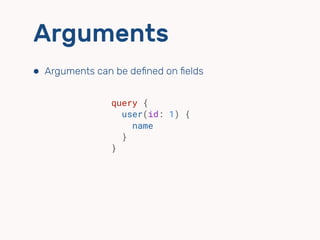
⬢ Arguments can be defined on fields
query {
user(id: 1) {
name
}
}
Arguments
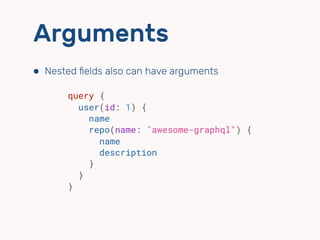
⬢ Nested fields also can have arguments
query {
user(id: 1) {
name
repo(name: "awesome-graphql") {
name
description
}
}
}
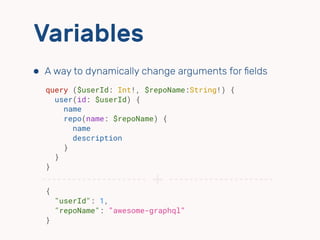
Variables
⬢ A way to dynamically change arguments for fields
query ($userId: Int!, $repoName:String!) {
user(id: $userId) {
name
repo(name: $repoName) {
name
description
}
}
}
{

"userId": 1,
"repoName": "awesome-graphql"
}
+
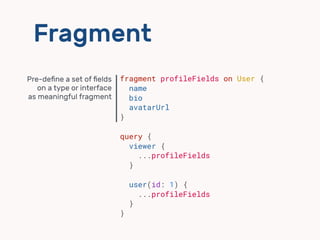
Fragment
fragment profileFields on User {
name
bio
avatarUrl
}
query {
viewer {
...profileFields
}
user(id: 1) {
...profileFields
}
}
Pre-define a set of fields

on a type or interface
as meaningful fragment
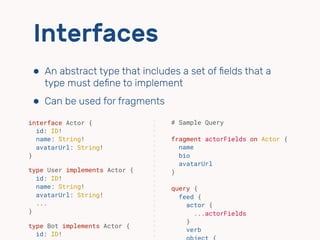
Interfaces
⬢ An abstract type that includes a set of fields that a
type must define to implement
⬢ Can be used for fragments
interface Actor {
id: ID!
name: String!
avatarUrl: String!
}
type User implements Actor {
id: ID!
name: String!
avatarUrl: String!
...
}
type Bot implements Actor {
id: ID!
# Sample Query
fragment actorFields on Actor {
name
bio
avatarUrl
}
query {
feed {
actor {
...actorFields
}

verb

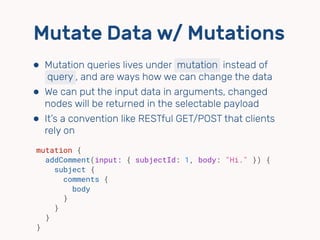
Mutate Data w/ Mutations
⬢ Mutation queries lives under mutation instead of

query , and are ways how we can change the data
⬢ We can put the input data in arguments, changed
nodes will be returned in the selectable payload
⬢ It’s a convention like RESTful GET/POST that clients
rely on
mutation {
addComment(input: { subjectId: 1, body: "Hi." }) {
subject {
comments {
body
}
}
}
}
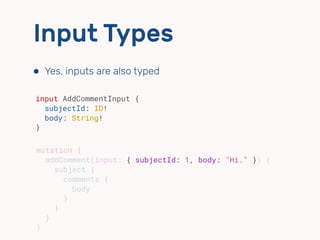
Input Types
⬢ Yes, inputs are also typed
input AddCommentInput {
subjectId: ID!
body: String!
}
mutation {
addComment(input: { subjectId: 1, body: "Hi." }) {
subject {
comments {
body
}
}
}
}
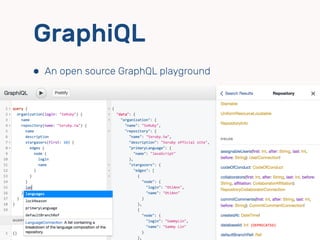
GraphiQL
⬢ An open source GraphQL playground
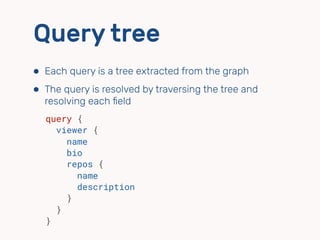
Query tree
⬢ Each query is a tree extracted from the graph
⬢ The query is resolved by traversing the tree and
resolving each field
query {
viewer {
name

bio
repos {
name

description
}
}
}
$
{
"name": "J
"bio":"...
"followers
"repos": [
}
$
{
"name": "Pusheen",
"bio":"Nyan nyan nyan~",
"followers": [◌],
$
{
"name": "Lucy",
"bio":"...",
"followers": [◌],
"repos": [◌, ◌]

}
!
{
"name": "Awe
"description
"stargazers"
}
!
{
"name": "Todo",
"description": "...",
"stargazers": [◌]

}
!
!
{
"name": "Thing Compiler",
"description": "...",
"stargazers": [◌, ◌, ◌]

}
!
{
"name": "Thing Compiler",
"description": "...",
"stargazers": [◌, ◌, ◌]

}
!
{
"name": "Handy Ut
"description": ".
"stargazers": [◌]
{ }
{
"viewer": ◌

}
$
{
"name": "Pokai Chang",
"bio":"Yet another geek.",
"followers": [◌, ◌, ◌],
"repos": [◌, ◌, ◌]

}
Query tree
Query tree
!
{
"name": "Thing Compiler",
"description": "...",
"stargazers": [◌, ◌, ◌]

}
!
{
"name": "Thing Compiler",
"description": "...",
"stargazers": [◌, ◌, ◌]

}
!
{
"name": "Handy Util",
"description": "...",
"stargazers": [◌]

}
{ }
{
"viewer": ◌

}
$
{
"name": "Pokai Chang",
"bio":"Yet another geek.",
"followers": [◌, ◌, ◌],
"repos": [◌, ◌, ◌]

}
graphql.org
⬡ Complain about RESTful Introduce GraphQL
⬡ Just enough GraphQL to get started
⬡ GraphQL client library overview
⬡ Intro to Relay
⬡ Demo: GraphQL & Relay on Rails

https://github.com/zetavg/RailsRelayTodoMVC
Outline
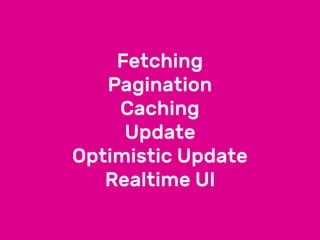
Fetching
Pagination

Caching
Update
Optimistic Update
Realtime UI
Fetching
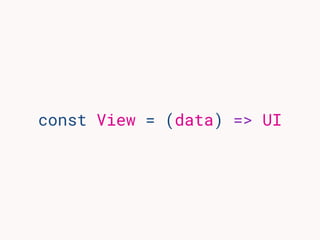
const View = (data) => UI
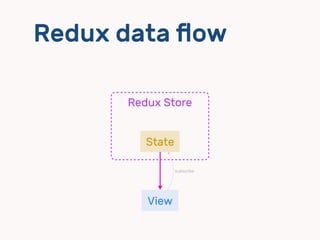
Redux data flow
View
State
subscribe
Redux Store
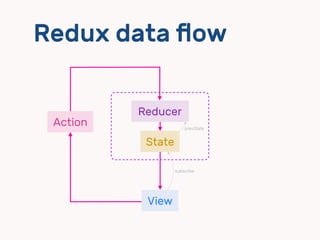
Redux data flow
View
State
Reducer
Action
subscribe
prevState
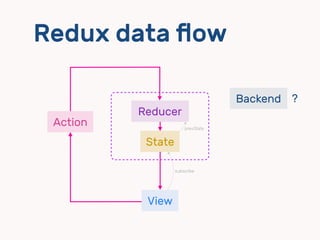
Redux data flow
View
State
Reducer
Action
subscribe
prevState
Backend ?
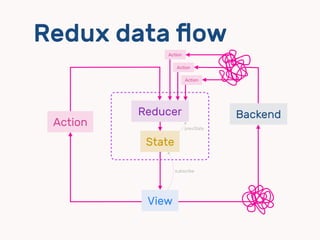
Redux data flow
View
State
Reducer
Action
subscribe
prevState
Backend
Action
Action
Action
$
{
"name": "Neson",
"bio":"Yet another geek.",
"followers": [◌, ◌, ◌],
"repos": [◌, ◌, ◌]

}
$
{
"name": "Lucy",
"bio":"...",
"followers": [◌],
"repos": [◌, ◌]

}
$
{
"name": "Ja
"bio":"..."
"followers"
"repos": [◌
}
$
{
"name": "Pusheen",
"bio":"Nyan nyan nyan~",
"followers": [◌],
"repos": [◌]

}
!
{
"name": "Thing Compiler",
"description": "...",
"stargazers": [◌, ◌, ◌]

}
!
{
"name": "Hello World",
"description": "...",
"stargazers": [◌, ◌]

}
!
{
"name": "Handy Ut
"description": ".
"stargazers": [◌]
}
!
{
"name": "Awes
"description"
"stargazers":
}
!
{
"name": "Todo",
"description": "...",
"stargazers": [◌]

}
!
{ }
{
"viewer": ◌

}
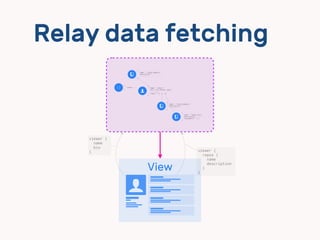
GraphQL
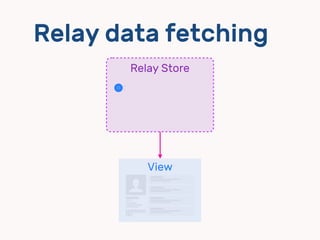
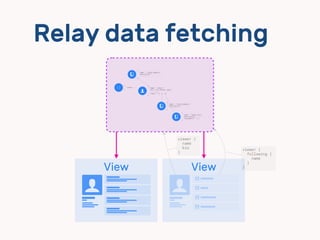
Relay data fetching
View
$
$
$ $
$
dd
$ $ $ $
dd
dd
dd
Relay Store
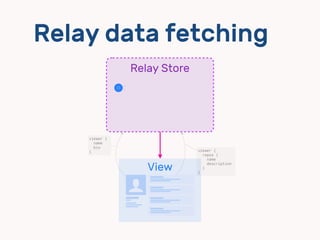
Relay data fetching
viewer {
name
bio
}
View
dd
dd
dd
dd
viewer {
repos {
name
description
}
}
$
Relay Store
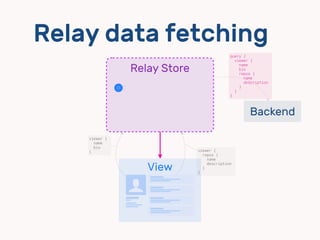
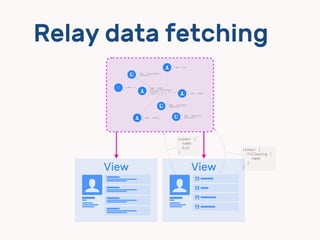
Relay data fetching
View
dd
dd
dd
dd
viewer {
repos {
name
description
}
}
Backend
query {
viewer {

name

bio
repos {
name
description
}
}
}
$
Relay Store
viewer {
name
bio
}
Relay data fetching
View
dd
dd
dd
dd
viewer {
repos {
name
description
}
}
Backend
{
"data": {
"viewer": {

"name": "…",
"bio": "…",
"followers": […],
"repos": […]
}
}
}
$
viewer {
name
bio
}
query {
viewer {

name

bio
repos {
name
description
}
}
}
Relay data fetching
View
$
ㄎㄎㄎㄎ
viewer {
repos {
name
description
}
}
dd
dd
dd
dd
viewer {
name
bio
}
View
Relay data fetching
viewer {
name
bio
}
View
$
ㄎㄎㄎㄎ
viewer {
following {
name
}
}
dd
dd
dd
dd
$
$
$
$
$
View
Relay data fetching
viewer {
name
bio
}
View
$
ㄎㄎㄎㄎ
viewer {
following {
name
}
}
dd
dd
dd
dd
$
$
$
$
$
Backend
query {
viewer {
following {
name
}
}
}
{
"data": {
"viewer": {
"following": […]
}
}
}
View
Relay data fetching
viewer {
name
bio
}
View
$
ㄎㄎㄎㄎ
viewer {
following {
name
}
}
dd
dd
dd
dd
$
$
$
$
$
ㄎㄎㄎㄎ
Caching
Query tree
query {
user(login: "zetavg") {
name
repositories {
name
}
}
}
{
"data": {
"user": {
"name": "Pokai Chang",
"repositories": [
{ "name": "dotfiles" },
{ "name": "Thing" },
{ "name": "Stuff" }
]
}
}
}
Query tree
Query Root
User
Repo Repo Repo
name
user(login: "zetavg")
"Pokai Chang"
"dotfiles"
name repositories
name
"Thing"
name
"Stuff"
query {
user(login: "zetavg") {
name
repositories {
name
}
}
}
{
"data": {
"user": {
"name": "Pokai Chang",
"repositories": [
{ "name": "dotfiles" },
{ "name": "Thing" },
{ "name": "Stuff" }
]
}
}
}
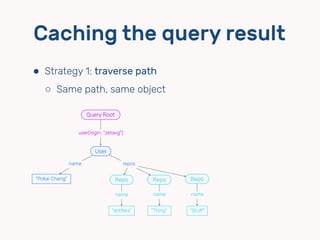
Caching the query result
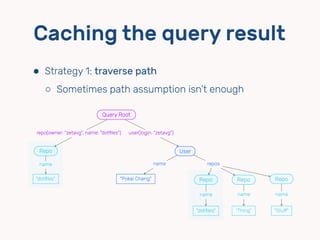
⬢ Strategy 1: traverse path
Query Root
user(login: "zetavg")
User
Repo Repo Repo
name
"Pokai Chang"
"dotfiles"
name repos
name
"Thing"
name
"Stuff"
⬡ Same path, same object
⬢ Strategy 1: traverse path
Query Root
user(login: "zetavg")
User
Repo Repo Repo
name
"Pokai Chang"
"dotfiles"
name repos
name
"Thing"
name
"Stuff"
user(login: "zetavg")
user(login: "zetavg")/repos[2]
⬡ Same path, same object
Caching the query result
⬢ Strategy 1: traverse path
Query Root
user(login: "zetavg")
User
Repo Repo Repo
name
"Pokai Chang"
"dotfiles"
name repos
name
"Thing"
name
"Stuff"
repo(owner: "zetavg", name: "dotfiles")
Repo
name
"dotfiles"
⬡ Sometimes path assumption isn’t enough
Caching the query result
⬢ Strategy 1: traverse path
Query Root
user(login: "zetavg")
User
Repo Repo Repo
name
"Pokai Chang"
"dotfiles"
name repos
name
"Thing"
name
"Stuff"
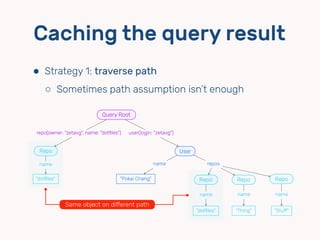
repo(owner: "zetavg", name: "dotfiles")
Repo
name
"dotfiles"
Same object on different path
⬡ Sometimes path assumption isn’t enough
Caching the query result
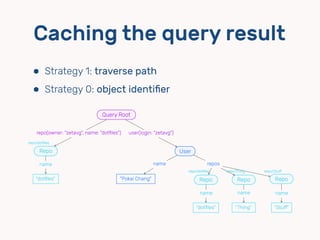
⬢ Strategy 1: traverse path
⬢ Strategy 0: object identifier
repo/dotfiles
Repo
name
"dotfiles"
repo/dotfiles
Repo
name
"dotfiles"
Query Root
User
Repo Repo
user(login: "zetavg")
"Pokai Chang"
name repos
name
"Thing"
name
"Stuff"
repo(owner: "zetavg", name: "dotfiles")
repo/Thing repo/Stuff
Caching the query result
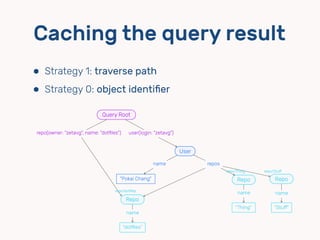
⬢ Strategy 1: traverse path
⬢ Strategy 0: object identifier
Query Root
User
Repo Repo
user(login: "zetavg")
"Pokai Chang"
name repos
name
"Thing"
name
"Stuff"
repo(owner: "zetavg", name: "dotfiles")
repo/Thing repo/Stuff
Repo
name
"dotfiles"
repo/dotfiles
Caching the query result
⬢ Strategy 1: traverse path
⬢ Strategy 0: object identifier
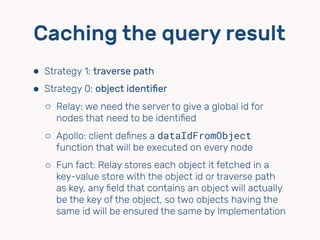
⬡ Relay: we need the server to give a global id for
nodes that need to be identified
⬡ Apollo: client defines a dataIdFromObject
function that will be executed on every node
⬡ Fun fact: Relay stores each object it fetched in a
key-value store with the object id or traverse path
as key, any field that contains an object will actually
be the key of the object, so two objects having the
same id will be ensured the same by Implementation
Caching the query result
Pagination
Cursor Based Pagination
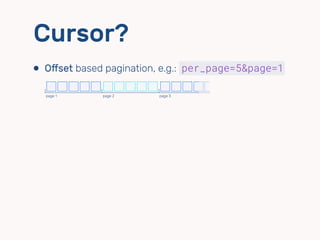
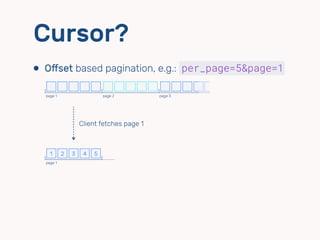
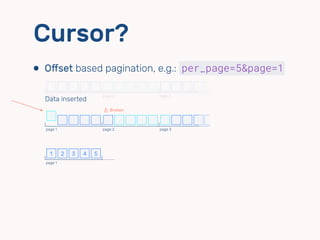
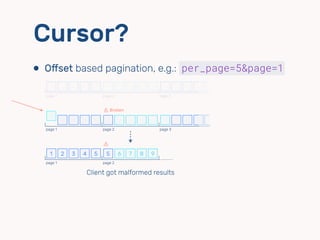
⬢ Offset based pagination, e.g.: per_page=5&page=1
Cursor?
page 1 page 2 page 3
⬢ Offset based pagination, e.g.: per_page=5&page=1
⬢
Cursor?
page 1 page 2 page 3
1 2 3 4 5
page 1
Client fetches page 1
⬢ Offset based pagination, e.g.: per_page=5&page=1
⬢
Cursor?
page 1 page 2 page 3
' Broken
page 1 page 2 page 3
1 2 3 4 5
page 1
Data inserted
⬢ Offset based pagination, e.g.: per_page=5&page=1
⬢
Cursor?
page 1 page 2 page 3
' Broken
page 1 page 2 page 3
1 2 3 4 5
page 1 page 2
5 6 7 8 9
'
Client got malformed results
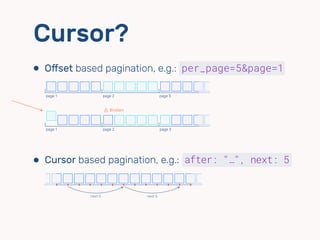
⬢ Offset based pagination, e.g.: per_page=5&page=1
⬢
⬢ Cursor based pagination, e.g.: after: "…", next: 5
Cursor?
next 5next 5
page 1 page 2 page 3
' Broken
page 1 page 2 page 3
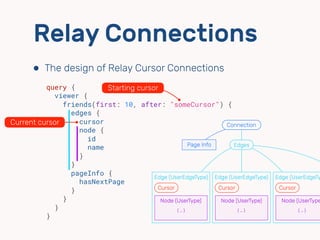
Relay Connections
⬢ The design of Relay Cursor Connections
query {
viewer {
friends(first: 10, after: "someCursor") {
edges {
cursor
node {
id
name
}
}
pageInfo {
hasNextPage
}
}
}
}
Edge (UserEdgeType)
Node (UserType)
{ … }
Cursor
Current cursor Connection
Edges
Edge (UserEdgeType)
Node (UserType)
{ … }
Cursor
Edge (UserEdgeTy
Node (UserType
{ … }
Cursor
Page Info
Starting cursor
Update
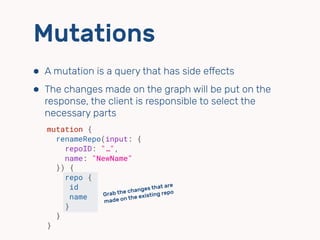
Mutations
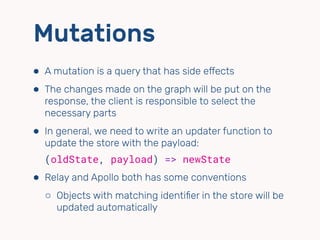
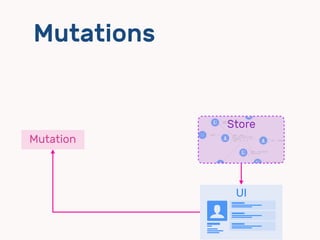
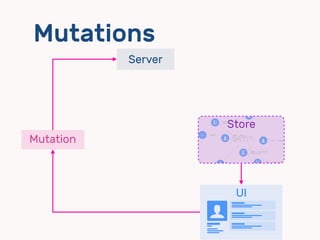
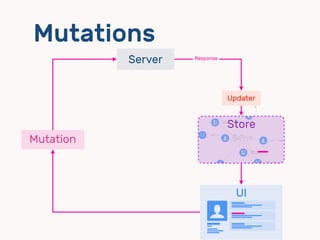
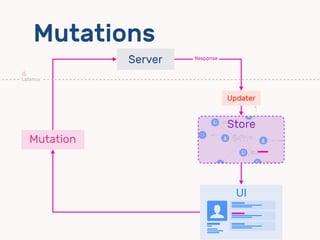
⬢ A mutation is a query that has side effects
⬢ The changes made on the graph will be put on the
response, the client is responsible to select the
necessary parts
mutation {
renameRepo(input: {
repoID: "…",
name: "NewName"
}) {
repo {

id
name
}
}
}
Grab the changes that are

made on the existing repo
Mutations
⬢ A mutation is a query that has side effects
⬢ The changes made on the graph will be put on the
response, the client is responsible to select the
necessary parts
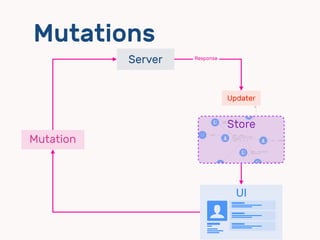
⬢ In general, we need to write an updater function to
update the store with the payload:


(oldState, payload) => newState
⬢ Relay and Apollo both has some conventions
⬡ Objects with matching identifier in the store will be
updated automatically
Mutations
UI
$
ㄎㄎㄎㄎ
dd
dd
dd
Mutation
Store
Mutations
UI
$
ㄎㄎㄎㄎ
dd
dd
dd
Mutation
Server
Store
Mutations
UI
$
ㄎㄎㄎㄎ
dd
dd
dd
Mutation
Server
Updater
Store
Response
Mutations
UI
$
ㄎㄎㄎㄎ
dd
dd
dd
Mutation
Server
Updater
Store
Response
Optimistic Update
Mutations
UI
$
ㄎㄎㄎㄎ
dd
dd
dd
Mutation
Server
Updater
Store
Latency
Response
'
Optimistic Update
UI
$
ㄎㄎㄎㄎ
dd
dd
dd
Mutation
Store
Latency
Optimistic Update
UI
$
ㄎㄎㄎㄎ
dd
dd
dd
Mutation Optimistic Updater
Store
Latency
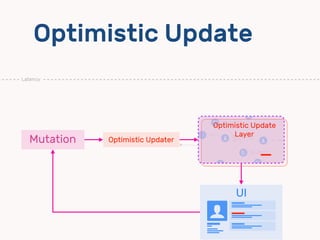
Optimistic Update
Layer
Optimistic Update
UI
$
ㄎㄎㄎㄎ
dd
dd
dd
Mutation Optimistic Updater
Server
Updater
Store
Latency
Response
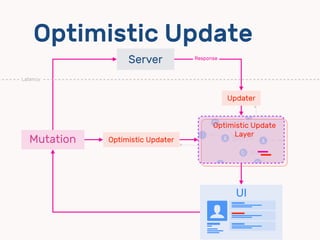
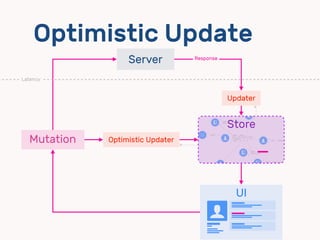
Optimistic Update
Layer
Optimistic Update
UI
$
ㄎㄎㄎㄎ
dd
dd
dd
Mutation Optimistic Updater
Server
Updater
Store
Latency
Response
Realtime UI
GraphQL Live Query
⬢ Idea: after the client sends a query, server can push
updates of the query result to the client
⬢ May require a fully reactive backend
⬢ No open implementations yet
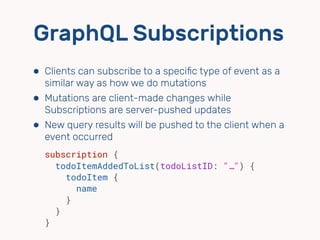
GraphQL Subscriptions
⬢ Clients can subscribe to a specific type of event as a
similar way as how we do mutations
⬢ Mutations are client-made changes while
Subscriptions are server-pushed updates
⬢ New query results will be pushed to the client when a
event occurred
subscription {
todoItemAddedToList(todoListID: "…") {
todoItem {
name
}
}
}
GraphQL Subscriptions
⬢ Clients can subscribe to a specific type of event as a
similar way as how we do mutations
⬢ Mutations are client-made changes while
Subscriptions are server-pushed updates
⬢ New query results will be pushed to the client when a
event occurred
⬢ GraphQL just tells us how things should work, we
need to configure different implementations
(WebSocket, APNS, GCM) of sending the data on
different platforms
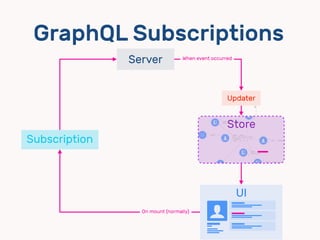
GraphQL Subscriptions
UI
$
ㄎㄎㄎㄎ
dd
dd
dd
Subscription
Server
Updater
Store
When event occurred
On mount (normally)
References
⬢ GraphQL API Explorer
⬢ GraphQL Concepts Visualized
⬢ Mutations and Optimistic UI in Apollo Client
⬢ GraphQL Subscriptions in Apollo Client
⬢ https://github.com/zetavg/graphql-todomvc
Thanks + Q&A

Overview of GraphQL & Clients

  • 1.
    Overview of
 GraphQL &Clients ! # @zetavg
 fb.me/pokaichang72
  • 2.
    My Background ⬢ Buildingstuff as a web developer from 2012 ⬢ Shallow experiences covered from design, mobile, front-end and backend develop to cloud deployments (AWS) ⬢ Fan of GraphQL/Relay of its beauty of API design since 2015 ⬢ Working at with Ruby, JavaScript (React.js) and playing Elixir ⬢ Former tech lead at Colorgy ! # @zetavg
 fb.me/pokaichang72
  • 3.
    ⬡ Complain aboutRESTful Introduce GraphQL ⬡ Just enough GraphQL to get started ⬡ GraphQL client library overview ⬡ Intro to Relay ⬡ Demo: GraphQL & Relay on Rails
 https://github.com/zetavg/RailsRelayTodoMVC Outline
  • 4.
  • 5.
    The evolution ofAPI ⬢ RESTful: Easy to use, easy to develop ⬡ Directly based on Wide World Web ⬡ URI as resource name (noun), HTTP method as action (verb) ⬡ We need documents: Swagger... ⬡ ...and type definitions: JSON Schema ⬡ ...and data relations: JSON API ⬡ Combine them all: API Blueprint, RAML
  • 6.
    The evolution ofAPI ⬢ But for the front-end, especially SPA or mobile apps: ⬡ Querying complex data efficiently is still hard ⬡ We may come up with lots of endpoint versions ⬡ Or messy features on different endpoints ⬡ On purpose specs are hard to follow, without an clear interface, APIs tends to be hard to reuse and maintain ⬡ Writing code to fetch and store data is annoying ⬡ Caching is hard cause there's no explicit schema ⬡ Co-working may be messy cause there's no schema
  • 7.
  • 8.
  • 9.
    API should belike this
  • 10.
  • 11.
    GraphQL ⬢ A newquery language ⬢ Brief History: ⬡ 2012 - Used for Facebook mobile app ⬡ 2015 - Publicly released ⬡ 2017 - Now: GraphQL & Relay re-licensed under 
     MIT ⬢ Normally uses a single endpoint URL ( POST /graphql )
  • 12.
    A Glance onGraphQL
  • 13.
    All your applicationdata 
 can be represented as a graph
  • 14.
    $ { "name": "Pokai Chang", "bio":"Yetanother geek.", "followers": [◌, ◌, ◌], "repos": [◌, ◌, ◌]
 } $ { "name": "Lucy", "bio":"...", "followers": [◌], "repos": [◌, ◌]
 } $ { "name": "Ja "bio":"..." "followers" "repos": [◌ } $ { "name": "Pusheen", "bio":"Nyan nyan nyan~", "followers": [◌], "repos": [◌]
 } ! { "name": "Thing Compiler", "description": "...", "stargazers": [◌, ◌, ◌]
 } ! { "name": "Hello World", "description": "...", "stargazers": [◌, ◌]
 } ! { "name": "Handy Ut "description": ". "stargazers": [◌] } ! { "name": "Awes "description" "stargazers": } ! { "name": "Todo", "description": "...", "stargazers": [◌]
 } ! { } { "viewer": ◌
 }
  • 15.
    A subset ofthe graph 
 is used to show an UI
  • 16.
    $ { } $ { "name": "Pusheen", "bio":"Nyan nyannyan~", "followers": [◌], "repos": [◌]
 } $ { "name": "Lucy", "bio":"...", "followers": [◌] "repos": [◌, ◌]
 } ! { "n "d "s } ! { "name": "Todo", "description": "...", "stargazers": [◌]
 } ! { "name": "Thing Compiler", "description": "...", "stargazers": [◌, ◌, ◌]
 } ! { "name": "Thing Compile "description": "...", "stargazers": [◌, ◌, ◌ } ! { "name" "descr "starg } { } { "viewer": ◌
 } $ { "name": "Pokai Chang", "bio":"Yet another geek.", "followers": [◌, ◌, ◌], "repos": [◌, ◌, ◌]
 } $ dd dd dd dd
  • 17.
    ! { "name": "Thing Compiler", "description":"...", "stargazers": [◌, ◌, ◌]
 } ! { "name": "Thing Compile "description": "...", "stargazers": [◌, ◌, ◌ } ! { "name" "descr "starg } ! { "n "d "s } ! { "name": "Todo", "description": "...", "stargazers": [◌]
 } { } { "viewer": ◌
 } $ { "name": "Pokai Chang", "bio":"Yet another geek.", "followers": [◌, ◌, ◌], "repos": [◌, ◌, ◌]
 } $ { "name": "Lucy", "bio":"...", "followers": [◌] "repos": [◌, ◌]
 } $ { } $ { "name": "Pusheen", "bio":"Nyan nyan nyan~", "followers": [◌], "repos": [◌]
 } $ $ $ $ $ $
  • 18.
    ! { "name" "descr "starg } ! { "name": "Thing Compile "description":"...", "stargazers": [◌, ◌, ◌ } $ { "name": "Pusheen", "bio":"Nyan nyan nyan~", "followers": [◌], "repos": [◌]
 } ! { "n "d "s } ! { "name": "Todo", "description": "...", "stargazers": [◌]
 } ! { "name": "Thing Compiler", "description": "...", "stargazers": [◌, ◌, ◌]
 } { } { "viewer": ◌
 } $ $ $ $ $ $ $ $ $ $ $ / $ { "name": "Lucy", "bio":"...", "followers": [◌] "repos": [◌, ◌]
 } $ { } $ { "name": "Pokai Chang", "bio":"Yet another geek.", "followers": [◌, ◌, ◌], "repos": [◌, ◌, ◌]
 }
  • 19.
    $ { "name": "Pokai Chang", "bio":"Yetanother geek.", "followers": [◌, ◌, ◌], "repos": [◌, ◌, ◌]
 } $ { "name": "Lucy", "bio":"...", "followers": [◌], "repos": [◌, ◌]
 } $ { "name": "Ja "bio":"..." "followers" "repos": [◌ } $ { "name": "Pusheen", "bio":"Nyan nyan nyan~", "followers": [◌], "repos": [◌]
 } ! { "name": "Thing Compiler", "description": "...", "stargazers": [◌, ◌, ◌]
 } ! { "name": "Hello World", "description": "...", "stargazers": [◌, ◌]
 } ! { "name": "Handy Ut "description": ". "stargazers": [◌] } ! { "name": "Awes "description" "stargazers": } ! { "name": "Todo", "description": "...", "stargazers": [◌]
 } ! { } { "viewer": ◌
 } GraphQL
  • 20.
    ⬡ Complain aboutRESTful Introduce GraphQL ⬡ Just enough GraphQL to get started ⬡ GraphQL client library overview ⬡ Intro to Relay ⬡ Demo: GraphQL & Relay on Rails
 https://github.com/zetavg/RailsRelayTodoMVC Outline
  • 21.
    Basic Query ⬢ Startswith selecting fields on the query root ⬢ WYSIWYG { "data": { "viewer": { "name": "Pokai Chang" } } } query { viewer { name } }
  • 22.
    Basic Query ⬢ Queryingnested fields { "data": { "viewer": { "name": "Pokai Chang", "birthday": { "month": 7, "day": 2 } } } } query { viewer { name birthday { month day } } }
  • 23.
    Types ⬢ Get thetype of a object using the __typename meta field { "data": { "viewer": { "__typename": "User", "birthday": { "__typename": "Date" } } } } query { viewer { __typename birthday { __typename } } }
  • 24.
    Type defs asdocs # GraphQL query language
 
 query { viewer { name birthday { month day } following { name } } } # GraphQL schema language
 
 type Query { viewer: User } type User { name: String!
 birthday: Date
 followers: [User] following: [User] } type Date { year: Integer month: Integer day: Integer }
  • 25.
    Non-Null & Lists #GraphQL schema language
 
 type Query { viewer: User } type User { name: String!
 birthday: Date
 followers: [User] following: [User] } type Date { year: Integer month: Integer day: Integer } [<thing>] means an array of <thing> objects ! means that the field is non-nullable
  • 26.
    Arguments ⬢ Arguments canbe defined on fields query { user(id: 1) { name } }
  • 27.
    Arguments ⬢ Nested fieldsalso can have arguments query { user(id: 1) { name repo(name: "awesome-graphql") { name description } } }
  • 28.
    Variables ⬢ A wayto dynamically change arguments for fields query ($userId: Int!, $repoName:String!) { user(id: $userId) { name repo(name: $repoName) { name description } } } {
 "userId": 1, "repoName": "awesome-graphql" } +
  • 29.
    Fragment fragment profileFields onUser { name bio avatarUrl } query { viewer { ...profileFields } user(id: 1) { ...profileFields } } Pre-define a set of fields
 on a type or interface as meaningful fragment
  • 30.
    Interfaces ⬢ An abstracttype that includes a set of fields that a type must define to implement ⬢ Can be used for fragments interface Actor { id: ID! name: String! avatarUrl: String! } type User implements Actor { id: ID! name: String! avatarUrl: String! ... } type Bot implements Actor { id: ID! # Sample Query fragment actorFields on Actor { name bio avatarUrl } query { feed { actor { ...actorFields }
 verb

  • 31.
    Mutate Data w/Mutations ⬢ Mutation queries lives under mutation instead of
 query , and are ways how we can change the data ⬢ We can put the input data in arguments, changed nodes will be returned in the selectable payload ⬢ It’s a convention like RESTful GET/POST that clients rely on mutation { addComment(input: { subjectId: 1, body: "Hi." }) { subject { comments { body } } } }
  • 32.
    Input Types ⬢ Yes,inputs are also typed input AddCommentInput { subjectId: ID! body: String! } mutation { addComment(input: { subjectId: 1, body: "Hi." }) { subject { comments { body } } } }
  • 33.
    GraphiQL ⬢ An opensource GraphQL playground
  • 34.
    Query tree ⬢ Eachquery is a tree extracted from the graph ⬢ The query is resolved by traversing the tree and resolving each field query { viewer { name
 bio repos { name
 description } } }
  • 35.
    $ { "name": "J "bio":"... "followers "repos": [ } $ { "name":"Pusheen", "bio":"Nyan nyan nyan~", "followers": [◌], $ { "name": "Lucy", "bio":"...", "followers": [◌], "repos": [◌, ◌]
 } ! { "name": "Awe "description "stargazers" } ! { "name": "Todo", "description": "...", "stargazers": [◌]
 } ! ! { "name": "Thing Compiler", "description": "...", "stargazers": [◌, ◌, ◌]
 } ! { "name": "Thing Compiler", "description": "...", "stargazers": [◌, ◌, ◌]
 } ! { "name": "Handy Ut "description": ". "stargazers": [◌] { } { "viewer": ◌
 } $ { "name": "Pokai Chang", "bio":"Yet another geek.", "followers": [◌, ◌, ◌], "repos": [◌, ◌, ◌]
 } Query tree
  • 36.
    Query tree ! { "name": "ThingCompiler", "description": "...", "stargazers": [◌, ◌, ◌]
 } ! { "name": "Thing Compiler", "description": "...", "stargazers": [◌, ◌, ◌]
 } ! { "name": "Handy Util", "description": "...", "stargazers": [◌]
 } { } { "viewer": ◌
 } $ { "name": "Pokai Chang", "bio":"Yet another geek.", "followers": [◌, ◌, ◌], "repos": [◌, ◌, ◌]
 }
  • 37.
  • 38.
    ⬡ Complain aboutRESTful Introduce GraphQL ⬡ Just enough GraphQL to get started ⬡ GraphQL client library overview ⬡ Intro to Relay ⬡ Demo: GraphQL & Relay on Rails
 https://github.com/zetavg/RailsRelayTodoMVC Outline
  • 39.
  • 41.
  • 43.
    const View =(data) => UI
  • 44.
  • 45.
  • 46.
  • 47.
  • 48.
    $ { "name": "Neson", "bio":"Yet anothergeek.", "followers": [◌, ◌, ◌], "repos": [◌, ◌, ◌]
 } $ { "name": "Lucy", "bio":"...", "followers": [◌], "repos": [◌, ◌]
 } $ { "name": "Ja "bio":"..." "followers" "repos": [◌ } $ { "name": "Pusheen", "bio":"Nyan nyan nyan~", "followers": [◌], "repos": [◌]
 } ! { "name": "Thing Compiler", "description": "...", "stargazers": [◌, ◌, ◌]
 } ! { "name": "Hello World", "description": "...", "stargazers": [◌, ◌]
 } ! { "name": "Handy Ut "description": ". "stargazers": [◌] } ! { "name": "Awes "description" "stargazers": } ! { "name": "Todo", "description": "...", "stargazers": [◌]
 } ! { } { "viewer": ◌
 } GraphQL
  • 49.
    Relay data fetching View $ $ $$ $ dd $ $ $ $ dd dd dd Relay Store
  • 50.
    Relay data fetching viewer{ name bio } View dd dd dd dd viewer { repos { name description } } $ Relay Store
  • 51.
    Relay data fetching View dd dd dd dd viewer{ repos { name description } } Backend query { viewer {
 name
 bio repos { name description } } } $ Relay Store viewer { name bio }
  • 52.
    Relay data fetching View dd dd dd dd viewer{ repos { name description } } Backend { "data": { "viewer": {
 "name": "…", "bio": "…", "followers": […], "repos": […] } } } $ viewer { name bio } query { viewer {
 name
 bio repos { name description } } }
  • 53.
    Relay data fetching View $ ㄎㄎㄎㄎ viewer{ repos { name description } } dd dd dd dd viewer { name bio }
  • 54.
    View Relay data fetching viewer{ name bio } View $ ㄎㄎㄎㄎ viewer { following { name } } dd dd dd dd $ $ $ $ $
  • 55.
    View Relay data fetching viewer{ name bio } View $ ㄎㄎㄎㄎ viewer { following { name } } dd dd dd dd $ $ $ $ $ Backend query { viewer { following { name } } } { "data": { "viewer": { "following": […] } } }
  • 56.
    View Relay data fetching viewer{ name bio } View $ ㄎㄎㄎㄎ viewer { following { name } } dd dd dd dd $ $ $ $ $ ㄎㄎㄎㄎ
  • 57.
  • 58.
    Query tree query { user(login:"zetavg") { name repositories { name } } } { "data": { "user": { "name": "Pokai Chang", "repositories": [ { "name": "dotfiles" }, { "name": "Thing" }, { "name": "Stuff" } ] } } }
  • 59.
    Query tree Query Root User RepoRepo Repo name user(login: "zetavg") "Pokai Chang" "dotfiles" name repositories name "Thing" name "Stuff" query { user(login: "zetavg") { name repositories { name } } } { "data": { "user": { "name": "Pokai Chang", "repositories": [ { "name": "dotfiles" }, { "name": "Thing" }, { "name": "Stuff" } ] } } }
  • 60.
    Caching the queryresult ⬢ Strategy 1: traverse path Query Root user(login: "zetavg") User Repo Repo Repo name "Pokai Chang" "dotfiles" name repos name "Thing" name "Stuff" ⬡ Same path, same object
  • 61.
    ⬢ Strategy 1:traverse path Query Root user(login: "zetavg") User Repo Repo Repo name "Pokai Chang" "dotfiles" name repos name "Thing" name "Stuff" user(login: "zetavg") user(login: "zetavg")/repos[2] ⬡ Same path, same object Caching the query result
  • 62.
    ⬢ Strategy 1:traverse path Query Root user(login: "zetavg") User Repo Repo Repo name "Pokai Chang" "dotfiles" name repos name "Thing" name "Stuff" repo(owner: "zetavg", name: "dotfiles") Repo name "dotfiles" ⬡ Sometimes path assumption isn’t enough Caching the query result
  • 63.
    ⬢ Strategy 1:traverse path Query Root user(login: "zetavg") User Repo Repo Repo name "Pokai Chang" "dotfiles" name repos name "Thing" name "Stuff" repo(owner: "zetavg", name: "dotfiles") Repo name "dotfiles" Same object on different path ⬡ Sometimes path assumption isn’t enough Caching the query result
  • 64.
    ⬢ Strategy 1:traverse path ⬢ Strategy 0: object identifier repo/dotfiles Repo name "dotfiles" repo/dotfiles Repo name "dotfiles" Query Root User Repo Repo user(login: "zetavg") "Pokai Chang" name repos name "Thing" name "Stuff" repo(owner: "zetavg", name: "dotfiles") repo/Thing repo/Stuff Caching the query result
  • 65.
    ⬢ Strategy 1:traverse path ⬢ Strategy 0: object identifier Query Root User Repo Repo user(login: "zetavg") "Pokai Chang" name repos name "Thing" name "Stuff" repo(owner: "zetavg", name: "dotfiles") repo/Thing repo/Stuff Repo name "dotfiles" repo/dotfiles Caching the query result
  • 66.
    ⬢ Strategy 1:traverse path ⬢ Strategy 0: object identifier ⬡ Relay: we need the server to give a global id for nodes that need to be identified ⬡ Apollo: client defines a dataIdFromObject function that will be executed on every node ⬡ Fun fact: Relay stores each object it fetched in a key-value store with the object id or traverse path as key, any field that contains an object will actually be the key of the object, so two objects having the same id will be ensured the same by Implementation Caching the query result
  • 67.
  • 68.
  • 69.
    ⬢ Offset basedpagination, e.g.: per_page=5&page=1 Cursor? page 1 page 2 page 3
  • 70.
    ⬢ Offset basedpagination, e.g.: per_page=5&page=1 ⬢ Cursor? page 1 page 2 page 3 1 2 3 4 5 page 1 Client fetches page 1
  • 71.
    ⬢ Offset basedpagination, e.g.: per_page=5&page=1 ⬢ Cursor? page 1 page 2 page 3 ' Broken page 1 page 2 page 3 1 2 3 4 5 page 1 Data inserted
  • 72.
    ⬢ Offset basedpagination, e.g.: per_page=5&page=1 ⬢ Cursor? page 1 page 2 page 3 ' Broken page 1 page 2 page 3 1 2 3 4 5 page 1 page 2 5 6 7 8 9 ' Client got malformed results
  • 73.
    ⬢ Offset basedpagination, e.g.: per_page=5&page=1 ⬢ ⬢ Cursor based pagination, e.g.: after: "…", next: 5 Cursor? next 5next 5 page 1 page 2 page 3 ' Broken page 1 page 2 page 3
  • 74.
    Relay Connections ⬢ Thedesign of Relay Cursor Connections query { viewer { friends(first: 10, after: "someCursor") { edges { cursor node { id name } } pageInfo { hasNextPage } } } } Edge (UserEdgeType) Node (UserType) { … } Cursor Current cursor Connection Edges Edge (UserEdgeType) Node (UserType) { … } Cursor Edge (UserEdgeTy Node (UserType { … } Cursor Page Info Starting cursor
  • 75.
  • 76.
    Mutations ⬢ A mutationis a query that has side effects ⬢ The changes made on the graph will be put on the response, the client is responsible to select the necessary parts mutation { renameRepo(input: { repoID: "…", name: "NewName" }) { repo {
 id name } } } Grab the changes that are
 made on the existing repo
  • 77.
    Mutations ⬢ A mutationis a query that has side effects ⬢ The changes made on the graph will be put on the response, the client is responsible to select the necessary parts ⬢ In general, we need to write an updater function to update the store with the payload:
 
 (oldState, payload) => newState ⬢ Relay and Apollo both has some conventions ⬡ Objects with matching identifier in the store will be updated automatically
  • 78.
  • 79.
  • 80.
  • 81.
  • 82.
  • 83.
  • 84.
  • 85.
    Optimistic Update UI $ ㄎㄎㄎㄎ dd dd dd Mutation OptimisticUpdater Store Latency Optimistic Update Layer
  • 86.
    Optimistic Update UI $ ㄎㄎㄎㄎ dd dd dd Mutation OptimisticUpdater Server Updater Store Latency Response Optimistic Update Layer
  • 87.
    Optimistic Update UI $ ㄎㄎㄎㄎ dd dd dd Mutation OptimisticUpdater Server Updater Store Latency Response
  • 88.
  • 89.
    GraphQL Live Query ⬢Idea: after the client sends a query, server can push updates of the query result to the client ⬢ May require a fully reactive backend ⬢ No open implementations yet
  • 90.
    GraphQL Subscriptions ⬢ Clientscan subscribe to a specific type of event as a similar way as how we do mutations ⬢ Mutations are client-made changes while Subscriptions are server-pushed updates ⬢ New query results will be pushed to the client when a event occurred subscription { todoItemAddedToList(todoListID: "…") { todoItem { name } } }
  • 91.
    GraphQL Subscriptions ⬢ Clientscan subscribe to a specific type of event as a similar way as how we do mutations ⬢ Mutations are client-made changes while Subscriptions are server-pushed updates ⬢ New query results will be pushed to the client when a event occurred ⬢ GraphQL just tells us how things should work, we need to configure different implementations (WebSocket, APNS, GCM) of sending the data on different platforms
  • 92.
  • 93.
    References ⬢ GraphQL APIExplorer ⬢ GraphQL Concepts Visualized ⬢ Mutations and Optimistic UI in Apollo Client ⬢ GraphQL Subscriptions in Apollo Client ⬢ https://github.com/zetavg/graphql-todomvc
  • 94.