Planarity & Dual Graph
A.B.M. Ashikur Rahman
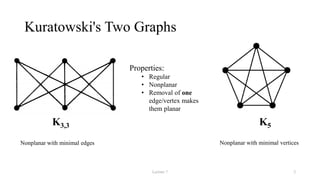
Kuratowski's Two Graphs
Lecture 7 2
Properties:
• Regular
• Nonplanar
• Removal of one
edge/vertex makes
them planar
K3,3 K5
Nonplanar with minimal edges Nonplanar with minimal vertices
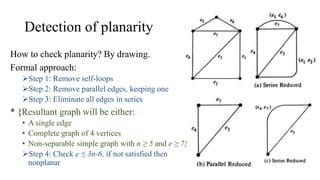
Detection of planarity
How to check planarity? By drawing.
Formal approach:
Step 1: Remove self-loops
Step 2: Remove parallel edges, keeping one
Step 3: Eliminate all edges in series
* {Resultant graph will be either:
• A single edge
• Complete graph of 4 vertices
• Non-separable simple graph with n ≥ 5 and e ≥ 7}
Step 4: Check e ≤ 3n-6, if not satisfied then
nonplanar
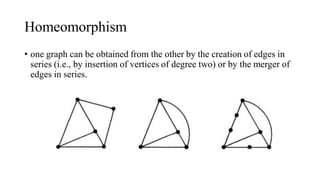
Homeomorphism
• one graph can be obtained from the other by the creation of edges in
series (i.e., by insertion of vertices of degree two) or by the merger of
edges in series.
Detection of planarity
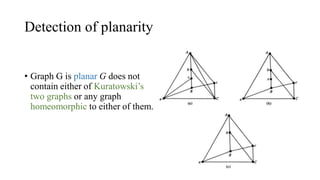
• Graph G is planar G does not
contain either of Kuratowski’s
two graphs or any graph
homeomorphic to either of them.
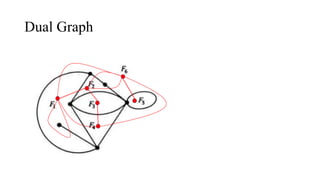
Dual Graph
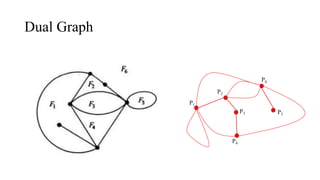
Dual Graph
P1
P5
P4
P3
P6
P2
Dual Graph
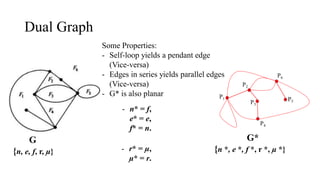
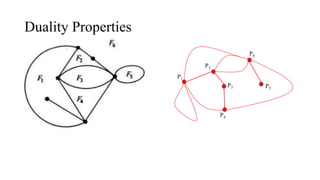
Some Properties:
- Self-loop yields a pendant edge
(Vice-versa)
- Edges in series yields parallel edges
(Vice-versa)
- G* is also planar
G
{n, e, f, r, µ}
G*
{n *, e *, f *, r *, µ *}
- n* = f,
e* = e,
f* = n.
- r* = µ,
µ* = r.
P1 P5
P4
P3
P6
P2
Duality Properties
P1
P5
P4
P3
P6
P2
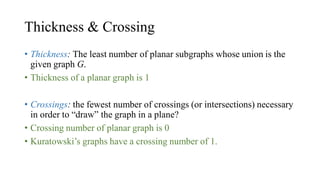
Thickness & Crossing
• Thickness: The least number of planar subgraphs whose union is the
given graph G.
• Thickness of a planar graph is 1
• Crossings: the fewest number of crossings (or intersections) necessary
in order to “draw” the graph in a plane?
• Crossing number of planar graph is 0
• Kuratowski’s graphs have a crossing number of 1.
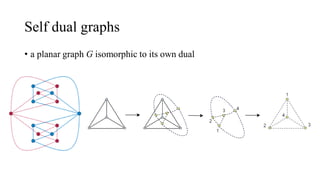
Self dual graphs
• a planar graph G isomorphic to its own dual
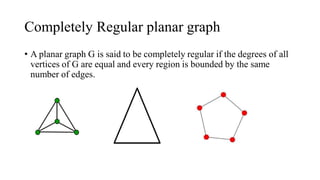
Completely Regular planar graph
• A planar graph G is said to be completely regular if the degrees of all
vertices of G are equal and every region is bounded by the same
number of edges.

Graph Theory: Planarity & Dual Graph

  • 1.
    Planarity & DualGraph A.B.M. Ashikur Rahman
  • 2.
    Kuratowski's Two Graphs Lecture7 2 Properties: • Regular • Nonplanar • Removal of one edge/vertex makes them planar K3,3 K5 Nonplanar with minimal edges Nonplanar with minimal vertices
  • 3.
    Detection of planarity Howto check planarity? By drawing. Formal approach: Step 1: Remove self-loops Step 2: Remove parallel edges, keeping one Step 3: Eliminate all edges in series * {Resultant graph will be either: • A single edge • Complete graph of 4 vertices • Non-separable simple graph with n ≥ 5 and e ≥ 7} Step 4: Check e ≤ 3n-6, if not satisfied then nonplanar
  • 4.
    Homeomorphism • one graphcan be obtained from the other by the creation of edges in series (i.e., by insertion of vertices of degree two) or by the merger of edges in series.
  • 5.
    Detection of planarity •Graph G is planar G does not contain either of Kuratowski’s two graphs or any graph homeomorphic to either of them.
  • 6.
  • 7.
  • 8.
    Dual Graph Some Properties: -Self-loop yields a pendant edge (Vice-versa) - Edges in series yields parallel edges (Vice-versa) - G* is also planar G {n, e, f, r, µ} G* {n *, e *, f *, r *, µ *} - n* = f, e* = e, f* = n. - r* = µ, µ* = r. P1 P5 P4 P3 P6 P2
  • 9.
  • 10.
    Thickness & Crossing •Thickness: The least number of planar subgraphs whose union is the given graph G. • Thickness of a planar graph is 1 • Crossings: the fewest number of crossings (or intersections) necessary in order to “draw” the graph in a plane? • Crossing number of planar graph is 0 • Kuratowski’s graphs have a crossing number of 1.
  • 11.
    Self dual graphs •a planar graph G isomorphic to its own dual
  • 12.
    Completely Regular planargraph • A planar graph G is said to be completely regular if the degrees of all vertices of G are equal and every region is bounded by the same number of edges.