
CONTENTS
 INTRODUCTION
 GRANITIC TIN AND URANIUM
 CLASSIFICATION
 GRANITIC TIN
 WHERE THEY ARE FOUND
 BLUE TIER TIN FIELD
 GRANITIC URANIUM
 OCCURENCE
 ECONOMIC IMPORTANTS
 CONCLUSION
 REFERENCE
INTRODUCTION
 Granite is a common type of intrusive, felsic, igneous
rock body.
 Tin is a chemical element with symbol Sn.
 And its atomic number is 50.
 Tin is obtained chiefly from the mineral casseterite,
where it occurs as tin-dioxide.
 Uranium is one of the more common element in earth
crust.
 Uranium ore deposit are available in economically
recoverable concenterations within the earth’s crust.
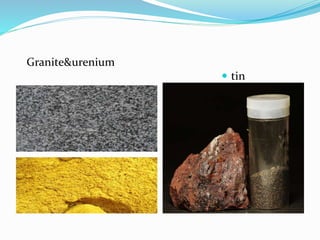
 tin
Granite&urenium
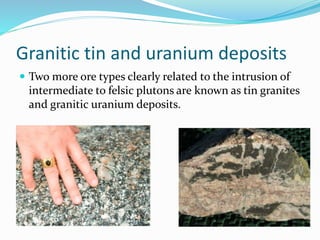
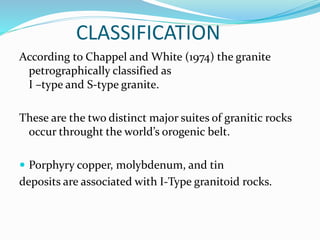
Granitic tin and uranium deposits
 Two more ore types clearly related to the intrusion of
intermediate to felsic plutons are known as tin granites
and granitic uranium deposits.
CLASSIFICATION
According to Chappel and White (1974) the granite
petrographically classified as
I –type and S-type granite.
These are the two distinct major suites of granitic rocks
occur throught the world’s orogenic belt.
 Porphyry copper, molybdenum, and tin
deposits are associated with I-Type granitoid rocks.
Cntd…
 Tin, tungsten, tantalum, molybdenum, berylium,
bismath, and uranium “Granite” deposits are found
only in S-Type Granites.
 Both of these type of granites are formed by melting of
high grade metamorphic rocks either other granites or
intrusive mafic rocks.
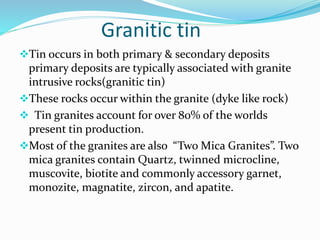
Granitic tin
Tin occurs in both primary & secondary deposits
primary deposits are typically associated with granite
intrusive rocks(granitic tin)
These rocks occur within the granite (dyke like rock)
 Tin granites account for over 80% of the worlds
present tin production.
Most of the granites are also “Two Mica Granites”. Two
mica granites contain Quartz, twinned microcline,
muscovite, biotite and commonly accessory garnet,
monozite, magnatite, zircon, and apatite.
Where they are found..??
 Tin granites occur chiefly in Malaysia, South Africa,
and Australia.
 The tin granite constitute an imporant resource
elsewhere, as in Tasmania, Alaska, and Nigeria,.
 And also mainly available in Blue tire tinfield.
 Granitic tin are found in orogenic belt i.e. in Malaysia,
France, etc
 Mainly they are found in “Blue tier tinfield-
tasmania “
Blue tier tinfield Tasmania
 The blue tier tin field and batholith lies at the extreme
north eastern corner of Tasmania.
 Tin was discovered in 1874.
 The productive area in underline entirely by late
orogenic S-Type granitic rocks of Upper devonian age
intruded into silurian-ordovician sediments.
 The granite is a composite tabular body, 45 by 75 Km
across and 12Km thick.
 It is generlly seperated into Two principle types.
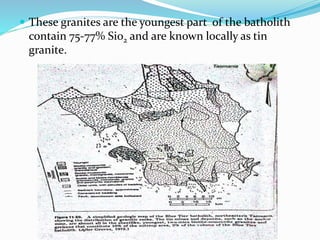
 These granites are the youngest part of the batholith
contain 75-77% Sio2 and are known locally as tin
granite.
Granitic Uranium
 Granitic uranium ocurances are many and include the
largest “hard rock” uranium mine in the world
 The complex economic geology of uranium includes
many deposits and associated with felsic plutonic to
epizonal igneous bodies.
 In igneous rock uranium is found in important
quantities in granites, Kimberlites, and Carbonites.
 In granites its found in normal high granites and alkali
rich granites, anatectic S-Granites.
 The uranium ions U+4 and U+6 are both too large too
highly charged to participate in main line silicate
fractional crystillization phases.
 I-type or s- type granitoid rocks it may be precipitate
as the oxide uraninite in disseminations
 Their to be deposited as veinlets, veins or
disseminations of uranium minerals, including this
silicates coffinite and brannerite
OCCURENCE
In India the granitic uranium occure in Jadudurga.
The world largest uranium deposit are found in rossing
deposit of Namibia.
Granite- is in biotite- and zircon – rich zones in
Alaskite.
Similar deposit occure in Nigeria.
These deposit occure as in veins segregation pipes etc..
Ross-Adms deposit at bokan mountain, Alaska.
USES
The granitic tin is used in the manufacture of tin alloys
and in solders;bronzes,bell metal,gun metal.
The most important use is in manufacture of tin
plates.
Granetic uranium is used to generate heat in nuclear
reacter it is radio active mineral, used in build
powerfull types of bomb.
It is an important resource world wide that is used
primarily as fuel for nuclear power plants.
CONCLUSION
 The important ore mineral of tin is cassiterite.
 The tin deposit are associated with granite is known as
granitic tin.
 Monozite is a main source of uranium.
 The granite is classified as I-type & S –type granite.
 Tin-bearing granites are rich from
F,Li,B,Be,Sn,Ta,Nb,Rb,U,Tn,Pb etc..
 S-type granite derived from partial melting of crust,I-
type is derived from mantle source.
REFERANCE
 The geology of ore deposits by
John.M Guilbert
copyright @ 1986 by W H Freeman and co,
printed in USA
Pg no-507-514
• Indias mineral resources by S.Krishna swamy
III edition in 1988
Pg no-443,469
Web-www.mineral resources.com
s
Thank you.

Granitic tin and uranium deposits

  • 2.
    CONTENTS  INTRODUCTION  GRANITICTIN AND URANIUM  CLASSIFICATION  GRANITIC TIN  WHERE THEY ARE FOUND  BLUE TIER TIN FIELD  GRANITIC URANIUM  OCCURENCE  ECONOMIC IMPORTANTS  CONCLUSION  REFERENCE
  • 3.
    INTRODUCTION  Granite isa common type of intrusive, felsic, igneous rock body.  Tin is a chemical element with symbol Sn.  And its atomic number is 50.  Tin is obtained chiefly from the mineral casseterite, where it occurs as tin-dioxide.  Uranium is one of the more common element in earth crust.  Uranium ore deposit are available in economically recoverable concenterations within the earth’s crust.
  • 4.
  • 5.
    Granitic tin anduranium deposits  Two more ore types clearly related to the intrusion of intermediate to felsic plutons are known as tin granites and granitic uranium deposits.
  • 6.
    CLASSIFICATION According to Chappeland White (1974) the granite petrographically classified as I –type and S-type granite. These are the two distinct major suites of granitic rocks occur throught the world’s orogenic belt.  Porphyry copper, molybdenum, and tin deposits are associated with I-Type granitoid rocks.
  • 7.
    Cntd…  Tin, tungsten,tantalum, molybdenum, berylium, bismath, and uranium “Granite” deposits are found only in S-Type Granites.  Both of these type of granites are formed by melting of high grade metamorphic rocks either other granites or intrusive mafic rocks.
  • 8.
    Granitic tin Tin occursin both primary & secondary deposits primary deposits are typically associated with granite intrusive rocks(granitic tin) These rocks occur within the granite (dyke like rock)  Tin granites account for over 80% of the worlds present tin production. Most of the granites are also “Two Mica Granites”. Two mica granites contain Quartz, twinned microcline, muscovite, biotite and commonly accessory garnet, monozite, magnatite, zircon, and apatite.
  • 9.
    Where they arefound..??  Tin granites occur chiefly in Malaysia, South Africa, and Australia.  The tin granite constitute an imporant resource elsewhere, as in Tasmania, Alaska, and Nigeria,.  And also mainly available in Blue tire tinfield.  Granitic tin are found in orogenic belt i.e. in Malaysia, France, etc  Mainly they are found in “Blue tier tinfield- tasmania “
  • 10.
    Blue tier tinfieldTasmania  The blue tier tin field and batholith lies at the extreme north eastern corner of Tasmania.  Tin was discovered in 1874.  The productive area in underline entirely by late orogenic S-Type granitic rocks of Upper devonian age intruded into silurian-ordovician sediments.  The granite is a composite tabular body, 45 by 75 Km across and 12Km thick.  It is generlly seperated into Two principle types.
  • 11.
     These granitesare the youngest part of the batholith contain 75-77% Sio2 and are known locally as tin granite.
  • 12.
    Granitic Uranium  Graniticuranium ocurances are many and include the largest “hard rock” uranium mine in the world  The complex economic geology of uranium includes many deposits and associated with felsic plutonic to epizonal igneous bodies.  In igneous rock uranium is found in important quantities in granites, Kimberlites, and Carbonites.  In granites its found in normal high granites and alkali rich granites, anatectic S-Granites.
  • 13.
     The uraniumions U+4 and U+6 are both too large too highly charged to participate in main line silicate fractional crystillization phases.  I-type or s- type granitoid rocks it may be precipitate as the oxide uraninite in disseminations  Their to be deposited as veinlets, veins or disseminations of uranium minerals, including this silicates coffinite and brannerite
  • 14.
    OCCURENCE In India thegranitic uranium occure in Jadudurga. The world largest uranium deposit are found in rossing deposit of Namibia. Granite- is in biotite- and zircon – rich zones in Alaskite. Similar deposit occure in Nigeria. These deposit occure as in veins segregation pipes etc.. Ross-Adms deposit at bokan mountain, Alaska.
  • 15.
    USES The granitic tinis used in the manufacture of tin alloys and in solders;bronzes,bell metal,gun metal. The most important use is in manufacture of tin plates. Granetic uranium is used to generate heat in nuclear reacter it is radio active mineral, used in build powerfull types of bomb. It is an important resource world wide that is used primarily as fuel for nuclear power plants.
  • 16.
    CONCLUSION  The importantore mineral of tin is cassiterite.  The tin deposit are associated with granite is known as granitic tin.  Monozite is a main source of uranium.  The granite is classified as I-type & S –type granite.  Tin-bearing granites are rich from F,Li,B,Be,Sn,Ta,Nb,Rb,U,Tn,Pb etc..  S-type granite derived from partial melting of crust,I- type is derived from mantle source.
  • 17.
    REFERANCE  The geologyof ore deposits by John.M Guilbert copyright @ 1986 by W H Freeman and co, printed in USA Pg no-507-514 • Indias mineral resources by S.Krishna swamy III edition in 1988 Pg no-443,469 Web-www.mineral resources.com
  • 18.