FORMS OF VERB
DEMO LESSON
BY
FOUZIA IRAM
Outline
• Base Form
• Infinitive Form
• Simple past Form
• Past Participle Form
• Present Participle Form
• Exception Of ‘be’
Base Form
• This is the most commonly used form.it is also
called first form,ground form, simple present
form or as an imperative form.
• Examples:
• I eat mangoes.
• I work as a teacher.
• Complete your work.
Infinitive Form
• A complete infinitive form contains a ‘to’
before it.
• It does other purposes rather than being the
main verb.
• After an adjective: I am happy to see you.
• After a usual verb: I want to come.
• As infinitive structure: They want to help you.
Infinitive Form
• One can also have a bare infinitive along with
auxiliary or helping verbs as follows.
• I will come.
• They sing sweetly.
• We go there daily.
Simple Past Form
• This form is called second form of verb. This
form we commonly see with an added –ed
extension if the verb is regular.
• He worked hard to pass the exam.
• I wrote a letter.
• She watered the plants.
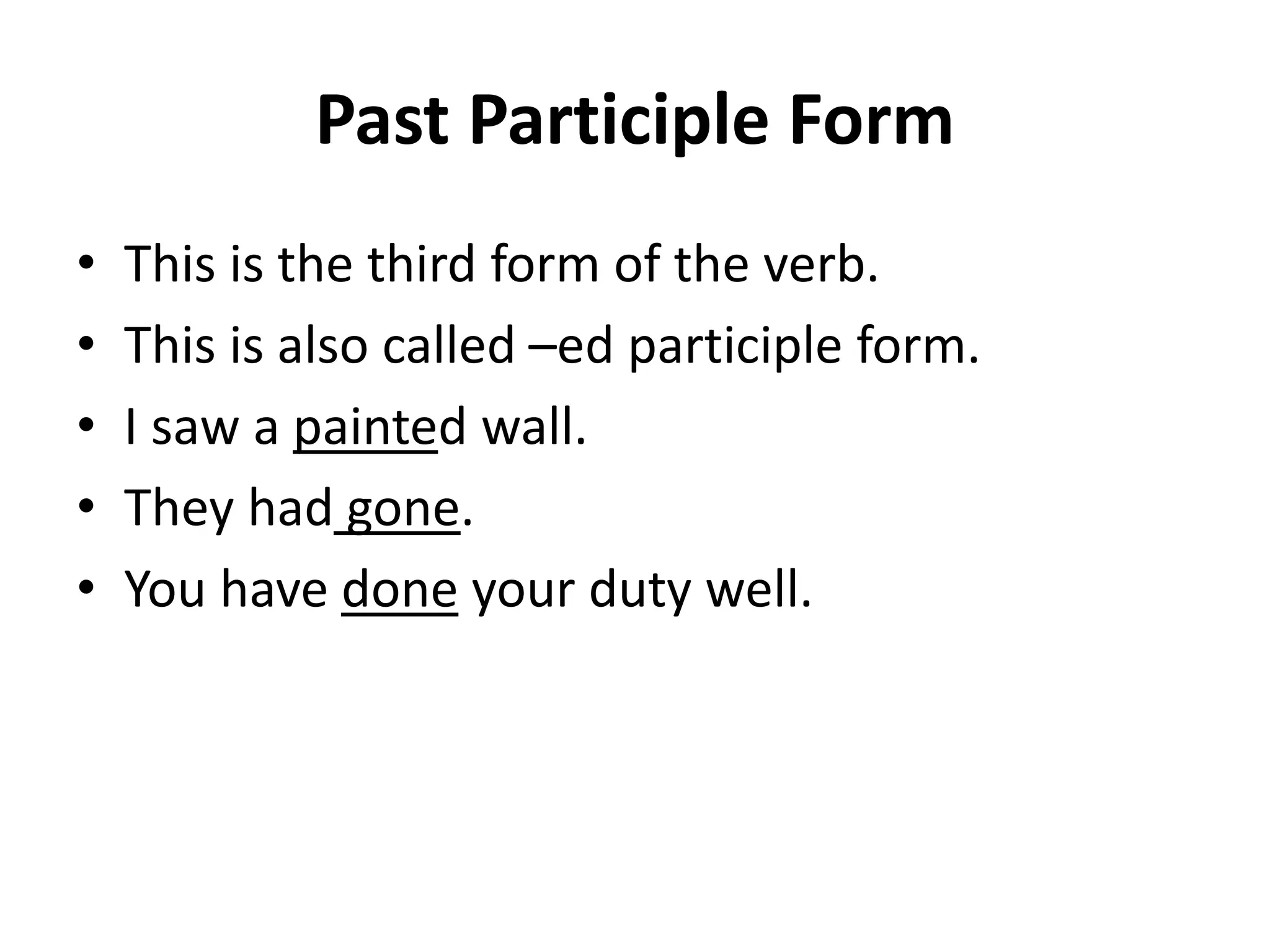
Past Participle Form
• This is the third form of the verb.
• This is also called –ed participle form.
• I saw a painted wall.
• They had gone.
• You have done your duty well.
Present Participle Form
• This is the fourth form of verb. It is also called
–ing participle. Adding –ing can also make a
verb as an adjective.
• I am going to market.
• He is the shinning star of this class.
• The girl standing there is my sister.
• She is painting a picture.
Exceptions of Be
• In English be is an exceptional verb. It has
many forms.
• I have to be present there. ( infinitive)
• Be happy. ( base)
• It is my duty.( simple Present)
• Being good to all is possible.( present
participle)
• She has never been late. ( past participle)
• I was reading a book. ( simple past )
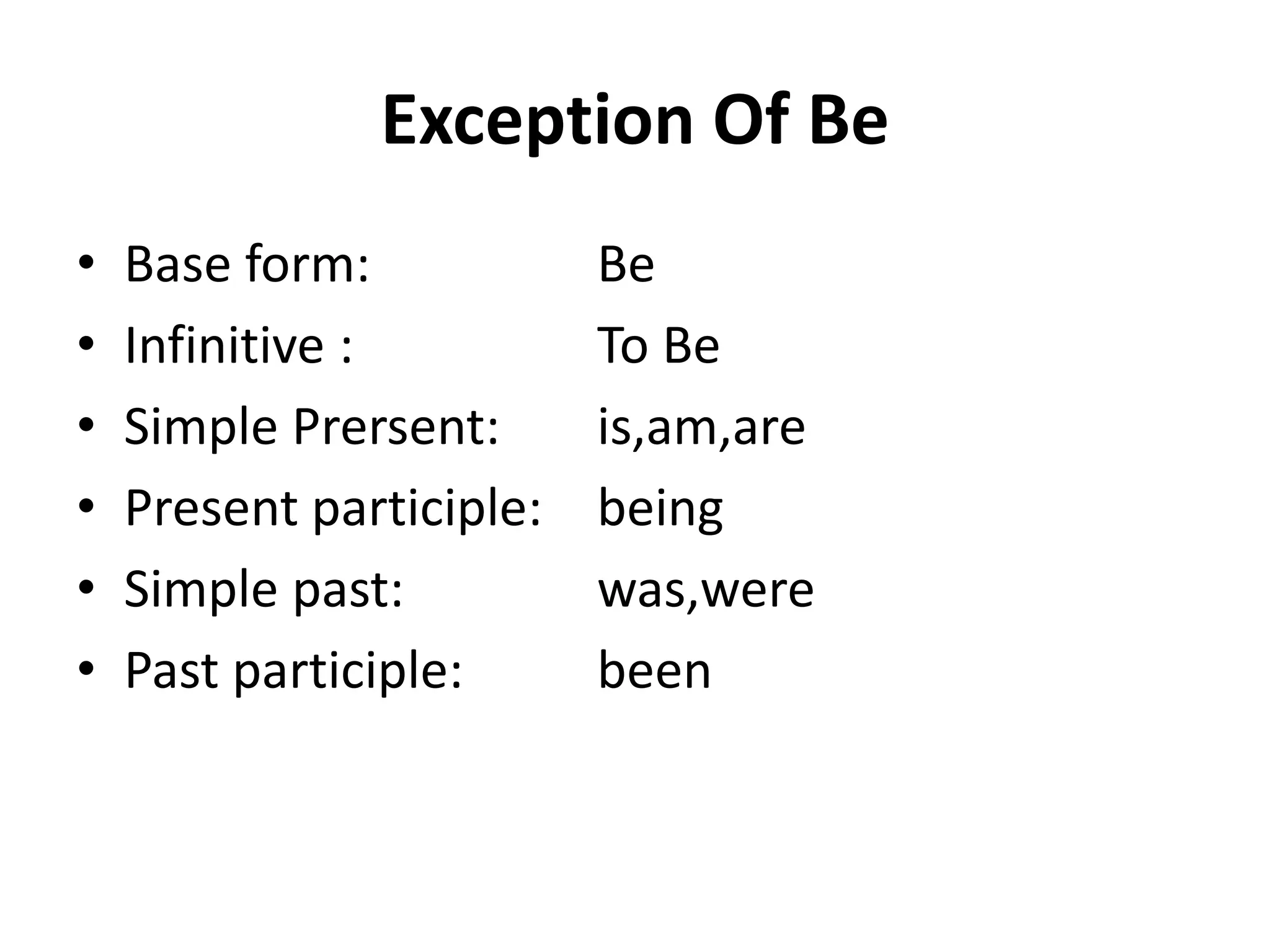
Exception Of Be
• Base form: Be
• Infinitive : To Be
• Simple Prersent: is,am,are
• Present participle: being
• Simple past: was,were
• Past participle: been
Grammar class 9th federal textbook board Islamabad FORMS OF VERB.pptx

Grammar class 9th federal textbook board Islamabad FORMS OF VERB.pptx

  • 1.
    FORMS OF VERB DEMOLESSON BY FOUZIA IRAM
  • 2.
    Outline • Base Form •Infinitive Form • Simple past Form • Past Participle Form • Present Participle Form • Exception Of ‘be’
  • 3.
    Base Form • Thisis the most commonly used form.it is also called first form,ground form, simple present form or as an imperative form. • Examples: • I eat mangoes. • I work as a teacher. • Complete your work.
  • 4.
    Infinitive Form • Acomplete infinitive form contains a ‘to’ before it. • It does other purposes rather than being the main verb. • After an adjective: I am happy to see you. • After a usual verb: I want to come. • As infinitive structure: They want to help you.
  • 5.
    Infinitive Form • Onecan also have a bare infinitive along with auxiliary or helping verbs as follows. • I will come. • They sing sweetly. • We go there daily.
  • 6.
    Simple Past Form •This form is called second form of verb. This form we commonly see with an added –ed extension if the verb is regular. • He worked hard to pass the exam. • I wrote a letter. • She watered the plants.
  • 7.
    Past Participle Form •This is the third form of the verb. • This is also called –ed participle form. • I saw a painted wall. • They had gone. • You have done your duty well.
  • 8.
    Present Participle Form •This is the fourth form of verb. It is also called –ing participle. Adding –ing can also make a verb as an adjective. • I am going to market. • He is the shinning star of this class. • The girl standing there is my sister. • She is painting a picture.
  • 9.
    Exceptions of Be •In English be is an exceptional verb. It has many forms. • I have to be present there. ( infinitive) • Be happy. ( base) • It is my duty.( simple Present) • Being good to all is possible.( present participle) • She has never been late. ( past participle) • I was reading a book. ( simple past )
  • 10.
    Exception Of Be •Base form: Be • Infinitive : To Be • Simple Prersent: is,am,are • Present participle: being • Simple past: was,were • Past participle: been