JEMMARIE G. SUETOS
Subject-in-charge
SY: 2020-2021
Suetos, J.G., 2021
Few farmers follow recommendation in their
entirety because of :
1. Some argue that farmers are at fault
2. Some claim that extension is ineffective
3. Others say that credit is unsuitable
4. Some point out that inputs are not available when needed
5. Rec. tech are simply not appropriate to farmer’s condition
Suetos, J.G., 2021
Farmers’ perspective
 Clarify some concepts (or misconcepts) about FS
from a wide range of perspective
- micro-perspective – based on legally and
culturally acceptable farm boundaries
- macro-perspective – include both external &
internal factors to the farm
Suetos, J.G., 2021
Farming System
Suetos, J.G., 2021
Terminologies
• Is an activity (of man), carried out primarily to produce FOOD and
FIBER (and fuel as well as many other materials) by the deliberate and
controlled use of (mainly terrestrial) plants and animals
AGRICULTU
RE
• Is an activity of man carried out primarily to produce food and money
(as well as many other materials) by the deliberate and controlled use
of plants and animals in either a terrestrial or aquatic habitat.
FARMING
• Is a highly organized integrated set of operation, which exist in a
complex of natural, social, political, and economic environment.
Farm
Note: Farming activity per se involved DECISION (
Suetos, J.G., 2021
Terminologies
• it implies action
Activity
• it implies other important products
Primarily
• it implies purpose
Deliberate
Controlled • it implies farming
Suetos, J.G., 2021
Terminologies
• Is a group of interacting components, operating together for a
purpose, capable of reacting as a whole to external stimuli;
• It is affected directly by its own outputs and has specified boundary
on the inclusion of all significant feedbacks (Colin Spedding)
SYSTEM
• Is defined as the farming pattern or a mix of farming enterprise
farm family allocate its resources (land, labor, capital) to efficiently
exploit the existing environment (rainfall, soil properties, solar
market, credit infrastructure and service institution) for the
of the family’s goal (increase income, improve quality of life, etc.)
FARMIN
SYSTEM
Suetos, J.G., 2021
ATTRIBUTES OF
Farming Systems
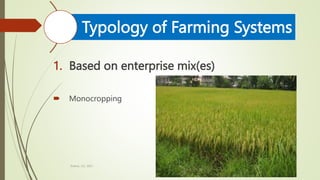
1. Based on enterprise mix(es)
 Monocropping
Suetos, J.G., 2021
Typology of Farming Systems
1. Based on enterprise mix(es)
 Diversified farming
Suetos, J.G., 2021
Typology of Farming Systems
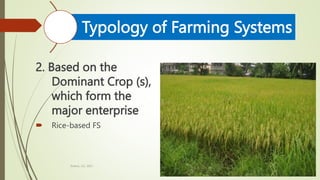
2. Based on the
Dominant Crop (s),
which form the
major enterprise
 Rice-based FS
Suetos, J.G., 2021
Typology of Farming Systems
 Sugarcane-based
FS
Suetos, J.G., 2021
Typology of Farming Systems
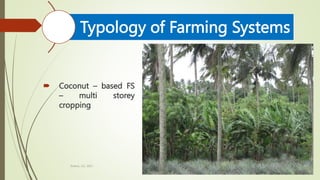
 Coconut – based FS
– multi storey
cropping
Suetos, J.G., 2021
Typology of Farming Systems
 Fruit trees – based FS
Suetos, J.G., 2021
Typology of Farming Systems
3. Based on agro – environment
 Moisture/water source (rainfed/irrigated)
Suetos, J.G., 2021
Typology of Farming Systems
 Topography (lowland, hilly land  agroforestry 
SALT)
Suetos, J.G., 2021
Typology of Farming
4. Based on the use of inputs in farming
 High external input (HEI) FS – modern/ scientific
agriculture
- green revolution
- chemical fertilizer, pesticides, HYV seeds
Suetos, J.G., 2021
Typology of Farming Systems
 Low external input (LEI) FS – purist, which pursue farming
chemical free
- nature farming
- organic farming, etc…
- external input come in the form of machines
- more liberal minded accept minimal
application of chemical inputs
- environment & health hazard impact
Suetos, J.G., 2021
Typology of Farming Systems
Organic
Farming
Suetos, J.G., 2021
Typology of Farming
5. Based on the central or unique
feature of the farm
 Crop centered FS
 Livestock centered FS
 Integrated crop & livestock FS
 Integrated crop & aquaculture FS
 Integrated livestock & aquaculture FS
Suetos, J.G., 2021
Typology of Farming Systems
6. “Evolving Types” of FS
 Recreational or hobby FS
- prof and businessmen engaged in farming during
weekends
 Agro-tourism-oriented FS
- the aim of FS design for agro-tourism is to have free space
for “AGROTOURIST”
Suetos, J.G., 2021
Typology of Farming Systems
1. Farm resort
Irrigationswimming poolwater
fishpond or rice field/vegetable
Suetos, J.G., 2021
6. “Evolving Types” of FS
Typology of Farming
2. Open farm - farm level marketing
allow/ accept visitors to harvest for
themselvesweighprice
Suetos, J.G., 2021
7. Specialized farming system
 Production of high valued crops – limited space – high valued crops
Typology of Farming
Aquaculture – fingerlings
production
Aquarium fish
Suetos, J.G., 2021
Typology of Farming
Love Birds Farming
Suetos, J.G., 2021
Typology of Farming
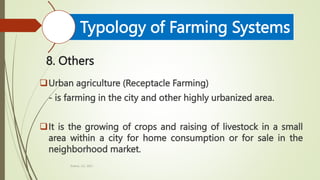
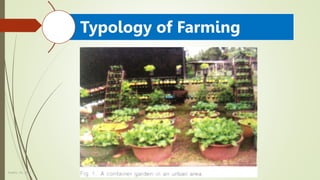
8. Others
Urban agriculture (Receptacle Farming)
- is farming in the city and other highly urbanized area.
It is the growing of crops and raising of livestock in a small
area within a city for home consumption or for sale in the
neighborhood market.
Suetos, J.G., 2021
Typology of Farming Systems
Suetos, J.G., 2021
Typology of Farming
Suetos, J.G., 2021
Typology of Farming
 Protected cultivation (green house, net house, net tunnel and black
plastic mulch)
- means modification of natural environment such as temperature,
humidity, light and carbon dioxide to achieve optimum plant growth.
- also it means, sparing the crop partially or totally from negative
effects of abiotic and biotic agents.
The purpose of protecting the crop is to make their availability during
off-season.
Suetos, J.G., 2021
Typology of Farming Systems
Suetos, J.G., 2021
Typology of Farming
Suetos, J.G., 2021
Typology of Farming
It is a group of interacting components, operating
together for common purposes, capable of
reacting as a whole to external stimuli.
It is unaffected directly by its own outputs and
has a special boundary based on the inclusion of
all significant feedbacks.
Suetos, J.G., 2021
What is a System
It is an orderly set of interdependent and
interacting components, none of which can be
modified without causing an unrelated change
elsewhere in the system.
Example:
 The vascular system in our bodies
 Integrated Farming System (Crop + Livestock + Fish)
Suetos, J.G., 2021
What is a System
Rice Bran
DRAFT POWER
Straw & Rice
Bran
Manure
Manure
Water
Water & Pond Mud
CROP
(RICE)
ANIMAL
(CARABAO)
FISH
(TILAPIA)
Food & Money Food & Money
Food & Money
Family Market Family Market Family Market
CROP + ANIMAL + FISH FARM
Suetos, J.G., 2021
Typology of Farming
Systems
Is it right to conclude that anything can be a system? YES
or NO
If YES, the concept would be useless
System has properties, summarized in phrase “BEHAVIOUR
AS A WHOLE IN RESPONSE TO STIMULI TO ANY PART”.
Thus, collection of unrelated item does not constitute a
system.
Suetos, J.G., 2021
Implication of the systems definition
Example:
A bag of marble is not a system; if a marble is added or
subtracted, bag of marble remains and maybe completely
unaffected by change.
The marbles only behave as a whole if the whole bag is
influenced, for example by dropping it, but it bursts the
constituent parts will go their own way.
Suetos, J.G., 2021
Implication of the systems definition
Objective or Purpose – single or multiple objectives.
Objectives are achieved by employing resources within a
framework of constraints.
Interaction – is a dynamic, hence, the system will change
with different objectives, resource combinations and a new
set of constraints
Suetos, J.G., 2021
Elements of a system
Resources – are at the same time, constraints
when they occur in limited quantities or when
their quality deteriorates
Environment – systems also possess as
environment. They do not exist in a vacuum but
are affected by their surroundings
Suetos, J.G., 2021
Implication of the systems definition
Self-regulating – it is the characteristics of a
system to maintain itself in a steady state of
equilibrium.
If there is a stress, the system will seek another
equilibrium state
Is accomplish through dynamic interaction of system
component parts
Suetos, J.G., 2021
Characteristic or feature of a system
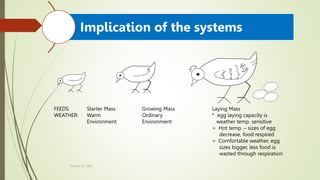
FEEDS:
WEATHER:
Starter Mass
Warm
Environment
Growing Mass
Ordinary
Environment
Laying Mass
* egg laying capacity is
weather temp. sensitive
= Hot temp. – sizes of egg
decrease, food respired
= Comfortable weather, egg
sizes bigger, less food is
wasted through respiration
Suetos, J.G., 2021
Implication of the systems
Seedlings
(after transplanting)
Vegetative Reproductive Ripening
- urea (good start)
- cool weather
- less urea, more on P & K
- warm weather
= high yield
= better grain quality
Suetos, J.G., 2021
Implication of the systems
 Self-correcting or adjusting – an interaction with the
environment in some instances, results in conditions that
upset the normal self-regulatory operation of system.
 Organized complexity – between and among component
parts of subsystem of a system, there is organization. System
is viewed as an organized whole.
 The organization in a system is also achieved due to feedback or
interaction.
Suetos, J.G., 2021
Implication of the systems definition
POULTRY
HOUSE
FISH POND
Suetos, J.G., 2021
Implication of the systems
 Hierarchy – is universal in all systems whether it is physical,
biological, political, social system. The order can be ascending or
descending, depends on where the starting point is.
- macrohierarchy – represented by astronomical universe
-microhierarchy system – represented by the terrestrial (earth
system)
Suetos, J.G., 2021
Implication of the systems definition
CLASSES OF SEEDS
Breeder seeds
Foundation seeds
Registered seeds
Certified seeds
Good seeds
Suetos, J.G., 2021
Implication of the systems definition
Tag color
White
Red
Green
Blue
Sources
Comes directly from plant breeder
Grown from breeder seed
Grown from foundation seed can be grown by
selected farmers
Grown from either foundation, registered or
certified seed, for commercial planting
Seed that maybe produced from varieties not
yet approved by NSIC
International trade in
Agricultural Products
Level of focus in agricultural development
Suetos, J.G., 2021
Intra-national trade
Agricultural System
Farming Systems
Sub-systems
Components
Politicians
Economists
Traders
Farmers
Agriculturists
Merchants
Plant & Animal Scientist
Agricultural engineers
?
Implication of the systems definition
Boundaries – identifying system boundaries is
important in the study of system analysis as
there can be no end in the study of systems
system
Suetos, J.G., 2021
Implication of the systems definition
The fact that there is something that can be called an
approach implies that there must be:
1. A philosophical foundation upon in which in rests.
 Karl Popper’s view appeal most.
 He argues that all organisms live by hypothesis about solution
to the problems they encounter, as the hypothesis are proved
wrong they are discarded and new ones evolved until the
problem is solved.
Suetos, J.G., 2021
System Approach
2. A set of principles to guide action.
The first of which is to identify, classify and describe the
system in which one is interested in order to establish their initial
state, and most importantly, their purpose.
3. A way of proceeding (a method of operation)
After we have decided what system it is we are talking
about and how it operates now, if our purpose is to improve it,
we must identify and clearly define the problem that stands in
the way of achieving the improvement.
Suetos, J.G., 2021
System Approach
The next steps are:
a) Analyze the problem in relation to system purpose
b) Hypothesize a solution
c) Synthesize the system under investigation
Suetos, J.G., 2021
System Approach
In this last we can proceed in one or all the three ways:
a) Accept the hypothesis as a reasonable estimate of the truth and
go ahead and test it in ad hoc way (on-farm research)
b) Test the hypothesis physically in a controlled, scientific way
c) Test the hypothesis in an abstract way by using computer models
in which changes in system variables can be manipulated.
If the solution is not acceptable then we have to forget about it and
go back through the whole process again.
Suetos, J.G., 2021
System Approach

Introduction to farming system.pptx

  • 1.
    JEMMARIE G. SUETOS Subject-in-charge SY:2020-2021 Suetos, J.G., 2021
  • 2.
    Few farmers followrecommendation in their entirety because of : 1. Some argue that farmers are at fault 2. Some claim that extension is ineffective 3. Others say that credit is unsuitable 4. Some point out that inputs are not available when needed 5. Rec. tech are simply not appropriate to farmer’s condition Suetos, J.G., 2021 Farmers’ perspective
  • 3.
     Clarify someconcepts (or misconcepts) about FS from a wide range of perspective - micro-perspective – based on legally and culturally acceptable farm boundaries - macro-perspective – include both external & internal factors to the farm Suetos, J.G., 2021 Farming System
  • 4.
    Suetos, J.G., 2021 Terminologies •Is an activity (of man), carried out primarily to produce FOOD and FIBER (and fuel as well as many other materials) by the deliberate and controlled use of (mainly terrestrial) plants and animals AGRICULTU RE • Is an activity of man carried out primarily to produce food and money (as well as many other materials) by the deliberate and controlled use of plants and animals in either a terrestrial or aquatic habitat. FARMING • Is a highly organized integrated set of operation, which exist in a complex of natural, social, political, and economic environment. Farm Note: Farming activity per se involved DECISION (
  • 5.
    Suetos, J.G., 2021 Terminologies •it implies action Activity • it implies other important products Primarily • it implies purpose Deliberate Controlled • it implies farming
  • 6.
    Suetos, J.G., 2021 Terminologies •Is a group of interacting components, operating together for a purpose, capable of reacting as a whole to external stimuli; • It is affected directly by its own outputs and has specified boundary on the inclusion of all significant feedbacks (Colin Spedding) SYSTEM • Is defined as the farming pattern or a mix of farming enterprise farm family allocate its resources (land, labor, capital) to efficiently exploit the existing environment (rainfall, soil properties, solar market, credit infrastructure and service institution) for the of the family’s goal (increase income, improve quality of life, etc.) FARMIN SYSTEM
  • 7.
  • 8.
    1. Based onenterprise mix(es)  Monocropping Suetos, J.G., 2021 Typology of Farming Systems
  • 9.
    1. Based onenterprise mix(es)  Diversified farming Suetos, J.G., 2021 Typology of Farming Systems
  • 10.
    2. Based onthe Dominant Crop (s), which form the major enterprise  Rice-based FS Suetos, J.G., 2021 Typology of Farming Systems
  • 11.
     Sugarcane-based FS Suetos, J.G.,2021 Typology of Farming Systems
  • 12.
     Coconut –based FS – multi storey cropping Suetos, J.G., 2021 Typology of Farming Systems
  • 13.
     Fruit trees– based FS Suetos, J.G., 2021 Typology of Farming Systems
  • 14.
    3. Based onagro – environment  Moisture/water source (rainfed/irrigated) Suetos, J.G., 2021 Typology of Farming Systems
  • 15.
     Topography (lowland,hilly land  agroforestry  SALT) Suetos, J.G., 2021 Typology of Farming
  • 16.
    4. Based onthe use of inputs in farming  High external input (HEI) FS – modern/ scientific agriculture - green revolution - chemical fertilizer, pesticides, HYV seeds Suetos, J.G., 2021 Typology of Farming Systems
  • 17.
     Low externalinput (LEI) FS – purist, which pursue farming chemical free - nature farming - organic farming, etc… - external input come in the form of machines - more liberal minded accept minimal application of chemical inputs - environment & health hazard impact Suetos, J.G., 2021 Typology of Farming Systems
  • 18.
  • 19.
    5. Based onthe central or unique feature of the farm  Crop centered FS  Livestock centered FS  Integrated crop & livestock FS  Integrated crop & aquaculture FS  Integrated livestock & aquaculture FS Suetos, J.G., 2021 Typology of Farming Systems
  • 20.
    6. “Evolving Types”of FS  Recreational or hobby FS - prof and businessmen engaged in farming during weekends  Agro-tourism-oriented FS - the aim of FS design for agro-tourism is to have free space for “AGROTOURIST” Suetos, J.G., 2021 Typology of Farming Systems
  • 21.
    1. Farm resort Irrigationswimmingpoolwater fishpond or rice field/vegetable Suetos, J.G., 2021 6. “Evolving Types” of FS Typology of Farming 2. Open farm - farm level marketing allow/ accept visitors to harvest for themselvesweighprice
  • 22.
    Suetos, J.G., 2021 7.Specialized farming system  Production of high valued crops – limited space – high valued crops Typology of Farming
  • 23.
    Aquaculture – fingerlings production Aquariumfish Suetos, J.G., 2021 Typology of Farming
  • 24.
    Love Birds Farming Suetos,J.G., 2021 Typology of Farming
  • 25.
    8. Others Urban agriculture(Receptacle Farming) - is farming in the city and other highly urbanized area. It is the growing of crops and raising of livestock in a small area within a city for home consumption or for sale in the neighborhood market. Suetos, J.G., 2021 Typology of Farming Systems
  • 26.
  • 27.
  • 28.
     Protected cultivation(green house, net house, net tunnel and black plastic mulch) - means modification of natural environment such as temperature, humidity, light and carbon dioxide to achieve optimum plant growth. - also it means, sparing the crop partially or totally from negative effects of abiotic and biotic agents. The purpose of protecting the crop is to make their availability during off-season. Suetos, J.G., 2021 Typology of Farming Systems
  • 29.
  • 30.
  • 31.
    It is agroup of interacting components, operating together for common purposes, capable of reacting as a whole to external stimuli. It is unaffected directly by its own outputs and has a special boundary based on the inclusion of all significant feedbacks. Suetos, J.G., 2021 What is a System
  • 32.
    It is anorderly set of interdependent and interacting components, none of which can be modified without causing an unrelated change elsewhere in the system. Example:  The vascular system in our bodies  Integrated Farming System (Crop + Livestock + Fish) Suetos, J.G., 2021 What is a System
  • 33.
    Rice Bran DRAFT POWER Straw& Rice Bran Manure Manure Water Water & Pond Mud CROP (RICE) ANIMAL (CARABAO) FISH (TILAPIA) Food & Money Food & Money Food & Money Family Market Family Market Family Market CROP + ANIMAL + FISH FARM Suetos, J.G., 2021 Typology of Farming Systems
  • 34.
    Is it rightto conclude that anything can be a system? YES or NO If YES, the concept would be useless System has properties, summarized in phrase “BEHAVIOUR AS A WHOLE IN RESPONSE TO STIMULI TO ANY PART”. Thus, collection of unrelated item does not constitute a system. Suetos, J.G., 2021 Implication of the systems definition
  • 35.
    Example: A bag ofmarble is not a system; if a marble is added or subtracted, bag of marble remains and maybe completely unaffected by change. The marbles only behave as a whole if the whole bag is influenced, for example by dropping it, but it bursts the constituent parts will go their own way. Suetos, J.G., 2021 Implication of the systems definition
  • 36.
    Objective or Purpose– single or multiple objectives. Objectives are achieved by employing resources within a framework of constraints. Interaction – is a dynamic, hence, the system will change with different objectives, resource combinations and a new set of constraints Suetos, J.G., 2021 Elements of a system
  • 37.
    Resources – areat the same time, constraints when they occur in limited quantities or when their quality deteriorates Environment – systems also possess as environment. They do not exist in a vacuum but are affected by their surroundings Suetos, J.G., 2021 Implication of the systems definition
  • 38.
    Self-regulating – itis the characteristics of a system to maintain itself in a steady state of equilibrium. If there is a stress, the system will seek another equilibrium state Is accomplish through dynamic interaction of system component parts Suetos, J.G., 2021 Characteristic or feature of a system
  • 39.
    FEEDS: WEATHER: Starter Mass Warm Environment Growing Mass Ordinary Environment LayingMass * egg laying capacity is weather temp. sensitive = Hot temp. – sizes of egg decrease, food respired = Comfortable weather, egg sizes bigger, less food is wasted through respiration Suetos, J.G., 2021 Implication of the systems
  • 40.
    Seedlings (after transplanting) Vegetative ReproductiveRipening - urea (good start) - cool weather - less urea, more on P & K - warm weather = high yield = better grain quality Suetos, J.G., 2021 Implication of the systems
  • 41.
     Self-correcting oradjusting – an interaction with the environment in some instances, results in conditions that upset the normal self-regulatory operation of system.  Organized complexity – between and among component parts of subsystem of a system, there is organization. System is viewed as an organized whole.  The organization in a system is also achieved due to feedback or interaction. Suetos, J.G., 2021 Implication of the systems definition
  • 42.
    POULTRY HOUSE FISH POND Suetos, J.G.,2021 Implication of the systems
  • 43.
     Hierarchy –is universal in all systems whether it is physical, biological, political, social system. The order can be ascending or descending, depends on where the starting point is. - macrohierarchy – represented by astronomical universe -microhierarchy system – represented by the terrestrial (earth system) Suetos, J.G., 2021 Implication of the systems definition
  • 44.
    CLASSES OF SEEDS Breederseeds Foundation seeds Registered seeds Certified seeds Good seeds Suetos, J.G., 2021 Implication of the systems definition Tag color White Red Green Blue Sources Comes directly from plant breeder Grown from breeder seed Grown from foundation seed can be grown by selected farmers Grown from either foundation, registered or certified seed, for commercial planting Seed that maybe produced from varieties not yet approved by NSIC
  • 45.
    International trade in AgriculturalProducts Level of focus in agricultural development Suetos, J.G., 2021 Intra-national trade Agricultural System Farming Systems Sub-systems Components Politicians Economists Traders Farmers Agriculturists Merchants Plant & Animal Scientist Agricultural engineers ? Implication of the systems definition
  • 46.
    Boundaries – identifyingsystem boundaries is important in the study of system analysis as there can be no end in the study of systems system Suetos, J.G., 2021 Implication of the systems definition
  • 47.
    The fact thatthere is something that can be called an approach implies that there must be: 1. A philosophical foundation upon in which in rests.  Karl Popper’s view appeal most.  He argues that all organisms live by hypothesis about solution to the problems they encounter, as the hypothesis are proved wrong they are discarded and new ones evolved until the problem is solved. Suetos, J.G., 2021 System Approach
  • 48.
    2. A setof principles to guide action. The first of which is to identify, classify and describe the system in which one is interested in order to establish their initial state, and most importantly, their purpose. 3. A way of proceeding (a method of operation) After we have decided what system it is we are talking about and how it operates now, if our purpose is to improve it, we must identify and clearly define the problem that stands in the way of achieving the improvement. Suetos, J.G., 2021 System Approach
  • 49.
    The next stepsare: a) Analyze the problem in relation to system purpose b) Hypothesize a solution c) Synthesize the system under investigation Suetos, J.G., 2021 System Approach
  • 50.
    In this lastwe can proceed in one or all the three ways: a) Accept the hypothesis as a reasonable estimate of the truth and go ahead and test it in ad hoc way (on-farm research) b) Test the hypothesis physically in a controlled, scientific way c) Test the hypothesis in an abstract way by using computer models in which changes in system variables can be manipulated. If the solution is not acceptable then we have to forget about it and go back through the whole process again. Suetos, J.G., 2021 System Approach