Q1_W2_D3
Performing Computer Operation (Part 1)
GRADE 8
RANDY M. GARAY, MAEd
Subject Teacher
Learning Objectives:
1. Access program/application
containing the information required
according to company procedures.
2. Select, open, and close desktop for
navigation purposes
HOW DO WE ACCESS INFORMATION
STORED IN A COMPUTER?
• Manually locate the file.
• Using the Search box.
This method is applicable whether your file is stored in a hard disk, flash
drive, network drive, CD/DVD, or portable external hard disk.
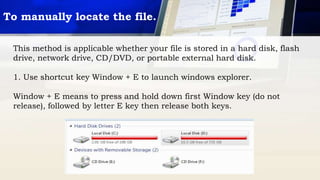
1. Use shortcut key Window + E to launch windows explorer.
Window + E means to press and hold down first Window key (do not
release), followed by letter E key then release both keys.
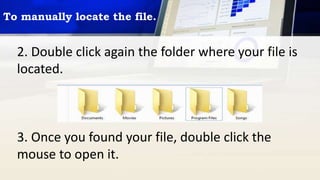
To manually locate the file.
2. Double click again the folder where your file is
located.
3. Once you found your file, double click the
mouse to open it.
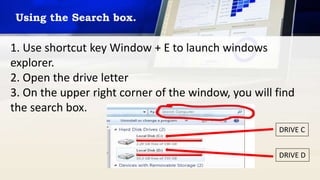
Using the Search box.
1. Use shortcut key Window + E to launch windows
explorer.
2. Open the drive letter
3. On the upper right corner of the window, you will find
the search box.
DRIVE C
DRIVE D
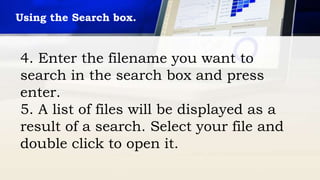
Using the Search box.
4. Enter the filename you want to
search in the search box and press
enter.
5. A list of files will be displayed as a
result of a search. Select your file and
double click to open it.
Produce Output/Data Using
Computer System
Example of Output Devices
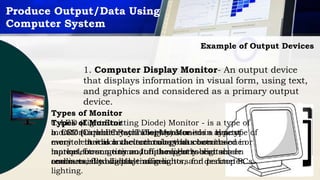
1. Computer Display Monitor- An output device
that displays information in visual form, using text,
and graphics and considered as a primary output
device.
Types of Monitor
a. CRT (Cathode Ray Tube) Monitor – is a type of
monitor that is a vacuum tube that contains one or
more electron guns and a phosphorescent screen
and is used to display images.
Types of Monitor
c. LED (Light Emitting Diode) Monitor - is a type of
monitor in which technology was used in almost
every electrical and electronic product on the
market, from a tiny on/off the light to digital
readouts, flashlights, traffic lights, and perimeter
lighting.
Types of Monitor
b. LCD (Liquid Crystal Display) Monitor – is a type of
monitor in which the technology has been used in
laptops for some time. It has recently been made
commercially available as monitors for desktop PCs.
Produce Output/Data Using
Computer System
Example of Output Devices
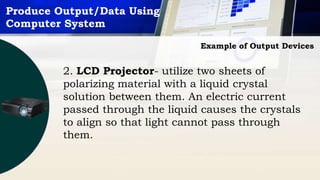
2. LCD Projector- utilize two sheets of
polarizing material with a liquid crystal
solution between them. An electric current
passed through the liquid causes the crystals
to align so that light cannot pass through
them.
Produce Output/Data Using
Computer System
Example of Output Devices
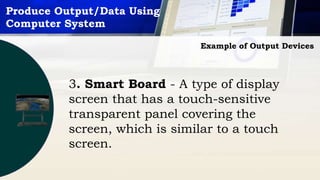
3. Smart Board - A type of display
screen that has a touch-sensitive
transparent panel covering the
screen, which is similar to a touch
screen.
Produce Output/Data Using
Computer System
Example of Output Devices
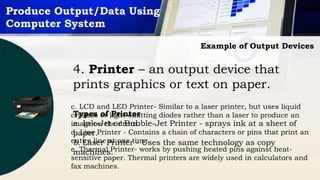
4. Printer – an output device that
prints graphics or text on paper.
Types of Printer
a. Ink-Jet or Bubble-Jet Printer - sprays ink at a sheet of
paper.
b. Laser Printer - Uses the same technology as copy
machines.
c. LCD and LED Printer- Similar to a laser printer, but uses liquid
crystals or light-emitting diodes rather than a laser to produce an
image on the drum.
d. Line Printer - Contains a chain of characters or pins that print an
entire line at one time.
e. Thermal Printer- works by pushing heated pins against heat-
sensitive paper. Thermal printers are widely used in calculators and
fax machines.
Produce Output/Data Using
Computer System
Example of Output Devices
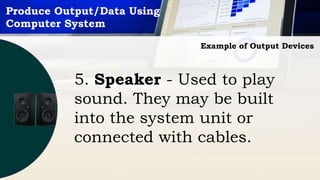
5. Speaker - Used to play
sound. They may be built
into the system unit or
connected with cables.
Produce Output/Data Using
Computer System
Example of Output Devices
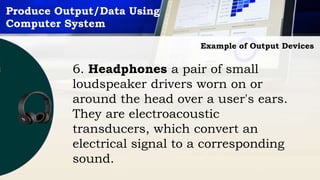
6. Headphones a pair of small
loudspeaker drivers worn on or
around the head over a user's ears.
They are electroacoustic
transducers, which convert an
electrical signal to a corresponding
sound.
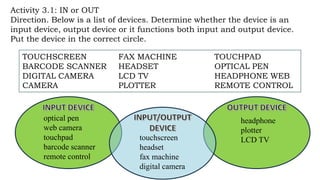
Activity 3.1: IN or OUT
Direction. Below is a list of devices. Determine whether the device is an
input device, output device or it functions both input and output device.
Put the device in the correct circle.
TOUCHSCREEN FAX MACHINE TOUCHPAD
BARCODE SCANNER HEADSET OPTICAL PEN
DIGITAL CAMERA LCD TV HEADPHONE WEB
CAMERA PLOTTER REMOTE CONTROL
optical pen
web camera
touchpad
barcode scanner
remote control
headphone
plotter
LCD TV
touchscreen
headset
fax machine
digital camera
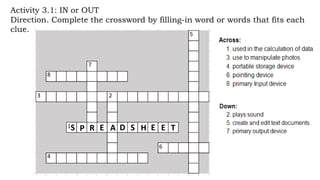
Activity 3.1: IN or OUT
Direction. Complete the crossword by filling-in word or words that fits each
clue.
1
8
3
6
4
7
2
5
S P R E A D S H E E T
Slide Title
Product A
• Feature 1
• Feature 2
• Feature 3
Product B
• Feature 1
• Feature 2
• Feature 3

Grade Eight_Quarter 1_Week Four_Day 1.pptx

  • 2.
    Q1_W2_D3 Performing Computer Operation(Part 1) GRADE 8 RANDY M. GARAY, MAEd Subject Teacher
  • 3.
    Learning Objectives: 1. Accessprogram/application containing the information required according to company procedures. 2. Select, open, and close desktop for navigation purposes
  • 4.
    HOW DO WEACCESS INFORMATION STORED IN A COMPUTER? • Manually locate the file. • Using the Search box.
  • 5.
    This method isapplicable whether your file is stored in a hard disk, flash drive, network drive, CD/DVD, or portable external hard disk. 1. Use shortcut key Window + E to launch windows explorer. Window + E means to press and hold down first Window key (do not release), followed by letter E key then release both keys. To manually locate the file.
  • 6.
    To manually locatethe file. 2. Double click again the folder where your file is located. 3. Once you found your file, double click the mouse to open it.
  • 7.
    Using the Searchbox. 1. Use shortcut key Window + E to launch windows explorer. 2. Open the drive letter 3. On the upper right corner of the window, you will find the search box. DRIVE C DRIVE D
  • 8.
    Using the Searchbox. 4. Enter the filename you want to search in the search box and press enter. 5. A list of files will be displayed as a result of a search. Select your file and double click to open it.
  • 9.
    Produce Output/Data Using ComputerSystem Example of Output Devices 1. Computer Display Monitor- An output device that displays information in visual form, using text, and graphics and considered as a primary output device. Types of Monitor a. CRT (Cathode Ray Tube) Monitor – is a type of monitor that is a vacuum tube that contains one or more electron guns and a phosphorescent screen and is used to display images. Types of Monitor c. LED (Light Emitting Diode) Monitor - is a type of monitor in which technology was used in almost every electrical and electronic product on the market, from a tiny on/off the light to digital readouts, flashlights, traffic lights, and perimeter lighting. Types of Monitor b. LCD (Liquid Crystal Display) Monitor – is a type of monitor in which the technology has been used in laptops for some time. It has recently been made commercially available as monitors for desktop PCs.
  • 10.
    Produce Output/Data Using ComputerSystem Example of Output Devices 2. LCD Projector- utilize two sheets of polarizing material with a liquid crystal solution between them. An electric current passed through the liquid causes the crystals to align so that light cannot pass through them.
  • 11.
    Produce Output/Data Using ComputerSystem Example of Output Devices 3. Smart Board - A type of display screen that has a touch-sensitive transparent panel covering the screen, which is similar to a touch screen.
  • 12.
    Produce Output/Data Using ComputerSystem Example of Output Devices 4. Printer – an output device that prints graphics or text on paper. Types of Printer a. Ink-Jet or Bubble-Jet Printer - sprays ink at a sheet of paper. b. Laser Printer - Uses the same technology as copy machines. c. LCD and LED Printer- Similar to a laser printer, but uses liquid crystals or light-emitting diodes rather than a laser to produce an image on the drum. d. Line Printer - Contains a chain of characters or pins that print an entire line at one time. e. Thermal Printer- works by pushing heated pins against heat- sensitive paper. Thermal printers are widely used in calculators and fax machines.
  • 13.
    Produce Output/Data Using ComputerSystem Example of Output Devices 5. Speaker - Used to play sound. They may be built into the system unit or connected with cables.
  • 14.
    Produce Output/Data Using ComputerSystem Example of Output Devices 6. Headphones a pair of small loudspeaker drivers worn on or around the head over a user's ears. They are electroacoustic transducers, which convert an electrical signal to a corresponding sound.
  • 15.
    Activity 3.1: INor OUT Direction. Below is a list of devices. Determine whether the device is an input device, output device or it functions both input and output device. Put the device in the correct circle. TOUCHSCREEN FAX MACHINE TOUCHPAD BARCODE SCANNER HEADSET OPTICAL PEN DIGITAL CAMERA LCD TV HEADPHONE WEB CAMERA PLOTTER REMOTE CONTROL optical pen web camera touchpad barcode scanner remote control headphone plotter LCD TV touchscreen headset fax machine digital camera
  • 16.
    Activity 3.1: INor OUT Direction. Complete the crossword by filling-in word or words that fits each clue. 1 8 3 6 4 7 2 5 S P R E A D S H E E T
  • 17.
    Slide Title Product A •Feature 1 • Feature 2 • Feature 3 Product B • Feature 1 • Feature 2 • Feature 3