Learning and
Development in 4th
Industrial Revolution:
Trends and Challenges
Learning Outcomes
● Defined L&D
● Determined the trends and challenges
in learning and development
● Explained the concepts of reskilling,
upskilling and cross-skilling.
2
Learning and Development
A specialized HR function, learning
and development (L&D) is defined as
the process of empowering
employees with specific skills to
drive better business performance.
3
4
What the future of jobs
will be like?
L & D Trends
In a post-COVID world, organizations
have adapted to a new workplace
challenges – many around how
to manage a remote workforce.
Perhaps no department met tougher
challenges than corporate learning and
development (L&D) teams.
5
1. Microlearning
Microlearning is a learning framework where
training is delivered small, digestible, 2-5 minute
chunks.
The average employee reports having just 4
minutes per day to dedicate to learning.
6
L & D Trends
7
2. DEI Trainings
2020 saw Diversity, Equity and Inclusion
(DEI) catapulted to the forefront as an area
for improvement. Many changed their
corporate culture to one that better works
in the interests of all.
L & D Trends
3. On-demand Training
On-demand training delivered online offers the
flexibility of the modern-day workplace as
employees are allowed to learn at their
convenience - at a time, pace and device of their
choosing. Employees don't have to be on-site to
get training, and managers don't have to hire
external trainers or cover travel costs.
e.g.: Skillshare, EduMe
8
L & D Trends
9
4. Corporate Learning Management
System
It builds online courses to train and educate
their employees. Some LMS require a separate
authoring tool for course creation, while others
let you build directly on their platform. LMS is
used to store, organize, and distribute courses
to employees as needed.
L & D Trends
5. Hybrid Learning Approach
It is an approach to education that
combines online educational materials with
traditional in-person classroom
methods. Put another way, hybrid learning
is a form of synchronous learning that
happens both physically and remotely.
10
L & D Trends
1. Digital Transformation
It is the act of modernizing business processes by
replacing traditional systems with digital
technologies.
According to WEF, manual labor from humans to
machines will lead to the loss of 85 million jobs by
2025 – but will also create 97 million new ones.
11
L & D Challenges
12
2. L&D Post Evaluation
● Development of soft skills
● Learning Transfer
● Tangible or intangible outputs
● Changed behavior
L & D Challenges
3. Development of soft skills
With social distancing and remote work,
people have experienced higher anxiety
levels and lack of physical support from the
organization.
13
L & D Challenges
14
4. Employee Engagement
Accessing training remotely may be
convenient but it causes competition to
the learner’s attention from constant
distractions, emails and calls and the
temptation to surf the internet.
L & D Challenges
5. Multi-generational learners
There cannot be a one-size-fits all learning.
Workers in different stages of their careers
will inevitably have different goals and training
needs. It’s L&D’s responsibility to make sure
they are offering opportunities for
development to employees across all career-
growth stages.
15
L & D Trends
L&D Challenges
16
As an emerging Human
Resource Professional, what is
the concrete solution to the
challenges of L&D?
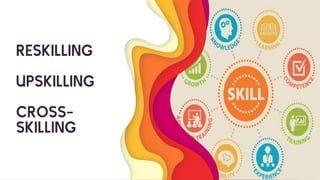
RESKILLING
UPSKILLING
CROSS-
SKILLING
17
Reskilling refers to an employee learning a
new set of skills in order to perform a
different job.
18
Upskilling refers to an employee learning
additional skills to be better equipped to do
his/her job.
Cross-skilling refers to an employee developing
new skills that apply across different functions.
19
UPSKILLING AND
RESKILLING
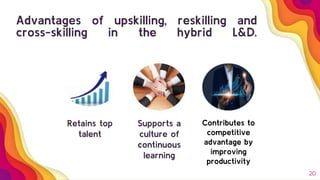
Advantages of upskilling, reskilling and
cross-skilling in the hybrid L&D.
20
Retains top
talent
Supports a
culture of
continuous
learning
Contributes to
competitive
advantage by
improving
productivity
Thanks!
MS. AMY RUTH CASTRO
Instructor, Accenture Ilocos
Delivery Center
21

PRESENTATION.pptx

  • 1.
    Learning and Development in4th Industrial Revolution: Trends and Challenges
  • 2.
    Learning Outcomes ● DefinedL&D ● Determined the trends and challenges in learning and development ● Explained the concepts of reskilling, upskilling and cross-skilling. 2
  • 3.
    Learning and Development Aspecialized HR function, learning and development (L&D) is defined as the process of empowering employees with specific skills to drive better business performance. 3
  • 4.
    4 What the futureof jobs will be like?
  • 5.
    L & DTrends In a post-COVID world, organizations have adapted to a new workplace challenges – many around how to manage a remote workforce. Perhaps no department met tougher challenges than corporate learning and development (L&D) teams. 5
  • 6.
    1. Microlearning Microlearning isa learning framework where training is delivered small, digestible, 2-5 minute chunks. The average employee reports having just 4 minutes per day to dedicate to learning. 6 L & D Trends
  • 7.
    7 2. DEI Trainings 2020saw Diversity, Equity and Inclusion (DEI) catapulted to the forefront as an area for improvement. Many changed their corporate culture to one that better works in the interests of all. L & D Trends
  • 8.
    3. On-demand Training On-demandtraining delivered online offers the flexibility of the modern-day workplace as employees are allowed to learn at their convenience - at a time, pace and device of their choosing. Employees don't have to be on-site to get training, and managers don't have to hire external trainers or cover travel costs. e.g.: Skillshare, EduMe 8 L & D Trends
  • 9.
    9 4. Corporate LearningManagement System It builds online courses to train and educate their employees. Some LMS require a separate authoring tool for course creation, while others let you build directly on their platform. LMS is used to store, organize, and distribute courses to employees as needed. L & D Trends
  • 10.
    5. Hybrid LearningApproach It is an approach to education that combines online educational materials with traditional in-person classroom methods. Put another way, hybrid learning is a form of synchronous learning that happens both physically and remotely. 10 L & D Trends
  • 11.
    1. Digital Transformation Itis the act of modernizing business processes by replacing traditional systems with digital technologies. According to WEF, manual labor from humans to machines will lead to the loss of 85 million jobs by 2025 – but will also create 97 million new ones. 11 L & D Challenges
  • 12.
    12 2. L&D PostEvaluation ● Development of soft skills ● Learning Transfer ● Tangible or intangible outputs ● Changed behavior L & D Challenges
  • 13.
    3. Development ofsoft skills With social distancing and remote work, people have experienced higher anxiety levels and lack of physical support from the organization. 13 L & D Challenges
  • 14.
    14 4. Employee Engagement Accessingtraining remotely may be convenient but it causes competition to the learner’s attention from constant distractions, emails and calls and the temptation to surf the internet. L & D Challenges
  • 15.
    5. Multi-generational learners Therecannot be a one-size-fits all learning. Workers in different stages of their careers will inevitably have different goals and training needs. It’s L&D’s responsibility to make sure they are offering opportunities for development to employees across all career- growth stages. 15 L & D Trends
  • 16.
    L&D Challenges 16 As anemerging Human Resource Professional, what is the concrete solution to the challenges of L&D?
  • 17.
  • 18.
    Reskilling refers toan employee learning a new set of skills in order to perform a different job. 18 Upskilling refers to an employee learning additional skills to be better equipped to do his/her job. Cross-skilling refers to an employee developing new skills that apply across different functions.
  • 19.
  • 20.
    Advantages of upskilling,reskilling and cross-skilling in the hybrid L&D. 20 Retains top talent Supports a culture of continuous learning Contributes to competitive advantage by improving productivity
  • 21.
    Thanks! MS. AMY RUTHCASTRO Instructor, Accenture Ilocos Delivery Center 21