Introduction toTask 3:
New Media
ATAR Media Production & AnalysisYear 11
Trends in media use, genres and/or styles
Key Info & Dates:
- Short Answer Response (Approx. One page)
- AnsweringTWO from choice of FOUR
- Unseen Questions (Given on day of assess.)
- Writing on Friday Week 3Term 2 (13th May)
Syllabus Point:
Trends in media
use, genres
and/or styles
Activity 1:
- Locate the definition of MediaTrends in the SCSA MPA
Glossary (in “Important Documents” folder on Class OneNote)
- Having a brief discussion with the person next to you,
try to think of at least ONE example of a media trend.
New Media &
TheCreative
Revolution
New media technology has opened up enormous potential for creativity and
creation. Creating media products, such as film or video games, was
traditionally only possible if you had access to equipment that was expensive
and difficult to use. Over the last decade, there has been a significant shift in
the production of media.
Creativity & Change
For several hundred years, the ability to publish and broadcast has largely been in
the hands of the wealthy. Now, with little more than a smartphone and internet
access, you can share your work with millions of people.
While many argue the democratisation of media as a cultural revolution some
worry about it’s impact on the very nature of creativity and art.
Lets discuss this point…
New Media: means of mass
communication using digital
technologies such as the
internet.
Traditional Media: forms of
mass media before the advent
of digital media. Print,TV,
Radio etc.
New Media &
TheCreative
Revolution
New media technology has opened up enormous potential for creativity and creation.
Creating media products, such as film or video games, was traditionally only possible if
you had access to equipment that was expensive and difficult to use. Over the last
decade, there has been a significant shift in the production of media.
Creativity & Change
The creative revolution that we are currently experiencing was sparked by the way
the internet evolved to incorporate greater interactivity, socialisation and use-
generated content. In the early days of the internet, websites were typically static
and lacked interactivity.
The arrival of blogs, wikis and sits such asYouTube and Facebook gave ordinary
people the freedom to create and distribute their own media texts. MediaTheorist
Henry Jenkins has dubbed this ‘participatory culture’.According to Jenkins,
participatory culture is an environment in which there are few barriers to artistic
expression and creation of content. People work together in a collaborative and
supportive environment where they share knowledge and skills and value the
contributions of others.
Technology is simply a tool.While it makes certain creative endeavours possible,
these will only become widespread if the culture supports it. Many young people
are already involved in participatory culture through their affiliation with online
communities, the creation of new media products and collaborations via new
media.
User-
Generated
Content
Using only single word answers, what words come
to mind when you hear the term User-generated
Content?
Whiteboard graffiti
User-
Generated
Content
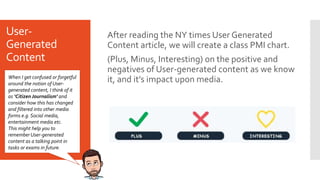
After reading the NY times User Generated
Content article, we will create a class PMI chart.
(Plus, Minus, Interesting) on the positive and
negatives of User-generated content as we know
it, and it’s impact upon media.
When I get confused or forgetful
around the notion of User-
generated content, I think of it
as ‘CitizenJournalism’ and
consider how this has changed
and filtered into other media
forms e.g. Social media,
entertainment media etc.
This might help you to
remember User-generated
content as a talking point in
tasks or exams in future.
Citizen
Journalism
New Media
technologies have
allowed average users
anactive rolein the
collecting, reporting,
analysing and
disseminating ofnews
andinformation.
Citizen journalism is a term that encompasses a range of individual and
social involvement in media creation, reporting and filtering. It has the
following features:
User Reporters. Typical users or amateur reporters report directly on the
news or analyse its content and meaning.They do this through blogs and video
blogs, through user-generated news sites or through submitting the content to
mainstream news organisations.
MobileTechnology. The convergence of mobile technology and cameras
means an average citizen carrying a camera is now more likely to be first on the
scene of a news story than a professional crew. Often the user is actually involved
in the event. Even when not directly reporting on the news, amateurs are able to
submit footage for use in news reporting.
Social Filtering. Social filtering of news allows users to highlight a news
story they consider important and upload the story, or a link to it, to social network
news sites. Others can vote for or against the display of a story.
Q: How could citizen journalism impact the quality of news production?
Citizen
Journalism
Issues &
Considerations
Mainstream journalists are worried about issues of quality
control, bias and accuracy.The assumption that ‘everyone
can be a journalist’ can devalue the skill and experience of
professional journalists and editors.
There are more civilians than there are journalists.
Therefore, there are more eyes and ears to record and
report a story. Ordinary citizens can go where journalists
cant, or wont. Key events and instances can be captured
at the time of occurrence, rather than later when a news
crew arrive at the scene.
Can you think of any other considerations?
Decentralisation
The media have been integrated into and dispersed throughout many aspects of
everyday life. Consumption of media texts has been marked by a shift from a
limited number of standardised texts to a very large number of highly
differentiated texts.
These changes to texts and audiences mean that for some media, such as
subscription television, the business model and industry goals have shifted
considerably: subscription television is not reliant on audience ratings to secure
advertisers in the same way as broadcast television.The goal of cable stations such
as HBO and Showtime, and now Streaming services such as Netflix and Amazon
Prime is to achieve high levels of audience loyalty to at least one quality television
series so that people will continue their monthly subscriptions.
In addition to the dispersal of audiences and corresponding changes in the industry,
media production has become decentralised in that ordinary citizens have become
producers of blogs, digital videos, and other media. Formerly, media production
required expensive capital, such as a printing press or a broadcast licence, whereas
now it only requires access to a computer with an internet connection or a
smartphone to record and disseminate text, images, and sounds. Such digital
media are called 'prosumer' technologies because they equalise the power balance
between media producers and consumers, in some cases eliminating the
distinction between them altogether.
Decentralisation (of media)
refers to the dispersal and
personalisation of new media
in contrast with traditional
media.There has been a shift
from a central one-to-many
mass to a networked, many-
to-many model of media
production, transmission, and
consumption in which there
are multiple inputs, outputs,
and connections.
The media have been integrated into and dispersed throughout many aspects of
everyday life. Consumption of media texts has been marked by a shift from a
limited number of standardised texts to a very large number of highly
differentiated texts.
These changes to texts and audiences mean that for some media, such as
subscription television, the business model and industry goals have shifted
considerably: subscription television is not reliant on audience ratings to secure
advertisers in the same way as broadcast television.The goal of cable stations such
as HBO and Showtime, and now Streaming services such as Netflix and Amazon
Prime is to achieve high levels of audience loyalty to at least one quality television
series so that people will continue their monthly subscriptions.
In addition to the dispersal of audiences and corresponding changes in the industry,
media production has become decentralised in that ordinary citizens have become
producers of blogs, digital videos, and other media. Formerly, media production
required expensive capital, such as a printing press or a broadcast licence, whereas
now it only requires access to a computer with an internet connection or a
smartphone to record and disseminate text, images, and sounds. Such digital
media are called 'prosumer' technologies because they equalise the power balance
between media producers and consumers, in some cases eliminating the
distinction between them altogether.
This is a great example of a
discussion points for the
syllabus points:
- relationship between media,
popular culture and context
- trends in media use, genres
and/or styles
You can keep this in mind for
exam or written task
preparation/study.
KeyTakeaway
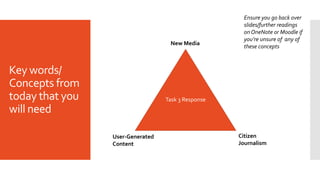
Key words/
Concepts from
today that you
will need
Task 3 Response
New Media
Citizen
Journalism
User-Generated
Content
Ensure you go back over
slides/further readings
on OneNote or Moodle if
you’re unsure of any of
these concepts

3.1 - Trends & New Media.pptx

  • 1.
    Introduction toTask 3: NewMedia ATAR Media Production & AnalysisYear 11 Trends in media use, genres and/or styles
  • 2.
    Key Info &Dates: - Short Answer Response (Approx. One page) - AnsweringTWO from choice of FOUR - Unseen Questions (Given on day of assess.) - Writing on Friday Week 3Term 2 (13th May)
  • 3.
    Syllabus Point: Trends inmedia use, genres and/or styles Activity 1: - Locate the definition of MediaTrends in the SCSA MPA Glossary (in “Important Documents” folder on Class OneNote) - Having a brief discussion with the person next to you, try to think of at least ONE example of a media trend.
  • 4.
    New Media & TheCreative Revolution Newmedia technology has opened up enormous potential for creativity and creation. Creating media products, such as film or video games, was traditionally only possible if you had access to equipment that was expensive and difficult to use. Over the last decade, there has been a significant shift in the production of media. Creativity & Change For several hundred years, the ability to publish and broadcast has largely been in the hands of the wealthy. Now, with little more than a smartphone and internet access, you can share your work with millions of people. While many argue the democratisation of media as a cultural revolution some worry about it’s impact on the very nature of creativity and art. Lets discuss this point… New Media: means of mass communication using digital technologies such as the internet. Traditional Media: forms of mass media before the advent of digital media. Print,TV, Radio etc.
  • 5.
    New Media & TheCreative Revolution Newmedia technology has opened up enormous potential for creativity and creation. Creating media products, such as film or video games, was traditionally only possible if you had access to equipment that was expensive and difficult to use. Over the last decade, there has been a significant shift in the production of media. Creativity & Change The creative revolution that we are currently experiencing was sparked by the way the internet evolved to incorporate greater interactivity, socialisation and use- generated content. In the early days of the internet, websites were typically static and lacked interactivity. The arrival of blogs, wikis and sits such asYouTube and Facebook gave ordinary people the freedom to create and distribute their own media texts. MediaTheorist Henry Jenkins has dubbed this ‘participatory culture’.According to Jenkins, participatory culture is an environment in which there are few barriers to artistic expression and creation of content. People work together in a collaborative and supportive environment where they share knowledge and skills and value the contributions of others. Technology is simply a tool.While it makes certain creative endeavours possible, these will only become widespread if the culture supports it. Many young people are already involved in participatory culture through their affiliation with online communities, the creation of new media products and collaborations via new media.
  • 6.
    User- Generated Content Using only singleword answers, what words come to mind when you hear the term User-generated Content? Whiteboard graffiti
  • 7.
    User- Generated Content After reading theNY times User Generated Content article, we will create a class PMI chart. (Plus, Minus, Interesting) on the positive and negatives of User-generated content as we know it, and it’s impact upon media. When I get confused or forgetful around the notion of User- generated content, I think of it as ‘CitizenJournalism’ and consider how this has changed and filtered into other media forms e.g. Social media, entertainment media etc. This might help you to remember User-generated content as a talking point in tasks or exams in future.
  • 8.
    Citizen Journalism New Media technologies have allowedaverage users anactive rolein the collecting, reporting, analysing and disseminating ofnews andinformation. Citizen journalism is a term that encompasses a range of individual and social involvement in media creation, reporting and filtering. It has the following features: User Reporters. Typical users or amateur reporters report directly on the news or analyse its content and meaning.They do this through blogs and video blogs, through user-generated news sites or through submitting the content to mainstream news organisations. MobileTechnology. The convergence of mobile technology and cameras means an average citizen carrying a camera is now more likely to be first on the scene of a news story than a professional crew. Often the user is actually involved in the event. Even when not directly reporting on the news, amateurs are able to submit footage for use in news reporting. Social Filtering. Social filtering of news allows users to highlight a news story they consider important and upload the story, or a link to it, to social network news sites. Others can vote for or against the display of a story. Q: How could citizen journalism impact the quality of news production?
  • 9.
    Citizen Journalism Issues & Considerations Mainstream journalistsare worried about issues of quality control, bias and accuracy.The assumption that ‘everyone can be a journalist’ can devalue the skill and experience of professional journalists and editors. There are more civilians than there are journalists. Therefore, there are more eyes and ears to record and report a story. Ordinary citizens can go where journalists cant, or wont. Key events and instances can be captured at the time of occurrence, rather than later when a news crew arrive at the scene. Can you think of any other considerations?
  • 10.
    Decentralisation The media havebeen integrated into and dispersed throughout many aspects of everyday life. Consumption of media texts has been marked by a shift from a limited number of standardised texts to a very large number of highly differentiated texts. These changes to texts and audiences mean that for some media, such as subscription television, the business model and industry goals have shifted considerably: subscription television is not reliant on audience ratings to secure advertisers in the same way as broadcast television.The goal of cable stations such as HBO and Showtime, and now Streaming services such as Netflix and Amazon Prime is to achieve high levels of audience loyalty to at least one quality television series so that people will continue their monthly subscriptions. In addition to the dispersal of audiences and corresponding changes in the industry, media production has become decentralised in that ordinary citizens have become producers of blogs, digital videos, and other media. Formerly, media production required expensive capital, such as a printing press or a broadcast licence, whereas now it only requires access to a computer with an internet connection or a smartphone to record and disseminate text, images, and sounds. Such digital media are called 'prosumer' technologies because they equalise the power balance between media producers and consumers, in some cases eliminating the distinction between them altogether. Decentralisation (of media) refers to the dispersal and personalisation of new media in contrast with traditional media.There has been a shift from a central one-to-many mass to a networked, many- to-many model of media production, transmission, and consumption in which there are multiple inputs, outputs, and connections.
  • 11.
    The media havebeen integrated into and dispersed throughout many aspects of everyday life. Consumption of media texts has been marked by a shift from a limited number of standardised texts to a very large number of highly differentiated texts. These changes to texts and audiences mean that for some media, such as subscription television, the business model and industry goals have shifted considerably: subscription television is not reliant on audience ratings to secure advertisers in the same way as broadcast television.The goal of cable stations such as HBO and Showtime, and now Streaming services such as Netflix and Amazon Prime is to achieve high levels of audience loyalty to at least one quality television series so that people will continue their monthly subscriptions. In addition to the dispersal of audiences and corresponding changes in the industry, media production has become decentralised in that ordinary citizens have become producers of blogs, digital videos, and other media. Formerly, media production required expensive capital, such as a printing press or a broadcast licence, whereas now it only requires access to a computer with an internet connection or a smartphone to record and disseminate text, images, and sounds. Such digital media are called 'prosumer' technologies because they equalise the power balance between media producers and consumers, in some cases eliminating the distinction between them altogether. This is a great example of a discussion points for the syllabus points: - relationship between media, popular culture and context - trends in media use, genres and/or styles You can keep this in mind for exam or written task preparation/study. KeyTakeaway
  • 12.
    Key words/ Concepts from todaythat you will need Task 3 Response New Media Citizen Journalism User-Generated Content Ensure you go back over slides/further readings on OneNote or Moodle if you’re unsure of any of these concepts