Gr11 Geography
Geomorphology
By Mr. M DUMAKUDE
TERM 2- WEEK 1
Topography associated with horizontally layered rocks:
LESSON OBJECTIVES
At the end of this lesson, you should be able to do the following:
-Identify the key characteristics of canyon and basaltic plateaus formed by horizontally layered rocks
-Describe processes that are involved in the development of hilly, karoo landscapes, canyon and basaltic plateaus
-Interpret images on slides showing different landscapes
-Draw a diagram showing a scarp retreat or back-wasting
-Evaluate the impact of human utilization of landscapes, basaltic plateaus and canyons considering both positive and
negative effects on the environment and local communities
-Propose a strategy on how can we preserve basaltic plateaus for agricultural purposes
An image of a certain type of rock
Take a guess ???
Characteristics and processes associated with the development of
Hilly landscapes
WET AND HUMID AREAS CHARACTERISTICS:
 Slopes are rounded
 Undulating landscapes (Moving In waves)
 Deep soils on the slope
 Rocks are horizontally and sedimentary and uniformly resistant to erosion
 Steep hilly landscapes
 These regions typically have high rainfall with the water eroding and smoothing these hills
PROCESSES: Chemical weathering is most active
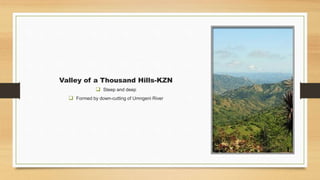
Valley of a Thousand Hills-KZN
 Steep and deep
 Formed by down-cutting of Umngeni River
Characteristics and processes associated with the development of
hilly landscapes
ARID AREAS CHARACTERISTICS:
 Landscapes are more rugged and angular
 Weathering and erosion of horizontal layers of rocks leads to steep and uneven slopes
ARID AREAS PROCESSES:
 Mechanical weathering is active due to lack of water
 There is no chemical change in the rocks. Rocks are physically broken down into smaller fragments
 Mechanical Weathering includes: Ice wedging, exfoliation, and sandblasting
Topography associated with horizontally layered rocks
 Horizontally layered rocks refer to sedimentary rocks as they are layered
 They form from deposits of sediments that are built up in a series of layers on the sea floor
 These parallel layers of sedimentary rocks are called beds or strata
 The junction where the layers join between sedimentary rocks are called bedding planes
Layers of horizontal layered rocks can be formed from:
 Lava flows
 Exposed sills (Igneous rock)
 When horizontal sedimentary rocks are uplifted without changing their horizontal position
 NB: When this type of rock is eroded, it forms canyons and basaltic plateaus
Canyon Landscape
 For canyons to form, the original layers of rock are level
 The harder layers of rock resist erosion and the softer layers or faults are more susceptible to erosion
 The down-cutting action by rivers, maintains the narrow, vertical profile, thus creating a canyon or gorge
 The freezing and expansion of water trapped in the cracks and faults of the rock strata, results in physical
weathering
 This process is also responsible for the formation of Canyons
 Example of the canyon: Blyde River Canyon situated in Mpumalanga province.
It is also the third-largest canyon on Earth and is situated below the confluence of Blyde and
Treur rivers
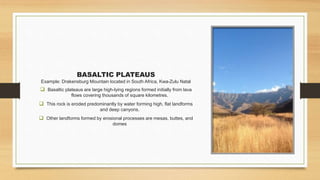
BASALTIC PLATEAUS
Example: Drakensburg Mountain located in South Africa, Kwa-Zulu Natal
 Basaltic plateaus are large high-lying regions formed initially from lava
flows covering thousands of square kilometres.
 This rock is eroded predominantly by water forming high, flat landforms
and deep canyons.
 Other landforms formed by erosional processes are mesas, buttes, and
domes
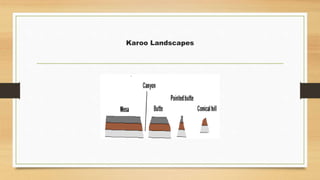
Karoo Landscapes
Karoo landscapes characteristics and processes
Characteristics are:
 They form due to erosion over time
 They are flat-topped hills separated by wide flat plains
 Dolerite sills form the flat tops of the hill-more resistant to erosion
Processes:
 Magma intrudes between the horizontal layers of sandstone and shale that had formed over most S.A
 Magma cools and form horizontal sills
 Layers of sedimentary rocks are removed by weathering and erosion –sills of dolerite is then exposed
 Forming Karoo Landscapes with flat-topped hills.
Utilization of these landscapes by people
HILLY LANDSCAPES
HUMID
 Soils are more developed-agricultural activities
 Slopes are better drained due to vegetation cover and
contour ploughing-therefore limit soil erosion
 Heavy farming machinery will be limited on steep
slopes
ARID
 Slopes are more ragged
 Limited use of land due to less water and soils are
thinner
 Limited cultivation of slopes
 Large scale erosion due to lack of vegetation
 Grazing is more suitable
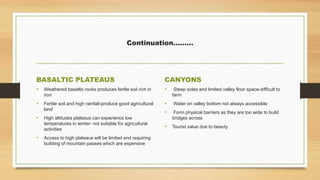
Continuation………
BASALTIC PLATEAUS
• Weathered basaltic rocks produces fertile soil rich in
iron
• Fertile soil and high rainfall-produce good agricultural
land
• High altitudes plateaus can experience low
temperatures in winter- not suitable for agricultural
activities
• Access to high plateaus will be limited and requiring
building of mountain passes which are expensive
CANYONS
• Steep sides and limited valley floor space-difficult to
farm
• Water on valley bottom not always accessible
• Form physical barriers as they are too wide to build
bridges across
• Tourist value due to beauty
Continuation…..
Karoo landscapes:
• Flat and easy for farming
• Flat and easy for building urban areas and transport routes
• Mostly in dry areas- Limit agricultural activities
• Soil is thin and rainfall is limited
• Rainfall in form of thunderstorms- sheet wash will increase run-off- no infiltration
• Large-scale sheep farming takes place
• Tourist destination
REFERENCES
Baer, G. (1991). Mechanisms of dike propagation in layered rocks and in massive, porous sedimentary rocks. Journal of
Geophysical Research: Solid Earth, 96(B7), 11911-11929.
Pettijohn, F. J. (1975). Sedimentary rocks (Vol. 3, p. 628). New York: Harper & Row.

Gr11 Geography Geomorphology-Presentation.pptx

  • 1.
  • 2.
    TERM 2- WEEK1 Topography associated with horizontally layered rocks: LESSON OBJECTIVES At the end of this lesson, you should be able to do the following: -Identify the key characteristics of canyon and basaltic plateaus formed by horizontally layered rocks -Describe processes that are involved in the development of hilly, karoo landscapes, canyon and basaltic plateaus -Interpret images on slides showing different landscapes -Draw a diagram showing a scarp retreat or back-wasting -Evaluate the impact of human utilization of landscapes, basaltic plateaus and canyons considering both positive and negative effects on the environment and local communities -Propose a strategy on how can we preserve basaltic plateaus for agricultural purposes
  • 3.
    An image ofa certain type of rock Take a guess ???
  • 4.
    Characteristics and processesassociated with the development of Hilly landscapes WET AND HUMID AREAS CHARACTERISTICS:  Slopes are rounded  Undulating landscapes (Moving In waves)  Deep soils on the slope  Rocks are horizontally and sedimentary and uniformly resistant to erosion  Steep hilly landscapes  These regions typically have high rainfall with the water eroding and smoothing these hills PROCESSES: Chemical weathering is most active
  • 5.
    Valley of aThousand Hills-KZN  Steep and deep  Formed by down-cutting of Umngeni River
  • 6.
    Characteristics and processesassociated with the development of hilly landscapes ARID AREAS CHARACTERISTICS:  Landscapes are more rugged and angular  Weathering and erosion of horizontal layers of rocks leads to steep and uneven slopes ARID AREAS PROCESSES:  Mechanical weathering is active due to lack of water  There is no chemical change in the rocks. Rocks are physically broken down into smaller fragments  Mechanical Weathering includes: Ice wedging, exfoliation, and sandblasting
  • 7.
    Topography associated withhorizontally layered rocks  Horizontally layered rocks refer to sedimentary rocks as they are layered  They form from deposits of sediments that are built up in a series of layers on the sea floor  These parallel layers of sedimentary rocks are called beds or strata  The junction where the layers join between sedimentary rocks are called bedding planes
  • 8.
    Layers of horizontallayered rocks can be formed from:  Lava flows  Exposed sills (Igneous rock)  When horizontal sedimentary rocks are uplifted without changing their horizontal position  NB: When this type of rock is eroded, it forms canyons and basaltic plateaus
  • 9.
    Canyon Landscape  Forcanyons to form, the original layers of rock are level  The harder layers of rock resist erosion and the softer layers or faults are more susceptible to erosion  The down-cutting action by rivers, maintains the narrow, vertical profile, thus creating a canyon or gorge  The freezing and expansion of water trapped in the cracks and faults of the rock strata, results in physical weathering  This process is also responsible for the formation of Canyons  Example of the canyon: Blyde River Canyon situated in Mpumalanga province. It is also the third-largest canyon on Earth and is situated below the confluence of Blyde and Treur rivers
  • 10.
    BASALTIC PLATEAUS Example: DrakensburgMountain located in South Africa, Kwa-Zulu Natal  Basaltic plateaus are large high-lying regions formed initially from lava flows covering thousands of square kilometres.  This rock is eroded predominantly by water forming high, flat landforms and deep canyons.  Other landforms formed by erosional processes are mesas, buttes, and domes
  • 11.
  • 12.
    Karoo landscapes characteristicsand processes Characteristics are:  They form due to erosion over time  They are flat-topped hills separated by wide flat plains  Dolerite sills form the flat tops of the hill-more resistant to erosion Processes:  Magma intrudes between the horizontal layers of sandstone and shale that had formed over most S.A  Magma cools and form horizontal sills  Layers of sedimentary rocks are removed by weathering and erosion –sills of dolerite is then exposed  Forming Karoo Landscapes with flat-topped hills.
  • 13.
    Utilization of theselandscapes by people HILLY LANDSCAPES HUMID  Soils are more developed-agricultural activities  Slopes are better drained due to vegetation cover and contour ploughing-therefore limit soil erosion  Heavy farming machinery will be limited on steep slopes ARID  Slopes are more ragged  Limited use of land due to less water and soils are thinner  Limited cultivation of slopes  Large scale erosion due to lack of vegetation  Grazing is more suitable
  • 14.
    Continuation……… BASALTIC PLATEAUS • Weatheredbasaltic rocks produces fertile soil rich in iron • Fertile soil and high rainfall-produce good agricultural land • High altitudes plateaus can experience low temperatures in winter- not suitable for agricultural activities • Access to high plateaus will be limited and requiring building of mountain passes which are expensive CANYONS • Steep sides and limited valley floor space-difficult to farm • Water on valley bottom not always accessible • Form physical barriers as they are too wide to build bridges across • Tourist value due to beauty
  • 15.
    Continuation….. Karoo landscapes: • Flatand easy for farming • Flat and easy for building urban areas and transport routes • Mostly in dry areas- Limit agricultural activities • Soil is thin and rainfall is limited • Rainfall in form of thunderstorms- sheet wash will increase run-off- no infiltration • Large-scale sheep farming takes place • Tourist destination
  • 16.
    REFERENCES Baer, G. (1991).Mechanisms of dike propagation in layered rocks and in massive, porous sedimentary rocks. Journal of Geophysical Research: Solid Earth, 96(B7), 11911-11929. Pettijohn, F. J. (1975). Sedimentary rocks (Vol. 3, p. 628). New York: Harper & Row.