HOW INSTITUTIONAL TRANSPARENCY
HELPS PREVENT CORRUPTION
ANDREA MURTA
A S S O C I A T E D I R E C T O R , A D R I E N N E A R S H T L A T I N
A M E R I C A C E N T E R
ATLANTIC COUNCIL
A View from the Private Sector
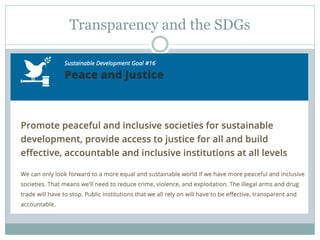
Transparency and the SDGs
A Global Anti-Corruption Movement
 A global regulatory movement against corruption has been
accelerating in the past couple decades.
 There is an observable convergence of regulations towards
standards set by, among others, the FCPA, the OECD Anti-
Bribery Convention, the UN Convention Against Corruption.
 The Brazilian Clean Company Act, enacted in February 2014,
is a recent example. It holds companies liable for corrupt acts
committed by their employees.
 Obviously, there is a big difference between regulation and
implementation.
The FCPA– A Global Trigger
 The Foreign Corruption Practice Act (FCPA) is arguably the
largest global trigger of anti-corruption efforts in the private
sector.
 Enacted in 1977, it prohibits corrupt acts practiced by a
company’s officers and agents. It also has provisions about
successor liability.
 Importantly, the FCPA leaves open the definition of a public
official, greatly enlarging the number of acts which could fall
under its jurisdiction.
 The result is a great level of concern about a company’s foreign
partners.
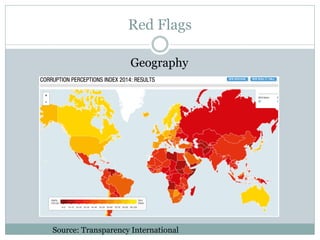
Red Flags
Geography
Source: Transparency International
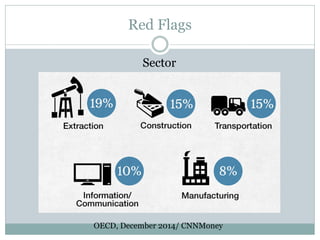
Red Flags
Sector
OECD, December 2014/ CNNMoney
Red Flags
 Business with frequent interaction with government
officials: customs brokers, importers, public service
providers
 Business whose owners are associates or family members
of government officials
 Business with a record of corruption, money laundering,
fraud, and similar lawsuits
 Obscure corporate structures
 Officers mentioned in watchlists
 A reputation for any of the above
Methodology
 Beneficial owners and corporate structure – articles of
incorporation and public records
 Company history – public records, online presence
 Executives – corporate records, personal records,
directorships, shareholdings
 Involvement in legal proceedings – legal records
 Government records
 Media references
Institutional Transparency
1. Corporate records are generally kept by public
commercial registries.
 Are corporate records publicly available?
 How can they be obtained?
 How can they be searched?
 What type of information do they contain?
 Are beneficial owners listed?
2. Files on directorships and shareholdings vary
wildly.
 Are these searchable on commercial registries for public and private
companies alike?
Institutional Transparency
1. Court records are kept by local, state, federal, and
superior courts.
 Are court records publicly available, even for ongoing cases?
 How can they be obtained?
 How can they be searched?
 What type of information do they contain?
2. Government procurement records may or may not
be available on public databases.
 Can we search by recipient?
3. Local media may or may not be available online,
and language capabilities are essential.
Institutional Transparency
The answer to these questions are not a matter of
accident.
They are the result of institutional choices.
How transparent are
governments willing to be?
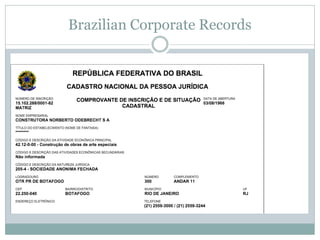
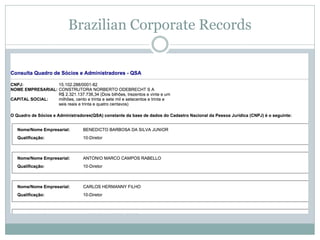
Brazilian Corporate Records
Brazilian State Corporate Records
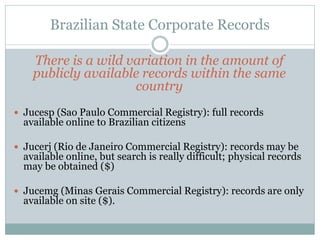
There is a wild variation in the amount of
publicly available records within the same
country
 Jucesp (Sao Paulo Commercial Registry): full records
available online to Brazilian citizens
 Jucerj (Rio de Janeiro Commercial Registry): records may be
available online, but search is really difficult; physical records
may be obtained ($)
 Jucemg (Minas Gerais Commercial Registry): records are only
available on site ($).
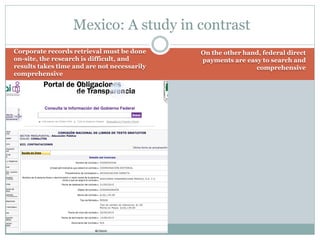
Corporate records retrieval must be done
on-site, the research is difficult, and
results takes time and are not necessarily
comprehensive
On the other hand, federal direct
payments are easy to search and
comprehensive
Mexico: A study in contrast
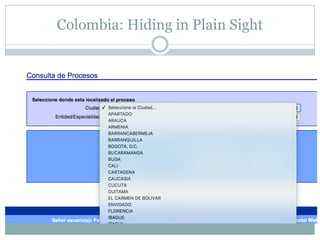
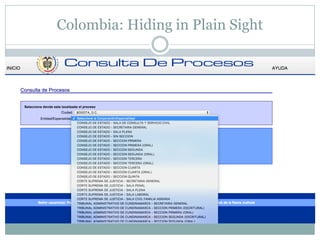
Colombia: Hiding in Plain Sight
And it gets more complicated
 Venezuela
 Most of Central America
 British Virgin Islands
 Caribbean Islands
Lack of institutional transparency
constrains the private sector’s
ability to prevent corruption
Then what?
 It gets expensive
 Methods get more complicated
 It takes longer to find suitable partners
Most of the time, companies don’t
dig deep enough.
Contact Information
Andrea Murta
Associate Director, Adrienne Arsht Latin America
Center, Atlantic Council
amurta@atlanticcoucil.org

Day3 sp3-3 georgetown-panelandreamurta_en

  • 1.
    HOW INSTITUTIONAL TRANSPARENCY HELPSPREVENT CORRUPTION ANDREA MURTA A S S O C I A T E D I R E C T O R , A D R I E N N E A R S H T L A T I N A M E R I C A C E N T E R ATLANTIC COUNCIL A View from the Private Sector
  • 2.
  • 3.
    A Global Anti-CorruptionMovement  A global regulatory movement against corruption has been accelerating in the past couple decades.  There is an observable convergence of regulations towards standards set by, among others, the FCPA, the OECD Anti- Bribery Convention, the UN Convention Against Corruption.  The Brazilian Clean Company Act, enacted in February 2014, is a recent example. It holds companies liable for corrupt acts committed by their employees.  Obviously, there is a big difference between regulation and implementation.
  • 4.
    The FCPA– AGlobal Trigger  The Foreign Corruption Practice Act (FCPA) is arguably the largest global trigger of anti-corruption efforts in the private sector.  Enacted in 1977, it prohibits corrupt acts practiced by a company’s officers and agents. It also has provisions about successor liability.  Importantly, the FCPA leaves open the definition of a public official, greatly enlarging the number of acts which could fall under its jurisdiction.  The result is a great level of concern about a company’s foreign partners.
  • 5.
  • 6.
  • 7.
    Red Flags  Businesswith frequent interaction with government officials: customs brokers, importers, public service providers  Business whose owners are associates or family members of government officials  Business with a record of corruption, money laundering, fraud, and similar lawsuits  Obscure corporate structures  Officers mentioned in watchlists  A reputation for any of the above
  • 8.
    Methodology  Beneficial ownersand corporate structure – articles of incorporation and public records  Company history – public records, online presence  Executives – corporate records, personal records, directorships, shareholdings  Involvement in legal proceedings – legal records  Government records  Media references
  • 9.
    Institutional Transparency 1. Corporaterecords are generally kept by public commercial registries.  Are corporate records publicly available?  How can they be obtained?  How can they be searched?  What type of information do they contain?  Are beneficial owners listed? 2. Files on directorships and shareholdings vary wildly.  Are these searchable on commercial registries for public and private companies alike?
  • 10.
    Institutional Transparency 1. Courtrecords are kept by local, state, federal, and superior courts.  Are court records publicly available, even for ongoing cases?  How can they be obtained?  How can they be searched?  What type of information do they contain? 2. Government procurement records may or may not be available on public databases.  Can we search by recipient? 3. Local media may or may not be available online, and language capabilities are essential.
  • 11.
    Institutional Transparency The answerto these questions are not a matter of accident. They are the result of institutional choices. How transparent are governments willing to be?
  • 12.
  • 13.
  • 14.
    Brazilian State CorporateRecords There is a wild variation in the amount of publicly available records within the same country  Jucesp (Sao Paulo Commercial Registry): full records available online to Brazilian citizens  Jucerj (Rio de Janeiro Commercial Registry): records may be available online, but search is really difficult; physical records may be obtained ($)  Jucemg (Minas Gerais Commercial Registry): records are only available on site ($).
  • 15.
    Corporate records retrievalmust be done on-site, the research is difficult, and results takes time and are not necessarily comprehensive On the other hand, federal direct payments are easy to search and comprehensive Mexico: A study in contrast
  • 16.
  • 17.
  • 18.
    And it getsmore complicated  Venezuela  Most of Central America  British Virgin Islands  Caribbean Islands Lack of institutional transparency constrains the private sector’s ability to prevent corruption
  • 19.
    Then what?  Itgets expensive  Methods get more complicated  It takes longer to find suitable partners Most of the time, companies don’t dig deep enough.
  • 20.
    Contact Information Andrea Murta AssociateDirector, Adrienne Arsht Latin America Center, Atlantic Council amurta@atlanticcoucil.org