A Political Scientist’s
Perspective on Corruption
Prepared for the International Consortium on Governmental
Financial Management Winter Training Conference
December 9, 2015
Yonatan L. Morse, Ph.D.
Georgetown University
Democracy and Governance Program
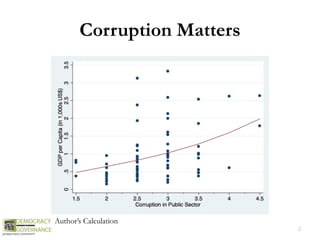
Corruption Matters
2
Author’s Calculation
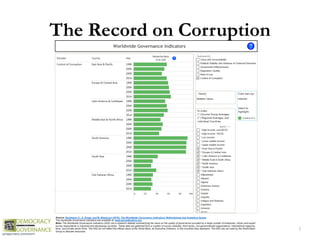
The Record on Corruption
3
The Broader Correlates of
Corruption
‱ Economic Development
‱ Political Institutions
– Levels and History of Democracy
– Free Press
– Electoral Systems
– Decentralization
‱ Economic Rents and Market
Competition
– Natural Resources
– Openness to Trade
– State Intervention
‱ Direction and pathway unclear
4
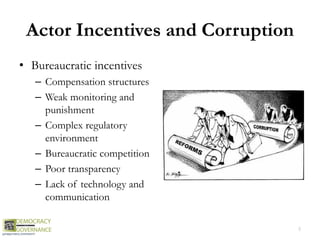
Actor Incentives and Corruption
‱ Bureaucratic incentives
– Compensation structures
– Weak monitoring and
punishment
– Complex regulatory
environment
– Bureaucratic competition
– Poor transparency
– Lack of technology and
communication
5
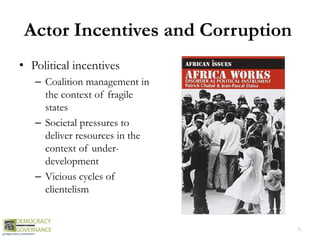
Actor Incentives and Corruption
‱ Political incentives
– Coalition management in
the context of fragile
states
– Societal pressures to
deliver resources in the
context of under-
development
– Vicious cycles of
clientelism
6
Taxation and Corruption
‱ Fiscal decentralization, complex tax systems, improper
oversight, increased personal interaction, and high tax
rates create incentives for corruption
‱ Examples include administrative bribes, tax avoidance
schemes, tax delays, tax coercion
‱ Possible solutions include tax code reform, coordinated
tax rates, clearer revenue sharing, effective tax assignment,
organizational restructuring, computerization, staff
training, auditing, public records
7
Custom Agencies and Corruption
‱ Opaque and cumbersome legal code, poor oversight, high
tariffs, increased personal contact create incentives for
corruption
‱ Examples include administrative bribes, discretionary
exemptions, trade fraud, non-payment/evasion, missing
goods, privileged access
‱ Possible solutions include organizational restructuring,
public records, staff training, simplified legal codes, lower
tariffs, electronic information, payment, and assessment
systems
8
Budget and Expenditure
Management
‱ Absent clear guidelines, monitoring and transparency, the
budgetary processes is skewed and used for personal gain
‱ Examples include secondary budgets/earmarking,
skewed investments, poor expenditure auditing
‱ Possible solutions include stronger legal frameworks for
budget preparation, auditing, on-line procurement
systems, technical expertise, legislative strengthening
9
Contact Information
Yonatan Morse
Democracy and Governance Program
Department of Government
Georgetown University
ylm3@georgetown.edu

Day3 sp3-4 georgetown-panelyonatonmorse_en

  • 1.
    A Political Scientist’s Perspectiveon Corruption Prepared for the International Consortium on Governmental Financial Management Winter Training Conference December 9, 2015 Yonatan L. Morse, Ph.D. Georgetown University Democracy and Governance Program
  • 2.
  • 3.
    The Record onCorruption 3
  • 4.
    The Broader Correlatesof Corruption ‱ Economic Development ‱ Political Institutions – Levels and History of Democracy – Free Press – Electoral Systems – Decentralization ‱ Economic Rents and Market Competition – Natural Resources – Openness to Trade – State Intervention ‱ Direction and pathway unclear 4
  • 5.
    Actor Incentives andCorruption ‱ Bureaucratic incentives – Compensation structures – Weak monitoring and punishment – Complex regulatory environment – Bureaucratic competition – Poor transparency – Lack of technology and communication 5
  • 6.
    Actor Incentives andCorruption ‱ Political incentives – Coalition management in the context of fragile states – Societal pressures to deliver resources in the context of under- development – Vicious cycles of clientelism 6
  • 7.
    Taxation and Corruption ‱Fiscal decentralization, complex tax systems, improper oversight, increased personal interaction, and high tax rates create incentives for corruption ‱ Examples include administrative bribes, tax avoidance schemes, tax delays, tax coercion ‱ Possible solutions include tax code reform, coordinated tax rates, clearer revenue sharing, effective tax assignment, organizational restructuring, computerization, staff training, auditing, public records 7
  • 8.
    Custom Agencies andCorruption ‱ Opaque and cumbersome legal code, poor oversight, high tariffs, increased personal contact create incentives for corruption ‱ Examples include administrative bribes, discretionary exemptions, trade fraud, non-payment/evasion, missing goods, privileged access ‱ Possible solutions include organizational restructuring, public records, staff training, simplified legal codes, lower tariffs, electronic information, payment, and assessment systems 8
  • 9.
    Budget and Expenditure Management ‱Absent clear guidelines, monitoring and transparency, the budgetary processes is skewed and used for personal gain ‱ Examples include secondary budgets/earmarking, skewed investments, poor expenditure auditing ‱ Possible solutions include stronger legal frameworks for budget preparation, auditing, on-line procurement systems, technical expertise, legislative strengthening 9
  • 10.
    Contact Information Yonatan Morse Democracyand Governance Program Department of Government Georgetown University ylm3@georgetown.edu