THREE GLOBAL CASES: IMPROVING
DOMESTIC RESOURCE MOBILIZATION
IN AFGHANISTAN, PROCUREMENT IN
VIETNAM, AND POLICY IN TUNISIA
ICGFM 2015 WINTER TRAINING
CONFERENCE, DECEMBER 9, 2015
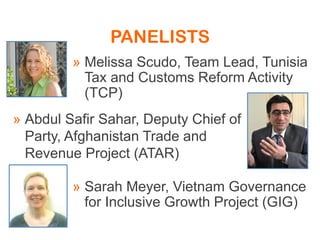
» Melissa Scudo, Team Lead, Tunisia
Tax and Customs Reform Activity
(TCP)
» Sarah Meyer, Vietnam Governance
for Inclusive Growth Project (GIG)
» Abdul Safir Sahar, Deputy Chief of
Party, Afghanistan Trade and
Revenue Project (ATAR)
PANELISTS
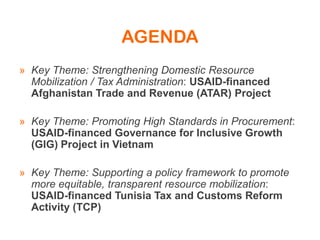
AGENDA
» Key Theme: Strengthening Domestic Resource
Mobilization / Tax Administration: USAID-financed
Afghanistan Trade and Revenue (ATAR) Project
» Key Theme: Promoting High Standards in Procurement:
USAID-financed Governance for Inclusive Growth
(GIG) Project in Vietnam
» Key Theme: Supporting a policy framework to promote
more equitable, transparent resource mobilization:
USAID-financed Tunisia Tax and Customs Reform
Activity (TCP)
IMPROVING DOMESTIC RESOURCE
MOBILIZATION IN AFGHANISTAN
Afghanistan Trade and Revenue Project
Component 3: to enhance the Afghan
government’s capacity to generate revenue by
improving customs procedures to increase
transparency, efficiency, and uniformity in the
collection of revenue, performance of core
functions, and facilitation of trade.
IMPROVING DOMESTIC RESOURCE
MOBILIZATION IN AFGHANISTAN
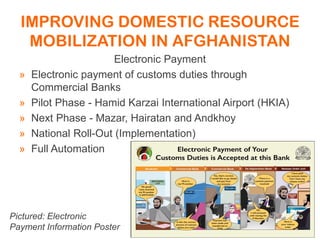
Electronic Payment
» Electronic payment of customs duties through
Commercial Banks
» Pilot Phase - Hamid Karzai International Airport (HKIA)
» Next Phase - Mazar, Hairatan and Andkhoy
» National Roll-Out (Implementation)
» Full Automation
Pictured: Electronic
Payment Information Poster
IMPROVING DOMESTIC RESOURCE
MOBILIZATION IN AFGHANISTAN
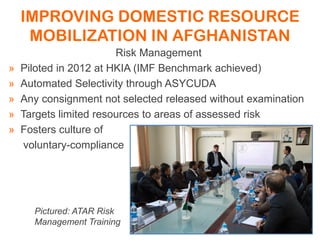
Risk Management
» Piloted in 2012 at HKIA (IMF Benchmark achieved)
» Automated Selectivity through ASYCUDA
» Any consignment not selected released without examination
» Targets limited resources to areas of assessed risk
» Fosters culture of
voluntary-compliance
Pictured: ATAR Risk
Management Training
IMPROVING DOMESTIC RESOURCE
MOBILIZATION IN AFGHANISTAN
Internal Audit
» Conformance with internal rules, regulations and laws
» Founded upon ‘International Professional Practices
Framework’ standards
» Comprehensive Procedural Manual developed
» Governance, risk management and control
» Committee responsible for authorizing recommendations
IMPROVING DOMESTIC RESOURCE
MOBILIZATION IN AFGHANISTAN
Development of Post Clearance Audit (PCA)
» PCA objective is to support voluntary compliance
» Draft Policy / Procedures drafted ready for
implementation
» Officials being trained in “Best Practice” methodology
» Ongoing coaching / mentoring in new areas of skill
» Confidence building through practice and planned pilot
phase
IMPROVING DOMESTIC RESOURCE
MOBILIZATION IN AFGHANISTAN
Professional Standards
» Significant misconduct issues within ACD
» Strategy founded upon detailed ‘Code of Conduct’
» Comprehensive Procedural Manual developed
» Access to ‘Fast-Track’ proceedings for Gross Misconduct
» Authority to suspend, transfer, or dismiss staff
IMPROVING DOMESTIC RESOURCE
MOBILIZATION IN AFGHANISTAN
Impact
» Trade facilitation through enhanced automation
» Focused use of resources to target risk
» Enhanced compliance with internal procedures
» Fostering environment for voluntary compliance
» Viable deterrence to misconduct
IMPROVING DOMESTIC RESOURCE
MOBILIZATION IN AFGHANISTAN
» ATAR will continue to work with ACD to improve customs
procedures to increase transparency, efficiency, and
uniformity in the collection of revenue, performance of
core functions, and facilitation of trade to increase trade
volumes and revenues.
IMPROVING PROCUREMENT IN
VIETNAM
Promoting High Standards in Procurement
» GIG’s support to:
• Vietnamese Ministry of Planning and Investment
• State Budget Law Implementation
• Committee on Finance and Budgetary Affairs
• Trans-Pacific Partnership
IMPROVING PROCUREMENT IN
VIETNAM
» International trade agreements will open Vietnam’s
government procurement system to member countries.
• Non-discrimination obligations
• Transparent, predictable and fair processes
• Market access commitments
IMPROVING PROCUREMENT IN
VIETNAM
» Vietnam’s Procurement Measures
• 2005: 1st procurement law
• 2012: PPA conducted procurement assessment
• 2014: New Public Procurement Law enacted
IMPROVING PROCUREMENT IN
VIETNAM
» Procurement Policy Recommendations
• Review/revise Public Procurement Law
• Focus preferential procurement programs on SMEs
• Establish domestic review body, independent from
procuring entities
IMPROVING PROCUREMENT IN
VIETNAM
» Procurement Policy Recommendations (continued)
• Promote and facilitate compliance with TPP obligations
• Develop handbook/procurement guide
• Training opportunities for procurement officials
• Prescribe policies and procedures for government
officials to avoid improper business practices
IMPROVING PROCUREMENT IN
VIETNAM
Impact
» The quality and the use of e-procurement are enhanced
and promoted
» Procurement policy coherence and transparency are
improved through better management
» Broad-based growth through effective public
procurement management is facilitated
IMPROVING PROCUREMENT IN
VIETNAM
Conclusion
» Improve and expand E-procurement
» Implement National Training Strategy for Public
Procurement
» Improve the quality and scale of public procurement
auditing
» Enhance the capacity for public procurement staff
through trainings
» Concentrate on procurement policy
» Implement TPP pledge: building related legal
documents
IMPROVING POLICY IN TUNISIA
Challenge: First major tax reform in 30 years
» Need: budget neutrality
» Need: “ambitious” reform package
» Need: analytical tools to assess aggregate impact
» Need: Fiscal Analysis Unit
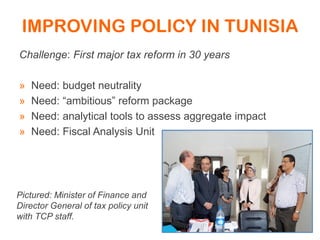
Pictured: Minister of Finance and
Director General of tax policy unit
with TCP staff.
IMPROVING POLICY IN TUNISIA
Solution: Modern analytical tools reduce risk
» Diagnostic, propositions and impact study
» Micro-simulation models
» Statistics of Income Analysis
» Tax Expenditure Analysis
IMPROVING POLICY IN TUNISIA
Implementation: Steps of Analysis
1. Tax declarations to compute taxpayer liability
2. Tax calculator model: calculate taxpayer current liability
3. Recalculate liability under new tax law parameters
4. Results of two computations are compared
IMPROVING POLICY IN TUNISIA
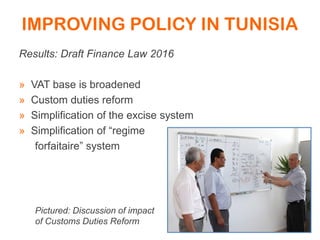
Results: Draft Finance Law 2016
» VAT base is broadened
» Custom duties reform
» Simplification of the excise system
» Simplification of “regime
forfaitaire” system
Pictured: Discussion of impact
of Customs Duties Reform
IMPROVING POLICY IN TUNISIA
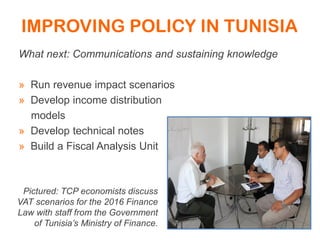
What next: Communications and sustaining knowledge
» Run revenue impact scenarios
» Develop income distribution
models
» Develop technical notes
» Build a Fiscal Analysis Unit
Pictured: TCP economists discuss
VAT scenarios for the 2016 Finance
Law with staff from the Government
of Tunisia’s Ministry of Finance.
IMPROVING POLICY IN TUNISIA
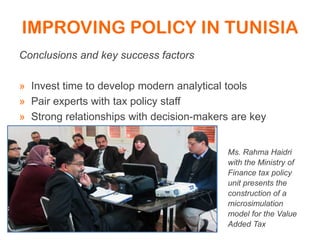
Conclusions and key success factors
» Invest time to develop modern analytical tools
» Pair experts with tax policy staff
» Strong relationships with decision-makers are key
Ms. Rahma Haidri
with the Ministry of
Finance tax policy
unit presents the
construction of a
microsimulation
model for the Value
Added Tax
SPEAKER CONTACTS
» Melissa Scudo, Team Leader, Tunisia Tax and Customs
Reform Activity, mscudo@tunisiatcp.org
» Sarah Meyer, Director, Asia Region, Chemonics
International, smeyer@Chemonics.com
» Abdul Safir Sahar, Deputy Chief of Party, Afghanistan
Trade and Revenue Project, asahar@atar-af.com

Day3 sp4 chemonics-icgfm_dec2015_en

  • 1.
    THREE GLOBAL CASES:IMPROVING DOMESTIC RESOURCE MOBILIZATION IN AFGHANISTAN, PROCUREMENT IN VIETNAM, AND POLICY IN TUNISIA ICGFM 2015 WINTER TRAINING CONFERENCE, DECEMBER 9, 2015
  • 2.
    » Melissa Scudo,Team Lead, Tunisia Tax and Customs Reform Activity (TCP) » Sarah Meyer, Vietnam Governance for Inclusive Growth Project (GIG) » Abdul Safir Sahar, Deputy Chief of Party, Afghanistan Trade and Revenue Project (ATAR) PANELISTS
  • 3.
    AGENDA » Key Theme:Strengthening Domestic Resource Mobilization / Tax Administration: USAID-financed Afghanistan Trade and Revenue (ATAR) Project » Key Theme: Promoting High Standards in Procurement: USAID-financed Governance for Inclusive Growth (GIG) Project in Vietnam » Key Theme: Supporting a policy framework to promote more equitable, transparent resource mobilization: USAID-financed Tunisia Tax and Customs Reform Activity (TCP)
  • 4.
    IMPROVING DOMESTIC RESOURCE MOBILIZATIONIN AFGHANISTAN Afghanistan Trade and Revenue Project Component 3: to enhance the Afghan government’s capacity to generate revenue by improving customs procedures to increase transparency, efficiency, and uniformity in the collection of revenue, performance of core functions, and facilitation of trade.
  • 5.
    IMPROVING DOMESTIC RESOURCE MOBILIZATIONIN AFGHANISTAN Electronic Payment » Electronic payment of customs duties through Commercial Banks » Pilot Phase - Hamid Karzai International Airport (HKIA) » Next Phase - Mazar, Hairatan and Andkhoy » National Roll-Out (Implementation) » Full Automation Pictured: Electronic Payment Information Poster
  • 6.
    IMPROVING DOMESTIC RESOURCE MOBILIZATIONIN AFGHANISTAN Risk Management » Piloted in 2012 at HKIA (IMF Benchmark achieved) » Automated Selectivity through ASYCUDA » Any consignment not selected released without examination » Targets limited resources to areas of assessed risk » Fosters culture of voluntary-compliance Pictured: ATAR Risk Management Training
  • 7.
    IMPROVING DOMESTIC RESOURCE MOBILIZATIONIN AFGHANISTAN Internal Audit » Conformance with internal rules, regulations and laws » Founded upon ‘International Professional Practices Framework’ standards » Comprehensive Procedural Manual developed » Governance, risk management and control » Committee responsible for authorizing recommendations
  • 8.
    IMPROVING DOMESTIC RESOURCE MOBILIZATIONIN AFGHANISTAN Development of Post Clearance Audit (PCA) » PCA objective is to support voluntary compliance » Draft Policy / Procedures drafted ready for implementation » Officials being trained in “Best Practice” methodology » Ongoing coaching / mentoring in new areas of skill » Confidence building through practice and planned pilot phase
  • 9.
    IMPROVING DOMESTIC RESOURCE MOBILIZATIONIN AFGHANISTAN Professional Standards » Significant misconduct issues within ACD » Strategy founded upon detailed ‘Code of Conduct’ » Comprehensive Procedural Manual developed » Access to ‘Fast-Track’ proceedings for Gross Misconduct » Authority to suspend, transfer, or dismiss staff
  • 10.
    IMPROVING DOMESTIC RESOURCE MOBILIZATIONIN AFGHANISTAN Impact » Trade facilitation through enhanced automation » Focused use of resources to target risk » Enhanced compliance with internal procedures » Fostering environment for voluntary compliance » Viable deterrence to misconduct
  • 11.
    IMPROVING DOMESTIC RESOURCE MOBILIZATIONIN AFGHANISTAN » ATAR will continue to work with ACD to improve customs procedures to increase transparency, efficiency, and uniformity in the collection of revenue, performance of core functions, and facilitation of trade to increase trade volumes and revenues.
  • 12.
    IMPROVING PROCUREMENT IN VIETNAM PromotingHigh Standards in Procurement » GIG’s support to: • Vietnamese Ministry of Planning and Investment • State Budget Law Implementation • Committee on Finance and Budgetary Affairs • Trans-Pacific Partnership
  • 13.
    IMPROVING PROCUREMENT IN VIETNAM »International trade agreements will open Vietnam’s government procurement system to member countries. • Non-discrimination obligations • Transparent, predictable and fair processes • Market access commitments
  • 14.
    IMPROVING PROCUREMENT IN VIETNAM »Vietnam’s Procurement Measures • 2005: 1st procurement law • 2012: PPA conducted procurement assessment • 2014: New Public Procurement Law enacted
  • 15.
    IMPROVING PROCUREMENT IN VIETNAM »Procurement Policy Recommendations • Review/revise Public Procurement Law • Focus preferential procurement programs on SMEs • Establish domestic review body, independent from procuring entities
  • 16.
    IMPROVING PROCUREMENT IN VIETNAM »Procurement Policy Recommendations (continued) • Promote and facilitate compliance with TPP obligations • Develop handbook/procurement guide • Training opportunities for procurement officials • Prescribe policies and procedures for government officials to avoid improper business practices
  • 17.
    IMPROVING PROCUREMENT IN VIETNAM Impact »The quality and the use of e-procurement are enhanced and promoted » Procurement policy coherence and transparency are improved through better management » Broad-based growth through effective public procurement management is facilitated
  • 18.
    IMPROVING PROCUREMENT IN VIETNAM Conclusion »Improve and expand E-procurement » Implement National Training Strategy for Public Procurement » Improve the quality and scale of public procurement auditing » Enhance the capacity for public procurement staff through trainings » Concentrate on procurement policy » Implement TPP pledge: building related legal documents
  • 19.
    IMPROVING POLICY INTUNISIA Challenge: First major tax reform in 30 years » Need: budget neutrality » Need: “ambitious” reform package » Need: analytical tools to assess aggregate impact » Need: Fiscal Analysis Unit Pictured: Minister of Finance and Director General of tax policy unit with TCP staff.
  • 20.
    IMPROVING POLICY INTUNISIA Solution: Modern analytical tools reduce risk » Diagnostic, propositions and impact study » Micro-simulation models » Statistics of Income Analysis » Tax Expenditure Analysis
  • 21.
    IMPROVING POLICY INTUNISIA Implementation: Steps of Analysis 1. Tax declarations to compute taxpayer liability 2. Tax calculator model: calculate taxpayer current liability 3. Recalculate liability under new tax law parameters 4. Results of two computations are compared
  • 22.
    IMPROVING POLICY INTUNISIA Results: Draft Finance Law 2016 » VAT base is broadened » Custom duties reform » Simplification of the excise system » Simplification of “regime forfaitaire” system Pictured: Discussion of impact of Customs Duties Reform
  • 23.
    IMPROVING POLICY INTUNISIA What next: Communications and sustaining knowledge » Run revenue impact scenarios » Develop income distribution models » Develop technical notes » Build a Fiscal Analysis Unit Pictured: TCP economists discuss VAT scenarios for the 2016 Finance Law with staff from the Government of Tunisia’s Ministry of Finance.
  • 24.
    IMPROVING POLICY INTUNISIA Conclusions and key success factors » Invest time to develop modern analytical tools » Pair experts with tax policy staff » Strong relationships with decision-makers are key Ms. Rahma Haidri with the Ministry of Finance tax policy unit presents the construction of a microsimulation model for the Value Added Tax
  • 25.
    SPEAKER CONTACTS » MelissaScudo, Team Leader, Tunisia Tax and Customs Reform Activity, mscudo@tunisiatcp.org » Sarah Meyer, Director, Asia Region, Chemonics International, smeyer@Chemonics.com » Abdul Safir Sahar, Deputy Chief of Party, Afghanistan Trade and Revenue Project, asahar@atar-af.com