Chicago, October 19 - 22, 2010
How to analyze your data and take
advantage of machine learning in
your application
Chris Schalk - Google
SpringOne 2GX 2009. All rights
reserved. Do not distribute without
Google’s new Cloud Technologies
Topics covered
•  Google Storage for Developers
•  Prediction API (machine learning)
•  BigQuery
Google Storage for Developers
Store your data in Google's cloud
What Is Google Storage?
•  Store your data in Google's cloud
o  any format, any amount, any time
•  You control access to your data
o  private, shared, or public
•  Access via Google APIs or 3rd party tools/libraries
Sample Use Cases
Static content hosting
e.g. static html, images, music, video
Backup and recovery
e.g. personal data, business records
Sharing
e.g. share data with your customers
Data storage for applications
e.g. used as storage backend for Android, AppEngine, Cloud based apps
Storage for Computation
e.g. BigQuery, Prediction API
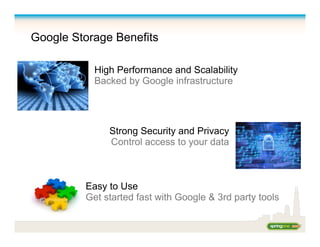
Google Storage Benefits
High Performance and Scalability
Backed by Google infrastructure
Strong Security and Privacy
Control access to your data
Easy to Use
Get started fast with Google & 3rd party tools
Google Storage Technical Details
•  RESTful API 
o  Verbs: GET, PUT, POST, HEAD, DELETE 
o  Resources: identified by URI
o  Compatible with S3 
•  Buckets 
o  Flat containers 
•  Objects 
o  Any type
o  Size: 100 GB / object
•  Access Control for Google Accounts 
o  For individuals and groups
•  Two Ways to Authenticate Requests 
o  Sign request using access keys 
o  Web browser login
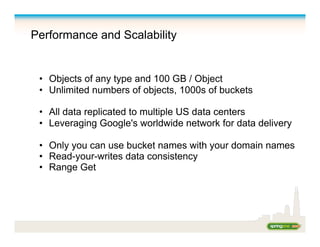
Performance and Scalability
•  Objects of any type and 100 GB / Object
•  Unlimited numbers of objects, 1000s of buckets
•  All data replicated to multiple US data centers
•  Leveraging Google's worldwide network for data delivery
•  Only you can use bucket names with your domain names
•  Read-your-writes data consistency
•  Range Get
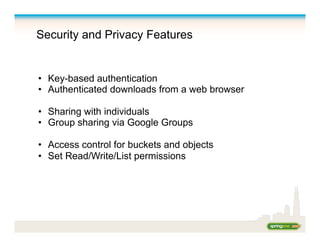
Security and Privacy Features
•  Key-based authentication
•  Authenticated downloads from a web browser
•  Sharing with individuals
•  Group sharing via Google Groups
•  Access control for buckets and objects
•  Set Read/Write/List permissions
Demo
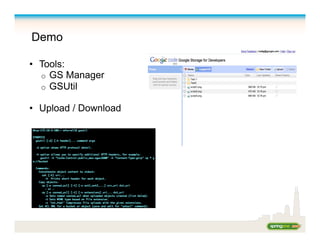
Demo
•  Tools:
o  GS Manager
o  GSUtil
•  Upload / Download
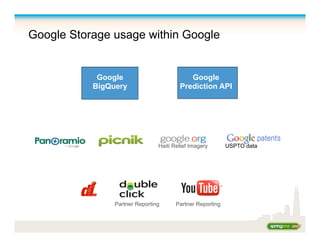
Google Storage usage within Google
Haiti Relief Imagery USPTO data
Partner Reporting
Google
BigQuery
Google
Prediction API
Partner Reporting
Some Early Google Storage Adopters
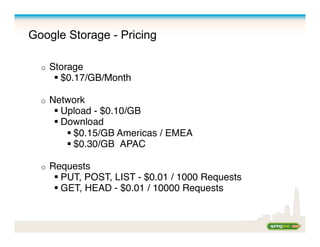
Google Storage - Pricing
o  Storage
 $0.17/GB/Month
o  Network
 Upload - $0.10/GB
 Download
 $0.15/GB Americas / EMEA
 $0.30/GB  APAC
o  Requests
 PUT, POST, LIST - $0.01 / 1000 Requests
 GET, HEAD - $0.01 / 10000 Requests
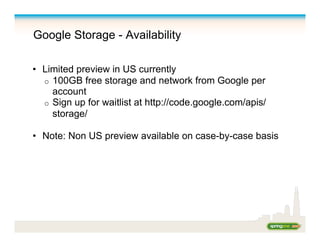
Google Storage - Availability
•  Limited preview in US currently
o  100GB free storage and network from Google per
account
o  Sign up for waitlist at http://code.google.com/apis/
storage/
•  Note: Non US preview available on case-by-case basis
Google Storage Summary
•  Store any kind of data using Google's cloud infrastructure
•  Easy to Use APIs
•  Many available tools and libraries
o  gsutil, GS Manager
o  3rd party:
 Boto, CloudBerry, CyberDuck, JetS3t, and more
Google Prediction API
Google's prediction engine in the cloud
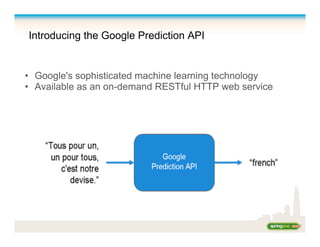
Introducing the Google Prediction API
•  Google's sophisticated machine learning technology
•  Available as an on-demand RESTful HTTP web service
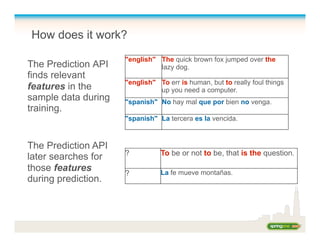
How does it work?
"english" The quick brown fox jumped over the
lazy dog.
"english" To err is human, but to really foul things
up you need a computer.
"spanish" No hay mal que por bien no venga.
"spanish" La tercera es la vencida.
? To be or not to be, that is the question.
? La fe mueve montañas.
The Prediction API
finds relevant
features in the
sample data during
training.
The Prediction API
later searches for
those features
during prediction.
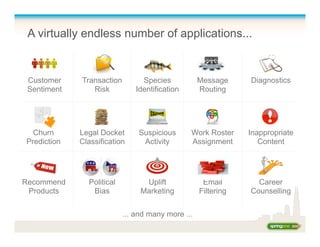
A virtually endless number of applications...
Customer
Sentiment
Transaction
Risk
Species
Identification
Message
Routing
Legal Docket
Classification
Suspicious
Activity
Work Roster
Assignment
Recommend
Products
Political
Bias
Uplift
Marketing
Email
Filtering
Diagnostics
Inappropriate
Content
Career
Counselling
Churn
Prediction
... and many more ...
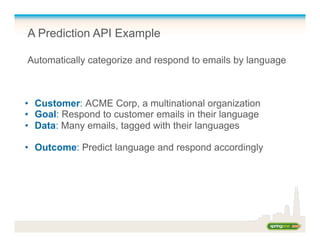
A Prediction API Example
Automatically categorize and respond to emails by language
•  Customer: ACME Corp, a multinational organization
•  Goal: Respond to customer emails in their language
•  Data: Many emails, tagged with their languages
•  Outcome: Predict language and respond accordingly
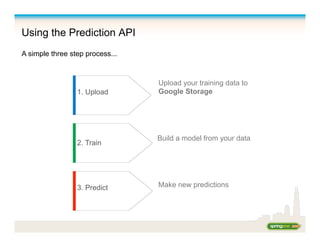
Using the Prediction API
1. Upload
2. Train
Upload your training data to
Google Storage
Build a model from your data
Make new predictions3. Predict
A simple three step process...
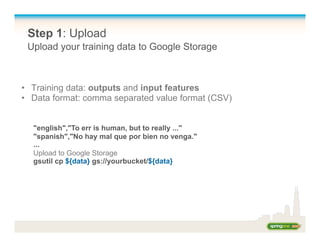
Step 1: Upload
Upload your training data to Google Storage
•  Training data: outputs and input features
•  Data format: comma separated value format (CSV)
"english","To err is human, but to really ..."
"spanish","No hay mal que por bien no venga."
...
Upload to Google Storage
gsutil cp ${data} gs://yourbucket/${data}
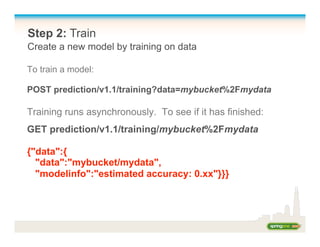
Step 2: Train
Create a new model by training on data
To train a model:
POST prediction/v1.1/training?data=mybucket%2Fmydata
Training runs asynchronously. To see if it has finished:
GET prediction/v1.1/training/mybucket%2Fmydata
{"data":{
"data":"mybucket/mydata",
"modelinfo":"estimated accuracy: 0.xx"}}}
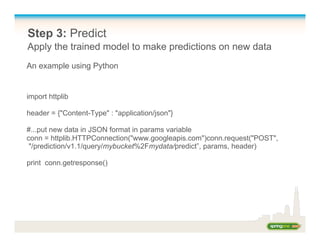
Step 3: Predict
Apply the trained model to make predictions on new data
POST prediction/v1.1/query/mybucket%2Fmydata/predict
{ "data":{
"input": { "text" : [
"J'aime X! C'est le meilleur" ]}}}
Step 3: Predict
Apply the trained model to make predictions on new data
POST prediction/v1.1/query/mybucket%2Fmydata/predict
{ "data":{
"input": { "text" : [
"J'aime X! C'est le meilleur" ]}}}
{ data : {
"kind" : "prediction#output",
"outputLabel":"French",
"outputMulti" :[
{"label":"French", "score": x.xx}
{"label":"English", "score": x.xx}
{"label":"Spanish", "score": x.xx}]}}
Step 3: Predict
Apply the trained model to make predictions on new data
import httplib
header = {"Content-Type" : "application/json"}
#...put new data in JSON format in params variable
conn = httplib.HTTPConnection("www.googleapis.com")conn.request("POST",
"/prediction/v1.1/query/mybucket%2Fmydata/predict”, params, header)
print conn.getresponse()
An example using Python
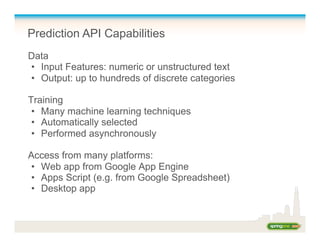
Prediction API Capabilities
Data
•  Input Features: numeric or unstructured text
•  Output: up to hundreds of discrete categories
Training
•  Many machine learning techniques
•  Automatically selected
•  Performed asynchronously
Access from many platforms:
•  Web app from Google App Engine
•  Apps Script (e.g. from Google Spreadsheet)
•  Desktop app
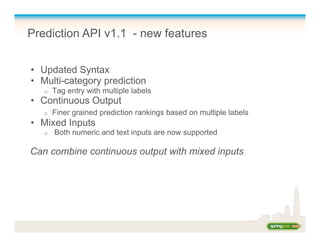
Prediction API v1.1 - new features
•  Updated Syntax
•  Multi-category prediction
o  Tag entry with multiple labels
•  Continuous Output
o  Finer grained prediction rankings based on multiple labels
•  Mixed Inputs
o  Both numeric and text inputs are now supported
Can combine continuous output with mixed inputs
Demo
Using the Prediction API to Predict a Cuisine
Google BigQuery
Interactive analysis of large datasets in Google's cloud
Introducing Google BigQuery
•  Google's large data adhoc analysis technology
o  Analyze massive amounts of data in seconds
•  Simple SQL-like query language
•  Flexible access
o  REST APIs, JSON-RPC, Google Apps Script
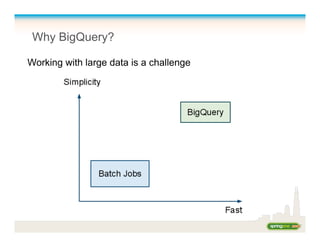
Why BigQuery?
Working with large data is a challenge
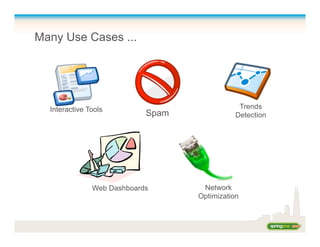
Many Use Cases ...
Spam
Trends
Detection
Web Dashboards Network
Optimization
Interactive Tools
Key Capabilities of BigQuery
•  Scalable: Billions of rows
•  Fast: Response in seconds
•  Simple: Queries in SQL
•  Web Service
o  REST
o  JSON-RPC
o  Google App Scripts
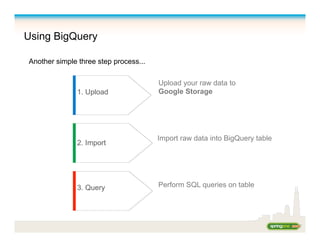
Using BigQuery
1. Upload
2. Import
Upload your raw data to
Google Storage
Import raw data into BigQuery table
Perform SQL queries on table3. Query
Another simple three step process...
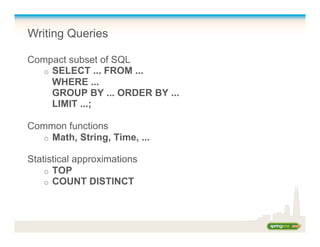
Writing Queries
Compact subset of SQL
o  SELECT ... FROM ...
WHERE ...
GROUP BY ... ORDER BY ...
LIMIT ...;
Common functions
o  Math, String, Time, ...
Statistical approximations
o  TOP
o  COUNT DISTINCT
BigQuery via REST
GET /bigquery/v1/tables/{table name}
GET /bigquery/v1/query?q={query}
Sample JSON Reply:
{
"results": {
"fields": { [
{"id":"COUNT(*)","type":"uint64"}, ... ]
},
"rows": [
{"f":[{"v":"2949"}, ...]},
{"f":[{"v":"5387"}, ...]}, ... ]
}
}
Also supports JSON-RPC
Security and Privacy
Standard Google Authentication
•  Client Login
•  OAuth
•  AuthSub
HTTPS support
•  protects your credentials
•  protects your data
Relies on Google Storage to manage access
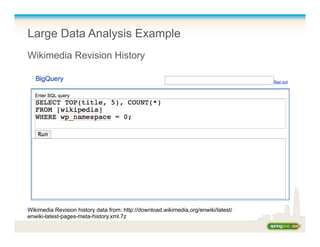
Large Data Analysis Example
Wikimedia Revision history data from: http://download.wikimedia.org/enwiki/latest/
enwiki-latest-pages-meta-history.xml.7z
Wikimedia Revision History
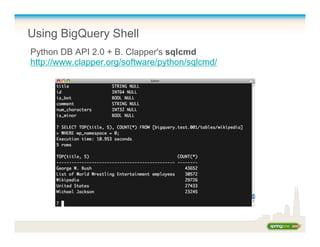
Using BigQuery Shell
Python DB API 2.0 + B. Clapper's sqlcmd
http://www.clapper.org/software/python/sqlcmd/
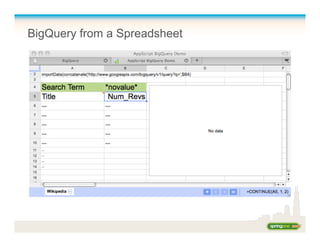
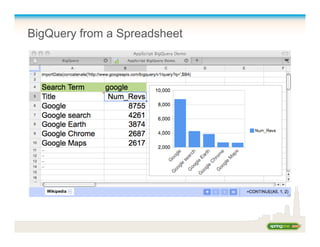
BigQuery from a Spreadsheet
Recap
•  Google Storage
o  High speed data storage on Google Cloud
•  Prediction API
o  Google's machine learning technology able to
predict outcomes based on sample data
•  BigQuery
o  Interactive analysis of very large data sets
o  Simple SQL query language access
Further info available at:
•  Google Storage for Developers
o  http://code.google.com/apis/storage
•  Prediction API
o  http://code.google.com/apis/predict
•  BigQuery
o  http://code.google.com/apis/bigquery
SpringOne 2GX 2010. All rights reserved. Do not distribute without permission.
Demo
SpringOne 2GX 2010. All rights reserved. Do not distribute without permission.
Q&A
SpringOne 2GX 2010. All rights reserved. Do not distribute without permission.
Thank You!
Chris Schalk
Google Developer
Advocate
http://twitter.com/cschalk

Introduction to Google Cloud platform technologies

  • 1.
    Chicago, October 19- 22, 2010 How to analyze your data and take advantage of machine learning in your application Chris Schalk - Google
  • 2.
    SpringOne 2GX 2009.All rights reserved. Do not distribute without Google’s new Cloud Technologies Topics covered •  Google Storage for Developers •  Prediction API (machine learning) •  BigQuery
  • 3.
    Google Storage forDevelopers Store your data in Google's cloud
  • 4.
    What Is GoogleStorage? •  Store your data in Google's cloud o  any format, any amount, any time •  You control access to your data o  private, shared, or public •  Access via Google APIs or 3rd party tools/libraries
  • 5.
    Sample Use Cases Staticcontent hosting e.g. static html, images, music, video Backup and recovery e.g. personal data, business records Sharing e.g. share data with your customers Data storage for applications e.g. used as storage backend for Android, AppEngine, Cloud based apps Storage for Computation e.g. BigQuery, Prediction API
  • 6.
    Google Storage Benefits HighPerformance and Scalability Backed by Google infrastructure Strong Security and Privacy Control access to your data Easy to Use Get started fast with Google & 3rd party tools
  • 7.
    Google Storage TechnicalDetails •  RESTful API  o  Verbs: GET, PUT, POST, HEAD, DELETE  o  Resources: identified by URI o  Compatible with S3  •  Buckets  o  Flat containers  •  Objects  o  Any type o  Size: 100 GB / object •  Access Control for Google Accounts  o  For individuals and groups •  Two Ways to Authenticate Requests  o  Sign request using access keys  o  Web browser login
  • 8.
    Performance and Scalability • Objects of any type and 100 GB / Object •  Unlimited numbers of objects, 1000s of buckets •  All data replicated to multiple US data centers •  Leveraging Google's worldwide network for data delivery •  Only you can use bucket names with your domain names •  Read-your-writes data consistency •  Range Get
  • 9.
    Security and PrivacyFeatures •  Key-based authentication •  Authenticated downloads from a web browser •  Sharing with individuals •  Group sharing via Google Groups •  Access control for buckets and objects •  Set Read/Write/List permissions
  • 10.
  • 11.
    Demo •  Tools: o  GSManager o  GSUtil •  Upload / Download
  • 12.
    Google Storage usagewithin Google Haiti Relief Imagery USPTO data Partner Reporting Google BigQuery Google Prediction API Partner Reporting
  • 13.
    Some Early GoogleStorage Adopters
  • 14.
    Google Storage -Pricing o  Storage  $0.17/GB/Month o  Network  Upload - $0.10/GB  Download  $0.15/GB Americas / EMEA  $0.30/GB  APAC o  Requests  PUT, POST, LIST - $0.01 / 1000 Requests  GET, HEAD - $0.01 / 10000 Requests
  • 15.
    Google Storage -Availability •  Limited preview in US currently o  100GB free storage and network from Google per account o  Sign up for waitlist at http://code.google.com/apis/ storage/ •  Note: Non US preview available on case-by-case basis
  • 16.
    Google Storage Summary • Store any kind of data using Google's cloud infrastructure •  Easy to Use APIs •  Many available tools and libraries o  gsutil, GS Manager o  3rd party:  Boto, CloudBerry, CyberDuck, JetS3t, and more
  • 17.
    Google Prediction API Google'sprediction engine in the cloud
  • 18.
    Introducing the GooglePrediction API •  Google's sophisticated machine learning technology •  Available as an on-demand RESTful HTTP web service
  • 19.
    How does itwork? "english" The quick brown fox jumped over the lazy dog. "english" To err is human, but to really foul things up you need a computer. "spanish" No hay mal que por bien no venga. "spanish" La tercera es la vencida. ? To be or not to be, that is the question. ? La fe mueve montañas. The Prediction API finds relevant features in the sample data during training. The Prediction API later searches for those features during prediction.
  • 20.
    A virtually endlessnumber of applications... Customer Sentiment Transaction Risk Species Identification Message Routing Legal Docket Classification Suspicious Activity Work Roster Assignment Recommend Products Political Bias Uplift Marketing Email Filtering Diagnostics Inappropriate Content Career Counselling Churn Prediction ... and many more ...
  • 21.
    A Prediction APIExample Automatically categorize and respond to emails by language •  Customer: ACME Corp, a multinational organization •  Goal: Respond to customer emails in their language •  Data: Many emails, tagged with their languages •  Outcome: Predict language and respond accordingly
  • 22.
    Using the PredictionAPI 1. Upload 2. Train Upload your training data to Google Storage Build a model from your data Make new predictions3. Predict A simple three step process...
  • 23.
    Step 1: Upload Uploadyour training data to Google Storage •  Training data: outputs and input features •  Data format: comma separated value format (CSV) "english","To err is human, but to really ..." "spanish","No hay mal que por bien no venga." ... Upload to Google Storage gsutil cp ${data} gs://yourbucket/${data}
  • 24.
    Step 2: Train Createa new model by training on data To train a model: POST prediction/v1.1/training?data=mybucket%2Fmydata Training runs asynchronously. To see if it has finished: GET prediction/v1.1/training/mybucket%2Fmydata {"data":{ "data":"mybucket/mydata", "modelinfo":"estimated accuracy: 0.xx"}}}
  • 25.
    Step 3: Predict Applythe trained model to make predictions on new data POST prediction/v1.1/query/mybucket%2Fmydata/predict { "data":{ "input": { "text" : [ "J'aime X! C'est le meilleur" ]}}}
  • 26.
    Step 3: Predict Applythe trained model to make predictions on new data POST prediction/v1.1/query/mybucket%2Fmydata/predict { "data":{ "input": { "text" : [ "J'aime X! C'est le meilleur" ]}}} { data : { "kind" : "prediction#output", "outputLabel":"French", "outputMulti" :[ {"label":"French", "score": x.xx} {"label":"English", "score": x.xx} {"label":"Spanish", "score": x.xx}]}}
  • 27.
    Step 3: Predict Applythe trained model to make predictions on new data import httplib header = {"Content-Type" : "application/json"} #...put new data in JSON format in params variable conn = httplib.HTTPConnection("www.googleapis.com")conn.request("POST", "/prediction/v1.1/query/mybucket%2Fmydata/predict”, params, header) print conn.getresponse() An example using Python
  • 28.
    Prediction API Capabilities Data • Input Features: numeric or unstructured text •  Output: up to hundreds of discrete categories Training •  Many machine learning techniques •  Automatically selected •  Performed asynchronously Access from many platforms: •  Web app from Google App Engine •  Apps Script (e.g. from Google Spreadsheet) •  Desktop app
  • 29.
    Prediction API v1.1- new features •  Updated Syntax •  Multi-category prediction o  Tag entry with multiple labels •  Continuous Output o  Finer grained prediction rankings based on multiple labels •  Mixed Inputs o  Both numeric and text inputs are now supported Can combine continuous output with mixed inputs
  • 30.
    Demo Using the PredictionAPI to Predict a Cuisine
  • 31.
    Google BigQuery Interactive analysisof large datasets in Google's cloud
  • 32.
    Introducing Google BigQuery • Google's large data adhoc analysis technology o  Analyze massive amounts of data in seconds •  Simple SQL-like query language •  Flexible access o  REST APIs, JSON-RPC, Google Apps Script
  • 33.
    Why BigQuery? Working withlarge data is a challenge
  • 34.
    Many Use Cases... Spam Trends Detection Web Dashboards Network Optimization Interactive Tools
  • 35.
    Key Capabilities ofBigQuery •  Scalable: Billions of rows •  Fast: Response in seconds •  Simple: Queries in SQL •  Web Service o  REST o  JSON-RPC o  Google App Scripts
  • 36.
    Using BigQuery 1. Upload 2.Import Upload your raw data to Google Storage Import raw data into BigQuery table Perform SQL queries on table3. Query Another simple three step process...
  • 37.
    Writing Queries Compact subsetof SQL o  SELECT ... FROM ... WHERE ... GROUP BY ... ORDER BY ... LIMIT ...; Common functions o  Math, String, Time, ... Statistical approximations o  TOP o  COUNT DISTINCT
  • 38.
    BigQuery via REST GET/bigquery/v1/tables/{table name} GET /bigquery/v1/query?q={query} Sample JSON Reply: { "results": { "fields": { [ {"id":"COUNT(*)","type":"uint64"}, ... ] }, "rows": [ {"f":[{"v":"2949"}, ...]}, {"f":[{"v":"5387"}, ...]}, ... ] } } Also supports JSON-RPC
  • 39.
    Security and Privacy StandardGoogle Authentication •  Client Login •  OAuth •  AuthSub HTTPS support •  protects your credentials •  protects your data Relies on Google Storage to manage access
  • 40.
    Large Data AnalysisExample Wikimedia Revision history data from: http://download.wikimedia.org/enwiki/latest/ enwiki-latest-pages-meta-history.xml.7z Wikimedia Revision History
  • 41.
    Using BigQuery Shell PythonDB API 2.0 + B. Clapper's sqlcmd http://www.clapper.org/software/python/sqlcmd/
  • 42.
    BigQuery from aSpreadsheet
  • 43.
    BigQuery from aSpreadsheet
  • 44.
    Recap •  Google Storage o High speed data storage on Google Cloud •  Prediction API o  Google's machine learning technology able to predict outcomes based on sample data •  BigQuery o  Interactive analysis of very large data sets o  Simple SQL query language access
  • 45.
    Further info availableat: •  Google Storage for Developers o  http://code.google.com/apis/storage •  Prediction API o  http://code.google.com/apis/predict •  BigQuery o  http://code.google.com/apis/bigquery
  • 46.
    SpringOne 2GX 2010.All rights reserved. Do not distribute without permission. Demo
  • 47.
    SpringOne 2GX 2010.All rights reserved. Do not distribute without permission. Q&A
  • 48.
    SpringOne 2GX 2010.All rights reserved. Do not distribute without permission. Thank You! Chris Schalk Google Developer Advocate http://twitter.com/cschalk