Google’s mission
 Google’s mission is to organize the world’s
information and make it universally
accessible and useful.
History
 Founders Larry Page and Sergey Brin met at
Stanford University in 1995. By 1996, they
had built a search engine (initially called
BackRub) that used links to determine the
importance of individual webpages.
 In 1998, Larry and Sergey named the search
engine they built “Google”
Founders
 The founders of Google Inc. are Larry Page and
Sergey Brin.
Culture
 It’s really the people that make Google the
kind of company it is. They hire people who
are smart and determined, and They favor
ability over experience.
Culture…..
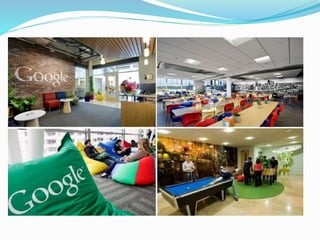
 They strive to maintain the open culture
often associated with startups, in which
everyone is a hands-on contributor and feels
comfortable sharing ideas and opinions.
 Weekly all-hands (“TGIF”) meetings
Ten things they know to be true
1. Focus on the user and all else will follow.
2. It’s best to do one thing really, really well.
3. Fast is better than slow.
4. Democracy on the web works.
5. You don’t need to be at your desk to need an answer.
6. You can make money without doing evil.
7. There’s always more information out there.
8. The need for information crosses all borders.
9. You can be serious without a suit.
10. Great just isn’t good enough.
Focus on the user and all else will follow.
 They’ve focused on providing the best user
experience possible. Whether they are
designing a new Internet browser or a new
tweak to the look of the homepage, they
take great care to ensure that they will
ultimately serve you
It’s best to do one thing really, really well.
 They do search. With one of the world’s
largest research groups focused exclusively
on solving search problems, they know what
they do well, and how they could do it
better.
Fast is better than slow.
 They know your time is valuable, so when
you’re seeking an answer on the web you
want it right away–and they aim to please.
they may be the only people in the world
who can say our goal is to have people leave
our website as quickly as possible.
Democracy on the web works.
 Google search works because it relies on the
millions of individuals posting links on
websites to help determine which other sites
offer content of value. They assess the
importance of every web page using more
than 200 signals and a variety of techniques.
You don’t need to be at your desk to need
an answer
 The world is increasingly mobile: people
want access to information wherever they
are, whenever they need it. They are
pioneering new technologies and offering
new solutions for mobile services that help
people all over the globe.
You can make money without doing evil.
 They have a set of guiding principles for
their advertising programs and practices:
 They don’t allow ads to be displayed on their
results pages unless they are relevant where
they are shown.
 They believe that advertising can be
effective without being flashy.
 Advertising on Google is always clearly
identified as a “Sponsored Link”
There’s always more information out there.
 Once they’d indexed more of the HTML
pages on the Internet than any other search
service, their engineers turned their
attention to information that was not as
readily accessible.
The need for information crosses all
borders.
 The company was founded in California, but
their mission is to facilitate access to
information for the entire world, and in
every language.
You can be serious without a suit.
 Their founders built Google around the idea
that work should be challenging, and the
challenge should be fun. They believe that
great, creative things are more likely to
happen with the right company culture.
Great just isn’t good enough.
 They see being great at something as a
starting point, not an endpoint. They set
goals that they know they can’t reach yet.
 Even if you don’t know exactly what you’re
looking for, finding an answer on the web is
their problem, not yours.
The End

Google History

  • 2.
    Google’s mission  Google’smission is to organize the world’s information and make it universally accessible and useful.
  • 3.
    History  Founders LarryPage and Sergey Brin met at Stanford University in 1995. By 1996, they had built a search engine (initially called BackRub) that used links to determine the importance of individual webpages.  In 1998, Larry and Sergey named the search engine they built “Google”
  • 4.
    Founders  The foundersof Google Inc. are Larry Page and Sergey Brin.
  • 5.
    Culture  It’s reallythe people that make Google the kind of company it is. They hire people who are smart and determined, and They favor ability over experience.
  • 6.
    Culture…..  They striveto maintain the open culture often associated with startups, in which everyone is a hands-on contributor and feels comfortable sharing ideas and opinions.  Weekly all-hands (“TGIF”) meetings
  • 11.
    Ten things theyknow to be true 1. Focus on the user and all else will follow. 2. It’s best to do one thing really, really well. 3. Fast is better than slow. 4. Democracy on the web works. 5. You don’t need to be at your desk to need an answer. 6. You can make money without doing evil. 7. There’s always more information out there. 8. The need for information crosses all borders. 9. You can be serious without a suit. 10. Great just isn’t good enough.
  • 12.
    Focus on theuser and all else will follow.  They’ve focused on providing the best user experience possible. Whether they are designing a new Internet browser or a new tweak to the look of the homepage, they take great care to ensure that they will ultimately serve you
  • 13.
    It’s best todo one thing really, really well.  They do search. With one of the world’s largest research groups focused exclusively on solving search problems, they know what they do well, and how they could do it better.
  • 14.
    Fast is betterthan slow.  They know your time is valuable, so when you’re seeking an answer on the web you want it right away–and they aim to please. they may be the only people in the world who can say our goal is to have people leave our website as quickly as possible.
  • 15.
    Democracy on theweb works.  Google search works because it relies on the millions of individuals posting links on websites to help determine which other sites offer content of value. They assess the importance of every web page using more than 200 signals and a variety of techniques.
  • 16.
    You don’t needto be at your desk to need an answer  The world is increasingly mobile: people want access to information wherever they are, whenever they need it. They are pioneering new technologies and offering new solutions for mobile services that help people all over the globe.
  • 17.
    You can makemoney without doing evil.  They have a set of guiding principles for their advertising programs and practices:  They don’t allow ads to be displayed on their results pages unless they are relevant where they are shown.  They believe that advertising can be effective without being flashy.  Advertising on Google is always clearly identified as a “Sponsored Link”
  • 18.
    There’s always moreinformation out there.  Once they’d indexed more of the HTML pages on the Internet than any other search service, their engineers turned their attention to information that was not as readily accessible.
  • 19.
    The need forinformation crosses all borders.  The company was founded in California, but their mission is to facilitate access to information for the entire world, and in every language.
  • 20.
    You can beserious without a suit.  Their founders built Google around the idea that work should be challenging, and the challenge should be fun. They believe that great, creative things are more likely to happen with the right company culture.
  • 21.
    Great just isn’tgood enough.  They see being great at something as a starting point, not an endpoint. They set goals that they know they can’t reach yet.  Even if you don’t know exactly what you’re looking for, finding an answer on the web is their problem, not yours.
  • 22.