This presentation has been made for you by


FRANCISCO GUIJARRO BELDA
    From Isaac Albéniz Secondary School

            Leganés. Madrid. Spain.
THE FIBONACCI SERIES

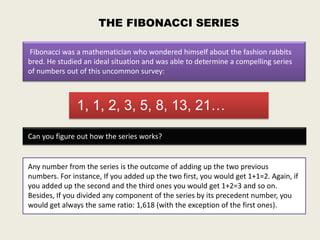
Fibonacci was a mathematician who wondered himself about the fashion rabbits
bred. He studied an ideal situation and was able to determine a compelling series
of numbers out of this uncommon survey:


               1, 1, 2, 3, 5, 8, 13, 21…

Can you figure out how the series works?


Any number from the series is the outcome of adding up the two previous
numbers. For instance, If you added up the two first, you would get 1+1=2. Again, if
you added up the second and the third ones you would get 1+2=3 and so on.
Besides, If you divided any component of the series by its precedent number, you
would get always the same ratio: 1,618 (with the exception of the first ones).
LET S APPLY THIS IDEA TO A SERIES OF
                   SQUARES
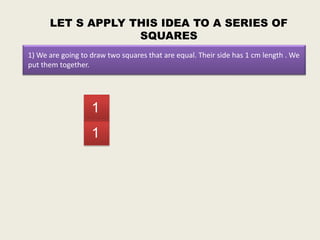
1) We are going to draw two squares that are equal. Their side has 1 cm length . We
put them together.


                   1
                   1
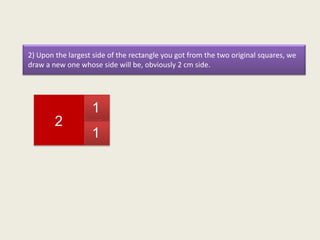
2) Upon the largest side of the rectangle you got from the two original squares, we
draw a new one whose side will be, obviously 2 cm side.


                   1
        2
                   1
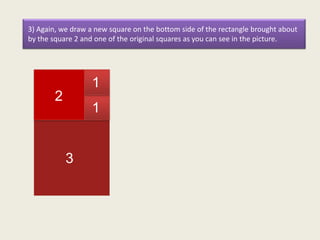
3) Again, we draw a new square on the bottom side of the rectangle brought about
by the square 2 and one of the original squares as you can see in the picture.


                   1
       2
                   1


           3
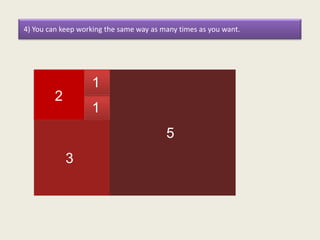
4) You can keep working the same way as many times as you want.


                   1
         2
                   1
                                         5
             3
5) Next step will be to draw an arc with the compass. You will put the point of it on
the middle of the two 1 cm side squares and take a radius of the same length.


        2

                                           5
            3
6) Once you have drawn the semicircle,
You must join points
 P and Q with the          you will keep drawing another arc on
     compass               square number 2. Take center on point
                           B and radius the side of the square (2
                       Q   cm)


            2
P
                       B    5
                3
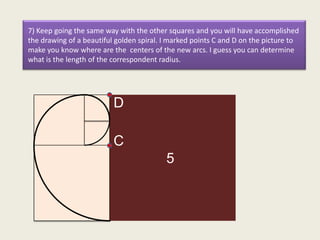
7) Keep going the same way with the other squares and you will have accomplished
the drawing of a beautiful golden spiral. I marked points C and D on the picture to
make you know where are the centers of the new arcs. I guess you can determine
what is the length of the correspondent radius.


                          D

                          C
                                          5
7) And here we go. It is needless to say that we could have developed the spiral
endlessly. Unfortunately we are hampered by our drawing sheet limits.

Golden spiral fibonacci

  • 1.
    This presentation hasbeen made for you by FRANCISCO GUIJARRO BELDA From Isaac Albéniz Secondary School Leganés. Madrid. Spain.
  • 2.
    THE FIBONACCI SERIES Fibonacciwas a mathematician who wondered himself about the fashion rabbits bred. He studied an ideal situation and was able to determine a compelling series of numbers out of this uncommon survey: 1, 1, 2, 3, 5, 8, 13, 21… Can you figure out how the series works? Any number from the series is the outcome of adding up the two previous numbers. For instance, If you added up the two first, you would get 1+1=2. Again, if you added up the second and the third ones you would get 1+2=3 and so on. Besides, If you divided any component of the series by its precedent number, you would get always the same ratio: 1,618 (with the exception of the first ones).
  • 3.
    LET S APPLYTHIS IDEA TO A SERIES OF SQUARES 1) We are going to draw two squares that are equal. Their side has 1 cm length . We put them together. 1 1
  • 4.
    2) Upon thelargest side of the rectangle you got from the two original squares, we draw a new one whose side will be, obviously 2 cm side. 1 2 1
  • 5.
    3) Again, wedraw a new square on the bottom side of the rectangle brought about by the square 2 and one of the original squares as you can see in the picture. 1 2 1 3
  • 6.
    4) You cankeep working the same way as many times as you want. 1 2 1 5 3
  • 7.
    5) Next stepwill be to draw an arc with the compass. You will put the point of it on the middle of the two 1 cm side squares and take a radius of the same length. 2 5 3
  • 8.
    6) Once youhave drawn the semicircle, You must join points P and Q with the you will keep drawing another arc on compass square number 2. Take center on point B and radius the side of the square (2 Q cm) 2 P B 5 3
  • 9.
    7) Keep goingthe same way with the other squares and you will have accomplished the drawing of a beautiful golden spiral. I marked points C and D on the picture to make you know where are the centers of the new arcs. I guess you can determine what is the length of the correspondent radius. D C 5
  • 10.
    7) And herewe go. It is needless to say that we could have developed the spiral endlessly. Unfortunately we are hampered by our drawing sheet limits.