This presentation has been made for you by

FRANCISCO GUIJARRO BELDA
From Isaac Albéniz Secondary School
Leganés. Madrid. Spain.
HOW TO DIVIDE A LINE SEGMENT INTO ANY NUMBER OF
EQUAL PARTS
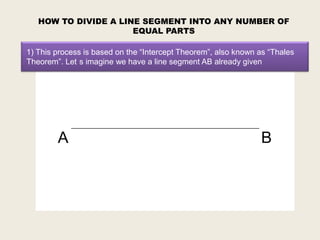
1) This process is based on the “Intercept Theorem”, also known as “Thales
Theorem”. Let s imagine we have a line segment AB already given
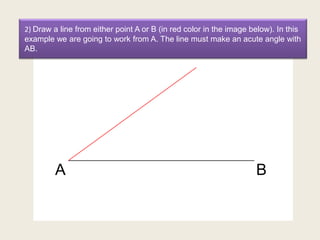
2) Draw a line from either point A or B (in red color in the image below). In this
example we are going to work from A. The line must make an acute angle with
AB.
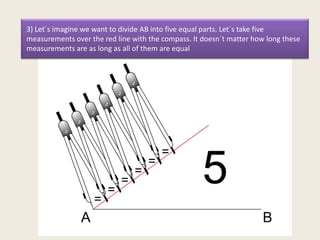
3) Let´s imagine we want to divide AB into five equal parts. Let´s take five
measurements over the red line with the compass. It doesn´t matter how long these
measurements are as long as all of them are equal
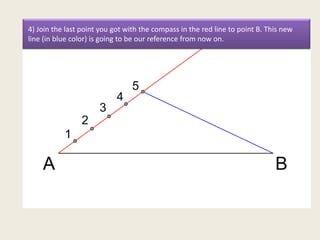
4) Join the last point you got with the compass in the red line to point B. This new
line (in blue color) is going to be our reference from now on.
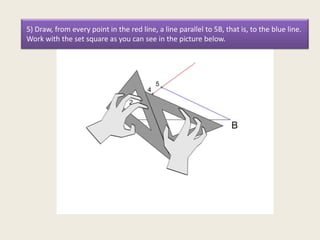
5) Draw, from every point in the red line, a line parallel to 5B, that is, to the blue line.
Work with the set square as you can see in the picture below.
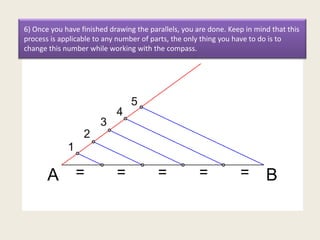
6) Once you have finished drawing the parallels, you are done. Keep in mind that this
process is applicable to any number of parts, the only thing you have to do is to
change this number while working with the compass.

Intercept theorem

  • 1.
    This presentation hasbeen made for you by FRANCISCO GUIJARRO BELDA From Isaac Albéniz Secondary School Leganés. Madrid. Spain.
  • 2.
    HOW TO DIVIDEA LINE SEGMENT INTO ANY NUMBER OF EQUAL PARTS 1) This process is based on the “Intercept Theorem”, also known as “Thales Theorem”. Let s imagine we have a line segment AB already given
  • 3.
    2) Draw aline from either point A or B (in red color in the image below). In this example we are going to work from A. The line must make an acute angle with AB.
  • 4.
    3) Let´s imaginewe want to divide AB into five equal parts. Let´s take five measurements over the red line with the compass. It doesn´t matter how long these measurements are as long as all of them are equal
  • 5.
    4) Join thelast point you got with the compass in the red line to point B. This new line (in blue color) is going to be our reference from now on.
  • 6.
    5) Draw, fromevery point in the red line, a line parallel to 5B, that is, to the blue line. Work with the set square as you can see in the picture below.
  • 7.
    6) Once youhave finished drawing the parallels, you are done. Keep in mind that this process is applicable to any number of parts, the only thing you have to do is to change this number while working with the compass.