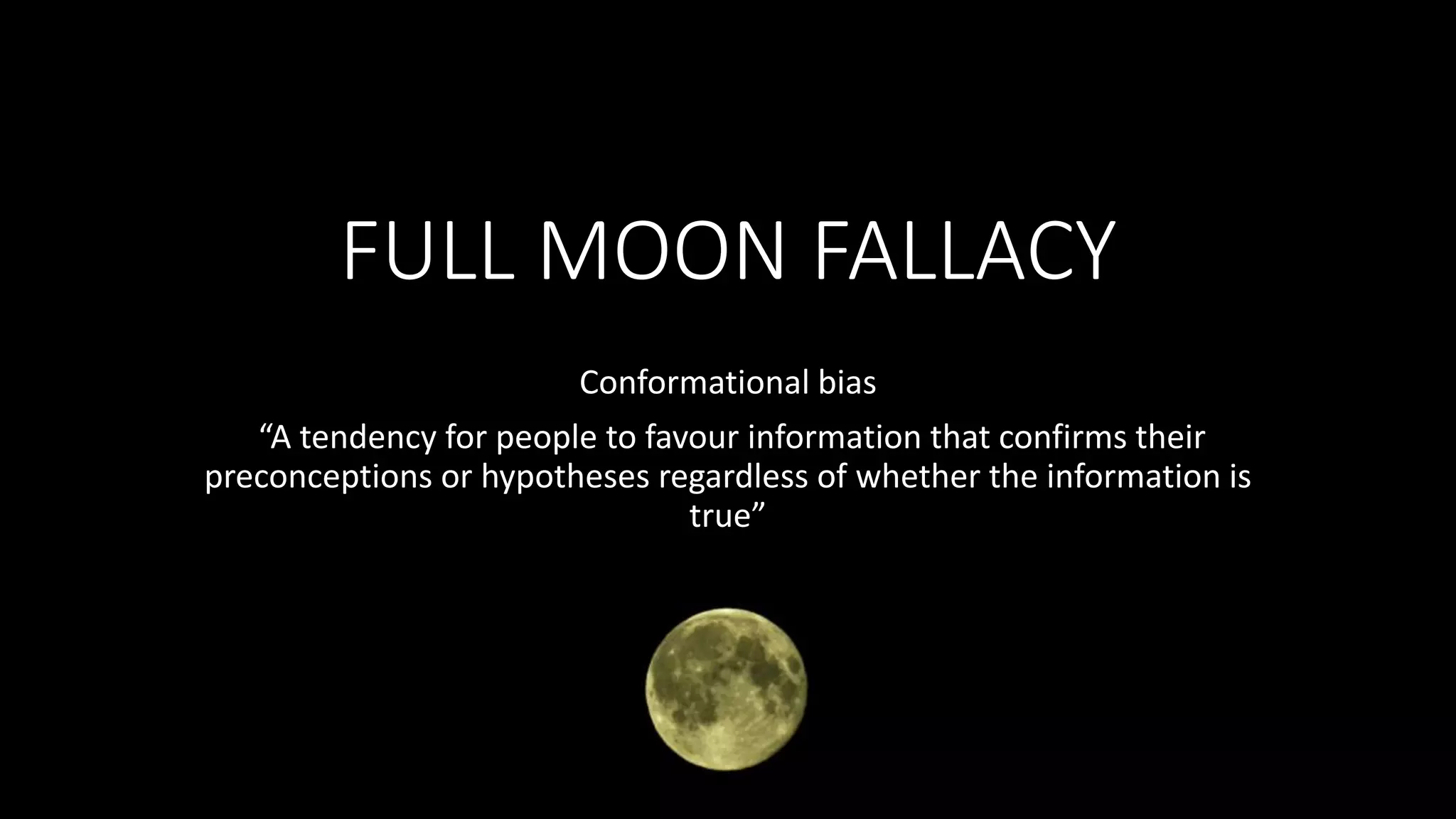
FULL MOON FALLACY
Conformational bias
“A tendency for people to favour information that confirms their
preconceptions or hypotheses regardless of whether the information is
true”
Fallacies
In order to understand what a fallacy is, one must understand what an argument is. Very briefly, an argument
consists of one or more premises and one conclusion. A premise is a statement that is offered in support of the
claim being made, which is the conclusion.
• There are two main types of arguments: deductive and inductive.
• A deductive argument is an argument such that the premises provide (or appear to provide) complete
support for the conclusion.
• An inductive argument is an argument such that the premises provide (or appear to provide) some degree of
support (but less than complete support) for the conclusion.
• If the premises actually provide the required degree of support for the conclusion, then the argument is a
good one.
• A fallacy is, very generally, an error in reasoning. This differs from a factual error, which is simply being wrong
about the facts. To be more specific, a fallacy is an "argument" in which the premises given for the
conclusion do not provide the needed degree of support.
• A deductive fallacy is a deductive argument that is invalid (it is such that it could have all true premises and
still have a false conclusion).
• An inductive fallacy is less formal than a deductive fallacy. They are simply "arguments" which appear to be
inductive arguments, but the premises do not provided enough support for the conclusion. In such cases,
even if the premises were true, the conclusion would not be more likely to be true
FALLACY
dicto simpliciter ad dictum secundum quid
• People like simplicity and would often rather keep simplicity at the
cost of rationality
• also known as: destroying the exception,
• When an attempt is made to apply a general rule to all situations,
when clearly there are exceptions to the rule.
• Simplistic rules or laws rarely take into consideration legitimate
exceptions, and to ignore these exceptions is to bypass reason to
preserve the illusion of a perfect law.
The following ‘Walk down’ is based on actual
arguments.
• Many people believe that the Full Moon affects behaviour and is
responsible for;
• Increased birth rate.
• Increased crime rates
• Increased accidents
• In a article by USA Today, several studies were evaluated in respect to the
effect of the full moon and violent crimes and the like. It has always been
an urban legend that the full moon incites insanity and malcontent, “which
most anecdotal evidence will confirm”.
• However, all anecdotal evidence is highly subjective, and usually
inconsistent. there is no link between the full moon’s presence and the
variables tested.
An employee injured themselves when opening a
gate. A really big heavy one made of metal.
• A careful, objective and logical analysis of the accident revealed that
the Guard injured them self as a result of obvious unawareness of
their environmental conditions prevalent at the time of their accident
On the 2nd of June 2015
• A walk down and demonstration of the accident on the 2nd of July
2015 resulted in a further injury to the employee again very
apparently due to an unawareness of their environment.
ROOT CAUSE ANALYSIS or MOONY TUNES
EVIDENCE?
• Two PREVIOUS accidents occurred on a FULL MOON
• The demonstration also took place during a full
moon.
• Therefore the FULL MOON is the ROOT CAUSE
The Employee was obviously unaware of the full moon “as it was
cloudy”
• Employees are trained to be aware of their environment at all times.
• Clouds would not have an effect on the moons influence, tides are
not effected by clouds.
• Expert opinion states that the moon exerts huge gravitational
influence, therefore greater awareness should be observed during a
full moon
• It is clear that not being aware of the full moon caused them to be
the author of their own down fall.
MOON as a ROOT CAUSE or fallacies
• There is no proof that accidents are not caused by a full moon.
• Two previous accidents during a full moon is clear evidence that the
full moon increases the risk of accidents.
• The accident demonstration also occurred at the time of a full moon
therefore supports the conclusions.
• No accidents have occurred during the previous New Moon.
Therefore this is evidence that the new moon is safer.
Control measures?
Or moon shine?
• Employees to be instructed to make a note in their diary on the
phases of the moon.
• An Instruction should be issued as a reminder and signed for on a
Memorandum of Understanding, to prevent further accidents being
caused by an unawareness of a full moon and to reduce the
foreseeable risks from lunacy to ALARP
THERE ARE PEOPLE THAT THINK LIKE THIS
Did you spot all the fallacies?
Or were you convinced that the moon was the
Root cause?
WALK DOWN
• Base your investigations on logic.
• Most accidents have a logical sequence.
• Be careful not to fall into the fallacy trap.
• Use a recognised RCA Tool such as a Cause and Effect diagram
• DO NOT MAKE ASSUMPTIONS
• The primary goal is accident prevention, not to attribute blame.
• Ultimately you may have to justify your findings in Court.
THE END
Jim McCann

Full moon fallacy.pptx2

  • 1.
    FULL MOON FALLACY Conformationalbias “A tendency for people to favour information that confirms their preconceptions or hypotheses regardless of whether the information is true”
  • 2.
    Fallacies In order tounderstand what a fallacy is, one must understand what an argument is. Very briefly, an argument consists of one or more premises and one conclusion. A premise is a statement that is offered in support of the claim being made, which is the conclusion. • There are two main types of arguments: deductive and inductive. • A deductive argument is an argument such that the premises provide (or appear to provide) complete support for the conclusion. • An inductive argument is an argument such that the premises provide (or appear to provide) some degree of support (but less than complete support) for the conclusion. • If the premises actually provide the required degree of support for the conclusion, then the argument is a good one. • A fallacy is, very generally, an error in reasoning. This differs from a factual error, which is simply being wrong about the facts. To be more specific, a fallacy is an "argument" in which the premises given for the conclusion do not provide the needed degree of support. • A deductive fallacy is a deductive argument that is invalid (it is such that it could have all true premises and still have a false conclusion). • An inductive fallacy is less formal than a deductive fallacy. They are simply "arguments" which appear to be inductive arguments, but the premises do not provided enough support for the conclusion. In such cases, even if the premises were true, the conclusion would not be more likely to be true
  • 3.
    FALLACY dicto simpliciter addictum secundum quid • People like simplicity and would often rather keep simplicity at the cost of rationality • also known as: destroying the exception, • When an attempt is made to apply a general rule to all situations, when clearly there are exceptions to the rule. • Simplistic rules or laws rarely take into consideration legitimate exceptions, and to ignore these exceptions is to bypass reason to preserve the illusion of a perfect law.
  • 4.
    The following ‘Walkdown’ is based on actual arguments. • Many people believe that the Full Moon affects behaviour and is responsible for; • Increased birth rate. • Increased crime rates • Increased accidents • In a article by USA Today, several studies were evaluated in respect to the effect of the full moon and violent crimes and the like. It has always been an urban legend that the full moon incites insanity and malcontent, “which most anecdotal evidence will confirm”. • However, all anecdotal evidence is highly subjective, and usually inconsistent. there is no link between the full moon’s presence and the variables tested.
  • 5.
    An employee injuredthemselves when opening a gate. A really big heavy one made of metal. • A careful, objective and logical analysis of the accident revealed that the Guard injured them self as a result of obvious unawareness of their environmental conditions prevalent at the time of their accident On the 2nd of June 2015 • A walk down and demonstration of the accident on the 2nd of July 2015 resulted in a further injury to the employee again very apparently due to an unawareness of their environment.
  • 6.
    ROOT CAUSE ANALYSISor MOONY TUNES EVIDENCE? • Two PREVIOUS accidents occurred on a FULL MOON • The demonstration also took place during a full moon. • Therefore the FULL MOON is the ROOT CAUSE
  • 7.
    The Employee wasobviously unaware of the full moon “as it was cloudy” • Employees are trained to be aware of their environment at all times. • Clouds would not have an effect on the moons influence, tides are not effected by clouds. • Expert opinion states that the moon exerts huge gravitational influence, therefore greater awareness should be observed during a full moon • It is clear that not being aware of the full moon caused them to be the author of their own down fall.
  • 8.
    MOON as aROOT CAUSE or fallacies • There is no proof that accidents are not caused by a full moon. • Two previous accidents during a full moon is clear evidence that the full moon increases the risk of accidents. • The accident demonstration also occurred at the time of a full moon therefore supports the conclusions. • No accidents have occurred during the previous New Moon. Therefore this is evidence that the new moon is safer.
  • 9.
    Control measures? Or moonshine? • Employees to be instructed to make a note in their diary on the phases of the moon. • An Instruction should be issued as a reminder and signed for on a Memorandum of Understanding, to prevent further accidents being caused by an unawareness of a full moon and to reduce the foreseeable risks from lunacy to ALARP
  • 10.
    THERE ARE PEOPLETHAT THINK LIKE THIS Did you spot all the fallacies? Or were you convinced that the moon was the Root cause?
  • 11.
    WALK DOWN • Baseyour investigations on logic. • Most accidents have a logical sequence. • Be careful not to fall into the fallacy trap. • Use a recognised RCA Tool such as a Cause and Effect diagram • DO NOT MAKE ASSUMPTIONS • The primary goal is accident prevention, not to attribute blame. • Ultimately you may have to justify your findings in Court.
  • 12.

Editor's Notes

  • #3 ACCIDENT FALLACYa dicto simpliciter ad dictum secundum quid(also known as: destroying the exception, dicto secundum quid ad dictum simpliciter, dicto simpliciter, converse accident, reverse accident, fallacy of the general rule, sweeping generalization)Description: When an attempt is made to apply a general rule to all situations, when clearly there are exceptions to the rule. Simplistic rules or laws rarely take into consideration legitimate exceptions, and to ignore these exceptions is to bypass reason to preserve the illusion of a perfect law.  People like simplicity and would often rather keep simplicity at the cost of rationality.
  • #4 Example, You must only PUSH a manually operated gate i.e. a general rule Clearly there is an exception where you may have to pull e.g. where a handle is on one side and not to use it to pull would mean the gate was not under proper control.