 In the past gold containing alloys were the
more pre-dominant metals used for spectacle
frames. Today few frames contain gold.
 Metal frames may not have any gold or any
significant amount of gold in the frame. This
doesn’t imply anything about the quality of the
frame.
When a frame has a substantial gold content,
numbers other than those indicating the size of
frame are printed on the frame to indicate the
nature of the gold content.
 The colour of a frame with gold content
has nothing to do with its quality.
The colour depends on what type of metal is
used in combination with gold to make the
gold alloy.
The Karat system is used to determine the
amount of gold present.
The number marked on the article is the
amount of gold by weight in comparison to a
total of 24 units:
an article marked 12k is an alloy made up of
one-half gold and one-half another metal.
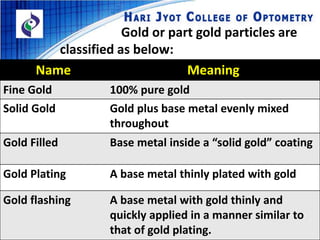
Gold or part gold particles are
classified as below:
Name Meaning
Fine Gold 100% pure gold
Solid Gold Gold plus base metal evenly mixed
throughout
Gold Filled Base metal inside a “solid gold” coating
Gold Plating A base metal thinly plated with gold
Gold flashing A base metal with gold thinly and
quickly applied in a manner similar to
that of gold plating.
Name used for an article that has no metal in it
other than gold.
Gold found in it is chemically pure and too soft.
Although this is the purest form, it is not always
the most practical, as is the case in spectacle
frames.
Frames of fine gold would be too malleable and
would bend and dent too easily so not used
practical.
Using the karat system, fine gold is 24 karats
fine, which means that by weight, 24 parts out
of 24 are gold.
Gold Metal Vintage Round eyeglass
Frame Clear Lens Full-Rim Glasses.
•Actually an alloy of gold and another
metal, a mixture of gold and a base
metal. Thus the term is misleading as it
does not mean all gold.
• It is made entirely of gold alloy.
•It maintains it luster regardless of how far
down it is worn through use.
•10 karat gold used.
•Frame is solid rather than hollow.
18k Solid Gold
Rimless Optical
Frame
With Diamond
Stones
 Made of metal other than gold and
then covered with a gold alloy.
Term doesn’t indicate that the article is
“filled with gold”, but rather the
opposite: an outer wrapper of gold
alloy is “filled” with a baser metal.
Base metal inside around that solid gold
coating by the use of heat and pressure.
To be classified as a gold filled, minimum of
one twentieth of the article’s total weight
must be gold. Fineness must be 10 karat.
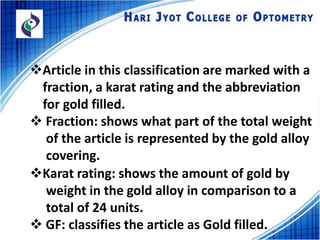
Article in this classification are marked with a
fraction, a karat rating and the abbreviation
for gold filled.
 Fraction: shows what part of the total weight
of the article is represented by the gold alloy
covering.
Karat rating: shows the amount of gold by
weight in the gold alloy in comparison to a
total of 24 units.
 GF: classifies the article as Gold filled.
For example:
1/10: 10% of the total weight of article is
alloy.
12k: 12 parts out of 24 parts of covering
alloy by weight are gold.
GF: The article classified as gold filled.
Thus the article would bear the marking of
1/10 12k GF.
 It retains its luster until the gold
covering eventually wears through.
If a frame is made from parts having different
percents of
gold, the frame must be marked according to
the part
containing the least amount of gold.
 For example:
Temples: 1/8 12k GF
Front: 1/10 12k GF
Frame must be marked as: 1/10 12k GF.
1/10 12k GF- Full
Rimmed
Eyeglasses
1/10 12k GF – Cateye
Style eyeglasses
with Full Metal Rim
 Made of some other metal, the surface of
which is plated with gold, usually by an
electrolytic process.
 Articles classified as gold plate have no
minimum requirements as to the total
amount of gold used.
 But the gold is less than 1/20 to the total
volume of the weight.
 Maintain luster only until the thin plating is worn
through and the base metal is exposed.
23k Gold Plated
Optical Frame
18k Gold Plated
Eyewear Frame
Glasses
 Method of gold application that is done in
almost the same way that gold plating is done,
only faster.
 This is applied using a cyanide-based bath
instead of an acid- based bath.
It produces an extremely thin layer of gold.
 If it were not for the protective coating, which
works very well, the gold would not be very
durable.
 A large percentage of spectacle frames have gold
flashing and because of the coating are very
serviceable.
Gold frames

Gold frames

  • 2.
     In thepast gold containing alloys were the more pre-dominant metals used for spectacle frames. Today few frames contain gold.  Metal frames may not have any gold or any significant amount of gold in the frame. This doesn’t imply anything about the quality of the frame. When a frame has a substantial gold content, numbers other than those indicating the size of frame are printed on the frame to indicate the nature of the gold content.
  • 3.
     The colourof a frame with gold content has nothing to do with its quality. The colour depends on what type of metal is used in combination with gold to make the gold alloy. The Karat system is used to determine the amount of gold present. The number marked on the article is the amount of gold by weight in comparison to a total of 24 units: an article marked 12k is an alloy made up of one-half gold and one-half another metal.
  • 4.
    Gold or partgold particles are classified as below: Name Meaning Fine Gold 100% pure gold Solid Gold Gold plus base metal evenly mixed throughout Gold Filled Base metal inside a “solid gold” coating Gold Plating A base metal thinly plated with gold Gold flashing A base metal with gold thinly and quickly applied in a manner similar to that of gold plating.
  • 6.
    Name used foran article that has no metal in it other than gold. Gold found in it is chemically pure and too soft. Although this is the purest form, it is not always the most practical, as is the case in spectacle frames. Frames of fine gold would be too malleable and would bend and dent too easily so not used practical. Using the karat system, fine gold is 24 karats fine, which means that by weight, 24 parts out of 24 are gold.
  • 7.
    Gold Metal VintageRound eyeglass Frame Clear Lens Full-Rim Glasses.
  • 8.
    •Actually an alloyof gold and another metal, a mixture of gold and a base metal. Thus the term is misleading as it does not mean all gold. • It is made entirely of gold alloy. •It maintains it luster regardless of how far down it is worn through use. •10 karat gold used. •Frame is solid rather than hollow.
  • 9.
    18k Solid Gold RimlessOptical Frame With Diamond Stones
  • 10.
     Made ofmetal other than gold and then covered with a gold alloy. Term doesn’t indicate that the article is “filled with gold”, but rather the opposite: an outer wrapper of gold alloy is “filled” with a baser metal. Base metal inside around that solid gold coating by the use of heat and pressure. To be classified as a gold filled, minimum of one twentieth of the article’s total weight must be gold. Fineness must be 10 karat.
  • 11.
    Article in thisclassification are marked with a fraction, a karat rating and the abbreviation for gold filled.  Fraction: shows what part of the total weight of the article is represented by the gold alloy covering. Karat rating: shows the amount of gold by weight in the gold alloy in comparison to a total of 24 units.  GF: classifies the article as Gold filled.
  • 12.
    For example: 1/10: 10%of the total weight of article is alloy. 12k: 12 parts out of 24 parts of covering alloy by weight are gold. GF: The article classified as gold filled. Thus the article would bear the marking of 1/10 12k GF.
  • 13.
     It retainsits luster until the gold covering eventually wears through. If a frame is made from parts having different percents of gold, the frame must be marked according to the part containing the least amount of gold.  For example: Temples: 1/8 12k GF Front: 1/10 12k GF Frame must be marked as: 1/10 12k GF.
  • 14.
    1/10 12k GF-Full Rimmed Eyeglasses 1/10 12k GF – Cateye Style eyeglasses with Full Metal Rim
  • 15.
     Made ofsome other metal, the surface of which is plated with gold, usually by an electrolytic process.  Articles classified as gold plate have no minimum requirements as to the total amount of gold used.  But the gold is less than 1/20 to the total volume of the weight.  Maintain luster only until the thin plating is worn through and the base metal is exposed.
  • 16.
    23k Gold Plated OpticalFrame 18k Gold Plated Eyewear Frame Glasses
  • 17.
     Method ofgold application that is done in almost the same way that gold plating is done, only faster.  This is applied using a cyanide-based bath instead of an acid- based bath. It produces an extremely thin layer of gold.  If it were not for the protective coating, which works very well, the gold would not be very durable.  A large percentage of spectacle frames have gold flashing and because of the coating are very serviceable.