

Going serverless on AWS
The Threats and Opportunities of Going Serverless
Valentyn Nastenko
nastenko@zeoalliance.com
Figleaf
The choice to be private is
all yours.
https://figleafapp.com
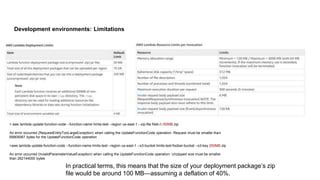
Development environments: Limitations
> aws lambda update-function-code --function-name limits-test --region us-east-1 --zip-file fileb://./50MB.zip
An error occurred (RequestEntityTooLargeException) when calling the UpdateFunctionCode operation: Request must be smaller than
69905067 bytes for the UpdateFunctionCode operation
>aws lambda update-function-code --function-name limits-test --region us-east-1 --s3-bucket limits-test-foobar-bucket --s3-key 250MB.zip
An error occurred (InvalidParameterValueException) when calling the UpdateFunctionCode operation: Unzipped size must be smaller
than 262144000 bytes
In practical terms, this means that the size of your deployment package’s zip
file would be around 100 MB—assuming a deflation of 40%.
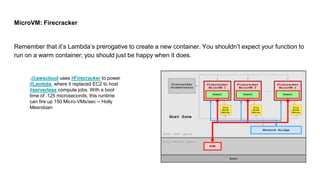
MicroVM: Firecracker
Remember that it’s Lambda’s prerogative to create a new container. You shouldn’t expect your function to
run on a warm container; you should just be happy when it does.
.@awscloud uses #Firecracker to power
#Lambda, where it replaced EC2 to host
#serverless compute jobs. With a boot
time of .125 microseconds, this runtime
can fire up 150 Micro-VMs/sec -- Holly
Mesrobian
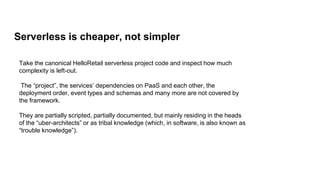
Serverless is cheaper, not simpler
Take the canonical HelloRetail serverless project code and inspect how much
complexity is left-out.
The “project”, the services’ dependencies on PaaS and each other, the
deployment order, event types and schemas and many more are not covered by
the framework.
They are partially scripted, partially documented, but mainly residing in the heads
of the “uber-architects” or as tribal knowledge (which, in software, is also known as
“trouble knowledge”).
Development environments: Patterns
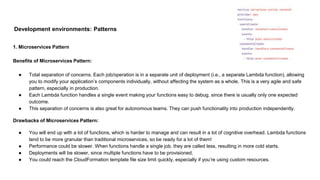
1. Microservices Pattern
Benefits of Microservices Pattern:
● Total separation of concerns. Each job/operation is in a separate unit of deployment (i.e., a separate Lambda function), allowing
you to modify your application’s components individually, without affecting the system as a whole. This is a very agile and safe
pattern, especially in production.
● Each Lambda function handles a single event making your functions easy to debug, since there is usually only one expected
outcome.
● This separation of concerns is also great for autonomous teams. They can push functionality into production independently.
Drawbacks of Microservices Pattern:
● You will end up with a lot of functions, which is harder to manage and can result in a lot of cognitive overhead. Lambda functions
tend to be more granular than traditional microservices, so be ready for a lot of them!
● Performance could be slower. When functions handle a single job, they are called less, resulting in more cold starts.
● Deployments will be slower, since multiple functions have to be provisioned.
● You could reach the CloudFormation template file size limit quickly, especially if you’re using custom resources.
Development environments: Patterns
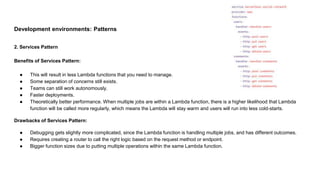
2. Services Pattern
Benefits of Services Pattern:
● This will result in less Lambda functions that you need to manage.
● Some separation of concerns still exists.
● Teams can still work autonomously.
● Faster deployments.
● Theoretically better performance. When multiple jobs are within a Lambda function, there is a higher likelihood that Lambda
function will be called more regularly, which means the Lambda will stay warm and users will run into less cold-starts.
Drawbacks of Services Pattern:
● Debugging gets slightly more complicated, since the Lambda function is handling multiple jobs, and has different outcomes.
● Requires creating a router to call the right logic based on the request method or endpoint.
● Bigger function sizes due to putting multiple operations within the same Lambda function.
Development environments: Patterns
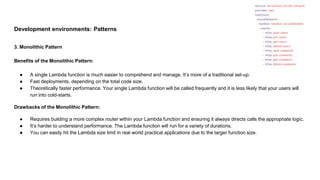
3. Monolithic Pattern
Benefits of the Monolithic Pattern:
● A single Lambda function is much easier to comprehend and manage. It’s more of a traditional set-up.
● Fast deployments, depending on the total code size.
● Theoretically faster performance. Your single Lambda function will be called frequently and it is less likely that your users will
run into cold-starts.
Drawbacks of the Monolithic Pattern:
● Requires building a more complex router within your Lambda function and ensuring it always directs calls the appropriate logic.
● It’s harder to understand performance. The Lambda function will run for a variety of durations.
● You can easily hit the Lambda size limit in real world practical applications due to the larger function size.
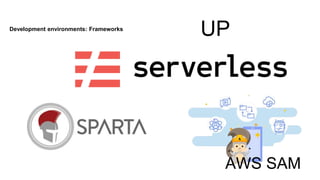
Development environments: Frameworks
UP
AWS SAM
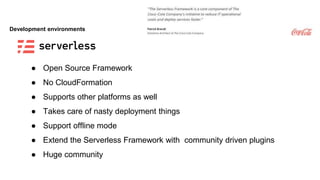
Development environments
● Open Source Framework
● No CloudFormation
● Supports other platforms as well
● Takes care of nasty deployment things
● Support offline mode
● Extend the Serverless Framework with community driven plugins
● Huge community
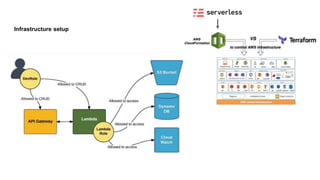
Infrastructure setup
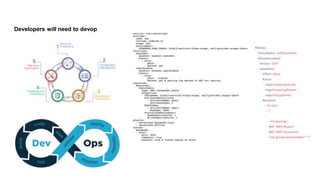
Developers will need to devop
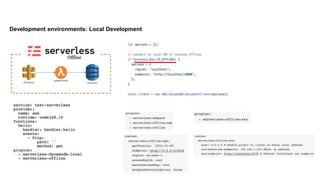
Development environments: Local Development
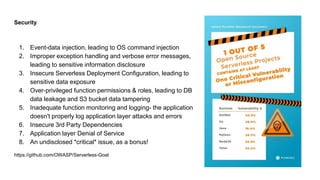
Security
1. Event-data injection, leading to OS command injection
2. Improper exception handling and verbose error messages,
leading to sensitive information disclosure
3. Insecure Serverless Deployment Configuration, leading to
sensitive data exposure
4. Over-privileged function permissions & roles, leading to DB
data leakage and S3 bucket data tampering
5. Inadequate function monitoring and logging- the application
doesn't properly log application layer attacks and errors
6. Insecure 3rd Party Dependencies
7. Application layer Denial of Service
8. An undisclosed *critical* issue, as a bonus!
https://github.com/OWASP/Serverless-Goat
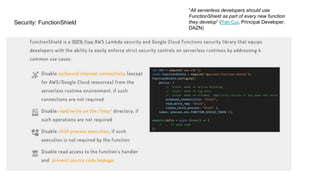
Security: FunctionShield
“All serverless developers should use
FunctionShield as part of every new function
they develop” (Yan Cui, Principal Developer,
DAZN)
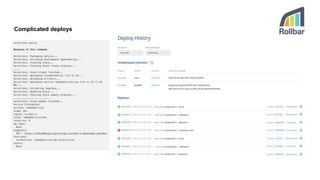
Complicated deploys
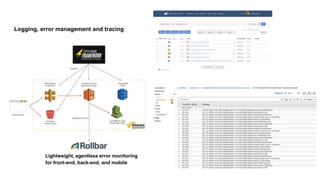
Logging, error management and tracing
Lightweight, agentless error monitoring
for front-end, back-end, and mobile
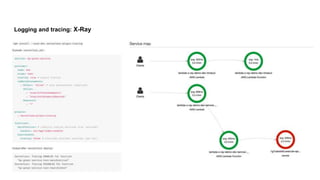
Logging and tracing: X-Ray
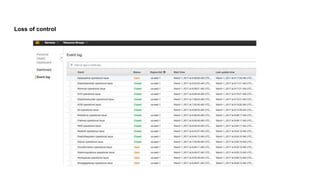
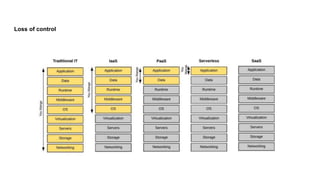
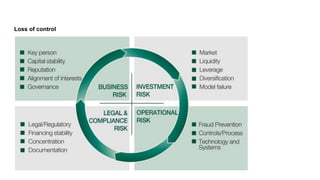
Loss of control
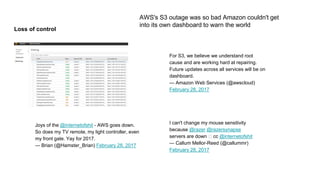
Loss of control
AWS's S3 outage was so bad Amazon couldn't get
into its own dashboard to warn the world
For S3, we believe we understand root
cause and are working hard at repairing.
Future updates across all services will be on
dashboard.
— Amazon Web Services (@awscloud)
February 28, 2017
I can't change my mouse sensitivity
because @razer @razersynapse
servers are down 🙄 cc @internetofshit
— Callum Mellor-Reed (@callummr)
February 28, 2017
Joys of the @internetofshit - AWS goes down.
So does my TV remote, my light controller, even
my front gate. Yay for 2017.
— Brian (@Hamster_Brian) February 28, 2017
Loss of control
Loss of control
Opportunities:
● Automated Infrastructure Management: An entire chain of manual infrastructure management processes is eliminated as
users no longer need to coordinate and manage resource for increasingly distributed software components that constitute
modern apps.
● Cost and Time Saving: The operational costs and time is reduced as no system administration processes are required to
package and deploy the apps.
● High Scalability and Optimized Resource Utilization: The cost barrier to scale apps is also reduced as serverless IT
workloads don’t require dedicated resources. Every application request is met with continuous and independent scalability
requirements, yet the users are charged only during the period that requests are served.
● Truly Agile Business Processes: Since the application deployment process is (apparently) decoupled from the underlying
infrastructure, Agile and DevOps-driven organizations are can maintain flexible IT operations and business processes. The
constraints due to hardware complexity and infrastructure configuration limitations have less impact and role in dictating IT-
driven business operations or app functionality. Agile teams can aim for faster development sprints and deploy iterative
improvements or changing app functionality with fewer constraints.
● Reliability and Performance: Services like AWS are inherently resilient and can guarantee performance SLAs most of the
times. Serverless architecture offers the convenience of reducing the opportunities of hardware misconfigurations that
potentially lead to performance degradation with traditional app deployment practices.
Thank you for your attention
Valentyn Nastenko
nastenko@zeoalliance.comhttps://goo.gl/T3SqRy

Going Serverless on AWS

  • 1.
    Going serverless onAWS The Threats and Opportunities of Going Serverless Valentyn Nastenko nastenko@zeoalliance.com
  • 2.
    Figleaf The choice tobe private is all yours. https://figleafapp.com
  • 4.
    Development environments: Limitations >aws lambda update-function-code --function-name limits-test --region us-east-1 --zip-file fileb://./50MB.zip An error occurred (RequestEntityTooLargeException) when calling the UpdateFunctionCode operation: Request must be smaller than 69905067 bytes for the UpdateFunctionCode operation >aws lambda update-function-code --function-name limits-test --region us-east-1 --s3-bucket limits-test-foobar-bucket --s3-key 250MB.zip An error occurred (InvalidParameterValueException) when calling the UpdateFunctionCode operation: Unzipped size must be smaller than 262144000 bytes In practical terms, this means that the size of your deployment package’s zip file would be around 100 MB—assuming a deflation of 40%.
  • 5.
    MicroVM: Firecracker Remember thatit’s Lambda’s prerogative to create a new container. You shouldn’t expect your function to run on a warm container; you should just be happy when it does. .@awscloud uses #Firecracker to power #Lambda, where it replaced EC2 to host #serverless compute jobs. With a boot time of .125 microseconds, this runtime can fire up 150 Micro-VMs/sec -- Holly Mesrobian
  • 6.
    Serverless is cheaper,not simpler Take the canonical HelloRetail serverless project code and inspect how much complexity is left-out. The “project”, the services’ dependencies on PaaS and each other, the deployment order, event types and schemas and many more are not covered by the framework. They are partially scripted, partially documented, but mainly residing in the heads of the “uber-architects” or as tribal knowledge (which, in software, is also known as “trouble knowledge”).
  • 7.
    Development environments: Patterns 1.Microservices Pattern Benefits of Microservices Pattern: ● Total separation of concerns. Each job/operation is in a separate unit of deployment (i.e., a separate Lambda function), allowing you to modify your application’s components individually, without affecting the system as a whole. This is a very agile and safe pattern, especially in production. ● Each Lambda function handles a single event making your functions easy to debug, since there is usually only one expected outcome. ● This separation of concerns is also great for autonomous teams. They can push functionality into production independently. Drawbacks of Microservices Pattern: ● You will end up with a lot of functions, which is harder to manage and can result in a lot of cognitive overhead. Lambda functions tend to be more granular than traditional microservices, so be ready for a lot of them! ● Performance could be slower. When functions handle a single job, they are called less, resulting in more cold starts. ● Deployments will be slower, since multiple functions have to be provisioned. ● You could reach the CloudFormation template file size limit quickly, especially if you’re using custom resources.
  • 8.
    Development environments: Patterns 2.Services Pattern Benefits of Services Pattern: ● This will result in less Lambda functions that you need to manage. ● Some separation of concerns still exists. ● Teams can still work autonomously. ● Faster deployments. ● Theoretically better performance. When multiple jobs are within a Lambda function, there is a higher likelihood that Lambda function will be called more regularly, which means the Lambda will stay warm and users will run into less cold-starts. Drawbacks of Services Pattern: ● Debugging gets slightly more complicated, since the Lambda function is handling multiple jobs, and has different outcomes. ● Requires creating a router to call the right logic based on the request method or endpoint. ● Bigger function sizes due to putting multiple operations within the same Lambda function.
  • 9.
    Development environments: Patterns 3.Monolithic Pattern Benefits of the Monolithic Pattern: ● A single Lambda function is much easier to comprehend and manage. It’s more of a traditional set-up. ● Fast deployments, depending on the total code size. ● Theoretically faster performance. Your single Lambda function will be called frequently and it is less likely that your users will run into cold-starts. Drawbacks of the Monolithic Pattern: ● Requires building a more complex router within your Lambda function and ensuring it always directs calls the appropriate logic. ● It’s harder to understand performance. The Lambda function will run for a variety of durations. ● You can easily hit the Lambda size limit in real world practical applications due to the larger function size.
  • 10.
  • 11.
    Development environments ● OpenSource Framework ● No CloudFormation ● Supports other platforms as well ● Takes care of nasty deployment things ● Support offline mode ● Extend the Serverless Framework with community driven plugins ● Huge community
  • 12.
  • 13.
  • 14.
  • 15.
    Security 1. Event-data injection,leading to OS command injection 2. Improper exception handling and verbose error messages, leading to sensitive information disclosure 3. Insecure Serverless Deployment Configuration, leading to sensitive data exposure 4. Over-privileged function permissions & roles, leading to DB data leakage and S3 bucket data tampering 5. Inadequate function monitoring and logging- the application doesn't properly log application layer attacks and errors 6. Insecure 3rd Party Dependencies 7. Application layer Denial of Service 8. An undisclosed *critical* issue, as a bonus! https://github.com/OWASP/Serverless-Goat
  • 16.
    Security: FunctionShield “All serverlessdevelopers should use FunctionShield as part of every new function they develop” (Yan Cui, Principal Developer, DAZN)
  • 17.
  • 18.
    Logging, error managementand tracing Lightweight, agentless error monitoring for front-end, back-end, and mobile
  • 19.
  • 20.
  • 21.
    Loss of control AWS'sS3 outage was so bad Amazon couldn't get into its own dashboard to warn the world For S3, we believe we understand root cause and are working hard at repairing. Future updates across all services will be on dashboard. — Amazon Web Services (@awscloud) February 28, 2017 I can't change my mouse sensitivity because @razer @razersynapse servers are down 🙄 cc @internetofshit — Callum Mellor-Reed (@callummr) February 28, 2017 Joys of the @internetofshit - AWS goes down. So does my TV remote, my light controller, even my front gate. Yay for 2017. — Brian (@Hamster_Brian) February 28, 2017
  • 22.
  • 23.
  • 24.
    Opportunities: ● Automated InfrastructureManagement: An entire chain of manual infrastructure management processes is eliminated as users no longer need to coordinate and manage resource for increasingly distributed software components that constitute modern apps. ● Cost and Time Saving: The operational costs and time is reduced as no system administration processes are required to package and deploy the apps. ● High Scalability and Optimized Resource Utilization: The cost barrier to scale apps is also reduced as serverless IT workloads don’t require dedicated resources. Every application request is met with continuous and independent scalability requirements, yet the users are charged only during the period that requests are served. ● Truly Agile Business Processes: Since the application deployment process is (apparently) decoupled from the underlying infrastructure, Agile and DevOps-driven organizations are can maintain flexible IT operations and business processes. The constraints due to hardware complexity and infrastructure configuration limitations have less impact and role in dictating IT- driven business operations or app functionality. Agile teams can aim for faster development sprints and deploy iterative improvements or changing app functionality with fewer constraints. ● Reliability and Performance: Services like AWS are inherently resilient and can guarantee performance SLAs most of the times. Serverless architecture offers the convenience of reducing the opportunities of hardware misconfigurations that potentially lead to performance degradation with traditional app deployment practices.
  • 25.
    Thank you foryour attention Valentyn Nastenko nastenko@zeoalliance.comhttps://goo.gl/T3SqRy