INTERIO® B2B
I201 Yesha Babariya
I224 Mohit Lakhani
I214 Virat Gautam
I234 Vinesh Hegde
L019 Priyan Shah
L010 Kushal Kerkar
Road Map
Overview
Product Line
B2B Sales
Sale Force Organization
01
02
03
04
Pre Sales Process05
Overview
 Business unit of Godrej & Boyce Mfg. Co. Ltd.
Largest furniture manufacturer in India
 50 showrooms in 18 cities across India
 A strong network of over 800 dealers in India,
200 exclusive retailers, in which 51 are COCO
rest are franchise stores
 Offerings can be broadly classified into:
i. Retail office and home furniture
ii. Contract Manufacturing
iii. Projects
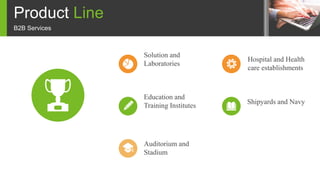
Product Line
B2B Services
Solution and
Laboratories
Auditorium and
Stadium
Education and
Training Institutes
Hospital and Health
care establishments
Shipyards and Navy
B2B Sales
It refers to an activity where a business is selling its products or
services (=creating value) to another business. It is distinct from
B2C—or business-to-consumer sales—which means sales to
individuals rather than businesses.
B2B vs B2C sales
Forrester estimated that the total size of the US B2B sales
market was $9 trillion in 2018 with B2B ecommerce accounting for
$1.1 trillion. While statistics that provide a direct comparison are
hard to come by, for some context, US B2C ecommerce sales stood
at $512 billion in 2018—less than half the value of the B2B market.
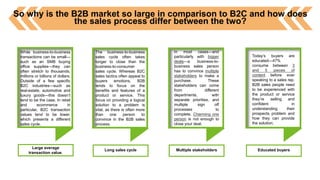
So why is the B2B market so large in comparison to B2C and how does
the sales process differ between the two?
While business-to-business
transactions can be small—
such as an SMB buying
office supplies—they can
often stretch to thousands,
millions or billions of dollars.
Outside of a few specific
B2C industries—such as
real-estate, automotive and
luxury goods—this doesn’t
tend to be the case. In retail
and ecommerce in
particular, B2C transaction
values tend to be lower,
which presents a different
sales cycle.
Large average
transaction value.
The business-to-business
sales cycle often takes
longer to close than the
business-to-consumer
sales cycle. Whereas B2C
sales tactics often appeal to
buyers emotions, B2B
tends to focus on the
benefits and features of a
product or service. This
focus on providing a logical
solution to a problem is
vital, as there is often more
than one person to
convince in the B2B sales
process.
Long sales cycle
In most cases—and
particularly with bigger
deals—a business-to-
business sales person
has to convince multiple
stakeholders to make a
purchase. These
stakeholders can come
from different
departments, with
separate priorities, and
multiple sign off
processes to
complete. Charming one
person is not enough to
close your deal.
Multiple stakeholders
Today’s buyers are
educated—47%
consume between 3
and 5 pieces of
content before ever
speaking to a sales rep.
B2B sales people need
to be experienced with
the product or service
they’re selling and
confident in
understanding their
prospects problem and
how they can provide
the solution.
Educated buyers
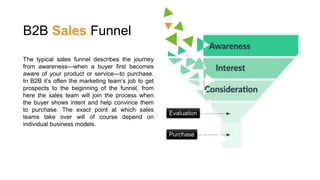
B2B Sales Funnel
The typical sales funnel describes the journey
from awareness—when a buyer first becomes
aware of your product or service—to purchase.
In B2B it’s often the marketing team’s job to get
prospects to the beginning of the funnel, from
here the sales team will join the process when
the buyer shows intent and help convince them
to purchase. The exact point at which sales
teams take over will of course depend on
individual business models.
Evaluation
Purchase
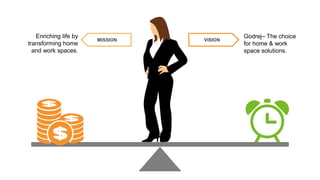
VISIONMISSION
Godrej– The choice
for home & work
space solutions.
Enriching life by
transforming home
and work spaces.
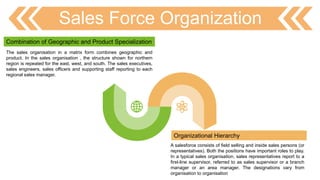
Sales Force Organization
Combination of Geographic and Product Specialization
The sales organisation in a matrix form combines geographic and
product. In the sales organisation , the structure shown for northern
region is repeated for the east, west, and south. The sales executives,
sales engineers, sales officers and supporting staff reporting to each
regional sales manager.
Organizational Hierarchy
A salesforce consists of field selling and inside sales persons (or
representatives). Both the positions have important roles to play.
In a typical sales organisation, sales representatives report to a
first-line supervisor, referred to as sales supervisor or a branch
manager or an area manager. The designations vary from
organisation to organisation
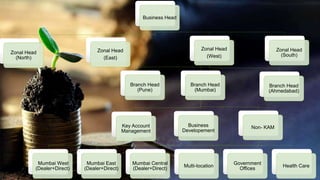
Business Head
Zonal Head
(North)
Zonal Head
(East)
Zonal Head
(West)
Branch Head
(Pune)
Branch Head
(Mumbai)
Key Account
Management
Business
Developement
Non- KAM
Mumbai West
(Dealer+Direct)
Mumbai East
(Dealer+Direct)
Mumbai Central
(Dealer+Direct)
Multi-location
Government
Offices
Health Care
Branch Head
(Ahmedabad)
Zonal Head
(South)
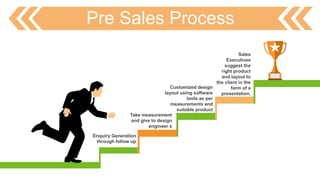
Pre Sales Process
Take measurement
and give to design
engineer s
Customized design
layout using software
tools as per
measurements and
suitable product
Sales
Executives
suggest the
right product
and layout to
the client in the
form of a
presentation.
Enquiry Generation
through follow up
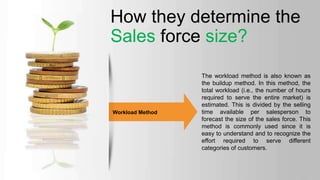
Workload Method
How they determine the
Sales force size?
The workload method is also known as
the buildup method. In this method, the
total workload (i.e., the number of hours
required to serve the entire market) is
estimated. This is divided by the selling
time available per salesperson to
forecast the size of the sales force. This
method is commonly used since it is
easy to understand and to recognize the
effort required to serve different
categories of customers.
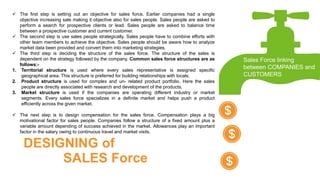
 The first step is setting out an objective for sales force. Earlier companies had a single
objective increasing sale making it objective also for sales people. Sales people are asked to
perform a search for prospective clients or lead. Sales people are asked to balance time
between a prospective customer and current customer.
 The second step is use sales people strategically. Sales people have to combine efforts with
other team members to achieve the objective. Sales people should be aware how to analyze
market data been provided and convert them into marketing strategies.
 The third step is deciding the structure of the sales force. The structure of the sales is
dependent on the strategy followed by the company. Common sales force structures are as
follows:-
1. Territorial structure is used where every sales representative is assigned specific
geographical area. This structure is preferred for building relationships with locals.
2. Product structure is used for complex and un- related product portfolio. Here the sales
people are directly associated with research and development of the products.
3. Market structure is used if the companies are operating different industry or market
segments. Every sales force specializes in a definite market and helps push a product
efficiently across the given market.
 The next step is to design compensation for the sales force. Compensation plays a big
motivational factor for sales people. Companies follow a structure of a fixed amount plus a
variable amount depending of success achieved in the market. Allowances play an important
factor in the salary owing to continuous travel and market visits.
Sales Force linking
between COMPANIES and
CUSTOMERS
DESIGNING of
SALES Force
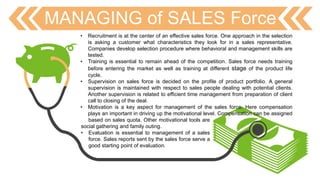
MANAGING of SALES Force
• Recruitment is at the center of an effective sales force. One approach in the selection
is asking a customer what characteristics they look for in a sales representative.
Companies develop selection procedure where behavioral and management skills are
tested.
• Training is essential to remain ahead of the competition. Sales force needs training
before entering the market as well as training at different stage of the product life
cycle.
• Supervision on sales force is decided on the profile of product portfolio. A general
supervision is maintained with respect to sales people dealing with potential clients.
Another supervision is related to efficient time management from preparation of client
call to closing of the deal.
• Motivation is a key aspect for management of the sales force. Here compensation
plays an important in driving up the motivational level. Compensation can be assigned
based on sales quota. Other motivational tools are
social gathering and family outing.
• Evaluation is essential to management of a sales
force. Sales reports sent by the sales force serve a
good starting point of evaluation.
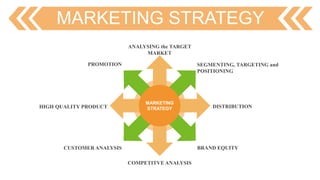
MARKETING STRATEGY
COMPETITVE ANALYSIS
BRAND EQUITY
DISTRIBUTION
CUSTOMER ANALYSIS
HIGH QUALITY PRODUCT
PROMOTION
MARKETING
STRATEGY
SEGMENTING, TARGETING and
POSITIONING
ANALYSING the TARGET
MARKET
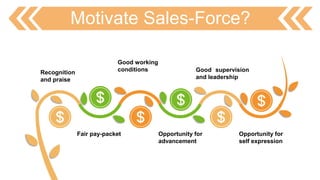
Motivate Sales-Force?
Recognition
and praise
Fair pay-packet Opportunity for
advancement
Good working
conditions Good supervision
and leadership
Opportunity for
self expression
THANK YOU

Godrej interio B2B Sales

  • 1.
    INTERIO® B2B I201 YeshaBabariya I224 Mohit Lakhani I214 Virat Gautam I234 Vinesh Hegde L019 Priyan Shah L010 Kushal Kerkar
  • 2.
    Road Map Overview Product Line B2BSales Sale Force Organization 01 02 03 04 Pre Sales Process05
  • 3.
    Overview  Business unitof Godrej & Boyce Mfg. Co. Ltd. Largest furniture manufacturer in India  50 showrooms in 18 cities across India  A strong network of over 800 dealers in India, 200 exclusive retailers, in which 51 are COCO rest are franchise stores  Offerings can be broadly classified into: i. Retail office and home furniture ii. Contract Manufacturing iii. Projects
  • 4.
    Product Line B2B Services Solutionand Laboratories Auditorium and Stadium Education and Training Institutes Hospital and Health care establishments Shipyards and Navy
  • 5.
    B2B Sales It refersto an activity where a business is selling its products or services (=creating value) to another business. It is distinct from B2C—or business-to-consumer sales—which means sales to individuals rather than businesses. B2B vs B2C sales Forrester estimated that the total size of the US B2B sales market was $9 trillion in 2018 with B2B ecommerce accounting for $1.1 trillion. While statistics that provide a direct comparison are hard to come by, for some context, US B2C ecommerce sales stood at $512 billion in 2018—less than half the value of the B2B market.
  • 6.
    So why isthe B2B market so large in comparison to B2C and how does the sales process differ between the two? While business-to-business transactions can be small— such as an SMB buying office supplies—they can often stretch to thousands, millions or billions of dollars. Outside of a few specific B2C industries—such as real-estate, automotive and luxury goods—this doesn’t tend to be the case. In retail and ecommerce in particular, B2C transaction values tend to be lower, which presents a different sales cycle. Large average transaction value. The business-to-business sales cycle often takes longer to close than the business-to-consumer sales cycle. Whereas B2C sales tactics often appeal to buyers emotions, B2B tends to focus on the benefits and features of a product or service. This focus on providing a logical solution to a problem is vital, as there is often more than one person to convince in the B2B sales process. Long sales cycle In most cases—and particularly with bigger deals—a business-to- business sales person has to convince multiple stakeholders to make a purchase. These stakeholders can come from different departments, with separate priorities, and multiple sign off processes to complete. Charming one person is not enough to close your deal. Multiple stakeholders Today’s buyers are educated—47% consume between 3 and 5 pieces of content before ever speaking to a sales rep. B2B sales people need to be experienced with the product or service they’re selling and confident in understanding their prospects problem and how they can provide the solution. Educated buyers
  • 7.
    B2B Sales Funnel Thetypical sales funnel describes the journey from awareness—when a buyer first becomes aware of your product or service—to purchase. In B2B it’s often the marketing team’s job to get prospects to the beginning of the funnel, from here the sales team will join the process when the buyer shows intent and help convince them to purchase. The exact point at which sales teams take over will of course depend on individual business models. Evaluation Purchase
  • 8.
    VISIONMISSION Godrej– The choice forhome & work space solutions. Enriching life by transforming home and work spaces.
  • 9.
    Sales Force Organization Combinationof Geographic and Product Specialization The sales organisation in a matrix form combines geographic and product. In the sales organisation , the structure shown for northern region is repeated for the east, west, and south. The sales executives, sales engineers, sales officers and supporting staff reporting to each regional sales manager. Organizational Hierarchy A salesforce consists of field selling and inside sales persons (or representatives). Both the positions have important roles to play. In a typical sales organisation, sales representatives report to a first-line supervisor, referred to as sales supervisor or a branch manager or an area manager. The designations vary from organisation to organisation
  • 10.
    Business Head Zonal Head (North) ZonalHead (East) Zonal Head (West) Branch Head (Pune) Branch Head (Mumbai) Key Account Management Business Developement Non- KAM Mumbai West (Dealer+Direct) Mumbai East (Dealer+Direct) Mumbai Central (Dealer+Direct) Multi-location Government Offices Health Care Branch Head (Ahmedabad) Zonal Head (South)
  • 11.
    Pre Sales Process Takemeasurement and give to design engineer s Customized design layout using software tools as per measurements and suitable product Sales Executives suggest the right product and layout to the client in the form of a presentation. Enquiry Generation through follow up
  • 12.
    Workload Method How theydetermine the Sales force size? The workload method is also known as the buildup method. In this method, the total workload (i.e., the number of hours required to serve the entire market) is estimated. This is divided by the selling time available per salesperson to forecast the size of the sales force. This method is commonly used since it is easy to understand and to recognize the effort required to serve different categories of customers.
  • 13.
     The firststep is setting out an objective for sales force. Earlier companies had a single objective increasing sale making it objective also for sales people. Sales people are asked to perform a search for prospective clients or lead. Sales people are asked to balance time between a prospective customer and current customer.  The second step is use sales people strategically. Sales people have to combine efforts with other team members to achieve the objective. Sales people should be aware how to analyze market data been provided and convert them into marketing strategies.  The third step is deciding the structure of the sales force. The structure of the sales is dependent on the strategy followed by the company. Common sales force structures are as follows:- 1. Territorial structure is used where every sales representative is assigned specific geographical area. This structure is preferred for building relationships with locals. 2. Product structure is used for complex and un- related product portfolio. Here the sales people are directly associated with research and development of the products. 3. Market structure is used if the companies are operating different industry or market segments. Every sales force specializes in a definite market and helps push a product efficiently across the given market.  The next step is to design compensation for the sales force. Compensation plays a big motivational factor for sales people. Companies follow a structure of a fixed amount plus a variable amount depending of success achieved in the market. Allowances play an important factor in the salary owing to continuous travel and market visits. Sales Force linking between COMPANIES and CUSTOMERS DESIGNING of SALES Force
  • 14.
    MANAGING of SALESForce • Recruitment is at the center of an effective sales force. One approach in the selection is asking a customer what characteristics they look for in a sales representative. Companies develop selection procedure where behavioral and management skills are tested. • Training is essential to remain ahead of the competition. Sales force needs training before entering the market as well as training at different stage of the product life cycle. • Supervision on sales force is decided on the profile of product portfolio. A general supervision is maintained with respect to sales people dealing with potential clients. Another supervision is related to efficient time management from preparation of client call to closing of the deal. • Motivation is a key aspect for management of the sales force. Here compensation plays an important in driving up the motivational level. Compensation can be assigned based on sales quota. Other motivational tools are social gathering and family outing. • Evaluation is essential to management of a sales force. Sales reports sent by the sales force serve a good starting point of evaluation.
  • 15.
    MARKETING STRATEGY COMPETITVE ANALYSIS BRANDEQUITY DISTRIBUTION CUSTOMER ANALYSIS HIGH QUALITY PRODUCT PROMOTION MARKETING STRATEGY SEGMENTING, TARGETING and POSITIONING ANALYSING the TARGET MARKET
  • 16.
    Motivate Sales-Force? Recognition and praise Fairpay-packet Opportunity for advancement Good working conditions Good supervision and leadership Opportunity for self expression
  • 17.