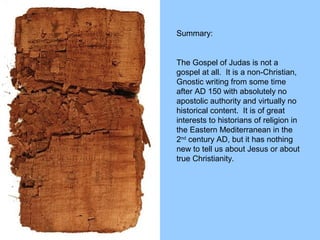
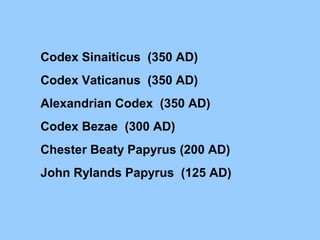
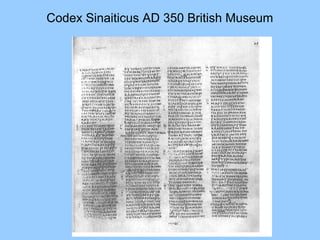
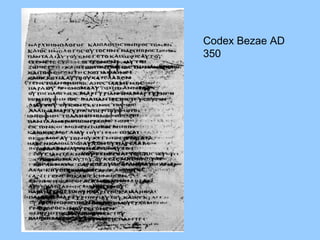
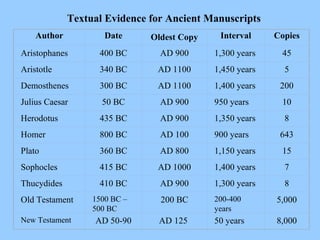
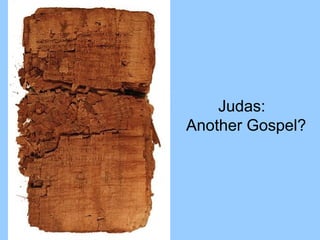
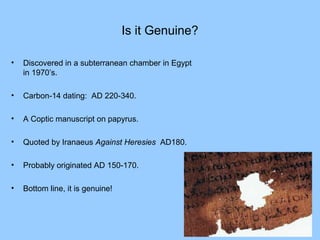
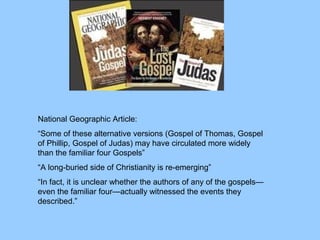
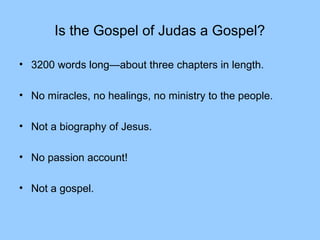
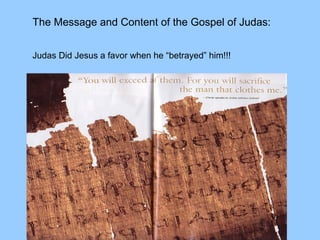
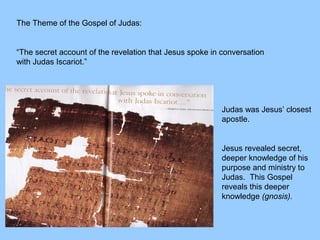
The document discusses the authenticity and historical significance of various gospels, particularly the Gospel of Judas, which is characterized as a non-Christian gnostic writing lacking apostolic authority. It contrasts the recognized four gospels with other gnostic texts, highlighting their absence of historical credibility and the consensus of early church authorities on the New Testament canon. The text emphasizes that the canonical gospels provide a literal historical account of Jesus, unlike the apocryphal gospels, which deviate from established Christian beliefs.


![Content (cont.)
• A bizarre Gnostic cosmology put into the mouth of Jesus
• “Come, that I may teach you about [secrets] no person [has]
seen…” (GJ, p. 47)
• 12 Aeons (gods?) (see on Gnosticism below).
• 72 heavens and 72 luminaries: six for each of the Aeons.
• 360 firmaments and 360 luminaries: five for each of the heavens.
• Characters such as Nebro, Yaldabaoth, Saklas, Galila, Yobel,
Adonaios, Seth. “The first is Seth, who is called Christ” (GJ p. 52)
Jesus is Seth, one of the five rulers of the underworld.](https://image.slidesharecdn.com/judashowwegotthebible-160425153918/85/Power-Point-How-We-Got-the-Bible-8-320.jpg)