If someone asked you, “Hey, what’s the
difference between the Catholic Bible and
non-Catholic Bible?”

Would you know how to answer that person?
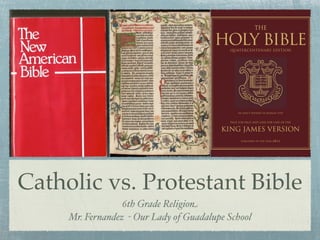
Catholic vs. Protestant Bible
                  6th Grade Religion
     Mr. Fernandez - Our Lady of Guadalupe School
Why does the Bible matter?
 Word of God

 History of Salvation

     Explains the history of how mankind was
     designed for a purpose and that we are
     not just things taking up space in the
     world

 Story about the God who creates because of
 love

 He constantly interacts with his people to
 bring them to the fullness of love

 Basic Instructions Before Leaving Earth

     Bible guides us on how we should live our
     lives on Earth before living with our
     Father in Heaven
Why does the Bible matter?
 He constantly interacts with his people to
 bring them to the fullness of love

 Basic Instructions Before Leaving Earth

     Bible guides us on how we should live
     our lives on Earth before living with our
     Father in Heaven

 Many traditions of the Catholic Church
 stems from the Bible

 Readings at Mass all come from the Bible

 New Roman Missal: “Lord, I am not worthy
 that you should enter under my roof, but
 only say the word and my soul shall be
 healed” (Mt 8:8 and Lk 7:6)
Blest Are We Textbook
At the beginning of your textbook,
turn to page viii and silently read the
page.

After you read p. viii, in your religion
notebook, answer the questions of the
What is Your Bible IQ? section on the
next page, p. ix.

When you’re done filling out the Bible
IQ Quiz, check the answers on p. xiv
and mark the ones you got wrong.

Next, p. x-xiv.
Catholic Bible = 73 Books
Protestant Bible = 66 Books
   How did that happen?
Vocab Words
Canon: general standard or rule

Septuagint: Greek Bible translated from Hebrew by about 70 translators; includes
the deuterocanonical books of the Bible

Deuterocanonical: “2nd canon,” includes the 7 books of the Bible: Tobit, Judith,
Baruch, Wisdom, Sirach, 1 Maccabees, 2 Maccabees

Apocrypha: what the Protestants call the 7 “hidden/uncertain” books of the Bible

Reformation: the religious movement in Europe started by Martin Luther, a
former Catholic priest against the Catholic Church

Protestant: people who PROTESTed against the traditions and teachings of the
Catholic Church; Christians who are not Catholic
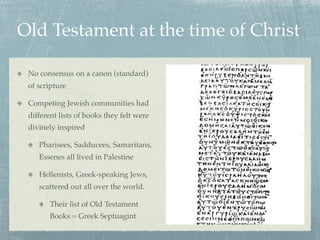
Old Testament at the time of Christ

 No consensus on a canon (standard)
 of scripture

 Competing Jewish communities had
 different lists of books they felt were
 divinely inspired

    Pharisees, Sadducees, Samaritans,
    Essenes all lived in Palestine

    Hellenists, Greek-speaking Jews,
    scattered out all over the world.

        Their list of Old Testament
        Books = Greek Septuagint
Old Testament at the time of Christ


 Christ, the Apostles, and the early Christians used the
 Septuagint as their primary Old Testament

 Of the approximately 300 Old Testament quotes in the New
 Testament, 2/3 of them are quotes from the Septuagint as
 opposed to the Hebrew Scriptures

 How do we know?
Hebrew Scripture vs. Greek
Septuagint
 Because the wording of the Septuagint is
 sometimes different from that of the Hebrew
 Bible.

 A classic example of this is Isaiah 7:14.

     In the original Hebrew it states that a
     young woman (Hebrew: almah) will bear a
     child and he shall be called Emmanuel.

     In the Greek Septuagint it states that a
     virgin (Greek: parthenos) will bear a child
     and he shall be called Emmanuel.

 Matthew the Apostle, under the inspiration of
 the Holy Spirit, chooses the Greek Septuagint
 version of this verse to quote in Matthew 1:23
 where he declares, “a virgin shall be with
 Child” in the Christmas story.
The Pharisees Call a Council
 When the Roman legions burned the Temple during the
 Jewish Wars in 70 A.D. much of the Jewish way of life lay in
 embers. Gone was the central unifying symbol of Judaism.

 Furthermore, the Christian faith was threatening Judaism as it
 was proclaiming that Jesus of Nazareth was the Jewish
 Messiah. The Old Testament Bible of the Christians was the
 Greek Septuagint and as such, the Jews grew increasingly
 dissatisfied with it because the early Christians were using
 the Septuagint to help spread the Church of Jesus Christ.
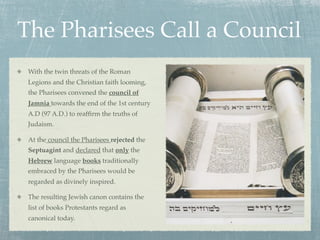
The Pharisees Call a Council
 With the twin threats of the Roman
 Legions and the Christian faith looming,
 the Pharisees convened the council of
 Jamnia towards the end of the 1st century
 A.D (97 A.D.) to reaffirm the truths of
 Judaism.

 At the council the Pharisees rejected the
 Septuagint and declared that only the
 Hebrew language books traditionally
 embraced by the Pharisees would be
 regarded as divinely inspired.

 The resulting Jewish canon contains the
 list of books Protestants regard as
 canonical today.
The Church Calls a Council

 In the early centuries there were controversies in the Church
 over what the New Testament canon should be.

 The Church finally settled the matter in various important
 meetings, especially in 3 local councils, or meetings.

   Council of Rome (382 A.D.)

   Council of Hippo (393 A.D.)

   Council of Carthage (397 A.D.)
The Church Calls a Council
 In these councils the Catholic Church authoritatively and infallibly declared
 what books are to be considered divinely inspired and authoritative.

    The 27 books that make up our New Testament were declared canonical
    in these councils. And as such the matter was considered closed. But the
    Church didn’t just list the New Testament books; she also listed the Old
    Testament books.

    And that list contained the Deutercanonical (2nd Canon) books found in
    Catholic Bibles today.

 It is ironic that the same councils Protestants point to as authoritative in
 settling the New Testament canon were also used by the Church to
 authoritatively settle the Old Testament canon.
The Reformation
Catholic: 73 Books

Protestant: 66 Books

  7 Books were taken out during Martin Luther’s
  Reformation

    Martin Luther was a former Catholic priest that
    protested against certain teachings/actions of the Roman
    Catholic Church; hence, that’s how PROTESTants came
    to be
7 Books Removed
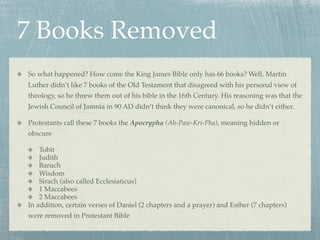
So what happened? How come the King James Bible only has 66 books? Well, Martin
Luther didn’t like 7 books of the Old Testament that disagreed with his personal view of
theology, so he threw them out of his bible in the 16th Century. His reasoning was that the
Jewish Council of Jamnia in 90 AD didn’t think they were canonical, so he didn’t either.

Protestants call these 7 books the Apocrypha (Ah-Paw-Kri-Pha), meaning hidden or
obscure

    Tobit
    Judith
    Baruch
    Wisdom
    Sirach (also called Ecclesiaticus)
    1 Maccabees
    2 Maccabees
In addition, certain verses of Daniel (2 chapters and a prayer) and Esther (7 chapters)
were removed in Protestant Bible
Protestant Argument Against
Catholic Bible
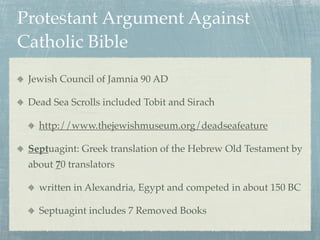
 Jewish Council of Jamnia 90 AD

 Dead Sea Scrolls included Tobit and Sirach

   http://www.thejewishmuseum.org/deadseafeature

 Septuagint: Greek translation of the Hebrew Old Testament by
 about 70 translators

   written in Alexandria, Egypt and competed in about 150 BC

   Septuagint includes 7 Removed Books
Protestant Argument Against
Catholic Bible
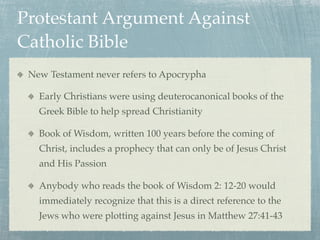
 New Testament never refers to Apocrypha

   Early Christians were using deuterocanonical books of the
   Greek Bible to help spread Christianity

   Book of Wisdom, written 100 years before the coming of
   Christ, includes a prophecy that can only be of Jesus Christ
   and His Passion

   Anybody who reads the book of Wisdom 2: 12-20 would
   immediately recognize that this is a direct reference to the
   Jews who were plotting against Jesus in Matthew 27:41-43
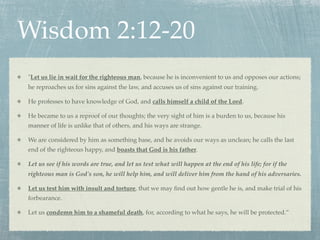
Wisdom 2:12-20
"Let us lie in wait for the righteous man, because he is inconvenient to us and opposes our actions;
he reproaches us for sins against the law, and accuses us of sins against our training.

He professes to have knowledge of God, and calls himself a child of the Lord.

He became to us a reproof of our thoughts; the very sight of him is a burden to us, because his
manner of life is unlike that of others, and his ways are strange.

We are considered by him as something base, and he avoids our ways as unclean; he calls the last
end of the righteous happy, and boasts that God is his father.

Let us see if his words are true, and let us test what will happen at the end of his life; for if the
righteous man is God's son, he will help him, and will deliver him from the hand of his adversaries.

Let us test him with insult and torture, that we may find out how gentle he is, and make trial of his
forbearance.

Let us condemn him to a shameful death, for, according to what he says, he will be protected.”
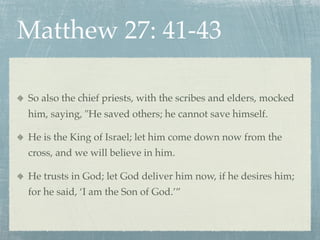
Matthew 27: 41-43

So also the chief priests, with the scribes and elders, mocked
him, saying, "He saved others; he cannot save himself.

He is the King of Israel; let him come down now from the
cross, and we will believe in him.

He trusts in God; let God deliver him now, if he desires him;
for he said, ‘I am the Son of God.’”
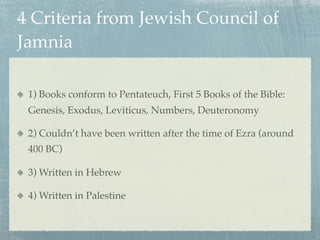
4 Criteria from Jewish Council of
Jamnia

 1) Books conform to Pentateuch, First 5 Books of the Bible:
 Genesis, Exodus, Leviticus, Numbers, Deuteronomy

 2) Couldn’t have been written after the time of Ezra (around
 400 BC)

 3) Written in Hebrew

 4) Written in Palestine
4 Criteria from Jewish Council of
Jamnia
 RULE: So this method employed by first century Jews would automatically
 exclude all of the Gospels, and the Epistles of the New Testament, which were
 also written in the first century.

 1) Books conform to Pentateuch, First 5 Books of the Bible: Genesis, Exodus,
 Leviticus, Numbers, Deuteronomy

 2) Couldn’t have been written after the time of Ezra (around 400 BC)

    some books written after this

 3) Written in Hebrew

    some written in Greek

 4) Written in Palestine
Summary
There is only one way we know whether a book is divinely inspired. And it
is not because a book claims to be inspired. It is not because Christ or the
Apostles quotes from it. It is not because we think we know who the author
is. It is not because the Holy Spirit has guided history to ensure a consensus
amongst Christians.

Rather, it is because the Church is the only entity with the authority to
define what the received books are.

Christ did not hand us a New Testament when he ascended to heaven. But
he did leave us a Church with a Magisterium to make decisions that are
binding on earth and also binding in heaven.

It is the Church that is the pillar and foundation of truth.

Catholic vs. Protestant Bible Slides

  • 1.
    If someone askedyou, “Hey, what’s the difference between the Catholic Bible and non-Catholic Bible?” Would you know how to answer that person?
  • 2.
    Catholic vs. ProtestantBible 6th Grade Religion Mr. Fernandez - Our Lady of Guadalupe School
  • 3.
    Why does theBible matter? Word of God History of Salvation Explains the history of how mankind was designed for a purpose and that we are not just things taking up space in the world Story about the God who creates because of love He constantly interacts with his people to bring them to the fullness of love Basic Instructions Before Leaving Earth Bible guides us on how we should live our lives on Earth before living with our Father in Heaven
  • 4.
    Why does theBible matter? He constantly interacts with his people to bring them to the fullness of love Basic Instructions Before Leaving Earth Bible guides us on how we should live our lives on Earth before living with our Father in Heaven Many traditions of the Catholic Church stems from the Bible Readings at Mass all come from the Bible New Roman Missal: “Lord, I am not worthy that you should enter under my roof, but only say the word and my soul shall be healed” (Mt 8:8 and Lk 7:6)
  • 5.
    Blest Are WeTextbook At the beginning of your textbook, turn to page viii and silently read the page. After you read p. viii, in your religion notebook, answer the questions of the What is Your Bible IQ? section on the next page, p. ix. When you’re done filling out the Bible IQ Quiz, check the answers on p. xiv and mark the ones you got wrong. Next, p. x-xiv.
  • 6.
    Catholic Bible =73 Books Protestant Bible = 66 Books How did that happen?
  • 7.
    Vocab Words Canon: generalstandard or rule Septuagint: Greek Bible translated from Hebrew by about 70 translators; includes the deuterocanonical books of the Bible Deuterocanonical: “2nd canon,” includes the 7 books of the Bible: Tobit, Judith, Baruch, Wisdom, Sirach, 1 Maccabees, 2 Maccabees Apocrypha: what the Protestants call the 7 “hidden/uncertain” books of the Bible Reformation: the religious movement in Europe started by Martin Luther, a former Catholic priest against the Catholic Church Protestant: people who PROTESTed against the traditions and teachings of the Catholic Church; Christians who are not Catholic
  • 8.
    Old Testament atthe time of Christ No consensus on a canon (standard) of scripture Competing Jewish communities had different lists of books they felt were divinely inspired Pharisees, Sadducees, Samaritans, Essenes all lived in Palestine Hellenists, Greek-speaking Jews, scattered out all over the world. Their list of Old Testament Books = Greek Septuagint
  • 9.
    Old Testament atthe time of Christ Christ, the Apostles, and the early Christians used the Septuagint as their primary Old Testament Of the approximately 300 Old Testament quotes in the New Testament, 2/3 of them are quotes from the Septuagint as opposed to the Hebrew Scriptures How do we know?
  • 10.
    Hebrew Scripture vs.Greek Septuagint Because the wording of the Septuagint is sometimes different from that of the Hebrew Bible. A classic example of this is Isaiah 7:14. In the original Hebrew it states that a young woman (Hebrew: almah) will bear a child and he shall be called Emmanuel. In the Greek Septuagint it states that a virgin (Greek: parthenos) will bear a child and he shall be called Emmanuel. Matthew the Apostle, under the inspiration of the Holy Spirit, chooses the Greek Septuagint version of this verse to quote in Matthew 1:23 where he declares, “a virgin shall be with Child” in the Christmas story.
  • 11.
    The Pharisees Calla Council When the Roman legions burned the Temple during the Jewish Wars in 70 A.D. much of the Jewish way of life lay in embers. Gone was the central unifying symbol of Judaism. Furthermore, the Christian faith was threatening Judaism as it was proclaiming that Jesus of Nazareth was the Jewish Messiah. The Old Testament Bible of the Christians was the Greek Septuagint and as such, the Jews grew increasingly dissatisfied with it because the early Christians were using the Septuagint to help spread the Church of Jesus Christ.
  • 12.
    The Pharisees Calla Council With the twin threats of the Roman Legions and the Christian faith looming, the Pharisees convened the council of Jamnia towards the end of the 1st century A.D (97 A.D.) to reaffirm the truths of Judaism. At the council the Pharisees rejected the Septuagint and declared that only the Hebrew language books traditionally embraced by the Pharisees would be regarded as divinely inspired. The resulting Jewish canon contains the list of books Protestants regard as canonical today.
  • 13.
    The Church Callsa Council In the early centuries there were controversies in the Church over what the New Testament canon should be. The Church finally settled the matter in various important meetings, especially in 3 local councils, or meetings. Council of Rome (382 A.D.) Council of Hippo (393 A.D.) Council of Carthage (397 A.D.)
  • 14.
    The Church Callsa Council In these councils the Catholic Church authoritatively and infallibly declared what books are to be considered divinely inspired and authoritative. The 27 books that make up our New Testament were declared canonical in these councils. And as such the matter was considered closed. But the Church didn’t just list the New Testament books; she also listed the Old Testament books. And that list contained the Deutercanonical (2nd Canon) books found in Catholic Bibles today. It is ironic that the same councils Protestants point to as authoritative in settling the New Testament canon were also used by the Church to authoritatively settle the Old Testament canon.
  • 15.
    The Reformation Catholic: 73Books Protestant: 66 Books 7 Books were taken out during Martin Luther’s Reformation Martin Luther was a former Catholic priest that protested against certain teachings/actions of the Roman Catholic Church; hence, that’s how PROTESTants came to be
  • 16.
    7 Books Removed Sowhat happened? How come the King James Bible only has 66 books? Well, Martin Luther didn’t like 7 books of the Old Testament that disagreed with his personal view of theology, so he threw them out of his bible in the 16th Century. His reasoning was that the Jewish Council of Jamnia in 90 AD didn’t think they were canonical, so he didn’t either. Protestants call these 7 books the Apocrypha (Ah-Paw-Kri-Pha), meaning hidden or obscure Tobit Judith Baruch Wisdom Sirach (also called Ecclesiaticus) 1 Maccabees 2 Maccabees In addition, certain verses of Daniel (2 chapters and a prayer) and Esther (7 chapters) were removed in Protestant Bible
  • 17.
    Protestant Argument Against CatholicBible Jewish Council of Jamnia 90 AD Dead Sea Scrolls included Tobit and Sirach http://www.thejewishmuseum.org/deadseafeature Septuagint: Greek translation of the Hebrew Old Testament by about 70 translators written in Alexandria, Egypt and competed in about 150 BC Septuagint includes 7 Removed Books
  • 18.
    Protestant Argument Against CatholicBible New Testament never refers to Apocrypha Early Christians were using deuterocanonical books of the Greek Bible to help spread Christianity Book of Wisdom, written 100 years before the coming of Christ, includes a prophecy that can only be of Jesus Christ and His Passion Anybody who reads the book of Wisdom 2: 12-20 would immediately recognize that this is a direct reference to the Jews who were plotting against Jesus in Matthew 27:41-43
  • 19.
    Wisdom 2:12-20 "Let uslie in wait for the righteous man, because he is inconvenient to us and opposes our actions; he reproaches us for sins against the law, and accuses us of sins against our training. He professes to have knowledge of God, and calls himself a child of the Lord. He became to us a reproof of our thoughts; the very sight of him is a burden to us, because his manner of life is unlike that of others, and his ways are strange. We are considered by him as something base, and he avoids our ways as unclean; he calls the last end of the righteous happy, and boasts that God is his father. Let us see if his words are true, and let us test what will happen at the end of his life; for if the righteous man is God's son, he will help him, and will deliver him from the hand of his adversaries. Let us test him with insult and torture, that we may find out how gentle he is, and make trial of his forbearance. Let us condemn him to a shameful death, for, according to what he says, he will be protected.”
  • 20.
    Matthew 27: 41-43 Soalso the chief priests, with the scribes and elders, mocked him, saying, "He saved others; he cannot save himself. He is the King of Israel; let him come down now from the cross, and we will believe in him. He trusts in God; let God deliver him now, if he desires him; for he said, ‘I am the Son of God.’”
  • 21.
    4 Criteria fromJewish Council of Jamnia 1) Books conform to Pentateuch, First 5 Books of the Bible: Genesis, Exodus, Leviticus, Numbers, Deuteronomy 2) Couldn’t have been written after the time of Ezra (around 400 BC) 3) Written in Hebrew 4) Written in Palestine
  • 22.
    4 Criteria fromJewish Council of Jamnia RULE: So this method employed by first century Jews would automatically exclude all of the Gospels, and the Epistles of the New Testament, which were also written in the first century. 1) Books conform to Pentateuch, First 5 Books of the Bible: Genesis, Exodus, Leviticus, Numbers, Deuteronomy 2) Couldn’t have been written after the time of Ezra (around 400 BC) some books written after this 3) Written in Hebrew some written in Greek 4) Written in Palestine
  • 23.
    Summary There is onlyone way we know whether a book is divinely inspired. And it is not because a book claims to be inspired. It is not because Christ or the Apostles quotes from it. It is not because we think we know who the author is. It is not because the Holy Spirit has guided history to ensure a consensus amongst Christians. Rather, it is because the Church is the only entity with the authority to define what the received books are. Christ did not hand us a New Testament when he ascended to heaven. But he did leave us a Church with a Magisterium to make decisions that are binding on earth and also binding in heaven. It is the Church that is the pillar and foundation of truth.