GMOs
The Unanticipated
Consequences
By Robert Biffis
GMO’s Threat On Society
GMOs threaten the integrity of
humankind and the environment as
they takeover our communities and
food supply.
Are GMOs A Solution To
World Hunger?
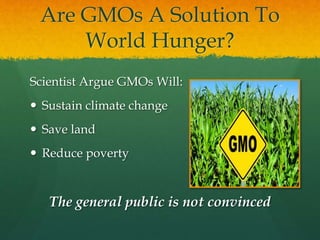
Scientist Argue GMOs Will:
 Sustain climate change
 Save land
 Reduce poverty
The general public is not convinced
GMO Is One Of The Most Rapid
Adoptions Of A New Technology
In early 1990s it was
rare to find GM
crops planted.
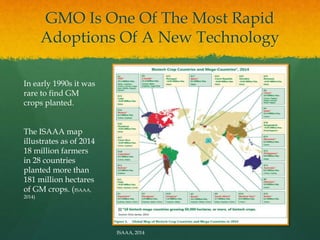
The ISAAA map
illustrates as of 2014
18 million farmers
in 28 countries
planted more than
181 million hectares
of GM crops. (ISAAA,
2014)
ISAAA, 2014
In Canada
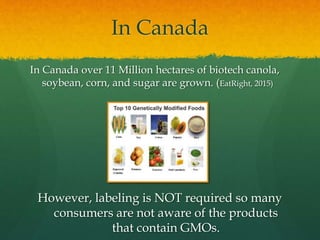
In Canada over 11 Million hectares of biotech canola,
soybean, corn, and sugar are grown. (EatRight, 2015)
However, labeling is NOT required so many
consumers are not aware of the products
that contain GMOs.
MONSANTO
Monsanto is a agricultural biotechnology
company and leading producer of genetically
engineered seed.
The company controls 80% of U.S. corn market
and 93% of U.S. soy market. (Mercolla, 2013)
MONSANTO HAS A HUGE CONTROL ON THE
WORLD’S FOOD SUPPLY
Why Are We All Being Fed
By A Poison Expert?
Click To Watch “The Undercurrent’s” video on
Monsanto
What Research Tells Us
Pesticides & Herbicides
Monsanto tells us GMOs decrease
the use of insecticides.
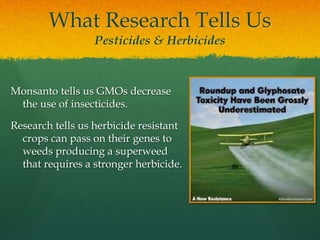
Research tells us herbicide resistant
crops can pass on their genes to
weeds producing a superweed
that requires a stronger herbicide.
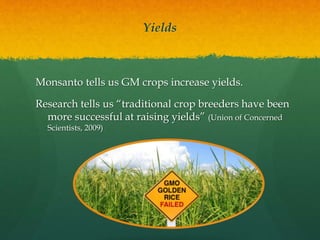
Yields
Monsanto tells us GM crops increase yields.
Research tells us “traditional crop breeders have been
more successful at raising yields” (Union of Concerned
Scientists, 2009)
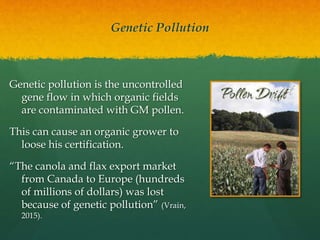
Genetic Pollution
Genetic pollution is the uncontrolled
gene flow in which organic fields
are contaminated with GM pollen.
This can cause an organic grower to
loose his certification.
“The canola and flax export market
from Canada to Europe (hundreds
of millions of dollars) was lost
because of genetic pollution” (Vrain,
2015).
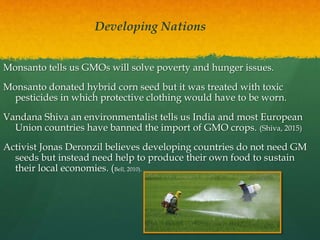
Monsanto tells us GMOs will solve poverty and hunger issues.
Monsanto donated hybrid corn seed but it was treated with toxic
pesticides in which protective clothing would have to be worn.
Vandana Shiva an environmentalist tells us India and most European
Union countries have banned the import of GMO crops. (Shiva, 2015)
Activist Jonas Deronzil believes developing countries do not need GM
seeds but instead need help to produce their own food to sustain
their local economies. (Bell, 2010).
Developing Nations
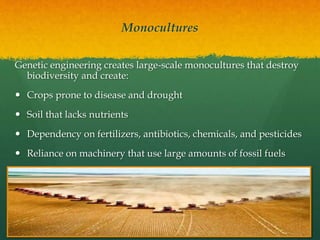
Monocultures
Genetic engineering creates large-scale monocultures that destroy
biodiversity and create:
 Crops prone to disease and drought
 Soil that lacks nutrients
 Dependency on fertilizers, antibiotics, chemicals, and pesticides
 Reliance on machinery that use large amounts of fossil fuels
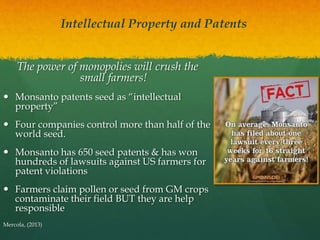
The power of monopolies will crush the
small farmers!
 Monsanto patents seed as “intellectual
property”
 Four companies control more than half of the
world seed.
 Monsanto has 650 seed patents & has won
hundreds of lawsuits against US farmers for
patent violations
 Farmers claim pollen or seed from GM crops
contaminate their field BUT they are help
responsible
Mercola, (2013)
Intellectual Property and Patents
Conflict Theory
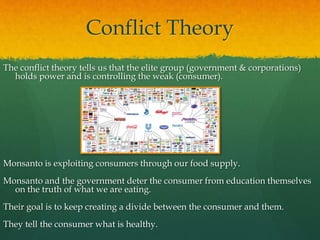
The conflict theory tells us that the elite group (government & corporations)
holds power and is controlling the weak (consumer).
Monsanto is exploiting consumers through our food supply.
Monsanto and the government deter the consumer from education themselves
on the truth of what we are eating.
Their goal is to keep creating a divide between the consumer and them.
They tell the consumer what is healthy.
GMO’s Affect On Society
 Are they safe?
 Increases use of toxic pesticides & herbicides
 Glyphosate shown to have negative impact on health
 Wreaks havoc with environment & wildlife
 Creates corporate monopolies
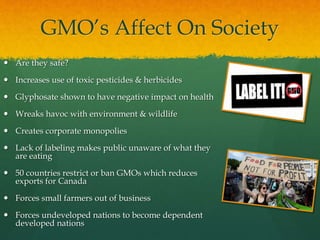
 Lack of labeling makes public unaware of what they
are eating
 50 countries restrict or ban GMOs which reduces
exports for Canada
 Forces small farmers out of business
 Forces undeveloped nations to become dependent
developed nations
No Single Solution
 Traditional farming techniques have proven
themselves for thousands of years
 Developing countries need freedom and tools to
produce sustainable yields
 Consumers globally should have the right to accept
or refuse GM food
 More research, not funded by GMO producers, is
needed
Dr. Mercola Reminds Us
Agriculture is a complete system that is inter-related
“Any time you change one part of that system, you change the
interaction of all the other components, because they work
together” (Mercola, 2013).
References
ISAAA. (2014). Global Status of Commercialized Biotech/GM Crops: 2014. Retrieved from
http://isaaa.org/resources/publications/briefs/49/executivesummary/default.asp
Bell, Beverly. (2010). Help Us Produce, Don’t Give Us Food. Retrieved from https://www.worldpulse.com/en/community/users/beverly-
bell/posts/12026
EatRight Ontario. (2015). Understanding Genetically Modified Foods. Retrieved From https://www.eatrightontario.ca/en/Articles/Food-
technology/Biotechnology/Novel-foods/Understanding-Genetically-Modified-Foods.aspx#.VcQCGc6DSJV
Mercola. (2013). Photographic Adventure Reveals the Frightening Deadness of Genetically Engineered Corn Field. Retrieved from
http://articles.mercola.com/sites/articles/archive/2013/01/01/bees-dying-from-chemical-agriculture.aspx
The Undercurrent. (2015). Why Are We All Being Fed By A Poison Expert? Retrieved from
https://www.youtube.com/watch?v=vYhNryOPSJ0
Union of Concerned Scientists. (2009). Failure To Yield: Biotechnology’s BrokenPromises. Retrieved from
http://www.ucsusa.org/sites/default/files/legacy/assets/documents/food_and_agriculture/failure-to-yield-brochure.pdf
Vrain, Thiery. (2015). Former Pro-GMO Scientist Speaks Out On The Real Dangers of Genetically Engineered Food. Retrieved from
http://www.globalresearch.ca/former-pro-gmo-scientist-speaks-out-on-the-real-dangers-of-genetically-engineered-food/5424010
Vandana Shiva. (2015). About Dr. Vandana Shiva. Retrieved from http://vandanashiva.com

Gmo presentation

  • 1.
  • 2.
    GMO’s Threat OnSociety GMOs threaten the integrity of humankind and the environment as they takeover our communities and food supply.
  • 3.
    Are GMOs ASolution To World Hunger? Scientist Argue GMOs Will:  Sustain climate change  Save land  Reduce poverty The general public is not convinced
  • 4.
    GMO Is OneOf The Most Rapid Adoptions Of A New Technology In early 1990s it was rare to find GM crops planted. The ISAAA map illustrates as of 2014 18 million farmers in 28 countries planted more than 181 million hectares of GM crops. (ISAAA, 2014) ISAAA, 2014
  • 5.
    In Canada In Canadaover 11 Million hectares of biotech canola, soybean, corn, and sugar are grown. (EatRight, 2015) However, labeling is NOT required so many consumers are not aware of the products that contain GMOs.
  • 6.
    MONSANTO Monsanto is aagricultural biotechnology company and leading producer of genetically engineered seed. The company controls 80% of U.S. corn market and 93% of U.S. soy market. (Mercolla, 2013) MONSANTO HAS A HUGE CONTROL ON THE WORLD’S FOOD SUPPLY
  • 7.
    Why Are WeAll Being Fed By A Poison Expert? Click To Watch “The Undercurrent’s” video on Monsanto
  • 8.
    What Research TellsUs Pesticides & Herbicides Monsanto tells us GMOs decrease the use of insecticides. Research tells us herbicide resistant crops can pass on their genes to weeds producing a superweed that requires a stronger herbicide.
  • 9.
    Yields Monsanto tells usGM crops increase yields. Research tells us “traditional crop breeders have been more successful at raising yields” (Union of Concerned Scientists, 2009)
  • 10.
    Genetic Pollution Genetic pollutionis the uncontrolled gene flow in which organic fields are contaminated with GM pollen. This can cause an organic grower to loose his certification. “The canola and flax export market from Canada to Europe (hundreds of millions of dollars) was lost because of genetic pollution” (Vrain, 2015).
  • 11.
    Monsanto tells usGMOs will solve poverty and hunger issues. Monsanto donated hybrid corn seed but it was treated with toxic pesticides in which protective clothing would have to be worn. Vandana Shiva an environmentalist tells us India and most European Union countries have banned the import of GMO crops. (Shiva, 2015) Activist Jonas Deronzil believes developing countries do not need GM seeds but instead need help to produce their own food to sustain their local economies. (Bell, 2010). Developing Nations
  • 12.
    Monocultures Genetic engineering createslarge-scale monocultures that destroy biodiversity and create:  Crops prone to disease and drought  Soil that lacks nutrients  Dependency on fertilizers, antibiotics, chemicals, and pesticides  Reliance on machinery that use large amounts of fossil fuels
  • 13.
    The power ofmonopolies will crush the small farmers!  Monsanto patents seed as “intellectual property”  Four companies control more than half of the world seed.  Monsanto has 650 seed patents & has won hundreds of lawsuits against US farmers for patent violations  Farmers claim pollen or seed from GM crops contaminate their field BUT they are help responsible Mercola, (2013) Intellectual Property and Patents
  • 14.
    Conflict Theory The conflicttheory tells us that the elite group (government & corporations) holds power and is controlling the weak (consumer). Monsanto is exploiting consumers through our food supply. Monsanto and the government deter the consumer from education themselves on the truth of what we are eating. Their goal is to keep creating a divide between the consumer and them. They tell the consumer what is healthy.
  • 15.
    GMO’s Affect OnSociety  Are they safe?  Increases use of toxic pesticides & herbicides  Glyphosate shown to have negative impact on health  Wreaks havoc with environment & wildlife  Creates corporate monopolies  Lack of labeling makes public unaware of what they are eating  50 countries restrict or ban GMOs which reduces exports for Canada  Forces small farmers out of business  Forces undeveloped nations to become dependent developed nations
  • 16.
    No Single Solution Traditional farming techniques have proven themselves for thousands of years  Developing countries need freedom and tools to produce sustainable yields  Consumers globally should have the right to accept or refuse GM food  More research, not funded by GMO producers, is needed
  • 17.
    Dr. Mercola RemindsUs Agriculture is a complete system that is inter-related “Any time you change one part of that system, you change the interaction of all the other components, because they work together” (Mercola, 2013).
  • 18.
    References ISAAA. (2014). GlobalStatus of Commercialized Biotech/GM Crops: 2014. Retrieved from http://isaaa.org/resources/publications/briefs/49/executivesummary/default.asp Bell, Beverly. (2010). Help Us Produce, Don’t Give Us Food. Retrieved from https://www.worldpulse.com/en/community/users/beverly- bell/posts/12026 EatRight Ontario. (2015). Understanding Genetically Modified Foods. Retrieved From https://www.eatrightontario.ca/en/Articles/Food- technology/Biotechnology/Novel-foods/Understanding-Genetically-Modified-Foods.aspx#.VcQCGc6DSJV Mercola. (2013). Photographic Adventure Reveals the Frightening Deadness of Genetically Engineered Corn Field. Retrieved from http://articles.mercola.com/sites/articles/archive/2013/01/01/bees-dying-from-chemical-agriculture.aspx The Undercurrent. (2015). Why Are We All Being Fed By A Poison Expert? Retrieved from https://www.youtube.com/watch?v=vYhNryOPSJ0 Union of Concerned Scientists. (2009). Failure To Yield: Biotechnology’s BrokenPromises. Retrieved from http://www.ucsusa.org/sites/default/files/legacy/assets/documents/food_and_agriculture/failure-to-yield-brochure.pdf Vrain, Thiery. (2015). Former Pro-GMO Scientist Speaks Out On The Real Dangers of Genetically Engineered Food. Retrieved from http://www.globalresearch.ca/former-pro-gmo-scientist-speaks-out-on-the-real-dangers-of-genetically-engineered-food/5424010 Vandana Shiva. (2015). About Dr. Vandana Shiva. Retrieved from http://vandanashiva.com

Editor's Notes

  • #4 Picture: http://rinf.com/alt-news/sicence-technology/food-fascists-gmo-pesticide-manufacturers-dirty-2/
  • #5 Picture -   ISAAA. (2014). Global Status of Commercialized Biotech/GM Crops: 2014. Retrieved from http://isaaa.org/resources/publications/briefs/49/executivesummary/default.asp
  • #6 Picture - https://sites.google.com/a/opotikicol.school.nz/jenny-mays-learning-larder/home/genetically-modified-food
  • #7 Picture - http://www.elcondorsa.com
  • #8 Video: The Undercurrent. (2015). Why Are We All Being Fed By A Poison Expert? Retrieved from https://www.youtube.com/watch?v=vYhNryOPSJ0
  • #9 Picture - https://www.pinterest.com/ergogenics/say-no-to-gmos/
  • #10 Picture - http://www.gmwatch.org/news/latest-news/16503
  • #11 Picture - http://digitalcommons.law.uga.edu/cgi/viewcontent.cgi?article=1018&context=advocate
  • #12 Picture - https://gmoeffects.wikispaces.com/Advantages+and+Disadvantages+of+GMOs
  • #13 Picture - http://www.livegreenbegreen.com/tag/monoculture/
  • #14 Picture - https://www.pinterest.com/jimjimzen/say-no-to-gmos/
  • #15 Picture - http://themostimportantnews.com/archives/tag/food-supply
  • #16 Picture - http://www.ctvnews.ca/canada/anti-gmo-protesters-rally-against-monsanto-1.2388102 Picture - http://www.offthegridnews.com/how-to-2/gmo-food-labeling-campaign-must-compete-against-grocery-manufacturers-association/
  • #18 Picture - http://theunhivedmind.com/wordpress3/irrefutable-evidence-that-gmo-can-harm-you/