GMOGenetically modified organismGenetically Modified Organism
          Camarines Norte State College                        Daet, Camarines NorteSubmitted By:Jovelle J. Bucal              BSED 1-CSubmitted to:Ms. Katrina Pobre
Genetically Modified Organism  Genetically modified organism (GMO) or genetically engineered organism (GEO) is an organism whose genetic material has been alter using genetic engineering techniques. These techniques, generally known as recombinant DNA. Technology, use DNA molecules from different source, which are combined into one molecule to create a new set of genes. This DNA is then transferred into an organism, giving it modified or novel genes.
G.M.O.ADVANTAGES
Advantages: In 1986, field test of bacteria genetically engineered to protect plants from frost damage. (ice-minus bacteria) at a small biotechnology company called Advanced Genetic Science of Oakland, California.
 They are used in biological and medical research, production of pharmaceutical drugs , experimental medicine (gene therapy) and agriculture (golden rice).Advantages: Patent- protected food crops which are resistant to commercial herbicides  or are able to produce pesticides proteins from within the plant, or stacked trait seeds, which do both.
 In 2007, Monsanto’s trait technologies were planted on 246 million acres ( 1,000,000 km2) throughout  the world, a growth of 13 percent from 2006.Advantages: In the corn market, Monsanto’s triple-stack corn which combines Roundup Ready 2 weed control technology with YieldGard Corn Borer and YieldGard Rootworm insect control.
 Transgenic animals are also becoming useful commercially.
 More informed customers, because they need to make more informed decisions in regard to nutrition, agriculture and science.Advantages:Less pesticide is needed to be used due to insect pest resistant plants.
More economically friendly as pesticides do not go into the air, soil, and water (especially freshwater supplies). Their production hazards to the environment also decreases.
Decrease in costs of growing and farming, due to the reduced use of pesticides.
Higher crop yields.
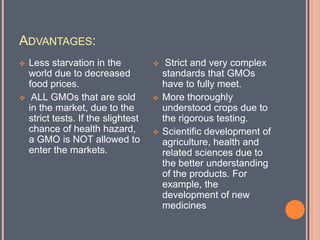
 Farmers have more income, which they could spend on such things as, for example, the education of their children.Advantages:Less starvation in the world due to decreased food prices.
 ALL GMOs that are sold in the market, due to the strict tests. If the slightest chance of health hazard, a GMO is NOT allowed to enter the markets.
 Strict and very complex standards that GMOs have to fully meet.
More thoroughly understood crops due to the rigorous testing.
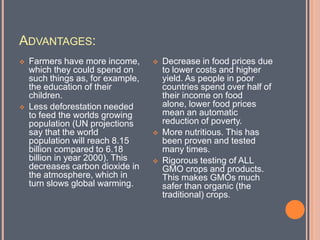
Scientific development of agriculture, health and related sciences due to the better understanding of the products. For example, the development of new medicinesAdvantages:Farmers have more income, which they could spend on such things as, for example, the education of their children.
Less deforestation needed to feed the worlds growing population (UN projections say that the world population will reach 8.15 billion compared to 6.18 billion in year 2000). This decreases carbon dioxide in the atmosphere, which in turn slows global warming.
Decrease in food prices due to lower costs and higher yield. As people in poor countries spend over half of their income on food alone, lower food prices mean an automatic reduction of poverty.
More nutritious. This has been proven and tested many times.
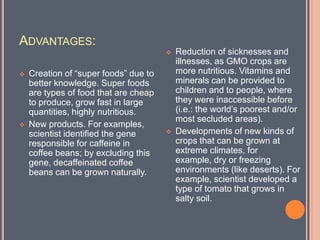
Rigorous testing of ALL GMO crops and products. This makes GMOs much safer than organic (the traditional) crops.Advantages:Creation of “super foods” due to better knowledge. Super foods are types of food that are cheap to produce, grow fast in large quantities, highly nutritious.
New products. For examples, scientist identified the gene responsible for caffeine in coffee beans; by excluding this gene, decaffeinated coffee beans can be grown naturally.
Reduction of sicknesses and illnesses, as GMO crops are more nutritious. Vitamins and minerals can be provided to children and to people, where they were inaccessible before (i.e.: the world’s poorest and/or most secluded areas).
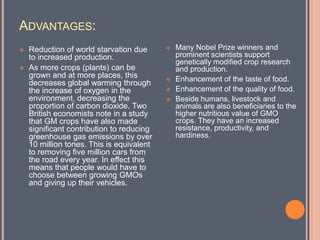
Developments of new kinds of crops that can be grown at extreme climates, for example, dry or freezing environments (like deserts). For example, scientist developed a type of tomato that grows in salty soil.Advantages:Reduction of world starvation due to increased production.
As more crops (plants) can be grown and at more places, this decreases global warming through the increase of oxygen in the environment, decreasing the proportion of carbon dioxide. Two British economists note in a study that GM crops have also made significant contribution to reducing greenhouse gas emissions by over 10 million tones. This is equivalent to removing five million cars from the road every year. In effect this means that people would have to choose between growing GMOs and giving up their vehicles.

G.M.O. project

  • 1.
  • 3.
    Camarines Norte State College Daet, Camarines NorteSubmitted By:Jovelle J. Bucal BSED 1-CSubmitted to:Ms. Katrina Pobre
  • 4.
    Genetically Modified Organism Genetically modified organism (GMO) or genetically engineered organism (GEO) is an organism whose genetic material has been alter using genetic engineering techniques. These techniques, generally known as recombinant DNA. Technology, use DNA molecules from different source, which are combined into one molecule to create a new set of genes. This DNA is then transferred into an organism, giving it modified or novel genes.
  • 5.
  • 6.
    Advantages: In 1986,field test of bacteria genetically engineered to protect plants from frost damage. (ice-minus bacteria) at a small biotechnology company called Advanced Genetic Science of Oakland, California.
  • 7.
    They areused in biological and medical research, production of pharmaceutical drugs , experimental medicine (gene therapy) and agriculture (golden rice).Advantages: Patent- protected food crops which are resistant to commercial herbicides or are able to produce pesticides proteins from within the plant, or stacked trait seeds, which do both.
  • 8.
    In 2007,Monsanto’s trait technologies were planted on 246 million acres ( 1,000,000 km2) throughout the world, a growth of 13 percent from 2006.Advantages: In the corn market, Monsanto’s triple-stack corn which combines Roundup Ready 2 weed control technology with YieldGard Corn Borer and YieldGard Rootworm insect control.
  • 9.
    Transgenic animalsare also becoming useful commercially.
  • 10.
    More informedcustomers, because they need to make more informed decisions in regard to nutrition, agriculture and science.Advantages:Less pesticide is needed to be used due to insect pest resistant plants.
  • 11.
    More economically friendlyas pesticides do not go into the air, soil, and water (especially freshwater supplies). Their production hazards to the environment also decreases.
  • 12.
    Decrease in costsof growing and farming, due to the reduced use of pesticides.
  • 13.
  • 14.
    Farmers havemore income, which they could spend on such things as, for example, the education of their children.Advantages:Less starvation in the world due to decreased food prices.
  • 15.
    ALL GMOsthat are sold in the market, due to the strict tests. If the slightest chance of health hazard, a GMO is NOT allowed to enter the markets.
  • 16.
    Strict andvery complex standards that GMOs have to fully meet.
  • 17.
    More thoroughly understoodcrops due to the rigorous testing.
  • 18.
    Scientific development ofagriculture, health and related sciences due to the better understanding of the products. For example, the development of new medicinesAdvantages:Farmers have more income, which they could spend on such things as, for example, the education of their children.
  • 19.
    Less deforestation neededto feed the worlds growing population (UN projections say that the world population will reach 8.15 billion compared to 6.18 billion in year 2000). This decreases carbon dioxide in the atmosphere, which in turn slows global warming.
  • 20.
    Decrease in foodprices due to lower costs and higher yield. As people in poor countries spend over half of their income on food alone, lower food prices mean an automatic reduction of poverty.
  • 21.
    More nutritious. Thishas been proven and tested many times.
  • 22.
    Rigorous testing ofALL GMO crops and products. This makes GMOs much safer than organic (the traditional) crops.Advantages:Creation of “super foods” due to better knowledge. Super foods are types of food that are cheap to produce, grow fast in large quantities, highly nutritious.
  • 23.
    New products. Forexamples, scientist identified the gene responsible for caffeine in coffee beans; by excluding this gene, decaffeinated coffee beans can be grown naturally.
  • 24.
    Reduction of sicknessesand illnesses, as GMO crops are more nutritious. Vitamins and minerals can be provided to children and to people, where they were inaccessible before (i.e.: the world’s poorest and/or most secluded areas).
  • 25.
    Developments of newkinds of crops that can be grown at extreme climates, for example, dry or freezing environments (like deserts). For example, scientist developed a type of tomato that grows in salty soil.Advantages:Reduction of world starvation due to increased production.
  • 26.
    As more crops(plants) can be grown and at more places, this decreases global warming through the increase of oxygen in the environment, decreasing the proportion of carbon dioxide. Two British economists note in a study that GM crops have also made significant contribution to reducing greenhouse gas emissions by over 10 million tones. This is equivalent to removing five million cars from the road every year. In effect this means that people would have to choose between growing GMOs and giving up their vehicles.