Glycemic Control in Diabetic
Kidney Disease
Dr. Pranay Giripunje 3rd
year PGT
CASE SCENARIO
 A 60-year-old patient male with CKD stage G4, multiple macrovascular
complications, several comorbidities, and impaired hypoglycemia
awareness visits the clinic. The patient has a short life expectancy and
limited access to hypoglycemia management resources. Based on this
scenario, what should the target HbA1c level for this patient be?
Options
A. Less than 6.5%
B. Less than 7.0%
C. Less than 7.5%
D. Less than 8.0%
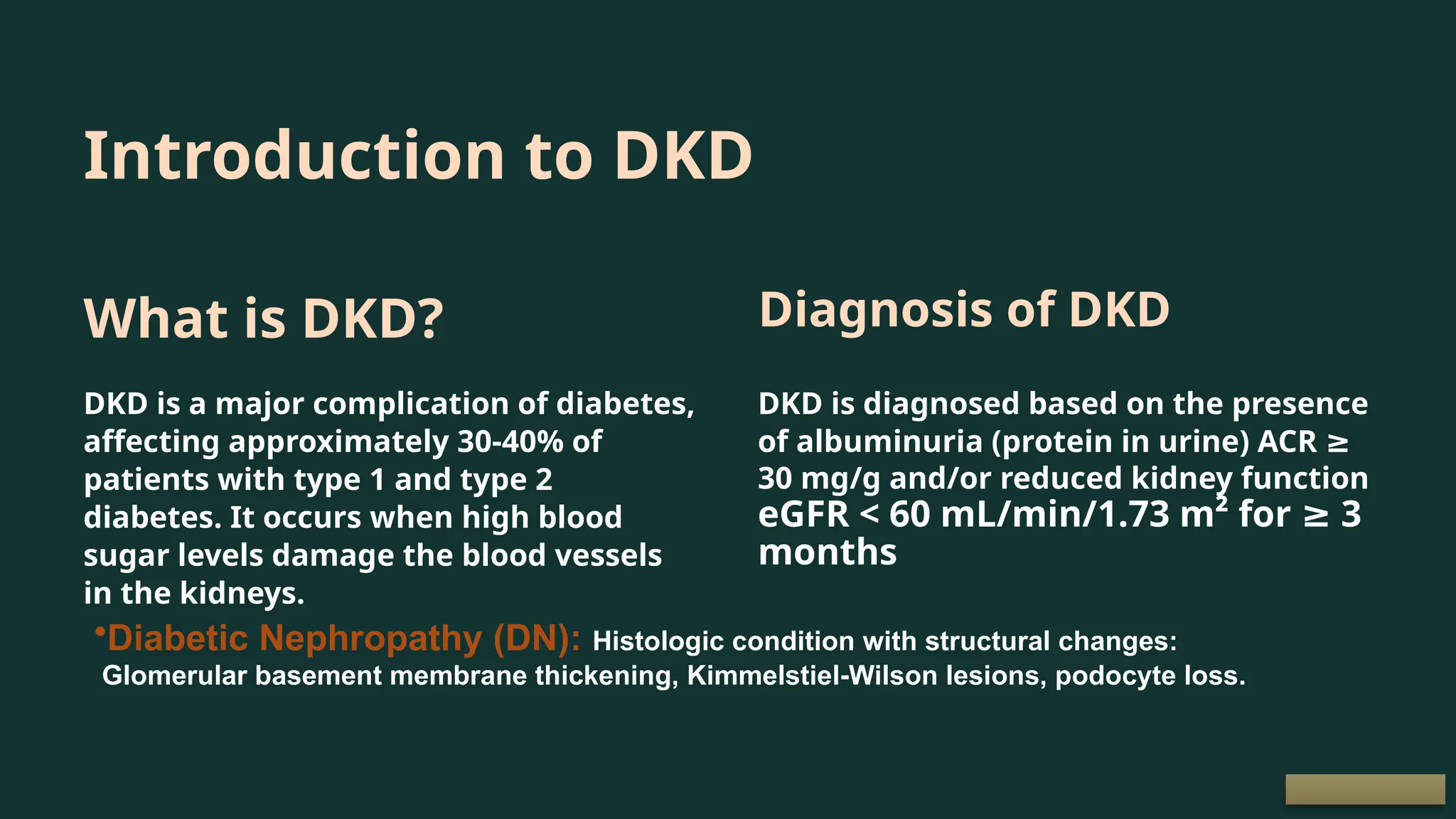
Introduction to DKD
What is DKD?
DKD is a major complication of diabetes,
affecting approximately 30-40% of
patients with type 1 and type 2
diabetes. It occurs when high blood
sugar levels damage the blood vessels
in the kidneys.
Diagnosis of DKD
DKD is diagnosed based on the presence
of albuminuria (protein in urine) ACR ≥
30 mg/g and/or reduced kidney function
eGFR < 60 mL/min/1.73 m² for 3
≥
months
•Diabetic Nephropathy (DN): Histologic condition with structural changes:
Glomerular basement membrane thickening, Kimmelstiel-Wilson lesions, podocyte loss.
Epidemiology of DKD
•Global Diabetes Trends (IDF):
•Prevalence expected to reach 700 million by 2045
•90–95% of newly diagnosed diabetes patients will eventually develop CKD.
•India – The Diabetes Capital:
•Thrifty gene hypothesis: Insulin resistance, higher inflammation.
•CKD and ESRD prevalence higher in rural areas (800/million and
150–200/million, respectively)
•Regional Data:
•Asia: 434.3 million adults with CKD (140.2 million in India)
Pathophysiology of Hyperglycemia in DKD
1
Hyperglycemia
Sustained high blood sugar levels trigger a cascade
of events that damage the kidneys.
2 Hyperfiltration
Hyperglycemia leads to increased pressure in the
glomeruli, resulting in overfiltration of blood,
damaging the delicate structures of the kidneys.
3
Oxidative Stress
High blood sugar levels create oxidative stress,
damaging the cells and tissues of the kidneys,
leading to inflammation and scarring. 4 Podocyte Injury
Oxidative stress and inflammation directly damage
podocytes, the cells that protect the glomeruli,
leading to protein leakage.
5
Nephron Loss
As the damage progresses, nephrons, the
functional units of the kidneys, are lost, leading to
progressive kidney failure.
Glycemic Control – Goals and Importance
• Why Glycemic Control?
• Reduces mortality and microvascular complications
• Helps prevent CKD progression and onset of albuminuria
• HbA1c Targets:
• General target: <7% (varies by stage and risk factors)
• CKD Stage 4/5: Adjusted for risks of hypoglycaemia
• Challenges in CKD Patients:
• Altered insulin clearance Risk of hypoglycaemia
→
• Analytical limitations of HbA1c due to uremia and ESA use
CASE SCENARIO
 A 60-year-old patient male with CKD stage G4, multiple macrovascular
complications, several comorbidities, and impaired hypoglycemia
awareness visits the clinic. The patient has a short life expectancy and
limited access to hypoglycemia management resources. Based on this
scenario, what should the target HbA1c level for this patient be?
Options
A. Less than 6.5%
B. Less than 7.0%
C. Less than 7.5%
D. Less than 8.0%
Limitations of Glycemic Markers in CKD
•HbA1c Variability:
•False elevations: Carbamylated hemoglobin (urea influence)
•Altered red cell turnover from ESAs(erythropoiesis-stimulating agents) or
anemia or blood transfusion.
•Alternatives:
•Glycated albumin or fructosamine (limited by proteinuria, peritoneal dialysis)
•Reliance on glucose monitoring (fingersticks, CGM)
Evidence from Landmark Trials
1
DCCT (diabetes control and complication trial) and EDIC (epidemiology of diabetes interven
and complication)
These studies in type 1 diabetes demonstrated that intensive glycemic control reduces the
risk of microvascular complications, including DKD.
2
UKPDS (united kingdom prospective study)
This study in type 2 diabetes showed that intensive glycemic control prevents
the development of albuminuria and slows the progression of CKD.
3
ACCORD (action to control cardiovascular risk in diabetes)
This trial indicated that aggressive glycemic control
(HbA1c < 6%) may increase mortality in patients with
advanced CKD and comorbidities.
Personalized Glycemic Management
1 Risk Assessment
2 Individualized Targets
3 Lifestyle Modifications
4 Pharmacotherapy
5 Monitoring and Adjustments
Management Strategies in CKD
Management Strategies in Non-
Dialysis CKD
•CKD Stage 4 (eGFR 15–29 mL/min):
•Preferred agents: GLP-1 RAs (cardio-renal benefits, minimal
hypoglycemia risk)
•Alternatives: Sulfonylureas (low hypoglycemia risk), DPP-4
inhibitors.
•CKD Stage 5 (eGFR <15 mL/min):
•Sulfonylureas with inactive metabolites
•Insulin therapy as renal clearance decreases
Glycaemic Management in Haemodialysis
•Challenges in Hemodialysis Patients:
•Impaired insulin clearance → Prolonged insulin action
•Therapeutic Options:
•Insulin analogs (e.g., insulin detemir, insulin degludec)
maintain pharmacokinetics
•DPP-4 inhibitors, thiazolidinediones, alpha-glucosidase
inhibitors
Glycemic Management in Peritoneal
Dialysis
•Therapy Selection:
•Continue oral agents in patient with good glycaemic control on OHA effective
pre-dialysis
•Avoid metformin (lactic acidosis risk)
•Transition to insulin over time.
•Subcutaneous Insulin is Preferred in patients on continuous ambulatory
peritoneal dialysis (CAPD) or continuous cycler peritoneal dialysis.
•Intraperitoneal insulin is often not used as it usually does not adequately
control blood sugar.
Key Outcome Metrics in DKD
1. Albuminuria Progression:
1. Surrogate marker for kidney health and therapeutic effectiveness.
2. Serum Creatinine/GFR Changes:
1. Early markers of CKD progression.
3. ESRD Development or Mortality:
1. Primary endpoint in reno-protective clinical trials.
THANK YOU

Glycemic Control inDiabetic Kidney Disease.pptx

  • 1.
    Glycemic Control inDiabetic Kidney Disease Dr. Pranay Giripunje 3rd year PGT
  • 2.
    CASE SCENARIO  A60-year-old patient male with CKD stage G4, multiple macrovascular complications, several comorbidities, and impaired hypoglycemia awareness visits the clinic. The patient has a short life expectancy and limited access to hypoglycemia management resources. Based on this scenario, what should the target HbA1c level for this patient be? Options A. Less than 6.5% B. Less than 7.0% C. Less than 7.5% D. Less than 8.0%
  • 3.
    Introduction to DKD Whatis DKD? DKD is a major complication of diabetes, affecting approximately 30-40% of patients with type 1 and type 2 diabetes. It occurs when high blood sugar levels damage the blood vessels in the kidneys. Diagnosis of DKD DKD is diagnosed based on the presence of albuminuria (protein in urine) ACR ≥ 30 mg/g and/or reduced kidney function eGFR < 60 mL/min/1.73 m² for 3 ≥ months •Diabetic Nephropathy (DN): Histologic condition with structural changes: Glomerular basement membrane thickening, Kimmelstiel-Wilson lesions, podocyte loss.
  • 4.
    Epidemiology of DKD •GlobalDiabetes Trends (IDF): •Prevalence expected to reach 700 million by 2045 •90–95% of newly diagnosed diabetes patients will eventually develop CKD. •India – The Diabetes Capital: •Thrifty gene hypothesis: Insulin resistance, higher inflammation. •CKD and ESRD prevalence higher in rural areas (800/million and 150–200/million, respectively) •Regional Data: •Asia: 434.3 million adults with CKD (140.2 million in India)
  • 5.
    Pathophysiology of Hyperglycemiain DKD 1 Hyperglycemia Sustained high blood sugar levels trigger a cascade of events that damage the kidneys. 2 Hyperfiltration Hyperglycemia leads to increased pressure in the glomeruli, resulting in overfiltration of blood, damaging the delicate structures of the kidneys. 3 Oxidative Stress High blood sugar levels create oxidative stress, damaging the cells and tissues of the kidneys, leading to inflammation and scarring. 4 Podocyte Injury Oxidative stress and inflammation directly damage podocytes, the cells that protect the glomeruli, leading to protein leakage. 5 Nephron Loss As the damage progresses, nephrons, the functional units of the kidneys, are lost, leading to progressive kidney failure.
  • 7.
    Glycemic Control –Goals and Importance • Why Glycemic Control? • Reduces mortality and microvascular complications • Helps prevent CKD progression and onset of albuminuria • HbA1c Targets: • General target: <7% (varies by stage and risk factors) • CKD Stage 4/5: Adjusted for risks of hypoglycaemia • Challenges in CKD Patients: • Altered insulin clearance Risk of hypoglycaemia → • Analytical limitations of HbA1c due to uremia and ESA use
  • 8.
    CASE SCENARIO  A60-year-old patient male with CKD stage G4, multiple macrovascular complications, several comorbidities, and impaired hypoglycemia awareness visits the clinic. The patient has a short life expectancy and limited access to hypoglycemia management resources. Based on this scenario, what should the target HbA1c level for this patient be? Options A. Less than 6.5% B. Less than 7.0% C. Less than 7.5% D. Less than 8.0%
  • 9.
    Limitations of GlycemicMarkers in CKD •HbA1c Variability: •False elevations: Carbamylated hemoglobin (urea influence) •Altered red cell turnover from ESAs(erythropoiesis-stimulating agents) or anemia or blood transfusion. •Alternatives: •Glycated albumin or fructosamine (limited by proteinuria, peritoneal dialysis) •Reliance on glucose monitoring (fingersticks, CGM)
  • 10.
    Evidence from LandmarkTrials 1 DCCT (diabetes control and complication trial) and EDIC (epidemiology of diabetes interven and complication) These studies in type 1 diabetes demonstrated that intensive glycemic control reduces the risk of microvascular complications, including DKD. 2 UKPDS (united kingdom prospective study) This study in type 2 diabetes showed that intensive glycemic control prevents the development of albuminuria and slows the progression of CKD. 3 ACCORD (action to control cardiovascular risk in diabetes) This trial indicated that aggressive glycemic control (HbA1c < 6%) may increase mortality in patients with advanced CKD and comorbidities.
  • 12.
    Personalized Glycemic Management 1Risk Assessment 2 Individualized Targets 3 Lifestyle Modifications 4 Pharmacotherapy 5 Monitoring and Adjustments
  • 13.
  • 16.
    Management Strategies inNon- Dialysis CKD •CKD Stage 4 (eGFR 15–29 mL/min): •Preferred agents: GLP-1 RAs (cardio-renal benefits, minimal hypoglycemia risk) •Alternatives: Sulfonylureas (low hypoglycemia risk), DPP-4 inhibitors. •CKD Stage 5 (eGFR <15 mL/min): •Sulfonylureas with inactive metabolites •Insulin therapy as renal clearance decreases
  • 17.
    Glycaemic Management inHaemodialysis •Challenges in Hemodialysis Patients: •Impaired insulin clearance → Prolonged insulin action •Therapeutic Options: •Insulin analogs (e.g., insulin detemir, insulin degludec) maintain pharmacokinetics •DPP-4 inhibitors, thiazolidinediones, alpha-glucosidase inhibitors
  • 18.
    Glycemic Management inPeritoneal Dialysis •Therapy Selection: •Continue oral agents in patient with good glycaemic control on OHA effective pre-dialysis •Avoid metformin (lactic acidosis risk) •Transition to insulin over time. •Subcutaneous Insulin is Preferred in patients on continuous ambulatory peritoneal dialysis (CAPD) or continuous cycler peritoneal dialysis. •Intraperitoneal insulin is often not used as it usually does not adequately control blood sugar.
  • 19.
    Key Outcome Metricsin DKD 1. Albuminuria Progression: 1. Surrogate marker for kidney health and therapeutic effectiveness. 2. Serum Creatinine/GFR Changes: 1. Early markers of CKD progression. 3. ESRD Development or Mortality: 1. Primary endpoint in reno-protective clinical trials.
  • 20.