Gluten
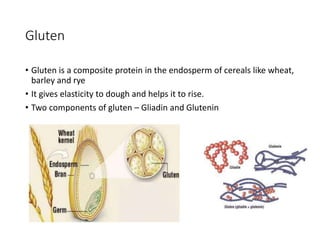
• Gluten is a composite protein in the endosperm of cereals like wheat,
barley and rye
• It gives elasticity to dough and helps it to rise.
• Two components of gluten – Gliadin and Glutenin
Background
• Earliest description came in 1980s when Holmes described Gluten
sensitivity diarrhea without evidence of celiac disease.
• Total number of publications related to this before 1990 were 125
and within last 25 year risen up to around 900.
• Accumulating evidence led to a conclusion that a group of patients
existed who were not fitting in definition of celiac disease but
responded to gluten restriction
• London 2011 meet - panel of 15 experts was convened – for
classification and nomenclature gluten related disorders.
Definition
• Since the term ‘Gluten sensitivity’ was often confused with celiac
disease new term non celiac gluten sensitivity(NCGS) was introduced.
• NCGS can be defined as condition where
• Symptoms triggered by gluten ingestion
• Absence of celiac specific antibodies
• Absence of classic celiac specific histology, variable HLA status
• Resolution of symptoms on gluten withdrawal from diet.
Nutrients 2013 Sapone
Epidemiology
• Exact prevalence not known - many of the pts. self diagnose them
selves(at least in the west) and start gluten free diet
• No population based surveys from India(or Asia) are available,
similarly data from west are scarce
• In a survey by University of Maryland 347 patients satisfied the
diagnostic criteria of NCGS of 5896  6%.
• In another study 30% of patients with IBS like symptoms based on
Rome – II had NCGS
AJG – 2012 Carrocio
• Adults in general more prone than children, M:F – 1:2.5
Spectrum of gluten related disorders
Bakers asthma Wheat dependent exercise
induced anaphylaxis
Clinical picture
• Abdominal
• Pain – 66 %
• Diarrhoea – 33%
• Nausea
• Wt. loss
• Bloating, flatulence
• Behavioural
• Decreased attention
• Depression -22%
• Hyeractivity
• Anxiety
• Cutaneous – 40%
• Erythema
• Eczema
• Dental
• Chronic ulcerative stomatis
• General
• Headache -35%
• Bone and joint pain 11%
• Numbness hand and feet – 20%
• Chronic tiredness – 33%
• Hematological
• Anemia-20%
University of Maryland 2004-2010
Natural history
• Symptoms usually occur soon after gluten ingestion, disappear with
withdrawal and relapse following challenge with in hours or few days
• Children GI manifestation – abdominal pain and diarrhea
predominate over the extra intestinal manifestation – MC – tiredness
• It is independent of personality traits, level of somatization, anxiety
and depressive disorders, a study found no difference in this factors
between celiac disease (CD) and NCGS
Brottveit Scan J Gastro 2012
• No major complications of untreated NCGS described unlike CD.
Pathogenesis
• Gluten is not completely digested by enzymes in stomach
• Gliadin – induces apoptosis and alters permeability in in-vivo models
• In contrast to CD where both innate and adaptive immunity play role in the
pathogenesis, innate immunity dominates the picture in NCGS
• TLR – key role in innate immunity – upregulated, NCGS>>CD
• Pathogenetically different from CD also w.r.t. epithelial permeability
• NCGS has increased expression of claudin-4 – marker of decreased intestinal
permeability
Claudin
• NCGS is marked by decreased intestinal permeability
• Protein other than gluten – might also be responsible for NCGS – CD
differences
• Bucci et al – basophils derived from mucosa in pts. with NCGS were
not gluten activated – unlike CD
• In vitro study amylase/trypsin inhibitor(ATI) LMW protein in wheat
can also cause release of inflammatory cytokines.
• Biesierkirski et al, pts. with NCGS with low FODMAPs diet had
reduced symptoms and reintroduction flared the symptoms
IBS and NCGS complex relationship
• Meta-analysis - pooled prevalence of IBS type symptoms in patients treated with CD
– 38%
• Pooled odds ratio for IBS in CD
• 5.6 – non adherent on gluten free diet(GFD)
• 2.6 – strict GFD
• Gluten alters the barrier function in patients with HLA DQ2/DQ8 positive patients
• Landmark study proving role of gluten in 34 patients with IBS and self reported NCGS
– double blind crossover trial, CD excluded by Bx and HLA
• 19 on gluten diet, 15 on GFD – Gluten group had more pain and bloating compared to
GFD group
• But the markers of intestinal inflammation and permeability - lactoferrin was normal
in gluten group unlike CD proving role of innate immunity in NCGS.
Biersckierski, AGJ 2011
IBS-NCGS and subsets
• Study by Carroccio et al – 920patients with IBS(Rome II) fulfilling
criteria for gluten sensitivity included
• Four week of wheat restriction – double blind wheat challenge – 276
(30%) became asymptomatic on GFD and had recurrence of symptoms
of on reintroduction of gluten containing diet(GCD)
• These 276 further were subjected to GFD and re-challenged with cows
milk – 70(25%) remained asymptomatic on cows milk.
• Rest 206 classified as – multiple food allergies
• Suggests that 2 distinct group of NCGS patients exist – only wheat
and other with multiple food allergy.
Autism – NCGS connection
• Autism is chronic behavioral disorder with onset before 3 years of age
• Studies with dietary interventions have shown that patient with gluten free casein
free diet may have better outcome in subgroup of patients.
Whiteley Nutri Neurosci 2010
• Hypothesis – Opiod peptides formed from the incomplete breakdown of food
containing gluten and casein
• Altered intestinal permeability – Leaky gut syndrome – allows these peptides to cross
intestinal membrane  bloodstream cross BBB affect endogenous opiate system
and neurotransmission in the brain.
• Increased intestinal permeability – by lactulose/mannitol ratio test – 37% had
abnormal test compared to normal subjects
J pediatric gastr nutri 2010
Lab evaluation
• No specific lab marker yet identified
• But a recent study by Volta suggest there is high titer of 1st
generation IgG Antigliadin(AGA) antibody
• CD – 81.2%
• NCGS – 56.4%
• Connective tissue disorders - 9%
• Autoimmune liver disease - 21%
• Normal – 2-8%
J Clin Gastro 2012
• On other hand IgA AGA is ~7.7% in NCGS
• Anti tTG antibody and anti endomysial antibody is are always
negative
• IgG Deamidated gliadin peptide antibody is consistently absent 
absence of role of adaptive immunity.
• HLA DQ2 and DQ8 seen in CD (95%) is seen in 50% of NCGS patients
compared with normal population(30%)
• Histopathology
• Marsh staging
• Sapone et study, 11 NCGS, 12 CD and 7 controls D2 HPE
• NCGS - Marsh 0-1
• CD – Marsh 3-4
• CD increased number of CD3+ intraepithelial lymphocytes - >50/100
enterocytes compared to controls, NCGS in between the two.
• Number of TLR gamma/delta increased in CD patients >3.4/100
enterocytes, NCGS number similar to controls
• Carrocio et al study, increased intraepithelial eosinophils(>4/100cells)
in colonic mucosa of 174/276(63%) of NCGS patients,
• Similarly higher eosinophil count in duodenum than in IBS, presence
could be a guide to elimination diet.
Diagnosis
• Primarily diagnosis of exclusion
• Exclusion of CD histology, serology and HLA
• Wheat allergy excluded by serum IgE levels
• Gluten elimination diet at least for 3 weeks(for practical purposes)
• Salreno expert’s criteria – Nutrients – April 2015 - 3rd international
Experts meeting on gluten related disorders, Salreno Italy reaching
consensus on diagnosis of NCGS
Diagnostic protocol
• Aim – assessing clinical response to GFD, measuring the effect of
reintroduction of GCD.
• Clinical evaluation is based on self administered instrument –
modified version of gastrointestinal symptom rating scale.
• Step 1 – Definition of response to GFD
• After excluding CD and wheat allergy
• Baseline normal gluten containing diet of at least 6 weeks
• At time 0 GFD started
• At least six week of GFD
• Response is a symptomatic decrease of at least 30% base line score
• Precise response definition – Patients who fulfill the response criteria
i.e. >30% reduction of one of the 3 main symptoms or at least 1
symptom with no worsening of others, for at least 50% of the
observation time.
• The patient identifies 1 to 3 main symptoms that needs to be
quantified using numerical rating scale from 1(mild) to 10(severe)
• Step 2 - Gluten challenge suggested dose of at least 8 gram of gluten
per day
• Observation period, one week following a one- week washout of
strict GFD.
• Repeat the questionnaire on GCD, an increment of at least 30% of
symptoms compared with GFD.
• Patients with negative gluten challenge should be investigated for
other possibility of IBS – like symptoms, e.g. intolerance to FODMAPS
or SIBO
CD vs NCGS
Conclusions and future perspectives
• NCGS is recently rediscovered clinical entity different from CD, for
which we have very little certainty and many gaps in knowledge
• Dire need of the day is identification of biomarker
• As of now 7 studies, registered with www.clinicaltrial.gov are in
progress to evaluate the serological and mucosal indices.
Unanswered questions
• Should all patients of IBS be investigated for NCGS ?
• Is the threshold sensitivity same for all individuals ?
• What is the prevalence of NCGS ?
• Clarity on the mechanism of NCGS needs to be explored
Thank you

Non celiac gluten sensitivity

  • 2.
    Gluten • Gluten isa composite protein in the endosperm of cereals like wheat, barley and rye • It gives elasticity to dough and helps it to rise. • Two components of gluten – Gliadin and Glutenin
  • 3.
    Background • Earliest descriptioncame in 1980s when Holmes described Gluten sensitivity diarrhea without evidence of celiac disease. • Total number of publications related to this before 1990 were 125 and within last 25 year risen up to around 900. • Accumulating evidence led to a conclusion that a group of patients existed who were not fitting in definition of celiac disease but responded to gluten restriction • London 2011 meet - panel of 15 experts was convened – for classification and nomenclature gluten related disorders.
  • 4.
    Definition • Since theterm ‘Gluten sensitivity’ was often confused with celiac disease new term non celiac gluten sensitivity(NCGS) was introduced. • NCGS can be defined as condition where • Symptoms triggered by gluten ingestion • Absence of celiac specific antibodies • Absence of classic celiac specific histology, variable HLA status • Resolution of symptoms on gluten withdrawal from diet. Nutrients 2013 Sapone
  • 5.
    Epidemiology • Exact prevalencenot known - many of the pts. self diagnose them selves(at least in the west) and start gluten free diet • No population based surveys from India(or Asia) are available, similarly data from west are scarce • In a survey by University of Maryland 347 patients satisfied the diagnostic criteria of NCGS of 5896  6%. • In another study 30% of patients with IBS like symptoms based on Rome – II had NCGS AJG – 2012 Carrocio • Adults in general more prone than children, M:F – 1:2.5
  • 6.
    Spectrum of glutenrelated disorders Bakers asthma Wheat dependent exercise induced anaphylaxis
  • 7.
    Clinical picture • Abdominal •Pain – 66 % • Diarrhoea – 33% • Nausea • Wt. loss • Bloating, flatulence • Behavioural • Decreased attention • Depression -22% • Hyeractivity • Anxiety • Cutaneous – 40% • Erythema • Eczema • Dental • Chronic ulcerative stomatis • General • Headache -35% • Bone and joint pain 11% • Numbness hand and feet – 20% • Chronic tiredness – 33% • Hematological • Anemia-20% University of Maryland 2004-2010
  • 8.
    Natural history • Symptomsusually occur soon after gluten ingestion, disappear with withdrawal and relapse following challenge with in hours or few days • Children GI manifestation – abdominal pain and diarrhea predominate over the extra intestinal manifestation – MC – tiredness • It is independent of personality traits, level of somatization, anxiety and depressive disorders, a study found no difference in this factors between celiac disease (CD) and NCGS Brottveit Scan J Gastro 2012 • No major complications of untreated NCGS described unlike CD.
  • 9.
    Pathogenesis • Gluten isnot completely digested by enzymes in stomach • Gliadin – induces apoptosis and alters permeability in in-vivo models • In contrast to CD where both innate and adaptive immunity play role in the pathogenesis, innate immunity dominates the picture in NCGS • TLR – key role in innate immunity – upregulated, NCGS>>CD • Pathogenetically different from CD also w.r.t. epithelial permeability • NCGS has increased expression of claudin-4 – marker of decreased intestinal permeability
  • 10.
  • 11.
    • NCGS ismarked by decreased intestinal permeability • Protein other than gluten – might also be responsible for NCGS – CD differences • Bucci et al – basophils derived from mucosa in pts. with NCGS were not gluten activated – unlike CD • In vitro study amylase/trypsin inhibitor(ATI) LMW protein in wheat can also cause release of inflammatory cytokines. • Biesierkirski et al, pts. with NCGS with low FODMAPs diet had reduced symptoms and reintroduction flared the symptoms
  • 12.
    IBS and NCGScomplex relationship • Meta-analysis - pooled prevalence of IBS type symptoms in patients treated with CD – 38% • Pooled odds ratio for IBS in CD • 5.6 – non adherent on gluten free diet(GFD) • 2.6 – strict GFD • Gluten alters the barrier function in patients with HLA DQ2/DQ8 positive patients • Landmark study proving role of gluten in 34 patients with IBS and self reported NCGS – double blind crossover trial, CD excluded by Bx and HLA • 19 on gluten diet, 15 on GFD – Gluten group had more pain and bloating compared to GFD group • But the markers of intestinal inflammation and permeability - lactoferrin was normal in gluten group unlike CD proving role of innate immunity in NCGS. Biersckierski, AGJ 2011
  • 13.
    IBS-NCGS and subsets •Study by Carroccio et al – 920patients with IBS(Rome II) fulfilling criteria for gluten sensitivity included • Four week of wheat restriction – double blind wheat challenge – 276 (30%) became asymptomatic on GFD and had recurrence of symptoms of on reintroduction of gluten containing diet(GCD) • These 276 further were subjected to GFD and re-challenged with cows milk – 70(25%) remained asymptomatic on cows milk. • Rest 206 classified as – multiple food allergies • Suggests that 2 distinct group of NCGS patients exist – only wheat and other with multiple food allergy.
  • 14.
    Autism – NCGSconnection • Autism is chronic behavioral disorder with onset before 3 years of age • Studies with dietary interventions have shown that patient with gluten free casein free diet may have better outcome in subgroup of patients. Whiteley Nutri Neurosci 2010 • Hypothesis – Opiod peptides formed from the incomplete breakdown of food containing gluten and casein • Altered intestinal permeability – Leaky gut syndrome – allows these peptides to cross intestinal membrane  bloodstream cross BBB affect endogenous opiate system and neurotransmission in the brain. • Increased intestinal permeability – by lactulose/mannitol ratio test – 37% had abnormal test compared to normal subjects J pediatric gastr nutri 2010
  • 15.
    Lab evaluation • Nospecific lab marker yet identified • But a recent study by Volta suggest there is high titer of 1st generation IgG Antigliadin(AGA) antibody • CD – 81.2% • NCGS – 56.4% • Connective tissue disorders - 9% • Autoimmune liver disease - 21% • Normal – 2-8% J Clin Gastro 2012 • On other hand IgA AGA is ~7.7% in NCGS • Anti tTG antibody and anti endomysial antibody is are always negative • IgG Deamidated gliadin peptide antibody is consistently absent  absence of role of adaptive immunity.
  • 16.
    • HLA DQ2and DQ8 seen in CD (95%) is seen in 50% of NCGS patients compared with normal population(30%) • Histopathology • Marsh staging
  • 17.
    • Sapone etstudy, 11 NCGS, 12 CD and 7 controls D2 HPE • NCGS - Marsh 0-1 • CD – Marsh 3-4 • CD increased number of CD3+ intraepithelial lymphocytes - >50/100 enterocytes compared to controls, NCGS in between the two. • Number of TLR gamma/delta increased in CD patients >3.4/100 enterocytes, NCGS number similar to controls • Carrocio et al study, increased intraepithelial eosinophils(>4/100cells) in colonic mucosa of 174/276(63%) of NCGS patients, • Similarly higher eosinophil count in duodenum than in IBS, presence could be a guide to elimination diet.
  • 18.
    Diagnosis • Primarily diagnosisof exclusion • Exclusion of CD histology, serology and HLA • Wheat allergy excluded by serum IgE levels • Gluten elimination diet at least for 3 weeks(for practical purposes) • Salreno expert’s criteria – Nutrients – April 2015 - 3rd international Experts meeting on gluten related disorders, Salreno Italy reaching consensus on diagnosis of NCGS
  • 19.
    Diagnostic protocol • Aim– assessing clinical response to GFD, measuring the effect of reintroduction of GCD. • Clinical evaluation is based on self administered instrument – modified version of gastrointestinal symptom rating scale. • Step 1 – Definition of response to GFD • After excluding CD and wheat allergy • Baseline normal gluten containing diet of at least 6 weeks • At time 0 GFD started • At least six week of GFD • Response is a symptomatic decrease of at least 30% base line score
  • 20.
    • Precise responsedefinition – Patients who fulfill the response criteria i.e. >30% reduction of one of the 3 main symptoms or at least 1 symptom with no worsening of others, for at least 50% of the observation time. • The patient identifies 1 to 3 main symptoms that needs to be quantified using numerical rating scale from 1(mild) to 10(severe)
  • 22.
    • Step 2- Gluten challenge suggested dose of at least 8 gram of gluten per day • Observation period, one week following a one- week washout of strict GFD. • Repeat the questionnaire on GCD, an increment of at least 30% of symptoms compared with GFD. • Patients with negative gluten challenge should be investigated for other possibility of IBS – like symptoms, e.g. intolerance to FODMAPS or SIBO
  • 25.
  • 26.
    Conclusions and futureperspectives • NCGS is recently rediscovered clinical entity different from CD, for which we have very little certainty and many gaps in knowledge • Dire need of the day is identification of biomarker • As of now 7 studies, registered with www.clinicaltrial.gov are in progress to evaluate the serological and mucosal indices.
  • 27.
    Unanswered questions • Shouldall patients of IBS be investigated for NCGS ? • Is the threshold sensitivity same for all individuals ? • What is the prevalence of NCGS ? • Clarity on the mechanism of NCGS needs to be explored
  • 28.