Optimization Algorithms :
Glowworm Swarm Algorithm
Presented By:
Arijeet Satapathy (B416014)
Seva Mahapatra (B416044)
Ritesh Kumar Pandey (B416063)
IIIT BHUBANESWAR
Glowworm Swarm
Optimization
Algorithm
INTRODUCTION
Swarm intelligence (SI) is a type of artificial intelligence,
based on the collective behavior of decentralized, self-
organized systems. It focuses on the study of the collective
behavior that is made up of a population of simple agents
interacting locally with one another and with their
environment.
The main idea:
This algorithm is derived from natural glowworm’s activities in the
night, the glowworm exercise in group, they interact with each
other by one’s luciferin. If the glowworm emits more light, it can
attracts more glowworms towards it.
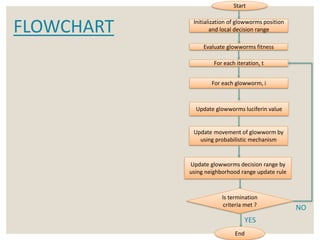
FLOWCHART
Start
Initialization of glowworms position
and local decision range
Evaluate glowworms fitness
For each iteration, t
For each glowworm, i
Update glowworms luciferin value
Update movement of glowworm by
using probabilistic mechanism
Update glowworms decision range by
using neighborhood range update rule
Is termination
criteria met ?
End
YES
NO
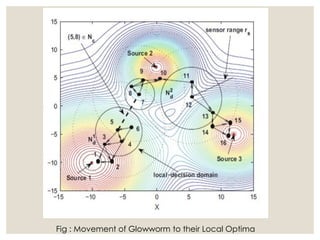
Fig : Movement of Glowworm to their Local Optima
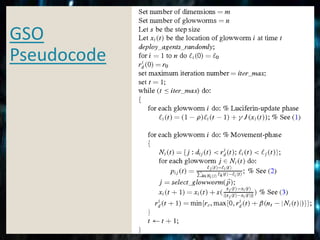
GSO
Pseudocode
Phase 1
Luciferin Update Phase
The luciferin update rule is:
li(t + 1) = (1 − ρ)li (t) + γ J (xi (t + 1))
li represent the luciferin level associated with glowworm i at time t,
l0 is ρ is the luciferin decay constant (0 < ρ < 1),
γ is the luciferin enhancement constant.
J (xi (t)) represents the value of the objective function at glowworm i ’s
location at time t.
Phase 2
Movement Phase A
The probability of movement for i to j:
𝑝𝑗 𝑡 =
𝑙𝑗 𝑡 − 𝑙𝑖(𝑡)
σ 𝑘∈𝑁 𝑖 𝑡 𝑙 𝑘 𝑡 − 𝑙𝑖(𝑡)
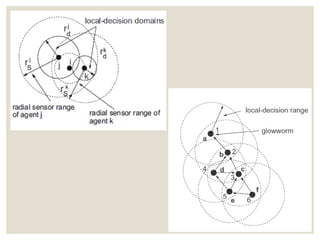
𝑗 ∈ 𝑁𝑖 𝑡 , 𝑁𝑖 𝑡 = 𝑗 ∶ 𝑑 𝑖, 𝑗 < 𝑟𝑑
𝑖
; 𝑙𝑗 𝑡 < 𝑙𝑖(𝑡)
is the set of neighbors of glowworm i at time t, d(i , j) represents the
Euclidean distance between glowworms i and j at time t, 𝑟𝑑
𝑖
(t)
represents the variable neighborhood range associated with glowworm i
at time t.
Phase 2
Movement Phase B
The movement from i location towards j location:
𝑥 ሶ𝑖 𝑡 + 1 = 𝑥𝑖 𝑡 + 𝑠
𝑥 ሶ𝑗 𝑡 − 𝑥𝑖 𝑡
𝑥𝑗 𝑡 − 𝑥𝑖 𝑡
where, 𝑥𝑖 ∈ 𝑅 𝑚is the location of glowworm i , at time t, in the m-
dimensional real space 𝑅 𝑚, || . || represents the Euclidean norm
operator, (s > 0) is the step size.
Phase 3
Neighborhood range update phase
Let 𝑟0 be the initial neighborhood range of each glowworm (i.e 𝑗𝑑𝑑).
To adaptively update the neighborhood range of each glowworm, the
following rule is applied:
𝑟𝑑
𝑖
𝑡 + 1 = min{𝑟𝑠 , max{0, 𝑟𝑑
𝑖
𝑡 + 𝛽 (𝑛 𝑡 − |𝑁𝑖(𝑡)|)}}
β is a constant parameter 𝑛 𝑡 is a parameter used to control the number
of neighbors
PYTHON
IMPLEMENTATION
OF
GLOWWARM
SWARM
OPTIMIZATION
APPLICATIONS
1. Detecting multiple sources of a general nutrient profile, that is distributed
spatially on a two dimensional workspace, using multiple robots.
2. Localizationand decommissioning of hostile sensors or transmitters,
scattered over a landscape, by sensing signals radiating from them.
3. Glowworm swarm optimizationcan be applied to solve the multi-
constrained (QoS) multicast routing problem (MQMR) problem using an
improved encoding method.
4. Chasing Multiple Mobile signal Sources.
5. Rolling bearing fault diagnosis method
6. Solving nonlinear equation systems.
7. GSO can be used to form a multi-robot cooperation
strategy for odor sources localization based on a modified
GSO algorithm (M-GSO).
References
1. K.N. Krishnanand, D. Ghose, “Detection of Multiple Source Locations
using a Glowworm Metaphor with Applications to Collective Robotics”,
Swarm Intelligence Symposium, 2005, pp. 84-91.
2. Kaipa, K. and Ghose, D. (2017). Glowworm Swarm Optimization
Theory, Algorithms, and Applications. Cham: Springer.
3. K.N. Krishnanand and D. Ghose. “Kinbots: A mobile robot platform for
collective robotics applications,” Technical Report GCDSL/2004/07,
Department of Aerospace Engg., IISc, Bangalore, August 2004.
4. E. Bonabeau, M. Dorigo, G. Theraulaz. Swarm Intelligence: From
Natural to Artificial Systems, Oxford University Press, 1999, pp.183-203.
5. Asha Gowda Karegowda and Mithilesh Prasad “A Survey of
Applications of Glowworm Swarm Optimization Algorithm”
International Conference on Computing and information Technology
(IC2IT-2013)

Glowworm Swarm Optimisation PPT

  • 1.
    Optimization Algorithms : GlowwormSwarm Algorithm Presented By: Arijeet Satapathy (B416014) Seva Mahapatra (B416044) Ritesh Kumar Pandey (B416063) IIIT BHUBANESWAR
  • 2.
  • 3.
    INTRODUCTION Swarm intelligence (SI)is a type of artificial intelligence, based on the collective behavior of decentralized, self- organized systems. It focuses on the study of the collective behavior that is made up of a population of simple agents interacting locally with one another and with their environment. The main idea: This algorithm is derived from natural glowworm’s activities in the night, the glowworm exercise in group, they interact with each other by one’s luciferin. If the glowworm emits more light, it can attracts more glowworms towards it.
  • 4.
    FLOWCHART Start Initialization of glowwormsposition and local decision range Evaluate glowworms fitness For each iteration, t For each glowworm, i Update glowworms luciferin value Update movement of glowworm by using probabilistic mechanism Update glowworms decision range by using neighborhood range update rule Is termination criteria met ? End YES NO
  • 5.
    Fig : Movementof Glowworm to their Local Optima
  • 6.
  • 8.
    Phase 1 Luciferin UpdatePhase The luciferin update rule is: li(t + 1) = (1 − ρ)li (t) + γ J (xi (t + 1)) li represent the luciferin level associated with glowworm i at time t, l0 is ρ is the luciferin decay constant (0 < ρ < 1), γ is the luciferin enhancement constant. J (xi (t)) represents the value of the objective function at glowworm i ’s location at time t.
  • 9.
    Phase 2 Movement PhaseA The probability of movement for i to j: 𝑝𝑗 𝑡 = 𝑙𝑗 𝑡 − 𝑙𝑖(𝑡) σ 𝑘∈𝑁 𝑖 𝑡 𝑙 𝑘 𝑡 − 𝑙𝑖(𝑡) 𝑗 ∈ 𝑁𝑖 𝑡 , 𝑁𝑖 𝑡 = 𝑗 ∶ 𝑑 𝑖, 𝑗 < 𝑟𝑑 𝑖 ; 𝑙𝑗 𝑡 < 𝑙𝑖(𝑡) is the set of neighbors of glowworm i at time t, d(i , j) represents the Euclidean distance between glowworms i and j at time t, 𝑟𝑑 𝑖 (t) represents the variable neighborhood range associated with glowworm i at time t.
  • 10.
    Phase 2 Movement PhaseB The movement from i location towards j location: 𝑥 ሶ𝑖 𝑡 + 1 = 𝑥𝑖 𝑡 + 𝑠 𝑥 ሶ𝑗 𝑡 − 𝑥𝑖 𝑡 𝑥𝑗 𝑡 − 𝑥𝑖 𝑡 where, 𝑥𝑖 ∈ 𝑅 𝑚is the location of glowworm i , at time t, in the m- dimensional real space 𝑅 𝑚, || . || represents the Euclidean norm operator, (s > 0) is the step size.
  • 11.
    Phase 3 Neighborhood rangeupdate phase Let 𝑟0 be the initial neighborhood range of each glowworm (i.e 𝑗𝑑𝑑). To adaptively update the neighborhood range of each glowworm, the following rule is applied: 𝑟𝑑 𝑖 𝑡 + 1 = min{𝑟𝑠 , max{0, 𝑟𝑑 𝑖 𝑡 + 𝛽 (𝑛 𝑡 − |𝑁𝑖(𝑡)|)}} β is a constant parameter 𝑛 𝑡 is a parameter used to control the number of neighbors
  • 12.
  • 13.
    APPLICATIONS 1. Detecting multiplesources of a general nutrient profile, that is distributed spatially on a two dimensional workspace, using multiple robots. 2. Localizationand decommissioning of hostile sensors or transmitters, scattered over a landscape, by sensing signals radiating from them. 3. Glowworm swarm optimizationcan be applied to solve the multi- constrained (QoS) multicast routing problem (MQMR) problem using an improved encoding method.
  • 14.
    4. Chasing MultipleMobile signal Sources. 5. Rolling bearing fault diagnosis method 6. Solving nonlinear equation systems. 7. GSO can be used to form a multi-robot cooperation strategy for odor sources localization based on a modified GSO algorithm (M-GSO).
  • 15.
    References 1. K.N. Krishnanand,D. Ghose, “Detection of Multiple Source Locations using a Glowworm Metaphor with Applications to Collective Robotics”, Swarm Intelligence Symposium, 2005, pp. 84-91. 2. Kaipa, K. and Ghose, D. (2017). Glowworm Swarm Optimization Theory, Algorithms, and Applications. Cham: Springer. 3. K.N. Krishnanand and D. Ghose. “Kinbots: A mobile robot platform for collective robotics applications,” Technical Report GCDSL/2004/07, Department of Aerospace Engg., IISc, Bangalore, August 2004. 4. E. Bonabeau, M. Dorigo, G. Theraulaz. Swarm Intelligence: From Natural to Artificial Systems, Oxford University Press, 1999, pp.183-203. 5. Asha Gowda Karegowda and Mithilesh Prasad “A Survey of Applications of Glowworm Swarm Optimization Algorithm” International Conference on Computing and information Technology (IC2IT-2013)