International Journal of Computer Networks & Communications (IJCNC) Vol.7, No.3, May 2015
DOI : 10.5121/ijcnc.2015.7307 91
A NOVEL ENERGY AWARE NODE CLUSTERING
ALGORITHM FOR WIRELESS SENSOR NETWORKS USING
A MODIFIED ARTIFICIAL FISH SWARM ALGORITHM
Reza Azizi1
, Hasan Sedghi2
, Hamid Shoja3
, Alireza Sepas-Moghaddam4
1
Young Researchers and Elite Club, Bojnourd Branch, Islamic Azad University,
Bojnourd, Iran
2
Department of Information Technology Engineering, PNU, Assaluye, Iran
3
Department of Computer Engineering and Information Technology, PNU, Tehran, Iran
4
Young Researchers and Elite Club, Science and Research Branch, Islamic Azad
University, Tehran, Iran
ABSTRACT
Clustering problems are considered amongst the prominent challenges in statistics and computational
science. Clustering of nodes in wireless sensor networks which is used to prolong the life-time of networks
is one of the difficult tasks of clustering procedure. In order to perform nodes’ clustering, a number of
nodes are determined as cluster heads and other ones are joined to one of these heads, based on different
criteria e.g. Euclidean distance. So far, different approaches have been proposed for this process, where
swarm and evolutionary algorithms contribute in this regard. In this study, a novel algorithm is proposed
based on Artificial Fish Swarm Algorithm (AFSA) for clustering procedure. In the proposed method, the
performance of the standard AFSA is improved by increasing balance between local and global searches.
Furthermore, a new mechanism has been added to the base algorithm for improving convergence speed in
clustering problems. Performance of the proposed technique is compared to a number of state-of-the-art
techniques in this field and the outcomes indicate the supremacy of the proposed technique.
KEYWORDS
Wireless Sensor Networks, Artificial Fish Swarm Algorithm, Node Clustering, Energy
1.INTRODUCTION
Optimization technique is used in order to minimize or maximize the outcome of a function by
adjusting its factors. All proper values for this problem are called possible solutions and the best
one is optimal solution. Up to now, different approaches were proposed to perform optimization
process e.g. swarm intelligence methods [1]. Swarm intelligence techniques are based on relations
between animals and insects swarms which tries to detect the solutions that are close to optimal
one. Particle Swarm Optimization (PSO) [2], Ant Colony Optimization (ACO) [3], Shuffled Frog
Leaping Algorithm (SFLA) [4] and Artificial Fish Swarm Algorithm (AFSA) [5] are some
examples of swarm intelligence algorithms. All swarm intelligence algorithms are based on
population, where their iterative procedure leads to improve the position of individual in
population and subsequently, their movement toward the better positions.
International Journal of Computer Networks & Communications (IJCNC) Vol.7, No.3, May 2015
92
As mentioned above, Artificial Fish Swarm Algorithm (AFSA) is one of the swarm intelligence
techniques [5]. The procedure of AFSA has been inspired from social behaviors of fish in nature,
based on random search, population and behaviorism. This algorithm involves some
characteristics i.e. high convergence speed, insensitivity to the initial values of artificial fish,
flexibility, and fault tolerant which make it useful for solving optimization problems. Fish can
find the zones involving more foods in underwater world by individual or swarm searches.
According to this property, AFSA model was proposed by Free-Movement, Food-Search,
Swarm-Movement and Follow Behaviors in order to search the problem space. This algorithm is
used in different applications [6] such as neural networks [7, 8], color quantization [9], dynamic
optimization problems [10], physics [11], global optimization [12-15], and data clustering [16].
In recent years, Wireless Sensor Network (WSN) has been significantly considered by
researchers. Each sensor network includes a number of nodes, where each node involves
processing resources and a limited amount of energy. Sensor nodes can sense, measure and
collect information by some local decision and transmit it to the main station [17]. Intelligent
sensor node consist of one or several sensors, one processor, a memory unit, a type of energy
supply with low energy utilization, transmitter, receiver, and a stimulator. Battery is the primary
source in a sensor node which is not commonly rechargeable, so the node will be dead by
finishing batteries’ energy. Network lifetime is determined by two criteria: 1) the time in which
the first node dies (FND) and 2) the time in which the last node dies (LND). Utilizing different
mechanisms to increase the lifetime of the network is considered amongst most challengeable
subjects in this domain. Many researches aim at enhancing the network lifetime by proposing
duty cycling schemes [18], coverage targeted protocols [19] or novel routing protocols [20].
One of the efficient solutions to increase the network’s lifetime is clustering of the nodes [21].
Clustering is especially important for sensor networks which contain a substantial number of
wireless sensors. Each network can be divided into smaller clusters and contain a cluster head
(CH). Sensor nodes in every cluster transfer their information to the relevant CH and CH collects
information and sends them to a primary station. In this way, cluster nodes can conserve more
energy by reducing the range and length of the communication. Swarm and evolutionary
algorithms can be used in the primary station to determine the members of each cluster along with
the cluster heads.
In this research, a novel algorithm for clustering of nodes in wireless sensor networks has been
proposed, based on AFSA. The proposed algorithm along with Leach algorithm [22] and several
other ones have been used for the clustering process. The results of the simulations showed that
the network’s lifetime has been increased by using the proposed method, compared to other ones.
The rest of the paper is organized as follow: in the second section Artificial Fish Swarm
Algorithm is reviewed. The third section describes the proposed method and the forth one shows
the experiments and the results. The fifth section concludes the paper.
2. ARTIFICIAL FISH SWARM ALGORITHM (AFSA)
AFSA is one of the swarm intelligence methods and evolutionary optimization techniques [5].
The framework of this algorithm is based on functions that are modelled from social interactions
of fish groups in the nature.
In this algorithm, there are four functions modelled from fish behaviors in fish swarms. The first
function is free-move behavior: as in nature, fishes move freely in the swarm when they do not
prey. The second function is prey behavior: certainly, every fish searches for its prey individually
by means of its senses. These senses are sense of vision, smell and available sensors on their
International Journal of Computer Networks & Communications (IJCNC) Vol.7, No.3, May 2015
93
bodies. In AFSA, the area where an artificial fish can sense a prey is modeled as a neighborhood
with a visual-sized radius. The next function is follow behavior: when a fish finds food, other
swarm members also follow it to reach the food. The last function is swarm behavior: in nature,
fish always try to be in the swarm and not to leave it in order to be protected from hunters.
In the underwater world, a fish can discover areas that have more food, which is done by
individual or swarm search by the fish. According to this characteristic, an artificial fish (AF)
model is expressed by four aforementioned behaviors. AFs search the problem space by these
behaviors. The environment, where an AF lives, is basically the solution space and other AFs
domain. Food consistency degree in the water area is AFSA objective function. Finally, AFs
reach to a point where its food consistency degree is maxima (global optimum).
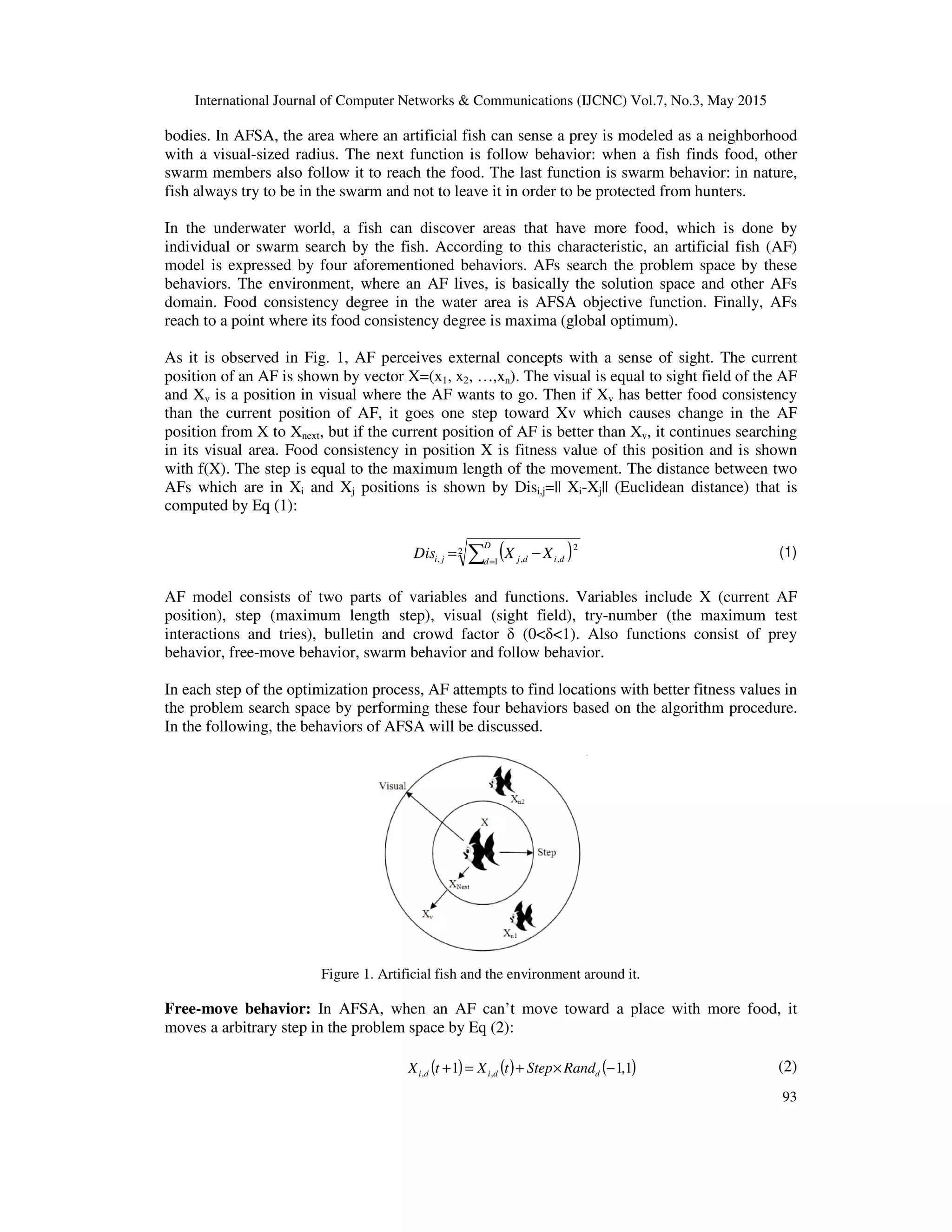
As it is observed in Fig. 1, AF perceives external concepts with a sense of sight. The current
position of an AF is shown by vector X=(x1, x2, …,xn). The visual is equal to sight field of the AF
and Xv is a position in visual where the AF wants to go. Then if Xv has better food consistency
than the current position of AF, it goes one step toward Xv which causes change in the AF
position from X to Xnext, but if the current position of AF is better than Xv, it continues searching
in its visual area. Food consistency in position X is fitness value of this position and is shown
with f(X). The step is equal to the maximum length of the movement. The distance between two
AFs which are in Xi and Xj positions is shown by Disi,j=|| Xi-Xj|| (Euclidean distance) that is
computed by Eq (1):
( )2
1
2
,,, ∑ =
−=
D
d didjji XXDis (1)
AF model consists of two parts of variables and functions. Variables include X (current AF
position), step (maximum length step), visual (sight field), try-number (the maximum test
interactions and tries), bulletin and crowd factor δ (0<δ<1). Also functions consist of prey
behavior, free-move behavior, swarm behavior and follow behavior.
In each step of the optimization process, AF attempts to find locations with better fitness values in
the problem search space by performing these four behaviors based on the algorithm procedure.
In the following, the behaviors of AFSA will be discussed.
Figure 1. Artificial fish and the environment around it.
Free-move behavior: In AFSA, when an AF can’t move toward a place with more food, it
moves a arbitrary step in the problem space by Eq (2):
( ) ( ) ( )1,11 ,, −×+=+ ddidi RandSteptXtX (2)
International Journal of Computer Networks & Communications (IJCNC) Vol.7, No.3, May 2015
94
Xi,d is component d of AF i’s position in the D-dimensional space and 1≤ d ≤ D. Rand function
generates a random number with a uniform distribution in [-1, 1].
Prey behavior: If Xi is the current position of AF i, we choose position Xj in the visual of AF i
randomly. f(X) is the food consistency in position X or its fitness value. Position Xj is given by
Eq (3):
)1,1(,, −×+= ddidj RandVisualXX (3)
Then food density in Xi is compared with the that of the current position, if f(Xi) ≥ f(Xj), AF i
moves forward a step from its current position to Xj, which is done by Eq (4):
( ) ( )
( )
( )1,01
,
RandStep
Dis
tXX
tXtX
ji
ij
ii ××
−
+=+
rr
rr (4)
Xi is a D-dimensional vector and Disi,j is the Euclidean distance between vectors Xi and Xj. Xj –
Xi generates a transfer vector from Xi to Xj and when divided by Disi,j, a vector with unit length is
created from Xi toward Xj. Here, Rand function generates a random number which causes AF i to
move as much as a random percent of Step toward position Xj. Nevertheless, if f(Xi) < f(Xj), we
choose another position Xi by Eq (3) and evaluate its food density to understand whether forward
condition is satisfied or not. If after try_number times AF does not succeed in satisfying forward
condition, the concerned AF performs free-move behavior and moves a step in the problem space
randomly.
Swarm behavior: In AFSA, in order to keep swarm generality, in each of the iterations, AFs try
to move toward a central position. A central position of swarm is given by Eq (5):
∑=
=
N
i didCenter X
N
X 1 ,,
1 (5)
As it is seen in Eq (5), component d of Xcenter vector is the arithmetic average of component d of
all swarm AFs. Let N be the population size, and nc be the number of AF in Visual field around
Xcenter. If f(Xcenter)≤ f(Xi) and δ>(nc/N), that is the central position has a better food consistency
than the current position and population density in its neighborhood is not much, so AF i moves
toward the central position by Eq (6):
( ) ( ) ( ) ( )1,01
,
RandStep
Dis
tXX
tXtX
Centeri
iCenter
ii ××
−
+=+
rr
rr (6)
If nc = 0 or the condition of moving toward the central position is not satisfied, prey behavior is
performed for AF i.
Follow behavior: If Xi is the current position of AF i, it checks neighbor Xn, if nn is the number
of AFs in the Visual of AF n, if f(Xn) ≤ f(Xi) and δ>(nn/N), i.e. position Xn has a better food
consistency than the current position of AF i and population density in its neighborhood is not
much, therefore AF i moves one step toward AF by Eq (7):
( ) ( ) ( ) ( )1,01
,
RandStep
Dis
tXX
tXtX
ni
in
ii ××
−
+=+
rr
rr (7)
If AF i has no neighbors or none of its neighbors satisfy following condition, prey behavior would
be performed for AF i.
International Journal of Computer Networks & Communications (IJCNC) Vol.7, No.3, May 2015
95
AFSA performs the optimization process iteratively by means of functions described as its
behaviors, and the algorithm factors or AFs try to get closer to our objectives by executing these
functions.
For AFs, prey and free-move behaviors are the individual ones and follow and swarm behaviors
are group behaviors. Prey behavior would be performed if an AF can't move to a better location
by executing follow behavior and/or swarm behavior, and free-move behavior is performed if an
AF is not successful in finding a better location by performing prey behavior. Certainly, prey and
free-move behaviors are not performed individually by AFs and are only performed when an AF
couldn’t move to a better location by follow and swarm behaviors. In AFSA, in each step of the
optimization process, all AFs pass the same procedure in parallel.
Let the position of AF i at time t be Xi(t). AF i performs follow behavior at position Xi(t) once,
which leads to obtain position Xi,Follow. After executing the follow behavior, AF i performs swarm
behavior from that position Xi(t) and it leads to obtain position Xi,Swarm. After performing both
follow and swarm behaviors that were done with respect to Xi(t), the next position of AF i
(Xi(t+1)) is obtained by Eq (8):
( )
( ) ( )
( ) ( )


>
≤
=+
swarmifollowiswarmi
swarmifollowifollowi
i
XfXfifX
XfXfifX
tX
,,,
,,,
1 (8)
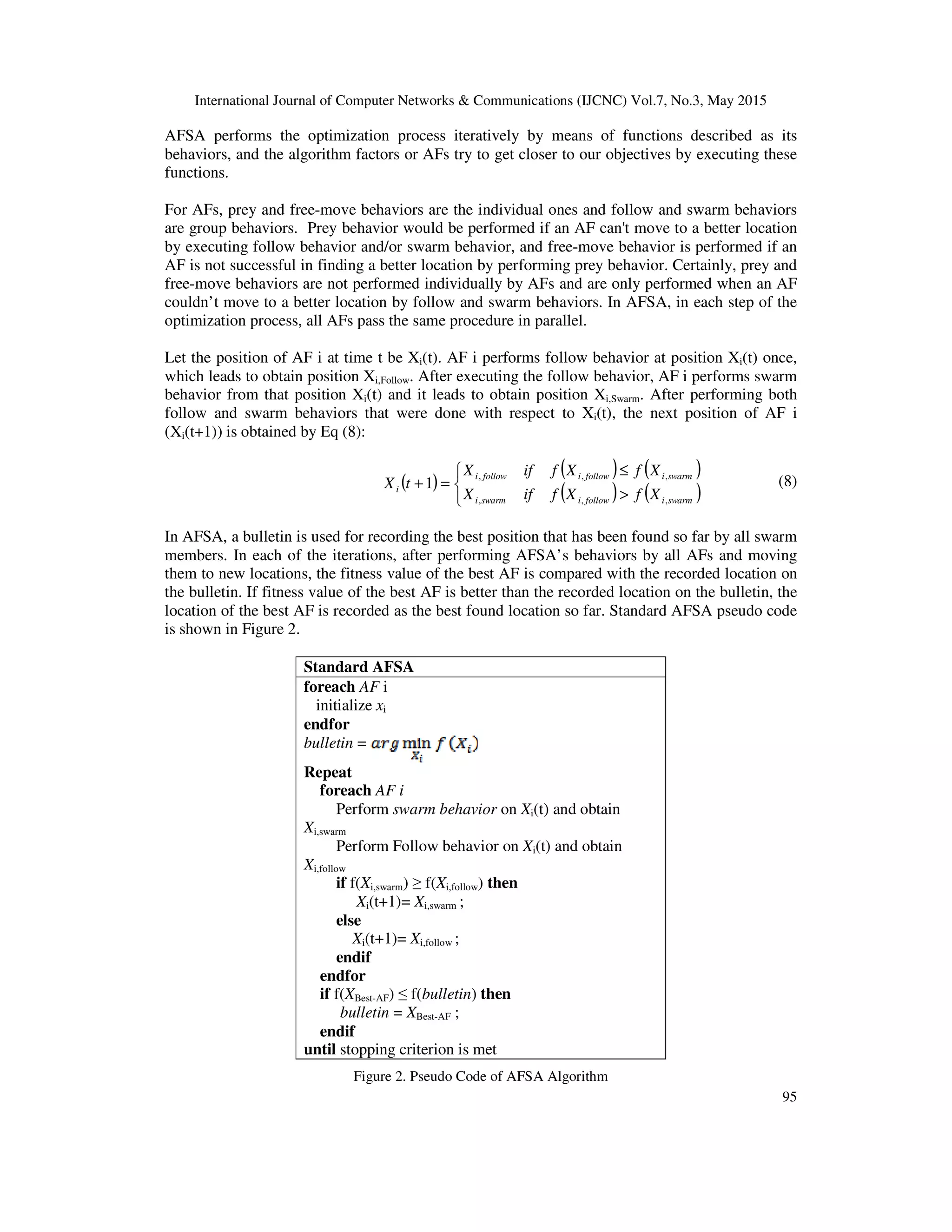
In AFSA, a bulletin is used for recording the best position that has been found so far by all swarm
members. In each of the iterations, after performing AFSA’s behaviors by all AFs and moving
them to new locations, the fitness value of the best AF is compared with the recorded location on
the bulletin. If fitness value of the best AF is better than the recorded location on the bulletin, the
location of the best AF is recorded as the best found location so far. Standard AFSA pseudo code
is shown in Figure 2.
Standard AFSA
foreach AF i
initialize xi
endfor
bulletin =
Repeat
foreach AF i
Perform swarm behavior on Xi(t) and obtain
Xi,swarm
Perform Follow behavior on Xi(t) and obtain
Xi,follow
if f(Xi,swarm) ≥ f(Xi,follow) then
Xi(t+1)= Xi,swarm ;
else
Xi(t+1)= Xi,follow ;
endif
endfor
if f(XBest-AF) ≤ f(bulletin) then
bulletin = XBest-AF ;
endif
until stopping criterion is met
Figure 2. Pseudo Code of AFSA Algorithm
International Journal of Computer Networks & Communications (IJCNC) Vol.7, No.3, May 2015
96
In this pseudo code, prey and free-move behaviors were considered as a part of swarm and follow
behaviors. That is, if an AF could not perform successfully a swarm or follow behavior, it would
perform prey behavior and if could not reach a better position by executing this behavior, it would
perform free move behavior.
3. THE PROPOSED METHOD
In this section, the proposed clustering algorithm is described. In this algorithm, there exists a
population of fish, where each fish includes n positions of clusters’ center. If the clustering
samples observe d-dimensional space, each artificial fish includes a position vector with n*d
dimensions.
In the proposed method, in order to establish a balance between exploration and exploitation,
some modifications have been applied to the structure of visual and step parameters. For this
reason, Euclidean distance between all artificial fish and the best position, which is stored in
bulletin, is calculated. Subsequently, the value of visual parameter for each fish is equal to v% of
its distance to the best found position and the amount of step parameter for each fish is equal to
s% of visual value. Based on the structure of swarm intelligent methods regarding convergence to
the goal and reduction in swarm diversity by approaching the goal, Step and Visual parameters
are reduced by approaching the goal. This issue leads to a balance between local and global
searches, and consequently increases the efficiency of the algorithm.
Concerning the calculation process of visual and step parameters in the proposed method, each
fish can use its visual and step parameters by equations 2, 3, 4, 6 and 7. It is worth to mention that
regarding the difference between values of visual parameter for different fish, crowed factor and
other related conditions are eliminated from follow and swarm behaviors of standard AFSA. By
eliminating this parameter, convergence speed is increased in the proposed method which leads to
premature convergence problem. To master this weakness, a novel mechanism is added to the
algorithm.
In the new mechanism, each artificial fish moves with probability of p1%, based on the stored
position in bulletin by eq. 9.
( ) ( ) ( )( ) ( )( )1,11 −×−+=+ RandtXXtXtX iBulletinii
rrrr
(9)
where, Xbulletin is equal to the best found position by the algorithm and Rand function generates a
random number in range of [-1,1] with uniform distribution. According to Eq. 9, in case of
generation the random number in range of [-1,0), the new position of the artificial fish is away
from bulletin position, which leads to explorer the distant regions by the artificial fish and escape
from local minima. On the other hand, in case of generation the random number in range of (0,1],
the positions of the fish approaches the bulletin which leads to increase convergence speed. So,
using Eq. 9, a balance between density and diversity is obvious, which leads to establish a balance
between exploration and exploitation.
In addition, another mechanism has been considered in the proposed method in order to increase
convergence speed in clusters. As it was mentioned before, each artificial fish included n × d-
dimensional cluster centers. Since the nodes’ clustering performs based on their position, and
each node consists two components (X and Y geographical coordinates), the problem space for
AFSA algorithm is a 2×n dimensional space. Position vector for each artificial fish is shown in
Figure 3. Here Zi,j represents the dimension j from cluster head i.
International Journal of Computer Networks & Communications (IJCNC) Vol.7, No.3, May 2015
97
( )2,1,2,21,22,11,1 ,,...,,,, nn ZZZZZZ
Figure 3. Structure of position vector for solving node clustering problem in wireless sensor networks.
Fitness function that has been used for each artificial fish in the proposed method is the total of
intra-cluster distances which is equal to the whole Euclidean distances between nodes and the
nearest cluster head.
In the third mechanism, one cluster head changes its position with the probability of P2% in each
iteration. This cluster head is arbitrarily chosen form entire set of cluster heads. To change the
position of the selected cluster, first, all nodes that their distance to the selected head is lower than
that to other ones are determined. Then, the new position of this head is equal to the center
position of the determined nodes. In other word, the center is equal to the average position of the
determined nodes.
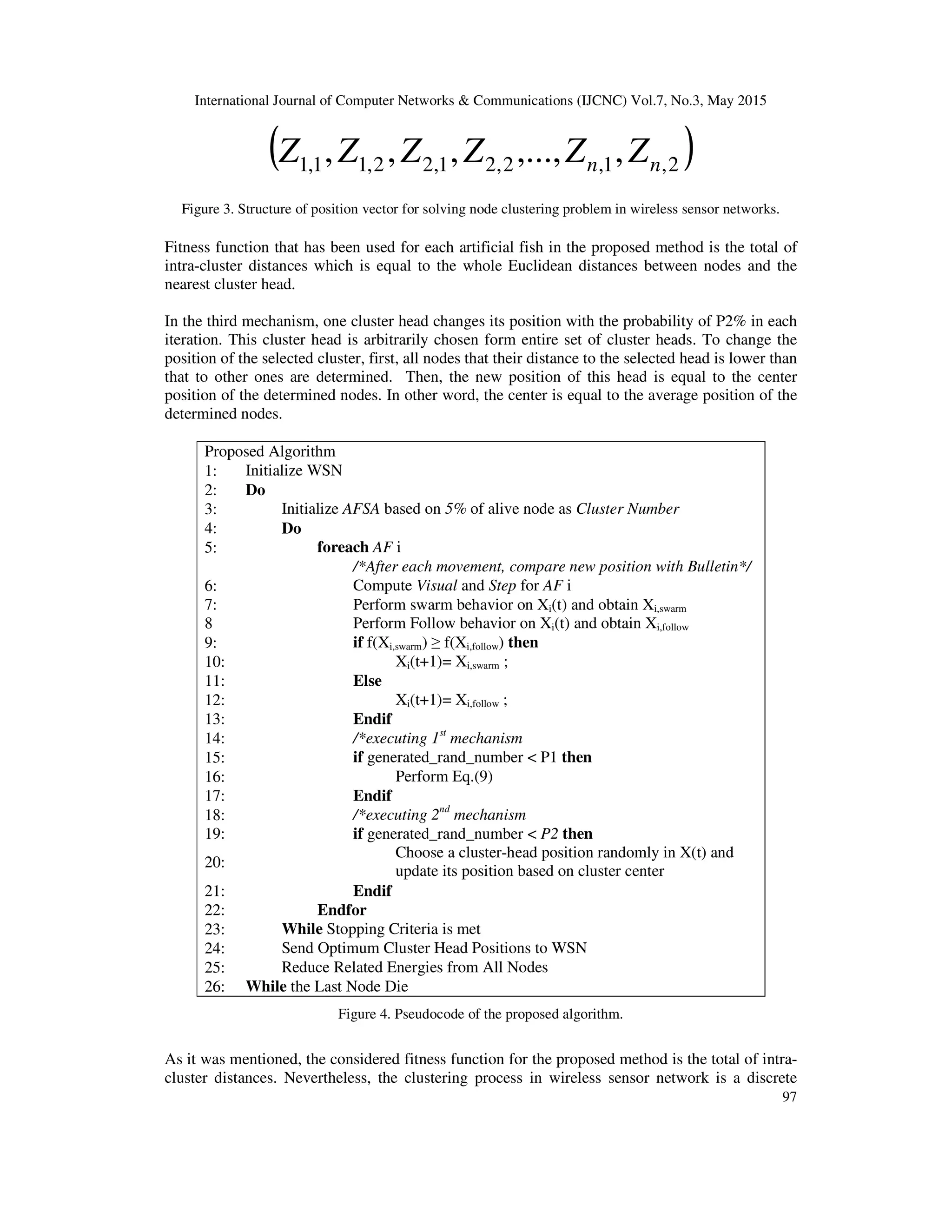
Proposed Algorithm
1: Initialize WSN
2: Do
3: Initialize AFSA based on 5% of alive node as Cluster Number
4: Do
5: foreach AF i
/*After each movement, compare new position with Bulletin*/
6: Compute Visual and Step for AF i
7: Perform swarm behavior on Xi(t) and obtain Xi,swarm
8 Perform Follow behavior on Xi(t) and obtain Xi,follow
9: if f(Xi,swarm) ≥ f(Xi,follow) then
10: Xi(t+1)= Xi,swarm ;
11: Else
12: Xi(t+1)= Xi,follow ;
13: Endif
14: /*executing 1st
mechanism
15: if generated_rand_number < P1 then
16: Perform Eq.(9)
17: Endif
18: /*executing 2nd
mechanism
19: if generated_rand_number < P2 then
20:
Choose a cluster-head position randomly in X(t) and
update its position based on cluster center
21: Endif
22: Endfor
23: While Stopping Criteria is met
24: Send Optimum Cluster Head Positions to WSN
25: Reduce Related Energies from All Nodes
26: While the Last Node Die
Figure 4. Pseudocode of the proposed algorithm.
As it was mentioned, the considered fitness function for the proposed method is the total of intra-
cluster distances. Nevertheless, the clustering process in wireless sensor network is a discrete
International Journal of Computer Networks & Communications (IJCNC) Vol.7, No.3, May 2015
98
process, since the cluster heads are selected among nodes. But, the proposed AFSA algorithm,
similar to as most swarm intelligence methods, is used in continuous problems. To solve this
problem, the movement of artificial fish in the algorithm is applied in form of continuous.
However, the obtained continuous positions by the algorithm are assigned to the nearest node
after each movement. It is worth to note that in order to prevent the death of nodes with low
energy, first, the average energy of alive nodes are calculated and the nearest node that its energy
is higher than the average energy is selected. Another important point is to determine the number
of clusters. To determine this amount, we used the approach proposed in [22] i.e. 5% of the
number of all alive nodes. Pseudocode of the proposed algorithm is shown in Figure 4.
4. EXPERIMENTS
In this section efficiency of proposed algorithm for node clustering in wireless sensor networks is
evaluated by experiments. First of all, configuration of the wireless sensor network which is used
as a testbed for clustering problem is described. Next, comparative algorithms alongside their
parameters’ setting are explained. Lastly, the experiments results are examined.
4.1. Network Configuration
We considered a network involving 100 nodes which are distributed in a ground with the size of
100*100 meters, where the main station is placed in the coordinate of 50 and 175. The network is
homogeneous (all nodes have the same energy) and it is considered that all nodes continuously
includes the information that must be sent. Each node sends a packet toward the cluster head in
each round and the head aggregates the gathered packet in the end of the round to be sent to the
main station. The length of each packet is 500 bytes (4000 bits). It is considered that the main
station is aware from the initial energy and positions of all nodes. Clustering algorithm is
performed in the initial station with unlimited computational power and energy. In addition, we
suppose that no information concerning the current energy is sent along with the information
packet by the nodes and no redundant packet is sent in this regard.
4.2. Energy Model
In this research we use the simple radio model [22] in order to determine the radio energy.
According to this model, for sending a message with k bit and the interval of d, the amount of
energy which used by radio ( ETx (k,d)), is calculated based on Eq. 10.
ETx (k,d) = Eelec * k + Eamp * k * d2 (10)
where, Eelec is the amount of consumed energy for establishing sender/receiver circuit. We
consider the value of this parameter equals to 50 (Eelec=50 nJ/bit). Eamp is the consumed energy by
amplifier to amplification of the sent signal. We consider the value of this parameter equals to
100 (Eamp=100 pJ/bit/m2).
In addition, for receiving a message, the amount of energy which used by radio ( ERx (k)), is
calculated based on Eq. 11.
ERx (k) = Eelec * k (11)
Cluster heads consumes more energy, since data aggregation is an additional phase for Cluster
heads. We consider this value equals to 5 (EDA=5nJ/bit/signal).
International Journal of Computer Networks & Communications (IJCNC) Vol.7, No.3, May 2015
99
So, the procedure of energy consumption in each round is as follow. First, all nodes receive a
packet including the information for determining clusters and cluster heads (receive energy by
nodes). Then, each node sends a packet to its cluster head (send energy by nodes and receive
energy by cluster heads). Cluster heads aggregate the gathered packet in the end of each round to
be sent to the main station (data aggregate energy and send energy by cluster heads).
4.3. Swarm Intelligence Algorithms
In order to evaluate the efficiency of the swarm intelligence algorithms for the node clustering
process, we have considered Particle Swarm Optimization (PSO) [23], Imperialist Competitive
Algorithm (ICA) [24], Shuffled Frog Leaping Algorithm (SFLA) [4], Modified Artificial Fish
Swarm Algorithm (CM-AFSA) and Leach algorithm [22] along with the proposed method. The
First four algorithms belong to swarm intelligence algorithms category.
Particle Swarm Optimization (PSO) is the most recognized swarm intelligence algorithm
proposed by Kennedy and Eberhart [2]. This algorithm simulates the fish and birds behaviors.
Imperialistic cognitive Algorithm (ICA) was proposed in 2007 by Atashpaz and Lucas [24]. This
algorithm is based on the social and political relations of imperialist and colonial countries. The
shuffled frog-leaping algorithm (SFLA) that was developed by Eusuff and Lansey in 2003 [4], is
a member of the swarm intelligence family. It is a meta-heuristic optimization technique based on
the mimetic evolution of frogs seeking food in a pond. CM-AFSA is an enhanced version of
AFSA algorithm in which PSO formulas are used to improve the performance of basic AFSA. In
addition, a communication behaviour is applied in order to improve the efficiency of the
algorithm.
For this reason, first, the number of clusters is considered equals to the 5% of the alive nodes
[22]. Then, clustering process is performed by swarm intelligence algorithm and some
mechanisms for mapping the center position of cluster heads to the nearest nodes with sufficient
energy are applied for all algorithms. The algorithms continue the clustering process until
reaching convergence condition. To determine the convergence condition, the central position of
cluster heads in the current iteration is compared to that in 20 previous iterations. If there is no
movement in the location of cluster heads for 20 iterations, convergence is executed.
The parameters’ values for different algorithms are tabulated in Table 1. It is worth to note that
the parameters are determined based on a wide range of experiments in this domain.
The experiments are iterated 50 times, where each iteration is performed up to 100 rounds in
wireless sensor network. The positions of nodes are randomly determined in each iteration. The
used criteria to evaluate the performance of the network are First Node Die (FND) and Last Node
Die (LND). The average values of FND and LND are presented in table 2 for all tested
algorithms. In addition, chart 5 illustrates the average remained energy in each round for different
algorithms.
As can be seen in table 2, Leach algorithm led to the worst results, compared to other algorithms.
However, it must be note that the computational cost of this algorithm is considerably lower than
that of swarm intelligence algorithms. The results obtained by the swarm intelligence algorithms
show that they led to different results, due to the performance of optimization process for
clustering purpose. Among the swarm intelligence algorithms, the first node is died in a network
which is clustered by ICA and PSO algorithms. The proposed algorithm outperforms other
comparative ones in case of FND criterion and CM-AFSA algorithm led to the second best result.
International Journal of Computer Networks & Communications (IJCNC) Vol.7, No.3, May 2015
100
Table 1: Parameters’ values for different swarm intelligence algorithms for node clustering process.
Algorithm Parameter Setting
G-PSO
Population size =20×Cluster number
c1=c2=2
Inertia Weight=0.5×(rand*0.5)
neighbor topology=Global star
CM-AFSA
Population size =10×Cluster number
try-number=5
crowd factor=0.75
Visual=Par[1]
Step = Visual/5
c3=c6=2
Std-ICA
Country number=20×Cluster number
empire number = 4×Cluster number
ξ=0.1
β=2
SFLA
Population size = 10×Cluster number
number of memeplex=5
Dmax=20
Iteration in memeplex = 10
Proposed
AFSA
Population size =10×Cluster number
try-number=5
Visual=Par[1]
Step = Visual/5
c3=c6=2
V% = 0.4 (40%)
S%=0.5(50%)
P1%=0.3
P2%=0.3
Table 2: Average and standard deviation of FND and LND by the algorithms
Algorithm FND LND
Leach 14.85 (0.74) 21.05 (0.51)
G-PSO 45.50(6.12) 76.80(3.59)
CM-AFSA 49.58(5.69) 76.33(3.72)
Std-ICA 45.60(5.20) 76.20(4.64)
SFLA 47.93(4.49) 77.10 (4.18)
Proposed AFSA 52.00(4.38) 78.92(3.86)
In addition, the proposed algorithm also outperforms other comparative ones in case of LND
criterion and SFLA algorithm led to the second best result. It must be note that the nodes that are
clustered using SFLA have died earlier than that using CM-AFSA, however, SFLA algorithm
performed better clustering in the next rounds by decreasing the number of alive nodes. All the
same, the proposed algorithms managed to achieve the best result both for FND and LND factors
International Journal of Computer Networks & Communications (IJCNC) Vol.7, No.3, May 2015
101
which illustrates the high performance of the proposed method in all series of the network. The
reasons for such improvement, particularly versus CM-AFSA, are establishing a balance between
local and global searches, increasing the escape ability from local minima and the high
convergence speed. These matters are obtained thanks to novel mechanisms 1 and 2, as well as
change in structure of visual and step parameters of artificial fish. Figure 5 shows the chart of
total remained energy in nodes after 50 iterations by different algorithms.
0 10 20 30 40 50 60 70 80 90 100
0
10
20
30
40
50
Round number
TotalRemainedEnergyinNetwork
Remained Energy
Leach
PSO
CM-AFSA
ICA
SFLA
Proposed AFSA
Figure 5. Energy reduction chart for all algorithms during 100 rounds.
5. CONCLUSIONS
In this paper, a novel artificial fish swarm algorithm was proposed. In the proposed algorithm, the
value of visual parameter was determined by the distance of each fish from the best found
position by the algorithm in each iteration. Even though, the preliminary search space of fish was
huge, but it was decreased by convergence of the swarm. So, the searched space by each fish was
commensurate with the progress of the algorithm and a balance between exploration and
exploitation has been established. On the other hand, using two novel mechanisms i.e. movement
based on the best found position and relocation of a cluster head toward the average position of
the swarm’s members led to improve convergence speed as well as escape ability form local
minima. The experiments have been done for nodes’ clustering in wireless sensor network and the
performance of the proposed method was compared to several state-of-the-art algorithms in this
domain. The results showed the superiority of the proposed method than comparative studies.
In this paper, a modified algorithm is used for clustering of nodes in wireless sensor networks.
Since, there are many applications based on mobile wireless sensor networks in which nodes are
able to move by time, node clustering in such networks can be a suitable topic for further
researches. For this purpose, clustering algorithms must be redesigned to cover the dynamic
environment of the problem.
REFERENCES
[1] X.S. Yang, Z. Cui, R. Xiao, A.H. Gandomi, M. Karamanoglu, Swarm intelligence and bio-inspired
computation: theory and applications, Elsevier, (2013) ISBN: 978-0-12-405163-8.
[2] J. Kennedy, R.C. Eberhart, Particle swarm optimization, IEEE International Conference on Neural
Networks, 4 (1995) 1942-1948, DOI: 10.1109/ICNN.1995.488968.
[3] M. Dorigo, Learning and natrual algorithms, Ph.D. thesis, Dipartimento di Elettronica, Politecnico di
Milano, Italy, 1992.
[4] M. Eusuff, K. Lansey, Optimization of water distribution network design using th shuffled frog
leaping algorithm, Journal of Water Resources Planning and Management, 129 (2003) 210-225, DOI:
10.1061/(ASCE)0733-9496(2003)129:3(210)).
International Journal of Computer Networks & Communications (IJCNC) Vol.7, No.3, May 2015
102
[5] L.X. Lei, Z.J. Shao, J.X. Qian, An optimizing method based on autonomous animate: fish swarm
algorithm, System Engineering Theory and Practice, 11 (2002) 32-38.
[6] M. Neshat, G. Sepidnam, M. Sargolzaei, A. Nadjaran Toosi, Artificial fish swarm algorithm: a survey
of the state-of-the-art, hybridization, combinatorial and indicative applications, Artificial Intelligence
Review, (2012), DOI: 10.1007/s10462-012-9342-2.
[7] H.C. Tsai, Y. H. Lin, Modification of the fish swarm algorithm with particle swarm optimization
formulation and communication behavior, Applied Soft Computing, 2011,
DOI:10.1016/j.asoc.2011.05.022.
[8] W. Shen, X. Guo, C. Wu, D. Wu, Forecasting stock indices using radial basis function neural
networks optimized by artificial fish swarm algorithm, Knowledge-Based Systems, 24 (2011) 378-
385, DOI: 10.1016/j.knosys.2010.11.001.
[9] D. Yazdani, H. Nabizadeh, E.M. Kosari, A.N. Toosi, Color quantization using modified artificial fish
swarm algorithm, Lecture Notes in Computer Science, 7106 (2011) 382-391, DOI: 10.1007/978-3-
642-25832-9_39.
[10] D. Yazdani, M.R. Akbarzadeh-T, B. Nasiri, M.R. Meybodi, A new artificial fish swarm algorithm for
dynamic optimization problems, IEEE Congress on Evolutionary Computation, CEC2012, (2012) 1-8,
DOI: 10.1109/CEC.2012.6256169.
[11] G. Zheng, Z. Lin, A winner determination algorithm for combinatorial auctions based on hybrid
artificial fish swarm algorithm, Physics Procedia, International Conference on Solid State Devices and
Materials Science, 25 (2012) 1666-1670, DOI: 10.1016/j.phpro.2012.03.292.
[12] R. Azizi, Empirical study of artificial fish swarm algorithm, International Journal of Computing,
Communications and Networking 3 (1) 1-7, DOI: arXiv:1405.4138 [cs.AI].
[13] A. Rocha, T. Martins, E. Fernandes, An augmented lagrangian fish swarm based method for global
optimization, Journal of Computational and Applied Mathematics, 235 (2011) 4611-4620, DOI:
10.1016/j.cam.2010.04.020.
[14] D. Yazdani, A. Nadjaran Toosi, M.R. Meybodi, Fuzzy adaptive artificial fish swarm algorithm, AI
2010: Advances in Artificial Intelligence, Lecture Notes in Computer Science, 6464 (2011) 334-343,
DOI: 10.1007/978-3-642-17432-2_34.
[15] D. Yazdani, S. Golyari, M.R. Meybodi, A new hybrid algorithm for optimization based on artificial
fish swarm algorithm and cellular learning automata, 5th International Symposium on
Telecommunications (IST), (2010) 914-919, DOI: 10.1109/ISTEL.2010.5734153.
[16] D. Yazdani, B. Saman, A. Sepas-Moghaddam, F.M. Kazemi, M.R. Meybodi, A new algorithm based
on improved artificial fish swarm algorithm for data clustering, International Journal of Artificial
Intelligence, 11 (2013) 193-221.
[17] J. Yick, B. Mukherjee, D. Ghosal, Wireless sensor network survey, Journal of Elsevier on Computer
Networks, 52 (2008) 2292-2330, DOI: 10.1016/j.comnet.2008.04.002.
[18] Z. Rezaei , S. Mobininejad, Energy Saving in Wireless Sensor Networks, International Journal of
Computer Science & Engineering Survey (IJCSES) Vol.3, No.1, February 2012, 23-37
[19] M. Parvin, E. Jafari, R. Azizi, A Multi-Armed Bandit Problem-Based Target Coverage Protocol for
Wireless Sensor Network, Computing, Communication and Networking Technologies (ICCCNT),
2014 International Conference on , pp.1-5, 2014
[20] S. Getsy S,R. Kalaiarasi ,S. Neelavathy Pari, D.Sridharan, Energy Efficient Clustering and Routing in
Mobile Wireless Sensor Network,” International Journal of Wireless & Mobile Networks (IJWMN),
vol.2, pp. 106-114, 2010
[21] A.A. Abbasi, M. Younis, A survey on clustering algorithms for wireless sensor networks, In Journal
of Elsevier Computer Communication, 30 (2007) 2826-2841, DOI: 10.1016/j.comcom.2007.05.024.
[22] W.B. Heinzelman, A.P. Chandrakasan, H. Balakrishnan, An application-specific protocol architecture
for wireless microsensor networks, IEEE Transactions on Wireless Communications, 1 (2002) 660-
670, DOI: 10.1109/TWC.2002.804190.
[23] Y. Shi, R. C. Eberhart, A modified particle swarm optimizer, IEEE world congress on computational
intelligence, (1998) 69-73 , DOI: 10.1109/ICEC.1998.699146.
[24] E. Atashpaz-Gargari, C. Lucas, Imperialist competitive algorithm: an algorithm for optimization
inspired by imperialistic competition, IEEE Congress on Evolutionary computation, (2007) 4661-
4667, DOI: 10.1109/CEC.2007.4425083.
International Journal of Computer Networks & Communications (IJCNC) Vol.7, No.3, May 2015
103
Authors
Reza Azizi was born in Bojnourd, Iran in 1983. He received the BS degree in Software
Engineering from Islamic Azad University of Shirvan, Iran, a MS degree in Computer
Engineering from Eastern Mediterranean University, Cyprus. He has been employed as a
research assistant at computer engineering department, where he has been involved in
multiple projects. He is currently working as Lecturer at Educational Center of Applied-
Science and Technology and a joint member of Islamic Azad University of Bojnourd.
Research interests: Simulation, Performance Evaluation and Optimization of Wireless Sensor and Mobile
Ad-Hoc Networks.
Hamid Shoja received the M.Sc. degree in Computer Software Engineering from the
University of Tehran (PNU), Iran, in 2012. Since 2012 he has been worked as a researcher,
system analyst and visualization manager at the Telecommunication Company of Iran,
Bojnourd. In 2014, he joined Hakiman University of Bojnourd as a Faculty Member. His
main areas of interest include visualization, load balancing issues in cloud computing and
ad hoc wireless networks.

A novel energy aware node clustering

  • 1.
    International Journal ofComputer Networks & Communications (IJCNC) Vol.7, No.3, May 2015 DOI : 10.5121/ijcnc.2015.7307 91 A NOVEL ENERGY AWARE NODE CLUSTERING ALGORITHM FOR WIRELESS SENSOR NETWORKS USING A MODIFIED ARTIFICIAL FISH SWARM ALGORITHM Reza Azizi1 , Hasan Sedghi2 , Hamid Shoja3 , Alireza Sepas-Moghaddam4 1 Young Researchers and Elite Club, Bojnourd Branch, Islamic Azad University, Bojnourd, Iran 2 Department of Information Technology Engineering, PNU, Assaluye, Iran 3 Department of Computer Engineering and Information Technology, PNU, Tehran, Iran 4 Young Researchers and Elite Club, Science and Research Branch, Islamic Azad University, Tehran, Iran ABSTRACT Clustering problems are considered amongst the prominent challenges in statistics and computational science. Clustering of nodes in wireless sensor networks which is used to prolong the life-time of networks is one of the difficult tasks of clustering procedure. In order to perform nodes’ clustering, a number of nodes are determined as cluster heads and other ones are joined to one of these heads, based on different criteria e.g. Euclidean distance. So far, different approaches have been proposed for this process, where swarm and evolutionary algorithms contribute in this regard. In this study, a novel algorithm is proposed based on Artificial Fish Swarm Algorithm (AFSA) for clustering procedure. In the proposed method, the performance of the standard AFSA is improved by increasing balance between local and global searches. Furthermore, a new mechanism has been added to the base algorithm for improving convergence speed in clustering problems. Performance of the proposed technique is compared to a number of state-of-the-art techniques in this field and the outcomes indicate the supremacy of the proposed technique. KEYWORDS Wireless Sensor Networks, Artificial Fish Swarm Algorithm, Node Clustering, Energy 1.INTRODUCTION Optimization technique is used in order to minimize or maximize the outcome of a function by adjusting its factors. All proper values for this problem are called possible solutions and the best one is optimal solution. Up to now, different approaches were proposed to perform optimization process e.g. swarm intelligence methods [1]. Swarm intelligence techniques are based on relations between animals and insects swarms which tries to detect the solutions that are close to optimal one. Particle Swarm Optimization (PSO) [2], Ant Colony Optimization (ACO) [3], Shuffled Frog Leaping Algorithm (SFLA) [4] and Artificial Fish Swarm Algorithm (AFSA) [5] are some examples of swarm intelligence algorithms. All swarm intelligence algorithms are based on population, where their iterative procedure leads to improve the position of individual in population and subsequently, their movement toward the better positions.
  • 2.
    International Journal ofComputer Networks & Communications (IJCNC) Vol.7, No.3, May 2015 92 As mentioned above, Artificial Fish Swarm Algorithm (AFSA) is one of the swarm intelligence techniques [5]. The procedure of AFSA has been inspired from social behaviors of fish in nature, based on random search, population and behaviorism. This algorithm involves some characteristics i.e. high convergence speed, insensitivity to the initial values of artificial fish, flexibility, and fault tolerant which make it useful for solving optimization problems. Fish can find the zones involving more foods in underwater world by individual or swarm searches. According to this property, AFSA model was proposed by Free-Movement, Food-Search, Swarm-Movement and Follow Behaviors in order to search the problem space. This algorithm is used in different applications [6] such as neural networks [7, 8], color quantization [9], dynamic optimization problems [10], physics [11], global optimization [12-15], and data clustering [16]. In recent years, Wireless Sensor Network (WSN) has been significantly considered by researchers. Each sensor network includes a number of nodes, where each node involves processing resources and a limited amount of energy. Sensor nodes can sense, measure and collect information by some local decision and transmit it to the main station [17]. Intelligent sensor node consist of one or several sensors, one processor, a memory unit, a type of energy supply with low energy utilization, transmitter, receiver, and a stimulator. Battery is the primary source in a sensor node which is not commonly rechargeable, so the node will be dead by finishing batteries’ energy. Network lifetime is determined by two criteria: 1) the time in which the first node dies (FND) and 2) the time in which the last node dies (LND). Utilizing different mechanisms to increase the lifetime of the network is considered amongst most challengeable subjects in this domain. Many researches aim at enhancing the network lifetime by proposing duty cycling schemes [18], coverage targeted protocols [19] or novel routing protocols [20]. One of the efficient solutions to increase the network’s lifetime is clustering of the nodes [21]. Clustering is especially important for sensor networks which contain a substantial number of wireless sensors. Each network can be divided into smaller clusters and contain a cluster head (CH). Sensor nodes in every cluster transfer their information to the relevant CH and CH collects information and sends them to a primary station. In this way, cluster nodes can conserve more energy by reducing the range and length of the communication. Swarm and evolutionary algorithms can be used in the primary station to determine the members of each cluster along with the cluster heads. In this research, a novel algorithm for clustering of nodes in wireless sensor networks has been proposed, based on AFSA. The proposed algorithm along with Leach algorithm [22] and several other ones have been used for the clustering process. The results of the simulations showed that the network’s lifetime has been increased by using the proposed method, compared to other ones. The rest of the paper is organized as follow: in the second section Artificial Fish Swarm Algorithm is reviewed. The third section describes the proposed method and the forth one shows the experiments and the results. The fifth section concludes the paper. 2. ARTIFICIAL FISH SWARM ALGORITHM (AFSA) AFSA is one of the swarm intelligence methods and evolutionary optimization techniques [5]. The framework of this algorithm is based on functions that are modelled from social interactions of fish groups in the nature. In this algorithm, there are four functions modelled from fish behaviors in fish swarms. The first function is free-move behavior: as in nature, fishes move freely in the swarm when they do not prey. The second function is prey behavior: certainly, every fish searches for its prey individually by means of its senses. These senses are sense of vision, smell and available sensors on their
  • 3.
    International Journal ofComputer Networks & Communications (IJCNC) Vol.7, No.3, May 2015 93 bodies. In AFSA, the area where an artificial fish can sense a prey is modeled as a neighborhood with a visual-sized radius. The next function is follow behavior: when a fish finds food, other swarm members also follow it to reach the food. The last function is swarm behavior: in nature, fish always try to be in the swarm and not to leave it in order to be protected from hunters. In the underwater world, a fish can discover areas that have more food, which is done by individual or swarm search by the fish. According to this characteristic, an artificial fish (AF) model is expressed by four aforementioned behaviors. AFs search the problem space by these behaviors. The environment, where an AF lives, is basically the solution space and other AFs domain. Food consistency degree in the water area is AFSA objective function. Finally, AFs reach to a point where its food consistency degree is maxima (global optimum). As it is observed in Fig. 1, AF perceives external concepts with a sense of sight. The current position of an AF is shown by vector X=(x1, x2, …,xn). The visual is equal to sight field of the AF and Xv is a position in visual where the AF wants to go. Then if Xv has better food consistency than the current position of AF, it goes one step toward Xv which causes change in the AF position from X to Xnext, but if the current position of AF is better than Xv, it continues searching in its visual area. Food consistency in position X is fitness value of this position and is shown with f(X). The step is equal to the maximum length of the movement. The distance between two AFs which are in Xi and Xj positions is shown by Disi,j=|| Xi-Xj|| (Euclidean distance) that is computed by Eq (1): ( )2 1 2 ,,, ∑ = −= D d didjji XXDis (1) AF model consists of two parts of variables and functions. Variables include X (current AF position), step (maximum length step), visual (sight field), try-number (the maximum test interactions and tries), bulletin and crowd factor δ (0<δ<1). Also functions consist of prey behavior, free-move behavior, swarm behavior and follow behavior. In each step of the optimization process, AF attempts to find locations with better fitness values in the problem search space by performing these four behaviors based on the algorithm procedure. In the following, the behaviors of AFSA will be discussed. Figure 1. Artificial fish and the environment around it. Free-move behavior: In AFSA, when an AF can’t move toward a place with more food, it moves a arbitrary step in the problem space by Eq (2): ( ) ( ) ( )1,11 ,, −×+=+ ddidi RandSteptXtX (2)
  • 4.
    International Journal ofComputer Networks & Communications (IJCNC) Vol.7, No.3, May 2015 94 Xi,d is component d of AF i’s position in the D-dimensional space and 1≤ d ≤ D. Rand function generates a random number with a uniform distribution in [-1, 1]. Prey behavior: If Xi is the current position of AF i, we choose position Xj in the visual of AF i randomly. f(X) is the food consistency in position X or its fitness value. Position Xj is given by Eq (3): )1,1(,, −×+= ddidj RandVisualXX (3) Then food density in Xi is compared with the that of the current position, if f(Xi) ≥ f(Xj), AF i moves forward a step from its current position to Xj, which is done by Eq (4): ( ) ( ) ( ) ( )1,01 , RandStep Dis tXX tXtX ji ij ii ×× − +=+ rr rr (4) Xi is a D-dimensional vector and Disi,j is the Euclidean distance between vectors Xi and Xj. Xj – Xi generates a transfer vector from Xi to Xj and when divided by Disi,j, a vector with unit length is created from Xi toward Xj. Here, Rand function generates a random number which causes AF i to move as much as a random percent of Step toward position Xj. Nevertheless, if f(Xi) < f(Xj), we choose another position Xi by Eq (3) and evaluate its food density to understand whether forward condition is satisfied or not. If after try_number times AF does not succeed in satisfying forward condition, the concerned AF performs free-move behavior and moves a step in the problem space randomly. Swarm behavior: In AFSA, in order to keep swarm generality, in each of the iterations, AFs try to move toward a central position. A central position of swarm is given by Eq (5): ∑= = N i didCenter X N X 1 ,, 1 (5) As it is seen in Eq (5), component d of Xcenter vector is the arithmetic average of component d of all swarm AFs. Let N be the population size, and nc be the number of AF in Visual field around Xcenter. If f(Xcenter)≤ f(Xi) and δ>(nc/N), that is the central position has a better food consistency than the current position and population density in its neighborhood is not much, so AF i moves toward the central position by Eq (6): ( ) ( ) ( ) ( )1,01 , RandStep Dis tXX tXtX Centeri iCenter ii ×× − +=+ rr rr (6) If nc = 0 or the condition of moving toward the central position is not satisfied, prey behavior is performed for AF i. Follow behavior: If Xi is the current position of AF i, it checks neighbor Xn, if nn is the number of AFs in the Visual of AF n, if f(Xn) ≤ f(Xi) and δ>(nn/N), i.e. position Xn has a better food consistency than the current position of AF i and population density in its neighborhood is not much, therefore AF i moves one step toward AF by Eq (7): ( ) ( ) ( ) ( )1,01 , RandStep Dis tXX tXtX ni in ii ×× − +=+ rr rr (7) If AF i has no neighbors or none of its neighbors satisfy following condition, prey behavior would be performed for AF i.
  • 5.
    International Journal ofComputer Networks & Communications (IJCNC) Vol.7, No.3, May 2015 95 AFSA performs the optimization process iteratively by means of functions described as its behaviors, and the algorithm factors or AFs try to get closer to our objectives by executing these functions. For AFs, prey and free-move behaviors are the individual ones and follow and swarm behaviors are group behaviors. Prey behavior would be performed if an AF can't move to a better location by executing follow behavior and/or swarm behavior, and free-move behavior is performed if an AF is not successful in finding a better location by performing prey behavior. Certainly, prey and free-move behaviors are not performed individually by AFs and are only performed when an AF couldn’t move to a better location by follow and swarm behaviors. In AFSA, in each step of the optimization process, all AFs pass the same procedure in parallel. Let the position of AF i at time t be Xi(t). AF i performs follow behavior at position Xi(t) once, which leads to obtain position Xi,Follow. After executing the follow behavior, AF i performs swarm behavior from that position Xi(t) and it leads to obtain position Xi,Swarm. After performing both follow and swarm behaviors that were done with respect to Xi(t), the next position of AF i (Xi(t+1)) is obtained by Eq (8): ( ) ( ) ( ) ( ) ( )   > ≤ =+ swarmifollowiswarmi swarmifollowifollowi i XfXfifX XfXfifX tX ,,, ,,, 1 (8) In AFSA, a bulletin is used for recording the best position that has been found so far by all swarm members. In each of the iterations, after performing AFSA’s behaviors by all AFs and moving them to new locations, the fitness value of the best AF is compared with the recorded location on the bulletin. If fitness value of the best AF is better than the recorded location on the bulletin, the location of the best AF is recorded as the best found location so far. Standard AFSA pseudo code is shown in Figure 2. Standard AFSA foreach AF i initialize xi endfor bulletin = Repeat foreach AF i Perform swarm behavior on Xi(t) and obtain Xi,swarm Perform Follow behavior on Xi(t) and obtain Xi,follow if f(Xi,swarm) ≥ f(Xi,follow) then Xi(t+1)= Xi,swarm ; else Xi(t+1)= Xi,follow ; endif endfor if f(XBest-AF) ≤ f(bulletin) then bulletin = XBest-AF ; endif until stopping criterion is met Figure 2. Pseudo Code of AFSA Algorithm
  • 6.
    International Journal ofComputer Networks & Communications (IJCNC) Vol.7, No.3, May 2015 96 In this pseudo code, prey and free-move behaviors were considered as a part of swarm and follow behaviors. That is, if an AF could not perform successfully a swarm or follow behavior, it would perform prey behavior and if could not reach a better position by executing this behavior, it would perform free move behavior. 3. THE PROPOSED METHOD In this section, the proposed clustering algorithm is described. In this algorithm, there exists a population of fish, where each fish includes n positions of clusters’ center. If the clustering samples observe d-dimensional space, each artificial fish includes a position vector with n*d dimensions. In the proposed method, in order to establish a balance between exploration and exploitation, some modifications have been applied to the structure of visual and step parameters. For this reason, Euclidean distance between all artificial fish and the best position, which is stored in bulletin, is calculated. Subsequently, the value of visual parameter for each fish is equal to v% of its distance to the best found position and the amount of step parameter for each fish is equal to s% of visual value. Based on the structure of swarm intelligent methods regarding convergence to the goal and reduction in swarm diversity by approaching the goal, Step and Visual parameters are reduced by approaching the goal. This issue leads to a balance between local and global searches, and consequently increases the efficiency of the algorithm. Concerning the calculation process of visual and step parameters in the proposed method, each fish can use its visual and step parameters by equations 2, 3, 4, 6 and 7. It is worth to mention that regarding the difference between values of visual parameter for different fish, crowed factor and other related conditions are eliminated from follow and swarm behaviors of standard AFSA. By eliminating this parameter, convergence speed is increased in the proposed method which leads to premature convergence problem. To master this weakness, a novel mechanism is added to the algorithm. In the new mechanism, each artificial fish moves with probability of p1%, based on the stored position in bulletin by eq. 9. ( ) ( ) ( )( ) ( )( )1,11 −×−+=+ RandtXXtXtX iBulletinii rrrr (9) where, Xbulletin is equal to the best found position by the algorithm and Rand function generates a random number in range of [-1,1] with uniform distribution. According to Eq. 9, in case of generation the random number in range of [-1,0), the new position of the artificial fish is away from bulletin position, which leads to explorer the distant regions by the artificial fish and escape from local minima. On the other hand, in case of generation the random number in range of (0,1], the positions of the fish approaches the bulletin which leads to increase convergence speed. So, using Eq. 9, a balance between density and diversity is obvious, which leads to establish a balance between exploration and exploitation. In addition, another mechanism has been considered in the proposed method in order to increase convergence speed in clusters. As it was mentioned before, each artificial fish included n × d- dimensional cluster centers. Since the nodes’ clustering performs based on their position, and each node consists two components (X and Y geographical coordinates), the problem space for AFSA algorithm is a 2×n dimensional space. Position vector for each artificial fish is shown in Figure 3. Here Zi,j represents the dimension j from cluster head i.
  • 7.
    International Journal ofComputer Networks & Communications (IJCNC) Vol.7, No.3, May 2015 97 ( )2,1,2,21,22,11,1 ,,...,,,, nn ZZZZZZ Figure 3. Structure of position vector for solving node clustering problem in wireless sensor networks. Fitness function that has been used for each artificial fish in the proposed method is the total of intra-cluster distances which is equal to the whole Euclidean distances between nodes and the nearest cluster head. In the third mechanism, one cluster head changes its position with the probability of P2% in each iteration. This cluster head is arbitrarily chosen form entire set of cluster heads. To change the position of the selected cluster, first, all nodes that their distance to the selected head is lower than that to other ones are determined. Then, the new position of this head is equal to the center position of the determined nodes. In other word, the center is equal to the average position of the determined nodes. Proposed Algorithm 1: Initialize WSN 2: Do 3: Initialize AFSA based on 5% of alive node as Cluster Number 4: Do 5: foreach AF i /*After each movement, compare new position with Bulletin*/ 6: Compute Visual and Step for AF i 7: Perform swarm behavior on Xi(t) and obtain Xi,swarm 8 Perform Follow behavior on Xi(t) and obtain Xi,follow 9: if f(Xi,swarm) ≥ f(Xi,follow) then 10: Xi(t+1)= Xi,swarm ; 11: Else 12: Xi(t+1)= Xi,follow ; 13: Endif 14: /*executing 1st mechanism 15: if generated_rand_number < P1 then 16: Perform Eq.(9) 17: Endif 18: /*executing 2nd mechanism 19: if generated_rand_number < P2 then 20: Choose a cluster-head position randomly in X(t) and update its position based on cluster center 21: Endif 22: Endfor 23: While Stopping Criteria is met 24: Send Optimum Cluster Head Positions to WSN 25: Reduce Related Energies from All Nodes 26: While the Last Node Die Figure 4. Pseudocode of the proposed algorithm. As it was mentioned, the considered fitness function for the proposed method is the total of intra- cluster distances. Nevertheless, the clustering process in wireless sensor network is a discrete
  • 8.
    International Journal ofComputer Networks & Communications (IJCNC) Vol.7, No.3, May 2015 98 process, since the cluster heads are selected among nodes. But, the proposed AFSA algorithm, similar to as most swarm intelligence methods, is used in continuous problems. To solve this problem, the movement of artificial fish in the algorithm is applied in form of continuous. However, the obtained continuous positions by the algorithm are assigned to the nearest node after each movement. It is worth to note that in order to prevent the death of nodes with low energy, first, the average energy of alive nodes are calculated and the nearest node that its energy is higher than the average energy is selected. Another important point is to determine the number of clusters. To determine this amount, we used the approach proposed in [22] i.e. 5% of the number of all alive nodes. Pseudocode of the proposed algorithm is shown in Figure 4. 4. EXPERIMENTS In this section efficiency of proposed algorithm for node clustering in wireless sensor networks is evaluated by experiments. First of all, configuration of the wireless sensor network which is used as a testbed for clustering problem is described. Next, comparative algorithms alongside their parameters’ setting are explained. Lastly, the experiments results are examined. 4.1. Network Configuration We considered a network involving 100 nodes which are distributed in a ground with the size of 100*100 meters, where the main station is placed in the coordinate of 50 and 175. The network is homogeneous (all nodes have the same energy) and it is considered that all nodes continuously includes the information that must be sent. Each node sends a packet toward the cluster head in each round and the head aggregates the gathered packet in the end of the round to be sent to the main station. The length of each packet is 500 bytes (4000 bits). It is considered that the main station is aware from the initial energy and positions of all nodes. Clustering algorithm is performed in the initial station with unlimited computational power and energy. In addition, we suppose that no information concerning the current energy is sent along with the information packet by the nodes and no redundant packet is sent in this regard. 4.2. Energy Model In this research we use the simple radio model [22] in order to determine the radio energy. According to this model, for sending a message with k bit and the interval of d, the amount of energy which used by radio ( ETx (k,d)), is calculated based on Eq. 10. ETx (k,d) = Eelec * k + Eamp * k * d2 (10) where, Eelec is the amount of consumed energy for establishing sender/receiver circuit. We consider the value of this parameter equals to 50 (Eelec=50 nJ/bit). Eamp is the consumed energy by amplifier to amplification of the sent signal. We consider the value of this parameter equals to 100 (Eamp=100 pJ/bit/m2). In addition, for receiving a message, the amount of energy which used by radio ( ERx (k)), is calculated based on Eq. 11. ERx (k) = Eelec * k (11) Cluster heads consumes more energy, since data aggregation is an additional phase for Cluster heads. We consider this value equals to 5 (EDA=5nJ/bit/signal).
  • 9.
    International Journal ofComputer Networks & Communications (IJCNC) Vol.7, No.3, May 2015 99 So, the procedure of energy consumption in each round is as follow. First, all nodes receive a packet including the information for determining clusters and cluster heads (receive energy by nodes). Then, each node sends a packet to its cluster head (send energy by nodes and receive energy by cluster heads). Cluster heads aggregate the gathered packet in the end of each round to be sent to the main station (data aggregate energy and send energy by cluster heads). 4.3. Swarm Intelligence Algorithms In order to evaluate the efficiency of the swarm intelligence algorithms for the node clustering process, we have considered Particle Swarm Optimization (PSO) [23], Imperialist Competitive Algorithm (ICA) [24], Shuffled Frog Leaping Algorithm (SFLA) [4], Modified Artificial Fish Swarm Algorithm (CM-AFSA) and Leach algorithm [22] along with the proposed method. The First four algorithms belong to swarm intelligence algorithms category. Particle Swarm Optimization (PSO) is the most recognized swarm intelligence algorithm proposed by Kennedy and Eberhart [2]. This algorithm simulates the fish and birds behaviors. Imperialistic cognitive Algorithm (ICA) was proposed in 2007 by Atashpaz and Lucas [24]. This algorithm is based on the social and political relations of imperialist and colonial countries. The shuffled frog-leaping algorithm (SFLA) that was developed by Eusuff and Lansey in 2003 [4], is a member of the swarm intelligence family. It is a meta-heuristic optimization technique based on the mimetic evolution of frogs seeking food in a pond. CM-AFSA is an enhanced version of AFSA algorithm in which PSO formulas are used to improve the performance of basic AFSA. In addition, a communication behaviour is applied in order to improve the efficiency of the algorithm. For this reason, first, the number of clusters is considered equals to the 5% of the alive nodes [22]. Then, clustering process is performed by swarm intelligence algorithm and some mechanisms for mapping the center position of cluster heads to the nearest nodes with sufficient energy are applied for all algorithms. The algorithms continue the clustering process until reaching convergence condition. To determine the convergence condition, the central position of cluster heads in the current iteration is compared to that in 20 previous iterations. If there is no movement in the location of cluster heads for 20 iterations, convergence is executed. The parameters’ values for different algorithms are tabulated in Table 1. It is worth to note that the parameters are determined based on a wide range of experiments in this domain. The experiments are iterated 50 times, where each iteration is performed up to 100 rounds in wireless sensor network. The positions of nodes are randomly determined in each iteration. The used criteria to evaluate the performance of the network are First Node Die (FND) and Last Node Die (LND). The average values of FND and LND are presented in table 2 for all tested algorithms. In addition, chart 5 illustrates the average remained energy in each round for different algorithms. As can be seen in table 2, Leach algorithm led to the worst results, compared to other algorithms. However, it must be note that the computational cost of this algorithm is considerably lower than that of swarm intelligence algorithms. The results obtained by the swarm intelligence algorithms show that they led to different results, due to the performance of optimization process for clustering purpose. Among the swarm intelligence algorithms, the first node is died in a network which is clustered by ICA and PSO algorithms. The proposed algorithm outperforms other comparative ones in case of FND criterion and CM-AFSA algorithm led to the second best result.
  • 10.
    International Journal ofComputer Networks & Communications (IJCNC) Vol.7, No.3, May 2015 100 Table 1: Parameters’ values for different swarm intelligence algorithms for node clustering process. Algorithm Parameter Setting G-PSO Population size =20×Cluster number c1=c2=2 Inertia Weight=0.5×(rand*0.5) neighbor topology=Global star CM-AFSA Population size =10×Cluster number try-number=5 crowd factor=0.75 Visual=Par[1] Step = Visual/5 c3=c6=2 Std-ICA Country number=20×Cluster number empire number = 4×Cluster number ξ=0.1 β=2 SFLA Population size = 10×Cluster number number of memeplex=5 Dmax=20 Iteration in memeplex = 10 Proposed AFSA Population size =10×Cluster number try-number=5 Visual=Par[1] Step = Visual/5 c3=c6=2 V% = 0.4 (40%) S%=0.5(50%) P1%=0.3 P2%=0.3 Table 2: Average and standard deviation of FND and LND by the algorithms Algorithm FND LND Leach 14.85 (0.74) 21.05 (0.51) G-PSO 45.50(6.12) 76.80(3.59) CM-AFSA 49.58(5.69) 76.33(3.72) Std-ICA 45.60(5.20) 76.20(4.64) SFLA 47.93(4.49) 77.10 (4.18) Proposed AFSA 52.00(4.38) 78.92(3.86) In addition, the proposed algorithm also outperforms other comparative ones in case of LND criterion and SFLA algorithm led to the second best result. It must be note that the nodes that are clustered using SFLA have died earlier than that using CM-AFSA, however, SFLA algorithm performed better clustering in the next rounds by decreasing the number of alive nodes. All the same, the proposed algorithms managed to achieve the best result both for FND and LND factors
  • 11.
    International Journal ofComputer Networks & Communications (IJCNC) Vol.7, No.3, May 2015 101 which illustrates the high performance of the proposed method in all series of the network. The reasons for such improvement, particularly versus CM-AFSA, are establishing a balance between local and global searches, increasing the escape ability from local minima and the high convergence speed. These matters are obtained thanks to novel mechanisms 1 and 2, as well as change in structure of visual and step parameters of artificial fish. Figure 5 shows the chart of total remained energy in nodes after 50 iterations by different algorithms. 0 10 20 30 40 50 60 70 80 90 100 0 10 20 30 40 50 Round number TotalRemainedEnergyinNetwork Remained Energy Leach PSO CM-AFSA ICA SFLA Proposed AFSA Figure 5. Energy reduction chart for all algorithms during 100 rounds. 5. CONCLUSIONS In this paper, a novel artificial fish swarm algorithm was proposed. In the proposed algorithm, the value of visual parameter was determined by the distance of each fish from the best found position by the algorithm in each iteration. Even though, the preliminary search space of fish was huge, but it was decreased by convergence of the swarm. So, the searched space by each fish was commensurate with the progress of the algorithm and a balance between exploration and exploitation has been established. On the other hand, using two novel mechanisms i.e. movement based on the best found position and relocation of a cluster head toward the average position of the swarm’s members led to improve convergence speed as well as escape ability form local minima. The experiments have been done for nodes’ clustering in wireless sensor network and the performance of the proposed method was compared to several state-of-the-art algorithms in this domain. The results showed the superiority of the proposed method than comparative studies. In this paper, a modified algorithm is used for clustering of nodes in wireless sensor networks. Since, there are many applications based on mobile wireless sensor networks in which nodes are able to move by time, node clustering in such networks can be a suitable topic for further researches. For this purpose, clustering algorithms must be redesigned to cover the dynamic environment of the problem. REFERENCES [1] X.S. Yang, Z. Cui, R. Xiao, A.H. Gandomi, M. Karamanoglu, Swarm intelligence and bio-inspired computation: theory and applications, Elsevier, (2013) ISBN: 978-0-12-405163-8. [2] J. Kennedy, R.C. Eberhart, Particle swarm optimization, IEEE International Conference on Neural Networks, 4 (1995) 1942-1948, DOI: 10.1109/ICNN.1995.488968. [3] M. Dorigo, Learning and natrual algorithms, Ph.D. thesis, Dipartimento di Elettronica, Politecnico di Milano, Italy, 1992. [4] M. Eusuff, K. Lansey, Optimization of water distribution network design using th shuffled frog leaping algorithm, Journal of Water Resources Planning and Management, 129 (2003) 210-225, DOI: 10.1061/(ASCE)0733-9496(2003)129:3(210)).
  • 12.
    International Journal ofComputer Networks & Communications (IJCNC) Vol.7, No.3, May 2015 102 [5] L.X. Lei, Z.J. Shao, J.X. Qian, An optimizing method based on autonomous animate: fish swarm algorithm, System Engineering Theory and Practice, 11 (2002) 32-38. [6] M. Neshat, G. Sepidnam, M. Sargolzaei, A. Nadjaran Toosi, Artificial fish swarm algorithm: a survey of the state-of-the-art, hybridization, combinatorial and indicative applications, Artificial Intelligence Review, (2012), DOI: 10.1007/s10462-012-9342-2. [7] H.C. Tsai, Y. H. Lin, Modification of the fish swarm algorithm with particle swarm optimization formulation and communication behavior, Applied Soft Computing, 2011, DOI:10.1016/j.asoc.2011.05.022. [8] W. Shen, X. Guo, C. Wu, D. Wu, Forecasting stock indices using radial basis function neural networks optimized by artificial fish swarm algorithm, Knowledge-Based Systems, 24 (2011) 378- 385, DOI: 10.1016/j.knosys.2010.11.001. [9] D. Yazdani, H. Nabizadeh, E.M. Kosari, A.N. Toosi, Color quantization using modified artificial fish swarm algorithm, Lecture Notes in Computer Science, 7106 (2011) 382-391, DOI: 10.1007/978-3- 642-25832-9_39. [10] D. Yazdani, M.R. Akbarzadeh-T, B. Nasiri, M.R. Meybodi, A new artificial fish swarm algorithm for dynamic optimization problems, IEEE Congress on Evolutionary Computation, CEC2012, (2012) 1-8, DOI: 10.1109/CEC.2012.6256169. [11] G. Zheng, Z. Lin, A winner determination algorithm for combinatorial auctions based on hybrid artificial fish swarm algorithm, Physics Procedia, International Conference on Solid State Devices and Materials Science, 25 (2012) 1666-1670, DOI: 10.1016/j.phpro.2012.03.292. [12] R. Azizi, Empirical study of artificial fish swarm algorithm, International Journal of Computing, Communications and Networking 3 (1) 1-7, DOI: arXiv:1405.4138 [cs.AI]. [13] A. Rocha, T. Martins, E. Fernandes, An augmented lagrangian fish swarm based method for global optimization, Journal of Computational and Applied Mathematics, 235 (2011) 4611-4620, DOI: 10.1016/j.cam.2010.04.020. [14] D. Yazdani, A. Nadjaran Toosi, M.R. Meybodi, Fuzzy adaptive artificial fish swarm algorithm, AI 2010: Advances in Artificial Intelligence, Lecture Notes in Computer Science, 6464 (2011) 334-343, DOI: 10.1007/978-3-642-17432-2_34. [15] D. Yazdani, S. Golyari, M.R. Meybodi, A new hybrid algorithm for optimization based on artificial fish swarm algorithm and cellular learning automata, 5th International Symposium on Telecommunications (IST), (2010) 914-919, DOI: 10.1109/ISTEL.2010.5734153. [16] D. Yazdani, B. Saman, A. Sepas-Moghaddam, F.M. Kazemi, M.R. Meybodi, A new algorithm based on improved artificial fish swarm algorithm for data clustering, International Journal of Artificial Intelligence, 11 (2013) 193-221. [17] J. Yick, B. Mukherjee, D. Ghosal, Wireless sensor network survey, Journal of Elsevier on Computer Networks, 52 (2008) 2292-2330, DOI: 10.1016/j.comnet.2008.04.002. [18] Z. Rezaei , S. Mobininejad, Energy Saving in Wireless Sensor Networks, International Journal of Computer Science & Engineering Survey (IJCSES) Vol.3, No.1, February 2012, 23-37 [19] M. Parvin, E. Jafari, R. Azizi, A Multi-Armed Bandit Problem-Based Target Coverage Protocol for Wireless Sensor Network, Computing, Communication and Networking Technologies (ICCCNT), 2014 International Conference on , pp.1-5, 2014 [20] S. Getsy S,R. Kalaiarasi ,S. Neelavathy Pari, D.Sridharan, Energy Efficient Clustering and Routing in Mobile Wireless Sensor Network,” International Journal of Wireless & Mobile Networks (IJWMN), vol.2, pp. 106-114, 2010 [21] A.A. Abbasi, M. Younis, A survey on clustering algorithms for wireless sensor networks, In Journal of Elsevier Computer Communication, 30 (2007) 2826-2841, DOI: 10.1016/j.comcom.2007.05.024. [22] W.B. Heinzelman, A.P. Chandrakasan, H. Balakrishnan, An application-specific protocol architecture for wireless microsensor networks, IEEE Transactions on Wireless Communications, 1 (2002) 660- 670, DOI: 10.1109/TWC.2002.804190. [23] Y. Shi, R. C. Eberhart, A modified particle swarm optimizer, IEEE world congress on computational intelligence, (1998) 69-73 , DOI: 10.1109/ICEC.1998.699146. [24] E. Atashpaz-Gargari, C. Lucas, Imperialist competitive algorithm: an algorithm for optimization inspired by imperialistic competition, IEEE Congress on Evolutionary computation, (2007) 4661- 4667, DOI: 10.1109/CEC.2007.4425083.
  • 13.
    International Journal ofComputer Networks & Communications (IJCNC) Vol.7, No.3, May 2015 103 Authors Reza Azizi was born in Bojnourd, Iran in 1983. He received the BS degree in Software Engineering from Islamic Azad University of Shirvan, Iran, a MS degree in Computer Engineering from Eastern Mediterranean University, Cyprus. He has been employed as a research assistant at computer engineering department, where he has been involved in multiple projects. He is currently working as Lecturer at Educational Center of Applied- Science and Technology and a joint member of Islamic Azad University of Bojnourd. Research interests: Simulation, Performance Evaluation and Optimization of Wireless Sensor and Mobile Ad-Hoc Networks. Hamid Shoja received the M.Sc. degree in Computer Software Engineering from the University of Tehran (PNU), Iran, in 2012. Since 2012 he has been worked as a researcher, system analyst and visualization manager at the Telecommunication Company of Iran, Bojnourd. In 2014, he joined Hakiman University of Bojnourd as a Faculty Member. His main areas of interest include visualization, load balancing issues in cloud computing and ad hoc wireless networks.