International Business
Environment
Dr.A.ANTONYRAJ
International Business
• The buying and selling of the goods and
services across the border.
• The national border are crossed by the
enterprises to expand their business
activities like manufacturing, mining,
construction, agriculture, banking,
insurance, health, education,
transportation, communication and so on.
Trade
• Trade means exchange of goods and services
for the satisfaction of human wants.
• When trade is confined to the geographical
limits of a country, it is a domestic or national
trade.
• International or foreign trade refers to the
trade between two countries.
• Technically, domestic trade and International
trade are more or less identical and are based
on the same basic principles of trades.
Differences between Domestic and
International Business
• Difference in Currencies
• Difference in Natural and Geographical Conditions
• Mobility of Factors of Production
• Sovereign Political Entities
– Imposition of tariffs and customs duties on imports and
exports;
– Quantitative restrictions like quotas;
– Exchange control;
– Imposition of more local taxes etc.
• Different Legal Systems
Importance of IBE
• Helps in expansion: Geographic expansion may be used
as a business strategy. Even though companies may
expand their business at home.
• Helps in managing product life cycle: Every product has
to pass through different stages of product life cycle-
when the product reaches the last stages of life cycle in
present market, it may get proper response at other
markets.
• Technology advantages: Some companies have
outstanding technology advantages through which they
enjoy core competency. This technology helps the
company in capturing other markets.
Cont…
Importance of IBE
• New business opportunities: Business opportunities in
overseas markets help in expansion of many companies.
They might have reached a saturation point in domestic
market.
• Proper use of resources: Sometimes industrial resources
like labor, minerals etc. are available in a country but are
not productively utilized.
• Availability of quality products: When markets are open,
better quality goods will be available every where.
Foreign companies will market latest products at
reasonable prices. Good product will be available in the
markets.
Cont…
Importance of IBE
• Earning foreign exchange: International business
helps in earning foreign exchange which may be
used for strategic imports. India needs foreign
exchange to import crude oil, deface equipment,
raw material and machinery.
• Helps in mutual growth: Countries depend upon
each other for meeting their requirements. India
depends on gulf countries for its crude oil supplies.
• Investment in infrastructure: International business
necessitates proper development of infrastructure.
Problems in International Business
• Controlling the market: Multinational try to control
the market of the host country. Whenever they enter a
new country, the first strategy is to eliminate the
competitors either by taking over their business or
forcing them out of market by following price
reduction policies.
• Exhausting natural resources: Multinational
corporations set up their production facilities in those
countries where natural resources are available in
sufficient quantities.
• Importance to luxuries: Multinational corporations
enter those areas where margin of profits is high.
Cont…
Problems in International Business
• Trade practices: Since multinational corporations have
their head office in one country and the trade practices
followed there are adhered to.
• Economic development: It is generally felt that the entry of
businessmen from outside may help in the economic
development of that country . The actual practice in many
countries is different.
• Shifting of investment: International business is related to
profitability of its operations. If a business is getting
sufficient profits in a particular country then the
investment remain there.
Need for International Business
– causes the flow of ideas, services, and capital across the
world
– offers consumers new choices
– permits the acquisition of a wider variety of products
– facilitates the mobility of labor, capital, and technology
– provides challenging employment opportunities
– reallocates resources, makes preferential choices, and
shifts activities to a global level
Trends in IB
• Trade between partners of Regional Trade
Agreements (RTAs)
• Developing countries’ trade
• South-South trade
• Air Cargo; Express cargo
• Global production network
• Intra-firm trade
• E-commerce
Developing countries’ trade
• It is observed that developing countries are
increasingly becoming an important
destination for the exports of developed
countries.
• Some problems have been recognized in
identifying tariff classification and assessing
the Customs value of second-hand goods
such as used cars, computer equipment,
machinery and clothing.
South-South trade
• Merchandise trade between developing
countries, i.e. South-South trade.
• Intra-regional trade, in particular
through RTAs, played a central role in the
rise of South-South trade.
Air Cargo; Express cargo
• It is reported that world air cargo accounts at present for a
small portion of world merchandise trade by weight, but a
significant portion by value.
• This important growth in express traffic can be attributed
to several factors
– globalization and associated Just-In-Time production
and distribution systems
– increased trade in high-value low-weight products and
– the provision of a service that assists SMEs to compete
effectively in an increasingly global market
Global Production Network
• The share of manufactured goods within world merchandise
trade has grown significantly throughout the world.
• The share of parts and components exports of total
merchandise exports has greatly increased in all six regions of
the world, for example from 6% in 1980 to 15% in 2002 in the
East Asia region.
• Exported goods contain a significant portion of imported
intermediate inputs. In the ā€œinternational segmentation of
productionā€, intermediate inputs are exported for more
processed intermediate inputs, which are then exported to
the next stage in production.
Intra-firm trade
• Intra-firm trade, i.e. trade within the same
company around one-third of world
merchandise trade, although aggregate data
are only available for a few countries.
• Intra-firm trade between high and middle-
income countries was directly related to the
internationalization of production.
• The affiliates in the middle-income countries
were mostly instructed to manufacture goods
destined for other markets, including the
country of the parent company.
E-commerce
• It has dominant factor in international trade and
business, although traditional methods of trade
and business continue to be utilized widely.
• It can reduce business costs in seeking potential
foreign business partners, as well as improve a
firm’s visibility in global marketing services, in
particular for SMEs.
• It enables firms to take more opportunities to
expand their business in global markets.
International Trade Theories
• Theory of Mercantilism
• Theory of Absolute Cost Advantage
• Theory of Comparative Cost Advantage
• Heckscher-Ohlin Model Leonief Paradox
Theory of Mercantilism
• This theory is during the sixteenth to the
three-fourths of the eighteenth centuries.
• It beliefs in nationalism and the welfare of
the nation alone, planning and regulation
of economic activities for achieving the
national goals, curbing imports and
promoting exports.
• It believed that the power of a nation lied
in its wealth, which grew by acquiring gold
from abroad.
Theory of Mercantilism
• Mercantilists failed to realize that simultaneous
export promotion and import regulation are not
possible in all countries, and the mere possession
of gold does not enhance the welfare of a people.
• Keeping the resources in the form of gold reduces
the production of goods and services and, thereby,
lowers welfare.
• It was rejected by Adam Smith and Ricardo by
stressing the importance of individuals, and
pointing out that their welfare was the welfare of
the nation.
Theory of Absolute Cost
Advantage
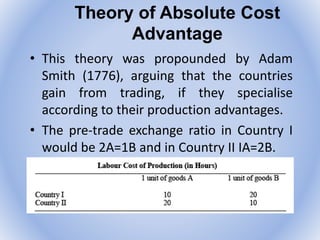
• This theory was propounded by Adam
Smith (1776), arguing that the countries
gain from trading, if they specialise
according to their production advantages.
• The pre-trade exchange ratio in Country I
would be 2A=1B and in Country II IA=2B.
Theory of Absolute Cost
Advantage
• If it is nearer to Country I domestic exchange
ratio then trade would be more beneficial to
Country II and vice versa.
• Assuming the international exchange ratio is
established IA=IB.
• The terms of trade between the trading partners
would depend upon their economic strength and
the bargaining power.
Theory of Comparative Cost
Advantage
• Ricardo (1817), though adhering to the absolute
cost advantage doctrine of Adam Smith, pointed
out that cost advantage to both the trade
partners was not a necessary condition for trade
to occur.
• According to Ricardo, so long as the other
country is not equally less productive in all lines
of production, measurable in terms of
opportunity cost of each commodity in the two
countries, it will still be mutually gainful for them
if they enter into trade.
Theory of Comparative Cost Advantage
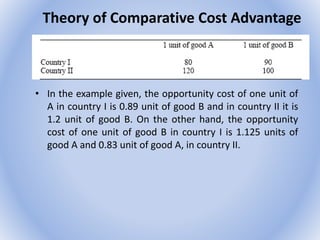
• In the example given, the opportunity cost of one unit of
A in country I is 0.89 unit of good B and in country II it is
1.2 unit of good B. On the other hand, the opportunity
cost of one unit of good B in country I is 1.125 units of
good A and 0.83 unit of good A, in country II.
Theory of Comparative Cost Advantage
• The opportunity cost of the two goods are different in
both the countries and as long as this is the case, they will
have comparative advantage in the production of either,
good A or good B, and will gain from trade regardless of
the fact that one of the trade partners may be possessing
absolute cost advantage in both lines of production.
• Thus, country I has comparative advantage in good A as
the opportunity cost of its production is lower in this
country as compared to its opportunity cost in country II
which has comparative advantage in the production of
good B on the same reasoning.
Types of International Business
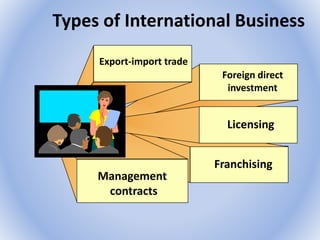
Export-import trade
Foreign direct
investment
Licensing
Franchising
Management
contracts

Ibe

  • 1.
  • 2.
    International Business • Thebuying and selling of the goods and services across the border. • The national border are crossed by the enterprises to expand their business activities like manufacturing, mining, construction, agriculture, banking, insurance, health, education, transportation, communication and so on.
  • 3.
    Trade • Trade meansexchange of goods and services for the satisfaction of human wants. • When trade is confined to the geographical limits of a country, it is a domestic or national trade. • International or foreign trade refers to the trade between two countries. • Technically, domestic trade and International trade are more or less identical and are based on the same basic principles of trades.
  • 4.
    Differences between Domesticand International Business • Difference in Currencies • Difference in Natural and Geographical Conditions • Mobility of Factors of Production • Sovereign Political Entities – Imposition of tariffs and customs duties on imports and exports; – Quantitative restrictions like quotas; – Exchange control; – Imposition of more local taxes etc. • Different Legal Systems
  • 5.
    Importance of IBE •Helps in expansion: Geographic expansion may be used as a business strategy. Even though companies may expand their business at home. • Helps in managing product life cycle: Every product has to pass through different stages of product life cycle- when the product reaches the last stages of life cycle in present market, it may get proper response at other markets. • Technology advantages: Some companies have outstanding technology advantages through which they enjoy core competency. This technology helps the company in capturing other markets. Cont…
  • 6.
    Importance of IBE •New business opportunities: Business opportunities in overseas markets help in expansion of many companies. They might have reached a saturation point in domestic market. • Proper use of resources: Sometimes industrial resources like labor, minerals etc. are available in a country but are not productively utilized. • Availability of quality products: When markets are open, better quality goods will be available every where. Foreign companies will market latest products at reasonable prices. Good product will be available in the markets. Cont…
  • 7.
    Importance of IBE •Earning foreign exchange: International business helps in earning foreign exchange which may be used for strategic imports. India needs foreign exchange to import crude oil, deface equipment, raw material and machinery. • Helps in mutual growth: Countries depend upon each other for meeting their requirements. India depends on gulf countries for its crude oil supplies. • Investment in infrastructure: International business necessitates proper development of infrastructure.
  • 8.
    Problems in InternationalBusiness • Controlling the market: Multinational try to control the market of the host country. Whenever they enter a new country, the first strategy is to eliminate the competitors either by taking over their business or forcing them out of market by following price reduction policies. • Exhausting natural resources: Multinational corporations set up their production facilities in those countries where natural resources are available in sufficient quantities. • Importance to luxuries: Multinational corporations enter those areas where margin of profits is high. Cont…
  • 9.
    Problems in InternationalBusiness • Trade practices: Since multinational corporations have their head office in one country and the trade practices followed there are adhered to. • Economic development: It is generally felt that the entry of businessmen from outside may help in the economic development of that country . The actual practice in many countries is different. • Shifting of investment: International business is related to profitability of its operations. If a business is getting sufficient profits in a particular country then the investment remain there.
  • 10.
    Need for InternationalBusiness – causes the flow of ideas, services, and capital across the world – offers consumers new choices – permits the acquisition of a wider variety of products – facilitates the mobility of labor, capital, and technology – provides challenging employment opportunities – reallocates resources, makes preferential choices, and shifts activities to a global level
  • 11.
    Trends in IB •Trade between partners of Regional Trade Agreements (RTAs) • Developing countries’ trade • South-South trade • Air Cargo; Express cargo • Global production network • Intra-firm trade • E-commerce
  • 12.
    Developing countries’ trade •It is observed that developing countries are increasingly becoming an important destination for the exports of developed countries. • Some problems have been recognized in identifying tariff classification and assessing the Customs value of second-hand goods such as used cars, computer equipment, machinery and clothing.
  • 13.
    South-South trade • Merchandisetrade between developing countries, i.e. South-South trade. • Intra-regional trade, in particular through RTAs, played a central role in the rise of South-South trade.
  • 14.
    Air Cargo; Expresscargo • It is reported that world air cargo accounts at present for a small portion of world merchandise trade by weight, but a significant portion by value. • This important growth in express traffic can be attributed to several factors – globalization and associated Just-In-Time production and distribution systems – increased trade in high-value low-weight products and – the provision of a service that assists SMEs to compete effectively in an increasingly global market
  • 15.
    Global Production Network •The share of manufactured goods within world merchandise trade has grown significantly throughout the world. • The share of parts and components exports of total merchandise exports has greatly increased in all six regions of the world, for example from 6% in 1980 to 15% in 2002 in the East Asia region. • Exported goods contain a significant portion of imported intermediate inputs. In the ā€œinternational segmentation of productionā€, intermediate inputs are exported for more processed intermediate inputs, which are then exported to the next stage in production.
  • 16.
    Intra-firm trade • Intra-firmtrade, i.e. trade within the same company around one-third of world merchandise trade, although aggregate data are only available for a few countries. • Intra-firm trade between high and middle- income countries was directly related to the internationalization of production. • The affiliates in the middle-income countries were mostly instructed to manufacture goods destined for other markets, including the country of the parent company.
  • 17.
    E-commerce • It hasdominant factor in international trade and business, although traditional methods of trade and business continue to be utilized widely. • It can reduce business costs in seeking potential foreign business partners, as well as improve a firm’s visibility in global marketing services, in particular for SMEs. • It enables firms to take more opportunities to expand their business in global markets.
  • 18.
    International Trade Theories •Theory of Mercantilism • Theory of Absolute Cost Advantage • Theory of Comparative Cost Advantage • Heckscher-Ohlin Model Leonief Paradox
  • 19.
    Theory of Mercantilism •This theory is during the sixteenth to the three-fourths of the eighteenth centuries. • It beliefs in nationalism and the welfare of the nation alone, planning and regulation of economic activities for achieving the national goals, curbing imports and promoting exports. • It believed that the power of a nation lied in its wealth, which grew by acquiring gold from abroad.
  • 20.
    Theory of Mercantilism •Mercantilists failed to realize that simultaneous export promotion and import regulation are not possible in all countries, and the mere possession of gold does not enhance the welfare of a people. • Keeping the resources in the form of gold reduces the production of goods and services and, thereby, lowers welfare. • It was rejected by Adam Smith and Ricardo by stressing the importance of individuals, and pointing out that their welfare was the welfare of the nation.
  • 21.
    Theory of AbsoluteCost Advantage • This theory was propounded by Adam Smith (1776), arguing that the countries gain from trading, if they specialise according to their production advantages. • The pre-trade exchange ratio in Country I would be 2A=1B and in Country II IA=2B.
  • 22.
    Theory of AbsoluteCost Advantage • If it is nearer to Country I domestic exchange ratio then trade would be more beneficial to Country II and vice versa. • Assuming the international exchange ratio is established IA=IB. • The terms of trade between the trading partners would depend upon their economic strength and the bargaining power.
  • 23.
    Theory of ComparativeCost Advantage • Ricardo (1817), though adhering to the absolute cost advantage doctrine of Adam Smith, pointed out that cost advantage to both the trade partners was not a necessary condition for trade to occur. • According to Ricardo, so long as the other country is not equally less productive in all lines of production, measurable in terms of opportunity cost of each commodity in the two countries, it will still be mutually gainful for them if they enter into trade.
  • 24.
    Theory of ComparativeCost Advantage • In the example given, the opportunity cost of one unit of A in country I is 0.89 unit of good B and in country II it is 1.2 unit of good B. On the other hand, the opportunity cost of one unit of good B in country I is 1.125 units of good A and 0.83 unit of good A, in country II.
  • 25.
    Theory of ComparativeCost Advantage • The opportunity cost of the two goods are different in both the countries and as long as this is the case, they will have comparative advantage in the production of either, good A or good B, and will gain from trade regardless of the fact that one of the trade partners may be possessing absolute cost advantage in both lines of production. • Thus, country I has comparative advantage in good A as the opportunity cost of its production is lower in this country as compared to its opportunity cost in country II which has comparative advantage in the production of good B on the same reasoning.
  • 26.
    Types of InternationalBusiness Export-import trade Foreign direct investment Licensing Franchising Management contracts