


Globalization in India

Presented by:
Narender singh
Neha kumari
Yash Ramkar
BBA 2nd sem(A)
*
* In early nineties .
* India’s import and export .
*

introduction of economic reforms .

*
Liberalization

Privatization

Globalization

*
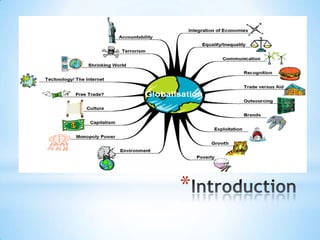
*Globalization can be defined as the process of

change, increasing interconnectedness and
interdependence among countries and economies,
bringing the world closer through better world-wide
communication, transport and trade links.

*
* Economic Impact
* Social impact

* cultural impact
* Industrial impact

* Investment impact

*
*

access to global markets.

* access to quality goods and services .

* Access to global capital resources via the stock market
and international debt.

* Access to technology.

* Increased access to better and qualitative education.

*
* The free flow of Information .
* liberalized our attitudes, reduced our biases and
predispositions .

* Diluted the inhibitions.
* Experience of relevance .

*
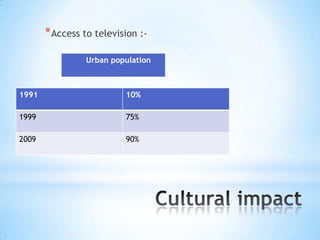
* Access to television :Urban population

1991

10%

1999

75%

2009

90%
*

MNC’s in India.

*

level of unemployment and poverty .

* demand has become homogeneous.
* competition in business world

*
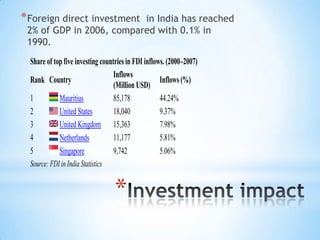
* Foreign direct investment

in India has reached
2% of GDP in 2006, compared with 0.1% in
1990.
Share of top five investing countries in FDI inflows. (2000–2007)
Inflows
Rank Country
Inflows (%)
(Million USD)
1
85,178
44.24%
Mauritius
2
United States
18,040
9.37%
3
United Kingdom 15,363
7.98%
4
11,177
5.81%
Netherlands
5
9,742
5.06%
Singapore
Source: FDI in India Statistics

*
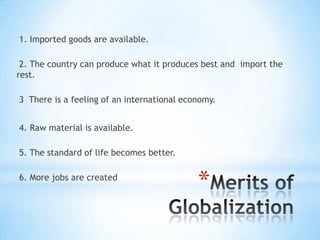
1. Imported goods are available.
2. The country can produce what it produces best and import the
rest.
3 There is a feeling of an international economy.
4. Raw material is available.
5. The standard of life becomes better.
6. More jobs are created

*
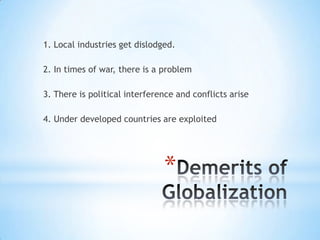
1. Local industries get dislodged.
2. In times of war, there is a problem
3. There is political interference and conflicts arise
4. Under developed countries are exploited

*
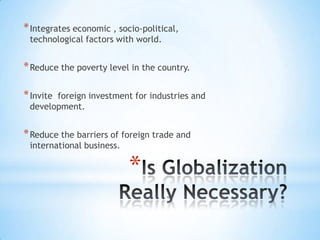
* Integrates economic , socio-political,
technological factors with world.

* Reduce the poverty level in the country.
* Invite

foreign investment for industries and
development.

* Reduce the barriers of foreign trade and
international business.

*
Globalization in india

Globalization in india

  • 1.
    Globalization in India Presentedby: Narender singh Neha kumari Yash Ramkar BBA 2nd sem(A)
  • 2.
  • 3.
    * In earlynineties . * India’s import and export . * introduction of economic reforms . *
  • 4.
  • 5.
    *Globalization can bedefined as the process of change, increasing interconnectedness and interdependence among countries and economies, bringing the world closer through better world-wide communication, transport and trade links. *
  • 6.
    * Economic Impact *Social impact * cultural impact * Industrial impact * Investment impact *
  • 7.
    * access to globalmarkets. * access to quality goods and services . * Access to global capital resources via the stock market and international debt. * Access to technology. * Increased access to better and qualitative education. *
  • 8.
    * The freeflow of Information . * liberalized our attitudes, reduced our biases and predispositions . * Diluted the inhibitions. * Experience of relevance . *
  • 9.
    * Access totelevision :Urban population 1991 10% 1999 75% 2009 90%
  • 11.
    * MNC’s in India. * levelof unemployment and poverty . * demand has become homogeneous. * competition in business world *
  • 12.
    * Foreign directinvestment in India has reached 2% of GDP in 2006, compared with 0.1% in 1990. Share of top five investing countries in FDI inflows. (2000–2007) Inflows Rank Country Inflows (%) (Million USD) 1 85,178 44.24% Mauritius 2 United States 18,040 9.37% 3 United Kingdom 15,363 7.98% 4 11,177 5.81% Netherlands 5 9,742 5.06% Singapore Source: FDI in India Statistics *
  • 13.
    1. Imported goodsare available. 2. The country can produce what it produces best and import the rest. 3 There is a feeling of an international economy. 4. Raw material is available. 5. The standard of life becomes better. 6. More jobs are created *
  • 14.
    1. Local industriesget dislodged. 2. In times of war, there is a problem 3. There is political interference and conflicts arise 4. Under developed countries are exploited *
  • 15.
    * Integrates economic, socio-political, technological factors with world. * Reduce the poverty level in the country. * Invite foreign investment for industries and development. * Reduce the barriers of foreign trade and international business. *