GLOBALIZATION &
INFORMATION AND COMMUNICATION
TECHNOLOGIES (ICTs)

LECTURE 3
POINTS TO COVER
1. What are some of the ways that ICTs have
facilitated globalization process?
2. What kinds of information skills are needed to be
personally, professionally, and academically
successful in the Information Age?
3. What factors contribute to the existence of digital
devices both within specific countries and between
developed and developing countries?
4. How might ICTs facilitate development?
5. What are some of the potentially positive and
potentially negative consequences of the
globalization media?
WHAT ARE ICTs?

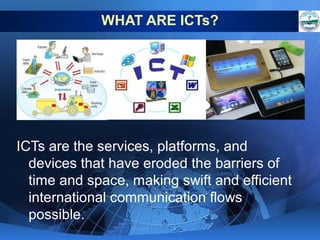
ICTs are the services, platforms, and
devices that have eroded the barriers of
time and space, making swift and efficient
international communication flows
possible.
Types of ICTs
Digital technologies and infrastructure and products that

facilitate the acquisition, storage, analysis, manipulation, and
distribution of information.
Other technologies that enable collection, processing,
transmission, and presentation of information in a number of
ways including voice, data, text, images, video, and
animation.
3 dominant ICT technologies: PC, cell-phone/mobile,
internet
ICT also includes webcams, email, DVDs, flash memory,
hard drives, servers, and networks, soft-wares.
ICTs ~ digital technologies that have rapidly changed the
world
WHAT ARE THE ROLES OF ICTs IN
GLOBALIZATION PROCESS?
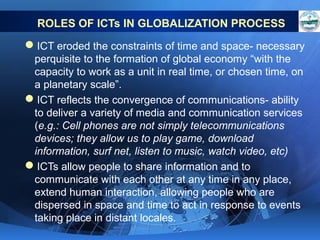
ROLES OF ICTs IN GLOBALIZATION PROCESS

ICT eroded the constraints of time and space- necessary
perquisite to the formation of global economy “with the
capacity to work as a unit in real time, or chosen time, on
a planetary scale”.
ICT reflects the convergence of communications- ability
to deliver a variety of media and communication services
(e.g.: Cell phones are not simply telecommunications
devices; they allow us to play game, download
information, surf net, listen to music, watch video, etc)
ICTs allow people to share information and to
communicate with each other at any time in any place,
extend human interaction, allowing people who are
dispersed in space and time to act in response to events
taking place in distant locales.
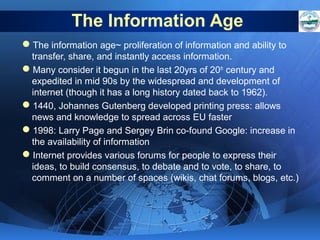
The Information Age
The information age~ proliferation of information and ability to
transfer, share, and instantly access information.
Many consider it begun in the last 20yrs of 20th century and
expedited in mid 90s by the widespread and development of
internet (though it has a long history dated back to 1962).
1440, Johannes Gutenberg developed printing press: allows
news and knowledge to spread across EU faster
1998: Larry Page and Sergey Brin co-found Google: increase in
the availability of information
Internet provides various forums for people to express their
ideas, to build consensus, to debate and to vote, to share, to
comment on a number of spaces (wikis, chat forums, blogs, etc.)
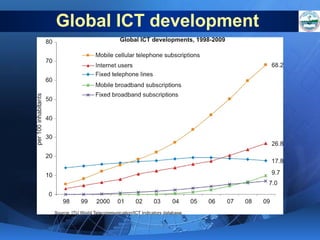
Global ICT development
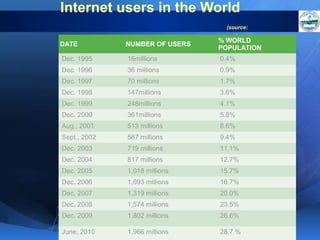
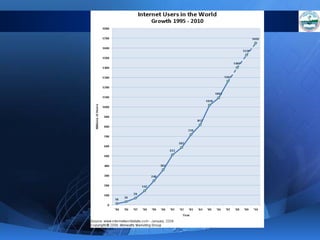
Internet users in the World
(source:
www.internetworldstats.com/emarketing.htm)

NUMBER OF USERS

% WORLD
POPULATION

Dec. 1995

16millions

0.4%

Dec. 1996

36 millions

0.9%

Dec. 1997

70 millions

1.7%

Dec. 1998

147millions

3.6%

Dec. 1999

248millions

4.1%

Dec. 2000

361millions

5.8%

Aug., 2001

513 millions

8.6%

Sept., 2002

587 millions

9.4%

Dec. 2003

719 millions

11.1%

Dec. 2004

817 millions

12.7%

Dec. 2005

1,018 millions

15.7%

Dec. 2006

1,093 millions

16.7%

Dec, 2007

1,319 millions

20.0%

Dec, 2008

1,574 millions

23.5%

Dec. 2009

1,802 millions

26.6%

June, 2010

1,966 millions

28.7 %

DATE
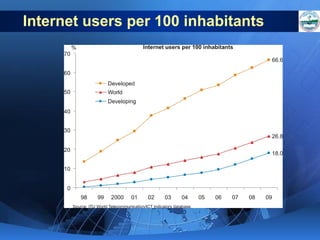
Internet users per 100 inhabitants
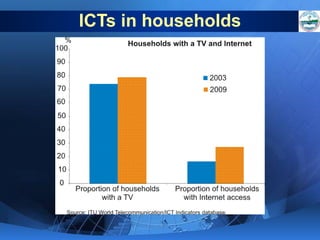
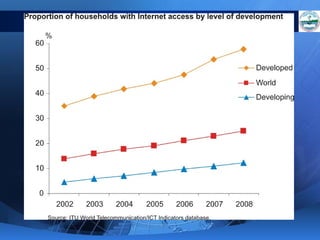
ICTs in households
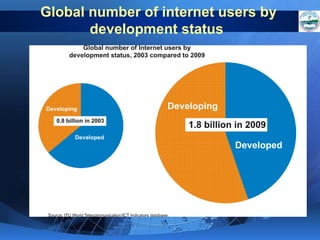
Global number of internet users by
development status
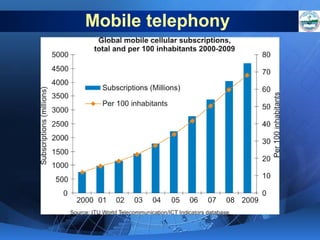
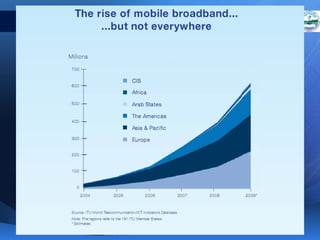
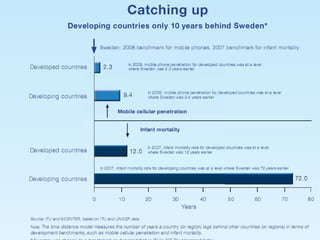
Mobile telephony
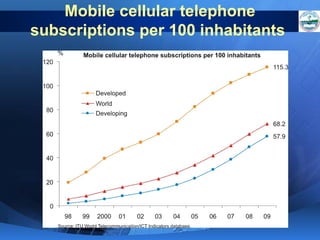
Mobile cellular telephone
subscriptions per 100 inhabitants
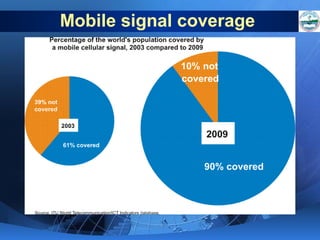
Mobile signal coverage
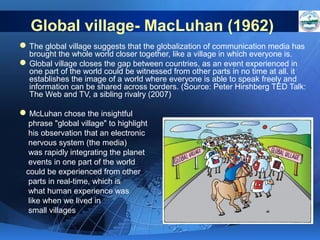
Global village- MacLuhan (1962)
 The global village suggests that the globalization of communication media has

brought the whole world closer together, like a village in which everyone is.
 Global village closes the gap between countries, as an event experienced in
one part of the world could be witnessed from other parts in no time at all. it
establishes the image of a world where everyone is able to speak freely and
information can be shared across borders. (Source: Peter Hirshberg TED Talk:
The Web and TV, a sibling rivalry (2007)

 McLuhan chose the insightful
phrase "global village" to highlight
his observation that an electronic
nervous system (the media)
was rapidly integrating the planet
events in one part of the world
could be experienced from other
parts in real-time, which is
what human experience was
like when we lived in
small villages
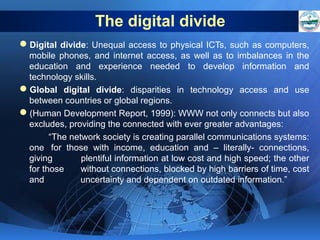
The digital divide
Digital divide: Unequal access to physical ICTs, such as computers,
mobile phones, and internet access, as well as to imbalances in the
education and experience needed to develop information and
technology skills.
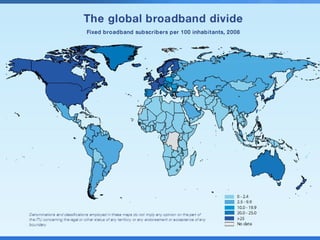
Global digital divide: disparities in technology access and use
between countries or global regions.
(Human Development Report, 1999): WWW not only connects but also
excludes, providing the connected with ever greater advantages:
“The network society is creating parallel communications systems:
one for those with income, education and – literally- connections,
giving
plentiful information at low cost and high speed; the other
for those
without connections, blocked by high barriers of time, cost
and
uncertainty and dependent on outdated information.”
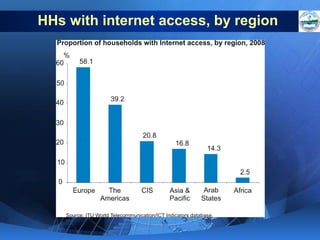
HHs with internet access, by region
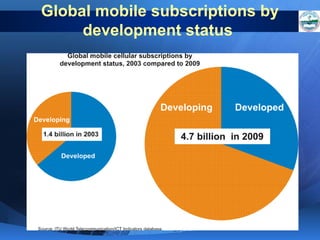
Global mobile subscriptions by
development status
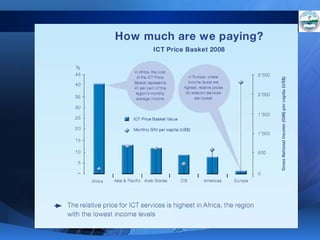
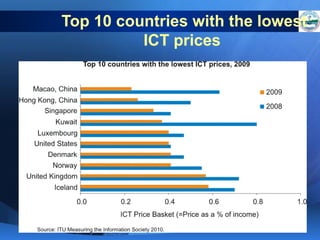
Top 10 countries with the lowest
ICT prices
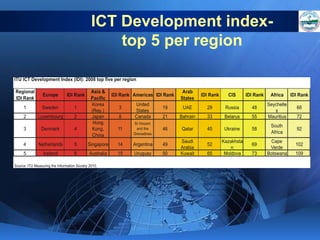
ICT Development indextop 5 per region
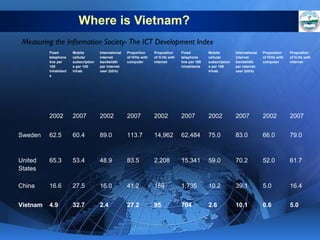
Where is Vietnam?
Measuring the Information Society- The ICT Development Index
Fixed
telephone
line per
100
inhabitant
s

Mobile
cellular
subscription
s per 100
inhab.

International
internet
bandwidth
per internet
user (bit/s)

Proportion
of H/Hs with
computer

Propostion
of H.Hs with
internet

Fixed
telephone
line per 100
inhabitants

Mobile
cellular
subscription
s per 100
inhab.

International
internet
bandwidth
per internet
user (bit/s)

Propostion
of H/Hs with
computer

Propostion
of H.Hs with
internet

2002

2007

2002

2007

2002

2007

2002

2007

2002

2007

Sweden

62.5

60.4

89.0

113.7

14,962

62,484

75.0

83.0

66.0

79.0

United
States

65.3

53.4

48.9

83.5

2,208

15,341

59.0

70.2

52.0

61.7

China

16.6

27.5

16.0

41.2

159

1,735

10.2

39.1

5.0

16.4

Vietnam

4.9

32.7

2.4

27.2

95

704

2.6

10.1

0.6

5.0
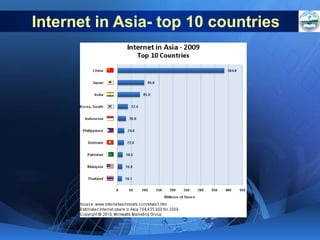
Internet in Asia- top 10 countries
Conclusion
ICTs encompasses the digital technologies and

infrastructure that have facilitated globalization
processes.
ICTs are the services, platforms, and devices that
have eroded the barriers of time and space, making
swift and efficient international communication flows
possible.
The important role of ICTs in poverty reduction
Efforts needed to provide people around the world
access to the information and communication tools
that can enhance their chances of achieving their
goals for themselves, their families and their
communities.
Convergence process of devices (mobile devices)
making media forms changing
Tutorial Questions
 What are some of the ways that
information and communication
technologies have facilitated globalization
processes?
 How might information and
communication technologies facilitate
development?
 What are some of the potentially positive
and negative consequences of the
globalization of media?

Globalization & ICTs

  • 1.
    GLOBALIZATION & INFORMATION ANDCOMMUNICATION TECHNOLOGIES (ICTs) LECTURE 3
  • 2.
    POINTS TO COVER 1.What are some of the ways that ICTs have facilitated globalization process? 2. What kinds of information skills are needed to be personally, professionally, and academically successful in the Information Age? 3. What factors contribute to the existence of digital devices both within specific countries and between developed and developing countries? 4. How might ICTs facilitate development? 5. What are some of the potentially positive and potentially negative consequences of the globalization media?
  • 3.
    WHAT ARE ICTs? ICTsare the services, platforms, and devices that have eroded the barriers of time and space, making swift and efficient international communication flows possible.
  • 4.
    Types of ICTs Digitaltechnologies and infrastructure and products that facilitate the acquisition, storage, analysis, manipulation, and distribution of information. Other technologies that enable collection, processing, transmission, and presentation of information in a number of ways including voice, data, text, images, video, and animation. 3 dominant ICT technologies: PC, cell-phone/mobile, internet ICT also includes webcams, email, DVDs, flash memory, hard drives, servers, and networks, soft-wares. ICTs ~ digital technologies that have rapidly changed the world
  • 5.
    WHAT ARE THEROLES OF ICTs IN GLOBALIZATION PROCESS?
  • 6.
    ROLES OF ICTsIN GLOBALIZATION PROCESS ICT eroded the constraints of time and space- necessary perquisite to the formation of global economy “with the capacity to work as a unit in real time, or chosen time, on a planetary scale”. ICT reflects the convergence of communications- ability to deliver a variety of media and communication services (e.g.: Cell phones are not simply telecommunications devices; they allow us to play game, download information, surf net, listen to music, watch video, etc) ICTs allow people to share information and to communicate with each other at any time in any place, extend human interaction, allowing people who are dispersed in space and time to act in response to events taking place in distant locales.
  • 7.
    The Information Age Theinformation age~ proliferation of information and ability to transfer, share, and instantly access information. Many consider it begun in the last 20yrs of 20th century and expedited in mid 90s by the widespread and development of internet (though it has a long history dated back to 1962). 1440, Johannes Gutenberg developed printing press: allows news and knowledge to spread across EU faster 1998: Larry Page and Sergey Brin co-found Google: increase in the availability of information Internet provides various forums for people to express their ideas, to build consensus, to debate and to vote, to share, to comment on a number of spaces (wikis, chat forums, blogs, etc.)
  • 8.
  • 9.
    Internet users inthe World (source: www.internetworldstats.com/emarketing.htm) NUMBER OF USERS % WORLD POPULATION Dec. 1995 16millions 0.4% Dec. 1996 36 millions 0.9% Dec. 1997 70 millions 1.7% Dec. 1998 147millions 3.6% Dec. 1999 248millions 4.1% Dec. 2000 361millions 5.8% Aug., 2001 513 millions 8.6% Sept., 2002 587 millions 9.4% Dec. 2003 719 millions 11.1% Dec. 2004 817 millions 12.7% Dec. 2005 1,018 millions 15.7% Dec. 2006 1,093 millions 16.7% Dec, 2007 1,319 millions 20.0% Dec, 2008 1,574 millions 23.5% Dec. 2009 1,802 millions 26.6% June, 2010 1,966 millions 28.7 % DATE
  • 11.
    Internet users per100 inhabitants
  • 12.
  • 13.
    Global number ofinternet users by development status
  • 14.
  • 15.
  • 16.
  • 17.
    Global village- MacLuhan(1962)  The global village suggests that the globalization of communication media has brought the whole world closer together, like a village in which everyone is.  Global village closes the gap between countries, as an event experienced in one part of the world could be witnessed from other parts in no time at all. it establishes the image of a world where everyone is able to speak freely and information can be shared across borders. (Source: Peter Hirshberg TED Talk: The Web and TV, a sibling rivalry (2007)  McLuhan chose the insightful phrase "global village" to highlight his observation that an electronic nervous system (the media) was rapidly integrating the planet events in one part of the world could be experienced from other parts in real-time, which is what human experience was like when we lived in small villages
  • 18.
    The digital divide Digitaldivide: Unequal access to physical ICTs, such as computers, mobile phones, and internet access, as well as to imbalances in the education and experience needed to develop information and technology skills. Global digital divide: disparities in technology access and use between countries or global regions. (Human Development Report, 1999): WWW not only connects but also excludes, providing the connected with ever greater advantages: “The network society is creating parallel communications systems: one for those with income, education and – literally- connections, giving plentiful information at low cost and high speed; the other for those without connections, blocked by high barriers of time, cost and uncertainty and dependent on outdated information.”
  • 21.
    HHs with internetaccess, by region
  • 24.
    Global mobile subscriptionsby development status
  • 26.
    Top 10 countrieswith the lowest ICT prices
  • 27.
  • 28.
    Where is Vietnam? Measuringthe Information Society- The ICT Development Index Fixed telephone line per 100 inhabitant s Mobile cellular subscription s per 100 inhab. International internet bandwidth per internet user (bit/s) Proportion of H/Hs with computer Propostion of H.Hs with internet Fixed telephone line per 100 inhabitants Mobile cellular subscription s per 100 inhab. International internet bandwidth per internet user (bit/s) Propostion of H/Hs with computer Propostion of H.Hs with internet 2002 2007 2002 2007 2002 2007 2002 2007 2002 2007 Sweden 62.5 60.4 89.0 113.7 14,962 62,484 75.0 83.0 66.0 79.0 United States 65.3 53.4 48.9 83.5 2,208 15,341 59.0 70.2 52.0 61.7 China 16.6 27.5 16.0 41.2 159 1,735 10.2 39.1 5.0 16.4 Vietnam 4.9 32.7 2.4 27.2 95 704 2.6 10.1 0.6 5.0
  • 29.
    Internet in Asia-top 10 countries
  • 30.
    Conclusion ICTs encompasses thedigital technologies and infrastructure that have facilitated globalization processes. ICTs are the services, platforms, and devices that have eroded the barriers of time and space, making swift and efficient international communication flows possible. The important role of ICTs in poverty reduction Efforts needed to provide people around the world access to the information and communication tools that can enhance their chances of achieving their goals for themselves, their families and their communities. Convergence process of devices (mobile devices) making media forms changing
  • 31.
    Tutorial Questions  Whatare some of the ways that information and communication technologies have facilitated globalization processes?  How might information and communication technologies facilitate development?  What are some of the potentially positive and negative consequences of the globalization of media?

Editor's Notes

  • #15 http://www.itu.int/ITU-D/ict/statistics/material/graphs/Global_mobile_cellular_00-09.jpg
  • #16 http://www.itu.int/ITU-D/ict/statistics/material/graphs/Mobile_cellular_98-08.jpg
  • #22 Commonwealth of Independent States (CIS) = former Soviet union countries
  • #25 http://www.itu.int/ITU-D/ict/statistics/material/graphs/Mobile_cellular_03-09.jpg