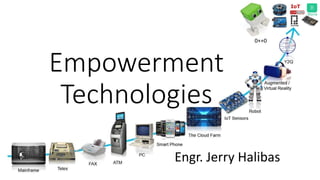
Empowerment
Technologies
Engr. Jerry Halibas
0++0
Information and Communication Technology
• Are you a digital native?
• Let’s find out. Answer the following questions honestly.
1. How many times have you checked your phone this morning?
2. How many status updates have you posted in Facebook or Twitter
today?
3. Did you use the Internet for an hour after you woke up this
morning?
4. Do you follow a celebrity via his/her social media account?
Information and Communication Technology
• If you happen to be “guilty as charged” in most of these questions,
chances are, you are a digital native. And chances are, from the
moment you were born, you were surrounded by technology. You are
surrounded by ICT.
• What is digital native?
• Digital Native is a person born or brought up during the age of digital
technology and therefore familiar with computers and the Internet
from an early age.
Information and Communication Technology
• As the famous saying goes, "Love makes the world go round." But you
might argue how the Internet has made the world go round for
decades before you start searching for someone to fall in love with.
Likewise, the Internet has probably made your world go round in the
motivation activity.
• In this lesson we will understand how information and
communication technologies in such a short period of time have
improved our lives.
Information and Communication Technology
• What is ICT?
• It deals with the use of different communication
technologies such as mobile phones, Internet and etc. to
locate, save, send, and edit information.
• Having a unified way to communicate is one of the goals of ICT. We
spend less because of ICT.
Information and Communication Technology
• What is www?
• It stands for world wide web, or also referred as w3 or
simply the Web is an interconnected system of public
webpages accessible through the Internet. It was invented
Sir Tim Berners-Lee in 1989.
• Web pages are what make up the world wide web and it
can either be static or dynamic.
Information and Communication Technology
• Web 1.0
• Web 1.0 is the term used for the earliest version of the Internet as it
emerged from its origins with Defense Advanced Research Projects
Agency (DARPA) and became, for the first time, a global network
representing the future of digital communications. It describes the
first “iteration” of what became a growing, evolving medium that
eventually expanded into a platform with profound multi-functional
uses.
• Web pages are static and not interactive. You can’t post comments or
create an account.
Information and Communication Technology
• Examples of websites in Web 1.0
Information and Communication Technology
• Examples of websites in Web 1.0
Information and Communication Technology
• Web 2.0
• Term used to describe the present generation of the World Wide Web
that concentrates on its capability of providing people the means to
collaborate and share information online.
• The second stage in World Wide Web
• Dynamic Website – The content of the website changes
• Interactive – The user may be able to comment or create user
account
• Enables an increased under participation in the web
Information and Communication Technology
• Web 2.0
• Term Darcy DiNucci, an information architecture consultant, coined
the term Web 2.0 in her 1999 article, “Fragmented Future”.
• The term was popularized by Tim O'Reilly and Dale Dougherty at the
O'Reilly Media Web 2.0 Conference in late 2004 (TechTarget, 2015).
Information and Communication Technology
• Features of Web 2.0
• Folksonomy - It allows users to categorize and classify/arrange
information using freely chosen keywords (e.g., tagging). Popular
social networking sites such as Twitter, Instagram, Facebook, etc. use
tags that start with the pound sign (#). This is also referred to as
hashtag.
• Rich User Experience - Content is dynamic and is responsive to user’s
input. An example would be a website that shows local content. In
the case of social networking sites, when logged on, your account is
used to modify what you see in their website.
Information and Communication Technology
• Features of Web 2.0
• User Participation - The owner of the website is not the only one who
is able to put content. Others are able to place a content of their own
by means of comment, reviews, and evaluation. Some websites allow
readers to comment on an article, participate in a poll, or review a
specific product (e.g., Amazon.com, online stores).
• Mass Participation - It is a diverse information sharing through
universal web access. Since most users can use the Internet, Web
2.0’s content is based on people from various cultures.
Information and Communication Technology
• Features of Web 2.0
• Software as a Service - Users will subscribe to a software only when
needed rather than purchasing them. This is a cheaper option if you
do not always need to use a software. For instance, Google Docs is a
free web-based application that allows the user to create and edit
word processing and spreadsheet documents online. When you need
a software, like a Word Processor, you can purchase it for a one-time
huge amount and install it in your computer and it is yours forever.
Software as a service allows you to “rent” a software for a minimal
fee.
Information and Communication Technology
• Web 3.0
• Also called as Semantic Web
• Semantics – ability of Web technologies to understand and interpret
human-generated content
Information and Communication Technology
• Web 3.0
• The aim of Web 3.0 is to have machines understand the user’s
preferences to be able to deliver web content specifically targeting
the user.
• The Internet is able to predict the best possible answers to your
question by “learning from your previous choices
Information and Communication Technology
• Trends in ICT
• As the world of ICT continues to grow, the industry has focused on
several innovations. These innovations cater to the needs of the
people that benefit most out of ICT. Whether it is for business or
personal use, these trends are current front runners in the innovation
of ICT.
Information and Communication Technology
• Trends in ICT
1. Convergence - Technological convergence is the combination of two
or more different entities of technologies to create a new single
device.
• Example: Using of smartphone to create word documents that was
previously can only be created using desktop computer.
2. Social Media
• It is a website, application, or online channel that enables web users
to create, co-create, modify, and exchange user-generated content.
Information and Communication Technology
• Trends in ICT
3. Mobile Technologies
• The popularity of smartphones and tablets has taken a major rise over the
years. This is largely because of the devices’ capability to do tasks that were
originally found in personal computers.
4. Assistive Media
• It is a nonprofit service designed to help people who have visual and
reading impairments. A database of audio recordings is used to read to the
user. You may visit http://assistivemedia.org/ for several of their audio
recordings.
Information and Communication Technology
• Types of Social Media
1. Social Networks - sites that allow you to connect with other people
with same interests or background.
Examples: Facebook, Google+
2. Bookmarking Sites - sites that allow users you to store and manage
links to various websites and resources, and to tag
Examples: StumbleUpon, Pinterest
Information and Communication Technology
• Types of Social Media
3. Social News - sites that allow users to post their own news items or
links to other news sources.
Examples: reddit, dig
4. Media Sharing - sites that allow you to upload and share media
content like images, music, and video.
Examples: Flickr, YouTube, and Instagram
Information and Communication Technology
• Types of Social Media
5. Microblogging - sites that focus on short updates from the user.
Those who are subscribed will receive updates.
Examples: Twitter, Plurk
6. Blogs and Forums - sites that allow users to post their content.
Examples: Blogger, WordPress, Tumblr
Information and Communication Technology
• Mobile Technologies
• The popularity of smartphones and tablets has taken a major rise
over the years. This is largely because of the devices’ capability to do
tasks that were originally found in personal computers.
Information and Communication Technology
• Different Types of Mobile Operating Systems:
1. iOS – used in Apple devices such as the iPhone and iPad
2. Android – an open source operating system developed by Google.
Being open source means several mobile phone companies use this
OS for free.
3. Blackberry OS – used in blackberry devices
4. Windows Phone OS – a closed source and proprietary operating
system developed by Microsoft
Information and Communication Technology
• Different Types of Mobile Operating Systems:
5. Symbian – the original smartphone OS used by Nokia devices
6. WebOS – originally used for smartphones; now used for smartTVs
7. Windows Mobile – developed by Microsoft for smartphones and
pocket PCs.

Empowerment Technologies 1.pptx

  • 1.
  • 2.
    Information and CommunicationTechnology • Are you a digital native? • Let’s find out. Answer the following questions honestly. 1. How many times have you checked your phone this morning? 2. How many status updates have you posted in Facebook or Twitter today? 3. Did you use the Internet for an hour after you woke up this morning? 4. Do you follow a celebrity via his/her social media account?
  • 3.
    Information and CommunicationTechnology • If you happen to be “guilty as charged” in most of these questions, chances are, you are a digital native. And chances are, from the moment you were born, you were surrounded by technology. You are surrounded by ICT. • What is digital native? • Digital Native is a person born or brought up during the age of digital technology and therefore familiar with computers and the Internet from an early age.
  • 4.
    Information and CommunicationTechnology • As the famous saying goes, "Love makes the world go round." But you might argue how the Internet has made the world go round for decades before you start searching for someone to fall in love with. Likewise, the Internet has probably made your world go round in the motivation activity. • In this lesson we will understand how information and communication technologies in such a short period of time have improved our lives.
  • 5.
    Information and CommunicationTechnology • What is ICT? • It deals with the use of different communication technologies such as mobile phones, Internet and etc. to locate, save, send, and edit information. • Having a unified way to communicate is one of the goals of ICT. We spend less because of ICT.
  • 6.
    Information and CommunicationTechnology • What is www? • It stands for world wide web, or also referred as w3 or simply the Web is an interconnected system of public webpages accessible through the Internet. It was invented Sir Tim Berners-Lee in 1989. • Web pages are what make up the world wide web and it can either be static or dynamic.
  • 7.
    Information and CommunicationTechnology • Web 1.0 • Web 1.0 is the term used for the earliest version of the Internet as it emerged from its origins with Defense Advanced Research Projects Agency (DARPA) and became, for the first time, a global network representing the future of digital communications. It describes the first “iteration” of what became a growing, evolving medium that eventually expanded into a platform with profound multi-functional uses. • Web pages are static and not interactive. You can’t post comments or create an account.
  • 8.
    Information and CommunicationTechnology • Examples of websites in Web 1.0
  • 9.
    Information and CommunicationTechnology • Examples of websites in Web 1.0
  • 10.
    Information and CommunicationTechnology • Web 2.0 • Term used to describe the present generation of the World Wide Web that concentrates on its capability of providing people the means to collaborate and share information online. • The second stage in World Wide Web • Dynamic Website – The content of the website changes • Interactive – The user may be able to comment or create user account • Enables an increased under participation in the web
  • 11.
    Information and CommunicationTechnology • Web 2.0 • Term Darcy DiNucci, an information architecture consultant, coined the term Web 2.0 in her 1999 article, “Fragmented Future”. • The term was popularized by Tim O'Reilly and Dale Dougherty at the O'Reilly Media Web 2.0 Conference in late 2004 (TechTarget, 2015).
  • 12.
    Information and CommunicationTechnology • Features of Web 2.0 • Folksonomy - It allows users to categorize and classify/arrange information using freely chosen keywords (e.g., tagging). Popular social networking sites such as Twitter, Instagram, Facebook, etc. use tags that start with the pound sign (#). This is also referred to as hashtag. • Rich User Experience - Content is dynamic and is responsive to user’s input. An example would be a website that shows local content. In the case of social networking sites, when logged on, your account is used to modify what you see in their website.
  • 13.
    Information and CommunicationTechnology • Features of Web 2.0 • User Participation - The owner of the website is not the only one who is able to put content. Others are able to place a content of their own by means of comment, reviews, and evaluation. Some websites allow readers to comment on an article, participate in a poll, or review a specific product (e.g., Amazon.com, online stores). • Mass Participation - It is a diverse information sharing through universal web access. Since most users can use the Internet, Web 2.0’s content is based on people from various cultures.
  • 14.
    Information and CommunicationTechnology • Features of Web 2.0 • Software as a Service - Users will subscribe to a software only when needed rather than purchasing them. This is a cheaper option if you do not always need to use a software. For instance, Google Docs is a free web-based application that allows the user to create and edit word processing and spreadsheet documents online. When you need a software, like a Word Processor, you can purchase it for a one-time huge amount and install it in your computer and it is yours forever. Software as a service allows you to “rent” a software for a minimal fee.
  • 15.
    Information and CommunicationTechnology • Web 3.0 • Also called as Semantic Web • Semantics – ability of Web technologies to understand and interpret human-generated content
  • 16.
    Information and CommunicationTechnology • Web 3.0 • The aim of Web 3.0 is to have machines understand the user’s preferences to be able to deliver web content specifically targeting the user. • The Internet is able to predict the best possible answers to your question by “learning from your previous choices
  • 17.
  • 18.
    Information and CommunicationTechnology • Trends in ICT • As the world of ICT continues to grow, the industry has focused on several innovations. These innovations cater to the needs of the people that benefit most out of ICT. Whether it is for business or personal use, these trends are current front runners in the innovation of ICT.
  • 19.
    Information and CommunicationTechnology • Trends in ICT 1. Convergence - Technological convergence is the combination of two or more different entities of technologies to create a new single device. • Example: Using of smartphone to create word documents that was previously can only be created using desktop computer. 2. Social Media • It is a website, application, or online channel that enables web users to create, co-create, modify, and exchange user-generated content.
  • 20.
    Information and CommunicationTechnology • Trends in ICT 3. Mobile Technologies • The popularity of smartphones and tablets has taken a major rise over the years. This is largely because of the devices’ capability to do tasks that were originally found in personal computers. 4. Assistive Media • It is a nonprofit service designed to help people who have visual and reading impairments. A database of audio recordings is used to read to the user. You may visit http://assistivemedia.org/ for several of their audio recordings.
  • 21.
    Information and CommunicationTechnology • Types of Social Media 1. Social Networks - sites that allow you to connect with other people with same interests or background. Examples: Facebook, Google+ 2. Bookmarking Sites - sites that allow users you to store and manage links to various websites and resources, and to tag Examples: StumbleUpon, Pinterest
  • 22.
    Information and CommunicationTechnology • Types of Social Media 3. Social News - sites that allow users to post their own news items or links to other news sources. Examples: reddit, dig 4. Media Sharing - sites that allow you to upload and share media content like images, music, and video. Examples: Flickr, YouTube, and Instagram
  • 23.
    Information and CommunicationTechnology • Types of Social Media 5. Microblogging - sites that focus on short updates from the user. Those who are subscribed will receive updates. Examples: Twitter, Plurk 6. Blogs and Forums - sites that allow users to post their content. Examples: Blogger, WordPress, Tumblr
  • 24.
    Information and CommunicationTechnology • Mobile Technologies • The popularity of smartphones and tablets has taken a major rise over the years. This is largely because of the devices’ capability to do tasks that were originally found in personal computers.
  • 25.
    Information and CommunicationTechnology • Different Types of Mobile Operating Systems: 1. iOS – used in Apple devices such as the iPhone and iPad 2. Android – an open source operating system developed by Google. Being open source means several mobile phone companies use this OS for free. 3. Blackberry OS – used in blackberry devices 4. Windows Phone OS – a closed source and proprietary operating system developed by Microsoft
  • 26.
    Information and CommunicationTechnology • Different Types of Mobile Operating Systems: 5. Symbian – the original smartphone OS used by Nokia devices 6. WebOS – originally used for smartphones; now used for smartTVs 7. Windows Mobile – developed by Microsoft for smartphones and pocket PCs.