UNITED NATIONS CONFERENCE ON TRADE AND DEVELOPMENT 
POLICY ISSUES IN INTERNATIONAL TRADE AND COMMODITIES 
STUDY SERIES No. 43 
TRADE LIBERALIZATION AND INFORMALITY: 
NEW STYLIZED FACTS 
by 
Marco Fugazza 
UNCTAD 
and 
Norbert Fiess 
World Bank 
UNITED NATIONS 
New York and Geneva, 2010
ii 
Note 
The purpose of this series of studies is to analyse policy issues and to stimulate 
discussions in the area of international trade and development. The series includes studies 
by UNCTAD staff and by distinguished researchers from academia. In keeping with the 
objective of the series, authors are encouraged to express their own views, which do not 
necessarily reflect the views of the United Nations. 
The designations employed and the presentation of the material do not imply the 
expression of any opinion whatsoever on the part of the United Nations Secretariat 
concerning the legal status of any country, territory, city or area, or of its authorities, or 
concerning the delimitation of its frontiers or boundaries. 
Material in this publication may be freely quoted or reprinted, but 
acknowledgement is requested, together with a reference to the document number. It 
would be appreciated if a copy of the publication containing the quotation or reprint were 
sent to the UNCTAD secretariat at the following address: 
Chief 
Trade Analysis Branch 
Division on International Trade in Goods and Services, and Commodities 
United Nations Conference on Trade and Development 
Palais des Nations 
CH-1211 Geneva 
Switzerland 
Series editor: 
Khalilur Rahman 
Chief, Trade Analysis Branch 
UNCTAD/ITCD/TAB/44 
UNITED NATIONS PUBLICATION 
ISSN 1607-8291 
© Copyright United Nations 2010 
All rights reserved
iii 
Abstract 
The relationship between trade liberalization and informal activity has not received 
the attention, whether theoretical or empirical, that it may deserve. The conventional view 
posits that trade liberalization would cause a rise in informality. This paper uses three 
different data sets to assess the sign of the relationship. Empirical results provide a mixed 
picture. Macro-founded data tend to produce results supporting the conventional view; 
micro-founded data do not. Empirical results also suggest that while informal output 
increases with deeper trade liberalization, informal employment falls. 
Keywords: Informal sector, trade liberalization, cross-sectional analysis, time series 
analysis, panel analysis. 
JEL classification: F13, F16, O17, C23
iv 
Acknowledgements 
We are grateful to participants in seminars at the Glasgow University, 
the University of Geneva and the ILO/WTO Workshop on 
"Globalization and informal employment: friends or foes?" for useful 
discussions and suggestions.
v 
Contents 
1. Introduction ............................................................................................................. 1 
2. Trade liberalization and informality: theoretical insights 
and country experiences.......................................................................................... 2 
2.1 Theoretical insights .......................................................................................... 2 
2.2 Country experiences.........................................................................................4 
3. Data and empirical strategy.................................................................................... 5 
3.1 Data sets and dependent variables.................................................................... 5 
3.2 Explanatory variables.......................................................................................7 
4. Results....................................................................................................................... 8 
4.1 Cross-sectional evidence ..................................................................................9 
4.2 Time series evidence ......................................................................................10 
4.3 Panel evidence................................................................................................12 
5. Discussion and concluding remarks..................................................................... 19 
References ........................................................................................................................ 21 
Appendix 1 Country listings ......................................................................................... 25 
Appendix 2 Informality measures ................................................................................. 27 
Appendix 3 Cross-sectional analysis............................................................................. 30 
Appendix 4 Cointegration analysis ............................................................................... 32
Tables 
Table 1. Alternative measures of informality: 1990–2004, annual data......................... 9 
Table 2. Panel unit root tests: 1990–2004 .................................................................... 10 
Table 3. Fixed effects: macro-eclectic measure of informality .................................... 13 
Table 4. Fixed effects: ILO measure of informality ..................................................... 13 
Table 5. Pooled Mean Group estimates: macro-eclectic measure of informality......... 14 
Table 6. Results from GMM (macro-eclectic informality measure) ............................ 16 
Table 7. Results from GMM (ILO informality measure) ............................................. 17 
Table 8. Results from GMM analysis (Schneider (2007) informality measure) .......... 18 
Appendix tables 
Table A1. Countries in ILO and macro-eclectic data sets ............................................... 25 
Table A2. ILO data set, country–year coverage.............................................................. 26 
Table A3. Cross-sectional correlation, levels, selected years.......................................... 27 
Table A4. Cross-sectional correlation, first differences, selected years.......................... 27 
Table A5. Cointegration analysis between Info_ILO and Info_Macro........................... 29 
Table A6. Cointegration analysis of informality and trade openness.............................. 32 
Table A7. Cointegration analysis between informality and trade restrictions................. 34 
Appendix figures 
Figure A1. Info_ILO versus Info_Macro (all years)......................................................... 28 
Figure A2. Info_ILO versus Info_Macro (mean) ............................................................. 28 
Figure A3. Info_ILO and alternative trade openness measures........................................ 30 
Figure A4. Info_Macro and alternative trade openness measures .................................... 31 
Figure A5. Info_S and alternative trade openness measures ............................................ 31 
vi
1 
1 Introduction 
Informality refers to that share of a country’s production of goods and services 
which does not comply with government regulation. Informal activity is a common feature 
of most countries, however it is greater in size and more pervasive in developing countries 
(Schneider and Enste, 2000; Tokman, 2007). 
Informality is often linked to trade liberalization. Under the conventional view, 
the informal sector represents the inferior segment of a dual labour market, which 
expands countercyclically during downturns when workers are rationed out of the formal 
labour market. In this setting, trade liberalization, if perceived as a force of greater 
competition for domestic producers, is expected to lead to a rise in informality, as firms 
shed formal workers (inputs) to cut costs. However, this conventional view of informality 
has been challenged on various grounds. 
Firstly, informal activity is not exclusively residual. There is significant evidence 
that informality, at least in parts, is driven by dynamic, small-scale entrepreneurial activity. 
This goes back to the seminal work of Hart (1972, 1973) on African labour markets, which 
has recently been confirmed for Latin America by Maloney (2004) and Perry et al. (2007). 
La Porta and Shleifer (2008) discuss the empirical relevance of various views on 
informality using three sets of surveys of both official and unofficial firms conducted 
recently by the World Bank.1 The notion of informal entrepreneurship is also noticeable in 
ILO’s official definition of informality adopted in 1993 by the International Conference of 
Labour Statisticians.2 
Secondly, only certain types of shocks and a specific regulatory environment cause 
a countercyclical response of informal activity. Fiess, Fugazza and Maloney (2002, 2008) 
develop a theoretical model where the sign of the relationship between relative 
formal/informal earnings and the relative size of labour force depends on the nature of 
economic shocks and on the tightness of labour regulations. A rise in informality is not 
necessarily the outcome of a negative economic shock; it can also result from a positive 
shock to the non-tradable sector. The model is tested empirically using time series for 
Argentina, Brazil, Colombia and Mexico, and results confirm the existence of procyclical 
movements in line with theoretical predictions. 
Thirdly, the relationship between trade liberalization and informality is ambiguous 
from both a theoretical and an empirical point of view. Moreover, empirical evidence for a 
large sample of countries is lacking. 
1 The enterprise surveys, the informal surveys and the micro surveys. 
2 The primary source is the International Labour Organization (ILO) (1993). In 2003, the International 
Conference of Labour Statisticians adopted statistical guidelines concerning this expanded concept of 
informal employment to complement the resolution concerning statistics on the informal sector adopted in 
1993. The resulting framework allows countries to adapt the basic operational definition and criteria to their 
specific circumstances. In particular, flexibility is allowed with respect to the upper limit on the size of 
employment, the introduction of additional criteria such as non-registration of either the enterprise or its 
employees, the inclusion or exclusion of professionals or domestic employees, and the inclusion or exclusion 
of agriculture.
2 
This paper provides comprehensive empirical evidence on the relationship between 
trade liberalization and informality for a large set of countries. For this purpose, we 
provide evidence from time series, cross-section and panel analyses. As informal activity 
by its very nature evades official records, measurement becomes a difficult issue. We use 
three alternative measures of informality, which have all been used in the literature, but 
never in parallel. The first is a survey-based measure of informal labour market activity 
from the International Labour Organization (ILO). The second is Schneider’s (2005, 2007) 
measure of informal activity, which is derived from a combination of indirect measures of 
informal production based on excess currency demand and latent variable methodologies. 
The third is based on the macro-eclectic approach of Kaufmann and Kaliberda (1996), 
where the size of the informal economy is measured from the discrepancy between 
electricity consumption, which is taken as an indicator of overall economic activity, and 
the official gross domestic product (GDP). 
Our empirical results offer a mixed picture, and no clear-cut conclusion can be 
drawn. While unconditional cross-sectional correlations support the view that trade 
liberalization induces a reduction of informality, whether in terms of employment share or 
in terms of output share, static panel results do not. Results from cointegration analysis 
suggest that more openness to trade is associated with greater informal employment and 
output for the majority of countries. Lower trade restrictions, on the contrary, appear to 
generate lower informal employment and output in most cases. Finally, systems GMM 
estimation generates contrasting results across data sets. In particular, fewer trade 
restrictions are associated with more informal output but less informal employment. 
The rest of the paper is organized as follows: Section 2 reviews major theoretical 
and empirical contributions on the link between trade liberalization and informality. 
Section 3 describes the data and the empirical methodologies, and section 4 presents the 
results. The last section discusses possible policy implications and further research 
orientations. 
2 Trade liberalization and informality: theoretical insights 
and country experiences 
2.1 Theoretical insights 
The relationship between trade liberalization and informality has received little 
attention, whether from a theoretical or an empirical point of view. According to a 
consensual but not necessarily formal argument, trade liberalization is expected to increase 
competition for domestic producers. In an effort to lower production costs, domestic 
producers will seek informally produced inputs (in the extreme, all inputs would be 
produced informally), which are cheaper since informal producers generally do not comply 
with labour or fiscal regulations. Greater demand for informally produced inputs is 
therefore expected to drive the extension of the informal sector following trade 
liberalization. 
Goldberg and Pavcnik (2003) adopt a model that unambiguously generates such a 
positive relationship. Their model is based on a dynamic efficiency wage model with three
essential assumptions. First, the representative firm faces demand uncertainty. Second, the 
representative firm can hire workers either from a pool of formal or informal workers. 
Third, formal employment is subject to labour market legislation, and formal workers 
receive benefits and severance pay on dismissal. Trade liberalization is modelled as a 
change in the probability function that governs price shocks. The model by Goldberg and 
Pavcnik (2003) suggests that the impact of trade liberalization on informality depends on 
the degree of labour market liberalization: the less flexible labour markets are, the greater 
the reallocation from the formal to the informal sector. 
However, not all theoretical models provide such clear-cut predictions on the 
relationship between trade liberalization and informality. For instance, in the 
heterogeneous firm model of Aleman-Castilla (2006), trade liberalization (i.e. lower trade 
costs) implies that some firms will find it more profitable to enter the formal sector, rather 
than remaining informal. The least productive informal firms will be forced to exit the 
industry, and only the most productive (formal) firms will export to international markets. 
Here, trade liberalization reduces the incidence of informality. Moreover, both – the exit of 
the least productive firms and the rise in output of the most productive (formal) firms – 
lead to an aggregate increase in productivity. 
The above models assume that all goods can be traded in principle. Non-tradability 
is endogenously determined and depends only on firms’ characteristics, not on goods’ 
characteristics. If some goods are allowed to be non-tradable, the impact of trade 
liberalization on informality will additionally depend on the reaction of the real exchange 
rate and/or relative sector productivities. To illustrate, if the informal sector is equated with 
the non-tradable goods sector, and, if non-tradable goods are only for consumption, then 
the relationship between trade openness and informality could become negative. In this 
context, trade liberalization would lower the price of the non-tradable good in terms of the 
tradable good (i.e. a real depreciation), and this would decrease the size of the informal 
sector.3 In certain circumstances, trade liberalization could lead to a real appreciation4 and 
hence increase the size of the informal sector. 
In a situation where formal firms use non-tradable (informal) goods as inputs, 
additional arbitrage conditions enter the relationship of trade liberalization and informality. 
Trade liberalization (a fall in trade costs) exposes uncompetitive firms to greater import 
competition. For these firms, the use of cheaper, informally produced inputs may present a 
survival strategy. However, as formal wages may well rise with greater labour demand 
from (old and new) exporting firms, informal wages may also increase to eliminate any 
arbitrage in workers’ occupational choice. The sign of the relationship between trade 
liberalization and informality will therefore depend on which force dominates. 
Furthermore, if pre-reform formal wages are determined by labour regulation (e.g. a 
binding minimum nominal wage), upward pressures on formal wages after reform might 
be slightly undermined; this would increase the chance to observe more informality as a 
consequence of trade liberalization. 
The fiscal environment can also influence the relationship between trade 
liberalization and informality. Existing models generally assume that public expenditures 
3 See, for instance Li (2004), for a theoretical treatment and empirical evidence. 
4 Calvo and Drazen (1998), for instance, show that trade liberalization of uncertain duration could lead to a 
real appreciation, due to an upward jump in the consumption of both tradable and non-tradable goods. 
3
fully adapt to fiscal revenues, without specifying how fiscal adjustment is actually 
achieved. Fiscal consolidation may require higher taxes or new fiscal instruments, and 
both are likely to affect firms’ incentives to extend informal inputs and workers’ choices to 
become informal. 
4 
Theoretical predictions of how trade liberalization impacts informality are 
ambiguous at best; the overall size of the informal sector could rise or fall with trade 
liberalization. We next review existing empirical studies on trade liberalization and 
informality. 
2.2 Country experiences 
Empirical evidence on the relationship between trade liberalization and informality 
is limited and is generally country-specific. Most of the evidence relates to Brazil, 
Colombia and Mexico, for which rich relevant and reliable micro data sets are available. 
Goldberg and Pavcnik (2003) use household survey data for Brazil and Colombia 
collected over the 1980s and 1990s. They find no evidence of any significant relationship 
between trade liberalization and informality in Brazil, whether positive of negative. For 
Colombia, they present evidence that informality increased after trade liberalization. 
However, this finding appears directly related to the degree of labour market flexibility. 
Goldberg and Pavcnik (2003) report that prior to labour market reform, when the costs of 
firing formal workers were high, an industry-specific tariff reduction was associated with a 
greater likelihood of becoming informal. Since labour market reform, however, industry-specific 
tariff reductions have been associated with smaller increases in the probability of 
becoming informal. 
Aleman-Castilla (2006) uses the North American Free Trade Agreement (NAFTA) 
experience to assess the impact of trade liberalization on informality in Mexico. Using 
Mexican and United States import tariff data and the Mexican National Survey of Urban 
Labour, the Aleman-Castilla (2006) findings suggest that lower import tariffs are related to 
lower informality in tradable industries. Results also suggest that informality decreases 
less in industries where import penetration is high, and more in industries with greater 
export orientation. 
Goldberg and Pavcnik (2003) and Aleman-Castilla (2006) use a similar two-step 
estimation approach. In the first step, a linear probability model of informal employment is 
estimated. Explanatory variables include worker characteristics and industry dummies 
capturing workers’ industry affiliation. Coefficients of the latter are defined as industry-informality 
differentials. These differentials are then used as the dependent variable in the 
second-step estimations. They are regressed against import tariffs across years, and the 
resulting coefficients are taken as measures of the impact of trade liberalization on 
informality. 
A related paper, although based on a different empirical approach, is Boni, Gosh 
and Maloney (2007). Boni et al. (2007) study gross worker flows to explain the rising 
informality in Brazil’s metropolitan labour markets from 1983 to 2002. This period covers 
two economic cycles, several macroeconomic stabilization plans, a far-reaching trade 
liberalization, and changes in labour legislation through the constitutional reform of 1988.
Secular movements in the levels and the volatility of gross flows suggest that the rise in 
informality during that period was largely caused by a reduction in job-finding rates in the 
formal sector. Part of the remainder is linked to the constitutional reform which 
contributed to rising labour costs and reduced labour market flexibility; only a small 
fraction of the observed rise in informality is explained by trade liberalization. 
In an earlier study, Currie and Harrison (1997) assess the impact of trade reform on 
employment in manufacturing firms in Morocco in the 1980s. This paper does not 
investigate the direct impact of trade reform on informality but offers insights on the role 
of trade protection on labour market composition. Currie and Harrison (1997) use a survey 
of manufacturing firms with more than 10 employees. Their results suggest that 
employment in the average firm has been unaffected by the reduction of tariffs and the 
elimination of quotas. However, the exporting firms and industries most affected by the 
reforms (textiles, beverages and apparel) experienced a significant decline in 
employment. 5 The results from Currie and Harrison (1997) further indicate that 
government-controlled firms behave quite differently from privately owned firms. 
Government-controlled firms actually increased employment in response to tariff 
reductions, mostly by hiring low-paid temporary workers. 
Empirical studies to date suggest that informality can respond to trade liberalization 
5 
either positively or negatively, depending on country and industry characteristics. 
3 Data and empirical strategy 
Our estimates of the size of the informal sector come from three different data sets. 
ILO’s is a micro-founded, survey-based measure that provides a directly observable 
measure of the share of informal employment. The Schneider (2005, 2007) informality 
measure and the macro-eclectic approach (Kaufmann and Kaliberda, 1996) are both 
macro-founded, indirect measures of informal output in total GDP. 
3.1 Data sets and dependent variables 
The first data set used in this paper is from ILO. The ILO statistical definition of 
informality represents an important step towards a better and more consensual 
measurement of informality around the world. In 1993, the International Conference of 
Labour Statisticians adopted the following international statistical definition of the 
informal sector: namely, all unregistered (or unincorporated) enterprises below a certain 
size, including (a) micro-enterprises owned by informal employers who hire one or more 
employees on a continuing basis; and (b) own-account operations owned by individuals 
who may employ contributing family workers and employees on an occasional basis. Data 
from ILO on informal employment allow us to construct an unbalanced panel for 32 
countries from 1990 to 2004; the corresponding variable is Info_ILO. 
5 The 24-point cut in tariff protection caused employment in exporting firms to fall by about 6 per cent. A 
21-point cut in tariff protection for textiles, beverages and apparel brought about a 3.5 per cent decline in 
employment in these sectors.
6 
The second data set used in this paper takes the estimates by Schneider (2005, 
2007) of informal activity. Schneider’s estimates are derived from a combination of the 
Currency Demand Approach and the DYMIMIC method of Giles. Schneider (2005) 
provides a snapshot of informality for 110 countries in 1990/91, 1994/95 and 1999/2000, 
and Schneider (2007) provides annual observations for the same countries during 2000 and 
2004. The corresponding variable is Info_S. 
Third, we use the macro-eclectic approach proposed by Kaufmann and Kaliberda 
(1996). According to this method, the size of the informal economy may be measured from 
any discrepancy between an indicator of the overall economic activity and the official 
gross domestic product. Given the high correlation between consumption of electricity and 
economic activity, the growth rate of electricity consumption serves as an indicator of the 
evolution of the total gross domestic product. Any difference between the growth of 
electricity consumption and the growth of the official gross domestic product is attributed 
to changes in the size of the informal economy. We use data on total electricity 
consumption from World Development Indicators and on real GDP from the International 
Monetary Fund’s International Financial Statistics (2006), and seed values for the size of 
the informal economy for 2000 from Schneider (2007). An advantage of the macro-eclectic 
approach is that it is the least data-intensive. It enables us, therefore, to construct a 
balanced panel on informality from 1990 to 2004 for 66 countries. The corresponding 
variable is Info_Macro.6 
None of our three measure of informality is, however, without criticism. While the 
surveys-based Info_ILO provides a direct measure of the information required to identify 
the informal sector, surveys commonly suffer from several errors related to design, 
coverage, non-response, and measurement and processing. Furthermore, differences in 
national survey design often make comparison across countries and over time difficult. 
The macro-eclectic approach has been mainly criticized on the following grounds, 
and similar criticism extends to Schneider (2005, 2007): (a) a large part of informal 
activity (e.g. personal services) does not require intensive energy use, or could be supplied 
from alternative energy sources (e.g. coal, wood); (b) technological progress has prompted 
efficiency gains in both demand and supply of energy (e.g. low-energy devices) as well as 
money (e.g. credit cards, online banking); and (c) the elasticity of electricity/GDP or 
money demand/GDP may not be stable over time or across countries. 
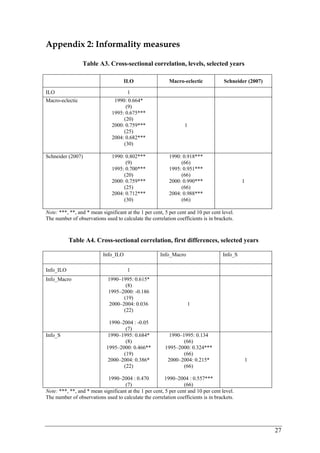
Despite these issues, there is a reasonable amount of correlation between these 
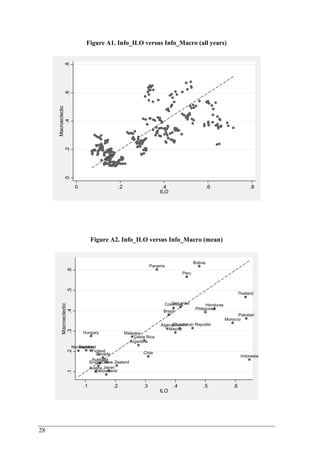
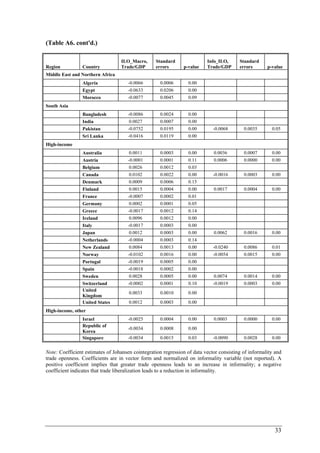
different estimates of informal activity. Appendix 2 (table A3 and figs. A1 and A2) 
provides the respective correlation coefficients. Correlation is highest in the cross-section. 
As an example, in 2004, Info_S correlates at 0.78 with Info_ILO; Info_Macro correlates 
with the Info_ ILO measure at 0.68. Correlation is the highest between Info_S and 
Info_Macro at 0.97. 
To assess co-movement between alternative measures of informality over time, we 
look at the correlation between changes in Info_ILO and Info_S during 2000 and 2004, and 
also at cointegration between Info_ILO and Info_Macro between 1990 and 2004 (appendix 
2, table A4). Even though co-movement between different informality measures over time 
6 Country coverage for the macro-eclectic and ILO measures are reported in appendix 1. See Schneider 
(2007) for a listing of the countries in his sample.
is lower compared to the correlation in the cross-section, co-movement is nevertheless 
sizeable. The correlation between first differences in Info_ILO and Info_S is 0.38 during 
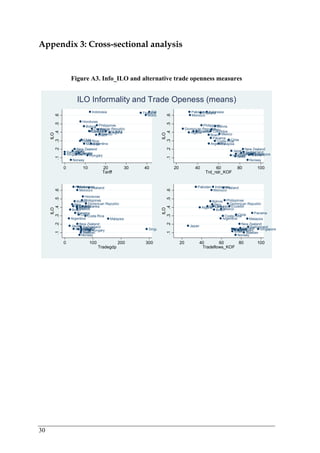
2000 and 2004. Cointegration tests between the ILO measure and the macro-eclectic 
measure of informality indicate that 16 out of 23 series (about 70 per cent) are cointegrated 
(see table A5 in appendix 2).7 
7 
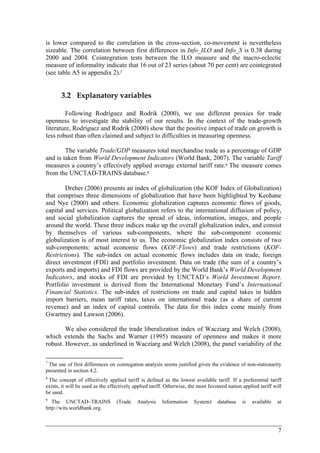
3.2 Explanatory variables 
Following RodrĂ­guez and Rodrik (2000), we use different proxies for trade 
openness to investigate the stability of our results. In the context of the trade-growth 
literature, RodrĂ­guez and Rodrik (2000) show that the positive impact of trade on growth is 
less robust than often claimed and subject to difficulties in measuring openness. 
The variable Trade/GDP measures total merchandise trade as a percentage of GDP 
and is taken from World Development Indicators (World Bank, 2007). The variable Tariff 
measures a country’s effectively applied average external tariff rate.8 The measure comes 
from the UNCTAD-TRAINS database.9 
Dreher (2006) presents an index of globalization (the KOF Index of Globalization) 
that comprises three dimensions of globalization that have been highlighted by Keohane 
and Nye (2000) and others. Economic globalization captures economic flows of goods, 
capital and services. Political globalization refers to the international diffusion of policy, 
and social globalization captures the spread of ideas, information, images, and people 
around the world. These three indices make up the overall globalization index, and consist 
by themselves of various sub-components, where the sub-component economic 
globalization is of most interest to us. The economic globalization index consists of two 
sub-components: actual economic flows (KOF-Flows) and trade restrictions (KOF-Restrictions). 
The sub-index on actual economic flows includes data on trade, foreign 
direct investment (FDI) and portfolio investment. Data on trade (the sum of a country’s 
exports and imports) and FDI flows are provided by the World Bank’s World Development 
Indicators, and stocks of FDI are provided by UNCTAD’s World Investment Report. 
Portfolio investment is derived from the International Monetary Fund’s International 
Financial Statistics. The sub-index of restrictions on trade and capital takes in hidden 
import barriers, mean tariff rates, taxes on international trade (as a share of current 
revenue) and an index of capital controls. The data for this index come mainly from 
Gwartney and Lawson (2006). 
We also considered the trade liberalization index of Wacziarg and Welch (2008), 
which extends the Sachs and Warner (1995) measure of openness and makes it more 
robust. However, as underlined in Wacziarg and Welch (2008), the panel variability of the 
7 The use of first differences on cointegation analysis seems justified given the evidence of non-stationarity 
presented in section 4.2. 
8 The concept of effectively applied tariff is defined as the lowest available tariff. If a preferential tariff 
exists, it will be used as the effectively applied tariff. Otherwise, the most favoured nation applied tariff will 
be used. 
9 The UNCTAD–TRAINS (Trade Analysis Information System) database is available at 
http://wits.worldbank.org.
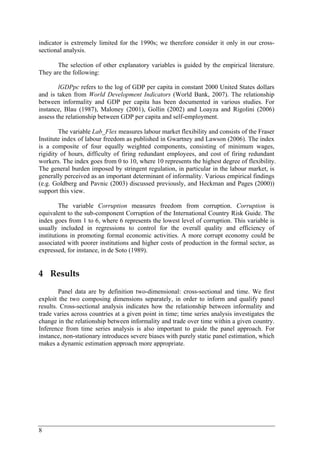
indicator is extremely limited for the 1990s; we therefore consider it only in our cross-sectional 
8 
analysis. 
The selection of other explanatory variables is guided by the empirical literature. 
They are the following: 
lGDPpc refers to the log of GDP per capita in constant 2000 United States dollars 
and is taken from World Development Indicators (World Bank, 2007). The relationship 
between informality and GDP per capita has been documented in various studies. For 
instance, Blau (1987), Maloney (2001), Gollin (2002) and Loayza and Rigolini (2006) 
assess the relationship between GDP per capita and self-employment. 
The variable Lab_Flex measures labour market flexibility and consists of the Fraser 
Institute index of labour freedom as published in Gwartney and Lawson (2006). The index 
is a composite of four equally weighted components, consisting of minimum wages, 
rigidity of hours, difficulty of firing redundant employees, and cost of firing redundant 
workers. The index goes from 0 to 10, where 10 represents the highest degree of flexibility. 
The general burden imposed by stringent regulation, in particular in the labour market, is 
generally perceived as an important determinant of informality. Various empirical findings 
(e.g. Goldberg and Pavnic (2003) discussed previously, and Heckman and Pages (2000)) 
support this view. 
The variable Corruption measures freedom from corruption. Corruption is 
equivalent to the sub-component Corruption of the International Country Risk Guide. The 
index goes from 1 to 6, where 6 represents the lowest level of corruption. This variable is 
usually included in regressions to control for the overall quality and efficiency of 
institutions in promoting formal economic activities. A more corrupt economy could be 
associated with poorer institutions and higher costs of production in the formal sector, as 
expressed, for instance, in de Soto (1989). 
4 Results 
Panel data are by definition two-dimensional: cross-sectional and time. We first 
exploit the two composing dimensions separately, in order to inform and qualify panel 
results. Cross-sectional analysis indicates how the relationship between informality and 
trade varies across countries at a given point in time; time series analysis investigates the 
change in the relationship between informality and trade over time within a given country. 
Inference from time series analysis is also important to guide the panel approach. For 
instance, non-stationary introduces severe biases with purely static panel estimation, which 
makes a dynamic estimation approach more appropriate.
4.1 Cross-sectional evidence 
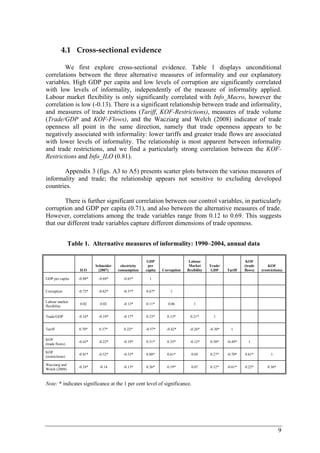
We first explore cross-sectional evidence. Table 1 displays unconditional 
correlations between the three alternative measures of informality and our explanatory 
variables. High GDP per capita and low levels of corruption are significantly correlated 
with low levels of informality, independently of the measure of informality applied. 
Labour market flexibility is only significantly correlated with Info_Macro, however the 
correlation is low (-0.13). There is a significant relationship between trade and informality, 
and measures of trade restrictions (Tariff, KOF-Restrictions), measures of trade volume 
(Trade/GDP and KOF-Flows), and the Wacziarg and Welch (2008) indicator of trade 
openness all point in the same direction, namely that trade openness appears to be 
negatively associated with informality: lower tariffs and greater trade flows are associated 
with lower levels of informality. The relationship is most apparent between informality 
and trade restrictions, and we find a particularly strong correlation between the KOF-Restrictions 
9 
and Info_ILO (0.81). 
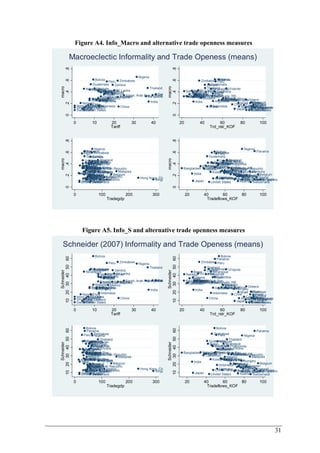
Appendix 3 (figs. A3 to A5) presents scatter plots between the various measures of 
informality and trade; the relationship appears not sensitive to excluding developed 
countries. 
There is further significant correlation between our control variables, in particularly 
corruption and GDP per capita (0.71), and also between the alternative measures of trade. 
However, correlations among the trade variables range from 0.12 to 0.69. This suggests 
that our different trade variables capture different dimensions of trade openness. 
Table 1. Alternative measures of informality: 1990–2004, annual data 
ILO 
Schneider 
(2007) 
electricity 
consumption 
GDP 
per 
capita Corruption 
Labour 
Market 
flexibility 
Trade/ 
GDP Tariff 
KOF 
(trade 
flows) 
KOF 
(restrictions) 
GDP per capita -0.88* -0.68* -0.65* 1 
Corruption -0.72* -0.62* -0.57* 0.67* 1 
Labour market 
flexibility 0.02 0.02 -0.13* 0.11* 0.06 1 
Trade/GDP -0.16* -0.19* -0.17* 0.23* 0.13* 0.21* 1 
Tariff 0.70* 0.37* 0.22* -0.57* -0.42* -0.26* -0.30* 1 
KOF 
(trade flows) -0.43* -0.22* -0.19* 0.51* 0.35* -0.12* 0.58* -0.49* 1 
KOF 
(restrictions) -0.81* -0.52* -0.53* 0.88* 0.61* 0.05 0.27* -0.70* 0.61* 1 
Wacziarg and 
Welch (2008) -0.24* -0.14 -0.13* 0.26* 0.19* 0.07 0.12* -0.61* 0.22* 0.36* 
Note: * indicates significance at the 1 per cent level of significance.
10 
4.2 Time series evidence 
We first pre-test our data for non-stationarity using the Im, Pesaran and Shin 
(2003), Hadri (2000) and Madalla and Wu (1999) panel unit root tests. 
Unit root tests 
The Im et al. (2003) and Hadri (2000) panel unit root tests both require balanced 
panels; we therefore also apply the Maddala and Wu (1999) test. This test, which is also 
referred to as the Fisher test, combines the p-values from N independent unit root tests. It 
assumes that all series are non-stationary under the null hypothesis against the alternative 
that at least one series in the panel is stationary. ZFisher follows a chi-square distribution 
with N*2 degrees of freedom. Due to the pooling of p-values from independent unit root 
tests, ZFisher can be applied to unbalanced panels. 
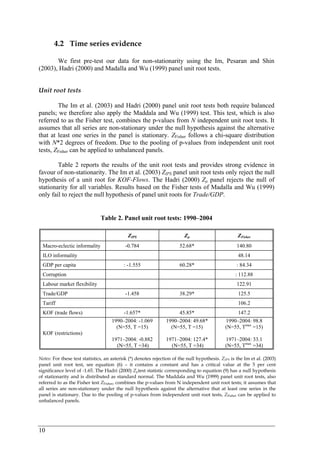
Table 2 reports the results of the unit root tests and provides strong evidence in 
favour of non-stationarity. The Im et al. (2003) ZIPS panel unit root tests only reject the null 
hypothesis of a unit root for KOF-Flows. The Hadri (2000) ZÎĽ panel rejects the null of 
stationarity for all variables. Results based on the Fisher tests of Madalla and Wu (1999) 
only fail to reject the null hypothesis of panel unit roots for Trade/GDP. 
Table 2. Panel unit root tests: 1990–2004 
ZIPS ZÎĽ ZFisher 
Macro-eclectic informality -0.784 52.68* 140.80 
ILO informality 48.14 
GDP per capita : -1.555 60.28* : 84.34 
Corruption : 112.88 
Labour market flexibility 122.91 
Trade/GDP -1.458 38.29* 125.5 
Tariff 106.2 
KOF (trade flows) -1.657* 45.85* 147.2 
KOF (restrictions) 
1990–2004: -1.069 
(N=55, T =15) 
1971–2004: -0.882 
(N=55, T =34) 
1990–2004: 49.68* 
(N=55, T =15) 
1971–2004: 127.4* 
(N=55, T =34) 
1990–2004: 98.8 
(N=55, Tmax =15) 
1971–2004: 33.1 
(N=55, Tmax =34) 
Notes: For these test statistics, an asterisk (*) denotes rejection of the null hypothesis. ZIPS is the Im et al. (2003) 
panel unit root test, see equation (6) – it contains a constant and has a critical value at the 5 per cent 
significance level of -1.65. The Hadri (2000) ZÎĽtest statistic corresponding to equation (9) has a null hypothesis 
of stationarity and is distributed as standard normal. The Maddala and Wu (1999) panel unit root tests, also 
referred to as the Fisher test ZFisher, combines the p-values from N independent unit root tests; it assumes that 
all series are non-stationary under the null hypothesis against the alternative that at least one series in the 
panel is stationary. Due to the pooling of p-values from independent unit root tests, ZFisher can be applied to 
unbalanced panels.
11 
Cointegration analysis 
Given strong evidence of non-stationarity, we use the Johansen (1988, 2002) 
cointegration approach to investigate the relationship between informality and trade 
liberalization from a time series perspective. In the presence of cointegration, super-consistency 
implies that we can concentrate on the relationship between informality and 
trade liberalization without fear of omitted variable bias; we therefore abstract from other 
control variables in this section.10 
Given the relatively small sample sizes, we simulate critical values and apply a 
Bartlett correction to the trace statistics following Johansen (2002). 
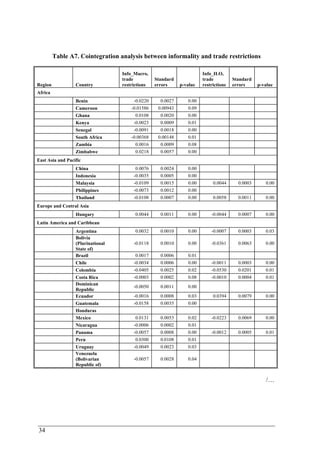
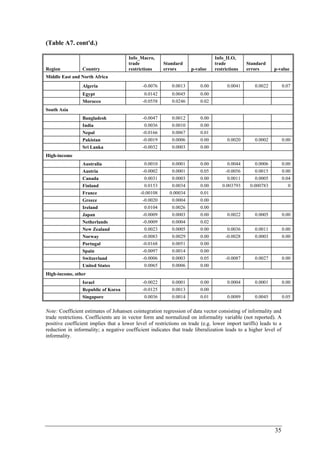
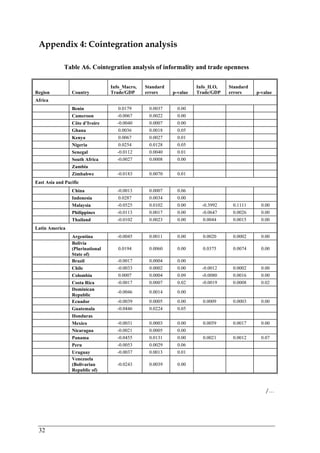
We find strong evidence of cointegration between both measures of informality and 
two trade liberalization indicators (Trade/GDP and KOF-Restrictions). The results of the 
individual cointegration tests are displayed in tables A6 and A7 in appendix 4. The 
coefficients are in vector form and normalized on the informality variable (not reported). 
There appears to be a fair degree of heterogeneity with respect to the sign of the 
empirical relationship between trade liberalization and informality. For Trade/GDP and 
Info_Macro we find that in almost 70 per cent of cases, greater trade openness is 
associated with higher informality between 1990 and 2004. For Trade/GDP and Info_ILO, 
we find a near 50:50 split between countries where informality rises or falls with trade 
liberalization. Not all countries in Info_Macro are available for Info_ILO; for countries 
that appear in both data sets, signs coincide in almost 60 per cent of cases. 
The results are similar when considering KOF-Restrictions as the measure of trade 
liberalization. In 70 per cent of cases, lower restrictions on trade have led to an increase of 
informal output, according to Info_Macro. For the Info_ ILO set, the split remains around 
50:50. Where we have country information from both informality data sets, the results are 
coherent in almost two thirds of observable cases. 
Our time series results by country seem to corroborate evidence from cases studies 
in the literature. We support the Goldberg and Pavcnik (2003) findings of a more positive 
link between trade liberalization and informality in Colombia (deeper trade liberalization 
increases informality). We also support the Currie and Harrison (1998) finding of an 
adverse impact of trade liberalization on informality in Morocco. Trade/GDP and 
KOF_Restrictions provide contradictory evidence on the relationship between trade 
openness and informality for Brazil and Mexico, and this may explain why Goldberg and 
Pavcnik (2003) and Aleman-Castilla (2006) fail to identify a clear relationship in these two 
countries. 
Overall, time series analysis indicates that for a given country, different measures 
of informality do not necessarily respond in a similar manner to the same measure of trade 
liberalization. Conversely, the same measure of informality does not relate to different 
measures of trade liberalization in the same fashion. However, if a dominant pattern had to 
be identified, results suggest that it should be the conventional view: greater openness to 
trade leads to higher informality, whether the latter is thought of in terms of employment 
or in terms of output. 
10 For a discussion of super-consistency, see Stock (1987).
12 
4.3 Panel evidence 
Cross-sectional analysis and time series investigation produce contrasting results, 
suggesting that an approach that merges both dimensions is needed before any possibly 
robust and clear-cut conclusion can be reached. 
Time series analysis points to unit roots in most of the variables under 
consideration. This would make the Pooled Mean Group (PMG) estimator of Pesaran, Shin 
and Smith (1999), which explicitly accounts for non-stationarity, appropriate. To robustify 
results, however, we also report panel estimates based on static fixed effects and on 
systems GMM. The latter approach is able to accommodate possible endogeneity of any of 
our explanatory variables. 
The PMG estimator requires a near-balanced panel, and can, therefore, only be 
applied to Info_Macro. GMM works best for large N and small T, which makes it ideal for 
Info_S, where we have four time series observations on informality, for 1990, 1995, 2000 
and 2004. 
Static approach: fixed effects 
A fixed effects static approach excludes the explicit treatment of both non-stationarity 
and endogeneity issues. Labour market flexibility and the corruption indices 
are not found to be significant in any of the fixed effects regressions. Because of their low 
time variability over the period under scrutiny, both variables effects are likely to be 
absorbed by the country fixed effects. Therefore, we removed them from estimations, 
without loss of either efficiency or power. 
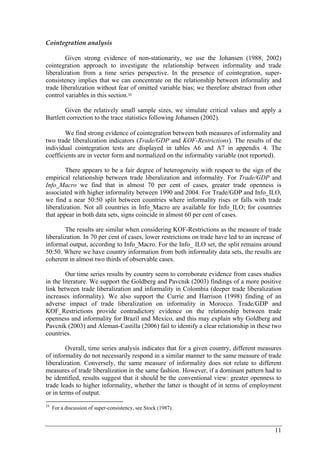
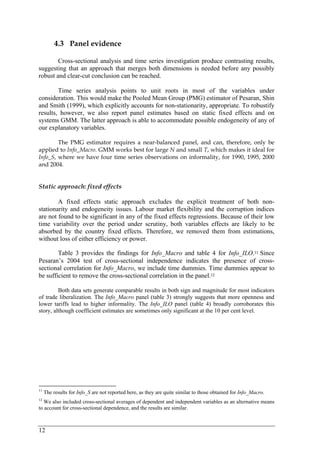
Table 3 provides the findings for Info_Macro and table 4 for Info_ILO.11 Since 
Pesaran’s 2004 test of cross-sectional independence indicates the presence of cross-sectional 
correlation for Info_Macro, we include time dummies. Time dummies appear to 
be sufficient to remove the cross-sectional correlation in the panel.12 
Both data sets generate comparable results in both sign and magnitude for most indicators 
of trade liberalization. The Info_Macro panel (table 3) strongly suggests that more openness and 
lower tariffs lead to higher informality. The Info_ILO panel (table 4) broadly corroborates this 
story, although coefficient estimates are sometimes only significant at the 10 per cent level. 
11 The results for Info_S are not reported here, as they are quite similar to those obtained for Info_Macro. 
12 We also included cross-sectional averages of dependent and independent variables as an alternative means 
to account for cross-sectional dependence, and the results are similar.
13 
Table 3. Fixed effects: macro-eclectic measure of informality 
TRADE TRADE FLOWS TARIFF TRADE 
RESTRICTIONS 
Lgdppc -0.088*** 
(0.0142) 
-0.0865*** 
(0.0149) 
-0.0771*** 
(0.0224) 
-0.0891*** 
(0.01494) 
Trade openness 
Trade/GDP -0.000 
(0.001) 
Trade flow KOF -0.000 
(0.0002) 
Tariff -0.0012*** 
(0.0002) 
Trade restrictions KOF 0.00066** 
(0.0003) 
Constant 0.9845*** 
(0.1154) 
1.034*** 
(0.1274) 
0.908*** 
(0.175) 
1.021*** 
(0.1208) 
Nobs/groups 990/ 66 915/61 617/ 53 825/55 
Overall R2 0.44 0.45 0.43 0.41 
Table 4. Fixed effects: ILO measure of informality 
TRADE TRADE FLOWS TARIFF TRADE 
RESTRICTIONS 
Lgdppc -0.0207* 
(0.0130) 
-0.03401** 
(0.1732) 
-0.02616 
(0.02205) 
-0.0339*** 
(0.1525) 
Trade openness 
Trade/GDP 0.00021* 
(000013) 
Trade flows KOF 0.00071** 
(0.00036) 
Tariff -0.00161* 
(0.00094) 
Trade restrictions KOF 0.00069*** 
(0.000259) 
Constant 0.4329*** 
(0.1110) 
0.5096*** 
(0.1380) 
0.5224*** 
(0.1998) 
0.5168*** 
(0.1267) 
Nobs/groups 310/ 30 301/ 29 245/ 28 286/ 28 
Overall R2 0.54 0.60 0.68 0.64
Dynamic non-stationary panel: Pooled Mean Group estimates 
14 
To account for non-stationarity in panels, we apply the Pooled Mean Group (PMG) 
and the Mean Group (MG) estimator. The MG estimator (see Pesaran and Smith, 1995) is 
based on estimating N time-series regressions and averaging the coefficients, while the 
PMG estimator relies on a combination of pooling and averaging of coefficients. The MG 
estimator allows intercepts, slopes and error variances to differ, while the PMG estimator 
imposes homogeneity on long-run coefficients across groups. If homogeneity cannot be 
rejected, the PMG estimator is consistent and more efficient than the MG estimator. 
Hausman tests select the PMG as the efficient estimator and indicate that the long-run 
relationship identified between trade openness and informality holds across groups. 
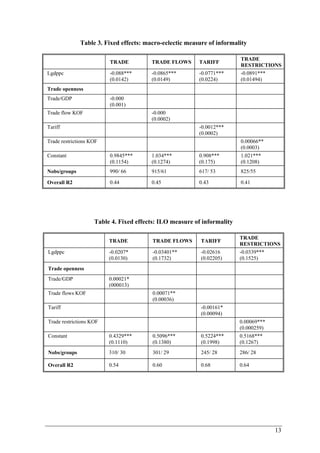
Results are provided in table 5. Coefficient estimates are similar in size to results based on 
static fixed effects, but they are generally more significant; they also suggest that more 
openness and fewer restrictions on trade lead to higher informal output. 
Table 5. Pooled Mean Group estimates: macro-eclectic measure of informality 
TRADE TRADE FLOWS TRADE 
RESTRICTIONS 
Lgdppc -0.0117 
(0.082) 
-0.0800*** 
(0.0033) 
-.03390*** 
(0.0127) 
Trade openness 
Trade/GDP 0.00035* 
(0.0001) 
Trade flows KOF 0.0006*** 
(0.0001) 
Tariff 
Trade restrictions KOF 0.0006* 
(0.0000) 
Nobs/groups 990/ 66 915/61 825/55 
Hausman test of 
efficiency of PMG 
over MG 
χ 2 (3) = 2.09 
p=0.55 
χ 2 (2) = 0.53 
p=0.77 
χ 2 (3) = 7.85 
p=0.05 
χ 2 (2) = 3.05 
p=0.22 
χ 2 (3) = 1.44 
p=0.69 
χ 2 (2) = 0.58 
p=0.75 
Endogeneity 
Fixed effects and PMG estimations do not account for possible endogeneity. 
Endogeneity could arise if the size of the informal sector influences the degree of trade 
liberalization in a country. An economy which is largely informal is likely to be poorly 
industrialized. In that context, economic power is usually highly concentrated and could be 
expected to be closely related to political power. Any reform would then most likely be 
guided by vested interests. In the case of trade policy, a strong preference for high 
protection for domestic productive sectors would most probably be the dominant decision 
factor in any reform. As a consequence, lower tariff cuts would be observed in economies 
with relatively larger informal sectors.
We then formally test for endogeneity in various cross-sections retrieved from our 
panel data set (not reported). We do find evidence – although it is not systematic – of 
endogeneity. This suggests that results obtained in a dynamic GMM panel set-up are likely 
to be the most reliable. 
15 
Dynamic approach: Generalized Method of Moments 
We implement the Arellano and Bond (1991) and Blundell and Bond (1998) 
Dynamic Panel Data Estimator. The approach is based on the Generalized Method of 
Moments (GMM) and a systems estimator for our instruments (lagged values of the 
variables themselves). 
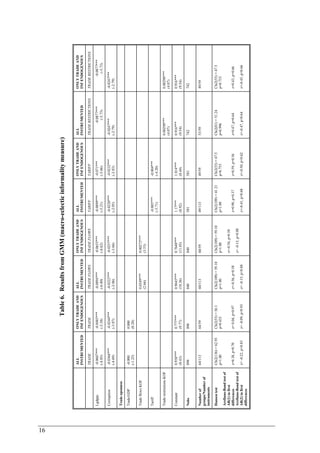
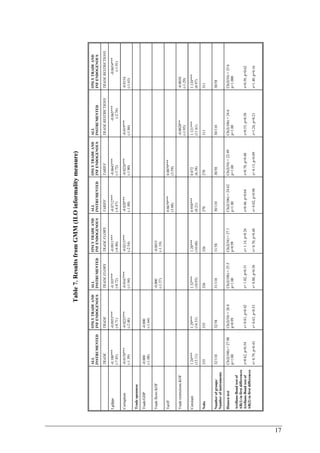
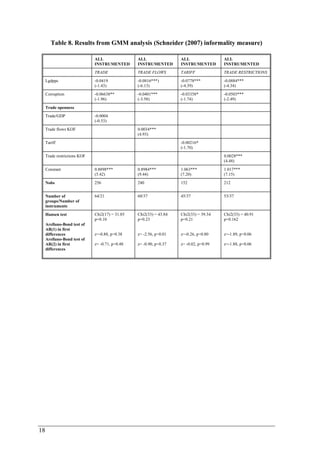
Tables 6, 7 and 8 report results for Info_Macro, Info_ILO and Info_S. Contrary to the 
results found with static panel estimations and PMG, the different measures of informality do not 
generate fully consistent results. 
As expected, we find that informality decreases with GDP per capita in all cases. 
Less corrupted administrations are also associated with less informality. The labour 
flexibility variable enters the estimation with the expected sign (not reported): more 
flexible labour markets reduce the incidence of informality. However, it is never 
significant at a reasonable level of confidence. 
Trade liberalization measured as the share of total trade in GDP enters 
insignificantly in all estimations. The composite flow measure from the KOF Index of 
Globalization (KOF-Flows) is significant for the two macro measures of informality. 
Coefficient estimates are always positive when significant. This indicates that more 
openness to trade generates higher shares of informal production. 
When using tariffs or KOF-Restrictions as the indicator of trade liberalization, we 
find that coefficient estimates are significant at least at 10 per cent in all regressions but 
one. We find contrasting evidence across data sets, but not across indicators. For the two 
macro data sets (Info_Macro and Info_S), less restricted trade is always associated with a 
larger share of informal output in total GDP. For Info_ILO, the share of informal 
employment falls with less restricted trade for both indicators of trade liberalization. 
In all set-ups, results are not affected by the number of endogenous variables. It is 
well known that too many instruments in system GMM can bias the results. Our results are 
further robust to the inclusion of time dummies. However, we find that coefficient 
estimates prove robust to treating all variables as endogenous or only trade and informality, 
which improves the group/instrument ratio (second column of tables 6 and 7).
16 
Table 6. Results from GMM (macro-eclectic informality measure) 
ALL 
INSTRUMENTED 
ONLY TRADE AND 
INF ENDOGENOUS 
ALL 
INSTRUMENTED 
ONLY TRADE AND 
INF ENDOGENOUS 
ALL 
INSTRUMENTED 
ONLY TRADE AND 
INF ENDOGENOUS 
ALL 
INSTRUMENTED 
ONLY TRADE AND 
INF ENDOGENOUS 
TRADE TRADE TRADE FLOWS TRADE FLOWS TARIFF TARIFF TRADE RESTRICTIONS TRADE RESTRICTIONS 
Lgdppc -0.0607*** 
(-4.85) 
-0.0485*** 
(-5.38) 
-0.0894*** 
(-6.40) 
-0.0655*** 
(-6.62) 
-0.0899*** 
(-5.21) 
-0.071*** 
(-5.66) 
-0.0877*** 
(-5.73) 
-0.0877*** 
(-5.73) 
Corruption -0.0368*** 
(-4.69) 
-0.0244*** 
(-3.07) 
-0.0222*** 
(-2.06) 
-0.0257*** 
(-3.66) 
-0.0220*** 
(-2.05) 
-0.0232*** 
(-2.83) 
-0.0247*** 
(-2.79) 
-0.0247*** 
(-2.79) 
Trade openness 
Trade/GDP -0.000 
(-1.25) 
0.000 
(0.28) 
Trade flows KOF 0.0249*** 
(2.66) 
0.00272*** 
(3.53) 
Tariff -0.005*** 
(-3.71) 
-0.004*** 
(-4.20) 
Trade restrictions KOF 0.00298*** 
(4.07) 
0.00298*** 
(4.07) 
Constant 0.938*** 
(8.43) 
0.777*** 
(9.77) 
0.9645*** 
(10.36) 
0.7648*** 
(11.03) 
1.17*** 
(8.92) 
1.014*** 
(8.44) 
0.916*** 
(9.54) 
0.916*** 
(9.54) 
Nobs 896 896 840 840 581 581 742 742 
Number of 
groups/Number of 
instruments 
64/113 64/59 60/113 60/59 49/113 49/59 53/59 49/59 
Hansen test 
Arellano-Bond test of 
AR(1) in first 
differences 
Arellano-Bond test of 
AR(2) in first 
differences 
Chi2(136) = 62.93 
p=1.00 
z=0.38, p=0.70 
z= -0.22, p=0.83 
Chi2(55) = 56.1 
p=0.435 
z= 0.04, p=0.97 
z= -0.09, p=0.93 
Chi2(109) = 59.10 
p=1.00 
z=-0.56, p=0.58 
z= -0.15, p=0.88 
Chi2(109) = 59.10 
p=1.00 
z=-0.56, p=0.58 
z= -0.15, p=0.88 
Chi2(109) = 41.21 
p=1.00 
z=0.90, p=0.37 
z=-0.41, p=0.68 
Chi2(55) = 47.5 
p=0.755 
z=0.59, p=0.56 
z=-0.50, p=0.62 
Chi2(81) = 51.24 
p=0.996 
z=0.47, p=0.64 
z=-0.47, p=0.64 
Chi2(55) = 47.5 
p=0.753 
z=0.43, p=0.66 
z=-0.45, p=0.66
17 
Table 7. Results from GMM (ILO informality measure) 
ALL 
INSTRUMENTED 
ONLY TRADE AND 
INF ENDOGENOUS 
ALL 
INSTRUMENTED 
ONLY TRADE AND 
INF ENDOGENOUS 
ALL 
INSTRUMENTED 
ONLY TRADE AND 
INF ENDOGENOUS 
ALL 
INSTRUMENTED 
ONLY TRADE AND 
INF ENDOGENOUS 
TRADE TRADE TRADE FLOWS TRADE FLOWS TARIFF TARIFF TRADE RESTRICTIONS TRADE RESTRICTIONS 
Lgdppc -0.100*** 
(-7.85) 
-0.0953*** 
(-8.71) 
-0.103*** 
(-8.72) 
-0.0911*** 
(-6.86) 
-0.0712*** 
(-4.47) 
-0.0645*** 
(-3.72) 
-0.065*** 
(-2.76) 
-0.0654*** 
(-1.91) 
Corruption -0.0158*** 
(-1.39) 
-0.0225*** 
(-2.48) 
-0.0167*** 
(-1.94) 
-0.0215*** 
(-2.54) 
-0.028*** 
(-1.88) 
-0.0226*** 
(-1.80) 
-0.019*** 
(-1.86) 
-0.0154 
(-1.63) 
Trade openness 
Trade/GDP -0.000 
(-1.08) 
-0.000 
(-1.64) 
Trade flows KOF -0.000 
(-1.57) 
-0.0015 
(-1.19) 
Tariff 0.0679*** 
(3.08) 
0.0079*** 
(3.59) 
Trade restrictions KOF -0.0028** 
(-1.95) 
-0.0030 
(-1.29) 
Constant 1.24*** 
(13.11) 
1.29*** 
(14.31) 
1.32*** 
(10.93) 
1.28*** 
(10.68) 
0.958*** 
(8.21) 
0.872 
(6.38) 
1.121*** 
(11.61) 
1.124*** 
(6.97) 
Nobs 335 335 326 326 270 270 311 311 
Number of groups/ 
Number of instruments 
32/110 32/58 31/110 31/58 30/110 30/58 30/110 30/58 
Hansen test 
Arellano-Bond test of 
AR(1) in first differences 
Arellano-Bond test of 
AR(2) in first differences 
Chi2(106) = 27.08 
p=1.00 
z=0.62, p=0.54 
z= 0.79, p=0.43 
Chi2(54) = 26.8 
p=0.99 
z= 0.81, p=0.42 
z= 0.63, p=0.53 
Chi2(106) = 25.5 
p=1.00 
z= 1.02, p=0.31 
z= 0.88, p=0.38 
Chi2(54) = 27.1 
p=0.99 
z= 1.14, p=0.26 
z= 0.70, p=0.48 
Chi2(106) = 24.62 
p=1.00 
z=0.46, p=0.64 
z= 0.02, p=0.98 
Chi2(54) = 22.49 
p=1.00 
z=0.70, p=0.48 
z= 0.13, p=0.89 
Chi2(106) = 24.6 
p=1.00 
z=0.55, p=0.58 
z=1.26, p=0.21 
Chi2(54) = 25.6 
p=1.000 
z=0.50, p=0.62 
z=1.40, p=0.16
18 
Table 8. Results from GMM analysis (Schneider (2007) informality measure) 
ALL 
INSTRUMENTED 
ALL 
INSTRUMENTED 
ALL 
INSTRUMENTED 
ALL 
INSTRUMENTED 
TRADE TRADE FLOWS TARIFF TRADE RESTRICTIONS 
Lgdppc -0.0419 
(-1.43) 
-0.0816***) 
(-6.13) 
-0.0778*** 
(-4.39) 
-0.0884*** 
(-4.34) 
Corruption -0.06638** 
(-1.96) 
-0.0401*** 
(-3.58) 
-0.03358* 
(-1.74) 
-0.0503*** 
(-2.49) 
Trade openness 
Trade/GDP -0.0004 
(-0.53) 
Trade flows KOF 0.0034*** 
(4.93) 
Tariff -0.00216* 
(-1.70) 
Trade restrictions KOF 0.0028*** 
(4.48) 
Constant 0.8898*** 
(5.42) 
0.8984*** 
(9.44) 
1.063*** 
(7.20) 
1.017*** 
(7.15) 
Nobs 256 240 152 212 
Number of 
groups/Number of 
instruments 
64/21 60/37 45/37 53/37 
Hansen test 
Arellano-Bond test of 
AR(1) in first 
differences 
Arellano-Bond test of 
AR(2) in first 
differences 
Chi2(17) = 31.85 
p=0.10 
z=-0.88, p=0.38 
z= -0.71, p=0.48 
Chi2(33) = 43.84 
p=0.23 
z= -2.56, p=0.01 
z= -0.90, p=0.37 
Chi2(33) = 39.34 
p=0.21 
z=-0.26, p=0.80 
z= -0.02, p=0.99 
Chi2(33) = 40.91 
p=0.162 
z=-1.89, p=0.06 
z=-1.88, p=0.06
19 
5 Discussion and concluding remarks 
The paper investigates the empirical relationship between informality and trade 
liberalization using three different measures of the informal sector (and four different 
indicators of trade liberalization). One measure of informality is retrieved from household 
surveys instigated by ILO and reflects informal employment as a share of total 
employment. The other two – the macro-eclectic and Schneider (2007) measures – are 
macro-founded and identify informal output as a share of formal output. Empirical results 
suggest a mixed picture of the relationship between trade liberalization and informality. 
Cross-sectional and time series properties of data appear to contrast with each other. 
However, in a dynamic panel estimation set-up that accounts for endogeneity, informal 
employment is found to decrease with deeper trade liberalization and informal output is 
found to increase with deeper trade liberalization. No existing theoretical framework is 
able to replicate these empirical findings. Indeed, the sign of the relationship is the same 
for any dimension of informality in all models. Both informal output and employment 
either increase or decrease with deeper trade liberalization. 
Our empirical results may suggest that productivity in the informal sector increases 
after trade liberalization. Such an outcome is consistent with a situation where only the 
most productive informal firms remain active and even extend production after trade 
liberalization.13 Assuming for a moment that informal output is produced exclusively by 
self-employed individuals, this would be consistent with the fact that the least productive 
individuals move to the formal sector where new and comparatively better employment 
opportunities have arisen because of trade liberalization. As the skills necessary to produce 
and survive in the informal sector are not necessarily those needed for employment in the 
formal sector, formal jobs could be thought of as homogeneous in skills requirements 
without any loss of generality. Improved formal employment opportunities after trade 
liberalization could be obtained in models with heterogeneity in formal firms’ productivity. 
In these types of models the least productive firms are forced to stop production, but any 
associated loss in production and employment would be more than compensated by the 
expansion of exporting firms that enjoy lower trade costs (and/or cheaper inputs). Overall, 
formal employment and output would rise, informal employment would fall, but informal 
output could rise and the informal share in GDP may also rise. 
However, time series analyses and existing empirical evidence at the firm level also 
suggest that the impact of trade liberalization is country- and industry-specific. 
Policymakers should therefore pay attention to factors that constrain resource reallocation 
not only across industries within the formal sector, but also from the informal to the formal 
sector. For instance, workers who are initially informal should be able to take up any job 
opportunity in the formal sector without any legal penalty. Or, they should be given the 
opportunity to fully reintegrate into the welfare system.14 In addition, policymakers would 
also have to facilitate access to capital (either directly or indirectly) for firms/individuals 
13 This could be observed even with a rationed access to capital, as long as labour hoarding remains possible 
and returns to capital are not too decreasing. 
14 Fugazza and Jacques (2004) show that improved access to welfare benefits affects positively the 
willingness of informal workers to search for a job in the formal sector.
operating in the informal sector. The latter approach has often been presented as an 
important step towards the formalization of informal activities.15 
20 
This paper contributes to qualifying, at least empirically, the relationship between 
the informal sector and the degree of trade liberalization prevailing in an economy. 
However, further attention – whether theoretical or empirical – should be devoted to this, 
as it is also a key feature in appreciating the relationship between poverty and trade. 
15 See, for instance, Tokman (2001) and the references therein.
21 
References 
Aleman-Castilla B (2006). The effect of trade liberalization on informality and wages: 
Evidence from Mexico. Centre for Economic Performance discussion paper 763. 
Arellano M and Bond S (1991). Some tests of specification for panel data: Monte Carlo 
evidence and an application to employment equations. Review of Economic Studies. 58: 
277–297. 
Blundell R and Bond S (1998). Initial conditions and moment restrictions in dynamic 
panel data models. Journal of Econometrics. 87: 111–143. 
Bosch M, Goni E and Maloney W (2006). The determinants of rising informality in Brazil: 
Evidence from gross worker flows. Institute for the Study of Labour (IZA) working 
paper 2970. 
Bosch M and Maloney W (2006). Gross worker flows in the presence of informal labour 
markets: The Mexican experience 1987–2002. World Bank working paper 3883. 
Calvo G and Drazen A (1998). Uncertain duration of reform: dynamic implications. 
Macroeconomic Dynamics. 2(4): 443–455. 
Chong A and Gradstein M (2007). Inequality and informality. Journal of Public 
Economics. 91(1–2): 159–179. 
Currie J and Harrison A (1997). Sharing the costs: The impact of trade reform on capital 
and labour in Morocco. Journal of Labour Economics. 15: S44–S71. 
Dreher A (2006). Does globalization affect growth? Evidence from a new index of 
globalization. Applied Economics. 38(10): 1091–1110. 
Fiess N, Fugazza M and Maloney W (2008). Informality and macroeconomic fluctuations. 
IZA discussion paper 3519. 
Fiess N, Fugazza M and Maloney W (2002). Exchange rate appreciations, labour market 
rigidities, and informality. World Bank policy working paper 2771. 
Fugazza M and Jacques J-F (2004). Labour market institutions, taxation and the 
underground economy. Journal of Public Economics. 88(1–2): 395–418. 
Goldberg PK and Pavcnik N (2003). The response of the informal sector to trade 
liberalization. Journal of Development Economics. 72: 463–496. 
Gwartney J and Lawson R, with Easterly W (2006). Economic Freedom of the World: 
2006 Annual Report. Vancouver. The Fraser Institute. Data retrieved from 
http://www.freetheworld.com. 
Hart K (1972). Employment, Income and Inequality: A Strategy for Increasing Productive 
Employment in Kenya. Geneva. International Labour Organization.
Hart K (1973). Informal income opportunities and urban employment in Ghana. Journal of 
Modern African Studies. 11(1): 61–69. 
International Labour Organization (1993). Report of the Fifteenth International 
Conference of Labour Statisticians. Geneva. 
International Monetary Fund (2006). International Financial Statistics. Washington D.C. 
Kaufmann D and Kaliberda A (1996). Integrating the unofficial economy into the 
dynamics of post-socialist economies. In: Kaminsky B, ed. Economic Transition in the 
Newly Independent States. Armonk NY. M.E. Sharpe Inc. 
Keohane R and Nye J (2000). Globalization: What’s New? What’s Not? (And So What?) 
Foreign Policy. Issue 118 (spring). 
La Porta R and Shleifer A (2008). The unofficial economy and economic development. 
Brookings Papers on Economic Activity (fall). 
Loayza VN and Rigolini J (2006). Informality trends and cycles. World Bank policy 
research working paper 4078. 
Li X (2004). Trade liberalization and real exchange rate movement. IMF Staff Papers. 51: 
553–584. 
Maloney W (2004). Informality revisited. World Development. 32(7): 1159–1178. 
Perry G, Maloney W, Arias O, Fajnzylber P, Mason A and Saavedra-Chanduvi J (2007). 
Informality: Exit and Exclusion. Washington D.C. World Bank. 
Rodríguez F and Rodrik D (2001). Trade policy and economic growth: A skeptic’s guide 
to the cross-national evidence. In: Bernanke B and Rogoff K, eds. National Bureau of 
Economic Research (NBER) Macroeconomics Annual 2000. Cambridge, Massachusetts. 
MIT Press. 
Shiller R and Perron P (1985). Testing the random walk hypothesis: Power versus 
frequency of observation. Economics Letters. 18: 381–386. 
Schneider F (2005). Informality around the world. European Journal of Political Economy. 
Schneider F (2007). Shadow economies and corruption all over the world: New estimates 
for 145 countries. Economics: The Open-Access, Open-Assessment E-Journal. Volume 1. 
Nr. 2007–9. http://www.economics-ejournal.org. 
Schneider F and Enste D (2000). Shadow economies: Size, causes and consequences. 
Journal of Economic Literature. 38: 77–114. 
Stock J (1987). Asymptotic properties of least squares estimators of co-integrating vectors. 
Econometrica. 5: 1035–1066. 
22
Tokman V (2001). Integrating the informal sector into the modernization process. SAIS 
Review. 21(1): 45–60. 
Tokman V (2007). Modernizing the informal sector. United Nations Department of 
Economic and Social Affairs working paper 42. 
Wacziarg R and Welch K (2008). Trade Liberalization and Growth: New Evidence. World 
Bank Economic Review. 
World Bank (2004). Doing Business in 2005: Removing Obstacles to Growth. New York. 
Oxford University Press. 
World Bank (2007). World Development Indicators. Washington D.C. 
23
25 
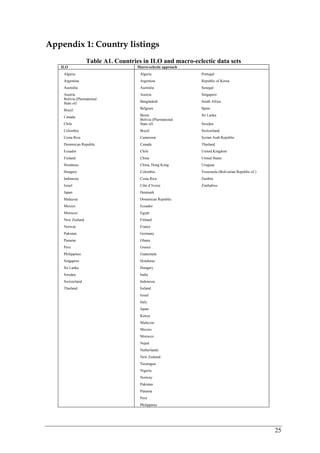
Appendix 1: Country listings 
Table A1. Countries in ILO and macro-eclectic data sets 
ILO Macro-eclectic approach 
Algeria 
Argentina 
Australia 
Austria 
Bolivia (Plurinational 
State of) 
Brazil 
Canada 
Chile 
Colombia 
Costa Rica 
Dominican Republic 
Ecuador 
Finland 
Honduras 
Hungary 
Indonesia 
Israel 
Japan 
Malaysia 
Mexico 
Morocco 
New Zealand 
Norway 
Pakistan 
Panama 
Peru 
Philippines 
Singapore 
Sri Lanka 
Sweden 
Switzerland 
Thailand 
Algeria Portugal 
Argentina Republic of Korea 
Australia Senegal 
Austria Singapore 
Bangladesh South Africa 
Belgium Spain 
Benin Sri Lanka 
Bolivia (Plurinational 
State of) Sweden 
Brazil Switzerland 
Cameroon Syrian Arab Republic 
Canada Thailand 
Chile United Kingdom 
China United States 
China, Hong Kong Uruguay 
Colombia Venezuela (Bolivarian Republic of ) 
Costa Rica Zambia 
Côte d’Ivoire Zimbabwe 
Denmark 
Dominican Republic 
Ecuador 
Egypt 
Finland 
France 
Germany 
Ghana 
Greece 
Guatemala 
Honduras 
Hungary 
India 
Indonesia 
Ireland 
Israel 
Italy 
Japan 
Kenya 
Malaysia 
Mexico 
Morocco 
Nepal 
Netherlands 
New Zealand 
Nicaragua 
Nigeria 
Norway 
Pakistan 
Panama 
Peru 
Philippines
26 
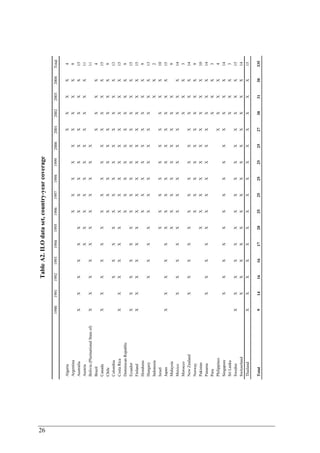
Table A2. ILO data set, country-year coverage 
1990 1991 1992 1993 1994 1995 1996 1997 1998 1999 2000 2001 2002 2003 2004 Total 
Algeria X X X X 4 
Argentina X X X X X X X X X 9 
Australia X X X X X X X X X X X X X X X 15 
Austria X X X X X X X X X X X 11 
Bolivia (Plurinational State of) X X X X X X X X X X X 11 
Brazil X X X X 4 
Canada X X X X X X X X X X X X X X X 15 
Chile X X X X X X X X X 9 
Colombia X X X X X X X X X X X X X 13 
Costa Rica X X X X X X X X X X X X X X X 15 
Dominican Republic X X X X X X X X X 9 
Ecuador X X X X X X X X X X X X X X X 15 
Finland X X X X X X X X X X X X X X X 15 
Honduras X X X X X X X X X 9 
Hungary X X X X X X X X X X X X X 13 
Indonesia X X 2 
Israel X X X X X X X X X X 10 
Japan X X X X X X X X X X X X X X X 15 
Malaysia X X X X X X X X X 9 
Mexico X X X X X X X X X X X X X X 14 
Morocco X X X 3 
New Zealand X X X X X X X X X X X X X X 14 
Norway X X X X X X X X X 9 
Pakistan X X X X X X X X X X 10 
Panama X X X X X X X X X X X X X X 14 
Peru X X X 3 
Philippines X X X X 4 
Singapore X X X X X X X X X X X X X X 14 
Sri Lanka X X X 3 
Sweden X X X X X X X X X X X X X X X 15 
Switzerland X X X X X X X X X X X X X X 14 
Thailand X X X X X X X X X X X X X X X 15 
Total 9 14 16 16 17 20 25 25 25 25 25 27 30 31 30 335
27 
Appendix 2: Informality measures 
Table A3. Cross-sectional correlation, levels, selected years 
ILO Macro-eclectic Schneider (2007) 
ILO 1 
Macro-eclectic 1990: 0.664* 
(9) 
1995: 0.675*** 
(20) 
2000: 0.759*** 
(25) 
2004: 0.682*** 
(30) 
1 
Schneider (2007) 1990: 0.802*** 
(9) 
1995: 0.700*** 
(20) 
2000: 0.759*** 
(25) 
2004: 0.712*** 
(30) 
1990: 0.918*** 
(66) 
1995: 0.951*** 
(66) 
2000: 0.990*** 
(66) 
2004: 0.988*** 
(66) 
1 
Note: ***, **, and * mean significant at the 1 per cent, 5 per cent and 10 per cent level. 
The number of observations used to calculate the correlation coefficients is in brackets. 
Table A4. Cross-sectional correlation, first differences, selected years 
Info_ILO Info_Macro Info_S 
Info_ILO 1 
Info_Macro 1990–1995: 0.615* 
(8) 
1995–2000: -0.186 
(19) 
2000–2004: 0.036 
(22) 
1990–2004 : -0.05 
(7) 
1 
Info_S 1990–1995: 0.684* 
(8) 
1995–2000: 0.466** 
(19) 
2000–2004: 0.386* 
(22) 
1990–2004 : 0.470 
(7) 
1990–1995: 0.134 
(66) 
1995–2000: 0.324*** 
(66) 
2000–2004: 0.215* 
(66) 
1990–2004 : 0.557*** 
(66) 
1 
Note: ***, **, and * mean significant at the 1 per cent, 5 per cent and 10 per cent level. 
The number of observations used to calculate the correlation coefficients is in brackets.
28 
Figure A1. Info_ILO versus Info_Macro (all years) 
0 .2 .4 .6 .8 
Macroeclectic 
0 .2 .4 .6 .8 
ILO 
Figure A2. Info_ILO versus Info_Macro (mean) 
Algeria 
Argentina 
Australia 
Austria 
Bolivia 
Brazil 
Canada Chile 
Colombia 
Costa Rica 
EDcoumadinoircan Republic 
Finland 
Honduras 
Hungary 
Indonesia 
Israel 
Japan 
Malaysia 
Mexico 
Morocco 
New Zealand 
Norway 
Pakistan 
Panama 
Peru 
Philippines 
Singapore 
Sri Lanka 
Sweden 
Switzerland 
Thailand 
.1 .2 .3 .4 .5 .6 
Macroeclectic .1 .2 .3 .4 .5 .6 
ILO
29 
Table A5. Cointegration analysis between Info_ILO and Info_Macro 
Cointegration rank Trace test Simulated c.v. 
Argentina r = 0 5.22* 15.93 
r = 1 0.49 7.36 
Australia r = 0 18.97 15.93 coint. 
r = 1 2.84* 7.36 
Austria r = 0 2.98* 15.93 
r = 1 0.42 7.36 
Bangladesh r = 0 16.04 15.93 coint. 
r = 1 1.52* 7.36 
Canada r = 0 19.64 15.93 coint. 
r = 1 4.75* 7.36 
Chile r = 0 17.11 15.93 coint. 
r = 1 0.66* 7.36 
Colombia r = 0 16.19 15.93 coint. 
r = 1 0.31* 7.36 
Costa Rica r = 0 16.35 15.93 coint. 
r = 1 0.26* 7.36 
Dominican Republic r = 0 7.19* 15.93 
r = 1 0.02 7.36 
Ecuador r = 0 17.80 15.93 coint. 
r = 1 3.85* 7.36 
Finland r = 0 16.47 15.93 coint. 
r = 1 0.00* 7.36 
Honduras r = 0 16.14 15.93 coint. 
r = 1 2.49* 7.36 
Hungary r = 0 8.50* 15.93 
r = 1 1.36 7.36 
Israel r = 0 11.95* 15.93 
r = 1 0.00 7.36 
Japan r = 0 20.72 15.93 coint. 
r = 1 2.37* 7.36 
New Zealand r = 0 16.14 15.93 coint. 
r = 1 0.67* 7.36 
Norway r = 0 17.85 15.93 coint. 
r = 1 2.74* 7.36 
Pakistan r = 0 7.30* 15.93 
r = 1 0.53 7.36 
Panama r = 0 23.33 15.93 coint. 
r = 1 4.43* 7.36 
Singapore r = 0 25.02 15.93 coint. 
r = 1 1.37* 7.36 
Sweden r = 0 17.35 15.93 coint. 
r = 1 0.01* 7.36 
Switzerland r = 0 18.58 15.93 coint. 
r = 1 3.46* 7.36 
Thailand r = 0 11.33* 15.93 
r = 1 2.11 7.36 
Notes: The Johansen (1988) trace test examines whether there is cointegration between the ILO measure of informality and 
the informality measure derived from the macro-eclectic approach. The null of cointegrating vectors is given by r. The 
model is selected on the basis of a model reduction procedure and residuals are reasonably well specified. To account for a 
potential small sample bias, critical values are simulated for N=14 and a Bartlett correction from Johansen (2002) is 
applied. Star (*) indicates that we reject the null of cointegration.
Appendix 3: Cross-sectional analysis 
30 
Figure A3. Info_ILO and alternative trade openness measures 
ILO Informality and Trade Openess (means) 
Indonesia 
Honduras 
Philippines 
Dominican Republic 
Ecuador 
Algeria 
Bolivia 
Brazil 
Argentina 
Chile 
Colombia 
Costa Rica 
Malaysia 
Mexico 
Pakistan 
Morocco 
Peru 
Sri Lanka 
Thailand 
SwitzJearlpAaaCnundsatnraaldiaa New Zealand 
Singapore 
Hungary 
Norway 
.1 .2 .3 .4 .5 .6 
ILO 
0 10 20 30 40 
Tariff 
Pakistan 
Algeria 
Indonesia 
Thailand 
Philippines 
Bolivia 
Peru 
Brazil 
Mexico 
Argentina 
Chile 
Colombia 
Costa Rica 
Dominican Republic 
Ecuador 
Malaysia 
Morocco 
Panama 
Sri Lanka 
Japan New Zealand 
AusCtraSanlwiaaitdzaerland 
Israel 
Hungary AFuisntlraiand 
Singapore 
Norway 
.1 .2 .3 .4 .5 .6 
ILO 
20 40 60 80 100 
Trd_rstr_KOF 
Pakistan 
Indonesia 
Morocco 
Honduras 
Philippines 
Sri Lanka 
Bolivia 
Brazil 
Dominican Republic 
Peru 
Ecuador 
Colombia 
Algeria 
Chile 
Argentina 
Costa Rica 
Malaysia 
Mexico 
Panama 
Thailand 
JapanNew Zealand 
AustrSCawlaianitzaedraland 
FinAluasntdriHaungary 
Sweden 
Israel 
Norway 
Singapore 
.1 .2 .3 .4 .5 .6 
ILO 
0 100 200 300 
Tradegdp 
Indonesia 
Morocco 
Bolivia 
Brazil 
Algeria 
Dominican Republic 
Ecuador 
Argentina 
Chile 
Colombia 
Costa Rica 
Malaysia 
Mexico 
Pakistan 
Panama 
Peru 
Philippines 
Sri Lanka 
Thailand 
Japan New Zealand 
AustraClaianaSdawitzerland 
Israel 
FAinuHlsatunrnidagary 
Norway 
Sweden 
Singapore 
.1 .2 .3 .4 .5 .6 
ILO 
20 40 60 80 100 
Tradeflows_KOF
31 
Figure A4. Info_Macro and alternative trade openness measures 
Macroeclectic Informality and Trade Openess (means) 
Guatemala 
Honduras 
Zimbabwe 
Zambia 
Uruguay Thailand 
Nicaragua 
Cote d'Ivoire 
EcDuoamdoinrican Republic 
Nepal Morocco 
Egypt, Arab Rep. 
Kenya 
Algeria 
Colombia 
Ghana 
MaKlaoyresaia, RMeepx.ico 
Costa Rica 
Argentina 
Bangladesh 
Bolivia 
Brazil 
Chile China 
India 
Hong KoAnCugsa,t nrCaalhdiaiana 
SingaJpaNoperaewn Zealand 
Indonesia 
Nigeria 
Pakistan 
Peru 
SenePghalilippines 
South Africa 
Sri Lanka 
Hungary 
Norway 
SwitzeUrlannitded States 
0 .2 .4 .6 .8 
macro 
0 10 20 30 40 
Tariff 
Zimbabwe 
Benin 
Zambia 
Thailand Uruguay 
Egypt, Arab Rep. 
DominicaEnc Algeria 
Ruaedpourblic 
Colombia 
Costa Rica 
Argentina 
Bangladesh 
Bolivia 
Brazil 
Cameroon 
HungaryGreece 
Israel 
Japan New ZSeainlagnadpore 
China Chile 
Ghana 
Guatemala 
India 
Indonesia 
Kenya 
KMMoareelxaaiyc, soRiaep. 
NepMalorocco 
Nicaragua 
Pakistan 
PPaenruama 
Senegal Philippines 
South Africa 
Sri Lanka 
Venezuela, RB 
NSPoporawritnuagyal 
FFrainnlcaend 
SwUitnzieterdla nSdtates 
AusCtraanliaada 
NIreeltahnedrlands 
Austria 
0 .2 .4 .6 .8 
macro 
20 40 60 80 100 
Trd_rstr_KOF 
Nigeria 
Panama 
Peru 
Bolivia 
Zimbabwe 
Guatemala 
Zambia 
Uruguay Thailand 
Nicaragua 
Honduras 
Sri Lanka 
Cote d'Ivoire 
EcuadDoorminican Republic 
Benin 
SePnheiglipapl ines 
South Africa 
Colombia 
Ghana 
Brazil 
Cameroon 
Kenya 
MeKxoicroea, Rep. Malaysia 
Pakistan 
NeMpoarlocco 
Egypt, Arab Rep. 
Venezuela, RB 
Bangladesh 
Algeria 
Greece Hungary 
Argentina 
Costa Rica 
India 
SpaNiPSnoowrrwetudageyanl 
FrGaenrcmeany 
FDinelannmdark Israel 
Belgium CChhinilae 
Syrian Arab Republic 
AustrCalaianada Indonesia 
Hong Kong, China 
JapanNew United Zealand Kingdom 
Singapore 
Austria 
Ireland 
Italy 
Netherlands 
United States 
Switzerland 
0 .2 .4 .6 .8 
macro 
0 100 200 300 
Tradegdp 
Bolivia 
Zimbabwe 
Peru 
Guatemala 
UruguaTyhailand 
Sri Lanka 
Senegal Philippines 
Pakistan 
Algeria 
Nicaragua 
Cote d'Ivoire 
Colombia 
Ghana 
Morocco 
Egypt, Arab Rep. 
Nigeria 
Panama 
Venezuela, RB 
DEocmuiandicoarn Republic 
Greece Hungary 
Costa Rica 
Argentina 
Bangladesh 
Benin 
Brazil 
Cameroon 
SpPaionrNtuograwlaSyweden 
Israel 
Belgium GerFmraanncye 
FinDlaenndmark China Chile 
India 
Indonesia 
Kenya 
Korea, ReMp.South exico Africa 
Malaysia 
United Kingdom 
Austria 
Ireland 
Italy 
Netherlands 
Switzerland 
United States 
AustraClaianada 
Japan New ZealandSingapore 
0 .2 .4 .6 .8 
macro 
20 40 60 80 100 
Tradeflows_KOF 
Figure A5. Info_S and alternative trade openness measures 
Schneider (2007) Informality and Trade Openess (means) 
Zimbabwe 
Uruguay Thailand Zambia 
HGounadteumraasla 
Nicaragua 
Cote d'Ivoire 
EcDuoamdoinrican RepuEbglyicpt, Arab Rep. 
Nepal Morocco 
Kenya 
Algeria 
Ghana 
Malaysia Mexico 
Korea, Rep. 
Argentina 
Bangladesh 
Bolivia 
Brazil 
Chile 
China 
Colombia 
Costa Rica 
India 
Indonesia 
Nigeria 
Pakistan 
Peru 
SenePghalilippines 
South Africa 
Sri Lanka 
Hungary 
Norway 
Hong KoAnCugsa,t nrCaalhdiaiana 
SingaJpaNoperaewn Zealand 
SwitzeUrlannitded States 
10 20 30 40 50 60 
Schneider 
0 10 20 30 40 
Tariff 
Zimbabwe 
Benin 
Thailand Uruguay 
Zambia 
DominEicgaEynpc Algeria 
tRu, aeAdproaurbb lRicep. 
Colombia 
MMaelxaiycsoia 
Argentina 
Bangladesh 
Bolivia 
Brazil 
Cameroon 
Israel 
Japan New ZSeainlagnadpore 
Chile 
China 
Costa Rica 
Ghana 
Guatemala 
India 
Indonesia 
Kenya 
Korea, Rep. 
NepMalorocco 
Nicaragua 
Pakistan 
Panama 
Peru 
Senegal Philippines 
South Africa 
Sri Lanka 
Venezuela, RB 
Greece 
SPpoaritnugal 
Norway 
Finland 
France 
AusCtraanliaada 
Austria 
Hungary 
NIreeltahnedrlands 
SwUitnzieterdla nSdtates 
10 20 30 40 50 60 
Schneider 
20 40 60 80 100 
Trd_rstr_KOF 
Bolivia 
Panama 
Peru 
Zimbabwe 
Nigeria 
Uruguay Thailand 
GuateHmoanldauras 
Zambia 
Nicaragua 
Benin 
Sri Lanka 
SePnheiglipapl ines 
Cote d'Ivoire 
Colombia 
Brazil 
Cameroon 
Ghana 
NeMpoarlocco 
Pakistan 
Bangladesh 
EgEypctu, aAdrDoaorbm Rineipc.an Republic 
Kenya 
Algeria 
Korea, Rep. 
Venezuela, RB 
Mexico Malaysia 
Greece 
South Africa 
Argentina 
Costa Rica 
India 
Hungary 
SpaiPnortugal 
Israel 
Indonesia 
Sweden 
Switzerland 
Chile 
China 
Syrian Arab Republic 
Norway 
AustrCalaianada Hong Kong, China 
JapanNew Zealand Singapore 
Austria 
Belgium 
FDinelannmdark 
FrGaenrcmeany 
Ireland 
Italy 
Netherlands 
United Kingdom 
United States 
10 20 30 40 50 60 
Schneider 
0 100 200 300 
Tradegdp 
Bolivia 
Zimbabwe 
UruguaTyhailand 
Sri Lanka 
Algeria 
Nicaragua 
Cote d'Ivoire 
Colombia 
Ghana 
Morocco 
Egypt, ArabD Venezuela, ERocemupia.ndicoarn RB 
Republic 
Mexico Malaysia 
Greece 
Argentina 
Bangladesh 
Benin 
Brazil 
Cameroon 
SpPaionrtugal 
Sweden 
Switzerland 
Israel 
Chile 
China 
Costa Rica 
Guatemala 
India 
Indonesia 
Kenya 
Korea, Rep. 
Nigeria 
Pakistan 
Panama 
Peru 
Senegal Philippines 
South Africa 
Austria 
Belgium 
FinDlaenndmark 
GerFmraanncye 
Hungary 
Ireland 
Italy 
Netherlands 
Norway 
United Kingdom 
United States 
AustraClaianada 
Japan New ZealandSingapore 
10 20 30 40 50 60 
Schneider 
20 40 60 80 100 
Tradeflows_KOF
Appendix 4: Cointegration analysis 
32 
Table A6. Cointegration analysis of informality and trade openness 
Region Country 
Info_Macro, 
Trade/GDP 
Standard 
errors p-value 
Info_ILO, 
Trade/GDP 
Standard 
errors p-value 
Africa 
Benin 0.0179 0.0037 0.00 
Cameroon -0.0067 0.0022 0.00 
Côte d’Ivoire -0.0040 0.0007 0.00 
Ghana 0.0036 0.0018 0.05 
Kenya 0.0067 0.0027 0.01 
Nigeria 0.0254 0.0128 0.05 
Senegal -0.0112 0.0040 0.01 
South Africa -0.0027 0.0008 0.00 
Zambia 
Zimbabwe -0.0183 0.0070 0.01 
East Asia and Pacific 
China -0.0013 0.0007 0.06 
Indonesia 0.0287 0.0034 0.00 
Malaysia -0.0525 0.0102 0.00 -0.3992 0.1111 0.00 
Philippines -0.0113 0.0017 0.00 -0.0647 0.0026 0.00 
Thailand -0.0102 0.0023 0.00 0.0044 0.0015 0.00 
Latin America 
Argentina -0.0045 0.0011 0.00 0.0020 0.0002 0.00 
Bolivia 
(Plurinational 
0.0194 0.0060 0.00 0.0375 0.0074 0.00 
State of) 
Brazil -0.0017 0.0004 0.00 
Chile -0.0033 0.0002 0.00 -0.0012 0.0002 0.00 
Colombia 0.0007 0.0004 0.09 -0.0080 0.0016 0.00 
Costa Rica -0.0017 0.0007 0.02 -0.0019 0.0008 0.02 
Dominican 
Republic -0.0046 0.0014 0.00 
Ecuador -0.0039 0.0005 0.00 0.0009 0.0003 0.00 
Guatemala -0.0446 0.0224 0.05 
Honduras 
Mexico -0.0031 0.0003 0.00 0.0059 0.0017 0.00 
Nicaragua -0.0021 0.0005 0.00 
Panama -0.0455 0.0131 0.00 0.0021 0.0012 0.07 
Peru -0.0053 0.0029 0.06 
Uruguay -0.0037 0.0013 0.01 
Venezuela 
(Bolivarian 
-0.0243 0.0039 0.00 
Republic of) 
/…
33 
(Table A6. cont'd.) 
Region Country 
ILO_Macro, 
Trade/GDP 
Standard 
errors p-value 
Info_ILO, 
Trade/GDP 
Standard 
errors p-value 
Middle East and Northern Africa 
Algeria -0.0066 0.0006 0.00 
Egypt -0.0633 0.0206 0.00 
Morocco -0.0077 0.0045 0.09 
South Asia 
Bangladesh -0.0086 0.0024 0.00 
India 0.0027 0.0007 0.00 
Pakistan -0.0752 0.0195 0.00 -0.0068 0.0035 0.05 
Sri Lanka -0.0416 0.0119 0.00 
High-income 
Australia 0.0011 0.0003 0.00 0.0036 0.0007 0.00 
Austria -0.0001 0.0001 0.11 0.0006 0.0000 0.00 
Belgium 0.0026 0.0012 0.03 
Canada 0.0102 0.0022 0.00 -0.0016 0.0003 0.00 
Denmark 0.0009 0.0006 0.15 
Finland 0.0015 0.0004 0.00 0.0017 0.0004 0.00 
France -0.0007 0.0002 0.01 
Germany 0.0002 0.0001 0.05 
Greece -0.0017 0.0012 0.14 
Ireland 0.0096 0.0012 0.00 
Italy -0.0017 0.0003 0.00 
Japan 0.0012 0.0003 0.00 0.0062 0.0016 0.00 
Netherlands -0.0004 0.0003 0.14 
New Zealand 0.0084 0.0013 0.00 -0.0240 0.0086 0.01 
Norway -0.0102 0.0016 0.00 -0.0054 0.0015 0.00 
Portugal -0.0019 0.0005 0.00 
Spain -0.0018 0.0002 0.00 
Sweden 0.0028 0.0005 0.00 0.0074 0.0014 0.00 
Switzerland -0.0002 0.0001 0.10 -0.0019 0.0003 0.00 
United 
Kingdom 0.0033 0.0010 0.00 
United States 0.0012 0.0003 0.00 
High-income, other 
Israel -0.0025 0.0004 0.00 0.0003 0.0000 0.00 
Republic of 
Korea -0.0034 0.0008 0.00 
Singapore -0.0034 0.0015 0.03 -0.0090 0.0028 0.00 
Note: Coefficient estimates of Johansen cointegration regression of data vector consisting of informality and 
trade openness. Coefficients are in vector form and normalized on informality variable (not reported). A 
positive coefficient implies that greater trade openness leads to an increase in informality; a negative 
coefficient indicates that trade liberalization leads to a reduction in informality.
34 
Table A7. Cointegration analysis between informality and trade restrictions 
Region Country 
Info_Macro, 
trade 
restrictions 
Standard 
errors p-value 
Info_ILO, 
trade 
restrictions 
Standard 
errors p-value 
Africa 
Benin -0.0220 0.0027 0.00 
Cameroon -0.01586 0.00943 0.09 
Ghana 0.0108 0.0020 0.00 
Kenya -0.0023 0.0009 0.01 
Senegal -0.0091 0.0018 0.00 
South Africa -0.00368 0.00148 0.01 
Zambia 0.0016 0.0009 0.08 
Zimbabwe 0.0218 0.0057 0.00 
East Asia and Pacific 
China 0.0076 0.0024 0.00 
Indonesia -0.0035 0.0005 0.00 
Malaysia -0.0109 0.0015 0.00 0.0044 0.0003 0.00 
Philippines -0.0073 0.0012 0.00 
Thailand -0.0108 0.0007 0.00 0.0058 0.0011 0.00 
Europe and Central Asia 
Hungary 0.0044 0.0011 0.00 -0.0044 0.0007 0.00 
Latin America and Caribbean 
Argentina 0.0032 0.0010 0.00 -0.0007 0.0003 0.03 
Bolivia 
(Plurinational 
State of) 
-0.0118 0.0010 0.00 -0.0361 0.0063 0.00 
Brazil 0.0017 0.0006 0.01 
Chile -0.0034 0.0006 0.00 -0.0011 0.0003 0.00 
Colombia -0.0405 0.0025 0.02 -0.0530 0.0201 0.01 
Costa Rica -0.0003 0.0002 0.08 -0.0010 0.0004 0.01 
Dominican 
Republic -0.0050 0.0011 0.00 
Ecuador -0.0016 0.0008 0.03 0.0394 0.0079 0.00 
Guatemala -0.0158 0.0035 0.00 
Honduras 
Mexico 0.0131 0.0053 0.02 -0.0223 0.0069 0.00 
Nicaragua -0.0006 0.0002 0.01 
Panama -0.0057 0.0008 0.00 -0.0012 0.0005 0.01 
Peru 0.0300 0.0108 0.01 
Uruguay -0.0049 0.0023 0.03 
Venezuela 
(Bolivarian 
-0.0057 0.0028 0.04 
Republic of) 
/…
35 
(Table A7. cont'd.) 
Region Country 
Info_Macro, 
trade 
restrictions 
Standard 
errors p-value 
Info_ILO, 
trade 
restrictions 
Standard 
errors p-value 
Middle East and North Africa 
Algeria -0.0076 0.0013 0.00 0.0041 0.0022 0.07 
Egypt 0.0142 0.0045 0.00 
Morocco -0.0558 0.0246 0.02 
South Asia 
Bangladesh -0.0047 0.0012 0.00 
India 0.0036 0.0010 0.00 
Nepal -0.0166 0.0067 0.01 
Pakistan -0.0019 0.0006 0.00 0.0020 0.0002 0.00 
Sri Lanka -0.0032 0.0003 0.00 
High-income 
Australia 0.0010 0.0001 0.00 0.0044 0.0006 0.00 
Austria -0.0002 0.0001 0.05 -0.0056 0.0015 0.00 
Canada 0.0031 0.0003 0.00 0.0011 0.0005 0.04 
Finland 0.0153 0.0034 0.00 0.003793 0.000783 0 
France -0.00108 0.00034 0.01 
Greece -0.0020 0.0004 0.00 
Ireland 0.0104 0.0026 0.00 
Japan -0.0009 0.0003 0.00 0.0022 0.0005 0.00 
Netherlands -0.0009 0.0004 0.02 
New Zealand 0.0023 0.0005 0.00 0.0036 0.0011 0.00 
Norway -0.0083 0.0029 0.00 -0.0028 0.0003 0.00 
Portugal -0.0168 0.0051 0.00 
Spain -0.0097 0.0014 0.00 
Switzerland -0.0006 0.0003 0.05 -0.0087 0.0027 0.00 
United States 0.0065 0.0006 0.00 
High-income, other 
Israel -0.0022 0.0001 0.00 0.0004 0.0001 0.00 
Republic of Korea -0.0125 0.0013 0.00 
Singapore 0.0036 0.0014 0.01 0.0089 0.0045 0.05 
Note: Coefficient estimates of Johansen cointegration regression of data vector consisting of informality and 
trade restrictions. Coefficients are in vector form and normalized on informality variable (not reported). A 
positive coefficient implies that a lower level of restrictions on trade (e.g. lower import tariffs) leads to a 
reduction in informality; a negative coefficient indicates that trade liberalization leads to a higher level of 
informality.
36 
UNCTAD Study Series on 
POLICY ISSUES IN INTERNATIONAL TRADE 
AND COMMODITIES 
No. 1 Erich Supper, Is there effectively a level playing field for developing country 
exports?, 2001, 138 p. Sales No. E.00.II.D.22. 
No. 2 Arvind Panagariya, E-commerce, WTO and developing countries, 2000, 24 p. Sales 
No. E.00.II.D.23. 
No. 3 Joseph Francois, Assessing the results of general equilibrium studies of multilateral 
trade negotiations, 2000, 26 p. Sales No. E.00.II.D.24. 
No. 4 John Whalley, What can the developing countries infer from the Uruguay Round 
models for future negotiations?, 2000, 29 p. Sales No. E.00.II.D.25. 
No. 5 Susan Teltscher, Tariffs, taxes and electronic commerce: Revenue implications for 
developing countries, 2000, 57 p. Sales No. E.00.II.D.36. 
No. 6 Bijit Bora, Peter J. Lloyd, Mari Pangestu, Industrial policy and the WTO, 2000, 47 p. 
Sales No. E.00.II.D.26. 
No. 7 Emilio J. Medina-Smith, Is the export-led growth hypothesis valid for developing 
countries? A case study of Costa Rica, 2001, 49 p. Sales No. E.01.II.D.8. 
No. 8 Christopher Findlay, Service sector reform and development strategies: Issues and 
research priorities, 2001, 24 p. Sales No. E.01.II.D.7. 
No. 9 Inge Nora Neufeld, Anti-dumping and countervailing procedures – Use or abuse? 
Implications for developing countries, 2001, 33 p. Sales No. E.01.II.D.6. 
No. 10 Robert Scollay, Regional trade agreements and developing countries: The case of 
the Pacific Islands’ proposed free trade agreement, 2001, 45 p. Sales No. 
E.01.II.D.16. 
No. 11 Robert Scollay and John Gilbert, An integrated approach to agricultural trade and 
development issues: Exploring the welfare and distribution issues, 2001, 43 p. Sales 
No. E.01.II.D.15. 
No. 12 Marc Bacchetta and Bijit Bora, Post-Uruguay round market access barriers for 
industrial products, 2001, 50 p. Sales No. E.01.II.D.23. 
No. 13 Bijit Bora and Inge Nora Neufeld, Tariffs and the East Asian financial crisis, 2001, 
30 p. Sales No. E.01.II.D.27. 
No. 14 Bijit Bora, Lucian Cernat, Alessandro Turrini, Duty and quota-free access for LDCs: 
Further evidence from CGE modelling, 2002, 130 p. Sales No. E.01.II.D.22.
No. 15 Bijit Bora, John Gilbert, Robert Scollay, Assessing regional trading arrangements in 
37 
the Asia-Pacific, 2001, 29 p. Sales No. E.01.II.D.21. 
No. 16 Lucian Cernat, Assessing regional trade arrangements: Are South-South RTAs more 
trade diverting?, 2001, 24 p. Sales No. E.01.II.D.32. 
No. 17 Bijit Bora, Trade related investment measures and the WTO: 1995-2001, 2002. 
No. 18 Bijit Bora, Aki Kuwahara, Sam Laird, Quantification of non-tariff measures, 2002, 
42 p. Sales No. E.02.II.D.8. 
No. 19 Greg McGuire, Trade in services – Market access opportunities and the benefits of 
liberalization for developing economies, 2002, 45 p. Sales No. E.02.II.D.9. 
No. 20 Alessandro Turrini, International trade and labour market performance: Major 
findings and open questions, 2002, 30 p. Sales No. E.02.II.D.10. 
No. 21 Lucian Cernat, Assessing south-south regional integration: Same issues, many 
metrics, 2003, 32 p. Sales No. E.02.II.D.11. 
No. 22 Kym Anderson, Agriculture, trade reform and poverty reduction: Implications for 
Sub-Saharan Africa, 2004, 30 p. Sales No. E.04.II.D.5. 
No. 23 Ralf Peters and David Vanzetti, Shifting sands: Searching for a compromise in the 
WTO negotiations on agriculture, 2004, 46 p. Sales No. E.04.II.D.4. 
No. 24 Ralf Peters and David Vanzetti, User manual and handbook on Agricultural Trade 
Policy Simulation Model (ATPSM), 2004, 45 p. Sales No. E.04.II.D.3. 
No. 25 Khalil Rahman, Crawling out of snake pit: Special and differential treatment and 
post-Cancun imperatives, 2004. 
No. 26 Marco Fugazza, Export performance and its determinants: Supply and demand 
constraints, 2004, 57 p. Sales No. E.04.II.D.20. 
No. 27 Luis Abugattas, Swimming in the spaghetti bowl: Challenges for developing 
countries under the “New Regionalism”, 2004, 30 p. Sales No. E.04.II.D.38. 
No. 28 David Vanzetti, Greg McGuire and Prabowo, Trade policy at the crossroads – The 
Indonesian story, 2005, 40 p. Sales No. E.04.II.D.40. 
No. 29 Simonetta Zarrilli, International trade in GMOs and GM products: National and 
multilateral legal frameworks, 2005, 57 p. Sales No. E.04.II.D.41. 
No. 30 Sam Laird, David Vanzetti and Santiago Fernández de Córdoba, Smoke and mirrors: 
Making sense of the WTO industrial tariff negotiations, 2006, Sales No. E.05.II.D.16. 
No. 31 David Vanzetti, Santiago Fernandez de CĂłrdoba and Veronica Chau, Banana split: 
How EU policies divide global producers, 2005, 27 p. Sales No. E.05.II.D.17. 
No. 32 Ralf Peters, Roadblock to reform: The persistence of agricultural export subsidies, 
2006, 43 p. Sales No. E.05.II.D.18. 
No. 33 Marco Fugazza and David Vanzetti, A South-South survival strategy: The potential 
for trade among developing countries, 2006, 25 p.
No. 34 Andrew Cornford, The global implementation of Basel II: Prospects and outstanding 
38 
problems, 2006, 30 p. 
No. 35 Lakshmi Puri, IBSA: An emerging trinity in the new geography of international 
trade, 2007, 50 p. 
No. 36 Craig VanGrasstek, The challenges of trade policymaking: Analysis, communication 
and representation, 2008, 45 p. 
No. 37 Sudip Ranjan Basu, A new way to link development to institutions, policies and 
geography, 2008, 50 p. 
No. 38 Marco Fugazza and Jean-Christophe Maur, Non-tariff barriers in computable general 
equilibrium modelling, 2008, 25 p. 
No. 39 Alberto Portugal-Perez, The costs of rules of origin in apparel: African preferential 
exports to the United States and the European Union, 2008, 35 p. 
No. 40 Bailey Klinger, Is South-South trade a testing ground for structural 
transformation?, 2009, 30 p. 
No. 41 Sudip Ranjan Basu, Victor Ognivtsev and Miho Shirotori, Building trade-relating 
institutions and WTO accession, 2009, 50 p. 
No. 42 Sudip Ranjan Basu and Monica Das, Institution and development revisited: A 
nonparametric approach, 2010, 26 p. 
No. 43 Marco Fugazza and Norbert Fiess, Trade liberalization and informality: New stylized 
facts, 2010, 45 p.
39 
United Nations Publications 
All orders from North America, Latin America, the Caribbean and Asia and the 
Pacific should be sent to: 
United Nations Publications 
Room DC2-853, 2 UN Plaza 
New York, NY 10017, USA 
Telephone: (212) 963-8302, Toll Free 1-800-253-9646 (North America only) 
Fax: (212) 963-3489 
E-mail: publications@un.org 
Customers in Europe, Africa and the Middle East should send their orders to: 
Section des Ventes et Commercialisation 
Bureau E-4, CH-1211 
Geneva 10, Switzerland 
Telephone: 41 (22) 917-2613/2614 
Fax: 41 (22) 917-0027 
E-mail: unpubli@unog.ch 
For further information, please visit: http://www.unctad.org/tab
Since 1999, the Trade Analysis Branch of the Division on International Trade in Goods and 
Services, and Commodities of UNCTAD has been carrying out policy-oriented analytical work 
aimed at improving the understanding of current and emerging issues in international trade and 
development. In order to improve the quality of the work of the Branch, it would be useful to 
receive the views of readers on this and other similar publications. It would therefore be greatly 
appreciated if you could complete the following questionnaire and return to: 
Trade Analysis Branch, DITC 
Rm. E-8076 
United Nations Conference on Trade and Development 
Palais des Nations 
CH-1211 Geneva 10, Switzerland 
1. Name and address of respondent (optional): 
2. Which of the following describes your area of work? 
Government Public enterprise 
Private enterprise institution Academic or research 
International organization Media 
Not-for-profi t organization Other (specify) _________________ 
3. In which country do you work? _________________________________________ 
4. Did you fi nd this publication Very useful Of some use Litt le use 
to your work? 
5. What is your assessment of the contents of this publication? 
Excellent Good Adequate Poor 
6. Other comments: 
QUESTIONNAIRE 
UNCTAD Study series on 
POLICY ISSUES IN INTERNATIONAL TRADE 
AND COMMODITIES 
(Study series no. 43: Trade liberalization and informality: 
New stylized facts) 
Readership Survey

Itcdtab44 en

  • 1.
    UNITED NATIONS CONFERENCEON TRADE AND DEVELOPMENT POLICY ISSUES IN INTERNATIONAL TRADE AND COMMODITIES STUDY SERIES No. 43 TRADE LIBERALIZATION AND INFORMALITY: NEW STYLIZED FACTS by Marco Fugazza UNCTAD and Norbert Fiess World Bank UNITED NATIONS New York and Geneva, 2010
  • 2.
    ii Note Thepurpose of this series of studies is to analyse policy issues and to stimulate discussions in the area of international trade and development. The series includes studies by UNCTAD staff and by distinguished researchers from academia. In keeping with the objective of the series, authors are encouraged to express their own views, which do not necessarily reflect the views of the United Nations. The designations employed and the presentation of the material do not imply the expression of any opinion whatsoever on the part of the United Nations Secretariat concerning the legal status of any country, territory, city or area, or of its authorities, or concerning the delimitation of its frontiers or boundaries. Material in this publication may be freely quoted or reprinted, but acknowledgement is requested, together with a reference to the document number. It would be appreciated if a copy of the publication containing the quotation or reprint were sent to the UNCTAD secretariat at the following address: Chief Trade Analysis Branch Division on International Trade in Goods and Services, and Commodities United Nations Conference on Trade and Development Palais des Nations CH-1211 Geneva Switzerland Series editor: Khalilur Rahman Chief, Trade Analysis Branch UNCTAD/ITCD/TAB/44 UNITED NATIONS PUBLICATION ISSN 1607-8291 © Copyright United Nations 2010 All rights reserved
  • 3.
    iii Abstract Therelationship between trade liberalization and informal activity has not received the attention, whether theoretical or empirical, that it may deserve. The conventional view posits that trade liberalization would cause a rise in informality. This paper uses three different data sets to assess the sign of the relationship. Empirical results provide a mixed picture. Macro-founded data tend to produce results supporting the conventional view; micro-founded data do not. Empirical results also suggest that while informal output increases with deeper trade liberalization, informal employment falls. Keywords: Informal sector, trade liberalization, cross-sectional analysis, time series analysis, panel analysis. JEL classification: F13, F16, O17, C23
  • 4.
    iv Acknowledgements Weare grateful to participants in seminars at the Glasgow University, the University of Geneva and the ILO/WTO Workshop on "Globalization and informal employment: friends or foes?" for useful discussions and suggestions.
  • 5.
    v Contents 1.Introduction ............................................................................................................. 1 2. Trade liberalization and informality: theoretical insights and country experiences.......................................................................................... 2 2.1 Theoretical insights .......................................................................................... 2 2.2 Country experiences.........................................................................................4 3. Data and empirical strategy.................................................................................... 5 3.1 Data sets and dependent variables.................................................................... 5 3.2 Explanatory variables.......................................................................................7 4. Results....................................................................................................................... 8 4.1 Cross-sectional evidence ..................................................................................9 4.2 Time series evidence ......................................................................................10 4.3 Panel evidence................................................................................................12 5. Discussion and concluding remarks..................................................................... 19 References ........................................................................................................................ 21 Appendix 1 Country listings ......................................................................................... 25 Appendix 2 Informality measures ................................................................................. 27 Appendix 3 Cross-sectional analysis............................................................................. 30 Appendix 4 Cointegration analysis ............................................................................... 32
  • 6.
    Tables Table 1.Alternative measures of informality: 1990–2004, annual data......................... 9 Table 2. Panel unit root tests: 1990–2004 .................................................................... 10 Table 3. Fixed effects: macro-eclectic measure of informality .................................... 13 Table 4. Fixed effects: ILO measure of informality ..................................................... 13 Table 5. Pooled Mean Group estimates: macro-eclectic measure of informality......... 14 Table 6. Results from GMM (macro-eclectic informality measure) ............................ 16 Table 7. Results from GMM (ILO informality measure) ............................................. 17 Table 8. Results from GMM analysis (Schneider (2007) informality measure) .......... 18 Appendix tables Table A1. Countries in ILO and macro-eclectic data sets ............................................... 25 Table A2. ILO data set, country–year coverage.............................................................. 26 Table A3. Cross-sectional correlation, levels, selected years.......................................... 27 Table A4. Cross-sectional correlation, first differences, selected years.......................... 27 Table A5. Cointegration analysis between Info_ILO and Info_Macro........................... 29 Table A6. Cointegration analysis of informality and trade openness.............................. 32 Table A7. Cointegration analysis between informality and trade restrictions................. 34 Appendix figures Figure A1. Info_ILO versus Info_Macro (all years)......................................................... 28 Figure A2. Info_ILO versus Info_Macro (mean) ............................................................. 28 Figure A3. Info_ILO and alternative trade openness measures........................................ 30 Figure A4. Info_Macro and alternative trade openness measures .................................... 31 Figure A5. Info_S and alternative trade openness measures ............................................ 31 vi
  • 7.
    1 1 Introduction Informality refers to that share of a country’s production of goods and services which does not comply with government regulation. Informal activity is a common feature of most countries, however it is greater in size and more pervasive in developing countries (Schneider and Enste, 2000; Tokman, 2007). Informality is often linked to trade liberalization. Under the conventional view, the informal sector represents the inferior segment of a dual labour market, which expands countercyclically during downturns when workers are rationed out of the formal labour market. In this setting, trade liberalization, if perceived as a force of greater competition for domestic producers, is expected to lead to a rise in informality, as firms shed formal workers (inputs) to cut costs. However, this conventional view of informality has been challenged on various grounds. Firstly, informal activity is not exclusively residual. There is significant evidence that informality, at least in parts, is driven by dynamic, small-scale entrepreneurial activity. This goes back to the seminal work of Hart (1972, 1973) on African labour markets, which has recently been confirmed for Latin America by Maloney (2004) and Perry et al. (2007). La Porta and Shleifer (2008) discuss the empirical relevance of various views on informality using three sets of surveys of both official and unofficial firms conducted recently by the World Bank.1 The notion of informal entrepreneurship is also noticeable in ILO’s official definition of informality adopted in 1993 by the International Conference of Labour Statisticians.2 Secondly, only certain types of shocks and a specific regulatory environment cause a countercyclical response of informal activity. Fiess, Fugazza and Maloney (2002, 2008) develop a theoretical model where the sign of the relationship between relative formal/informal earnings and the relative size of labour force depends on the nature of economic shocks and on the tightness of labour regulations. A rise in informality is not necessarily the outcome of a negative economic shock; it can also result from a positive shock to the non-tradable sector. The model is tested empirically using time series for Argentina, Brazil, Colombia and Mexico, and results confirm the existence of procyclical movements in line with theoretical predictions. Thirdly, the relationship between trade liberalization and informality is ambiguous from both a theoretical and an empirical point of view. Moreover, empirical evidence for a large sample of countries is lacking. 1 The enterprise surveys, the informal surveys and the micro surveys. 2 The primary source is the International Labour Organization (ILO) (1993). In 2003, the International Conference of Labour Statisticians adopted statistical guidelines concerning this expanded concept of informal employment to complement the resolution concerning statistics on the informal sector adopted in 1993. The resulting framework allows countries to adapt the basic operational definition and criteria to their specific circumstances. In particular, flexibility is allowed with respect to the upper limit on the size of employment, the introduction of additional criteria such as non-registration of either the enterprise or its employees, the inclusion or exclusion of professionals or domestic employees, and the inclusion or exclusion of agriculture.
  • 8.
    2 This paperprovides comprehensive empirical evidence on the relationship between trade liberalization and informality for a large set of countries. For this purpose, we provide evidence from time series, cross-section and panel analyses. As informal activity by its very nature evades official records, measurement becomes a difficult issue. We use three alternative measures of informality, which have all been used in the literature, but never in parallel. The first is a survey-based measure of informal labour market activity from the International Labour Organization (ILO). The second is Schneider’s (2005, 2007) measure of informal activity, which is derived from a combination of indirect measures of informal production based on excess currency demand and latent variable methodologies. The third is based on the macro-eclectic approach of Kaufmann and Kaliberda (1996), where the size of the informal economy is measured from the discrepancy between electricity consumption, which is taken as an indicator of overall economic activity, and the official gross domestic product (GDP). Our empirical results offer a mixed picture, and no clear-cut conclusion can be drawn. While unconditional cross-sectional correlations support the view that trade liberalization induces a reduction of informality, whether in terms of employment share or in terms of output share, static panel results do not. Results from cointegration analysis suggest that more openness to trade is associated with greater informal employment and output for the majority of countries. Lower trade restrictions, on the contrary, appear to generate lower informal employment and output in most cases. Finally, systems GMM estimation generates contrasting results across data sets. In particular, fewer trade restrictions are associated with more informal output but less informal employment. The rest of the paper is organized as follows: Section 2 reviews major theoretical and empirical contributions on the link between trade liberalization and informality. Section 3 describes the data and the empirical methodologies, and section 4 presents the results. The last section discusses possible policy implications and further research orientations. 2 Trade liberalization and informality: theoretical insights and country experiences 2.1 Theoretical insights The relationship between trade liberalization and informality has received little attention, whether from a theoretical or an empirical point of view. According to a consensual but not necessarily formal argument, trade liberalization is expected to increase competition for domestic producers. In an effort to lower production costs, domestic producers will seek informally produced inputs (in the extreme, all inputs would be produced informally), which are cheaper since informal producers generally do not comply with labour or fiscal regulations. Greater demand for informally produced inputs is therefore expected to drive the extension of the informal sector following trade liberalization. Goldberg and Pavcnik (2003) adopt a model that unambiguously generates such a positive relationship. Their model is based on a dynamic efficiency wage model with three
  • 9.
    essential assumptions. First,the representative firm faces demand uncertainty. Second, the representative firm can hire workers either from a pool of formal or informal workers. Third, formal employment is subject to labour market legislation, and formal workers receive benefits and severance pay on dismissal. Trade liberalization is modelled as a change in the probability function that governs price shocks. The model by Goldberg and Pavcnik (2003) suggests that the impact of trade liberalization on informality depends on the degree of labour market liberalization: the less flexible labour markets are, the greater the reallocation from the formal to the informal sector. However, not all theoretical models provide such clear-cut predictions on the relationship between trade liberalization and informality. For instance, in the heterogeneous firm model of Aleman-Castilla (2006), trade liberalization (i.e. lower trade costs) implies that some firms will find it more profitable to enter the formal sector, rather than remaining informal. The least productive informal firms will be forced to exit the industry, and only the most productive (formal) firms will export to international markets. Here, trade liberalization reduces the incidence of informality. Moreover, both – the exit of the least productive firms and the rise in output of the most productive (formal) firms – lead to an aggregate increase in productivity. The above models assume that all goods can be traded in principle. Non-tradability is endogenously determined and depends only on firms’ characteristics, not on goods’ characteristics. If some goods are allowed to be non-tradable, the impact of trade liberalization on informality will additionally depend on the reaction of the real exchange rate and/or relative sector productivities. To illustrate, if the informal sector is equated with the non-tradable goods sector, and, if non-tradable goods are only for consumption, then the relationship between trade openness and informality could become negative. In this context, trade liberalization would lower the price of the non-tradable good in terms of the tradable good (i.e. a real depreciation), and this would decrease the size of the informal sector.3 In certain circumstances, trade liberalization could lead to a real appreciation4 and hence increase the size of the informal sector. In a situation where formal firms use non-tradable (informal) goods as inputs, additional arbitrage conditions enter the relationship of trade liberalization and informality. Trade liberalization (a fall in trade costs) exposes uncompetitive firms to greater import competition. For these firms, the use of cheaper, informally produced inputs may present a survival strategy. However, as formal wages may well rise with greater labour demand from (old and new) exporting firms, informal wages may also increase to eliminate any arbitrage in workers’ occupational choice. The sign of the relationship between trade liberalization and informality will therefore depend on which force dominates. Furthermore, if pre-reform formal wages are determined by labour regulation (e.g. a binding minimum nominal wage), upward pressures on formal wages after reform might be slightly undermined; this would increase the chance to observe more informality as a consequence of trade liberalization. The fiscal environment can also influence the relationship between trade liberalization and informality. Existing models generally assume that public expenditures 3 See, for instance Li (2004), for a theoretical treatment and empirical evidence. 4 Calvo and Drazen (1998), for instance, show that trade liberalization of uncertain duration could lead to a real appreciation, due to an upward jump in the consumption of both tradable and non-tradable goods. 3
  • 10.
    fully adapt tofiscal revenues, without specifying how fiscal adjustment is actually achieved. Fiscal consolidation may require higher taxes or new fiscal instruments, and both are likely to affect firms’ incentives to extend informal inputs and workers’ choices to become informal. 4 Theoretical predictions of how trade liberalization impacts informality are ambiguous at best; the overall size of the informal sector could rise or fall with trade liberalization. We next review existing empirical studies on trade liberalization and informality. 2.2 Country experiences Empirical evidence on the relationship between trade liberalization and informality is limited and is generally country-specific. Most of the evidence relates to Brazil, Colombia and Mexico, for which rich relevant and reliable micro data sets are available. Goldberg and Pavcnik (2003) use household survey data for Brazil and Colombia collected over the 1980s and 1990s. They find no evidence of any significant relationship between trade liberalization and informality in Brazil, whether positive of negative. For Colombia, they present evidence that informality increased after trade liberalization. However, this finding appears directly related to the degree of labour market flexibility. Goldberg and Pavcnik (2003) report that prior to labour market reform, when the costs of firing formal workers were high, an industry-specific tariff reduction was associated with a greater likelihood of becoming informal. Since labour market reform, however, industry-specific tariff reductions have been associated with smaller increases in the probability of becoming informal. Aleman-Castilla (2006) uses the North American Free Trade Agreement (NAFTA) experience to assess the impact of trade liberalization on informality in Mexico. Using Mexican and United States import tariff data and the Mexican National Survey of Urban Labour, the Aleman-Castilla (2006) findings suggest that lower import tariffs are related to lower informality in tradable industries. Results also suggest that informality decreases less in industries where import penetration is high, and more in industries with greater export orientation. Goldberg and Pavcnik (2003) and Aleman-Castilla (2006) use a similar two-step estimation approach. In the first step, a linear probability model of informal employment is estimated. Explanatory variables include worker characteristics and industry dummies capturing workers’ industry affiliation. Coefficients of the latter are defined as industry-informality differentials. These differentials are then used as the dependent variable in the second-step estimations. They are regressed against import tariffs across years, and the resulting coefficients are taken as measures of the impact of trade liberalization on informality. A related paper, although based on a different empirical approach, is Boni, Gosh and Maloney (2007). Boni et al. (2007) study gross worker flows to explain the rising informality in Brazil’s metropolitan labour markets from 1983 to 2002. This period covers two economic cycles, several macroeconomic stabilization plans, a far-reaching trade liberalization, and changes in labour legislation through the constitutional reform of 1988.
  • 11.
    Secular movements inthe levels and the volatility of gross flows suggest that the rise in informality during that period was largely caused by a reduction in job-finding rates in the formal sector. Part of the remainder is linked to the constitutional reform which contributed to rising labour costs and reduced labour market flexibility; only a small fraction of the observed rise in informality is explained by trade liberalization. In an earlier study, Currie and Harrison (1997) assess the impact of trade reform on employment in manufacturing firms in Morocco in the 1980s. This paper does not investigate the direct impact of trade reform on informality but offers insights on the role of trade protection on labour market composition. Currie and Harrison (1997) use a survey of manufacturing firms with more than 10 employees. Their results suggest that employment in the average firm has been unaffected by the reduction of tariffs and the elimination of quotas. However, the exporting firms and industries most affected by the reforms (textiles, beverages and apparel) experienced a significant decline in employment. 5 The results from Currie and Harrison (1997) further indicate that government-controlled firms behave quite differently from privately owned firms. Government-controlled firms actually increased employment in response to tariff reductions, mostly by hiring low-paid temporary workers. Empirical studies to date suggest that informality can respond to trade liberalization 5 either positively or negatively, depending on country and industry characteristics. 3 Data and empirical strategy Our estimates of the size of the informal sector come from three different data sets. ILO’s is a micro-founded, survey-based measure that provides a directly observable measure of the share of informal employment. The Schneider (2005, 2007) informality measure and the macro-eclectic approach (Kaufmann and Kaliberda, 1996) are both macro-founded, indirect measures of informal output in total GDP. 3.1 Data sets and dependent variables The first data set used in this paper is from ILO. The ILO statistical definition of informality represents an important step towards a better and more consensual measurement of informality around the world. In 1993, the International Conference of Labour Statisticians adopted the following international statistical definition of the informal sector: namely, all unregistered (or unincorporated) enterprises below a certain size, including (a) micro-enterprises owned by informal employers who hire one or more employees on a continuing basis; and (b) own-account operations owned by individuals who may employ contributing family workers and employees on an occasional basis. Data from ILO on informal employment allow us to construct an unbalanced panel for 32 countries from 1990 to 2004; the corresponding variable is Info_ILO. 5 The 24-point cut in tariff protection caused employment in exporting firms to fall by about 6 per cent. A 21-point cut in tariff protection for textiles, beverages and apparel brought about a 3.5 per cent decline in employment in these sectors.
  • 12.
    6 The seconddata set used in this paper takes the estimates by Schneider (2005, 2007) of informal activity. Schneider’s estimates are derived from a combination of the Currency Demand Approach and the DYMIMIC method of Giles. Schneider (2005) provides a snapshot of informality for 110 countries in 1990/91, 1994/95 and 1999/2000, and Schneider (2007) provides annual observations for the same countries during 2000 and 2004. The corresponding variable is Info_S. Third, we use the macro-eclectic approach proposed by Kaufmann and Kaliberda (1996). According to this method, the size of the informal economy may be measured from any discrepancy between an indicator of the overall economic activity and the official gross domestic product. Given the high correlation between consumption of electricity and economic activity, the growth rate of electricity consumption serves as an indicator of the evolution of the total gross domestic product. Any difference between the growth of electricity consumption and the growth of the official gross domestic product is attributed to changes in the size of the informal economy. We use data on total electricity consumption from World Development Indicators and on real GDP from the International Monetary Fund’s International Financial Statistics (2006), and seed values for the size of the informal economy for 2000 from Schneider (2007). An advantage of the macro-eclectic approach is that it is the least data-intensive. It enables us, therefore, to construct a balanced panel on informality from 1990 to 2004 for 66 countries. The corresponding variable is Info_Macro.6 None of our three measure of informality is, however, without criticism. While the surveys-based Info_ILO provides a direct measure of the information required to identify the informal sector, surveys commonly suffer from several errors related to design, coverage, non-response, and measurement and processing. Furthermore, differences in national survey design often make comparison across countries and over time difficult. The macro-eclectic approach has been mainly criticized on the following grounds, and similar criticism extends to Schneider (2005, 2007): (a) a large part of informal activity (e.g. personal services) does not require intensive energy use, or could be supplied from alternative energy sources (e.g. coal, wood); (b) technological progress has prompted efficiency gains in both demand and supply of energy (e.g. low-energy devices) as well as money (e.g. credit cards, online banking); and (c) the elasticity of electricity/GDP or money demand/GDP may not be stable over time or across countries. Despite these issues, there is a reasonable amount of correlation between these different estimates of informal activity. Appendix 2 (table A3 and figs. A1 and A2) provides the respective correlation coefficients. Correlation is highest in the cross-section. As an example, in 2004, Info_S correlates at 0.78 with Info_ILO; Info_Macro correlates with the Info_ ILO measure at 0.68. Correlation is the highest between Info_S and Info_Macro at 0.97. To assess co-movement between alternative measures of informality over time, we look at the correlation between changes in Info_ILO and Info_S during 2000 and 2004, and also at cointegration between Info_ILO and Info_Macro between 1990 and 2004 (appendix 2, table A4). Even though co-movement between different informality measures over time 6 Country coverage for the macro-eclectic and ILO measures are reported in appendix 1. See Schneider (2007) for a listing of the countries in his sample.
  • 13.
    is lower comparedto the correlation in the cross-section, co-movement is nevertheless sizeable. The correlation between first differences in Info_ILO and Info_S is 0.38 during 2000 and 2004. Cointegration tests between the ILO measure and the macro-eclectic measure of informality indicate that 16 out of 23 series (about 70 per cent) are cointegrated (see table A5 in appendix 2).7 7 3.2 Explanatory variables Following Rodríguez and Rodrik (2000), we use different proxies for trade openness to investigate the stability of our results. In the context of the trade-growth literature, Rodríguez and Rodrik (2000) show that the positive impact of trade on growth is less robust than often claimed and subject to difficulties in measuring openness. The variable Trade/GDP measures total merchandise trade as a percentage of GDP and is taken from World Development Indicators (World Bank, 2007). The variable Tariff measures a country’s effectively applied average external tariff rate.8 The measure comes from the UNCTAD-TRAINS database.9 Dreher (2006) presents an index of globalization (the KOF Index of Globalization) that comprises three dimensions of globalization that have been highlighted by Keohane and Nye (2000) and others. Economic globalization captures economic flows of goods, capital and services. Political globalization refers to the international diffusion of policy, and social globalization captures the spread of ideas, information, images, and people around the world. These three indices make up the overall globalization index, and consist by themselves of various sub-components, where the sub-component economic globalization is of most interest to us. The economic globalization index consists of two sub-components: actual economic flows (KOF-Flows) and trade restrictions (KOF-Restrictions). The sub-index on actual economic flows includes data on trade, foreign direct investment (FDI) and portfolio investment. Data on trade (the sum of a country’s exports and imports) and FDI flows are provided by the World Bank’s World Development Indicators, and stocks of FDI are provided by UNCTAD’s World Investment Report. Portfolio investment is derived from the International Monetary Fund’s International Financial Statistics. The sub-index of restrictions on trade and capital takes in hidden import barriers, mean tariff rates, taxes on international trade (as a share of current revenue) and an index of capital controls. The data for this index come mainly from Gwartney and Lawson (2006). We also considered the trade liberalization index of Wacziarg and Welch (2008), which extends the Sachs and Warner (1995) measure of openness and makes it more robust. However, as underlined in Wacziarg and Welch (2008), the panel variability of the 7 The use of first differences on cointegation analysis seems justified given the evidence of non-stationarity presented in section 4.2. 8 The concept of effectively applied tariff is defined as the lowest available tariff. If a preferential tariff exists, it will be used as the effectively applied tariff. Otherwise, the most favoured nation applied tariff will be used. 9 The UNCTAD–TRAINS (Trade Analysis Information System) database is available at http://wits.worldbank.org.
  • 14.
    indicator is extremelylimited for the 1990s; we therefore consider it only in our cross-sectional 8 analysis. The selection of other explanatory variables is guided by the empirical literature. They are the following: lGDPpc refers to the log of GDP per capita in constant 2000 United States dollars and is taken from World Development Indicators (World Bank, 2007). The relationship between informality and GDP per capita has been documented in various studies. For instance, Blau (1987), Maloney (2001), Gollin (2002) and Loayza and Rigolini (2006) assess the relationship between GDP per capita and self-employment. The variable Lab_Flex measures labour market flexibility and consists of the Fraser Institute index of labour freedom as published in Gwartney and Lawson (2006). The index is a composite of four equally weighted components, consisting of minimum wages, rigidity of hours, difficulty of firing redundant employees, and cost of firing redundant workers. The index goes from 0 to 10, where 10 represents the highest degree of flexibility. The general burden imposed by stringent regulation, in particular in the labour market, is generally perceived as an important determinant of informality. Various empirical findings (e.g. Goldberg and Pavnic (2003) discussed previously, and Heckman and Pages (2000)) support this view. The variable Corruption measures freedom from corruption. Corruption is equivalent to the sub-component Corruption of the International Country Risk Guide. The index goes from 1 to 6, where 6 represents the lowest level of corruption. This variable is usually included in regressions to control for the overall quality and efficiency of institutions in promoting formal economic activities. A more corrupt economy could be associated with poorer institutions and higher costs of production in the formal sector, as expressed, for instance, in de Soto (1989). 4 Results Panel data are by definition two-dimensional: cross-sectional and time. We first exploit the two composing dimensions separately, in order to inform and qualify panel results. Cross-sectional analysis indicates how the relationship between informality and trade varies across countries at a given point in time; time series analysis investigates the change in the relationship between informality and trade over time within a given country. Inference from time series analysis is also important to guide the panel approach. For instance, non-stationary introduces severe biases with purely static panel estimation, which makes a dynamic estimation approach more appropriate.
  • 15.
    4.1 Cross-sectional evidence We first explore cross-sectional evidence. Table 1 displays unconditional correlations between the three alternative measures of informality and our explanatory variables. High GDP per capita and low levels of corruption are significantly correlated with low levels of informality, independently of the measure of informality applied. Labour market flexibility is only significantly correlated with Info_Macro, however the correlation is low (-0.13). There is a significant relationship between trade and informality, and measures of trade restrictions (Tariff, KOF-Restrictions), measures of trade volume (Trade/GDP and KOF-Flows), and the Wacziarg and Welch (2008) indicator of trade openness all point in the same direction, namely that trade openness appears to be negatively associated with informality: lower tariffs and greater trade flows are associated with lower levels of informality. The relationship is most apparent between informality and trade restrictions, and we find a particularly strong correlation between the KOF-Restrictions 9 and Info_ILO (0.81). Appendix 3 (figs. A3 to A5) presents scatter plots between the various measures of informality and trade; the relationship appears not sensitive to excluding developed countries. There is further significant correlation between our control variables, in particularly corruption and GDP per capita (0.71), and also between the alternative measures of trade. However, correlations among the trade variables range from 0.12 to 0.69. This suggests that our different trade variables capture different dimensions of trade openness. Table 1. Alternative measures of informality: 1990–2004, annual data ILO Schneider (2007) electricity consumption GDP per capita Corruption Labour Market flexibility Trade/ GDP Tariff KOF (trade flows) KOF (restrictions) GDP per capita -0.88* -0.68* -0.65* 1 Corruption -0.72* -0.62* -0.57* 0.67* 1 Labour market flexibility 0.02 0.02 -0.13* 0.11* 0.06 1 Trade/GDP -0.16* -0.19* -0.17* 0.23* 0.13* 0.21* 1 Tariff 0.70* 0.37* 0.22* -0.57* -0.42* -0.26* -0.30* 1 KOF (trade flows) -0.43* -0.22* -0.19* 0.51* 0.35* -0.12* 0.58* -0.49* 1 KOF (restrictions) -0.81* -0.52* -0.53* 0.88* 0.61* 0.05 0.27* -0.70* 0.61* 1 Wacziarg and Welch (2008) -0.24* -0.14 -0.13* 0.26* 0.19* 0.07 0.12* -0.61* 0.22* 0.36* Note: * indicates significance at the 1 per cent level of significance.
  • 16.
    10 4.2 Timeseries evidence We first pre-test our data for non-stationarity using the Im, Pesaran and Shin (2003), Hadri (2000) and Madalla and Wu (1999) panel unit root tests. Unit root tests The Im et al. (2003) and Hadri (2000) panel unit root tests both require balanced panels; we therefore also apply the Maddala and Wu (1999) test. This test, which is also referred to as the Fisher test, combines the p-values from N independent unit root tests. It assumes that all series are non-stationary under the null hypothesis against the alternative that at least one series in the panel is stationary. ZFisher follows a chi-square distribution with N*2 degrees of freedom. Due to the pooling of p-values from independent unit root tests, ZFisher can be applied to unbalanced panels. Table 2 reports the results of the unit root tests and provides strong evidence in favour of non-stationarity. The Im et al. (2003) ZIPS panel unit root tests only reject the null hypothesis of a unit root for KOF-Flows. The Hadri (2000) Zμ panel rejects the null of stationarity for all variables. Results based on the Fisher tests of Madalla and Wu (1999) only fail to reject the null hypothesis of panel unit roots for Trade/GDP. Table 2. Panel unit root tests: 1990–2004 ZIPS Zμ ZFisher Macro-eclectic informality -0.784 52.68* 140.80 ILO informality 48.14 GDP per capita : -1.555 60.28* : 84.34 Corruption : 112.88 Labour market flexibility 122.91 Trade/GDP -1.458 38.29* 125.5 Tariff 106.2 KOF (trade flows) -1.657* 45.85* 147.2 KOF (restrictions) 1990–2004: -1.069 (N=55, T =15) 1971–2004: -0.882 (N=55, T =34) 1990–2004: 49.68* (N=55, T =15) 1971–2004: 127.4* (N=55, T =34) 1990–2004: 98.8 (N=55, Tmax =15) 1971–2004: 33.1 (N=55, Tmax =34) Notes: For these test statistics, an asterisk (*) denotes rejection of the null hypothesis. ZIPS is the Im et al. (2003) panel unit root test, see equation (6) – it contains a constant and has a critical value at the 5 per cent significance level of -1.65. The Hadri (2000) Zμtest statistic corresponding to equation (9) has a null hypothesis of stationarity and is distributed as standard normal. The Maddala and Wu (1999) panel unit root tests, also referred to as the Fisher test ZFisher, combines the p-values from N independent unit root tests; it assumes that all series are non-stationary under the null hypothesis against the alternative that at least one series in the panel is stationary. Due to the pooling of p-values from independent unit root tests, ZFisher can be applied to unbalanced panels.
  • 17.
    11 Cointegration analysis Given strong evidence of non-stationarity, we use the Johansen (1988, 2002) cointegration approach to investigate the relationship between informality and trade liberalization from a time series perspective. In the presence of cointegration, super-consistency implies that we can concentrate on the relationship between informality and trade liberalization without fear of omitted variable bias; we therefore abstract from other control variables in this section.10 Given the relatively small sample sizes, we simulate critical values and apply a Bartlett correction to the trace statistics following Johansen (2002). We find strong evidence of cointegration between both measures of informality and two trade liberalization indicators (Trade/GDP and KOF-Restrictions). The results of the individual cointegration tests are displayed in tables A6 and A7 in appendix 4. The coefficients are in vector form and normalized on the informality variable (not reported). There appears to be a fair degree of heterogeneity with respect to the sign of the empirical relationship between trade liberalization and informality. For Trade/GDP and Info_Macro we find that in almost 70 per cent of cases, greater trade openness is associated with higher informality between 1990 and 2004. For Trade/GDP and Info_ILO, we find a near 50:50 split between countries where informality rises or falls with trade liberalization. Not all countries in Info_Macro are available for Info_ILO; for countries that appear in both data sets, signs coincide in almost 60 per cent of cases. The results are similar when considering KOF-Restrictions as the measure of trade liberalization. In 70 per cent of cases, lower restrictions on trade have led to an increase of informal output, according to Info_Macro. For the Info_ ILO set, the split remains around 50:50. Where we have country information from both informality data sets, the results are coherent in almost two thirds of observable cases. Our time series results by country seem to corroborate evidence from cases studies in the literature. We support the Goldberg and Pavcnik (2003) findings of a more positive link between trade liberalization and informality in Colombia (deeper trade liberalization increases informality). We also support the Currie and Harrison (1998) finding of an adverse impact of trade liberalization on informality in Morocco. Trade/GDP and KOF_Restrictions provide contradictory evidence on the relationship between trade openness and informality for Brazil and Mexico, and this may explain why Goldberg and Pavcnik (2003) and Aleman-Castilla (2006) fail to identify a clear relationship in these two countries. Overall, time series analysis indicates that for a given country, different measures of informality do not necessarily respond in a similar manner to the same measure of trade liberalization. Conversely, the same measure of informality does not relate to different measures of trade liberalization in the same fashion. However, if a dominant pattern had to be identified, results suggest that it should be the conventional view: greater openness to trade leads to higher informality, whether the latter is thought of in terms of employment or in terms of output. 10 For a discussion of super-consistency, see Stock (1987).
  • 18.
    12 4.3 Panelevidence Cross-sectional analysis and time series investigation produce contrasting results, suggesting that an approach that merges both dimensions is needed before any possibly robust and clear-cut conclusion can be reached. Time series analysis points to unit roots in most of the variables under consideration. This would make the Pooled Mean Group (PMG) estimator of Pesaran, Shin and Smith (1999), which explicitly accounts for non-stationarity, appropriate. To robustify results, however, we also report panel estimates based on static fixed effects and on systems GMM. The latter approach is able to accommodate possible endogeneity of any of our explanatory variables. The PMG estimator requires a near-balanced panel, and can, therefore, only be applied to Info_Macro. GMM works best for large N and small T, which makes it ideal for Info_S, where we have four time series observations on informality, for 1990, 1995, 2000 and 2004. Static approach: fixed effects A fixed effects static approach excludes the explicit treatment of both non-stationarity and endogeneity issues. Labour market flexibility and the corruption indices are not found to be significant in any of the fixed effects regressions. Because of their low time variability over the period under scrutiny, both variables effects are likely to be absorbed by the country fixed effects. Therefore, we removed them from estimations, without loss of either efficiency or power. Table 3 provides the findings for Info_Macro and table 4 for Info_ILO.11 Since Pesaran’s 2004 test of cross-sectional independence indicates the presence of cross-sectional correlation for Info_Macro, we include time dummies. Time dummies appear to be sufficient to remove the cross-sectional correlation in the panel.12 Both data sets generate comparable results in both sign and magnitude for most indicators of trade liberalization. The Info_Macro panel (table 3) strongly suggests that more openness and lower tariffs lead to higher informality. The Info_ILO panel (table 4) broadly corroborates this story, although coefficient estimates are sometimes only significant at the 10 per cent level. 11 The results for Info_S are not reported here, as they are quite similar to those obtained for Info_Macro. 12 We also included cross-sectional averages of dependent and independent variables as an alternative means to account for cross-sectional dependence, and the results are similar.
  • 19.
    13 Table 3.Fixed effects: macro-eclectic measure of informality TRADE TRADE FLOWS TARIFF TRADE RESTRICTIONS Lgdppc -0.088*** (0.0142) -0.0865*** (0.0149) -0.0771*** (0.0224) -0.0891*** (0.01494) Trade openness Trade/GDP -0.000 (0.001) Trade flow KOF -0.000 (0.0002) Tariff -0.0012*** (0.0002) Trade restrictions KOF 0.00066** (0.0003) Constant 0.9845*** (0.1154) 1.034*** (0.1274) 0.908*** (0.175) 1.021*** (0.1208) Nobs/groups 990/ 66 915/61 617/ 53 825/55 Overall R2 0.44 0.45 0.43 0.41 Table 4. Fixed effects: ILO measure of informality TRADE TRADE FLOWS TARIFF TRADE RESTRICTIONS Lgdppc -0.0207* (0.0130) -0.03401** (0.1732) -0.02616 (0.02205) -0.0339*** (0.1525) Trade openness Trade/GDP 0.00021* (000013) Trade flows KOF 0.00071** (0.00036) Tariff -0.00161* (0.00094) Trade restrictions KOF 0.00069*** (0.000259) Constant 0.4329*** (0.1110) 0.5096*** (0.1380) 0.5224*** (0.1998) 0.5168*** (0.1267) Nobs/groups 310/ 30 301/ 29 245/ 28 286/ 28 Overall R2 0.54 0.60 0.68 0.64
  • 20.
    Dynamic non-stationary panel:Pooled Mean Group estimates 14 To account for non-stationarity in panels, we apply the Pooled Mean Group (PMG) and the Mean Group (MG) estimator. The MG estimator (see Pesaran and Smith, 1995) is based on estimating N time-series regressions and averaging the coefficients, while the PMG estimator relies on a combination of pooling and averaging of coefficients. The MG estimator allows intercepts, slopes and error variances to differ, while the PMG estimator imposes homogeneity on long-run coefficients across groups. If homogeneity cannot be rejected, the PMG estimator is consistent and more efficient than the MG estimator. Hausman tests select the PMG as the efficient estimator and indicate that the long-run relationship identified between trade openness and informality holds across groups. Results are provided in table 5. Coefficient estimates are similar in size to results based on static fixed effects, but they are generally more significant; they also suggest that more openness and fewer restrictions on trade lead to higher informal output. Table 5. Pooled Mean Group estimates: macro-eclectic measure of informality TRADE TRADE FLOWS TRADE RESTRICTIONS Lgdppc -0.0117 (0.082) -0.0800*** (0.0033) -.03390*** (0.0127) Trade openness Trade/GDP 0.00035* (0.0001) Trade flows KOF 0.0006*** (0.0001) Tariff Trade restrictions KOF 0.0006* (0.0000) Nobs/groups 990/ 66 915/61 825/55 Hausman test of efficiency of PMG over MG χ 2 (3) = 2.09 p=0.55 χ 2 (2) = 0.53 p=0.77 χ 2 (3) = 7.85 p=0.05 χ 2 (2) = 3.05 p=0.22 χ 2 (3) = 1.44 p=0.69 χ 2 (2) = 0.58 p=0.75 Endogeneity Fixed effects and PMG estimations do not account for possible endogeneity. Endogeneity could arise if the size of the informal sector influences the degree of trade liberalization in a country. An economy which is largely informal is likely to be poorly industrialized. In that context, economic power is usually highly concentrated and could be expected to be closely related to political power. Any reform would then most likely be guided by vested interests. In the case of trade policy, a strong preference for high protection for domestic productive sectors would most probably be the dominant decision factor in any reform. As a consequence, lower tariff cuts would be observed in economies with relatively larger informal sectors.
  • 21.
    We then formallytest for endogeneity in various cross-sections retrieved from our panel data set (not reported). We do find evidence – although it is not systematic – of endogeneity. This suggests that results obtained in a dynamic GMM panel set-up are likely to be the most reliable. 15 Dynamic approach: Generalized Method of Moments We implement the Arellano and Bond (1991) and Blundell and Bond (1998) Dynamic Panel Data Estimator. The approach is based on the Generalized Method of Moments (GMM) and a systems estimator for our instruments (lagged values of the variables themselves). Tables 6, 7 and 8 report results for Info_Macro, Info_ILO and Info_S. Contrary to the results found with static panel estimations and PMG, the different measures of informality do not generate fully consistent results. As expected, we find that informality decreases with GDP per capita in all cases. Less corrupted administrations are also associated with less informality. The labour flexibility variable enters the estimation with the expected sign (not reported): more flexible labour markets reduce the incidence of informality. However, it is never significant at a reasonable level of confidence. Trade liberalization measured as the share of total trade in GDP enters insignificantly in all estimations. The composite flow measure from the KOF Index of Globalization (KOF-Flows) is significant for the two macro measures of informality. Coefficient estimates are always positive when significant. This indicates that more openness to trade generates higher shares of informal production. When using tariffs or KOF-Restrictions as the indicator of trade liberalization, we find that coefficient estimates are significant at least at 10 per cent in all regressions but one. We find contrasting evidence across data sets, but not across indicators. For the two macro data sets (Info_Macro and Info_S), less restricted trade is always associated with a larger share of informal output in total GDP. For Info_ILO, the share of informal employment falls with less restricted trade for both indicators of trade liberalization. In all set-ups, results are not affected by the number of endogenous variables. It is well known that too many instruments in system GMM can bias the results. Our results are further robust to the inclusion of time dummies. However, we find that coefficient estimates prove robust to treating all variables as endogenous or only trade and informality, which improves the group/instrument ratio (second column of tables 6 and 7).
  • 22.
    16 Table 6.Results from GMM (macro-eclectic informality measure) ALL INSTRUMENTED ONLY TRADE AND INF ENDOGENOUS ALL INSTRUMENTED ONLY TRADE AND INF ENDOGENOUS ALL INSTRUMENTED ONLY TRADE AND INF ENDOGENOUS ALL INSTRUMENTED ONLY TRADE AND INF ENDOGENOUS TRADE TRADE TRADE FLOWS TRADE FLOWS TARIFF TARIFF TRADE RESTRICTIONS TRADE RESTRICTIONS Lgdppc -0.0607*** (-4.85) -0.0485*** (-5.38) -0.0894*** (-6.40) -0.0655*** (-6.62) -0.0899*** (-5.21) -0.071*** (-5.66) -0.0877*** (-5.73) -0.0877*** (-5.73) Corruption -0.0368*** (-4.69) -0.0244*** (-3.07) -0.0222*** (-2.06) -0.0257*** (-3.66) -0.0220*** (-2.05) -0.0232*** (-2.83) -0.0247*** (-2.79) -0.0247*** (-2.79) Trade openness Trade/GDP -0.000 (-1.25) 0.000 (0.28) Trade flows KOF 0.0249*** (2.66) 0.00272*** (3.53) Tariff -0.005*** (-3.71) -0.004*** (-4.20) Trade restrictions KOF 0.00298*** (4.07) 0.00298*** (4.07) Constant 0.938*** (8.43) 0.777*** (9.77) 0.9645*** (10.36) 0.7648*** (11.03) 1.17*** (8.92) 1.014*** (8.44) 0.916*** (9.54) 0.916*** (9.54) Nobs 896 896 840 840 581 581 742 742 Number of groups/Number of instruments 64/113 64/59 60/113 60/59 49/113 49/59 53/59 49/59 Hansen test Arellano-Bond test of AR(1) in first differences Arellano-Bond test of AR(2) in first differences Chi2(136) = 62.93 p=1.00 z=0.38, p=0.70 z= -0.22, p=0.83 Chi2(55) = 56.1 p=0.435 z= 0.04, p=0.97 z= -0.09, p=0.93 Chi2(109) = 59.10 p=1.00 z=-0.56, p=0.58 z= -0.15, p=0.88 Chi2(109) = 59.10 p=1.00 z=-0.56, p=0.58 z= -0.15, p=0.88 Chi2(109) = 41.21 p=1.00 z=0.90, p=0.37 z=-0.41, p=0.68 Chi2(55) = 47.5 p=0.755 z=0.59, p=0.56 z=-0.50, p=0.62 Chi2(81) = 51.24 p=0.996 z=0.47, p=0.64 z=-0.47, p=0.64 Chi2(55) = 47.5 p=0.753 z=0.43, p=0.66 z=-0.45, p=0.66
  • 23.
    17 Table 7.Results from GMM (ILO informality measure) ALL INSTRUMENTED ONLY TRADE AND INF ENDOGENOUS ALL INSTRUMENTED ONLY TRADE AND INF ENDOGENOUS ALL INSTRUMENTED ONLY TRADE AND INF ENDOGENOUS ALL INSTRUMENTED ONLY TRADE AND INF ENDOGENOUS TRADE TRADE TRADE FLOWS TRADE FLOWS TARIFF TARIFF TRADE RESTRICTIONS TRADE RESTRICTIONS Lgdppc -0.100*** (-7.85) -0.0953*** (-8.71) -0.103*** (-8.72) -0.0911*** (-6.86) -0.0712*** (-4.47) -0.0645*** (-3.72) -0.065*** (-2.76) -0.0654*** (-1.91) Corruption -0.0158*** (-1.39) -0.0225*** (-2.48) -0.0167*** (-1.94) -0.0215*** (-2.54) -0.028*** (-1.88) -0.0226*** (-1.80) -0.019*** (-1.86) -0.0154 (-1.63) Trade openness Trade/GDP -0.000 (-1.08) -0.000 (-1.64) Trade flows KOF -0.000 (-1.57) -0.0015 (-1.19) Tariff 0.0679*** (3.08) 0.0079*** (3.59) Trade restrictions KOF -0.0028** (-1.95) -0.0030 (-1.29) Constant 1.24*** (13.11) 1.29*** (14.31) 1.32*** (10.93) 1.28*** (10.68) 0.958*** (8.21) 0.872 (6.38) 1.121*** (11.61) 1.124*** (6.97) Nobs 335 335 326 326 270 270 311 311 Number of groups/ Number of instruments 32/110 32/58 31/110 31/58 30/110 30/58 30/110 30/58 Hansen test Arellano-Bond test of AR(1) in first differences Arellano-Bond test of AR(2) in first differences Chi2(106) = 27.08 p=1.00 z=0.62, p=0.54 z= 0.79, p=0.43 Chi2(54) = 26.8 p=0.99 z= 0.81, p=0.42 z= 0.63, p=0.53 Chi2(106) = 25.5 p=1.00 z= 1.02, p=0.31 z= 0.88, p=0.38 Chi2(54) = 27.1 p=0.99 z= 1.14, p=0.26 z= 0.70, p=0.48 Chi2(106) = 24.62 p=1.00 z=0.46, p=0.64 z= 0.02, p=0.98 Chi2(54) = 22.49 p=1.00 z=0.70, p=0.48 z= 0.13, p=0.89 Chi2(106) = 24.6 p=1.00 z=0.55, p=0.58 z=1.26, p=0.21 Chi2(54) = 25.6 p=1.000 z=0.50, p=0.62 z=1.40, p=0.16
  • 24.
    18 Table 8.Results from GMM analysis (Schneider (2007) informality measure) ALL INSTRUMENTED ALL INSTRUMENTED ALL INSTRUMENTED ALL INSTRUMENTED TRADE TRADE FLOWS TARIFF TRADE RESTRICTIONS Lgdppc -0.0419 (-1.43) -0.0816***) (-6.13) -0.0778*** (-4.39) -0.0884*** (-4.34) Corruption -0.06638** (-1.96) -0.0401*** (-3.58) -0.03358* (-1.74) -0.0503*** (-2.49) Trade openness Trade/GDP -0.0004 (-0.53) Trade flows KOF 0.0034*** (4.93) Tariff -0.00216* (-1.70) Trade restrictions KOF 0.0028*** (4.48) Constant 0.8898*** (5.42) 0.8984*** (9.44) 1.063*** (7.20) 1.017*** (7.15) Nobs 256 240 152 212 Number of groups/Number of instruments 64/21 60/37 45/37 53/37 Hansen test Arellano-Bond test of AR(1) in first differences Arellano-Bond test of AR(2) in first differences Chi2(17) = 31.85 p=0.10 z=-0.88, p=0.38 z= -0.71, p=0.48 Chi2(33) = 43.84 p=0.23 z= -2.56, p=0.01 z= -0.90, p=0.37 Chi2(33) = 39.34 p=0.21 z=-0.26, p=0.80 z= -0.02, p=0.99 Chi2(33) = 40.91 p=0.162 z=-1.89, p=0.06 z=-1.88, p=0.06
  • 25.
    19 5 Discussionand concluding remarks The paper investigates the empirical relationship between informality and trade liberalization using three different measures of the informal sector (and four different indicators of trade liberalization). One measure of informality is retrieved from household surveys instigated by ILO and reflects informal employment as a share of total employment. The other two – the macro-eclectic and Schneider (2007) measures – are macro-founded and identify informal output as a share of formal output. Empirical results suggest a mixed picture of the relationship between trade liberalization and informality. Cross-sectional and time series properties of data appear to contrast with each other. However, in a dynamic panel estimation set-up that accounts for endogeneity, informal employment is found to decrease with deeper trade liberalization and informal output is found to increase with deeper trade liberalization. No existing theoretical framework is able to replicate these empirical findings. Indeed, the sign of the relationship is the same for any dimension of informality in all models. Both informal output and employment either increase or decrease with deeper trade liberalization. Our empirical results may suggest that productivity in the informal sector increases after trade liberalization. Such an outcome is consistent with a situation where only the most productive informal firms remain active and even extend production after trade liberalization.13 Assuming for a moment that informal output is produced exclusively by self-employed individuals, this would be consistent with the fact that the least productive individuals move to the formal sector where new and comparatively better employment opportunities have arisen because of trade liberalization. As the skills necessary to produce and survive in the informal sector are not necessarily those needed for employment in the formal sector, formal jobs could be thought of as homogeneous in skills requirements without any loss of generality. Improved formal employment opportunities after trade liberalization could be obtained in models with heterogeneity in formal firms’ productivity. In these types of models the least productive firms are forced to stop production, but any associated loss in production and employment would be more than compensated by the expansion of exporting firms that enjoy lower trade costs (and/or cheaper inputs). Overall, formal employment and output would rise, informal employment would fall, but informal output could rise and the informal share in GDP may also rise. However, time series analyses and existing empirical evidence at the firm level also suggest that the impact of trade liberalization is country- and industry-specific. Policymakers should therefore pay attention to factors that constrain resource reallocation not only across industries within the formal sector, but also from the informal to the formal sector. For instance, workers who are initially informal should be able to take up any job opportunity in the formal sector without any legal penalty. Or, they should be given the opportunity to fully reintegrate into the welfare system.14 In addition, policymakers would also have to facilitate access to capital (either directly or indirectly) for firms/individuals 13 This could be observed even with a rationed access to capital, as long as labour hoarding remains possible and returns to capital are not too decreasing. 14 Fugazza and Jacques (2004) show that improved access to welfare benefits affects positively the willingness of informal workers to search for a job in the formal sector.
  • 26.
    operating in theinformal sector. The latter approach has often been presented as an important step towards the formalization of informal activities.15 20 This paper contributes to qualifying, at least empirically, the relationship between the informal sector and the degree of trade liberalization prevailing in an economy. However, further attention – whether theoretical or empirical – should be devoted to this, as it is also a key feature in appreciating the relationship between poverty and trade. 15 See, for instance, Tokman (2001) and the references therein.
  • 27.
    21 References Aleman-CastillaB (2006). The effect of trade liberalization on informality and wages: Evidence from Mexico. Centre for Economic Performance discussion paper 763. Arellano M and Bond S (1991). Some tests of specification for panel data: Monte Carlo evidence and an application to employment equations. Review of Economic Studies. 58: 277–297. Blundell R and Bond S (1998). Initial conditions and moment restrictions in dynamic panel data models. Journal of Econometrics. 87: 111–143. Bosch M, Goni E and Maloney W (2006). The determinants of rising informality in Brazil: Evidence from gross worker flows. Institute for the Study of Labour (IZA) working paper 2970. Bosch M and Maloney W (2006). Gross worker flows in the presence of informal labour markets: The Mexican experience 1987–2002. World Bank working paper 3883. Calvo G and Drazen A (1998). Uncertain duration of reform: dynamic implications. Macroeconomic Dynamics. 2(4): 443–455. Chong A and Gradstein M (2007). Inequality and informality. Journal of Public Economics. 91(1–2): 159–179. Currie J and Harrison A (1997). Sharing the costs: The impact of trade reform on capital and labour in Morocco. Journal of Labour Economics. 15: S44–S71. Dreher A (2006). Does globalization affect growth? Evidence from a new index of globalization. Applied Economics. 38(10): 1091–1110. Fiess N, Fugazza M and Maloney W (2008). Informality and macroeconomic fluctuations. IZA discussion paper 3519. Fiess N, Fugazza M and Maloney W (2002). Exchange rate appreciations, labour market rigidities, and informality. World Bank policy working paper 2771. Fugazza M and Jacques J-F (2004). Labour market institutions, taxation and the underground economy. Journal of Public Economics. 88(1–2): 395–418. Goldberg PK and Pavcnik N (2003). The response of the informal sector to trade liberalization. Journal of Development Economics. 72: 463–496. Gwartney J and Lawson R, with Easterly W (2006). Economic Freedom of the World: 2006 Annual Report. Vancouver. The Fraser Institute. Data retrieved from http://www.freetheworld.com. Hart K (1972). Employment, Income and Inequality: A Strategy for Increasing Productive Employment in Kenya. Geneva. International Labour Organization.
  • 28.
    Hart K (1973).Informal income opportunities and urban employment in Ghana. Journal of Modern African Studies. 11(1): 61–69. International Labour Organization (1993). Report of the Fifteenth International Conference of Labour Statisticians. Geneva. International Monetary Fund (2006). International Financial Statistics. Washington D.C. Kaufmann D and Kaliberda A (1996). Integrating the unofficial economy into the dynamics of post-socialist economies. In: Kaminsky B, ed. Economic Transition in the Newly Independent States. Armonk NY. M.E. Sharpe Inc. Keohane R and Nye J (2000). Globalization: What’s New? What’s Not? (And So What?) Foreign Policy. Issue 118 (spring). La Porta R and Shleifer A (2008). The unofficial economy and economic development. Brookings Papers on Economic Activity (fall). Loayza VN and Rigolini J (2006). Informality trends and cycles. World Bank policy research working paper 4078. Li X (2004). Trade liberalization and real exchange rate movement. IMF Staff Papers. 51: 553–584. Maloney W (2004). Informality revisited. World Development. 32(7): 1159–1178. Perry G, Maloney W, Arias O, Fajnzylber P, Mason A and Saavedra-Chanduvi J (2007). Informality: Exit and Exclusion. Washington D.C. World Bank. Rodríguez F and Rodrik D (2001). Trade policy and economic growth: A skeptic’s guide to the cross-national evidence. In: Bernanke B and Rogoff K, eds. National Bureau of Economic Research (NBER) Macroeconomics Annual 2000. Cambridge, Massachusetts. MIT Press. Shiller R and Perron P (1985). Testing the random walk hypothesis: Power versus frequency of observation. Economics Letters. 18: 381–386. Schneider F (2005). Informality around the world. European Journal of Political Economy. Schneider F (2007). Shadow economies and corruption all over the world: New estimates for 145 countries. Economics: The Open-Access, Open-Assessment E-Journal. Volume 1. Nr. 2007–9. http://www.economics-ejournal.org. Schneider F and Enste D (2000). Shadow economies: Size, causes and consequences. Journal of Economic Literature. 38: 77–114. Stock J (1987). Asymptotic properties of least squares estimators of co-integrating vectors. Econometrica. 5: 1035–1066. 22
  • 29.
    Tokman V (2001).Integrating the informal sector into the modernization process. SAIS Review. 21(1): 45–60. Tokman V (2007). Modernizing the informal sector. United Nations Department of Economic and Social Affairs working paper 42. Wacziarg R and Welch K (2008). Trade Liberalization and Growth: New Evidence. World Bank Economic Review. World Bank (2004). Doing Business in 2005: Removing Obstacles to Growth. New York. Oxford University Press. World Bank (2007). World Development Indicators. Washington D.C. 23
  • 31.
    25 Appendix 1:Country listings Table A1. Countries in ILO and macro-eclectic data sets ILO Macro-eclectic approach Algeria Argentina Australia Austria Bolivia (Plurinational State of) Brazil Canada Chile Colombia Costa Rica Dominican Republic Ecuador Finland Honduras Hungary Indonesia Israel Japan Malaysia Mexico Morocco New Zealand Norway Pakistan Panama Peru Philippines Singapore Sri Lanka Sweden Switzerland Thailand Algeria Portugal Argentina Republic of Korea Australia Senegal Austria Singapore Bangladesh South Africa Belgium Spain Benin Sri Lanka Bolivia (Plurinational State of) Sweden Brazil Switzerland Cameroon Syrian Arab Republic Canada Thailand Chile United Kingdom China United States China, Hong Kong Uruguay Colombia Venezuela (Bolivarian Republic of ) Costa Rica Zambia Côte d’Ivoire Zimbabwe Denmark Dominican Republic Ecuador Egypt Finland France Germany Ghana Greece Guatemala Honduras Hungary India Indonesia Ireland Israel Italy Japan Kenya Malaysia Mexico Morocco Nepal Netherlands New Zealand Nicaragua Nigeria Norway Pakistan Panama Peru Philippines
  • 32.
    26 Table A2.ILO data set, country-year coverage 1990 1991 1992 1993 1994 1995 1996 1997 1998 1999 2000 2001 2002 2003 2004 Total Algeria X X X X 4 Argentina X X X X X X X X X 9 Australia X X X X X X X X X X X X X X X 15 Austria X X X X X X X X X X X 11 Bolivia (Plurinational State of) X X X X X X X X X X X 11 Brazil X X X X 4 Canada X X X X X X X X X X X X X X X 15 Chile X X X X X X X X X 9 Colombia X X X X X X X X X X X X X 13 Costa Rica X X X X X X X X X X X X X X X 15 Dominican Republic X X X X X X X X X 9 Ecuador X X X X X X X X X X X X X X X 15 Finland X X X X X X X X X X X X X X X 15 Honduras X X X X X X X X X 9 Hungary X X X X X X X X X X X X X 13 Indonesia X X 2 Israel X X X X X X X X X X 10 Japan X X X X X X X X X X X X X X X 15 Malaysia X X X X X X X X X 9 Mexico X X X X X X X X X X X X X X 14 Morocco X X X 3 New Zealand X X X X X X X X X X X X X X 14 Norway X X X X X X X X X 9 Pakistan X X X X X X X X X X 10 Panama X X X X X X X X X X X X X X 14 Peru X X X 3 Philippines X X X X 4 Singapore X X X X X X X X X X X X X X 14 Sri Lanka X X X 3 Sweden X X X X X X X X X X X X X X X 15 Switzerland X X X X X X X X X X X X X X 14 Thailand X X X X X X X X X X X X X X X 15 Total 9 14 16 16 17 20 25 25 25 25 25 27 30 31 30 335
  • 33.
    27 Appendix 2:Informality measures Table A3. Cross-sectional correlation, levels, selected years ILO Macro-eclectic Schneider (2007) ILO 1 Macro-eclectic 1990: 0.664* (9) 1995: 0.675*** (20) 2000: 0.759*** (25) 2004: 0.682*** (30) 1 Schneider (2007) 1990: 0.802*** (9) 1995: 0.700*** (20) 2000: 0.759*** (25) 2004: 0.712*** (30) 1990: 0.918*** (66) 1995: 0.951*** (66) 2000: 0.990*** (66) 2004: 0.988*** (66) 1 Note: ***, **, and * mean significant at the 1 per cent, 5 per cent and 10 per cent level. The number of observations used to calculate the correlation coefficients is in brackets. Table A4. Cross-sectional correlation, first differences, selected years Info_ILO Info_Macro Info_S Info_ILO 1 Info_Macro 1990–1995: 0.615* (8) 1995–2000: -0.186 (19) 2000–2004: 0.036 (22) 1990–2004 : -0.05 (7) 1 Info_S 1990–1995: 0.684* (8) 1995–2000: 0.466** (19) 2000–2004: 0.386* (22) 1990–2004 : 0.470 (7) 1990–1995: 0.134 (66) 1995–2000: 0.324*** (66) 2000–2004: 0.215* (66) 1990–2004 : 0.557*** (66) 1 Note: ***, **, and * mean significant at the 1 per cent, 5 per cent and 10 per cent level. The number of observations used to calculate the correlation coefficients is in brackets.
  • 34.
    28 Figure A1.Info_ILO versus Info_Macro (all years) 0 .2 .4 .6 .8 Macroeclectic 0 .2 .4 .6 .8 ILO Figure A2. Info_ILO versus Info_Macro (mean) Algeria Argentina Australia Austria Bolivia Brazil Canada Chile Colombia Costa Rica EDcoumadinoircan Republic Finland Honduras Hungary Indonesia Israel Japan Malaysia Mexico Morocco New Zealand Norway Pakistan Panama Peru Philippines Singapore Sri Lanka Sweden Switzerland Thailand .1 .2 .3 .4 .5 .6 Macroeclectic .1 .2 .3 .4 .5 .6 ILO
  • 35.
    29 Table A5.Cointegration analysis between Info_ILO and Info_Macro Cointegration rank Trace test Simulated c.v. Argentina r = 0 5.22* 15.93 r = 1 0.49 7.36 Australia r = 0 18.97 15.93 coint. r = 1 2.84* 7.36 Austria r = 0 2.98* 15.93 r = 1 0.42 7.36 Bangladesh r = 0 16.04 15.93 coint. r = 1 1.52* 7.36 Canada r = 0 19.64 15.93 coint. r = 1 4.75* 7.36 Chile r = 0 17.11 15.93 coint. r = 1 0.66* 7.36 Colombia r = 0 16.19 15.93 coint. r = 1 0.31* 7.36 Costa Rica r = 0 16.35 15.93 coint. r = 1 0.26* 7.36 Dominican Republic r = 0 7.19* 15.93 r = 1 0.02 7.36 Ecuador r = 0 17.80 15.93 coint. r = 1 3.85* 7.36 Finland r = 0 16.47 15.93 coint. r = 1 0.00* 7.36 Honduras r = 0 16.14 15.93 coint. r = 1 2.49* 7.36 Hungary r = 0 8.50* 15.93 r = 1 1.36 7.36 Israel r = 0 11.95* 15.93 r = 1 0.00 7.36 Japan r = 0 20.72 15.93 coint. r = 1 2.37* 7.36 New Zealand r = 0 16.14 15.93 coint. r = 1 0.67* 7.36 Norway r = 0 17.85 15.93 coint. r = 1 2.74* 7.36 Pakistan r = 0 7.30* 15.93 r = 1 0.53 7.36 Panama r = 0 23.33 15.93 coint. r = 1 4.43* 7.36 Singapore r = 0 25.02 15.93 coint. r = 1 1.37* 7.36 Sweden r = 0 17.35 15.93 coint. r = 1 0.01* 7.36 Switzerland r = 0 18.58 15.93 coint. r = 1 3.46* 7.36 Thailand r = 0 11.33* 15.93 r = 1 2.11 7.36 Notes: The Johansen (1988) trace test examines whether there is cointegration between the ILO measure of informality and the informality measure derived from the macro-eclectic approach. The null of cointegrating vectors is given by r. The model is selected on the basis of a model reduction procedure and residuals are reasonably well specified. To account for a potential small sample bias, critical values are simulated for N=14 and a Bartlett correction from Johansen (2002) is applied. Star (*) indicates that we reject the null of cointegration.
  • 36.
    Appendix 3: Cross-sectionalanalysis 30 Figure A3. Info_ILO and alternative trade openness measures ILO Informality and Trade Openess (means) Indonesia Honduras Philippines Dominican Republic Ecuador Algeria Bolivia Brazil Argentina Chile Colombia Costa Rica Malaysia Mexico Pakistan Morocco Peru Sri Lanka Thailand SwitzJearlpAaaCnundsatnraaldiaa New Zealand Singapore Hungary Norway .1 .2 .3 .4 .5 .6 ILO 0 10 20 30 40 Tariff Pakistan Algeria Indonesia Thailand Philippines Bolivia Peru Brazil Mexico Argentina Chile Colombia Costa Rica Dominican Republic Ecuador Malaysia Morocco Panama Sri Lanka Japan New Zealand AusCtraSanlwiaaitdzaerland Israel Hungary AFuisntlraiand Singapore Norway .1 .2 .3 .4 .5 .6 ILO 20 40 60 80 100 Trd_rstr_KOF Pakistan Indonesia Morocco Honduras Philippines Sri Lanka Bolivia Brazil Dominican Republic Peru Ecuador Colombia Algeria Chile Argentina Costa Rica Malaysia Mexico Panama Thailand JapanNew Zealand AustrSCawlaianitzaedraland FinAluasntdriHaungary Sweden Israel Norway Singapore .1 .2 .3 .4 .5 .6 ILO 0 100 200 300 Tradegdp Indonesia Morocco Bolivia Brazil Algeria Dominican Republic Ecuador Argentina Chile Colombia Costa Rica Malaysia Mexico Pakistan Panama Peru Philippines Sri Lanka Thailand Japan New Zealand AustraClaianaSdawitzerland Israel FAinuHlsatunrnidagary Norway Sweden Singapore .1 .2 .3 .4 .5 .6 ILO 20 40 60 80 100 Tradeflows_KOF
  • 37.
    31 Figure A4.Info_Macro and alternative trade openness measures Macroeclectic Informality and Trade Openess (means) Guatemala Honduras Zimbabwe Zambia Uruguay Thailand Nicaragua Cote d'Ivoire EcDuoamdoinrican Republic Nepal Morocco Egypt, Arab Rep. Kenya Algeria Colombia Ghana MaKlaoyresaia, RMeepx.ico Costa Rica Argentina Bangladesh Bolivia Brazil Chile China India Hong KoAnCugsa,t nrCaalhdiaiana SingaJpaNoperaewn Zealand Indonesia Nigeria Pakistan Peru SenePghalilippines South Africa Sri Lanka Hungary Norway SwitzeUrlannitded States 0 .2 .4 .6 .8 macro 0 10 20 30 40 Tariff Zimbabwe Benin Zambia Thailand Uruguay Egypt, Arab Rep. DominicaEnc Algeria Ruaedpourblic Colombia Costa Rica Argentina Bangladesh Bolivia Brazil Cameroon HungaryGreece Israel Japan New ZSeainlagnadpore China Chile Ghana Guatemala India Indonesia Kenya KMMoareelxaaiyc, soRiaep. NepMalorocco Nicaragua Pakistan PPaenruama Senegal Philippines South Africa Sri Lanka Venezuela, RB NSPoporawritnuagyal FFrainnlcaend SwUitnzieterdla nSdtates AusCtraanliaada NIreeltahnedrlands Austria 0 .2 .4 .6 .8 macro 20 40 60 80 100 Trd_rstr_KOF Nigeria Panama Peru Bolivia Zimbabwe Guatemala Zambia Uruguay Thailand Nicaragua Honduras Sri Lanka Cote d'Ivoire EcuadDoorminican Republic Benin SePnheiglipapl ines South Africa Colombia Ghana Brazil Cameroon Kenya MeKxoicroea, Rep. Malaysia Pakistan NeMpoarlocco Egypt, Arab Rep. Venezuela, RB Bangladesh Algeria Greece Hungary Argentina Costa Rica India SpaNiPSnoowrrwetudageyanl FrGaenrcmeany FDinelannmdark Israel Belgium CChhinilae Syrian Arab Republic AustrCalaianada Indonesia Hong Kong, China JapanNew United Zealand Kingdom Singapore Austria Ireland Italy Netherlands United States Switzerland 0 .2 .4 .6 .8 macro 0 100 200 300 Tradegdp Bolivia Zimbabwe Peru Guatemala UruguaTyhailand Sri Lanka Senegal Philippines Pakistan Algeria Nicaragua Cote d'Ivoire Colombia Ghana Morocco Egypt, Arab Rep. Nigeria Panama Venezuela, RB DEocmuiandicoarn Republic Greece Hungary Costa Rica Argentina Bangladesh Benin Brazil Cameroon SpPaionrNtuograwlaSyweden Israel Belgium GerFmraanncye FinDlaenndmark China Chile India Indonesia Kenya Korea, ReMp.South exico Africa Malaysia United Kingdom Austria Ireland Italy Netherlands Switzerland United States AustraClaianada Japan New ZealandSingapore 0 .2 .4 .6 .8 macro 20 40 60 80 100 Tradeflows_KOF Figure A5. Info_S and alternative trade openness measures Schneider (2007) Informality and Trade Openess (means) Zimbabwe Uruguay Thailand Zambia HGounadteumraasla Nicaragua Cote d'Ivoire EcDuoamdoinrican RepuEbglyicpt, Arab Rep. Nepal Morocco Kenya Algeria Ghana Malaysia Mexico Korea, Rep. Argentina Bangladesh Bolivia Brazil Chile China Colombia Costa Rica India Indonesia Nigeria Pakistan Peru SenePghalilippines South Africa Sri Lanka Hungary Norway Hong KoAnCugsa,t nrCaalhdiaiana SingaJpaNoperaewn Zealand SwitzeUrlannitded States 10 20 30 40 50 60 Schneider 0 10 20 30 40 Tariff Zimbabwe Benin Thailand Uruguay Zambia DominEicgaEynpc Algeria tRu, aeAdproaurbb lRicep. Colombia MMaelxaiycsoia Argentina Bangladesh Bolivia Brazil Cameroon Israel Japan New ZSeainlagnadpore Chile China Costa Rica Ghana Guatemala India Indonesia Kenya Korea, Rep. NepMalorocco Nicaragua Pakistan Panama Peru Senegal Philippines South Africa Sri Lanka Venezuela, RB Greece SPpoaritnugal Norway Finland France AusCtraanliaada Austria Hungary NIreeltahnedrlands SwUitnzieterdla nSdtates 10 20 30 40 50 60 Schneider 20 40 60 80 100 Trd_rstr_KOF Bolivia Panama Peru Zimbabwe Nigeria Uruguay Thailand GuateHmoanldauras Zambia Nicaragua Benin Sri Lanka SePnheiglipapl ines Cote d'Ivoire Colombia Brazil Cameroon Ghana NeMpoarlocco Pakistan Bangladesh EgEypctu, aAdrDoaorbm Rineipc.an Republic Kenya Algeria Korea, Rep. Venezuela, RB Mexico Malaysia Greece South Africa Argentina Costa Rica India Hungary SpaiPnortugal Israel Indonesia Sweden Switzerland Chile China Syrian Arab Republic Norway AustrCalaianada Hong Kong, China JapanNew Zealand Singapore Austria Belgium FDinelannmdark FrGaenrcmeany Ireland Italy Netherlands United Kingdom United States 10 20 30 40 50 60 Schneider 0 100 200 300 Tradegdp Bolivia Zimbabwe UruguaTyhailand Sri Lanka Algeria Nicaragua Cote d'Ivoire Colombia Ghana Morocco Egypt, ArabD Venezuela, ERocemupia.ndicoarn RB Republic Mexico Malaysia Greece Argentina Bangladesh Benin Brazil Cameroon SpPaionrtugal Sweden Switzerland Israel Chile China Costa Rica Guatemala India Indonesia Kenya Korea, Rep. Nigeria Pakistan Panama Peru Senegal Philippines South Africa Austria Belgium FinDlaenndmark GerFmraanncye Hungary Ireland Italy Netherlands Norway United Kingdom United States AustraClaianada Japan New ZealandSingapore 10 20 30 40 50 60 Schneider 20 40 60 80 100 Tradeflows_KOF
  • 38.
    Appendix 4: Cointegrationanalysis 32 Table A6. Cointegration analysis of informality and trade openness Region Country Info_Macro, Trade/GDP Standard errors p-value Info_ILO, Trade/GDP Standard errors p-value Africa Benin 0.0179 0.0037 0.00 Cameroon -0.0067 0.0022 0.00 Côte d’Ivoire -0.0040 0.0007 0.00 Ghana 0.0036 0.0018 0.05 Kenya 0.0067 0.0027 0.01 Nigeria 0.0254 0.0128 0.05 Senegal -0.0112 0.0040 0.01 South Africa -0.0027 0.0008 0.00 Zambia Zimbabwe -0.0183 0.0070 0.01 East Asia and Pacific China -0.0013 0.0007 0.06 Indonesia 0.0287 0.0034 0.00 Malaysia -0.0525 0.0102 0.00 -0.3992 0.1111 0.00 Philippines -0.0113 0.0017 0.00 -0.0647 0.0026 0.00 Thailand -0.0102 0.0023 0.00 0.0044 0.0015 0.00 Latin America Argentina -0.0045 0.0011 0.00 0.0020 0.0002 0.00 Bolivia (Plurinational 0.0194 0.0060 0.00 0.0375 0.0074 0.00 State of) Brazil -0.0017 0.0004 0.00 Chile -0.0033 0.0002 0.00 -0.0012 0.0002 0.00 Colombia 0.0007 0.0004 0.09 -0.0080 0.0016 0.00 Costa Rica -0.0017 0.0007 0.02 -0.0019 0.0008 0.02 Dominican Republic -0.0046 0.0014 0.00 Ecuador -0.0039 0.0005 0.00 0.0009 0.0003 0.00 Guatemala -0.0446 0.0224 0.05 Honduras Mexico -0.0031 0.0003 0.00 0.0059 0.0017 0.00 Nicaragua -0.0021 0.0005 0.00 Panama -0.0455 0.0131 0.00 0.0021 0.0012 0.07 Peru -0.0053 0.0029 0.06 Uruguay -0.0037 0.0013 0.01 Venezuela (Bolivarian -0.0243 0.0039 0.00 Republic of) /…
  • 39.
    33 (Table A6.cont'd.) Region Country ILO_Macro, Trade/GDP Standard errors p-value Info_ILO, Trade/GDP Standard errors p-value Middle East and Northern Africa Algeria -0.0066 0.0006 0.00 Egypt -0.0633 0.0206 0.00 Morocco -0.0077 0.0045 0.09 South Asia Bangladesh -0.0086 0.0024 0.00 India 0.0027 0.0007 0.00 Pakistan -0.0752 0.0195 0.00 -0.0068 0.0035 0.05 Sri Lanka -0.0416 0.0119 0.00 High-income Australia 0.0011 0.0003 0.00 0.0036 0.0007 0.00 Austria -0.0001 0.0001 0.11 0.0006 0.0000 0.00 Belgium 0.0026 0.0012 0.03 Canada 0.0102 0.0022 0.00 -0.0016 0.0003 0.00 Denmark 0.0009 0.0006 0.15 Finland 0.0015 0.0004 0.00 0.0017 0.0004 0.00 France -0.0007 0.0002 0.01 Germany 0.0002 0.0001 0.05 Greece -0.0017 0.0012 0.14 Ireland 0.0096 0.0012 0.00 Italy -0.0017 0.0003 0.00 Japan 0.0012 0.0003 0.00 0.0062 0.0016 0.00 Netherlands -0.0004 0.0003 0.14 New Zealand 0.0084 0.0013 0.00 -0.0240 0.0086 0.01 Norway -0.0102 0.0016 0.00 -0.0054 0.0015 0.00 Portugal -0.0019 0.0005 0.00 Spain -0.0018 0.0002 0.00 Sweden 0.0028 0.0005 0.00 0.0074 0.0014 0.00 Switzerland -0.0002 0.0001 0.10 -0.0019 0.0003 0.00 United Kingdom 0.0033 0.0010 0.00 United States 0.0012 0.0003 0.00 High-income, other Israel -0.0025 0.0004 0.00 0.0003 0.0000 0.00 Republic of Korea -0.0034 0.0008 0.00 Singapore -0.0034 0.0015 0.03 -0.0090 0.0028 0.00 Note: Coefficient estimates of Johansen cointegration regression of data vector consisting of informality and trade openness. Coefficients are in vector form and normalized on informality variable (not reported). A positive coefficient implies that greater trade openness leads to an increase in informality; a negative coefficient indicates that trade liberalization leads to a reduction in informality.
  • 40.
    34 Table A7.Cointegration analysis between informality and trade restrictions Region Country Info_Macro, trade restrictions Standard errors p-value Info_ILO, trade restrictions Standard errors p-value Africa Benin -0.0220 0.0027 0.00 Cameroon -0.01586 0.00943 0.09 Ghana 0.0108 0.0020 0.00 Kenya -0.0023 0.0009 0.01 Senegal -0.0091 0.0018 0.00 South Africa -0.00368 0.00148 0.01 Zambia 0.0016 0.0009 0.08 Zimbabwe 0.0218 0.0057 0.00 East Asia and Pacific China 0.0076 0.0024 0.00 Indonesia -0.0035 0.0005 0.00 Malaysia -0.0109 0.0015 0.00 0.0044 0.0003 0.00 Philippines -0.0073 0.0012 0.00 Thailand -0.0108 0.0007 0.00 0.0058 0.0011 0.00 Europe and Central Asia Hungary 0.0044 0.0011 0.00 -0.0044 0.0007 0.00 Latin America and Caribbean Argentina 0.0032 0.0010 0.00 -0.0007 0.0003 0.03 Bolivia (Plurinational State of) -0.0118 0.0010 0.00 -0.0361 0.0063 0.00 Brazil 0.0017 0.0006 0.01 Chile -0.0034 0.0006 0.00 -0.0011 0.0003 0.00 Colombia -0.0405 0.0025 0.02 -0.0530 0.0201 0.01 Costa Rica -0.0003 0.0002 0.08 -0.0010 0.0004 0.01 Dominican Republic -0.0050 0.0011 0.00 Ecuador -0.0016 0.0008 0.03 0.0394 0.0079 0.00 Guatemala -0.0158 0.0035 0.00 Honduras Mexico 0.0131 0.0053 0.02 -0.0223 0.0069 0.00 Nicaragua -0.0006 0.0002 0.01 Panama -0.0057 0.0008 0.00 -0.0012 0.0005 0.01 Peru 0.0300 0.0108 0.01 Uruguay -0.0049 0.0023 0.03 Venezuela (Bolivarian -0.0057 0.0028 0.04 Republic of) /…
  • 41.
    35 (Table A7.cont'd.) Region Country Info_Macro, trade restrictions Standard errors p-value Info_ILO, trade restrictions Standard errors p-value Middle East and North Africa Algeria -0.0076 0.0013 0.00 0.0041 0.0022 0.07 Egypt 0.0142 0.0045 0.00 Morocco -0.0558 0.0246 0.02 South Asia Bangladesh -0.0047 0.0012 0.00 India 0.0036 0.0010 0.00 Nepal -0.0166 0.0067 0.01 Pakistan -0.0019 0.0006 0.00 0.0020 0.0002 0.00 Sri Lanka -0.0032 0.0003 0.00 High-income Australia 0.0010 0.0001 0.00 0.0044 0.0006 0.00 Austria -0.0002 0.0001 0.05 -0.0056 0.0015 0.00 Canada 0.0031 0.0003 0.00 0.0011 0.0005 0.04 Finland 0.0153 0.0034 0.00 0.003793 0.000783 0 France -0.00108 0.00034 0.01 Greece -0.0020 0.0004 0.00 Ireland 0.0104 0.0026 0.00 Japan -0.0009 0.0003 0.00 0.0022 0.0005 0.00 Netherlands -0.0009 0.0004 0.02 New Zealand 0.0023 0.0005 0.00 0.0036 0.0011 0.00 Norway -0.0083 0.0029 0.00 -0.0028 0.0003 0.00 Portugal -0.0168 0.0051 0.00 Spain -0.0097 0.0014 0.00 Switzerland -0.0006 0.0003 0.05 -0.0087 0.0027 0.00 United States 0.0065 0.0006 0.00 High-income, other Israel -0.0022 0.0001 0.00 0.0004 0.0001 0.00 Republic of Korea -0.0125 0.0013 0.00 Singapore 0.0036 0.0014 0.01 0.0089 0.0045 0.05 Note: Coefficient estimates of Johansen cointegration regression of data vector consisting of informality and trade restrictions. Coefficients are in vector form and normalized on informality variable (not reported). A positive coefficient implies that a lower level of restrictions on trade (e.g. lower import tariffs) leads to a reduction in informality; a negative coefficient indicates that trade liberalization leads to a higher level of informality.
  • 42.
    36 UNCTAD StudySeries on POLICY ISSUES IN INTERNATIONAL TRADE AND COMMODITIES No. 1 Erich Supper, Is there effectively a level playing field for developing country exports?, 2001, 138 p. Sales No. E.00.II.D.22. No. 2 Arvind Panagariya, E-commerce, WTO and developing countries, 2000, 24 p. Sales No. E.00.II.D.23. No. 3 Joseph Francois, Assessing the results of general equilibrium studies of multilateral trade negotiations, 2000, 26 p. Sales No. E.00.II.D.24. No. 4 John Whalley, What can the developing countries infer from the Uruguay Round models for future negotiations?, 2000, 29 p. Sales No. E.00.II.D.25. No. 5 Susan Teltscher, Tariffs, taxes and electronic commerce: Revenue implications for developing countries, 2000, 57 p. Sales No. E.00.II.D.36. No. 6 Bijit Bora, Peter J. Lloyd, Mari Pangestu, Industrial policy and the WTO, 2000, 47 p. Sales No. E.00.II.D.26. No. 7 Emilio J. Medina-Smith, Is the export-led growth hypothesis valid for developing countries? A case study of Costa Rica, 2001, 49 p. Sales No. E.01.II.D.8. No. 8 Christopher Findlay, Service sector reform and development strategies: Issues and research priorities, 2001, 24 p. Sales No. E.01.II.D.7. No. 9 Inge Nora Neufeld, Anti-dumping and countervailing procedures – Use or abuse? Implications for developing countries, 2001, 33 p. Sales No. E.01.II.D.6. No. 10 Robert Scollay, Regional trade agreements and developing countries: The case of the Pacific Islands’ proposed free trade agreement, 2001, 45 p. Sales No. E.01.II.D.16. No. 11 Robert Scollay and John Gilbert, An integrated approach to agricultural trade and development issues: Exploring the welfare and distribution issues, 2001, 43 p. Sales No. E.01.II.D.15. No. 12 Marc Bacchetta and Bijit Bora, Post-Uruguay round market access barriers for industrial products, 2001, 50 p. Sales No. E.01.II.D.23. No. 13 Bijit Bora and Inge Nora Neufeld, Tariffs and the East Asian financial crisis, 2001, 30 p. Sales No. E.01.II.D.27. No. 14 Bijit Bora, Lucian Cernat, Alessandro Turrini, Duty and quota-free access for LDCs: Further evidence from CGE modelling, 2002, 130 p. Sales No. E.01.II.D.22.
  • 43.
    No. 15 BijitBora, John Gilbert, Robert Scollay, Assessing regional trading arrangements in 37 the Asia-Pacific, 2001, 29 p. Sales No. E.01.II.D.21. No. 16 Lucian Cernat, Assessing regional trade arrangements: Are South-South RTAs more trade diverting?, 2001, 24 p. Sales No. E.01.II.D.32. No. 17 Bijit Bora, Trade related investment measures and the WTO: 1995-2001, 2002. No. 18 Bijit Bora, Aki Kuwahara, Sam Laird, Quantification of non-tariff measures, 2002, 42 p. Sales No. E.02.II.D.8. No. 19 Greg McGuire, Trade in services – Market access opportunities and the benefits of liberalization for developing economies, 2002, 45 p. Sales No. E.02.II.D.9. No. 20 Alessandro Turrini, International trade and labour market performance: Major findings and open questions, 2002, 30 p. Sales No. E.02.II.D.10. No. 21 Lucian Cernat, Assessing south-south regional integration: Same issues, many metrics, 2003, 32 p. Sales No. E.02.II.D.11. No. 22 Kym Anderson, Agriculture, trade reform and poverty reduction: Implications for Sub-Saharan Africa, 2004, 30 p. Sales No. E.04.II.D.5. No. 23 Ralf Peters and David Vanzetti, Shifting sands: Searching for a compromise in the WTO negotiations on agriculture, 2004, 46 p. Sales No. E.04.II.D.4. No. 24 Ralf Peters and David Vanzetti, User manual and handbook on Agricultural Trade Policy Simulation Model (ATPSM), 2004, 45 p. Sales No. E.04.II.D.3. No. 25 Khalil Rahman, Crawling out of snake pit: Special and differential treatment and post-Cancun imperatives, 2004. No. 26 Marco Fugazza, Export performance and its determinants: Supply and demand constraints, 2004, 57 p. Sales No. E.04.II.D.20. No. 27 Luis Abugattas, Swimming in the spaghetti bowl: Challenges for developing countries under the “New Regionalism”, 2004, 30 p. Sales No. E.04.II.D.38. No. 28 David Vanzetti, Greg McGuire and Prabowo, Trade policy at the crossroads – The Indonesian story, 2005, 40 p. Sales No. E.04.II.D.40. No. 29 Simonetta Zarrilli, International trade in GMOs and GM products: National and multilateral legal frameworks, 2005, 57 p. Sales No. E.04.II.D.41. No. 30 Sam Laird, David Vanzetti and Santiago Fernández de Córdoba, Smoke and mirrors: Making sense of the WTO industrial tariff negotiations, 2006, Sales No. E.05.II.D.16. No. 31 David Vanzetti, Santiago Fernandez de Córdoba and Veronica Chau, Banana split: How EU policies divide global producers, 2005, 27 p. Sales No. E.05.II.D.17. No. 32 Ralf Peters, Roadblock to reform: The persistence of agricultural export subsidies, 2006, 43 p. Sales No. E.05.II.D.18. No. 33 Marco Fugazza and David Vanzetti, A South-South survival strategy: The potential for trade among developing countries, 2006, 25 p.
  • 44.
    No. 34 AndrewCornford, The global implementation of Basel II: Prospects and outstanding 38 problems, 2006, 30 p. No. 35 Lakshmi Puri, IBSA: An emerging trinity in the new geography of international trade, 2007, 50 p. No. 36 Craig VanGrasstek, The challenges of trade policymaking: Analysis, communication and representation, 2008, 45 p. No. 37 Sudip Ranjan Basu, A new way to link development to institutions, policies and geography, 2008, 50 p. No. 38 Marco Fugazza and Jean-Christophe Maur, Non-tariff barriers in computable general equilibrium modelling, 2008, 25 p. No. 39 Alberto Portugal-Perez, The costs of rules of origin in apparel: African preferential exports to the United States and the European Union, 2008, 35 p. No. 40 Bailey Klinger, Is South-South trade a testing ground for structural transformation?, 2009, 30 p. No. 41 Sudip Ranjan Basu, Victor Ognivtsev and Miho Shirotori, Building trade-relating institutions and WTO accession, 2009, 50 p. No. 42 Sudip Ranjan Basu and Monica Das, Institution and development revisited: A nonparametric approach, 2010, 26 p. No. 43 Marco Fugazza and Norbert Fiess, Trade liberalization and informality: New stylized facts, 2010, 45 p.
  • 45.
    39 United NationsPublications All orders from North America, Latin America, the Caribbean and Asia and the Pacific should be sent to: United Nations Publications Room DC2-853, 2 UN Plaza New York, NY 10017, USA Telephone: (212) 963-8302, Toll Free 1-800-253-9646 (North America only) Fax: (212) 963-3489 E-mail: publications@un.org Customers in Europe, Africa and the Middle East should send their orders to: Section des Ventes et Commercialisation Bureau E-4, CH-1211 Geneva 10, Switzerland Telephone: 41 (22) 917-2613/2614 Fax: 41 (22) 917-0027 E-mail: unpubli@unog.ch For further information, please visit: http://www.unctad.org/tab
  • 47.
    Since 1999, theTrade Analysis Branch of the Division on International Trade in Goods and Services, and Commodities of UNCTAD has been carrying out policy-oriented analytical work aimed at improving the understanding of current and emerging issues in international trade and development. In order to improve the quality of the work of the Branch, it would be useful to receive the views of readers on this and other similar publications. It would therefore be greatly appreciated if you could complete the following questionnaire and return to: Trade Analysis Branch, DITC Rm. E-8076 United Nations Conference on Trade and Development Palais des Nations CH-1211 Geneva 10, Switzerland 1. Name and address of respondent (optional): 2. Which of the following describes your area of work? Government Public enterprise Private enterprise institution Academic or research International organization Media Not-for-profi t organization Other (specify) _________________ 3. In which country do you work? _________________________________________ 4. Did you fi nd this publication Very useful Of some use Litt le use to your work? 5. What is your assessment of the contents of this publication? Excellent Good Adequate Poor 6. Other comments: QUESTIONNAIRE UNCTAD Study series on POLICY ISSUES IN INTERNATIONAL TRADE AND COMMODITIES (Study series no. 43: Trade liberalization and informality: New stylized facts) Readership Survey