IAF 605 - International Business Management


Government Influence on Trade


                                       Week 6
Agenda


          review Week 5

             Chapter 7 –
           Governmental
         Influence on Trade
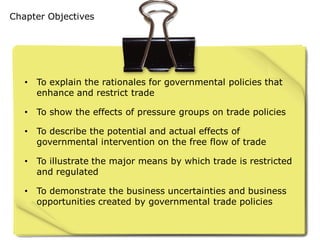
Chapter Objectives


   ‱   To explain the rationales for governmental policies that
       enhance and restrict trade

   ‱   To show the effects of pressure groups on trade policies

   ‱   To describe the potential and actual effects of
       governmental intervention on the free flow of trade

   ‱   To illustrate the major means by which trade is restricted
       and regulated

   ‱   To demonstrate the business uncertainties and business
       opportunities created by governmental trade policies
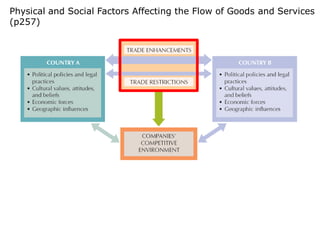
Physical and Social Factors Affecting the Flow of Goods and Services
(p257)
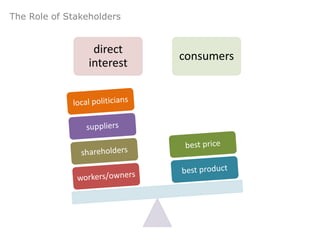
The Role of Stakeholders


                  direct
                            consumers
                 interest
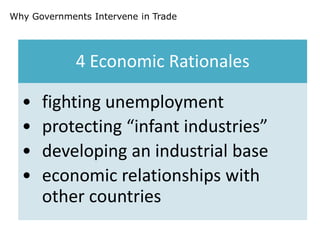
Why Governments Intervene in Trade


             4 Economic Rationales

  ‱   fighting unemployment
  ‱   protecting “infant industries”
  ‱   developing an industrial base
  ‱   economic relationships with
      other countries
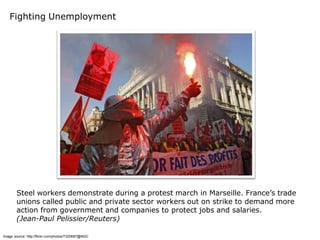
Fighting Unemployment


        Steel workers demonstrate during a protest march in Marseille. France’s trade
        unions called public and private sector workers out on strike to demand more
        action from government and companies to protect jobs and salaries.
        (Jean-Paul Pelissier/Reuters)

Image source: http://flickr.com/photos/7320687@N02/
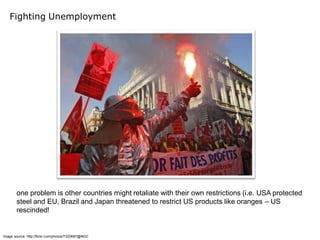
Fighting Unemployment


        one problem is other countries might retaliate with their own restrictions (i.e. USA protected
        steel and EU, Brazil and Japan threatened to restrict US products like oranges – US
        rescinded!


Image source: http://flickr.com/photos/7320687@N02/
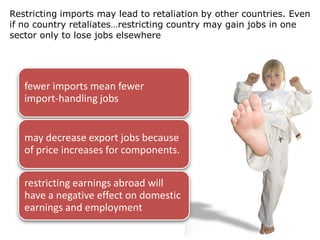
Restricting imports may lead to retaliation by other countries. Even
if no country retaliates
restricting country may gain jobs in one
sector only to lose jobs elsewhere


   fewer imports mean fewer
   import-handling jobs


   may decrease export jobs because
   of price increases for components.

   restricting earnings abroad will
   have a negative effect on domestic
   earnings and employment
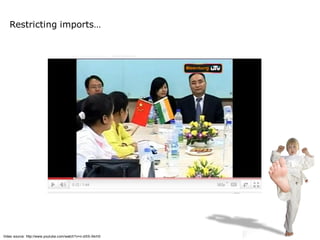
Restricting imports


Video source: http://www.youtube.com/watch?v=n-dXS-Xkrh0
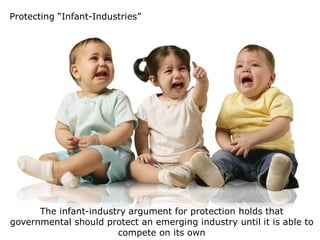
Protecting “Infant-Industries”


      The infant-industry argument for protection holds that
governmental should protect an emerging industry until it is able to
                       compete on its own
Protecting “Infant-Industries” – Assumptions and Risks


initial output costs for a small-scale industry in a given country
may be so high as to make its output non-competitive in world
markets
protection required until companies gain economies of
scale and higher productivity through experience
over time, gov’t gets higher domestic employment, lower social
costs and higher tax revenues

                              BUT
risk that costs never fall enough to be competitive – gov’t needs
to identify industries with high probability of success; also,
taxpayer $ could be spent elsewhere like education and
infrastructure
Developing an Industrial Base - assumptions


                              Brings faster growth than
                              agriculture.

                              Brings in investment funds.

                              Diversifies the economy.

                              Brings more income than
                              primary products do.

                              Reduces imports and
                              promotes exports.

                              Helps the nation-building
                              process.
Developing an Industrial Base


Video source: http://www.youtube.com/watch?v=3JzoBTpM-bs
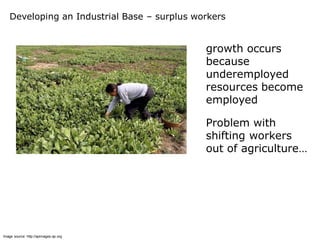
Developing an Industrial Base – surplus workers


                                             growth occurs
                                             because
                                             underemployed
                                             resources become
                                             employed

                                             Problem with
                                             shifting workers
                                             out of agriculture


Image source: http://apimages.ap.org
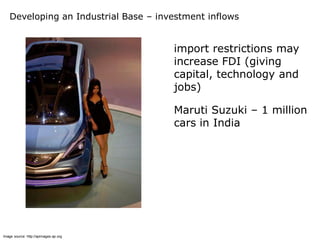
Developing an Industrial Base – investment inflows


                                       import restrictions may
                                       increase FDI (giving
                                       capital, technology and
                                       jobs)

                                       Maruti Suzuki – 1 million
                                       cars in India


Image source: http://apimages.ap.org
Developing an Industrial Base – diversification


                                                          uncontrollable factors
                                                          can affect
                                                          supply/demand

                                                          but..depending on
                                                          manufacturing does
                                                          not guarantee
                                                          diversification of
                                                          export earnings


Image source: http://www.flickr.com/photos/john_lustig/
Developing an Industrial Base – growth in manufactured goods

                                      terms of trade (quantity
                                      of imports that a given
                                      quantity of a country’s
                                      exports can buy)

                                      raw materials/
                                      commodities prices do not
                                      rise as fast as finished
                                      goods

                                      quantity of primary
                                      products demanded does
                                      not rise as fast as mfg’d
                                      goods
Developing an Industrial Base – import substitution and export-led
development

                                   developing countries may
                                   restrict imports to boost local
                                   production / consumption

                                   BUT

                                   if companies are not efficient,
                                   local customers support via
                                   higher prices or higher taxes

                                   export-led development:
                                   promoting development of
                                   industries that export their
                                   output
Developing an Industrial Base – nation building


                                   industrialization helps build
                                   infrastructure, advance rural
                                   development and boost the
                                   skills of the workforce
Using Trade Controls to Improve Economic Relations with Other Countries


 balance-of-trade adjustments
 comparable access or “fairness”
 restrictions as a bargaining tool – 2 criteria: believability and importance
 price-control objectives
 prevent dumping
 optimum-tariff theory
Why Governments Intervene in Trade


                         ‱ maintaining essential industries
   Noneconomic           ‱ dealing with unfriendly countries
                         ‱ maintaining or extending spheres
    Rationales             of influence
                         ‱ preserving national identity
Maintaining essential industries - protect essential domestic
industries during peacetime so a country is not dependent on
foreign sources of supply during war


                            Determine which ones are
                            essential.

                            Consider costs and
                            alternatives.

                            Consider political
                            consequences.
Preventing Shipments to “Unfriendly” Countries


                                                 motivated by:

                                            ‱ political rather than
                                              economic concerns
                                            ‱ maintaining domestic
                                              supplies of essential
                                              goods
                                            ‱ preventing potential
                                              enemies from gaining
                                              goods that would help
                                              them achieve their
                                              objectives
Maintaining or extending spheres of influence


                                  Governments give aid and credits
                                  to, and encourage imports from,
                                  countries that join a political
                                  alliance or vote a preferred way
                                  within international bodies.

                                  A country’s trade restrictions may
                                  coerce governments to follow
                                  certain political actions or punish
                                  companies whose governments
                                  do not.

                                   China delayed permission for Allianz, a
                                   German insurance group, to operate in
                                   China after Germany gave a reception for
                                   the Dalai Lama
Maintaining or extending spheres of influence


Video source: http://www.youtube.com/watch?v=xQ42xltm02M
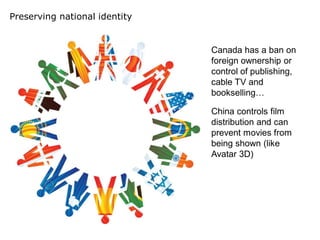
Preserving national identity


                               Canada has a ban on
                               foreign ownership or
                               control of publishing,
                               cable TV and
                               bookselling


                               China controls film
                               distribution and can
                               prevent movies from
                               being shown (like
                               Avatar 3D)
Preserving national identity


Video source: http://www.youtube.com/watch?v=XKjicnkplDY
Instruments of Trade Control


                               directly affect price and
                               indirectly affect quantity
                               ‱   tariffs (or duties)
                               ‱   subsidies
                               ‱   customs-valuation methods
                               ‱   special fees
Nontariff Barriers: Direct Price Influences


                                     directly affect price
                                     ‱ subsidies
                                     ‱ overcoming marketing
                                       imperfections
                                     ‱ aids and loans
                                     ‱ customs valuations
                                     ‱ consular fees; customs
                                       clearance/documentation
                                     ‱ deposits in advance of shipment
                                     ‱ minimum price levels
Nontariff Barriers: Quantity Controls


                              directly affect quantity
                              ‱ quotas (including embargoes)
                              ‱ voluntary export restraint (VERs)
                              ‱ “buy local” legislation
                              ‱ standards and labels
                              ‱ licensing arrangements/forex control
                              ‱ specific permission requirements
                              ‱ administrative delays
                              ‱ reciprocal requirements
                              ‱ restrictions on services
                              ‱ immigration
Options when facing Import Competition


                                                                         Seek other
                                          Move abroad
                                                                        market niches


                                         Make domestic
                                                                             Try to get
                                            output
                                                                             protection
                                          competitive
may not be realistic if you don’t have the expertise, resources or management to shift production
abroad

finding profitably niches is difficult

being innovative might help but others can rip you off/copy the innovation

can ask the gov’t to restrict imports or open export markets
Reminder


           Jun 23rd:
             mid-term exam
              chapters 1-4
               and 6-7
              cases
              class discussions
IAF605 week 6 government influence on trade

IAF605 week 6 government influence on trade

  • 1.
    IAF 605 -International Business Management Government Influence on Trade Week 6
  • 2.
    Agenda review Week 5 Chapter 7 – Governmental Influence on Trade
  • 3.
    Chapter Objectives ‱ To explain the rationales for governmental policies that enhance and restrict trade ‱ To show the effects of pressure groups on trade policies ‱ To describe the potential and actual effects of governmental intervention on the free flow of trade ‱ To illustrate the major means by which trade is restricted and regulated ‱ To demonstrate the business uncertainties and business opportunities created by governmental trade policies
  • 4.
    Physical and SocialFactors Affecting the Flow of Goods and Services (p257)
  • 5.
    The Role ofStakeholders direct consumers interest
  • 6.
    Why Governments Intervenein Trade 4 Economic Rationales ‱ fighting unemployment ‱ protecting “infant industries” ‱ developing an industrial base ‱ economic relationships with other countries
  • 7.
    Fighting Unemployment Steel workers demonstrate during a protest march in Marseille. France’s trade unions called public and private sector workers out on strike to demand more action from government and companies to protect jobs and salaries. (Jean-Paul Pelissier/Reuters) Image source: http://flickr.com/photos/7320687@N02/
  • 8.
    Fighting Unemployment one problem is other countries might retaliate with their own restrictions (i.e. USA protected steel and EU, Brazil and Japan threatened to restrict US products like oranges – US rescinded! Image source: http://flickr.com/photos/7320687@N02/
  • 9.
    Restricting imports maylead to retaliation by other countries. Even if no country retaliates
restricting country may gain jobs in one sector only to lose jobs elsewhere fewer imports mean fewer import-handling jobs may decrease export jobs because of price increases for components. restricting earnings abroad will have a negative effect on domestic earnings and employment
  • 10.
    Restricting imports
 Video source:http://www.youtube.com/watch?v=n-dXS-Xkrh0
  • 11.
    Protecting “Infant-Industries” The infant-industry argument for protection holds that governmental should protect an emerging industry until it is able to compete on its own
  • 12.
    Protecting “Infant-Industries” –Assumptions and Risks initial output costs for a small-scale industry in a given country may be so high as to make its output non-competitive in world markets
protection required until companies gain economies of scale and higher productivity through experience over time, gov’t gets higher domestic employment, lower social costs and higher tax revenues BUT risk that costs never fall enough to be competitive – gov’t needs to identify industries with high probability of success; also, taxpayer $ could be spent elsewhere like education and infrastructure
  • 13.
    Developing an IndustrialBase - assumptions Brings faster growth than agriculture. Brings in investment funds. Diversifies the economy. Brings more income than primary products do. Reduces imports and promotes exports. Helps the nation-building process.
  • 14.
    Developing an IndustrialBase Video source: http://www.youtube.com/watch?v=3JzoBTpM-bs
  • 15.
    Developing an IndustrialBase – surplus workers growth occurs because underemployed resources become employed Problem with shifting workers out of agriculture
 Image source: http://apimages.ap.org
  • 16.
    Developing an IndustrialBase – investment inflows import restrictions may increase FDI (giving capital, technology and jobs) Maruti Suzuki – 1 million cars in India Image source: http://apimages.ap.org
  • 17.
    Developing an IndustrialBase – diversification uncontrollable factors can affect supply/demand but..depending on manufacturing does not guarantee diversification of export earnings Image source: http://www.flickr.com/photos/john_lustig/
  • 18.
    Developing an IndustrialBase – growth in manufactured goods terms of trade (quantity of imports that a given quantity of a country’s exports can buy) raw materials/ commodities prices do not rise as fast as finished goods quantity of primary products demanded does not rise as fast as mfg’d goods
  • 19.
    Developing an IndustrialBase – import substitution and export-led development developing countries may restrict imports to boost local production / consumption BUT if companies are not efficient, local customers support via higher prices or higher taxes export-led development: promoting development of industries that export their output
  • 20.
    Developing an IndustrialBase – nation building industrialization helps build infrastructure, advance rural development and boost the skills of the workforce
  • 21.
    Using Trade Controlsto Improve Economic Relations with Other Countries balance-of-trade adjustments comparable access or “fairness” restrictions as a bargaining tool – 2 criteria: believability and importance price-control objectives prevent dumping optimum-tariff theory
  • 22.
    Why Governments Intervenein Trade ‱ maintaining essential industries Noneconomic ‱ dealing with unfriendly countries ‱ maintaining or extending spheres Rationales of influence ‱ preserving national identity
  • 23.
    Maintaining essential industries- protect essential domestic industries during peacetime so a country is not dependent on foreign sources of supply during war Determine which ones are essential. Consider costs and alternatives. Consider political consequences.
  • 24.
    Preventing Shipments to“Unfriendly” Countries motivated by: ‱ political rather than economic concerns ‱ maintaining domestic supplies of essential goods ‱ preventing potential enemies from gaining goods that would help them achieve their objectives
  • 25.
    Maintaining or extendingspheres of influence Governments give aid and credits to, and encourage imports from, countries that join a political alliance or vote a preferred way within international bodies. A country’s trade restrictions may coerce governments to follow certain political actions or punish companies whose governments do not. China delayed permission for Allianz, a German insurance group, to operate in China after Germany gave a reception for the Dalai Lama
  • 26.
    Maintaining or extendingspheres of influence Video source: http://www.youtube.com/watch?v=xQ42xltm02M
  • 27.
    Preserving national identity Canada has a ban on foreign ownership or control of publishing, cable TV and bookselling
 China controls film distribution and can prevent movies from being shown (like Avatar 3D)
  • 28.
    Preserving national identity Videosource: http://www.youtube.com/watch?v=XKjicnkplDY
  • 29.
    Instruments of TradeControl directly affect price and indirectly affect quantity ‱ tariffs (or duties) ‱ subsidies ‱ customs-valuation methods ‱ special fees
  • 30.
    Nontariff Barriers: DirectPrice Influences directly affect price ‱ subsidies ‱ overcoming marketing imperfections ‱ aids and loans ‱ customs valuations ‱ consular fees; customs clearance/documentation ‱ deposits in advance of shipment ‱ minimum price levels
  • 31.
    Nontariff Barriers: QuantityControls directly affect quantity ‱ quotas (including embargoes) ‱ voluntary export restraint (VERs) ‱ “buy local” legislation ‱ standards and labels ‱ licensing arrangements/forex control ‱ specific permission requirements ‱ administrative delays ‱ reciprocal requirements ‱ restrictions on services ‱ immigration
  • 32.
    Options when facingImport Competition Seek other Move abroad market niches Make domestic Try to get output protection competitive may not be realistic if you don’t have the expertise, resources or management to shift production abroad finding profitably niches is difficult being innovative might help but others can rip you off/copy the innovation can ask the gov’t to restrict imports or open export markets
  • 33.
    Reminder Jun 23rd: mid-term exam  chapters 1-4 and 6-7  cases  class discussions