HAWA MAHAL , JAIPUR
 It was built in 1799 by Maharaja Sawai Pratap Singh, and designed by Lal
Chand Ustad in the form of the crown of Krishna, the Hindu god.
 Its unique five-storey exterior is also akin to the honeycomb of the beehive with
its 953 small windows called jharokhas that are decorated with intricate
latticework.
Though no historical record is available to its
exact history, it is conjectured that Royal family
ladies, who were under strict observance of purdah
(the practice of preventing women from being seen
by men) , had to be given opportunity to witness
proceedings
in the market centre and watch the royal
processions and festivities sitting behind
the stone carved screens.
 Hawa Mahal did just that in style,
amidst its luxurious comforts and
behind strict screened exclusivity,
unseen by outsiders.
Royal family of Jaipur, during their
reign, also used the palace as a hot
weather retreat, during the suffocating
summer season of Jaipur, for several
years, since the unusually designed
window screens provided the much
needed cool breeze and ventilation.
The palace is a five-story pyramidal
shaped monument that rises to a
height of 50 feet (15 m) from its high
base.
The top three floors of the structure
have a dimension of one room width
while the first and second floors have
patios in front of them, on the rear
side of the structure.
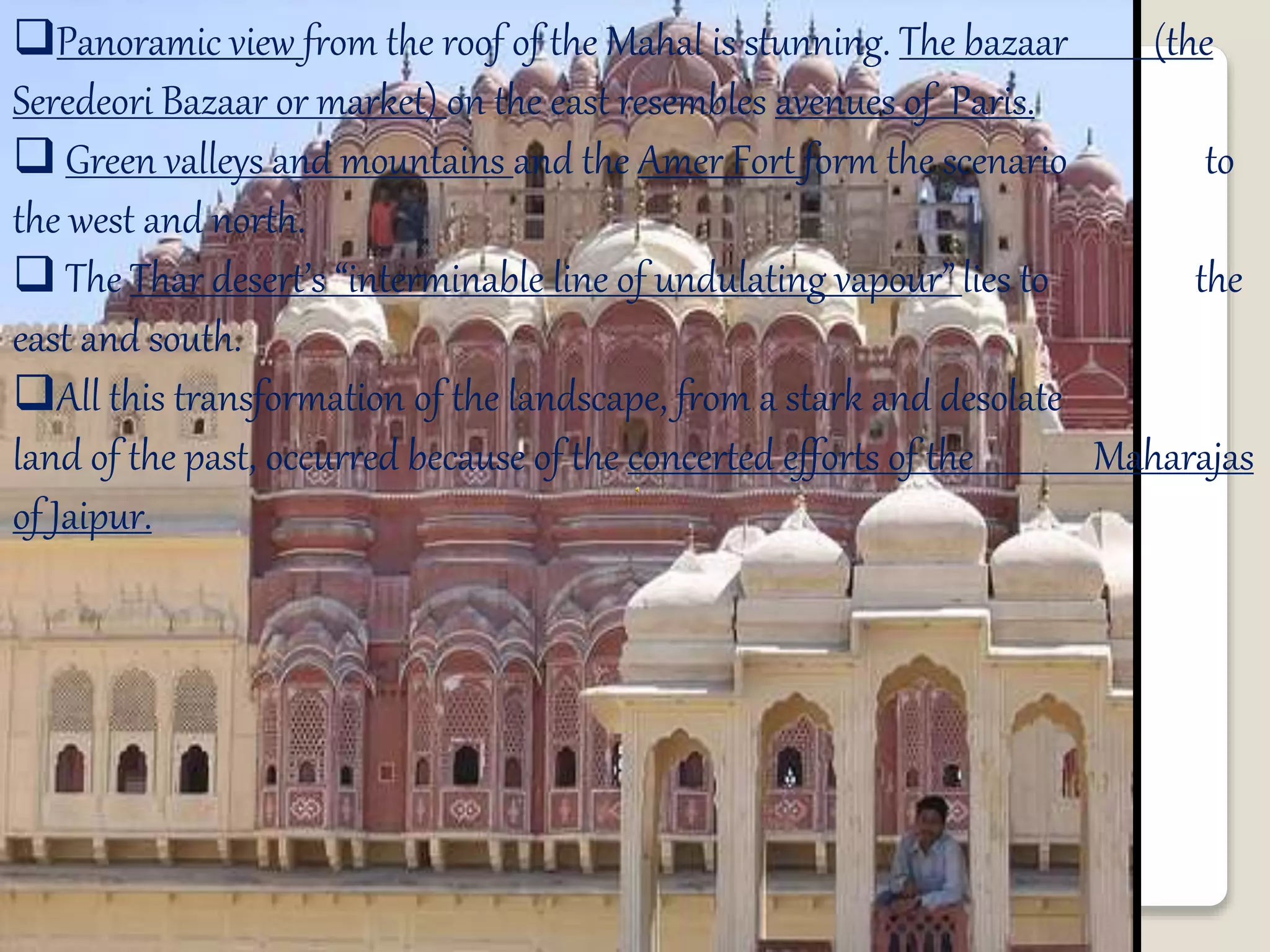
The front elevation, as seen from
the street, is like a honeycomb web
of a beehive built with small
portholes. Each porthole has
miniature windows and has carved
sandstone grills, finials and domes.
 It is a veritable mass of semi-
octagonal bays, which gives the
monument its unique facade. The
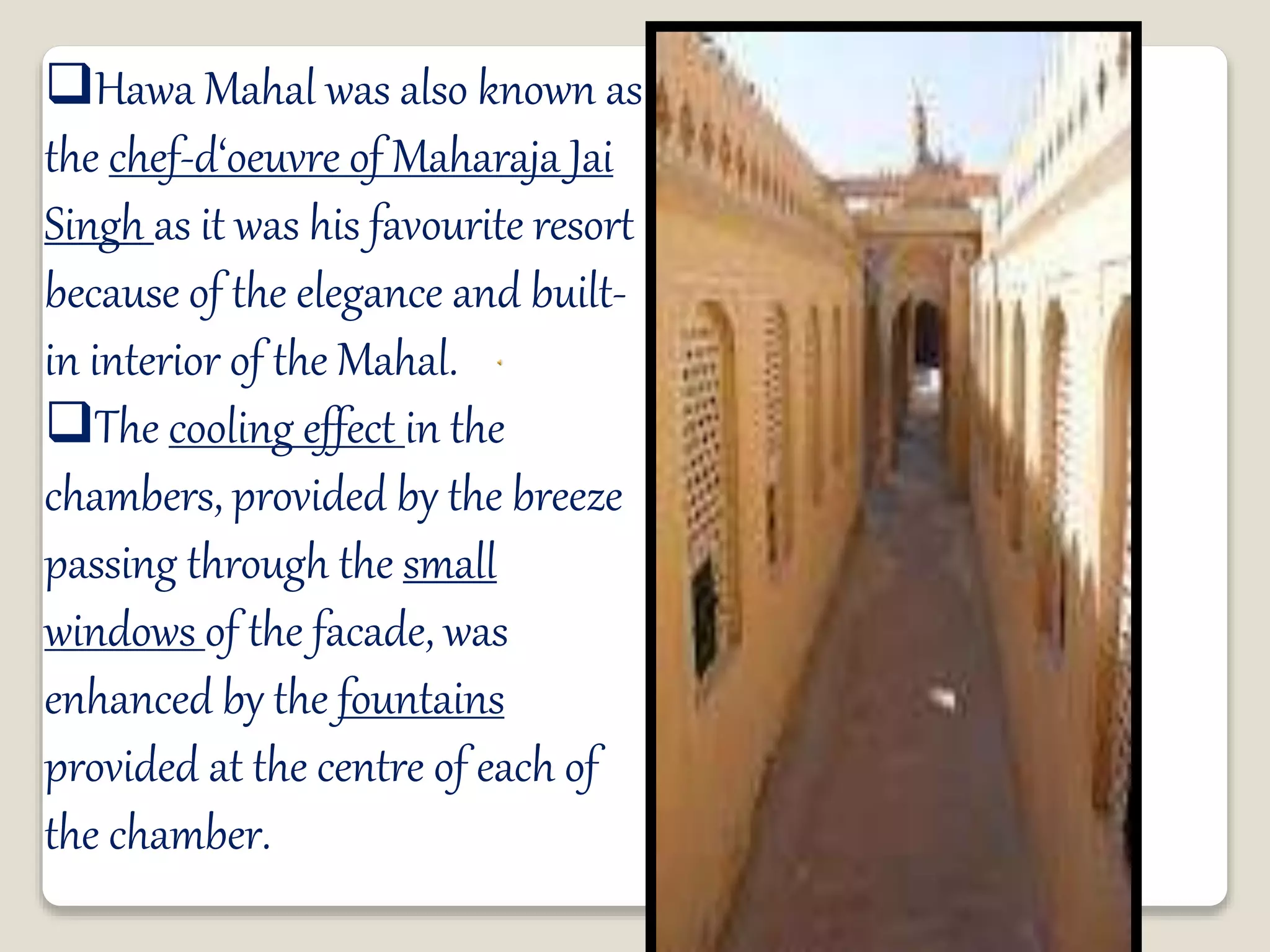
inner face on the back side of the
building consists of need-based
chambers built with pillars and
corridors with least ornamentation,
and reach up to the top floor.
The interior of the Mahal has been described as “having rooms of different coloured
marbles, relieved by inlaid panels or gilding; while fountains adorn the centre of the
courtyard Walls
Lal Chand Ustad was the architect of this unique structure who also planned Jaipur city,
considered then as one of the best-planned cities in India.
 Built in red and pink coloured sand stone, in keeping with the décor of the other
monuments in the city, its colour is a full testimony to the epithet of “Pink City” given to
Jaipur.
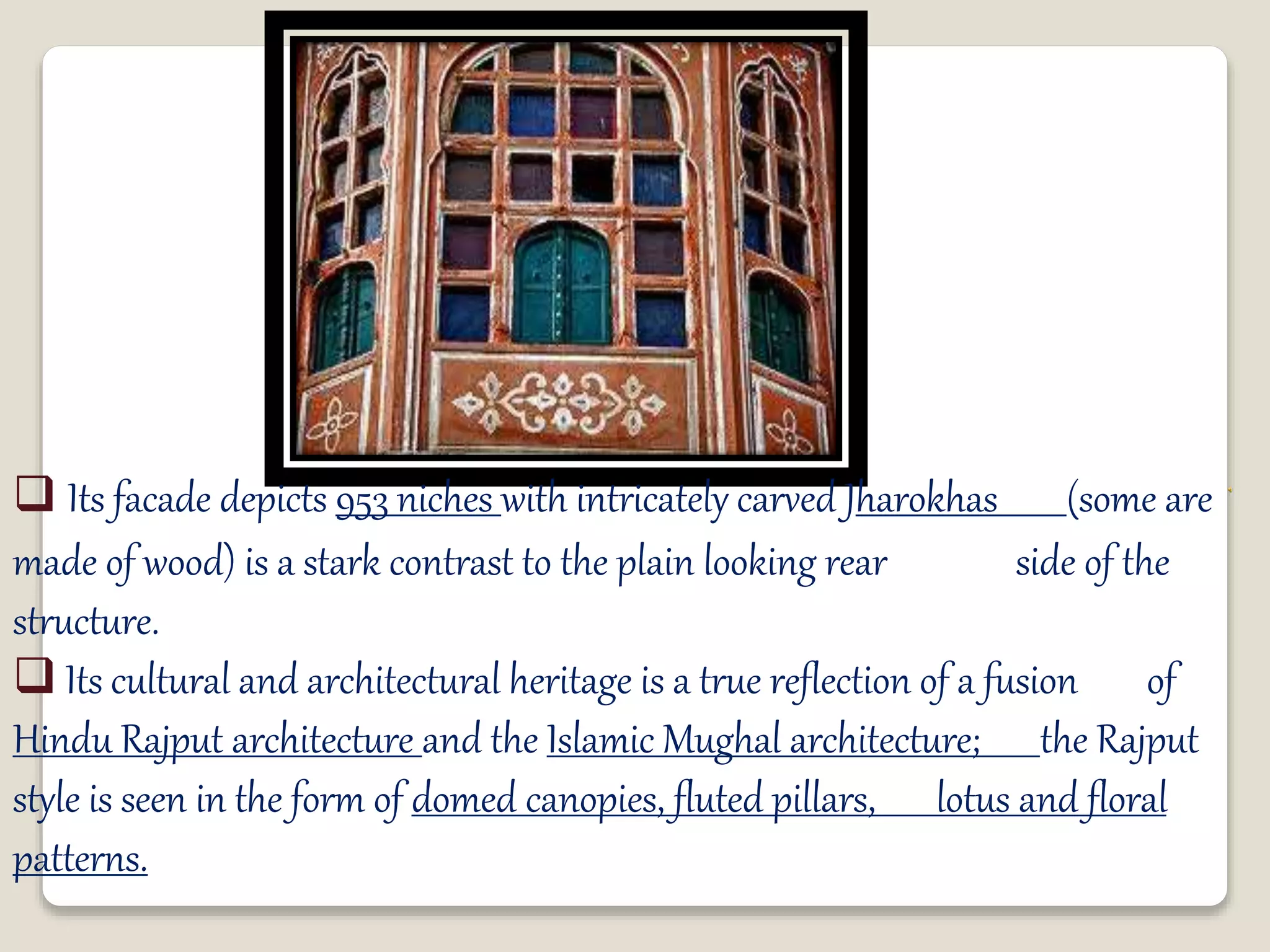
 Its facade depicts 953 niches with intricately carved Jharokhas (some are
made of wood) is a stark contrast to the plain looking rear side of the
structure.
 Its cultural and architectural heritage is a true reflection of a fusion of
Hindu Rajput architecture and the Islamic Mughal architecture; the Rajput
style is seen in the form of domed canopies, fluted pillars, lotus and floral
patterns.
Hawa Mahal was also known as
the chef-d‘oeuvre of Maharaja Jai
Singh as it was his favourite resort
because of the elegance and built-
in interior of the Mahal.
The cooling effect in the
chambers, provided by the breeze
passing through the small
windows of the facade, was
enhanced by the fountains
provided at the centre of each of
the chamber.
Panoramic view from the roof of the Mahal is stunning. The bazaar (the
Seredeori Bazaar or market) on the east resembles avenues of Paris.
 Green valleys and mountains and the Amer Fort form the scenario to
the west and north.
 The Thar desert’s “interminable line of undulating vapour”lies to the
east and south.
All this transformation of the landscape, from a stark and desolate
land of the past, occurred because of the concerted efforts of the Maharajas
of Jaipur.
In 2005, restoration and renovation works on the Mahal were undertaken, after
a long gap of 50 years, to give a face lift to the monument at an estimated cost of
Rs 45lakhs .
The corporate sector is also lending a hand to preserve the historical
monuments of Jaipur and the Unit Trust of India has adopted Hawa Mahal to
maintain it.
The walls of Hawa Mahal, which were once
witness to the presence of rulers, today bear
lines scribbled by lovebirds and its shaky
roofs testify the neglect that threatens to
make it a thing of the past.
The entire palace turned into a grazing
ground for cattle.
Local people said demands were made
several for conservation of the palace, but no
effort had yet been taken, Until now,
The arts and culture department, in
collaboration with the Indian National Trust
for Art and Cultural Heritage, had recently
taken a decision to take up conservation of
Hawa Mahal.
The palace s now maintained by the Archaeological Department. There is a small
museum located in the premises of Hawa Mahal that houses ancient artifacts
related to the Rajput lifestyle.

Hawa mahal

  • 2.
  • 3.
     It wasbuilt in 1799 by Maharaja Sawai Pratap Singh, and designed by Lal Chand Ustad in the form of the crown of Krishna, the Hindu god.  Its unique five-storey exterior is also akin to the honeycomb of the beehive with its 953 small windows called jharokhas that are decorated with intricate latticework.
  • 4.
    Though no historicalrecord is available to its exact history, it is conjectured that Royal family ladies, who were under strict observance of purdah (the practice of preventing women from being seen by men) , had to be given opportunity to witness proceedings in the market centre and watch the royal processions and festivities sitting behind the stone carved screens.  Hawa Mahal did just that in style, amidst its luxurious comforts and behind strict screened exclusivity, unseen by outsiders.
  • 5.
    Royal family ofJaipur, during their reign, also used the palace as a hot weather retreat, during the suffocating summer season of Jaipur, for several years, since the unusually designed window screens provided the much needed cool breeze and ventilation. The palace is a five-story pyramidal shaped monument that rises to a height of 50 feet (15 m) from its high base. The top three floors of the structure have a dimension of one room width while the first and second floors have patios in front of them, on the rear side of the structure.
  • 6.
    The front elevation,as seen from the street, is like a honeycomb web of a beehive built with small portholes. Each porthole has miniature windows and has carved sandstone grills, finials and domes.  It is a veritable mass of semi- octagonal bays, which gives the monument its unique facade. The inner face on the back side of the building consists of need-based chambers built with pillars and corridors with least ornamentation, and reach up to the top floor.
  • 7.
    The interior ofthe Mahal has been described as “having rooms of different coloured marbles, relieved by inlaid panels or gilding; while fountains adorn the centre of the courtyard Walls Lal Chand Ustad was the architect of this unique structure who also planned Jaipur city, considered then as one of the best-planned cities in India.  Built in red and pink coloured sand stone, in keeping with the décor of the other monuments in the city, its colour is a full testimony to the epithet of “Pink City” given to Jaipur.
  • 8.
     Its facadedepicts 953 niches with intricately carved Jharokhas (some are made of wood) is a stark contrast to the plain looking rear side of the structure.  Its cultural and architectural heritage is a true reflection of a fusion of Hindu Rajput architecture and the Islamic Mughal architecture; the Rajput style is seen in the form of domed canopies, fluted pillars, lotus and floral patterns.
  • 9.
    Hawa Mahal wasalso known as the chef-d‘oeuvre of Maharaja Jai Singh as it was his favourite resort because of the elegance and built- in interior of the Mahal. The cooling effect in the chambers, provided by the breeze passing through the small windows of the facade, was enhanced by the fountains provided at the centre of each of the chamber.
  • 10.
    Panoramic view fromthe roof of the Mahal is stunning. The bazaar (the Seredeori Bazaar or market) on the east resembles avenues of Paris.  Green valleys and mountains and the Amer Fort form the scenario to the west and north.  The Thar desert’s “interminable line of undulating vapour”lies to the east and south. All this transformation of the landscape, from a stark and desolate land of the past, occurred because of the concerted efforts of the Maharajas of Jaipur.
  • 11.
    In 2005, restorationand renovation works on the Mahal were undertaken, after a long gap of 50 years, to give a face lift to the monument at an estimated cost of Rs 45lakhs . The corporate sector is also lending a hand to preserve the historical monuments of Jaipur and the Unit Trust of India has adopted Hawa Mahal to maintain it.
  • 12.
    The walls ofHawa Mahal, which were once witness to the presence of rulers, today bear lines scribbled by lovebirds and its shaky roofs testify the neglect that threatens to make it a thing of the past. The entire palace turned into a grazing ground for cattle. Local people said demands were made several for conservation of the palace, but no effort had yet been taken, Until now, The arts and culture department, in collaboration with the Indian National Trust for Art and Cultural Heritage, had recently taken a decision to take up conservation of Hawa Mahal. The palace s now maintained by the Archaeological Department. There is a small museum located in the premises of Hawa Mahal that houses ancient artifacts related to the Rajput lifestyle.