ONE GLOBE -   ONE WORLD??? GLOBALISATION
The world’s countries are in different phases of development    so the world was divided  into different so-called “sub-worlds”:    First World Nations +  Industrialised countries   with  market economy (e.g. USA, Japan, GB, Austria...) GLOBALISATION
   BEMs = Developing countries which have  maintained sustained economic growth  over the years and show good economic  potential are called  emerging markets .  The  Big Emerging Market  economies are  e.g. Argentina, Brazil, China, Egypt,  India, Indonesia, Mexico, Poland, Russia,  South Africa, South Korea or Turkey  GLOBALISATION
   NICs  = newly industrialised countries Countries with more advanced economies  than other developing nations, but which have not yet fully demonstrated the signs of a developed country. e.g. Thailand, Vietnam, Cambodia,… GLOBALISATION
   LDCs = so-called „ developing countries” GLOBALISATION The application of the term  developing country  to any country which is not developed is inappropriate because a number of poor countries have experienced long periods of economic decline. Such countries are classified as either  least developed   countries  or  failed states.  e.g. Somalia, Sudan, Zimbabwe, Chad, Iraq
   LEDCs   GLOBALISATION International organisations have started to use the term „Less economically developed countries“ (LEDCs) for the poorest nations which can in no sense be regarded as developing.  That is, LEDCs are the poorest subset of LDCs. This also moderates the wrong tendency to believe that the standard of living in the entire developing world is the same.  e.g.Ethiopia, Eritrea, Niger…
GLOBALISATION Development entails  a modern infrastructure  and a  move away from low value added sectors  such as agriculture and natural resource  extraction.  Developed countries usually have economic systems based on continuous, self-sustaining economic growth in the tertiary and quarternary sectors and high standards of living.
GLOBALISATION Measure and concept of development The development of a country is measured with statistical indexes such as  income per capita (per person), GDP,  life expectancy, the rate of literacy, et cetera.  The UN has developed the  HDI , a compound indicator of the above statistics, to express the level of human development for countries where data is available.
GLOBALISATION Developing countries are in general countries which have  not achieved  a significant degree of  industrialisation  relative to their populations, and which have, in most cases a  medium to low   standard of living . There is a strong correlation between low income and high population growth.
GLOBALISATION The 21st century is stamped by a world-wide linkage of economy, called  globalisation .  There is a strong correlation between most countries in sense of tele-communications, industrial production and exchange of goods. There is no possibility for countries to escape this development.
GLOBALISATION
GLOBALISATION
What does  „ globalisation“  mean to me?  In what sense  am I a so-called „ Mc World  citizen“? GLOBALISATION
HOW TO DEVELOP A COUNTRY.... Development of a country has a logical consequence.  Every country has to go through different phases on its way to an  industrialised country. PHASE 1:   AGRARIAN COUNTRIES = no industrialisation at all / time before the start of industry The economy of such countries is  dominated by people working in the  primary sector (= mining of raw materials),  few people working in the secondary sector  (=processing and manufacturing) and very few people working in the  tertiary sector (= services). GLOBALISATION
GLOBALISATION PHASE 2 :  EARLY INDUSTRIAL COUNTRIES (NICs) = start of industrialisation The economy of these countries  shows a still high primary sector  but an increasing secondary sector  and a slowly increasing tertiary sector
GLOBALISATION PHASE 3:   HIGH INDUSTRIAL COUNTRIES = industrialisation completed The economy changes again:  the primary sector  decreases significantly,  the secondary sector becomes  the dominating sector and  also the tertiary sector increases.
GLOBALISATION PHASE 4:   POST INDUSTRIAL COUNTRIES = very  advanced  – mainly “new industries”    “leisure society” The economy’s primary sector has become very low in the meantime,  the secondary sector decreases significantly and  the tertiary sector becomes the  dominating one.  In addition a new quartery sector is added (= international services).
GLOBALISATION Developing countries are  eager  to attract any kind of industry to have at least the possibility of a start. They sell themselves with slogans like: free  building plots no or few taxes cheap workers (child work???) no  trade unions no environmental protection (no  restrictions )
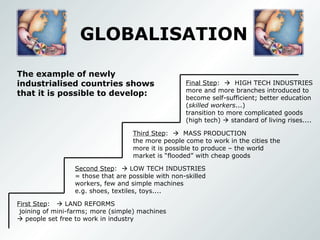
GLOBALISATION The example of newly industrialised countries shows that it is possible to develop: First Step :    LAND REFORMS joining of mini-farms; more (simple) machines    people set free to work in industry Second Step :    LOW TECH INDUSTRIES = those that are possible with non-skilled workers, few and simple machines e.g. shoes, textiles, toys.... Third Step :     MASS PRODUCTION the more people come to work in the cities the more it is possible to produce – the world market is “flooded” with cheap goods Final Step :     HIGH TECH INDUSTRIES more and more branches introduced to  become self-sufficient; better education  ( skilled workers ...) transition to more complicated goods  (high tech)    standard of living rises....
GLOBALISATION DEMOGRAPHIC VIEW Industrialised countries: About 200 years ago industrialisation started and with the years  prosperity  and  life expectancy  (better medical care, less  infant mortality ) grew continuously. In addition to better education, women at work, and a higher standard of living this caused a notable decrease of the birth rate    so in our days population increases very slowly or  stagnates  or even decreases! In general we notice a birth rate of ~ +/- 1% and a death rate of ~ +/- 1%, too. The tendency of  shrinking  growth is balanced out by migration from less developed countries. At the moment ~ ¼ of the world’s population lives in industrialised countries
GLOBALISATION Developing countries: Industrial development only started in the past 20 or 30 years.  Most of the countries currently are still in the first or second phase of development    that means that the population growth is enormous (“population scissors” open!)  In general we notice a birth rate of ~ +/- 4% and a death rate of ~ +/- 2%. At the moment ~ ¾ of the world’s population live in developing countries.
GLOBALISATION Reasons for many children: INFANT MORTALITY: Medical care is still not available for many  people living in the countryside WORKFORCE : children are needed to help  to support the family “ RETIREMENT INSURANCE ”: no state pensions – children have to  take care of their parents when they are old SOCIETY: only male  descendants  guarantee the survival of the old  (in connection to the current infant mortality  this means that every family should have at  least 4 sons to have their “pension” guaranteed SOCIAL PRESTIGE: “real men” have many children – men don’t co- operate with family planning RELIGION: nearly every religion is against contraceptives
GLOBALISATION Problems of excessive growth: food shortages bad employment situation uncontrollable migration to cities poor housing conditions poor education need for development
GLOBALISATION Possible solutions: Different countries have different methods to control their population:    sanctions   (e.g. China    many social problems)    rewards   (e.g. Indonesia    money, less tax,  pilgrimage   to Mecca for sterilisation)    free contraceptives  and sex education more or less successful! The best way would be to develop the countries’  economies and to integrate women into industrial work    a higher standard of living    fewer children e.g.  Kenya -  8,3 children/woman Ethiopia -  5,4 Brazil -  non-educated women – 6,5 / educated women (until 14!) – 2,5!!!!! compare Austria  -  1,5

Globalisation.Mandy

  • 1.
    ONE GLOBE - ONE WORLD??? GLOBALISATION
  • 2.
    The world’s countriesare in different phases of development  so the world was divided into different so-called “sub-worlds”:  First World Nations + Industrialised countries with market economy (e.g. USA, Japan, GB, Austria...) GLOBALISATION
  • 3.
    BEMs = Developing countries which have maintained sustained economic growth over the years and show good economic potential are called emerging markets . The Big Emerging Market economies are e.g. Argentina, Brazil, China, Egypt, India, Indonesia, Mexico, Poland, Russia, South Africa, South Korea or Turkey GLOBALISATION
  • 4.
    NICs = newly industrialised countries Countries with more advanced economies than other developing nations, but which have not yet fully demonstrated the signs of a developed country. e.g. Thailand, Vietnam, Cambodia,… GLOBALISATION
  • 5.
    LDCs = so-called „ developing countries” GLOBALISATION The application of the term developing country to any country which is not developed is inappropriate because a number of poor countries have experienced long periods of economic decline. Such countries are classified as either least developed countries or failed states. e.g. Somalia, Sudan, Zimbabwe, Chad, Iraq
  • 6.
    LEDCs GLOBALISATION International organisations have started to use the term „Less economically developed countries“ (LEDCs) for the poorest nations which can in no sense be regarded as developing. That is, LEDCs are the poorest subset of LDCs. This also moderates the wrong tendency to believe that the standard of living in the entire developing world is the same. e.g.Ethiopia, Eritrea, Niger…
  • 7.
    GLOBALISATION Development entails a modern infrastructure and a move away from low value added sectors such as agriculture and natural resource extraction. Developed countries usually have economic systems based on continuous, self-sustaining economic growth in the tertiary and quarternary sectors and high standards of living.
  • 8.
    GLOBALISATION Measure andconcept of development The development of a country is measured with statistical indexes such as income per capita (per person), GDP, life expectancy, the rate of literacy, et cetera. The UN has developed the HDI , a compound indicator of the above statistics, to express the level of human development for countries where data is available.
  • 9.
    GLOBALISATION Developing countriesare in general countries which have not achieved a significant degree of industrialisation relative to their populations, and which have, in most cases a medium to low standard of living . There is a strong correlation between low income and high population growth.
  • 10.
    GLOBALISATION The 21stcentury is stamped by a world-wide linkage of economy, called globalisation . There is a strong correlation between most countries in sense of tele-communications, industrial production and exchange of goods. There is no possibility for countries to escape this development.
  • 11.
  • 12.
  • 13.
    What does „ globalisation“ mean to me? In what sense am I a so-called „ Mc World citizen“? GLOBALISATION
  • 14.
    HOW TO DEVELOPA COUNTRY.... Development of a country has a logical consequence. Every country has to go through different phases on its way to an industrialised country. PHASE 1: AGRARIAN COUNTRIES = no industrialisation at all / time before the start of industry The economy of such countries is dominated by people working in the primary sector (= mining of raw materials), few people working in the secondary sector (=processing and manufacturing) and very few people working in the tertiary sector (= services). GLOBALISATION
  • 15.
    GLOBALISATION PHASE 2: EARLY INDUSTRIAL COUNTRIES (NICs) = start of industrialisation The economy of these countries shows a still high primary sector but an increasing secondary sector and a slowly increasing tertiary sector
  • 16.
    GLOBALISATION PHASE 3: HIGH INDUSTRIAL COUNTRIES = industrialisation completed The economy changes again: the primary sector decreases significantly, the secondary sector becomes the dominating sector and also the tertiary sector increases.
  • 17.
    GLOBALISATION PHASE 4: POST INDUSTRIAL COUNTRIES = very advanced – mainly “new industries”  “leisure society” The economy’s primary sector has become very low in the meantime, the secondary sector decreases significantly and the tertiary sector becomes the dominating one. In addition a new quartery sector is added (= international services).
  • 18.
    GLOBALISATION Developing countriesare eager to attract any kind of industry to have at least the possibility of a start. They sell themselves with slogans like: free building plots no or few taxes cheap workers (child work???) no trade unions no environmental protection (no restrictions )
  • 19.
    GLOBALISATION The exampleof newly industrialised countries shows that it is possible to develop: First Step :  LAND REFORMS joining of mini-farms; more (simple) machines  people set free to work in industry Second Step :  LOW TECH INDUSTRIES = those that are possible with non-skilled workers, few and simple machines e.g. shoes, textiles, toys.... Third Step :  MASS PRODUCTION the more people come to work in the cities the more it is possible to produce – the world market is “flooded” with cheap goods Final Step :  HIGH TECH INDUSTRIES more and more branches introduced to become self-sufficient; better education ( skilled workers ...) transition to more complicated goods (high tech)  standard of living rises....
  • 20.
    GLOBALISATION DEMOGRAPHIC VIEWIndustrialised countries: About 200 years ago industrialisation started and with the years prosperity and life expectancy (better medical care, less infant mortality ) grew continuously. In addition to better education, women at work, and a higher standard of living this caused a notable decrease of the birth rate  so in our days population increases very slowly or stagnates or even decreases! In general we notice a birth rate of ~ +/- 1% and a death rate of ~ +/- 1%, too. The tendency of shrinking growth is balanced out by migration from less developed countries. At the moment ~ ¼ of the world’s population lives in industrialised countries
  • 21.
    GLOBALISATION Developing countries:Industrial development only started in the past 20 or 30 years. Most of the countries currently are still in the first or second phase of development  that means that the population growth is enormous (“population scissors” open!) In general we notice a birth rate of ~ +/- 4% and a death rate of ~ +/- 2%. At the moment ~ ¾ of the world’s population live in developing countries.
  • 22.
    GLOBALISATION Reasons formany children: INFANT MORTALITY: Medical care is still not available for many people living in the countryside WORKFORCE : children are needed to help to support the family “ RETIREMENT INSURANCE ”: no state pensions – children have to take care of their parents when they are old SOCIETY: only male descendants guarantee the survival of the old (in connection to the current infant mortality this means that every family should have at least 4 sons to have their “pension” guaranteed SOCIAL PRESTIGE: “real men” have many children – men don’t co- operate with family planning RELIGION: nearly every religion is against contraceptives
  • 23.
    GLOBALISATION Problems ofexcessive growth: food shortages bad employment situation uncontrollable migration to cities poor housing conditions poor education need for development
  • 24.
    GLOBALISATION Possible solutions:Different countries have different methods to control their population:  sanctions (e.g. China  many social problems)  rewards (e.g. Indonesia  money, less tax, pilgrimage to Mecca for sterilisation)  free contraceptives and sex education more or less successful! The best way would be to develop the countries’ economies and to integrate women into industrial work  a higher standard of living  fewer children e.g. Kenya - 8,3 children/woman Ethiopia - 5,4 Brazil - non-educated women – 6,5 / educated women (until 14!) – 2,5!!!!! compare Austria - 1,5