0
Inclusive Growth – Poverty,
Inequality and Employment
Fabio Veras Soares, Raquel Ramos and Rafael
Ranieri
IPC-IG
Asia Public Policy Forum 2013
Jakarta, Indonesia
May 28-30, 2013
Inclusive Growth: Building a concept
Inclusive growth has become a central idea in the
development literature and in the political
discourse in many countries.
However, there is no clear consensus about what it
entails and how to measure it.
How does it differ from the concept(s) of pro-poor
growth?
How would an inclusive growth approach
contribute to the development policy thinking?
1
Inclusive Growth: Building a concept
IPC papers:
Ramos, R. and Ranieri, R. (2013) “Inclusive Growth: Building
up a concept”. IPC-IG Working paper series, N. 104.
http://www.ipc-undp.org/pub/IPCWorkingPaper104.pdf
Ramos, R; Ranieri, R and Lammens, J. (2013) “Mapping
Inclusive Growth”. IPC-IG Working paper series, N. 105.
http://www.ipc-undp.org/pub/IPCWorkingPaper105.pdf
Ramos, R. and Ruhl, D. (2013) “The Employment to Population
ration as an indicator of Participation and Inclusiveness”.
IPC-IG Policy Research Brief, N. 39.
http://www.ipc-undp.org/pub/IPCPolicyResearchBrief39.pdf
2
Growth, Poverty and Inequality…
1950s – 1970s:
–Trade‐offs between growth and income inequality
–Trickle-down effects of growth
–Development as an inevitable progression
1970s – 1980s:
–Poverty constrains economic growth
–Development requires engagement
Since the late 1990s:
–MDGs: targets require policies & coherent strategies
–Growth alone is not sufficient. How to ensure that growth
ameliorates the lot of the poor? – pro-poor
–What about inequality? Gradually integrated
3
Inclusive Growth: Building a concept
Kuznet’s hypothesis – inverted U relationship
between growh and inequality.
Natural evolution process – one should not worry
about inequality – it is positive for growth and it will
eventudally be brought down by the growth process
itself through a trickle down process.
Experience of many developing countries defies this
interpretation as different growth trajectories were
observed and a turning point was not a natural
result.
Growth that generates inequality could bring down
growth potential as the poor would under-invest in
their human capital bringing down productivity and
wages.
4
Pro-poor growth
Redistributive policies have the potential to
promote/enhance the growth process.
Growth and equity can and should go hand in hand
as a result of the rejection of the Kuznet’s
hypothesis.
Asian tiger’s had a major role in showing that rapid
and sutained growth could take place with stable
and low inequality.
Despite recognizing the centrality of growth for
poverty reduction, the literature started
acknowledging that redistributive growth was more
effective for poverty reduction than distribution-
neutral growth.
5
Pro-poor growth
The notion of pro-poor growth was a clear response
to the trickle down approach. But there was no
consensus with regard to its definition… Is pro-poor
growth any growth that benefits the poor?
“Weak absolute pro-poor growth” (Glosse et al.
2008) – any growth episode during which the
poverty rate declines, regardless to what happens to
inequality.
“Weak relative pro-poor growth” – it requires than
the poor people income grows at a higher rate than
the richer people. In this case, pro-poor growth also
decreases inequality.
“Strong absolute inequality” – absolute increases in
income of the poor are larger than absolute
increases in the income of the wealthier.
6
Pro-poor growth
Policy implication: how to promote pro-poor
growth?
Bias toward the poor? (Kakwani & Pernia, 2003)
Promoting growth would favour the poor? (Dollar
and Kray, 2000)
Growth with redistribution would help to accelerate
poverty reduction. (Ravallion, 2004).
Non-income dimension: multidimensional poverty
makes brings more complexity to the assessment of
pro-poorness of growth.
7
Inclusive Growth
Kakwani and Pernia (2000) “pro-poor growth as a
growth process that enables the poor to actively
particpate in and significantly benefit from economic
activity”- a inclusive economic growth.
Pro-poor growth: focus on poverty and inequality
(level and distribution of income) with non-income
dimension incorporated later (still as outcomes –
benefit sharing).
Inclusive growth: process – the idea of participation,
beyond benefit-sharing. Opposite of participation is
exclusion – vulnerable groups.
8
Inclusive Growth
Other views: all should benefit from the growth
process. Non-zero sum game – the benefit of the
poor helps to increase benefit for the richer.
Ali and Son (2007) focus on opportunities rather
than outcomes.
Ianchovichina and Lundstrom (2009) focus on the
sustainability of the growth process and emphasis on
the need to foster “productive employment”.
Pro-poor and inclusive growth can be differentiated
by the focus on the “process” of the latter: extensive
contribution of inputs from the labour force and
non-discrimination (Klassen, 2010).
9
Inclusive Growth
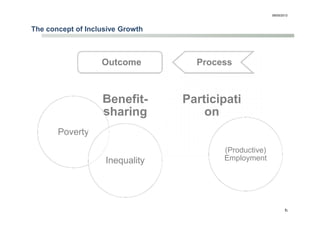
Empirical challenge – how to measure IG:
Benefit-sharing: poverty and inequality (Outcome)
Participation: participation in the labour market in a
productive/decent fashion and no discrimination of
specific groups (ethnic, age and gender based
discrimination) – process and outcome.
10
Inclusive Growth
McKinley (2010) IG index based on ADB Long-Term
Strategic framework 2008-2020 based on the notion
that IG entails:
i) Achieving sustainable growth that will create and
expand economic opportunities, and
ii) Ensuring broader access to these opportunities so
that members of society can participate in and
benefit from growth.
Components: productive employment; economic
infrastructure, income poverty and equity, gender
equity, human capabilities and social protection.
11
Inclusive Growth
Difficulties in measuring the process:
Productive employment –
identified as the key missing element/input, but how
to define what is productive employment.
Classification may vary from country to country.
Sector/wage-based classification may lead to
different results. Lack of data.
EPR is more general: low EPR is not inclusive, but high
EPR is not always good, given large proportion of
working poor in very poor countries.
12
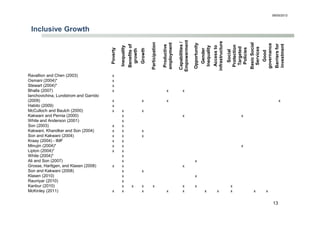
Inclusive Growth
Poverty
Inequality
Benefitsof
growth
Growth
Participation
Productive
employment
Capabilities/
Empowerment
Opportunity
Gender
Inequality
Accessto
infrastructure
Social
Protection
Targeted
Policies
BasicSocial
Services
Good
governance
Barriersfor
investment
Ravallion and Chen (2003) x
Osmani (2004)* x
Stewart (2004)* x
Bhalla (2007) x x x
Ianchovichina, Lundstrom and Garrido
(2009) x x x x
Habito (2009) x
McCulloch and Baulch (2000) x x x
Kakwani and Pernia (2000) x x x
White and Anderson (2001) x
Son (2003) x x
Kakwani, Khandker and Son (2004) x x x
Son and Kakwani (2004) x x x
Kraay (2004) - IMF x x
Minujin (2004)* x x x
Lipton (2004)* x x
White (2004)* x
Ali and Son (2007) x x
Grosse, Harttgen, and Klasen (2008) x x x
Son and Kakwani (2008) x x
Klasen (2010) x x
Rauniyar (2010) x
Kanbur (2010) x x x x x x x
McKinley (2011) x x x x x x x x x x
08/05/2013
13
The concept of Inclusive Growth
Benefit-
sharing
08/05/2013
h
Poverty
Inequality
Participati
on
(Productive)
Employment
Outcome Process
Inclusive Growth
Inclusive Growth:
An intuitively straightforward and yet elusive
concept; that determines policy objectives!
What makes growth inclusive?
How to assess the relationship between growth and
any element of inclusiveness?
Deeming a growth episode inclusive is sufficient to
establish that the process of growth and the country
are inclusive?
GDP versus Familiy’s income: National accounts and
Household survey data.
15
References
20/06/2013
GDN 14th Annual Global
Development Conference
16
Kuznets, S. (1955). ‘Economic Growth and
Income Inequality’, The American Economic
Review, Vol. 45, No. 1: 1–28.
Lopez, J.H. (2004). Pro-poor growth: a
review of what we know (and of what we
don’t know). Washington, DC, World Bank.
McKinley, T. (2010). ‘Inclusive Growth
Criteria and Indicators: An Inclusive Growth
Index for Diagnosis of Country Progress’,
ADB Sustainable Development Working
Paper Series, No. 14. Mandaluyong City,
Philippines, Asian Development Bank.
Ramos, R.A., Ranieri, R. and Lammens,
J.W. (2013). ‘Mapping Inclusive Growth in
Developing Countries’, IPC-IG Working
Paper, No. 105. Brasília, International
Policy Centre for Inclusive Growth.
Rauniyar, G. and Kanbur, R. (2010).
Inclusive Development: Two Papers on
Conceptualization, Application, and the
ADB Perspective. Mandaluyong City,
Philippines, Asian Development Bank.
Ravallion, M. (2004). Pro-poor Growth: A
Primer. Washington, DC, World Bank
Development Research Group.
Rostow, W.W. (1956). ‘The Take-Off Into
Self-Sustained Growth’, The Economic
Journal, Vol. 66, No. 261: 25–48.
Stiglitz. J.E. and Squire, L. (1998).
‘International Development: Is it Possible?’,
Foreign Policy, Issue 110: 138–151.
Zepeda, E. (2004). ‘Pro-poor Growth: What
Is It?,’ IPC-IG One Pager, No. 1. Brasília,
International Policy Centre for Inclusive
Growth.
Many Thanks
17

Inclusive Growth – Poverty, Inequality and Employment

  • 1.
    0 Inclusive Growth –Poverty, Inequality and Employment Fabio Veras Soares, Raquel Ramos and Rafael Ranieri IPC-IG Asia Public Policy Forum 2013 Jakarta, Indonesia May 28-30, 2013
  • 2.
    Inclusive Growth: Buildinga concept Inclusive growth has become a central idea in the development literature and in the political discourse in many countries. However, there is no clear consensus about what it entails and how to measure it. How does it differ from the concept(s) of pro-poor growth? How would an inclusive growth approach contribute to the development policy thinking? 1
  • 3.
    Inclusive Growth: Buildinga concept IPC papers: Ramos, R. and Ranieri, R. (2013) “Inclusive Growth: Building up a concept”. IPC-IG Working paper series, N. 104. http://www.ipc-undp.org/pub/IPCWorkingPaper104.pdf Ramos, R; Ranieri, R and Lammens, J. (2013) “Mapping Inclusive Growth”. IPC-IG Working paper series, N. 105. http://www.ipc-undp.org/pub/IPCWorkingPaper105.pdf Ramos, R. and Ruhl, D. (2013) “The Employment to Population ration as an indicator of Participation and Inclusiveness”. IPC-IG Policy Research Brief, N. 39. http://www.ipc-undp.org/pub/IPCPolicyResearchBrief39.pdf 2
  • 4.
    Growth, Poverty andInequality… 1950s – 1970s: –Trade‐offs between growth and income inequality –Trickle-down effects of growth –Development as an inevitable progression 1970s – 1980s: –Poverty constrains economic growth –Development requires engagement Since the late 1990s: –MDGs: targets require policies & coherent strategies –Growth alone is not sufficient. How to ensure that growth ameliorates the lot of the poor? – pro-poor –What about inequality? Gradually integrated 3
  • 5.
    Inclusive Growth: Buildinga concept Kuznet’s hypothesis – inverted U relationship between growh and inequality. Natural evolution process – one should not worry about inequality – it is positive for growth and it will eventudally be brought down by the growth process itself through a trickle down process. Experience of many developing countries defies this interpretation as different growth trajectories were observed and a turning point was not a natural result. Growth that generates inequality could bring down growth potential as the poor would under-invest in their human capital bringing down productivity and wages. 4
  • 6.
    Pro-poor growth Redistributive policieshave the potential to promote/enhance the growth process. Growth and equity can and should go hand in hand as a result of the rejection of the Kuznet’s hypothesis. Asian tiger’s had a major role in showing that rapid and sutained growth could take place with stable and low inequality. Despite recognizing the centrality of growth for poverty reduction, the literature started acknowledging that redistributive growth was more effective for poverty reduction than distribution- neutral growth. 5
  • 7.
    Pro-poor growth The notionof pro-poor growth was a clear response to the trickle down approach. But there was no consensus with regard to its definition… Is pro-poor growth any growth that benefits the poor? “Weak absolute pro-poor growth” (Glosse et al. 2008) – any growth episode during which the poverty rate declines, regardless to what happens to inequality. “Weak relative pro-poor growth” – it requires than the poor people income grows at a higher rate than the richer people. In this case, pro-poor growth also decreases inequality. “Strong absolute inequality” – absolute increases in income of the poor are larger than absolute increases in the income of the wealthier. 6
  • 8.
    Pro-poor growth Policy implication:how to promote pro-poor growth? Bias toward the poor? (Kakwani & Pernia, 2003) Promoting growth would favour the poor? (Dollar and Kray, 2000) Growth with redistribution would help to accelerate poverty reduction. (Ravallion, 2004). Non-income dimension: multidimensional poverty makes brings more complexity to the assessment of pro-poorness of growth. 7
  • 9.
    Inclusive Growth Kakwani andPernia (2000) “pro-poor growth as a growth process that enables the poor to actively particpate in and significantly benefit from economic activity”- a inclusive economic growth. Pro-poor growth: focus on poverty and inequality (level and distribution of income) with non-income dimension incorporated later (still as outcomes – benefit sharing). Inclusive growth: process – the idea of participation, beyond benefit-sharing. Opposite of participation is exclusion – vulnerable groups. 8
  • 10.
    Inclusive Growth Other views:all should benefit from the growth process. Non-zero sum game – the benefit of the poor helps to increase benefit for the richer. Ali and Son (2007) focus on opportunities rather than outcomes. Ianchovichina and Lundstrom (2009) focus on the sustainability of the growth process and emphasis on the need to foster “productive employment”. Pro-poor and inclusive growth can be differentiated by the focus on the “process” of the latter: extensive contribution of inputs from the labour force and non-discrimination (Klassen, 2010). 9
  • 11.
    Inclusive Growth Empirical challenge– how to measure IG: Benefit-sharing: poverty and inequality (Outcome) Participation: participation in the labour market in a productive/decent fashion and no discrimination of specific groups (ethnic, age and gender based discrimination) – process and outcome. 10
  • 12.
    Inclusive Growth McKinley (2010)IG index based on ADB Long-Term Strategic framework 2008-2020 based on the notion that IG entails: i) Achieving sustainable growth that will create and expand economic opportunities, and ii) Ensuring broader access to these opportunities so that members of society can participate in and benefit from growth. Components: productive employment; economic infrastructure, income poverty and equity, gender equity, human capabilities and social protection. 11
  • 13.
    Inclusive Growth Difficulties inmeasuring the process: Productive employment – identified as the key missing element/input, but how to define what is productive employment. Classification may vary from country to country. Sector/wage-based classification may lead to different results. Lack of data. EPR is more general: low EPR is not inclusive, but high EPR is not always good, given large proportion of working poor in very poor countries. 12
  • 14.
    Inclusive Growth Poverty Inequality Benefitsof growth Growth Participation Productive employment Capabilities/ Empowerment Opportunity Gender Inequality Accessto infrastructure Social Protection Targeted Policies BasicSocial Services Good governance Barriersfor investment Ravallion andChen (2003) x Osmani (2004)* x Stewart (2004)* x Bhalla (2007) x x x Ianchovichina, Lundstrom and Garrido (2009) x x x x Habito (2009) x McCulloch and Baulch (2000) x x x Kakwani and Pernia (2000) x x x White and Anderson (2001) x Son (2003) x x Kakwani, Khandker and Son (2004) x x x Son and Kakwani (2004) x x x Kraay (2004) - IMF x x Minujin (2004)* x x x Lipton (2004)* x x White (2004)* x Ali and Son (2007) x x Grosse, Harttgen, and Klasen (2008) x x x Son and Kakwani (2008) x x Klasen (2010) x x Rauniyar (2010) x Kanbur (2010) x x x x x x x McKinley (2011) x x x x x x x x x x 08/05/2013 13
  • 15.
    The concept ofInclusive Growth Benefit- sharing 08/05/2013 h Poverty Inequality Participati on (Productive) Employment Outcome Process
  • 16.
    Inclusive Growth Inclusive Growth: Anintuitively straightforward and yet elusive concept; that determines policy objectives! What makes growth inclusive? How to assess the relationship between growth and any element of inclusiveness? Deeming a growth episode inclusive is sufficient to establish that the process of growth and the country are inclusive? GDP versus Familiy’s income: National accounts and Household survey data. 15
  • 17.
    References 20/06/2013 GDN 14th AnnualGlobal Development Conference 16 Kuznets, S. (1955). ‘Economic Growth and Income Inequality’, The American Economic Review, Vol. 45, No. 1: 1–28. Lopez, J.H. (2004). Pro-poor growth: a review of what we know (and of what we don’t know). Washington, DC, World Bank. McKinley, T. (2010). ‘Inclusive Growth Criteria and Indicators: An Inclusive Growth Index for Diagnosis of Country Progress’, ADB Sustainable Development Working Paper Series, No. 14. Mandaluyong City, Philippines, Asian Development Bank. Ramos, R.A., Ranieri, R. and Lammens, J.W. (2013). ‘Mapping Inclusive Growth in Developing Countries’, IPC-IG Working Paper, No. 105. Brasília, International Policy Centre for Inclusive Growth. Rauniyar, G. and Kanbur, R. (2010). Inclusive Development: Two Papers on Conceptualization, Application, and the ADB Perspective. Mandaluyong City, Philippines, Asian Development Bank. Ravallion, M. (2004). Pro-poor Growth: A Primer. Washington, DC, World Bank Development Research Group. Rostow, W.W. (1956). ‘The Take-Off Into Self-Sustained Growth’, The Economic Journal, Vol. 66, No. 261: 25–48. Stiglitz. J.E. and Squire, L. (1998). ‘International Development: Is it Possible?’, Foreign Policy, Issue 110: 138–151. Zepeda, E. (2004). ‘Pro-poor Growth: What Is It?,’ IPC-IG One Pager, No. 1. Brasília, International Policy Centre for Inclusive Growth.
  • 18.