INDIAN ECONOMY AND GLOBALISATIONIRVING FISHER GROUP
The term globalization means International Integration.It is a process through which the diverse world is unified into a single society.Opening up  of world trade, development of advanced  means of communication, internationalisation of financial markets, growing importance of MNC's, population migrations and more generally increased mobility of persons, goods, capital, data and ideas  WHAT IS GLOBALISATION ?
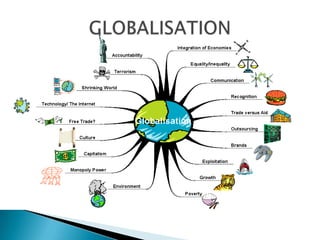
GLOBALISATION
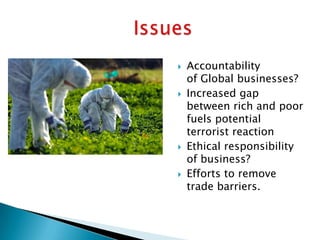
 IssuesAccountability of Global businesses?Increased gap between rich and poor fuels potential terrorist reactionEthical responsibility of business?Efforts to remove trade barriers.
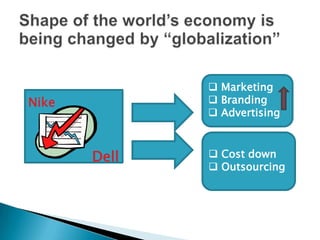
Shape of the world’s economy is being changed by “globalization” Marketing
 Branding
 AdvertisingNikeDell          Cost down
 OutsourcingNew trade pattern:developing countries don't just have to trade their raw materials to the West and get finished products in return; can become big-time producers as well. New production pattern:global product networkcompanies can locate different parts of their production, research and marketing in different countriesGlobalization – what’s really new? New Trade and Production Patterns
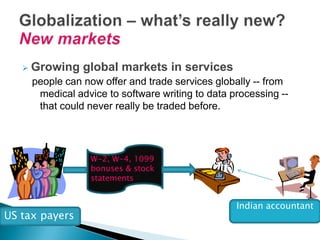
Growing global markets in servicespeople can now offer and trade services globally -- from medical advice to software writing to data processing -- that could never really be traded before.Globalization – what’s really new? New marketsW-2, W-4, 1099 bonuses & stock statementsIndian accountantUS tax payers
Market economic policies spreading around the world, with greater privatization and liberalization than in earlier decades.	ex: BRICWidespread adoption of democracy as the choice of political regime.Globalization – what’s really new? New rules and norms
Multilateral agreements in trade, taking on such new agendas as environmental and social conditions.
New multilateral agreements – for services, intellectual property , communications – more binding on national governments than any previous agreements.Globalization – what’s really new? New rules and norms
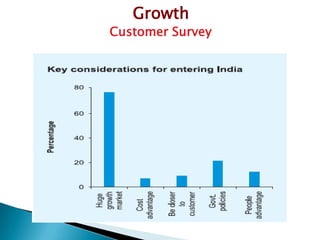
GrowthCustomer Survey
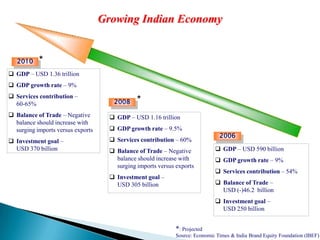
*2010GDP – USD 1.36 trillion
GDP growth rate – 9%
Services contribution – 60-65%
Balance of Trade – Negative balance should increase with surging imports versus exports
Investment goal – USD 370 billion*2008GDP – USD 1.16 trillion
GDP growth rate – 9.5%
Services contribution – 60%
Balance of Trade – Negative balance should increase with surging imports versus exports
Investment goal – USD 305 billion2006GDP – USD 590 billion
GDP growth rate – 9%
Services contribution – 54%
Balance of Trade – USD (-)46.2  billion
Investment goal – USD 250 billionGrowing Indian Economy*: ProjectedSource: Economic Times & India Brand Equity Foundation (IBEF)
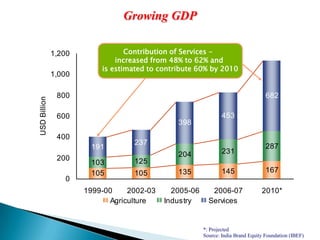
Growing GDPContribution of Services -  increased from 48% to 62% and is estimated to contribute 60% by 2010*: ProjectedSource: India Brand Equity Foundation (IBEF)
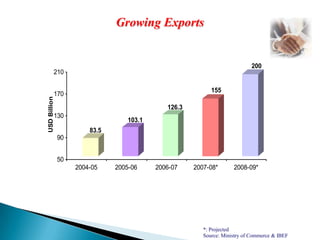
Growing Exports*: ProjectedSource: Ministry of Commerce & IBEF
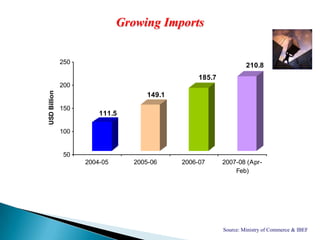
Source: Ministry of Commerce & IBEFGrowing Imports
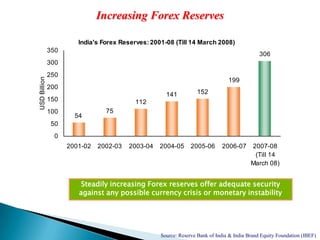
Increasing Forex ReservesSteadily increasing Forex reserves offer adequate security against any possible currency crisis or monetary instabilitySource: Reserve Bank of India & India Brand Equity Foundation (IBEF)
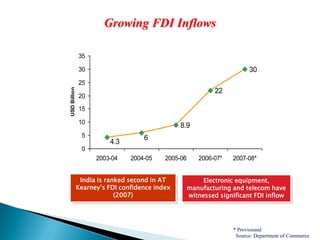
Growing FDI InflowsIndia is ranked second in AT Kearney’s FDI confidence index (2007)Electronic equipment, manufacturing and telecom have witnessed significant FDI inflow* Provisional  Source: Department of Commerce
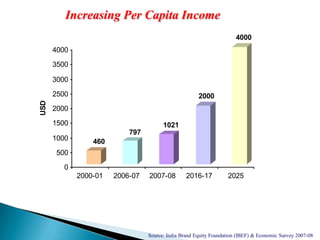
Increasing Per Capita IncomeSource: India Brand Equity Foundation (IBEF) & Economic Survey 2007-08
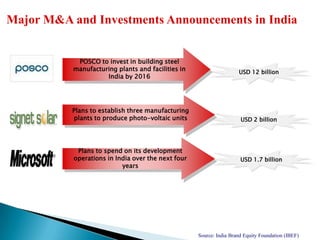
Major M&A and Investments Announcements in IndiaPOSCO to invest in building steel manufacturing plants and facilities in India by 2016USD 12 billion Plans to establish three manufacturing plants to produce photo-voltaic unitsUSD 2 billion Plans to spend on its development operations in India over the next four yearsUSD 1.7 billionSource: India Brand Equity Foundation (IBEF)

Indian Economy & Globalisation

  • 1.
    INDIAN ECONOMY ANDGLOBALISATIONIRVING FISHER GROUP
  • 2.
    The term globalizationmeans International Integration.It is a process through which the diverse world is unified into a single society.Opening up of world trade, development of advanced means of communication, internationalisation of financial markets, growing importance of MNC's, population migrations and more generally increased mobility of persons, goods, capital, data and ideas WHAT IS GLOBALISATION ?
  • 3.
  • 4.
    IssuesAccountability ofGlobal businesses?Increased gap between rich and poor fuels potential terrorist reactionEthical responsibility of business?Efforts to remove trade barriers.
  • 5.
    Shape of theworld’s economy is being changed by “globalization” Marketing
  • 6.
  • 7.
  • 8.
    OutsourcingNew tradepattern:developing countries don't just have to trade their raw materials to the West and get finished products in return; can become big-time producers as well. New production pattern:global product networkcompanies can locate different parts of their production, research and marketing in different countriesGlobalization – what’s really new? New Trade and Production Patterns
  • 9.
    Growing global marketsin servicespeople can now offer and trade services globally -- from medical advice to software writing to data processing -- that could never really be traded before.Globalization – what’s really new? New marketsW-2, W-4, 1099 bonuses & stock statementsIndian accountantUS tax payers
  • 10.
    Market economic policiesspreading around the world, with greater privatization and liberalization than in earlier decades. ex: BRICWidespread adoption of democracy as the choice of political regime.Globalization – what’s really new? New rules and norms
  • 11.
    Multilateral agreements intrade, taking on such new agendas as environmental and social conditions.
  • 12.
    New multilateral agreements– for services, intellectual property , communications – more binding on national governments than any previous agreements.Globalization – what’s really new? New rules and norms
  • 13.
  • 14.
    *2010GDP – USD1.36 trillion
  • 15.
  • 16.
  • 17.
    Balance of Trade– Negative balance should increase with surging imports versus exports
  • 18.
    Investment goal –USD 370 billion*2008GDP – USD 1.16 trillion
  • 19.
  • 20.
  • 21.
    Balance of Trade– Negative balance should increase with surging imports versus exports
  • 22.
    Investment goal –USD 305 billion2006GDP – USD 590 billion
  • 23.
  • 24.
  • 25.
    Balance of Trade– USD (-)46.2 billion
  • 26.
    Investment goal –USD 250 billionGrowing Indian Economy*: ProjectedSource: Economic Times & India Brand Equity Foundation (IBEF)
  • 27.
    Growing GDPContribution ofServices - increased from 48% to 62% and is estimated to contribute 60% by 2010*: ProjectedSource: India Brand Equity Foundation (IBEF)
  • 28.
    Growing Exports*: ProjectedSource:Ministry of Commerce & IBEF
  • 29.
    Source: Ministry ofCommerce & IBEFGrowing Imports
  • 30.
    Increasing Forex ReservesSteadilyincreasing Forex reserves offer adequate security against any possible currency crisis or monetary instabilitySource: Reserve Bank of India & India Brand Equity Foundation (IBEF)
  • 31.
    Growing FDI InflowsIndiais ranked second in AT Kearney’s FDI confidence index (2007)Electronic equipment, manufacturing and telecom have witnessed significant FDI inflow* Provisional Source: Department of Commerce
  • 32.
    Increasing Per CapitaIncomeSource: India Brand Equity Foundation (IBEF) & Economic Survey 2007-08
  • 33.
    Major M&A andInvestments Announcements in IndiaPOSCO to invest in building steel manufacturing plants and facilities in India by 2016USD 12 billion Plans to establish three manufacturing plants to produce photo-voltaic unitsUSD 2 billion Plans to spend on its development operations in India over the next four yearsUSD 1.7 billionSource: India Brand Equity Foundation (IBEF)