Globalization
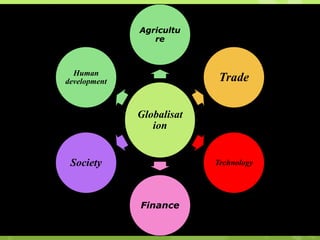
Agriculture, Trade, Transfer of Technology,
Finance & FDI, Society and Human development
Submitted to: Dr.Liaqat Ali
Submitted by: Kamaljot Kaur (15421006)
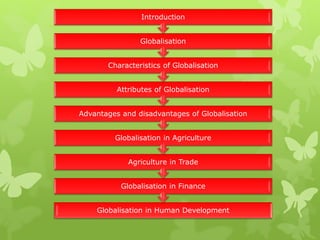
Globalisation in Human Development
Globalisation in Finance
Agriculture in Trade
Globalisation in Agriculture
Advantages and disadvantages of Globalisation
Attributes of Globalisation
Characteristics of Globalisation
Globalisation
Introduction
Introduction to
The term globalisation is derived from the word ’Globalise’,
which refers to the emergence of an international network of
economic systems.
The term globalization has been increasingly used since the mid-
1980s and especially since the mid-1990s. In 2000, the International
Monetary Fund (IMF) identified four basic aspects of globalisation
trade and transactions, capital and investment
movements,migration or movement of people, and the exchange
of knowledge.
In basic language we can
say that Globalization is a
process under which the
whole world is converted
into a Global Village.
Fe
at
ur
es
of
gl
ob
ali
za
ti
on
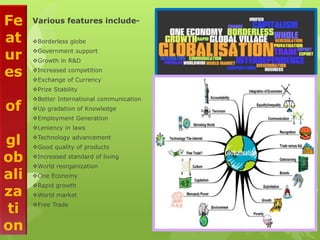
Various features include-
Borderless globe
Government support
Growth in R&D
Increased competition
Exchange of Currency
Prize Stability
Better International communication
Up gradation of Knowledge
Employment Generation
Leniency in laws
Technology advancement
Good quality of products
Increased standard of living
World reorganization
One Economy
Rapid growth
World market
Free Trade
Globalisat
ion
Agricultu
re
Trade
Technology
Finance
Society
Human
development
Globalization in
agriculture
 an engine of growth in low-income
countries making it to grow considerably
faster than domestic consumption.
 Globalization increases food security
through enlarged multipliers to the
massive, employment-intensive, non-
tradable rural non-farm sector.
 Changes in consumption patterns
 the slow growth in consumption of farm
products and, in middle-income
countries, the move away from grains
and other staples and towards livestock
and horticultural products, also alter the
net trade situation of countries.
Key drivers for change
(a) Structural changes in
global agricultural markets
(b) Technological changes and
trade costs
(c) Agricultural trade
distortions and policy reforms
Case study of Tea
production
 In 2016, Assam has produced 642.18 million kg in comparison to
631.22 million kg in 2015.
 In West Bengal too, production has gone up to 357.47 million kg
in comparison to 324.5 million kg in 2015.
 South Indian tea production is also up from 212.21 million kg in
2015 to 227.57 million kg in 2016.
 Exports have dropped by 2.46% in the period January to
November 2016, according to Tea Board data.
 Indian tea has faced tough competition in the world market from
Kenyan tea in 2016. Kenya had produced 73 million kg more teas
in 2016.
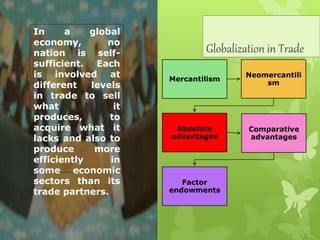
Globalization in Trade
In a global
economy, no
nation is self-
sufficient. Each
is involved at
different levels
in trade to sell
what it
produces, to
acquire what it
lacks and also to
produce more
efficiently in
some economic
sectors than its
trade partners.
Mercantilism
Neomercantili
sm
Absolute
advantages
Comparative
advantages
Factor
endowments
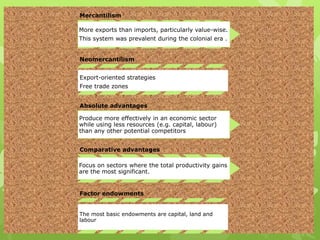
Mercantilism
More exports than imports, particularly value-wise.
This system was prevalent during the colonial era .
Neomercantilism
Export-oriented strategies
Free trade zones
Absolute advantages
Produce more effectively in an economic sector
while using less resources (e.g. capital, labour)
than any other potential competitors
Comparative advantages
Focus on sectors where the total productivity gains
are the most significant.
Factor endowments
The most basic endowments are capital, land and
labour
Activities in technology
transfers
♦Processing and evaluation of
invention disclosures
♦ Filing for patents
♦ Technology Marketing
♦ Licensing
♦ Protecting Intellectual
♦ Property developed from
research activities
♦ Assistance in creating new
businesses as well as the
promotion of the existing
organization’s success
Functions
associated with
technology transfer
coordination
nurture
Globalizationandtechnology
 The crises of the 1990s
underscored the need for
prudent sovereign debt
management
 the first lines of defence
against financial
problems and systemic
risks are sound financial
institutions, efficient
financial markets, and
effective market
discipline agreement
Globali
sation
and
finance
Role of IMF
 identifying and monitoring
weaknesses and vulnerabilities
in international financial
markets;
 developing early warning
systems for international
financial market imbalances;
 conducting research into the
nature and origins of
international financial crises and
the channels of contagion;
 seeking ways to contain and
resolve crises quickly and
smoothly, for example, by
involving the private sector.
Four main factors for globalised finance
 Advances in information and computer technologies
 The globalization of national economies
 The liberalization of national financial and capital
markets
 Competition among the providers of intermediary
services
Globalisation in
society and human
development
 a process of increasing interconnectedness of individuals,
groups, companies and countries.
 Huge opportunities for people of developing countries.
 Migration of people has become easier.
 World is becoming global village.
 Cultures are being accepted by people of different
countries.
 Feeling of oneness.
Human Development Index
consists of three components: longevity,
knowledge, and decent standard living.
 Impact on Gender Equality
increase in labour intensive exports
such as garments, shoes, jewellery,
etc. from developing countries.
Employers in these industries often
prefer to hire women, and the
growth of exports of these sectors
has almost always been accompanied
by a significant increase in female
wage employment in the formal
sector
 Increase Quality of life by
Ensuring Product Availability
increase their life quality by lowering
prices of imports and keeping prices
of substitutes for imported goods low
basic foods, pharmaceuticals and
other medical or basic health
products, and used clothing.
Employment and
Income Generation
. Labour market of a
country comprises
rural, urban and
informal sector.
Boost in
employability.
Some facts
 Globalization as a Promoter
of Human Development
Favourable Impact on
Education
Education is one of the key
components of Human
Development Index (HDI). Literacy
is considered as an indispensable
tool for transforming illiterate
population into human resources
as well as for creating awareness
among the masses about the
various ills of society including
menace of high population growth.
• South Asian countries
have made considerable
progress in the field of
child education.
• In Bangladesh, about 2
million jobs had been
created in the garment
industry by 1998, of which
two-thirds were held by
women
• In Madagascar, women
accounted for three-
quarters of the country’s
nearly 140,000 textile and
apparel workers in 1999.
• 50 rural families in Mexico for
20 years found that a
significant proportion of the
women reported an
improvement in their “quality
of life,” due mainly to their
income from working outside
their homes, including in
(export-oriented) factory jobs
Globalization

Globalization

  • 1.
    Globalization Agriculture, Trade, Transferof Technology, Finance & FDI, Society and Human development Submitted to: Dr.Liaqat Ali Submitted by: Kamaljot Kaur (15421006)
  • 2.
    Globalisation in HumanDevelopment Globalisation in Finance Agriculture in Trade Globalisation in Agriculture Advantages and disadvantages of Globalisation Attributes of Globalisation Characteristics of Globalisation Globalisation Introduction
  • 3.
    Introduction to The termglobalisation is derived from the word ’Globalise’, which refers to the emergence of an international network of economic systems. The term globalization has been increasingly used since the mid- 1980s and especially since the mid-1990s. In 2000, the International Monetary Fund (IMF) identified four basic aspects of globalisation trade and transactions, capital and investment movements,migration or movement of people, and the exchange of knowledge. In basic language we can say that Globalization is a process under which the whole world is converted into a Global Village.
  • 5.
    Fe at ur es of gl ob ali za ti on Various features include- Borderlessglobe Government support Growth in R&D Increased competition Exchange of Currency Prize Stability Better International communication Up gradation of Knowledge Employment Generation Leniency in laws Technology advancement Good quality of products Increased standard of living World reorganization One Economy Rapid growth World market Free Trade
  • 6.
  • 7.
    Globalization in agriculture  anengine of growth in low-income countries making it to grow considerably faster than domestic consumption.  Globalization increases food security through enlarged multipliers to the massive, employment-intensive, non- tradable rural non-farm sector.  Changes in consumption patterns  the slow growth in consumption of farm products and, in middle-income countries, the move away from grains and other staples and towards livestock and horticultural products, also alter the net trade situation of countries. Key drivers for change (a) Structural changes in global agricultural markets (b) Technological changes and trade costs (c) Agricultural trade distortions and policy reforms
  • 8.
    Case study ofTea production  In 2016, Assam has produced 642.18 million kg in comparison to 631.22 million kg in 2015.  In West Bengal too, production has gone up to 357.47 million kg in comparison to 324.5 million kg in 2015.  South Indian tea production is also up from 212.21 million kg in 2015 to 227.57 million kg in 2016.  Exports have dropped by 2.46% in the period January to November 2016, according to Tea Board data.  Indian tea has faced tough competition in the world market from Kenyan tea in 2016. Kenya had produced 73 million kg more teas in 2016.
  • 9.
    Globalization in Trade Ina global economy, no nation is self- sufficient. Each is involved at different levels in trade to sell what it produces, to acquire what it lacks and also to produce more efficiently in some economic sectors than its trade partners. Mercantilism Neomercantili sm Absolute advantages Comparative advantages Factor endowments
  • 10.
    Mercantilism More exports thanimports, particularly value-wise. This system was prevalent during the colonial era . Neomercantilism Export-oriented strategies Free trade zones Absolute advantages Produce more effectively in an economic sector while using less resources (e.g. capital, labour) than any other potential competitors Comparative advantages Focus on sectors where the total productivity gains are the most significant. Factor endowments The most basic endowments are capital, land and labour
  • 11.
    Activities in technology transfers ♦Processingand evaluation of invention disclosures ♦ Filing for patents ♦ Technology Marketing ♦ Licensing ♦ Protecting Intellectual ♦ Property developed from research activities ♦ Assistance in creating new businesses as well as the promotion of the existing organization’s success Functions associated with technology transfer coordination nurture Globalizationandtechnology
  • 12.
     The crisesof the 1990s underscored the need for prudent sovereign debt management  the first lines of defence against financial problems and systemic risks are sound financial institutions, efficient financial markets, and effective market discipline agreement Globali sation and finance
  • 13.
    Role of IMF identifying and monitoring weaknesses and vulnerabilities in international financial markets;  developing early warning systems for international financial market imbalances;  conducting research into the nature and origins of international financial crises and the channels of contagion;  seeking ways to contain and resolve crises quickly and smoothly, for example, by involving the private sector.
  • 14.
    Four main factorsfor globalised finance  Advances in information and computer technologies  The globalization of national economies  The liberalization of national financial and capital markets  Competition among the providers of intermediary services
  • 15.
    Globalisation in society andhuman development  a process of increasing interconnectedness of individuals, groups, companies and countries.  Huge opportunities for people of developing countries.  Migration of people has become easier.  World is becoming global village.  Cultures are being accepted by people of different countries.  Feeling of oneness.
  • 16.
    Human Development Index consistsof three components: longevity, knowledge, and decent standard living.  Impact on Gender Equality increase in labour intensive exports such as garments, shoes, jewellery, etc. from developing countries. Employers in these industries often prefer to hire women, and the growth of exports of these sectors has almost always been accompanied by a significant increase in female wage employment in the formal sector  Increase Quality of life by Ensuring Product Availability increase their life quality by lowering prices of imports and keeping prices of substitutes for imported goods low basic foods, pharmaceuticals and other medical or basic health products, and used clothing. Employment and Income Generation . Labour market of a country comprises rural, urban and informal sector. Boost in employability.
  • 17.
    Some facts  Globalizationas a Promoter of Human Development Favourable Impact on Education Education is one of the key components of Human Development Index (HDI). Literacy is considered as an indispensable tool for transforming illiterate population into human resources as well as for creating awareness among the masses about the various ills of society including menace of high population growth. • South Asian countries have made considerable progress in the field of child education. • In Bangladesh, about 2 million jobs had been created in the garment industry by 1998, of which two-thirds were held by women • In Madagascar, women accounted for three- quarters of the country’s nearly 140,000 textile and apparel workers in 1999. • 50 rural families in Mexico for 20 years found that a significant proportion of the women reported an improvement in their “quality of life,” due mainly to their income from working outside their homes, including in (export-oriented) factory jobs