Global Warming Update Guy Lion May 2009
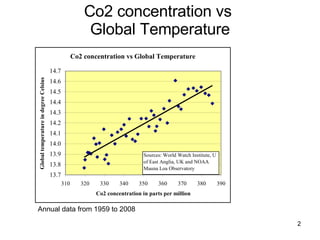
Co2 concentration vs  Global Temperature Annual data from 1959 to 2008
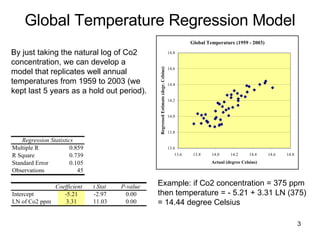
Global Temperature Regression Model By just taking the natural log of Co2 concentration, we can develop a model that replicates well annual temperatures from 1959 to 2003 (we kept last 5 years as a hold out period). Example: if Co2 concentration = 375 ppm then temperature = - 5.21 + 3.31 LN (375) = 14.44 degree Celsius
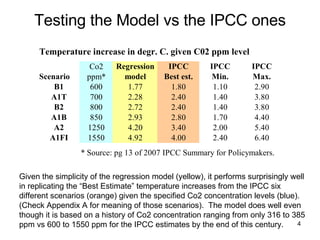
Testing the Model vs the IPCC ones Given the simplicity of the regression model (yellow), it performs surprisingly well in replicating the “Best Estimate” temperature increases from the IPCC six different scenarios (orange) given the specified Co2 concentration levels (blue). (Check Appendix A for meaning of those scenarios).  The model does well even though it is based on a history of Co2 concentration ranging from only 316 to 385 ppm vs 600 to 1550 ppm for the IPCC estimates by the end of this century.
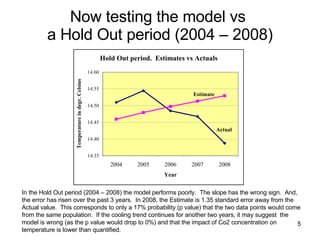
Now testing the model vs  a Hold Out period (2004 – 2008) In the Hold Out period (2004 – 2008) the model performs poorly.  The slope has the wrong sign.  And, the error has risen over the past 3 years.  In 2008, the Estimate is 1.35 standard error away from the Actual value.  This corresponds to only a 17% probability (p value) that the two data points would come from the same population.  If the cooling trend continues for another two years, it may suggest  the model is wrong (as the p value would drop to 0%) and that the impact of Co2 concentration on temperature is lower than quantified.
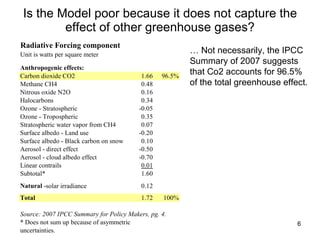
Is the Model poor because it does not capture the effect of other greenhouse gases? …  Not necessarily, the IPCC Summary of 2007 suggests that Co2 accounts for 96.5% of the total greenhouse effect.
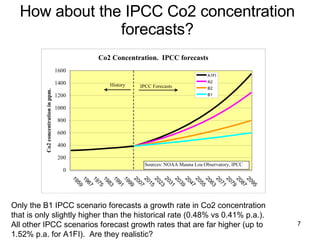
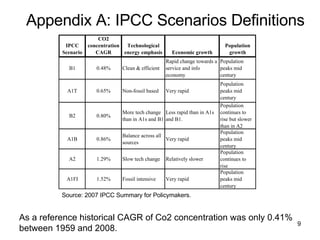
How about the IPCC Co2 concentration forecasts? Only the B1 IPCC scenario forecasts a growth rate in Co2 concentration that is only slightly higher than the historical rate (0.48% vs 0.41% p.a.).  All other IPCC scenarios forecast growth rates that are far higher (up to 1.52% p.a. for A1FI).  Are they realistic?
Conclusion A simple regression model using just the LN of Co2 concentration can replicate pretty well the Best Estimate of the six different IPCC scenarios (2007) given specified Co2 concentration by the end of this century. The IPCC reaches near catastrophic increases in temperature by century end (> 4 degree Celsius, see slide 4) by forecasting annual growth rate in Co2 concentration that are far more rapid than historical rate. The same regression model that replicated well history of temperature and IPCC scenario forecasts of temperature increases did really poorly in a hold out period (2004 – 2008) as it continued to show temperature increases in response to higher Co2 concentration level.  Instead, temperatures have decreased. Two issues come to mind: 1) In view of current trends, is the impact of Co2 on temperature less than as depicted by the IPCC? and 2) Are the IPCC Co2 concentration growth rates realistic?
Appendix A: IPCC Scenarios Definitions As a reference historical CAGR of Co2 concentration was only 0.41% between 1959 and 2008. Source: 2007 IPCC Summary for Policymakers.

Global Warming Update

  • 1.
    Global Warming UpdateGuy Lion May 2009
  • 2.
    Co2 concentration vs Global Temperature Annual data from 1959 to 2008
  • 3.
    Global Temperature RegressionModel By just taking the natural log of Co2 concentration, we can develop a model that replicates well annual temperatures from 1959 to 2003 (we kept last 5 years as a hold out period). Example: if Co2 concentration = 375 ppm then temperature = - 5.21 + 3.31 LN (375) = 14.44 degree Celsius
  • 4.
    Testing the Modelvs the IPCC ones Given the simplicity of the regression model (yellow), it performs surprisingly well in replicating the “Best Estimate” temperature increases from the IPCC six different scenarios (orange) given the specified Co2 concentration levels (blue). (Check Appendix A for meaning of those scenarios). The model does well even though it is based on a history of Co2 concentration ranging from only 316 to 385 ppm vs 600 to 1550 ppm for the IPCC estimates by the end of this century.
  • 5.
    Now testing themodel vs a Hold Out period (2004 – 2008) In the Hold Out period (2004 – 2008) the model performs poorly. The slope has the wrong sign. And, the error has risen over the past 3 years. In 2008, the Estimate is 1.35 standard error away from the Actual value. This corresponds to only a 17% probability (p value) that the two data points would come from the same population. If the cooling trend continues for another two years, it may suggest the model is wrong (as the p value would drop to 0%) and that the impact of Co2 concentration on temperature is lower than quantified.
  • 6.
    Is the Modelpoor because it does not capture the effect of other greenhouse gases? … Not necessarily, the IPCC Summary of 2007 suggests that Co2 accounts for 96.5% of the total greenhouse effect.
  • 7.
    How about theIPCC Co2 concentration forecasts? Only the B1 IPCC scenario forecasts a growth rate in Co2 concentration that is only slightly higher than the historical rate (0.48% vs 0.41% p.a.). All other IPCC scenarios forecast growth rates that are far higher (up to 1.52% p.a. for A1FI). Are they realistic?
  • 8.
    Conclusion A simpleregression model using just the LN of Co2 concentration can replicate pretty well the Best Estimate of the six different IPCC scenarios (2007) given specified Co2 concentration by the end of this century. The IPCC reaches near catastrophic increases in temperature by century end (> 4 degree Celsius, see slide 4) by forecasting annual growth rate in Co2 concentration that are far more rapid than historical rate. The same regression model that replicated well history of temperature and IPCC scenario forecasts of temperature increases did really poorly in a hold out period (2004 – 2008) as it continued to show temperature increases in response to higher Co2 concentration level. Instead, temperatures have decreased. Two issues come to mind: 1) In view of current trends, is the impact of Co2 on temperature less than as depicted by the IPCC? and 2) Are the IPCC Co2 concentration growth rates realistic?
  • 9.
    Appendix A: IPCCScenarios Definitions As a reference historical CAGR of Co2 concentration was only 0.41% between 1959 and 2008. Source: 2007 IPCC Summary for Policymakers.