Climate Change
US Cities
Gaetan Lion, September 26, 2022
Climate Change at the US City level
Mining the climate data from the National Oceanic and Atmospheric Administration (NOAA), I uncovered
24 cities that have yearly temperature records going back to 1895.
The temperature data is extremely volatile. In order to uncover the underlying trend of such data, and
smooth out the volatility, I took the following steps:
1) I calculated the 10 year moving average on a yearly basis. So the first data point is in 1904 reflecting
the average temperature over the 1895 to 1904 period;
2) I took the 10 year difference in such temperatures as calculated in the first step. So, now the first data
point is in 1914 reflecting the decadal difference in temperature between 1914 and 1904;
3) Next, I used a LOESS Regression that instead of fitting a straight regression trend line, fits a curving line
that fits this non linear data set much better. LOESS allows one to observe the changing trend over
time (see M vs. V patterns later in this presentation) and the most relevant recent trend over the most
recent 10 years.
2
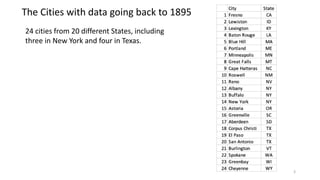
The Cities with data going back to 1895
24 cities from 20 different States, including
three in New York and four in Texas.
3
4
How does the Intergovernmental Panel for Climate Change (IPCC) look at
temperature?
The IPCC looks at global yearly temperature data as the anomaly or increase over the
average temperature during the 1850 – 1900 period.
It indicates that current temperatures are about 1 degree Celsius above that level. And,
that to maintain a relatively unimpaired environment we should maintain this temperature
increase to =< 1.5 degree Celsius by the end of this century. This seems extremely
challenging at best.
The IPCC indicates that a rise in temperature greater than 2 degrees would be already
somewhat adverse for the environment. And, an increase near or above 3 degrees could be
even more adverse. The IPCC has generated scenarios where temperatures could
potentially increase to 4, 5, or even 6 degrees Celsius by 2100. And, such temperature
increases would be associated with progressively more devastating impact on the
environment.
5
A look at US cities temperature
history
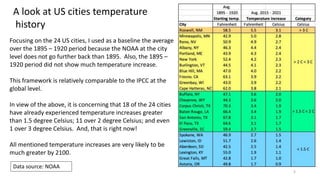
Focusing on the 24 US cities, I used as a baseline the average
over the 1895 – 1920 period because the NOAA at the city
level does not go further back than 1895. Also, the 1895 –
1920 period did not show much temperature increase.
This framework is relatively comparable to the IPCC at the
global level.
In view of the above, it is concerning that 18 of the 24 cities
have already experienced temperature increases greater
than 1.5 degree Celsius; 11 over 2 degree Celsius; and even
1 over 3 degree Celsius. And, that is right now!
All mentioned temperature increases are very likely to be
much greater by 2100.
Data source: NOAA
6
Ranking cities by most recent
10-year temperature increase using
LOESS estimates
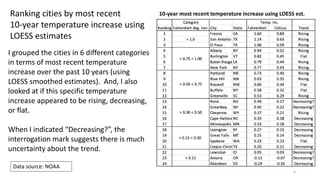
I grouped the cities in 6 different categories
in terms of most recent temperature
increase over the past 10 years (using
LOESS smoothed estimates). And, I also
looked at if this specific temperature
increase appeared to be rising, decreasing,
or flat.
When I indicated “Decreasing?”, the
interrogation mark suggests there is much
uncertainty about the trend.
10-year most recent temperature increase using LOESS est.
Data source: NOAA
7
Temperature increase estimates by 2100
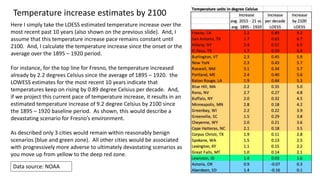
Here I simply take the LOESS estimated temperature increase over the
most recent past 10 years (also shown on the previous slide). And, I
assume that this temperature increase pace remains constant until
2100. And, I calculate the temperature increase since the onset or the
average over the 1895 – 1920 period.
For instance, for the top line for Fresno, the temperature increased
already by 2.2 degrees Celsius since the average of 1895 – 1920. the
LOWESS estimates for the most recent 10 years indicate that
temperatures keep on rising by 0.89 degree Celsius per decade. And,
if we project this current pace of temperature increase, it results in an
estimated temperature increase of 9.2 degree Celsius by 2100 since
the 1895 – 1920 baseline period. As shown, this would describe a
devastating scenario for Fresno’s environment.
As described only 3 cities would remain within reasonably benign
scenarios (blue and green zone). All other cities would be associated
with progressively more adverse to ultimately devastating scenarios as
you move up from yellow to the deep red zone.
Data source: NOAA
8
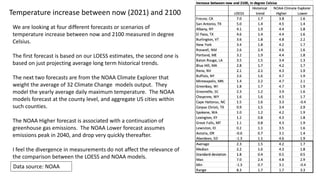
Temperature increase between now (2021) and 2100
We are looking at four different forecasts or scenarios of
temperature increase between now and 2100 measured in degree
Celsius.
The first forecast is based on our LOESS estimates, the second one is
based on just projecting average long term historical trends.
The next two forecasts are from the NOAA Climate Explorer that
weight the average of 32 Climate Change models output. They
model the yearly average daily maximum temperature. The NOAA
models forecast at the county level, and aggregate US cities within
such counties.
The NOAA Higher forecast is associated with a continuation of
greenhouse gas emissions. The NOAA Lower forecast assumes
emissions peak in 2040, and drop very quickly thereafter.
I feel the divergence in measurements do not affect the relevance of
the comparison between the LOESS and NOAA models.
Data source: NOAA
9
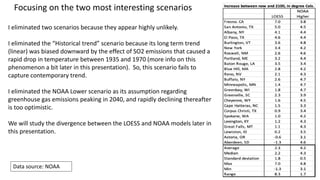
Focusing on the two most interesting scenarios
I eliminated two scenarios because they appear highly unlikely.
I eliminated the “Historical trend” scenario because its long term trend
(linear) was biased downward by the effect of SO2 emissions that caused a
rapid drop in temperature between 1935 and 1970 (more info on this
phenomenon a bit later in this presentation). So, this scenario fails to
capture contemporary trend.
I eliminated the NOAA Lower scenario as its assumption regarding
greenhouse gas emissions peaking in 2040, and rapidly declining thereafter
is too optimistic.
We will study the divergence between the LOESS and NOAA models later in
this presentation.
Data source: NOAA
10
Observing the historical temperature data in degree
Fahrenheit with LOESS estimates and Confidence Intervals
to get an idea of the underlying trend, including
directional shifts over time (up or down, decreasing or
declining)
11
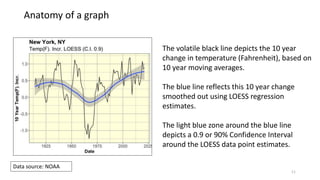
Anatomy of a graph
The volatile black line depicts the 10 year
change in temperature (Fahrenheit), based on
10 year moving averages.
The blue line reflects this 10 year change
smoothed out using LOESS regression
estimates.
The light blue zone around the blue line
depicts a 0.9 or 90% Confidence Interval
around the LOESS data point estimates.
Data source: NOAA
12
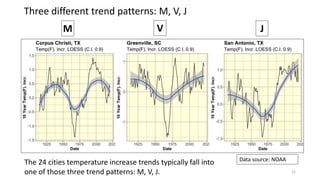
Three different trend patterns: M, V, J
M J
V
The 24 cities temperature increase trends typically fall into
one of those three trend patterns: M, V, J.
Data source: NOAA
13
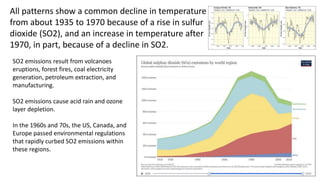
All patterns show a common decline in temperature
from about 1935 to 1970 because of a rise in sulfur
dioxide (SO2), and an increase in temperature after
1970, in part, because of a decline in SO2.
SO2 emissions result from volcanoes
eruptions, forest fires, coal electricity
generation, petroleum extraction, and
manufacturing.
SO2 emissions cause acid rain and ozone
layer depletion.
In the 1960s and 70s, the US, Canada, and
Europe passed environmental regulations
that rapidly curbed SO2 emissions within
these regions.
14
Source: armstrongeconomics.com
Source: “The Problem with Sulfur Dioxide”.
September 9, 2016. cullycleanair.org
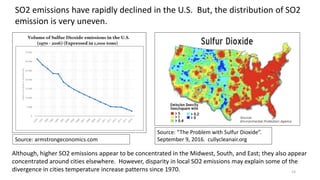
SO2 emissions have rapidly declined in the U.S. But, the distribution of SO2
emission is very uneven.
Although, higher SO2 emissions appear to be concentrated in the Midwest, South, and East; they also appear
concentrated around cities elsewhere. However, disparity in local SO2 emissions may explain some of the
divergence in cities temperature increase patterns since 1970.
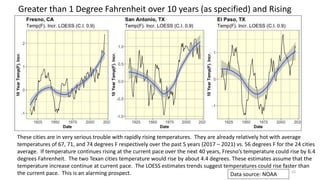
Greater than 1 Degree Fahrenheit over 10 years (as specified) and Rising
15
These cities are in very serious trouble with rapidly rising temperatures. They are already relatively hot with average
temperatures of 67, 71, and 74 degrees F respectively over the past 5 years (2017 – 2021) vs. 56 degrees F for the 24 cities
average. If temperature continues rising at the current pace over the next 40 years, Fresno’s temperature could rise by 6.4
degrees Fahrenheit. The two Texan cities temperature would rise by about 4.4 degrees. These estimates assume that the
temperature increase continue at current pace. The LOESS estimates trends suggest temperatures could rise faster than
the current pace. This is an alarming prospect. Data source: NOAA
> 0.75 < 1.00 Degree Fahrenheit over 10 years (as specified) and Rising
16
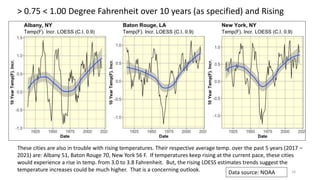
These cities are also in trouble with rising temperatures. Their respective average temp. over the past 5 years (2017 –
2021) are: Albany 51, Baton Rouge 70, New York 56 F. If temperatures keep rising at the current pace, these cities
would experience a rise in temp. from 3.0 to 3.8 Fahrenheit. But, the rising LOESS estimates trends suggest the
temperature increases could be much higher. That is a concerning outlook. Data source: NOAA
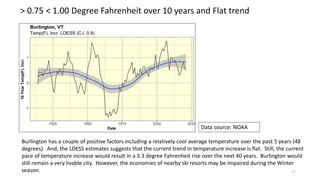
> 0.75 < 1.00 Degree Fahrenheit over 10 years and Flat trend
17
Burlington has a couple of positive factors including a relatively cool average temperature over the past 5 years (48
degrees). And, the LOESS estimates suggests that the current trend in temperature increase is flat. Still, the current
pace of temperature increase would result in a 3.3 degree Fahrenheit rise over the next 40 years. Burlington would
still remain a very livable city. However, the economies of nearby ski resorts may be impaired during the Winter
season.
Data source: NOAA
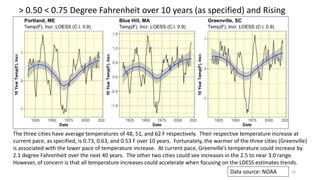
> 0.50 < 0.75 Degree Fahrenheit over 10 years (as specified) and Rising
18
The three cities have average temperatures of 48, 51, and 62 F respectively. Their respective temperature increase at
current pace, as specified, is 0.73, 0.63, and 0.53 F over 10 years. Fortunately, the warmer of the three cities (Greenville)
is associated with the lower pace of temperature increase. At current pace, Greenville’s temperature could increase by
2.1 degree Fahrenheit over the next 40 years. The other two cities could see increases in the 2.5 to near 3.0 range.
However, of concern is that all temperature increases could accelerate when focusing on the LOESS estimates trends.
Data source: NOAA
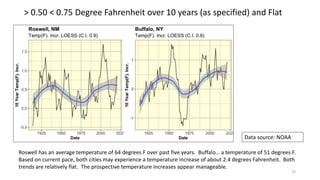
> 0.50 < 0.75 Degree Fahrenheit over 10 years (as specified) and Flat
19
Roswell has an average temperature of 64 degrees F over past five years. Buffalo… a temperature of 51 degrees F.
Based on current pace, both cities may experience a temperature increase of about 2.4 degrees Fahrenheit. Both
trends are relatively flat. The prospective temperature increases appear manageable.
Data source: NOAA
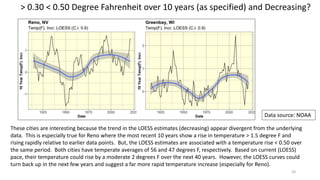
> 0.30 < 0.50 Degree Fahrenheit over 10 years (as specified) and Decreasing?
20
These cities are interesting because the trend in the LOESS estimates (decreasing) appear divergent from the underlying
data. This is especially true for Reno where the most recent 10 years show a rise in temperature > 1.5 degree F and
rising rapidly relative to earlier data points. But, the LOESS estimates are associated with a temperature rise < 0.50 over
the same period. Both cities have temperate averages of 56 and 47 degrees F, respectively. Based on current (LOESS)
pace, their temperature could rise by a moderate 2 degrees F over the next 40 years. However, the LOESS curves could
turn back up in the next few years and suggest a far more rapid temperature increase (especially for Reno).
Data source: NOAA
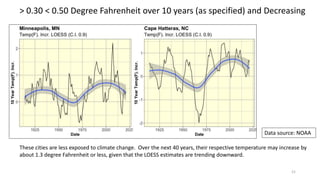
> 0.30 < 0.50 Degree Fahrenheit over 10 years (as specified) and Decreasing
21
These cities are less exposed to climate change. Over the next 40 years, their respective temperature may increase by
about 1.3 degree Fahrenheit or less, given that the LOESS estimates are trending downward.
Data source: NOAA
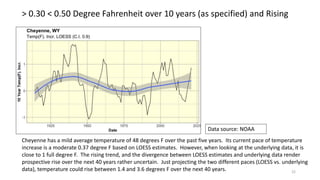
> 0.30 < 0.50 Degree Fahrenheit over 10 years (as specified) and Rising
22
Cheyenne has a mild average temperature of 48 degrees F over the past five years. Its current pace of temperature
increase is a moderate 0.37 degree F based on LOESS estimates. However, when looking at the underlying data, it is
close to 1 full degree F. The rising trend, and the divergence between LOESS estimates and underlying data render
prospective rise over the next 40 years rather uncertain. Just projecting the two different paces (LOESS vs. underlying
data), temperature could rise between 1.4 and 3.6 degrees F over the next 40 years.
Data source: NOAA
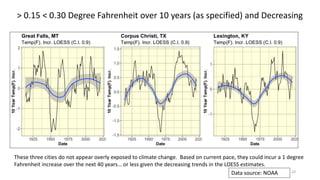
> 0.15 < 0.30 Degree Fahrenheit over 10 years (as specified) and Decreasing
23
These three cities do not appear overly exposed to climate change. Based on current pace, they could incur a 1 degree
Fahrenheit increase over the next 40 years… or less given the decreasing trends in the LOESS estimates.
Data source: NOAA
> 0.15 < 0.30 Degree and Flat or Rising
24
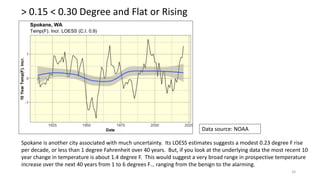
Spokane is another city associated with much uncertainty. Its LOESS estimates suggests a modest 0.23 degree F rise
per decade, or less than 1 degree Fahrenheit over 40 years. But, if you look at the underlying data the most recent 10
year change in temperature is about 1.4 degree F. This would suggest a very broad range in prospective temperature
increase over the next 40 years from 1 to 6 degrees F… ranging from the benign to the alarming.
Data source: NOAA
< 0.15 Decreasing or Rising?
25
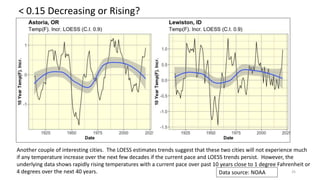
Another couple of interesting cities. The LOESS estimates trends suggest that these two cities will not experience much
if any temperature increase over the next few decades if the current pace and LOESS trends persist. However, the
underlying data shows rapidly rising temperatures with a current pace over past 10 years close to 1 degree Fahrenheit or
4 degrees over the next 40 years. Data source: NOAA
< 0.10 Degree Fahrenheit over 10 years (as specified) and Decreasing
26
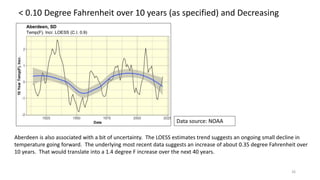
Aberdeen is also associated with a bit of uncertainty. The LOESS estimates trend suggests an ongoing small decline in
temperature going forward. The underlying most recent data suggests an increase of about 0.35 degree Fahrenheit over
10 years. That would translate into a 1.4 degree F increase over the next 40 years.
Data source: NOAA
27
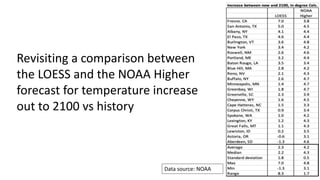
Revisiting a comparison between
the LOESS and the NOAA Higher
forecast for temperature increase
out to 2100 vs history
Data source: NOAA
28
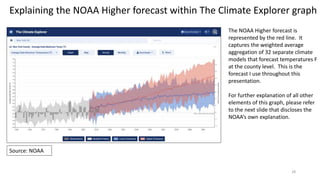
Explaining the NOAA Higher forecast within The Climate Explorer graph
Source: NOAA
The NOAA Higher forecast is
represented by the red line. It
captures the weighted average
aggregation of 32 separate climate
models that forecast temperatures F
at the county level. This is the
forecast I use throughout this
presentation.
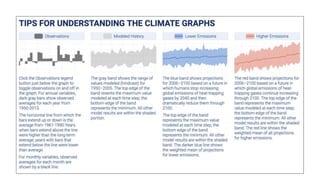
For further explanation of all other
elements of this graph, please refer
to the next slide that discloses the
NOAA’s own explanation.
29
30
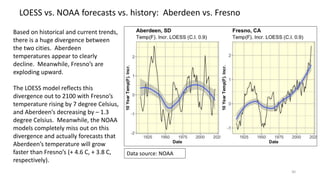
LOESS vs. NOAA forecasts vs. history: Aberdeen vs. Fresno
Based on historical and current trends,
there is a huge divergence between
the two cities. Aberdeen
temperatures appear to clearly
decline. Meanwhile, Fresno’s are
exploding upward.
The LOESS model reflects this
divergence out to 2100 with Fresno’s
temperature rising by 7 degree Celsius,
and Aberdeen’s decreasing by – 1.3
degree Celsius. Meanwhile, the NOAA
models completely miss out on this
divergence and actually forecasts that
Aberdeen’s temperature will grow
faster than Fresno’s (+ 4.6 C, + 3.8 C,
respectively).
Data source: NOAA
31
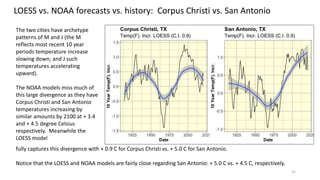
LOESS vs. NOAA forecasts vs. history: Corpus Christi vs. San Antonio
The two cities have archetype
patterns of M and J (the M
reflects most recent 10 year
periods temperature increase
slowing down; and J such
temperatures accelerating
upward).
The NOAA models miss much of
this large divergence as they have
Corpus Christi and San Antonio
temperatures increasing by
similar amounts by 2100 at + 3.4
and + 4.5 degree Celsius
respectively. Meanwhile the
LOESS model
fully captures this divergence with + 0.9 C for Corpus Christi vs. + 5.0 C for San Antonio.
Notice that the LOESS and NOAA models are fairly close regarding San Antonio: + 5.0 C vs. + 4.5 C, respectively.
32
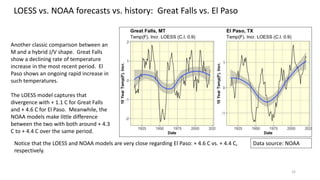
LOESS vs. NOAA forecasts vs. history: Great Falls vs. El Paso
Another classic comparison between an
M and a hybrid J/V shape. Great Falls
show a declining rate of temperature
increase in the most recent period. El
Paso shows an ongoing rapid increase in
such temperatures.
The LOESS model captures that
divergence with + 1.1 C for Great Falls
and + 4.6 C for El Paso. Meanwhile, the
NOAA models make little difference
between the two with both around + 4.3
C to + 4.4 C over the same period.
Notice that the LOESS and NOAA models are very close regarding El Paso: + 4.6 C vs. + 4.4 C,
respectively.
Data source: NOAA
33
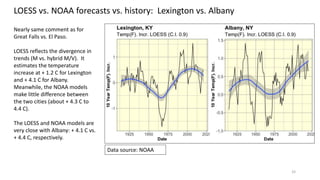
LOESS vs. NOAA forecasts vs. history: Lexington vs. Albany
Nearly same comment as for
Great Falls vs. El Paso.
LOESS reflects the divergence in
trends (M vs. hybrid M/V). It
estimates the temperature
increase at + 1.2 C for Lexington
and + 4.1 C for Albany.
Meanwhile, the NOAA models
make little difference between
the two cities (about + 4.3 C to
4.4 C).
The LOESS and NOAA models are
very close with Albany: + 4.1 C vs.
+ 4.4 C, respectively.
Data source: NOAA
34
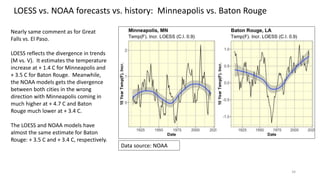
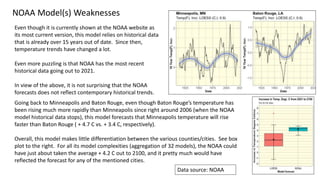
LOESS vs. NOAA forecasts vs. history: Minneapolis vs. Baton Rouge
Nearly same comment as for Great
Falls vs. El Paso.
LOESS reflects the divergence in trends
(M vs. V). It estimates the temperature
increase at + 1.4 C for Minneapolis and
+ 3.5 C for Baton Rouge. Meanwhile,
the NOAA models gets the divergence
between both cities in the wrong
direction with Minneapolis coming in
much higher at + 4.7 C and Baton
Rouge much lower at + 3.4 C.
The LOESS and NOAA models have
almost the same estimate for Baton
Rouge: + 3.5 C and + 3.4 C, respectively.
Data source: NOAA
35
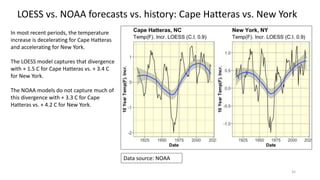
LOESS vs. NOAA forecasts vs. history: Cape Hatteras vs. New York
In most recent periods, the temperature
increase is decelerating for Cape Hatteras
and accelerating for New York.
The LOESS model captures that divergence
with + 1.5 C for Cape Hatteras vs. + 3.4 C
for New York.
The NOAA models do not capture much of
this divergence with + 3.3 C for Cape
Hatteras vs. + 4.2 C for New York.
Data source: NOAA
36
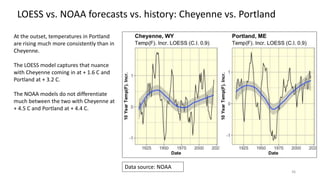
LOESS vs. NOAA forecasts vs. history: Cheyenne vs. Portland
At the outset, temperatures in Portland
are rising much more consistently than in
Cheyenne.
The LOESS model captures that nuance
with Cheyenne coming in at + 1.6 C and
Portland at + 3.2 C.
The NOAA models do not differentiate
much between the two with Cheyenne at
+ 4.5 C and Portland at + 4.4 C.
Data source: NOAA
37
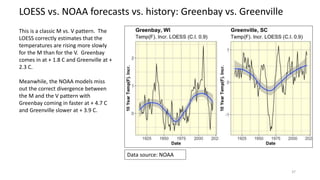
LOESS vs. NOAA forecasts vs. history: Greenbay vs. Greenville
This is a classic M vs. V pattern. The
LOESS correctly estimates that the
temperatures are rising more slowly
for the M than for the V. Greenbay
comes in at + 1.8 C and Greenville at +
2.3 C.
Meanwhile, the NOAA models miss
out the correct divergence between
the M and the V pattern with
Greenbay coming in faster at + 4.7 C
and Greenville slower at + 3.9 C.
Data source: NOAA
38
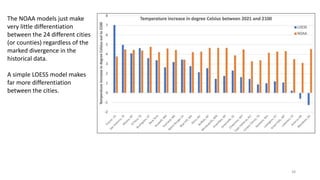
The NOAA models just make
very little differentiation
between the 24 different cities
(or counties) regardless of the
marked divergence in the
historical data.
A simple LOESS model makes
far more differentiation
between the cities.
39
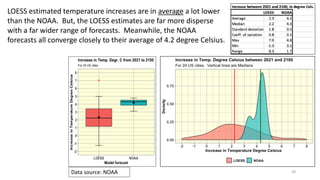
LOESS estimated temperature increases are in average a lot lower
than the NOAA. But, the LOESS estimates are far more disperse
with a far wider range of forecasts. Meanwhile, the NOAA
forecasts all converge closely to their average of 4.2 degree Celsius.
Data source: NOAA
40
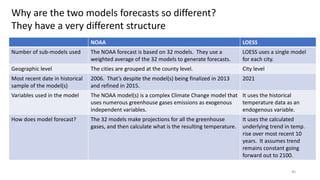
Why are the two models forecasts so different?
They have a very different structure
NOAA LOESS
Number of sub-models used The NOAA forecast is based on 32 models. They use a
weighted average of the 32 models to generate forecasts.
LOESS uses a single model
for each city.
Geographic level The cities are grouped at the county level. City level
Most recent date in historical
sample of the model(s)
2006. That’s despite the model(s) being finalized in 2013
and refined in 2015.
2021
Variables used in the model The NOAA model(s) is a complex Climate Change model that
uses numerous greenhouse gases emissions as exogenous
independent variables.
It uses the historical
temperature data as an
endogenous variable.
How does model forecast? The 32 models make projections for all the greenhouse
gases, and then calculate what is the resulting temperature.
It uses the calculated
underlying trend in temp.
rise over most recent 10
years. It assumes trend
remains constant going
forward out to 2100.
41
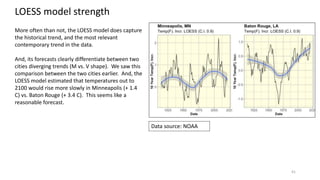
LOESS model strength
More often than not, the LOESS model does capture
the historical trend, and the most relevant
contemporary trend in the data.
And, its forecasts clearly differentiate between two
cities diverging trends (M vs. V shape). We saw this
comparison between the two cities earlier. And, the
LOESS model estimated that temperatures out to
2100 would rise more slowly in Minneapolis (+ 1.4
C) vs. Baton Rouge (+ 3.4 C). This seems like a
reasonable forecast.
Data source: NOAA
42
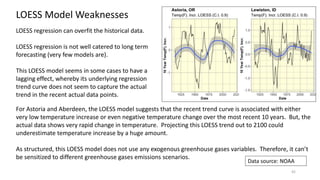
LOESS Model Weaknesses
LOESS regression can overfit the historical data.
LOESS regression is not well catered to long term
forecasting (very few models are).
This LOESS model seems in some cases to have a
lagging effect, whereby its underlying regression
trend curve does not seem to capture the actual
trend in the recent actual data points.
For Astoria and Aberdeen, the LOESS model suggests that the recent trend curve is associated with either
very low temperature increase or even negative temperature change over the most recent 10 years. But, the
actual data shows very rapid change in temperature. Projecting this LOESS trend out to 2100 could
underestimate temperature increase by a huge amount.
As structured, this LOESS model does not use any exogenous greenhouse gases variables. Therefore, it can’t
be sensitized to different greenhouse gases emissions scenarios.
Data source: NOAA
43
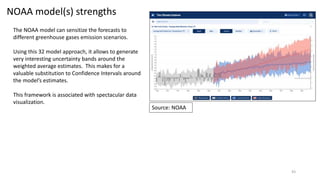
NOAA model(s) strengths
The NOAA model can sensitize the forecasts to
different greenhouse gases emission scenarios.
Using this 32 model approach, it allows to generate
very interesting uncertainty bands around the
weighted average estimates. This makes for a
valuable substitution to Confidence Intervals around
the model’s estimates.
This framework is associated with spectacular data
visualization.
Source: NOAA
44
NOAA Model(s) Weaknesses
Even though it is currently shown at the NOAA website as
its most current version, this model relies on historical data
that is already over 15 years out of date. Since then,
temperature trends have changed a lot.
Even more puzzling is that NOAA has the most recent
historical data going out to 2021.
In view of the above, it is not surprising that the NOAA
forecasts does not reflect contemporary historical trends.
Going back to Minneapolis and Baton Rouge, even though Baton Rouge’s temperature has
been rising much more rapidly than Minneapolis since right around 2006 (when the NOAA
model historical data stops), this model forecasts that Minneapolis temperature will rise
faster than Baton Rouge ( + 4.7 C vs. + 3.4 C, respectively).
Overall, this model makes little differentiation between the various counties/cities. See box
plot to the right. For all its model complexities (aggregation of 32 models), the NOAA could
have just about taken the average + 4.2 C out to 2100, and it pretty much would have
reflected the forecast for any of the mentioned cities.
Data source: NOAA
45
NOAA Model(s) Weaknesses continued
If you look closely at the historical visual data (for New York in
this specific case), the NOAA model does not appear to fit it
well. The NOAA does not disclose the weighted average
estimates during the history which should have been
represented by a black line.
The NOAA just showed the minimum and maximum of their
32 models.
If the NOAA model fit was good, the minimum and maximum estimates should be symmetric around the
historical temperature data points. They are often not [symmetric]. This is a reflection of a poor historical fit.
Source: NOAA
46
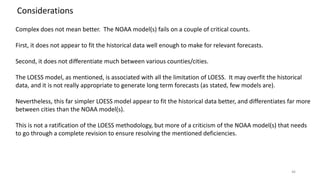
Considerations
Complex does not mean better. The NOAA model(s) fails on a couple of critical counts.
First, it does not appear to fit the historical data well enough to make for relevant forecasts.
Second, it does not differentiate much between various counties/cities.
The LOESS model, as mentioned, is associated with all the limitation of LOESS. It may overfit the historical
data, and it is not really appropriate to generate long term forecasts (as stated, few models are).
Nevertheless, this far simpler LOESS model appear to fit the historical data better, and differentiates far more
between cities than the NOAA model(s).
This is not a ratification of the LOESS methodology, but more of a criticism of the NOAA model(s) that needs
to go through a complete revision to ensure resolving the mentioned deficiencies.

Climate Change in 24 US Cities

  • 1.
    Climate Change US Cities GaetanLion, September 26, 2022
  • 2.
    Climate Change atthe US City level Mining the climate data from the National Oceanic and Atmospheric Administration (NOAA), I uncovered 24 cities that have yearly temperature records going back to 1895. The temperature data is extremely volatile. In order to uncover the underlying trend of such data, and smooth out the volatility, I took the following steps: 1) I calculated the 10 year moving average on a yearly basis. So the first data point is in 1904 reflecting the average temperature over the 1895 to 1904 period; 2) I took the 10 year difference in such temperatures as calculated in the first step. So, now the first data point is in 1914 reflecting the decadal difference in temperature between 1914 and 1904; 3) Next, I used a LOESS Regression that instead of fitting a straight regression trend line, fits a curving line that fits this non linear data set much better. LOESS allows one to observe the changing trend over time (see M vs. V patterns later in this presentation) and the most relevant recent trend over the most recent 10 years. 2
  • 3.
    The Cities withdata going back to 1895 24 cities from 20 different States, including three in New York and four in Texas. 3
  • 4.
    4 How does theIntergovernmental Panel for Climate Change (IPCC) look at temperature? The IPCC looks at global yearly temperature data as the anomaly or increase over the average temperature during the 1850 – 1900 period. It indicates that current temperatures are about 1 degree Celsius above that level. And, that to maintain a relatively unimpaired environment we should maintain this temperature increase to =< 1.5 degree Celsius by the end of this century. This seems extremely challenging at best. The IPCC indicates that a rise in temperature greater than 2 degrees would be already somewhat adverse for the environment. And, an increase near or above 3 degrees could be even more adverse. The IPCC has generated scenarios where temperatures could potentially increase to 4, 5, or even 6 degrees Celsius by 2100. And, such temperature increases would be associated with progressively more devastating impact on the environment.
  • 5.
    5 A look atUS cities temperature history Focusing on the 24 US cities, I used as a baseline the average over the 1895 – 1920 period because the NOAA at the city level does not go further back than 1895. Also, the 1895 – 1920 period did not show much temperature increase. This framework is relatively comparable to the IPCC at the global level. In view of the above, it is concerning that 18 of the 24 cities have already experienced temperature increases greater than 1.5 degree Celsius; 11 over 2 degree Celsius; and even 1 over 3 degree Celsius. And, that is right now! All mentioned temperature increases are very likely to be much greater by 2100. Data source: NOAA
  • 6.
    6 Ranking cities bymost recent 10-year temperature increase using LOESS estimates I grouped the cities in 6 different categories in terms of most recent temperature increase over the past 10 years (using LOESS smoothed estimates). And, I also looked at if this specific temperature increase appeared to be rising, decreasing, or flat. When I indicated “Decreasing?”, the interrogation mark suggests there is much uncertainty about the trend. 10-year most recent temperature increase using LOESS est. Data source: NOAA
  • 7.
    7 Temperature increase estimatesby 2100 Here I simply take the LOESS estimated temperature increase over the most recent past 10 years (also shown on the previous slide). And, I assume that this temperature increase pace remains constant until 2100. And, I calculate the temperature increase since the onset or the average over the 1895 – 1920 period. For instance, for the top line for Fresno, the temperature increased already by 2.2 degrees Celsius since the average of 1895 – 1920. the LOWESS estimates for the most recent 10 years indicate that temperatures keep on rising by 0.89 degree Celsius per decade. And, if we project this current pace of temperature increase, it results in an estimated temperature increase of 9.2 degree Celsius by 2100 since the 1895 – 1920 baseline period. As shown, this would describe a devastating scenario for Fresno’s environment. As described only 3 cities would remain within reasonably benign scenarios (blue and green zone). All other cities would be associated with progressively more adverse to ultimately devastating scenarios as you move up from yellow to the deep red zone. Data source: NOAA
  • 8.
    8 Temperature increase betweennow (2021) and 2100 We are looking at four different forecasts or scenarios of temperature increase between now and 2100 measured in degree Celsius. The first forecast is based on our LOESS estimates, the second one is based on just projecting average long term historical trends. The next two forecasts are from the NOAA Climate Explorer that weight the average of 32 Climate Change models output. They model the yearly average daily maximum temperature. The NOAA models forecast at the county level, and aggregate US cities within such counties. The NOAA Higher forecast is associated with a continuation of greenhouse gas emissions. The NOAA Lower forecast assumes emissions peak in 2040, and drop very quickly thereafter. I feel the divergence in measurements do not affect the relevance of the comparison between the LOESS and NOAA models. Data source: NOAA
  • 9.
    9 Focusing on thetwo most interesting scenarios I eliminated two scenarios because they appear highly unlikely. I eliminated the “Historical trend” scenario because its long term trend (linear) was biased downward by the effect of SO2 emissions that caused a rapid drop in temperature between 1935 and 1970 (more info on this phenomenon a bit later in this presentation). So, this scenario fails to capture contemporary trend. I eliminated the NOAA Lower scenario as its assumption regarding greenhouse gas emissions peaking in 2040, and rapidly declining thereafter is too optimistic. We will study the divergence between the LOESS and NOAA models later in this presentation. Data source: NOAA
  • 10.
    10 Observing the historicaltemperature data in degree Fahrenheit with LOESS estimates and Confidence Intervals to get an idea of the underlying trend, including directional shifts over time (up or down, decreasing or declining)
  • 11.
    11 Anatomy of agraph The volatile black line depicts the 10 year change in temperature (Fahrenheit), based on 10 year moving averages. The blue line reflects this 10 year change smoothed out using LOESS regression estimates. The light blue zone around the blue line depicts a 0.9 or 90% Confidence Interval around the LOESS data point estimates. Data source: NOAA
  • 12.
    12 Three different trendpatterns: M, V, J M J V The 24 cities temperature increase trends typically fall into one of those three trend patterns: M, V, J. Data source: NOAA
  • 13.
    13 All patterns showa common decline in temperature from about 1935 to 1970 because of a rise in sulfur dioxide (SO2), and an increase in temperature after 1970, in part, because of a decline in SO2. SO2 emissions result from volcanoes eruptions, forest fires, coal electricity generation, petroleum extraction, and manufacturing. SO2 emissions cause acid rain and ozone layer depletion. In the 1960s and 70s, the US, Canada, and Europe passed environmental regulations that rapidly curbed SO2 emissions within these regions.
  • 14.
    14 Source: armstrongeconomics.com Source: “TheProblem with Sulfur Dioxide”. September 9, 2016. cullycleanair.org SO2 emissions have rapidly declined in the U.S. But, the distribution of SO2 emission is very uneven. Although, higher SO2 emissions appear to be concentrated in the Midwest, South, and East; they also appear concentrated around cities elsewhere. However, disparity in local SO2 emissions may explain some of the divergence in cities temperature increase patterns since 1970.
  • 15.
    Greater than 1Degree Fahrenheit over 10 years (as specified) and Rising 15 These cities are in very serious trouble with rapidly rising temperatures. They are already relatively hot with average temperatures of 67, 71, and 74 degrees F respectively over the past 5 years (2017 – 2021) vs. 56 degrees F for the 24 cities average. If temperature continues rising at the current pace over the next 40 years, Fresno’s temperature could rise by 6.4 degrees Fahrenheit. The two Texan cities temperature would rise by about 4.4 degrees. These estimates assume that the temperature increase continue at current pace. The LOESS estimates trends suggest temperatures could rise faster than the current pace. This is an alarming prospect. Data source: NOAA
  • 16.
    > 0.75 <1.00 Degree Fahrenheit over 10 years (as specified) and Rising 16 These cities are also in trouble with rising temperatures. Their respective average temp. over the past 5 years (2017 – 2021) are: Albany 51, Baton Rouge 70, New York 56 F. If temperatures keep rising at the current pace, these cities would experience a rise in temp. from 3.0 to 3.8 Fahrenheit. But, the rising LOESS estimates trends suggest the temperature increases could be much higher. That is a concerning outlook. Data source: NOAA
  • 17.
    > 0.75 <1.00 Degree Fahrenheit over 10 years and Flat trend 17 Burlington has a couple of positive factors including a relatively cool average temperature over the past 5 years (48 degrees). And, the LOESS estimates suggests that the current trend in temperature increase is flat. Still, the current pace of temperature increase would result in a 3.3 degree Fahrenheit rise over the next 40 years. Burlington would still remain a very livable city. However, the economies of nearby ski resorts may be impaired during the Winter season. Data source: NOAA
  • 18.
    > 0.50 <0.75 Degree Fahrenheit over 10 years (as specified) and Rising 18 The three cities have average temperatures of 48, 51, and 62 F respectively. Their respective temperature increase at current pace, as specified, is 0.73, 0.63, and 0.53 F over 10 years. Fortunately, the warmer of the three cities (Greenville) is associated with the lower pace of temperature increase. At current pace, Greenville’s temperature could increase by 2.1 degree Fahrenheit over the next 40 years. The other two cities could see increases in the 2.5 to near 3.0 range. However, of concern is that all temperature increases could accelerate when focusing on the LOESS estimates trends. Data source: NOAA
  • 19.
    > 0.50 <0.75 Degree Fahrenheit over 10 years (as specified) and Flat 19 Roswell has an average temperature of 64 degrees F over past five years. Buffalo… a temperature of 51 degrees F. Based on current pace, both cities may experience a temperature increase of about 2.4 degrees Fahrenheit. Both trends are relatively flat. The prospective temperature increases appear manageable. Data source: NOAA
  • 20.
    > 0.30 <0.50 Degree Fahrenheit over 10 years (as specified) and Decreasing? 20 These cities are interesting because the trend in the LOESS estimates (decreasing) appear divergent from the underlying data. This is especially true for Reno where the most recent 10 years show a rise in temperature > 1.5 degree F and rising rapidly relative to earlier data points. But, the LOESS estimates are associated with a temperature rise < 0.50 over the same period. Both cities have temperate averages of 56 and 47 degrees F, respectively. Based on current (LOESS) pace, their temperature could rise by a moderate 2 degrees F over the next 40 years. However, the LOESS curves could turn back up in the next few years and suggest a far more rapid temperature increase (especially for Reno). Data source: NOAA
  • 21.
    > 0.30 <0.50 Degree Fahrenheit over 10 years (as specified) and Decreasing 21 These cities are less exposed to climate change. Over the next 40 years, their respective temperature may increase by about 1.3 degree Fahrenheit or less, given that the LOESS estimates are trending downward. Data source: NOAA
  • 22.
    > 0.30 <0.50 Degree Fahrenheit over 10 years (as specified) and Rising 22 Cheyenne has a mild average temperature of 48 degrees F over the past five years. Its current pace of temperature increase is a moderate 0.37 degree F based on LOESS estimates. However, when looking at the underlying data, it is close to 1 full degree F. The rising trend, and the divergence between LOESS estimates and underlying data render prospective rise over the next 40 years rather uncertain. Just projecting the two different paces (LOESS vs. underlying data), temperature could rise between 1.4 and 3.6 degrees F over the next 40 years. Data source: NOAA
  • 23.
    > 0.15 <0.30 Degree Fahrenheit over 10 years (as specified) and Decreasing 23 These three cities do not appear overly exposed to climate change. Based on current pace, they could incur a 1 degree Fahrenheit increase over the next 40 years… or less given the decreasing trends in the LOESS estimates. Data source: NOAA
  • 24.
    > 0.15 <0.30 Degree and Flat or Rising 24 Spokane is another city associated with much uncertainty. Its LOESS estimates suggests a modest 0.23 degree F rise per decade, or less than 1 degree Fahrenheit over 40 years. But, if you look at the underlying data the most recent 10 year change in temperature is about 1.4 degree F. This would suggest a very broad range in prospective temperature increase over the next 40 years from 1 to 6 degrees F… ranging from the benign to the alarming. Data source: NOAA
  • 25.
    < 0.15 Decreasingor Rising? 25 Another couple of interesting cities. The LOESS estimates trends suggest that these two cities will not experience much if any temperature increase over the next few decades if the current pace and LOESS trends persist. However, the underlying data shows rapidly rising temperatures with a current pace over past 10 years close to 1 degree Fahrenheit or 4 degrees over the next 40 years. Data source: NOAA
  • 26.
    < 0.10 DegreeFahrenheit over 10 years (as specified) and Decreasing 26 Aberdeen is also associated with a bit of uncertainty. The LOESS estimates trend suggests an ongoing small decline in temperature going forward. The underlying most recent data suggests an increase of about 0.35 degree Fahrenheit over 10 years. That would translate into a 1.4 degree F increase over the next 40 years. Data source: NOAA
  • 27.
    27 Revisiting a comparisonbetween the LOESS and the NOAA Higher forecast for temperature increase out to 2100 vs history Data source: NOAA
  • 28.
    28 Explaining the NOAAHigher forecast within The Climate Explorer graph Source: NOAA The NOAA Higher forecast is represented by the red line. It captures the weighted average aggregation of 32 separate climate models that forecast temperatures F at the county level. This is the forecast I use throughout this presentation. For further explanation of all other elements of this graph, please refer to the next slide that discloses the NOAA’s own explanation.
  • 29.
  • 30.
    30 LOESS vs. NOAAforecasts vs. history: Aberdeen vs. Fresno Based on historical and current trends, there is a huge divergence between the two cities. Aberdeen temperatures appear to clearly decline. Meanwhile, Fresno’s are exploding upward. The LOESS model reflects this divergence out to 2100 with Fresno’s temperature rising by 7 degree Celsius, and Aberdeen’s decreasing by – 1.3 degree Celsius. Meanwhile, the NOAA models completely miss out on this divergence and actually forecasts that Aberdeen’s temperature will grow faster than Fresno’s (+ 4.6 C, + 3.8 C, respectively). Data source: NOAA
  • 31.
    31 LOESS vs. NOAAforecasts vs. history: Corpus Christi vs. San Antonio The two cities have archetype patterns of M and J (the M reflects most recent 10 year periods temperature increase slowing down; and J such temperatures accelerating upward). The NOAA models miss much of this large divergence as they have Corpus Christi and San Antonio temperatures increasing by similar amounts by 2100 at + 3.4 and + 4.5 degree Celsius respectively. Meanwhile the LOESS model fully captures this divergence with + 0.9 C for Corpus Christi vs. + 5.0 C for San Antonio. Notice that the LOESS and NOAA models are fairly close regarding San Antonio: + 5.0 C vs. + 4.5 C, respectively.
  • 32.
    32 LOESS vs. NOAAforecasts vs. history: Great Falls vs. El Paso Another classic comparison between an M and a hybrid J/V shape. Great Falls show a declining rate of temperature increase in the most recent period. El Paso shows an ongoing rapid increase in such temperatures. The LOESS model captures that divergence with + 1.1 C for Great Falls and + 4.6 C for El Paso. Meanwhile, the NOAA models make little difference between the two with both around + 4.3 C to + 4.4 C over the same period. Notice that the LOESS and NOAA models are very close regarding El Paso: + 4.6 C vs. + 4.4 C, respectively. Data source: NOAA
  • 33.
    33 LOESS vs. NOAAforecasts vs. history: Lexington vs. Albany Nearly same comment as for Great Falls vs. El Paso. LOESS reflects the divergence in trends (M vs. hybrid M/V). It estimates the temperature increase at + 1.2 C for Lexington and + 4.1 C for Albany. Meanwhile, the NOAA models make little difference between the two cities (about + 4.3 C to 4.4 C). The LOESS and NOAA models are very close with Albany: + 4.1 C vs. + 4.4 C, respectively. Data source: NOAA
  • 34.
    34 LOESS vs. NOAAforecasts vs. history: Minneapolis vs. Baton Rouge Nearly same comment as for Great Falls vs. El Paso. LOESS reflects the divergence in trends (M vs. V). It estimates the temperature increase at + 1.4 C for Minneapolis and + 3.5 C for Baton Rouge. Meanwhile, the NOAA models gets the divergence between both cities in the wrong direction with Minneapolis coming in much higher at + 4.7 C and Baton Rouge much lower at + 3.4 C. The LOESS and NOAA models have almost the same estimate for Baton Rouge: + 3.5 C and + 3.4 C, respectively. Data source: NOAA
  • 35.
    35 LOESS vs. NOAAforecasts vs. history: Cape Hatteras vs. New York In most recent periods, the temperature increase is decelerating for Cape Hatteras and accelerating for New York. The LOESS model captures that divergence with + 1.5 C for Cape Hatteras vs. + 3.4 C for New York. The NOAA models do not capture much of this divergence with + 3.3 C for Cape Hatteras vs. + 4.2 C for New York. Data source: NOAA
  • 36.
    36 LOESS vs. NOAAforecasts vs. history: Cheyenne vs. Portland At the outset, temperatures in Portland are rising much more consistently than in Cheyenne. The LOESS model captures that nuance with Cheyenne coming in at + 1.6 C and Portland at + 3.2 C. The NOAA models do not differentiate much between the two with Cheyenne at + 4.5 C and Portland at + 4.4 C. Data source: NOAA
  • 37.
    37 LOESS vs. NOAAforecasts vs. history: Greenbay vs. Greenville This is a classic M vs. V pattern. The LOESS correctly estimates that the temperatures are rising more slowly for the M than for the V. Greenbay comes in at + 1.8 C and Greenville at + 2.3 C. Meanwhile, the NOAA models miss out the correct divergence between the M and the V pattern with Greenbay coming in faster at + 4.7 C and Greenville slower at + 3.9 C. Data source: NOAA
  • 38.
    38 The NOAA modelsjust make very little differentiation between the 24 different cities (or counties) regardless of the marked divergence in the historical data. A simple LOESS model makes far more differentiation between the cities.
  • 39.
    39 LOESS estimated temperatureincreases are in average a lot lower than the NOAA. But, the LOESS estimates are far more disperse with a far wider range of forecasts. Meanwhile, the NOAA forecasts all converge closely to their average of 4.2 degree Celsius. Data source: NOAA
  • 40.
    40 Why are thetwo models forecasts so different? They have a very different structure NOAA LOESS Number of sub-models used The NOAA forecast is based on 32 models. They use a weighted average of the 32 models to generate forecasts. LOESS uses a single model for each city. Geographic level The cities are grouped at the county level. City level Most recent date in historical sample of the model(s) 2006. That’s despite the model(s) being finalized in 2013 and refined in 2015. 2021 Variables used in the model The NOAA model(s) is a complex Climate Change model that uses numerous greenhouse gases emissions as exogenous independent variables. It uses the historical temperature data as an endogenous variable. How does model forecast? The 32 models make projections for all the greenhouse gases, and then calculate what is the resulting temperature. It uses the calculated underlying trend in temp. rise over most recent 10 years. It assumes trend remains constant going forward out to 2100.
  • 41.
    41 LOESS model strength Moreoften than not, the LOESS model does capture the historical trend, and the most relevant contemporary trend in the data. And, its forecasts clearly differentiate between two cities diverging trends (M vs. V shape). We saw this comparison between the two cities earlier. And, the LOESS model estimated that temperatures out to 2100 would rise more slowly in Minneapolis (+ 1.4 C) vs. Baton Rouge (+ 3.4 C). This seems like a reasonable forecast. Data source: NOAA
  • 42.
    42 LOESS Model Weaknesses LOESSregression can overfit the historical data. LOESS regression is not well catered to long term forecasting (very few models are). This LOESS model seems in some cases to have a lagging effect, whereby its underlying regression trend curve does not seem to capture the actual trend in the recent actual data points. For Astoria and Aberdeen, the LOESS model suggests that the recent trend curve is associated with either very low temperature increase or even negative temperature change over the most recent 10 years. But, the actual data shows very rapid change in temperature. Projecting this LOESS trend out to 2100 could underestimate temperature increase by a huge amount. As structured, this LOESS model does not use any exogenous greenhouse gases variables. Therefore, it can’t be sensitized to different greenhouse gases emissions scenarios. Data source: NOAA
  • 43.
    43 NOAA model(s) strengths TheNOAA model can sensitize the forecasts to different greenhouse gases emission scenarios. Using this 32 model approach, it allows to generate very interesting uncertainty bands around the weighted average estimates. This makes for a valuable substitution to Confidence Intervals around the model’s estimates. This framework is associated with spectacular data visualization. Source: NOAA
  • 44.
    44 NOAA Model(s) Weaknesses Eventhough it is currently shown at the NOAA website as its most current version, this model relies on historical data that is already over 15 years out of date. Since then, temperature trends have changed a lot. Even more puzzling is that NOAA has the most recent historical data going out to 2021. In view of the above, it is not surprising that the NOAA forecasts does not reflect contemporary historical trends. Going back to Minneapolis and Baton Rouge, even though Baton Rouge’s temperature has been rising much more rapidly than Minneapolis since right around 2006 (when the NOAA model historical data stops), this model forecasts that Minneapolis temperature will rise faster than Baton Rouge ( + 4.7 C vs. + 3.4 C, respectively). Overall, this model makes little differentiation between the various counties/cities. See box plot to the right. For all its model complexities (aggregation of 32 models), the NOAA could have just about taken the average + 4.2 C out to 2100, and it pretty much would have reflected the forecast for any of the mentioned cities. Data source: NOAA
  • 45.
    45 NOAA Model(s) Weaknessescontinued If you look closely at the historical visual data (for New York in this specific case), the NOAA model does not appear to fit it well. The NOAA does not disclose the weighted average estimates during the history which should have been represented by a black line. The NOAA just showed the minimum and maximum of their 32 models. If the NOAA model fit was good, the minimum and maximum estimates should be symmetric around the historical temperature data points. They are often not [symmetric]. This is a reflection of a poor historical fit. Source: NOAA
  • 46.
    46 Considerations Complex does notmean better. The NOAA model(s) fails on a couple of critical counts. First, it does not appear to fit the historical data well enough to make for relevant forecasts. Second, it does not differentiate much between various counties/cities. The LOESS model, as mentioned, is associated with all the limitation of LOESS. It may overfit the historical data, and it is not really appropriate to generate long term forecasts (as stated, few models are). Nevertheless, this far simpler LOESS model appear to fit the historical data better, and differentiates far more between cities than the NOAA model(s). This is not a ratification of the LOESS methodology, but more of a criticism of the NOAA model(s) that needs to go through a complete revision to ensure resolving the mentioned deficiencies.